
In everyday language “drug” and “medicine” are often used interchangeably. In the pharma industry, however, they usually imply different stages of the product lifecycle. A drug is generally the active pharmacological substance (API) that provides therapeutic effects. A medicine (sometimes called a medicinal product) is the finished product – the drug formulated and packaged for patient use. This distinction affects how products are developed, manufactured, and packaged. In simple terms, every medicine begins with a drug (active ingredient), but not every drug ends up as a marketable medicine. The differences in these terms can influence dosage form design, regulatory status, and choice of packaging machinery.
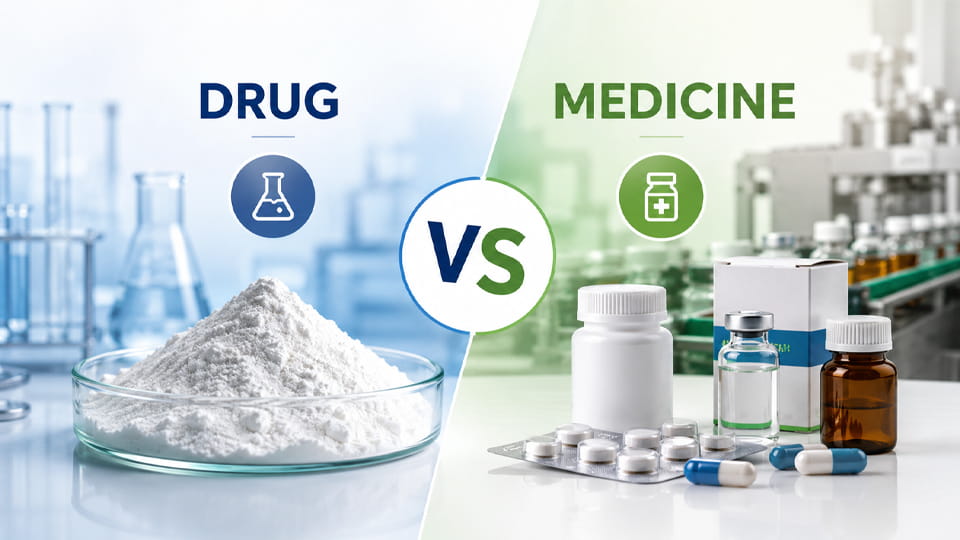
In pharmaceutical terms, a drug is an active chemical or biological substance used to diagnose, cure, mitigate, treat, or prevent disease. The FDA defines a drug broadly as “A substance intended for use in the diagnosis, cure, mitigation, treatment, or prevention of disease” in humans or animals. In practice, “drug” often refers to the pure active ingredient (API) itself. For example, ibuprofen or amoxicillin as a powder would be called a drug substance before it’s made into a tablet or capsule.
Key points about drugs in pharma manufacturing:
In summary, a drug is the raw therapeutic substance or API – the “what” that gives a medicine its effect. This term is common in formulation development and regulation.
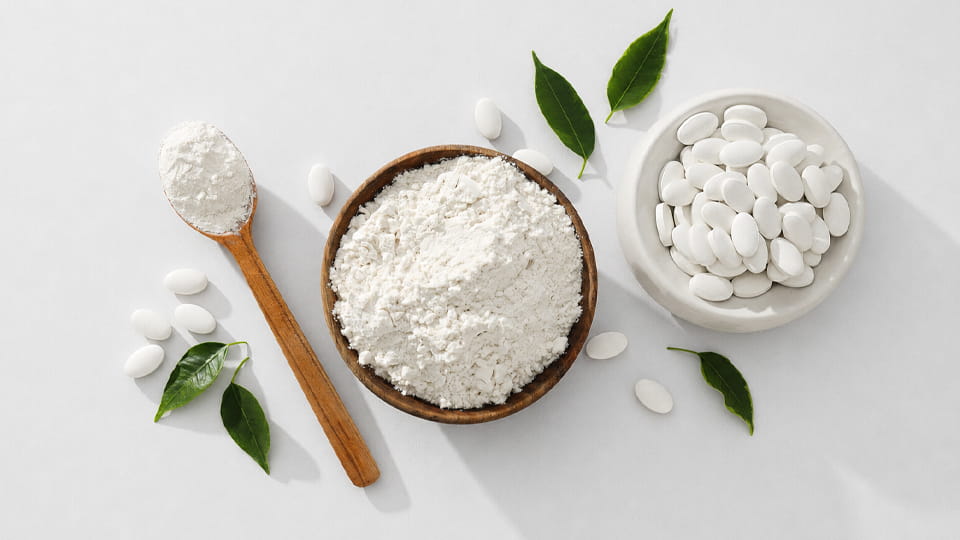
A medicine (or medicinal product) is a finished pharmaceutical product intended for patient use. It contains one or more drugs (APIs) plus inactive components (excipients) and is packaged for safe dispensing and use. In other words, once a drug is formulated into a dosage form (tablet, capsule, liquid, etc.) and labeled in a container, it becomes a medicine ready for sale.
In simple terms, a medicine is the packaged, patient-ready product used to diagnose or treat a condition. It includes the drug as the star ingredient, but also all the other stuff (excipients, container, label).
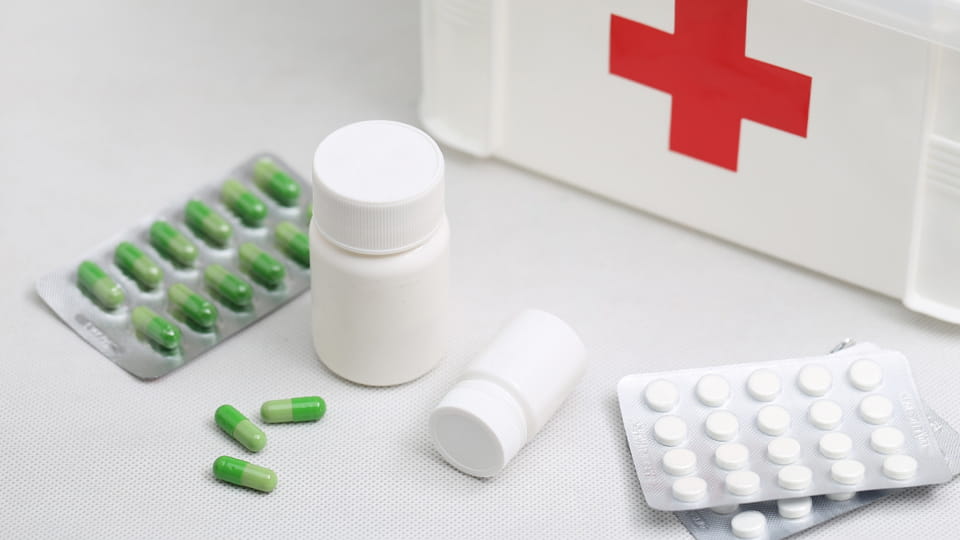
Below is a summary of the key distinctions between a drug and a medicine. The differences are subtle in plain language but important in manufacturing and regulatory contexts:
| Aspect | Drug | Medicine (Medicinal Product) |
| Basic meaning | Active substance (API) with therapeutic effect | Finished product containing the drug, ready for patient use |
| Stage | Often refers to early-stage ingredient or research compound | Refers to the final dosage form once formulated and packaged |
| Composition | The pure active ingredient (e.g. aspirin powder) | Includes API + excipients, container, label (e.g. aspirin tablet in blister) |
| Use context | Manufacturing, R&D, regulatory (approval process) | Clinical use, prescribing, dispensing (in healthcare settings) |
| Regulation | Broad FDA “drug” definition includes APIs | Strictly regulated finished products (FDA/EMA approvals, GMP) |
| Example | Ibuprofen API, insulin protein (bulk substance) | Ibuprofen tablets, insulin injections in vials |
In plain terms: A drug is the active chemical/biological substance with a pharmacological effect. A medicine is that drug plus formulation and packaging, intended for safe use by patients. As one pharma source put it, “Every medicine begins as a drug, but not every drug becomes a medicine”. For instance, pure morphine is a drug substance; once formulated into injectable doses with saline and sealed in vials, it becomes a medicine (a pain relief product).
The crucial point is that medicine implies a regulated, consumable product, whereas drug can mean just the raw active substance or a broader class of compounds. The table above highlights these differences.
To fully understand “drug vs medicine,” it helps to clarify related terms often used in pharma:
Bottom line: In pharma manufacturing, “drug substance” is the API, “drug product” is the formulated dosage form (tablets, capsules, injection, etc.), and “medicine” is what you call the drug product once it is a market-ready therapeutic product. For example, metformin is a drug substance, a 500 mg metformin tablet is the drug product, and that tablet (in its packaging) is the medicine the patient takes.
Understanding these terms is vital: once we know a drug product’s dosage form, we can select the right packaging line to turn it into a stable medicine.
Formulation & Dosage Form Development: A raw drug substance by itself isn’t patient-ready. It must be formulated into a suitable dosage form (tablet, capsule, syrup, injection, etc.) – this is a major part of manufacturing development. Each dosage form requires specific excipients and processing (mixing, granulation, sterilization) to become a drug product. For example, sensitive APIs for injectable biologics need aseptic processing, whereas a stable API for a pill goes through drying and tablet compression.
Regulatory Approval: Agencies like the FDA or EMA review data on the drug substance and the drug product/medicine. They assess the API’s safety and the final formulation’s efficacy. The finished medicine must meet strict standards (GMP, stability, labeling). FDA’s cGMP rules explicitly cover packaging processes and equipment – so how you package a medicine (even more than a raw drug) is highly regulated.
Packaging and Labeling: The distinction dictates packaging needs. A drug substance typically has minimal packaging (drums, vials for storage). A medicine, however, requires primary packaging that protects dosage (e.g. blister packs, bottles, vials) and secondary packaging (cartons) for information and traceability. For example, tablets (finished product) need moisture-proof blister packs or bottle-and-closure systems to ensure shelf-life. An injectable medicine needs sterile glass vials or ampoules plus tamper-evident seals. Each combination of API and dosage form has a matching packaging solution.
Equipment Selection: If you only think of APIs, you might consider reactors or mixers. But once a substance is a drug product needing packaging, you need the right packaging line. Blister packaging machines, capsule filling machines, liquid fillers, vial filling lines, cartoning machines – all become relevant. Recognizing “medicine” means packaged product prompts procurement of these machines.
In short, understanding “drug vs medicine” helps project teams know when and how to integrate packaging into the production workflow. It ensures that the drug product is not just formulated, but properly protected and presented to the market.
Packaging is the last critical step that transforms a formulated drug into a medicine patients can use safely. In pharmaceutical packaging, primary packaging is in direct contact with the dosage (the drug product) and provides the first barrier to degradation. For example, hard gelatin capsules and tablets often go into aluminum–plastic blister packs, while liquid syrups go into plastic (PET/HDPE) bottles. Injectable drugs are filled into sterile glass vials or ampoules. Each primary container is chosen for its inertness and barrier properties.
Once primary packaging is sealed, secondary packaging (cartons, labels, leaflets) provides patient information and batch data. For instance, blister packs or vials are grouped into branded cardboard cartons with instruction leaflets, batch numbers, and barcodes – crucial for compliance and patient safety.
At JinLuPacking, our machines automate these steps. An automatic blister packing machine can seal thousands of tablets into blisters per hour; a capsule filling machine doses the drug into capsules; a bottle filling and capping line counts tablets or fills syrups into bottles; and a cartoning machine wraps and boxes the finished products. All these stages – filling, capping, wrapping – ensure the final medicine is accurately dosed, safe, and ready for distribution.
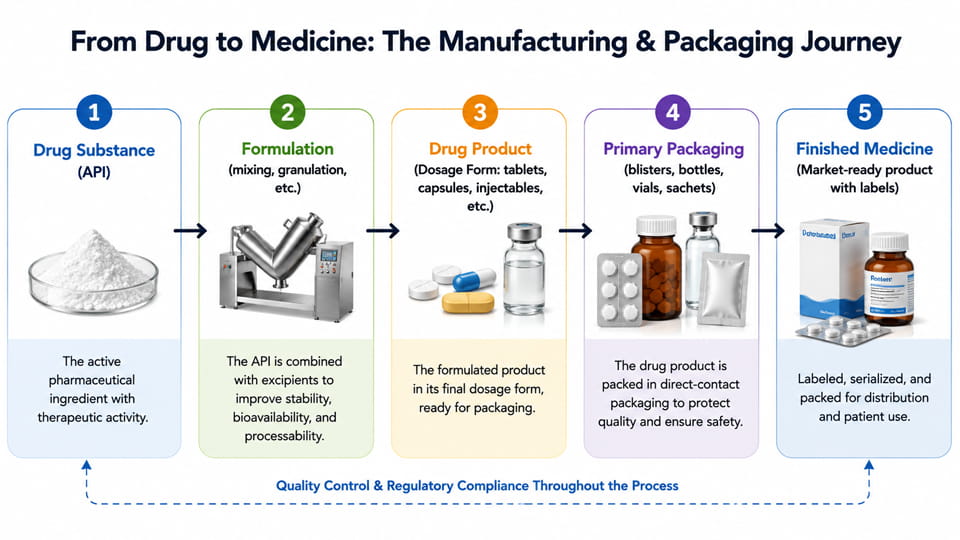
Figure: Flowchart of Drug → Medicine: The active drug substance (API) is formulated into a drug product (specific dosage form). Then it moves into primary packaging (e.g. blister packs for tablets, bottles for syrups, glass vials for injectables). Finally, it becomes a finished medicine with secondary packaging (cartons/labels) for patient use.
Different dosage forms require different packaging solutions. The table below summarizes typical pairings:
| Dosage Form | Common Primary Packaging | Example JinLuEquipment |
| Tablets (Solid Oral) | Blister packs (PVC/PVDC foil), or plastic bottles with screw caps | Blister Packing Machine; Tablet Counting & Bottling Line |
| Capsules (Oral) | Blister packs, or bottles similar to tablets | Automatic Capsule Filling Machine; Blister Machine |
| Oral Liquid (Syrups) | Plastic (PET/HDPE) bottles with child-safe caps | Liquid Filling and Capping System; Bottle Unscrambler |
| Powder / Sachet | Single-dose sachet packs (foil or laminate pouches) | Sachet/Stick Pack Packing Machine; Premade Pouch Line |
| Injectables (Sterile) | Glass vials, ampoules, or prefilled syringes, plus foil seals | Vial/Ampoule Filling & Stoppering Line; Induction Sealer |
| Ointments/Creams | Laminated tubes (aluminum or plastic) | Tube Filling and Sealing Machine |
| Softgel Capsules | Bottles (PET) or blister packs | Softgel Capsule Blister Machine; Counting Line |
The choice depends on factors like dose form stability, sterility, and patient convenience. For example, tablets and capsules often use blister machines or bottle filling lines, while liquids need bottle rinsers, filling, and capping machines. Injectable drugs require sterile filling systems under cleanroom conditions. Each solution is supported by specialized packaging machinery to ensure the drug product becomes a protected, labeled medicine that meets GMP standards.
To make it concrete, here are a few examples showing how specific drugs turn into medicines:
Each example shows: Drug (API) → Formulation (tableting, filling, etc.) → Packaging (blister, bottle, vial, sachet) → Medicine (end product with label).
Not necessarily. Every medicine starts from a drug, but not every drug becomes a medicine. Many chemical or biological compounds (drugs) never reach patients. Some drugs remain in R&D or are only used for research, and others are used outside medical settings (e.g. recreational drugs). Only when a drug is formulated, tested, and approved does it become a medicine.
As one FAQ answer notes, “Aspirin is both a drug and a medicine. It is a drug in its chemical form (acetylsalicylic acid) and becomes a medicine when formulated and used to treat fever, pain, or inflammation”. The key is the intended use and presentation: use as a patient-ready product makes it a medicine.
In summary, only approved, patient-intended products are medicines. Understanding this helps manufacturers and regulators distinguish between experimental substances and real market products.
In summary, “drug” usually refers to the active ingredient or any pharmaceutical agent, while “medicine” (medicinal product) refers to the finished, patient-ready product containing that drug. This distinction is important for pharmaceutical manufacturing: it guides R&D, regulatory status, and packaging choices. Understanding these terms helps ensure we move a drug substance through formulation and packaging properly to become a stable, compliant medicine.
When developing a new dosage form, remember: the right packaging line (blister packer, capsule filler, bottle line, vial filler, cartoner, etc.) is essential for protecting the medicine and meeting GMP. For example, tablet manufacturers rely on blister packaging machines and counting/filling lines, while injectable products require vial/ampoule filling and capping machines and secure secondary packing. JinLuPacking offers a full range of pharma packaging machinery tailored to each dosage form – from tablet & capsule blistering to sachet packing and cartoning.
Ready to turn your drug into a market-ready medicine? Explore our solutions: tablet & capsule blister packaging machines for solid doses, capsule filling machines for powder/liquid capsules, sachet & premade pouch machines for powders, and cartoning machines for final boxing. Our equipment helps protect product quality, ensure patient safety, and streamline your production line from drug to finished medicine.
Not exactly. In casual conversation they overlap, but technically a drug often means the active ingredient or any pharmacological substance, whereas a medicine is the finished product given to patients. One can say “every medicine contains a drug, but a drug by itself may not be a medicine until formulated”.
They are essentially the same concept in most pharmaceutical contexts. A drug product is the completed dosage form (tablet, capsule, injection) ready for sale. A medicine is what the drug product is called when it’s packaged for patient use. In practice, approved drug products (with labeling) are medicines.
A drug substance (or API) is the pure active ingredient – the chemical or biologic that has the therapeutic effect. A drug product is the final formulation containing that substance, plus excipients, in a dosage form (pill, solution, etc.). Think of salt and saltshaker: the salt (drug substance) is the ingredient; the salt with anti-caking agent in a bottle (drug product) is the usable product.
Packaging is crucial for turning a drug into a medicine. As the JinLuPacking resources note, pharmaceutical packaging (blister packs, vials, bottles) protects the drug product’s stability and dosage, and ensures compliance with regulations. Proper packaging and labeling transform a loose drug substance into a safe, user-friendly medicine.
Yes. A compound like ibuprofen or acetaminophen is a drug substance. When it is made into an OTC tablet with instructions, it is also a medicine. It depends on form and use. As noted above, aspirin is chemically a drug but is called medicine once it’s in tablets for pain relief. It’s the same with many pain relievers, antibiotics, etc.
Doctors often use “drug” in the neutral sense of any pharmaceutical agent. In clinical jargon and law (like the FDA Act), “drug” is the official term for a therapeutic substance. It covers everything from cough syrup to chemotherapy. Meanwhile, “medicine” is more patient-friendly. So a doctor might prescribe ibuprofen (drug) as a pain reliever (medicine).
References:
1.Drugs@FDA Glossary of Terms —— U.S. Food and Drug Administration
2.Classification of Products as Drugs and Devices and Additional Product Classification Issues —— U.S. Food and Drug Administration
3.Glossary (P terms: pharmaceutical product, excipient, starting material) —— WHO
4.Prequalification Glossary —— WHO
5.Dosage Forms | FDA —— U.S. Food and Drug Administration
6.Q7A Good Manufacturing Practice Guidance for Active Pharmaceutical Ingredients —— U.S. Food and Drug Administration
