

A bottle packaging line is an end-to-end automated system that turns empty bottles into labeled, packed products. For pharmaceutical and nutraceutical makers, these lines boost throughput, cut labor costs, and ensure GMP-compliant output. This guide explains what a bottle packaging line is, how it works, and the key machines involved. We cover different line types (tablet, liquid, nutraceutical, etc.), list the main benefits of automation, and give practical tips on choosing the right line. Whether you want a turnkey bottle packaging solution or are comparing manual vs. automatic, this article has you covered.
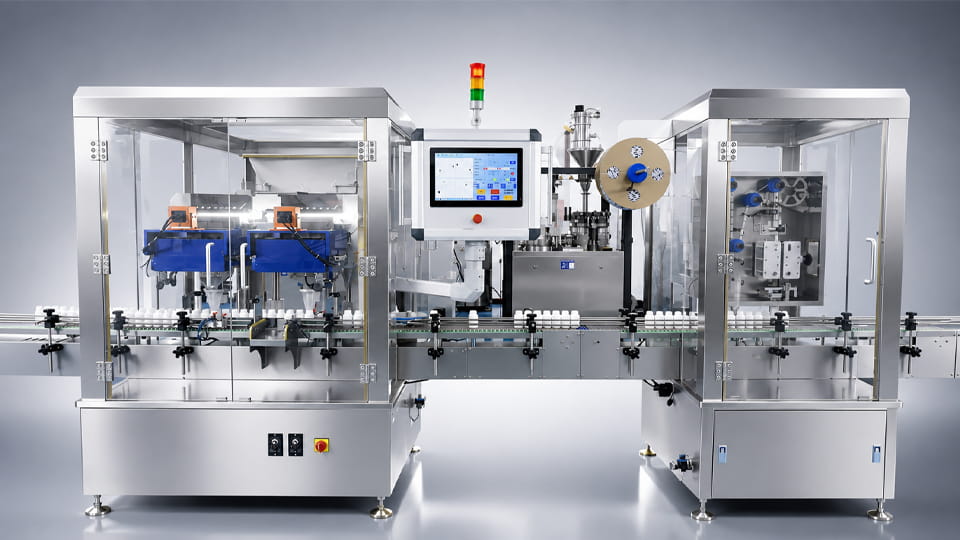
Figure:A typical pharmaceutical bottle packaging line.
A bottle packaging line is a series of machines and conveyors that automatically process empty bottles into finished, packaged products. In pharmaceuticals, this means taking empty tablets or liquid bottles and performing steps like counting/filling, capping, induction sealing (foil sealing), labeling, and final carton packing. In practice, a line “fully automates the entire process, from unscrambling bottles to counting, inserting desiccants, capping, aluminum foil sealing, and labeling”.
In other words, instead of manually picking up bottles and filling them one by one, an automated bottle packaging line feeds bottles through each station in sequence. A typical line starts with a bottle unscrambler (which orients bottles upright on the conveyor), then flows through filling/counting, cotton or desiccant insertion (if needed), capping, induction sealing, labeling, and finally cartoning. These machines work in sync under PLC control, forming a turnkey line that can run continuously. For example, one equipment supplier notes that a counting-filling line “can be connected with bottle unscrambler, desiccant inserter, capping machine, aluminum foil sealing machine and labeling machine”, covering all the main steps.
The bottles themselves can be plastic (PET, HDPE), glass, or other materials (amber glass for light-sensitive products, etc.). The line is usually built to handle a range of bottle sizes (e.g. 30–150 mm diameter, 40–300 mm height) and cap types (screw caps, snap caps, child-resistant closures). All product-contact parts are made from GMP-grade stainless steel with sanitary designs (smooth surfaces, no dead legs) to meet regulatory standards. Many machines include sensors and conveyors for quality inspection (e.g. checking fill level, cap torque, presence of labels) and support serialization (barcode/QR code printing) for traceability.
In short, a pharmaceutical bottle packaging line is an integrated, validated system that handles everything from empty bottle feeding to final cartoning, ensuring high speed, accuracy, and compliance.
The workflow of a bottle packaging line involves a sequence of stages that prepare, fill, seal, and package the bottles. The flowchart below shows a common sequence of steps:
Figure: Workflow of a typical bottle packaging line.
In practice, not all lines have every station. For example, a line for non-moisture-sensitive solids might skip cotton insertion, while a liquid line won’t use a tablet counter. Here is a brief rundown of each step:
Each of these stations is linked by conveyors and controlled by a central PLC/HMI system. The entire line is typically set up in a clean-room environment, built to cGMP standards: stainless-steel frames (SUS304/316L), FDA-approved tubing, washdown motors, and smooth welds. PLC automation (Siemens, Panasonic, Omron, etc.) synchronizes speed and operation across machines.
[jl_youtube src=”https://www.youtube.com/embed/tSrCmYZ-OQ0″]
Here are the key machines you’ll find in a typical bottle packaging line (with brief specs or benefits):
Feeds and orients empty bottles onto the conveyor. A high-quality unscrambler delivers 50–120 bottles/min, handling round plastic or PET bottles. It uses vibratory bowl feeders and tracks to turn bottles upright. Modern unscramblers are fully enclosed (dust-free, cGMP) and equipped with Siemens PLC controls and optical/pneumatic sensors, so that bottles arrive correctly oriented (100% accuracy) with no manual loading. Quick changeover parts let one operator switch bottle sizes in minutes.
For solid doses, an automatic counting machine (also called tablet/capsule counter or filler) drops an exact number of pills into each bottle. These use high-speed optical sensors or counting heads. JinLu’s counters, for instance, handle 3–40 mm solids, achieving output up to 100 bottles/hour with >99.98% accuracy. (Multi-head and multi-lane versions can multiply throughput.) They integrate seamlessly: “from sorting bottles to labeling… the count bottle filling line can be connected with bottle unscrambler, desiccant inserter, capping machine, [and] labeling machine”. In short, the counter ensures each bottle gets the correct pill count.
For syrups, injectables, or other liquids, an automatic liquid filler dispenses each dose. Jinlu’s liquid fillers use a servo-driven pump and submersible nozzle design, which avoids foam and drip-back. They run at 20–80 bottles per minute with ±0.2 g accuracy, and adapt to bottle volumes from a few ml up to liters. The filling station is often equipped with an index table or multi-nozzle manifold to increase speed. Critically, these machines are controlled by PLC/HMI for precise flow control and recipe-based filling.
After filling, a capper places and secures caps. A good capping machine will handle different cap styles (screw caps, snap caps, child-resistant, etc.) using specific cap heads. It automatically sorts, feeds, and applies the caps with the correct torque. Jinlu’s servo capping machines (e.g. model XG-120) adapt to diverse bottles and caps and run up to 120 bottles/min. Features include real-time torque adjustment (via a handwheel or servo motor) and cap presence checking. If a cap is misaligned or missing, the system will reject that bottle, ensuring 100% compliant output.
Also called an aluminum-foil sealer. This station applies a heat-sealed foil liner under the cap to create a hermetic seal. A typical induction sealer can process up to 120 bottles/min. It runs bottles on a conveyor under a high-frequency coil, briefly heating and bonding the foil. This step provides tamper evidence and prevents leaks. Modern sealers have dual-mode heads to adapt to varying bottle diameters and built-in cool-down fans for continuous operation.
Applies printed labels to bottles. High-speed rotary labelers (like JinLu’s TBJ series) can label up to 120 bottles/min with ±1 mm precision. They include a bottle divider to evenly space bottles and a smart detection system to align each label perfectly. Multi-mode labelers can handle front-wrap, wrap-around, and multi-sided labeling. Integrated coding heads often sit alongside the labelers for batch/lot printing. After labeling, vision systems may verify barcodes and text to meet serialization requirements.
Once bottles are labeled, groups of bottles (with instructions or leaflets if needed) are automatically inserted into cartons. Cartoning machines can erect and close up to 400–450 cartons per minute. In bottle lines, horizontal (sideload) cartoners are common. After cartons are formed, case packers or palletizers can further bundle the products. These end-of-line machines complete the system and often have their own PLC for synchronization with upstream equipment.
Each of these machines is an example of bottle packaging equipment. When linked together on conveyors with a central PLC control, they form a highly automated bottle packaging line.
Bottle packaging lines are typically categorized by the primary product type and application. Below is a sample of common line types:
| Line Type | Product/Application |
| Tablet/Capsule Bottle Line | Oral solids: tablets, capsules, powders (pharma & supplements) |
| Liquid Bottle Line | Liquids: syrups, syrups, tonics, injections (pharma & nutraceutical) |
| Vitamin & Nutraceutical Line | Dietary supplements, vitamins, herbal pills (food/health supplements) |
| Cosmetic Bottle Line | Personal care: creams, lotions, serums, oils (cosmetics) |
| Chemical Bottle Line | Industrial/household chemicals, reagents (chemicals) |
| Pre-Filled Syringe/Boltle | Specialized pharma sterile filling (injectables) |
These lines share similar architectures but use different filling/capping machines suited to the product. For example, a tablet bottle line uses counting machines for pills, while a syrup line uses liquid pumps. Nutraceutical lines often include features for delicate products (soft capsules, gummy vitamins), whereas cosmetic lines might integrate shrink-sleeving or higher-speed cappers. In each case, the line can be customized (nozzle types, conveyors) to the bottle shape and process needs.
Investing in a fully automated bottle packaging line offers many benefits over manual packing. Key advantages include:
In summary, automatic bottle packaging lines offer scalability and control. With the right machines, manufacturers achieve faster speeds, lower labor, and higher product quality simultaneously. As one packaging expert notes, these systems allow companies to “handle high volumes of products in a fraction of the time” while reducing errors.
Bottle packaging lines are essential in many sectors:
Any industry that bottles its product can benefit from an automated line. Even niche products (beeswax pills, CBD oil) use customized lines. The guiding principle is whether high throughput and quality control can improve production – in all these industries, automatic bottle lines play a key role.
Selecting the ideal bottle packaging line depends on several factors. Here’s what to consider:
In summary, specify your bottle types, product form, output targets, and budget. Then work with a trusted manufacturer to configure a custom line. They should provide a detailed layout, electrical requirements, and expected lead time. (Standard semi-auto machines might ship in weeks; a fully integrated line often takes 2–4 months to build and test.) Always validate the equipment performance with sample trials before finalizing.
| Manual Packaging | Automatic Packaging Line |
| Slow (often <20 BPM) | High speed (50–120 BPM or more) |
| Labor-intensive (many operators) | Minimal labor (one technician) |
| Variable accuracy (human error) | High precision (>99.9% accuracy) |
| Uneven quality (inconsistent filling) | Consistent output (repeatable quality) |
| Lower initial cost (but high OPEX) | Higher capex (but lower OPEX) |
| Minimal equipment integration needed | Turnkey integration (all-in-one) |
| Hard to scale quickly | Easily scaled by adding lanes/modules |
Table: Comparison of manual packing vs. an automatic bottle packaging line.
As the table shows, automation delivers much higher throughput and consistency. It also eases traceability (barcoding every bottle) and can often pay for itself in a few years through efficiency gains.
A modern bottle packaging line is the backbone of efficient pharmaceutical (and nutraceutical) manufacturing. By automating filling, capping, sealing, and labeling, these lines maximize productivity while ensuring quality and regulatory compliance. When choosing a line, align the design with your product type (tablet vs. liquid), throughput needs, and quality standards (GMP, serialization, etc.). Look for a reputable supplier like Jinlu Packing that offers integrated solutions and strong support.
In summary: an automated bottle packaging line converts empty bottles into final cartons in one smooth operation. It can handle large volumes (often hundreds per minute) with exceptional accuracy. For plant managers and engineers, the benefits – higher throughput, lower labor, better consistency – are clear.
Ready to automate your packaging? Contact Jinlu Packing’s sales team to discuss a custom bottle line for your products. We offer turnkey design, on-site commissioning, and 3-year warranties. With over 30 years in pharma equipment manufacturing, Jinlu can help you select the right speed, format, and automation level – ensuring your new line delivers fast ROI. Visit www.jinlupacking.com or request a quote to get started.
A bottle packaging line is an integrated system of machines that automates the packaging of bottled products. It typically includes a bottle unscrambler, a filling or counting station, capper, sealer, labeling machine, and often a cartoner. Together these stages take empty bottles and transform them into finished, packaged goods.
An automated line follows a set workflow: empty bottles are fed upright (unscrambled), then moved to a filler (for liquids) or counting machine (for tablets/capsules). Next, any additional items (cotton or desiccants) are added. Bottles are then capped, induction-sealed, and labeled. Finally, groups of bottles are packed into cartons. Each machine is synchronized by PLC control. Modern lines can even adjust in real-time (e.g. correcting fill weight) to maintain quality.
It depends on the model and format. Typical speeds are 50–120 bottles per minute per lane. For example, Jinlu’s Tablet Counting Line runs up to ~70 BPM, and many capping/labeling machines handle 120 BPM. Multi-lane lines can multiply output (a 6-lane counter, for instance, could do 6× the single-lane rate). For liquids, speeds around 20–80 BPM are common. Always check the vendor’s spec sheet for exact rates under your chosen configurations.
Key components are: a Bottle Unscrambler, Filling/Counting Machine, Cotton/Desiccant Inserters, Automatic Capping Machine, Induction Sealer, Labeling Machine, Inspection Station, and Cartoning/Case Packer. Each is supplied by the OEM and integrated on a common conveyor frame. Some lines may also add an in-line printer for batch codes and a reject sorter. The exact lineup depends on whether your product is solid or liquid, your bottle type, and packaging needs.
Yes, bottle lines can handle both tablets and capsules, since both are countable solids. The line would include a tablet/capsule counting filler, which typically works for any small solid shape (capsules, gummy candies, etc.) of the specified size range. Switching between tablets and capsules is usually a matter of adjusting the counting head and parameters. Many manufacturers design their counting machines to handle both by simply changing recipes. Thus a single line can run different SKUs (e.g. a vitamin tablet in one run, a capsule in the next) with minimal changeover time.
Yes – all machines in a pharmaceutical bottle packaging line are built to meet cGMP standards. They are constructed from pharmaceutical-grade stainless steel (SS316L), with sanitary design (no crevices, easy clean-down). Control systems support FDA 21 CFR Part 11 (electronic records) and typically come with validation documentation. For example, suppliers explicitly state their bottle lines “comply with Good Manufacturing Practice (GMP) and FDA regulations.”. When selecting equipment, look for CE marking, ISO certifications, and confirm that the vendor provides IQ/OQ protocols for regulatory compliance.
Prices vary widely with speed and configuration. A simple semi-automatic counting-and-capping setup might cost a few thousand USD, whereas a fully integrated high-speed line can run into the tens or even hundreds of thousands of dollars. Factors include number of stations (e.g. an extra labeling head adds cost), custom tooling, and compliance extras (e.g. vision systems). Always request quotes for your exact requirements. Remember to consider total cost of ownership: a slightly pricier high-quality line often saves money over time through reduced waste and downtime.
Turnkey bottle lines are complex. After manufacturing and testing at the factory, installation on site typically takes 2–7 days per machine module (depending on site prep, utilities, and training). Small lines might be up and running in a couple of weeks, while large multi-machine lines might require 4–6 weeks on site (including IQ/OQ validation). Your supplier should handle mechanical installation, electrical hookup, and initial qualification. Plan extra time for operator training and process validation.
Absolutely. Leading manufacturers (like Jinlu) specialize in custom and turnkey solutions. You can customize almost every aspect: conveyor lengths, machine spacing, PLC language, painting color, parts materials (e.g. SS304 vs SS316), and even integrate client-specific additions (metal detectors, RFID applicators, etc.). Because each plant’s space and workflow differ, layouts are tailored to fit. If you need modular expansion (e.g. adding a 2nd fill head later) or unique product handling (fragile products, special caps), discuss this upfront. The OEM will usually offer a 3D factory layout and simulation before build.
Yes – many suppliers offer turnkey integrated lines, meaning they deliver a fully engineered system ready to run. A turnkey project includes design, manufacturing, testing, shipping, installation, and final qualification. This is ideal if you want a single supplier responsible for the whole line. According to industry guides, a turnkey bottle line works “stage by stage” from bottle handling through capping and labeling. Companies like Jinlu will work with you on layout and then provide one contract price for the entire line. This simplifies validation and support because one team knows the whole system.
References:
1.Container Closure Systems for Packaging Human Drugs and Biologics —— U.S. Food and Drug Administration
2.Good Practice Guide: Packaging, Labeling, & Warehousing Facilities —— ispe.org
3.PART 211—CURRENT GOOD MANUFACTURING PRACTICE FOR FINISHED PHARMACEUTICALS —— ecfr.gov
4.Carton and Container Labeling Resources —— U.S. Food and Drug Administration
5.Guidelines on packaging for pharmaceutical products —— WHO