

Liquid-filled hard capsules (LFHCs) are basically standard two-piece capsules (hard gelatin or HPMC shells) that are filled with oil-based or other non-aqueous liquid formulations instead of powders or granules. Imagine a hard capsule you can open and fill with your own mix – but made at scale by precision machines. In manufacturing, a pump or syringe injects a measured dose of a liquid (often an oil or suspension) into the open body of each capsule. After filling, the cap is closed on the body, and the joint is immediately sealed (so nothing leaks). To visualize it, consider the image below of liquid-filled hard capsules:
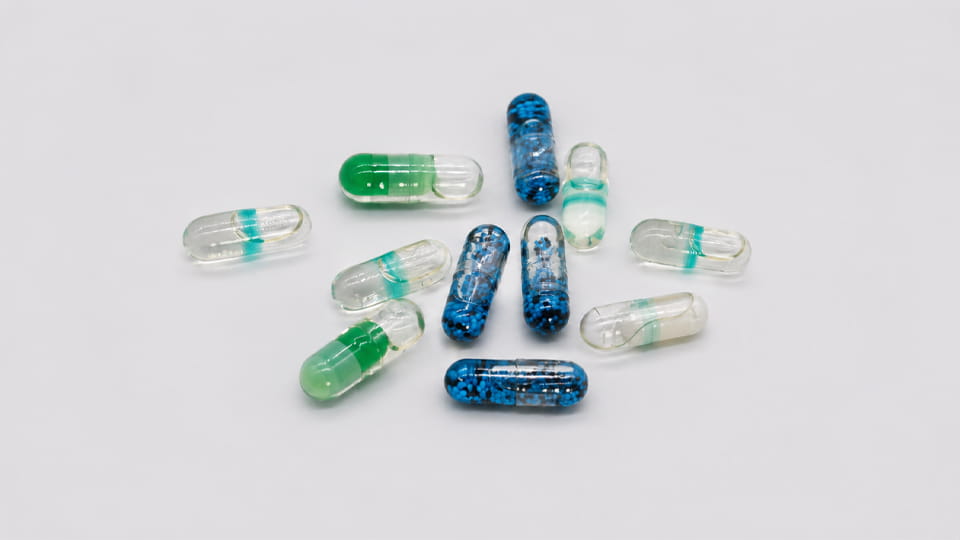
Figure: Two-piece hard capsules filled with liquid. Each capsule has a cap and body joined and sealed to hold an oil or liquid formulation.
Liquid-filled capsules require special sealing because liquids can leak. Common sealing methods include applying a thin gelatin band around the joint (called “band sealing”) or using fusion techniques. In fact, modern liquid capsule fillers like Jinlu’s NJY-1000C automatically fill liquids into standard hard shells and then seal them into a hybrid form that combines easy swallowing with fast drug absorption. In short, LFHCs let you deliver a liquid dosage form inside a solid capsule shell – a useful hybrid between powders and softgels.
To summarize, the benefits of liquid-filled hard capsules include: improved solubility and bioavailability for tough drugs; flexible dosing and easy development; faster, more cost-effective manufacturing; high product stability; and the ability to create novel combination products. These advantages make LFHCs attractive for both pharmaceutical and nutraceutical manufacturers.
It’s natural to wonder how LFHCs compare to soft gelatin capsules. Both deliver liquid formulations, but there are key differences. Softgels are made in one molding step and are great for oils, but they require plasticized gelatin (with moisture) and very tight humidity control during manufacturing. Hard capsules are made separately and filled in a second step, which means simpler equipment and no need to formulate the shell in-house. For example, with LFHC you can use HPMC shells for vegetarian products or moisture-sensitive fills – something not possible with standard softgels.
From a manufacturing viewpoint, hard capsules often win on cost and speed. Softgels need a specialized encapsulation machine and days of prep, whereas a liquid capsule filler completes the cycle in hours. Softgel processes also waste more gelatin and require costly gelatin preparation equipment. On the other hand, softgels inherently seal themselves when formed, so they don’t need a separate sealing step. LFHCs need that extra step (banding or fusion), but as discussed, this can be very efficient with modern banding machines.
| Feature | Liquid-Filled Hard Capsules | Softgels |
|---|---|---|
| Development Cost | Lower | Higher |
| Production Flexibility | High | Medium |
| Bioavailability | Excellent | Excellent |
| Capsule Materials | Gelatin/HPMC | Mostly Gelatin |
| Vegetarian Options | Available | Limited |
| Small Batch Production | Easier | Difficult |
| Equipment Investment | Lower | Higher |
In summary, liquid-filled hard capsules offer similar patient benefits (easy swallowing, fast release of liquid contents) as softgels, but with simpler manufacturing and more formulation flexibility. They essentially bridge the gap between hard capsules and softgels.
Producing liquid-filled hard capsules involves the familiar capsule-filling steps, with some special considerations for the liquid fill. The main stages are:
Figure: A liquid capsule filling machine at work. Empty hard capsules are filled with liquid and then sealed (banded or fusion) in one continuous process.
Each of the above steps must be validated for quality. In practice, manufacturers establish controls on liquid viscosity, pump calibration, banding solution, and drying conditions. They may also perform leak tests on samples (vacuum tests or visual checks) to ensure band integrity. But with a well-designed line – empties, filler, bander, and drying – liquid-filled capsule production can run at high throughput much like any other capsule line.
[jl_youtube src=”https://www.youtube.com/embed/jBjWRfpjJ4o”]
A closer look at band sealing is worthwhile, since it’s central to liquid capsule manufacturing. In this process, a narrow curtain of warmed gelatin solution is applied around the locked capsule seam. The capsule belt then passes through a cooling zone so the band sets. This method is fast, requires no solvents, and instantly makes the capsule tamper-evident. Altasciences and other experts favor band sealing because it avoids alcohol (so no residual solvent testing) and provides over-the-counter tamper evidence and brandable color bands. As one review puts it, band sealing “creates a hermetic, leak-proof seal that protects the formulation and increases product stability during transport”.
Other sealing types include fusion sealing, where the capsule seam is softened (usually with a hydroalcoholic mixture) and briefly fused. Fusion seals can look cleaner but require tight environmental controls. Micro-spray sealing is a targeted approach – a tiny amount of sealant is sprayed on the joint, followed by heat, which lowers the capsule’s melting point at the seam and bonds it. However, this requires careful monitoring to avoid bubbles or warping. In practice, most nutraceutical and pharmaceutical lines use banding due to its reliability and simplicity.
In equipment terms, there are dedicated capsule banding machines that integrate with filler lines. These machines accurately apply gel bands on thousands of capsules per minute. Because sealing is so important for LFHCs, leading filling machines now include built-in banders. For example, Jinlu’s patented sealing system automatically adjusts band speed so each capsule gets an even, leak-proof coat.
Liquid-filled hard capsules span a range of industries. In pharmaceuticals, they’re increasingly used for new chemical entities (NCEs) that are poorly soluble or highly potent. Many late-stage pipeline drugs today fit that description, and capsule delivery can simplify dosage form development. LFHCs can also revamp existing products: companies sometimes re-formulate an old tablet into a liquid capsule to improve onset of action or combine multiple active ingredients in one pill. For example, a chronic medication might deliver a fast-acting liquid insert plus a time-release pellet in one capsule.
In the nutraceutical and supplement field, liquid-filled capsules are popular for oil-soluble vitamins and botanical extracts. The richpacking sealing guide notes that products like fish oil, omega-3s, vitamin D, and herbal oils are commonly put into LFHCs. Indeed, many “softgel-style” supplements are now made as LFHCs with a band – consumers still get an easy-to-swallow liquid dose, but manufacturers benefit from simpler filling equipment. For dietary supplements, banded capsules provide tamper-evidence and appealing color bands without the cost of full blister packs.
Operations managers and procurement engineers will appreciate that LFHC lines can often run on the same production floor as standard capsule lines. For instance, a capsule-filling machine that already handles powders can sometimes be adapted or equipped to handle liquid dosing heads. This means plants can add liquid dosage capabilities without an entirely new softgel department. (One note: standard hard capsule shells handle non-aqueous liquids well, but very watery formulations usually require special capsules.) The versatility of LFHCs also extends to packaging. After sealing, capsules can be blister packed, bottled, or banded in bulk just like any other pill.
Finally, recall the benefits summary: LFHCs improve bioavailability of oils and suspensions, enable flexible dosing, and offer manufacturing speed and stability. They are ideal for low-dose or potent APIs (because filling a tiny volume is easier than dispensing a tiny powder weight). They also enable higher capsule throughput: high-speed machines can pump out tens of thousands per hour with capsule sizes from 000 (large) down to #5 (small). For an Operations Manager deciding on a capsule line, liquid capabilities mean you can run both powder and liquid products on one system (with changeovers), expanding your product mix without double investment.
Liquid-filled hard capsules are a powerful dosage form that combines the best of pills and liquids. They solve formulation headaches (especially for poorly soluble or complex drug combinations) and give manufacturers a scalable, cost-effective production route. By using liquid capsule filling machines and sealing techniques, companies can reliably mass-produce capsules that deliver oils, suspensions or emulsions in a neat, swallowable form. In the growing world of oral dosage forms, LFHCs stand out for their flexibility, patient appeal, and commercial speed. Whether you’re an operations manager in a pharma plant or a procurement engineer sourcing packaging machinery, exploring liquid-filled hard capsules could bring your products faster to market with better efficacy and lower cost.
Looking for a reliable liquid capsule filling solution? Jinlu Packing provides advanced capsule filling and packaging equipment for pharmaceutical and nutraceutical manufacturers worldwide.
Liquid-filled hard capsules are two-piece capsules made from gelatin or HPMC shells that contain liquid, semi-solid, suspension, or oil-based formulations. Unlike traditional powder-filled capsules, they allow manufacturers to deliver ingredients in a liquid state, which may improve formulation flexibility and ingredient performance.
The main benefits include improved bioavailability for poorly soluble ingredients, better taste masking, protection of sensitive compounds, precise dosing, and the ability to formulate oils, suspensions, and self-emulsifying systems inside a hard capsule shell.
The manufacturing process typically includes formulation preparation, liquid filling into empty hard capsules, capsule locking, sealing or banding, drying, inspection, and final packaging. Specialized liquid capsule filling machines ensure accurate dosing and prevent leakage.
Liquid-filled hard capsules can contain oils, lipid-based formulations, herbal extracts, suspensions, semi-solids, self-emulsifying drug delivery systems (SEDDS), and other non-aqueous liquid formulations. Water-based formulations are generally avoided because they can damage capsule shells.
Liquid-filled hard capsules use a two-piece capsule shell that is filled and sealed after encapsulation, while softgels are formed, filled, and sealed in a single process. Liquid-filled hard capsules often provide greater formulation flexibility, lower tooling costs, easier scale-up, and the option to use vegetarian HPMC shells. Softgels, however, offer a fully hermetic one-piece seal.
Yes. HPMC liquid-filled capsules are widely used for moisture-sensitive ingredients, vegetarian formulations, and nutraceutical products. They contain less moisture than gelatin capsules and are often preferred for plant-based supplements.
Capsule sealing prevents leakage during transportation and storage, improves product stability, enhances tamper resistance, and helps protect oxygen-sensitive ingredients. Common sealing methods include capsule banding and thermal sealing technologies.
Liquid-filled hard capsules are widely used in pharmaceutical manufacturing, nutraceutical production, dietary supplements, herbal products, veterinary medicine, and specialty healthcare formulations. They are particularly suitable for oils, vitamins, botanical extracts, and poorly soluble active ingredients.
A typical liquid-filled hard capsule production line may include a liquid capsule filling machine, capsule sealing or banding machine, capsule polishing machine, metal detector, capsule sorter, blister packaging machine, bottling line, and inspection systems. The exact configuration depends on production capacity and regulatory requirements.
When selecting a liquid capsule filling machine, manufacturers should evaluate filling accuracy, production speed, capsule size compatibility, sealing integration, cleaning convenience, GMP compliance, automation level, and future expansion requirements. The ideal solution depends on the formulation characteristics and production volume.
References:
1.Liquid Filled Hard Shell Capsules: Current Drug Delivery Influencing Pharmaceutical Technology —— National Library of Medicine
2.Liquid Filled Hard Gelatin Capsule —— jddtonline.info
3.A review on liquid-filled hard gelatin capsules —— merckmillipore.com
4.The evaluation of an automatic system for filling liquids into hard gelatin capsules —— National Library of Medicine
5.Liquid-filled hard gelatin capsules : excipient/capsule compatibility studies —— ScienceDirect
6.Liquid Filled and Sealed Hard Gelatin Capsules —— jddtonline.info
7.Selecting Excipients for Liquid-Filled Hard Capsules —— pharmtech.com