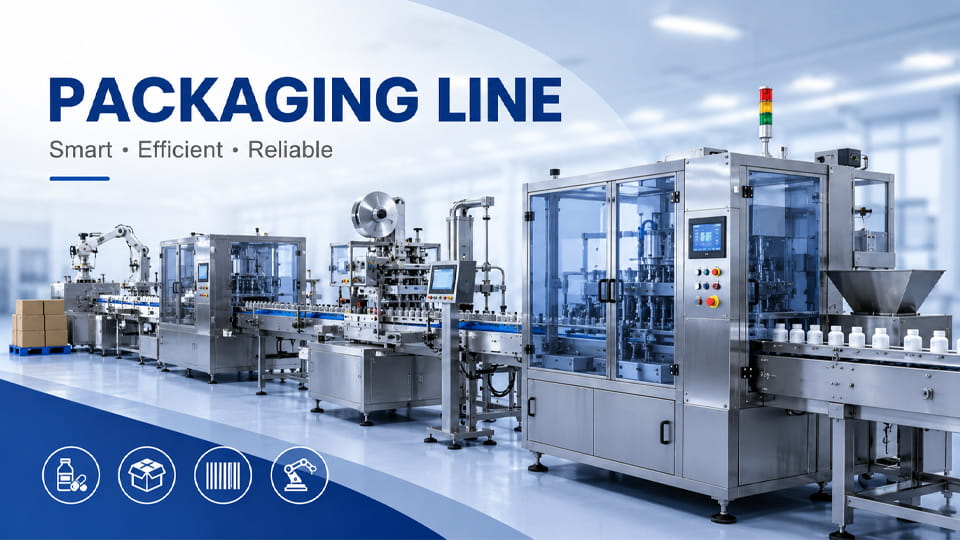
In manufacturing, a packaging line (or packaging production line) is a series of connected machines that prepare finished products for distribution, storage, and sale. In pharmaceutical factories, packaging lines protect drugs and ensure compliance. This guide explains packaging lines step-by-step, describes key machines (unscramblers, counters, fillers, cappers, labelers, blisterers, cartoners, case packers, palletizers), and covers types of lines (solid-dose, liquid, blister, sachet, end-of-line). We’ll also compare manual vs automated packing, discuss benefits of automation, industry applications, selection tips, and answer common FAQs. By understanding packaging lines, procurement and production managers can make informed choices for high-speed, compliant, and cost-effective packaging solutions.
Definition: What Is a Packaging Line?
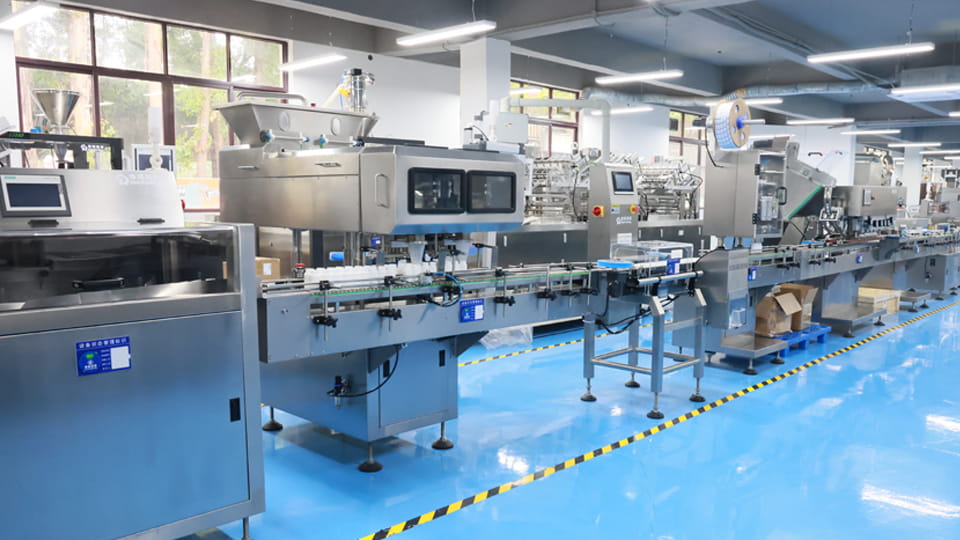
A packaging line is a coordinated system of equipment that automatically or semi-automatically packages products. It typically includes conveyors, fillers, sealers, labelers, and end-of-line machines arranged in sequence. Together, they load products (like tablets, capsules, bottles, sachets, etc.), add dosages or quantities, apply closures (caps or seals), attach labels, group items into cartons, and stack them for shipment.
For example, “a packaging line is a series of packaging equipment that prepares the products for distribution, storage, and sale. The equipment can be manual, semi-automatic, or fully automatic.” In the pharmaceutical and consumer industries, these lines ensure products are filled, sealed, labeled, and tracked under strict quality controls.
Modern packaging lines are often automation-integrated: Programmable Logic Controllers (PLCs) and robotics synchronize multiple machines, ensuring smooth flow and real-time monitoring. This is essential in pharma, where FDA and GMP regulations demand precise control of filling volumes, label accuracy, and packaging integrity.
How Does a Packaging Line Work? (Step-by-Step Workflow)
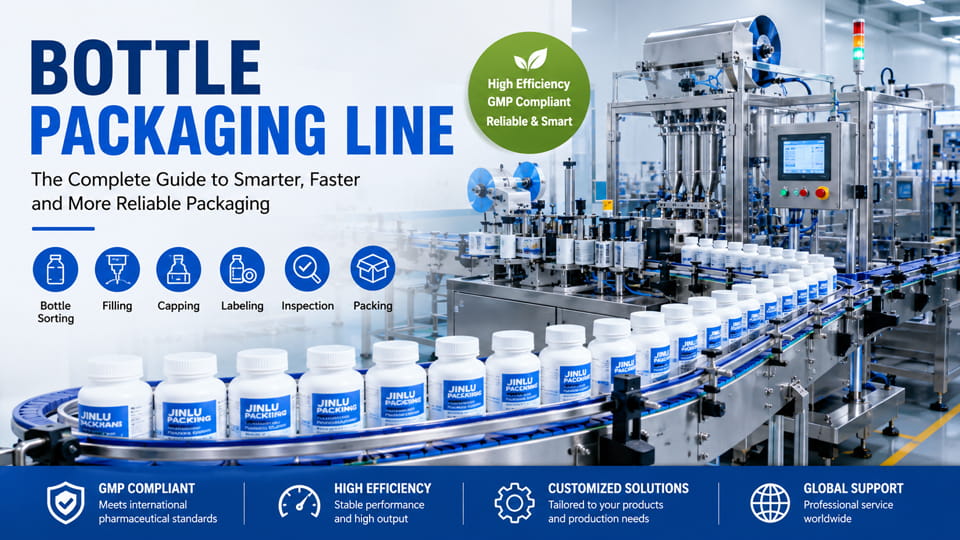
A packaging line follows a step-by-step workflow, much like an assembly line for packaging:
- Product Feeding/Unscrambling: Items (bottles, tablets, vials) are fed onto the line. For bottles, a bottle unscrambler orients and delivers bottles onto the conveyor. Tablets or capsules may arrive via hoppers or an upstream process. This replaces manual loading and ensures a steady flow.
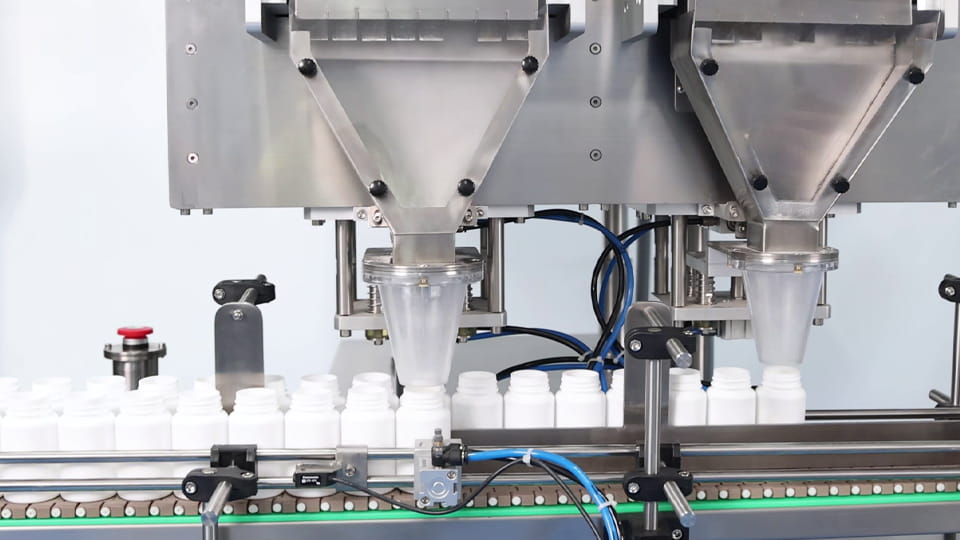
- Counting/Dosing: An automated counter/doser measures out the correct quantity. In pill lines, a tablet or capsule counting machine precisely counts and dispenses pills into bottles or blister cavities. For liquids, a filling machine dispenses exact volumes of syrup or solution. The goal is equal, accurate dosing in each package. For example, capsule counters can achieve >99.8% accuracy, reducing human error.
- Sealing/Capping: Once filled, containers are sealed. A capping machine picks and tightens caps on bottles. Modern cappers use automatic cap sorting and feeding, precise bottle positioning, and can reject misaligned caps. Heat or induction sealers apply foil liners or plastic seals. This step prevents leaks and contamination.
- Inspection/Quality Check: The line includes inspections like checkweighers (to verify package weight) and vision systems (to check fill level, label presence, or capsule orientation). Non-conforming packages (wrong weight, no label, miscap, cracked blister, etc.) are automatically rejected.
- Labeling: Labeling machines apply product information, barcodes, or batch/expiry data. Precision labelers ensure accurate placement. In pharmaceuticals, labeling must meet regulatory standards for clarity and content. (For instance, FDA’s CGMP part 211 requires accurate labeling procedures.) Some lines use printers to add serialization codes on the fly for traceability.
- Cartoning/Case Packing: Filled and labeled products are grouped into boxes or cartons. A cartoning machine erects paperboard cartons, inserts products (bottles, blisters, sachets, etc.), and closes the carton. Then a case packer loads cartons into corrugated cases or trays for shipping.
- Palletizing: Finally, a palletizer stacks cases on a pallet in a stable pattern, often with shrink-wrap or straps to secure the load. This completes the end-of-line process so products are ready for warehouse or distribution.
Here’s a simple flowchart of this workflow:
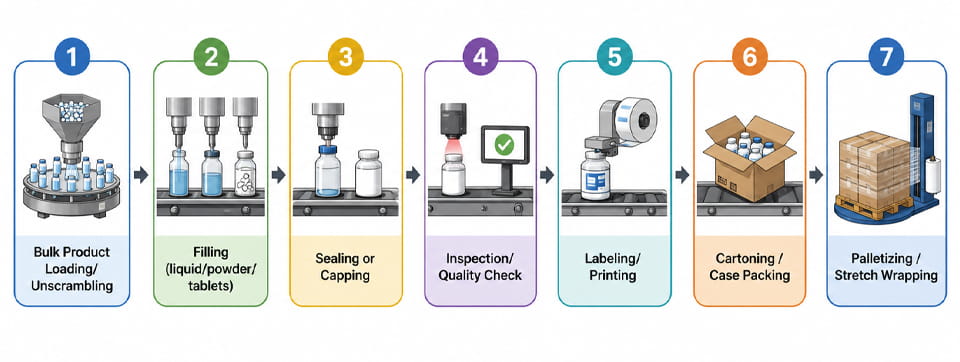
Throughout this flow, conveyors (often timing or servo-driven) move packages between stations. Controls coordinate machine speeds and buffering so each stage keeps up. Although the exact setup varies, this general sequence (feed → fill → seal → label → pack) covers most packaging lines.
[jl_youtube src=”https://www.youtube.com/embed/DZ7YIDhgknY”]
Main Components of a Packaging Line
A packaging line may include dozens of individual machines. Key components often include:
- Bottle Unscrambler (Orienter): This machine sorts and aligns empty bottles and feeds them onto the conveyor. It replaces tedious manual sorting. “A bottle unscrambler is a machine that sorts (unscrambles) and feeds bottles onto a production line conveyor belt system”. It handles various bottle shapes (round, square, oval) and can run at high speeds. Automating this step cuts labor costs and avoids human error.
- Counting/Filling Machine: For solid-dose products (tablets, capsules, gummies), a counting machine accurately dispenses the exact number into each bottle or blister cavity. For liquids, a liquid filling machine (volumetric or pressure filler) dispenses specified volumes. These machines can handle syrups, suspensions, ointments, and more. By automating dosing, each unit is consistently filled, ensuring compliance and reducing waste.
- Example: “Capsule counting machine… can accurately count capsules, tablets, soft capsules, pills, … and put them into bottles or other containers”, with built-in defect detection. Many counting machines integrate vibratory channels and optical sensors to achieve >99.97% counting accuracy.
- Capping Machine: This tightens caps onto bottles or vials. Modern cappers automatically sort and feed caps, place bottles, and tighten or crimp caps. For example, Jinlu’s capping machine “adapts to diverse bottle and cap types, with automatic cap sorting & feeding, precise bottle positioning, caps tightening, and defect rejection”. Proper capping is critical: it protects product quality and meets safety regulations.
- Labeling Machine: Applies labels or prints directly on packages. These high-speed labelers use sensors to detect each container and wrap paper or plastic labels around it. In pharmaceuticals, labels carry lot numbers and serialization codes. Advanced labelers can print and verify 2D DataMatrix codes on the fly to meet traceability regulations.
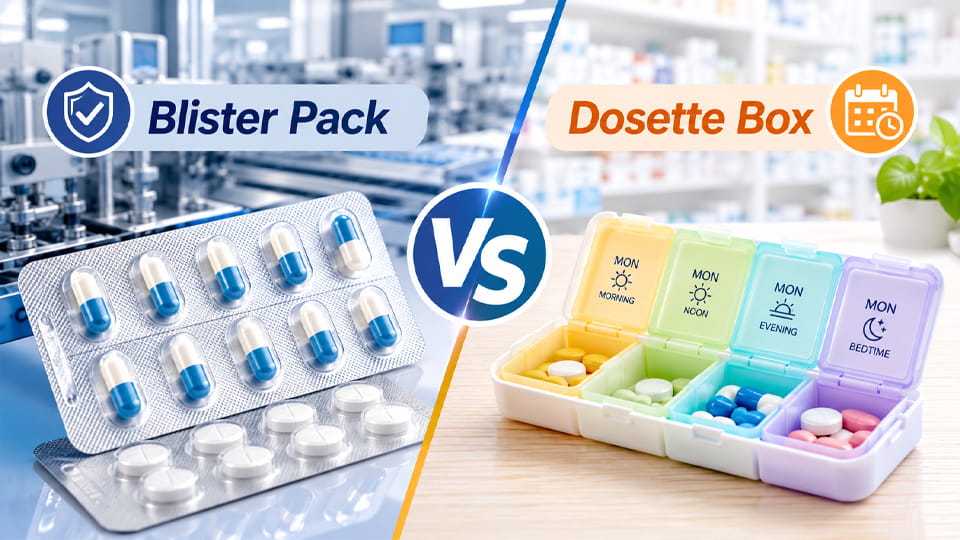
- Blister Packing Machine: Forms blister packs (plastic/foil pockets) for tablets or capsules. These thermoforming machines typically include a forming station, a feeding station (which inserts pills into cavities), a sealing station (applying heat or ultrasonic sealing of foil), and a cutting station to separate blisters. For example, Jinlu’s blister machine “handles the entire packing process in one go” for tablets, capsules, and candies, doing forming, feeding, sealing, and cutting in one continuous operation.
- Cartoning Machine: Packs products into cartons. Cartoners come in various styles (horizontal, vertical, wraparound) but generally erect flat cartons, load products (blister cards, bottles, sachets, etc.), and close the cartons. They can handle high speeds (e.g. 15,000 cartons/hour). Cartoners often receive product infeed from previous machines (like an inline blisterer or bottle filler).
- Case Packer: Loads groups of cartons or products into larger cases or trays. It’s an end-of-line machine that folds and seals corrugated boxes. Case packers can be top-loaders (placing items into an open-top case) or erecting side loaders. They ensure products are securely packed for transport.
- Palletizer: Stacks packed cases onto pallets in layers according to a programmed pattern. They may be robotic or gantry-style. Palletizers increase the speed of loading pallets and reduce injury risk from manual stacking.
Other common line components include metal detectors (to reject contaminated products), checkweighers (for weight compliance), dehumidifier/cold room for sensitive products, and VFFS (vertical form-fill-seal) machines for flexible packs or bags.
Manual vs Automated Packaging (Comparison Table)
| Feature |
Manual Packaging |
Automated Packaging Line |
| Speed/Throughput |
Slower, limited by workers’ pace |
High speed, continuous 24/7 operation |
| Labor Requirement |
High (many operators for each task) |
Low (mostly operator oversight) |
| Accuracy & Consistency |
Variable; human errors (miscounts, spills) |
Very consistent; precision filling/counting (often >99.9% accuracy) |
| Quality Control |
Manual inspections (less reliable) |
Integrated checks (weight, vision systems) |
| Traceability |
Paper records, prone to error |
Digital tracking (barcode/serialization on every unit) |
| Downtime |
Often due to fatigue/shifts or errors |
Scheduled maintenance only; predictive alerts reduce unexpected downtime |
| Flexibility |
Easily change tasks at will |
Changeovers require reprogramming/retooling |
| Investment |
Lower initial cost, higher ongoing labor cost |
Higher capital cost, lower operating cost |
| Safety & Hygiene |
More handling (higher contamination risk) |
Less human contact (safer for sterile products) |
| Scalability |
Limited (add labor to increase output) |
Scalable by adding modules or lines |
Table: Manual packaging relies on labor and offers flexibility but is slower and less consistent. Automated lines boost speed, consistency, and traceability, but require more initial investment.
Overall, automation pays off by boosting productivity, improving quality control, and ensuring compliance. In pharma, automated packaging minimizes operator exposure and contamination (critical in aseptic environments) and helps meet strict regulations like serialization requirements.
Types of Packaging Lines
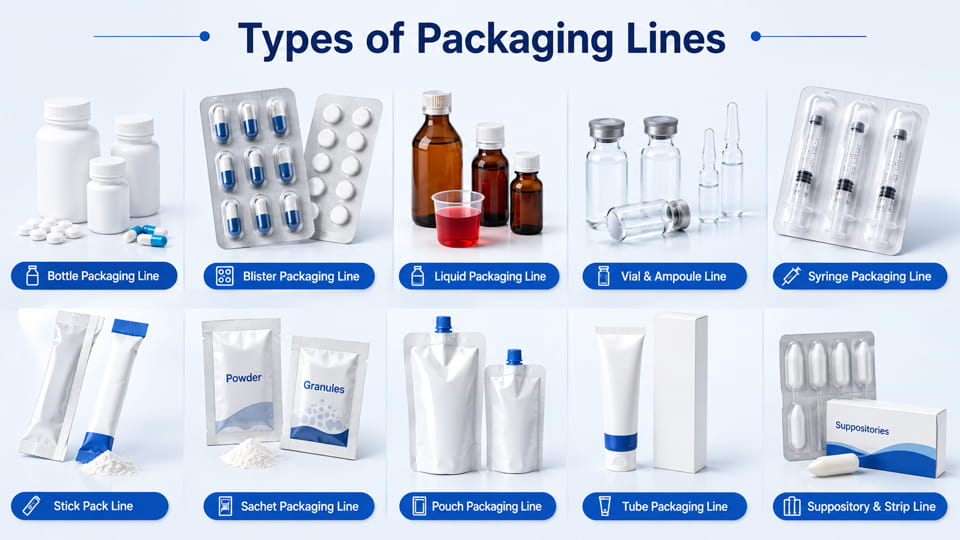
Packaging lines are tailored to product type and packaging format. Common types include:
- Solid-Dosage (Tablet/Capsule) Lines: These lines handle pills or capsules. Typical components: unscrambler (if bottles), counting machine, bottle filler, or blister machine, desiccant insert, capping/induction sealer, labeler, cartoner, and case packer. Solid-dose lines may have multiple parallel lanes to increase throughput.
- Liquid Packaging Lines: Designed for syrups, suspensions, injectables, or oils. Equipment includes bottle washer (for sterile vials), liquid filler (often aseptic filler for sterile products), capping machine (screw caps or crimp caps), and labeler. For sterile injectables, these lines operate inside cleanrooms (ISO Class 5). Some liquid lines integrate freeze-drying (lyophilization) after filling.
- Blister Packaging Lines: Specifically for forming thermoformed blister packs. A blister line includes a blister thermoformer, product feeder (dosing tablets into blisters), sheet or foil sealer, and a cutting or punching station. These lines output blister cards. As noted, modern blister machines handle forming, feeding, sealing, and cutting in one operation. They are common in pharma, nutraceuticals, and even confectionery. “Our DPP-180Pro Blister Packing Machine is suitable for Alu-Plastic and Alu-Alu blister packaging, with outputs up to 4,800 blisters/hour”, illustrating a high-speed blister line.
- Sachet/Stick Pack Lines: For single-serve packets of powder, granules, liquids, or gels. These usually use a VFFS (vertical form-fill-seal) machine that forms film pouches, fills product, and seals. Jinlu’s stick sachet machine (JL-VP series) offers multi-lane packaging for powders, granules, etc., with ±0.02 g accuracy. Sachet lines are popular in pharma (e.g. doses of powder meds), food (spices, drink mixes), and cosmetics (creams).
- End-of-Line Systems: These include case packing machines (grouping products into larger cartons), case sealers, palletizers, and automatic stretch-wrappers. For example, after cartoning bottles of pills, an automated case packer can bundle and a robotic palletizer stacks cases onto pallets. These systems complete the line by preparing packaged goods for warehouse shipment.
Each line is customized. A solid-dose bottle line looks different from a liquid vial line or a snack candy line. Vendors design the sequence of machines to match product form, packaging material (bottle, pouch, blister, carton), speed, and space.
Benefits of Automated Packaging Lines
Automating your packaging line offers many benefits:
- Higher Productivity: Machines run 24/7 at high speed. A fully automated line can pack many times the volume of manual operations, meeting growing demand without adding workers.
- Labor Savings: Automated lines need fewer operators. As one blog notes, “one of the easiest areas to automate is the packaging line”. This frees staff for higher-value tasks.
- Consistency & Quality: Machines perform repetitive tasks identically. Unlike humans, robots don’t tire. This leads to uniform filling, torque, and wrap every time, reducing defects and recalls.
- Reduced Waste & Errors: Precise filling and counting minimize product giveaway. Mistakes like miscounts or caps off-center are dramatically reduced. In pharma, this means fewer batch failures.
- Improved Safety: Less manual handling of heavy packages and sterile materials reduces worker injuries and contamination risk. In aseptic areas, “lights-out” robotics now handle fills to improve sterility.
- Better Traceability & Compliance: Automated lines easily integrate serial printing and scanning. Today’s packaging machines often act as data hubs, generating and verifying unique IDs on every unit. This meets regulations like the US DSCSA and EU FMD, which require unit-level traceability. (By 2026, “every pharma packaging machine is becoming a data hub” for serialization.)
- Optimized Resources: Machines use materials (labels, film, film) more efficiently. For example, consistent stretch-wrap tension on pallets cuts film use.
- Scalability: Automated lines can be upgraded or expanded. For instance, adding parallel lanes or a second line easily doubles throughput. Many modern lines are modular.
- One-Stop Turnkey Solutions: Vendors like Jinlu offer turnkey lines – fully integrated systems tailored to plant layout, capacity, and compliance. Jinlu notes we develop “tailor-fit packaging lines based on your plant condition, facility space, production capacity, and other demands”. This means you get a complete, tested line rather than piecing machines together.
By contrast, manual lines or semi-automated setups rely heavily on workers and are slower, which is risky when demand spikes or labor costs rise. Overall, automation boosts efficiency and ROI, even if initial investment is higher.
Industry Applications
Packaging lines are used across many industries:
- Pharmaceuticals & Nutraceuticals: Every factory has a packaging line for tablets, capsules, syrups, injections, ointments, etc. In pharma, strict GMP regulations (21 CFR 211 in the US) cover packaging controls. Packaging lines must ensure drug identity, strength, purity, and quality. For example, active pharmaceutical ingredients (APIs) must be kept free from cross-contamination.
- Food & Beverage: Lines package bottled drinks (water, soda, juices), sauces, spices (stick packs), snacks, confectionery, dairy, and more. The same principles apply: high speed, hygiene, and label accuracy.
- Cosmetics & Personal Care: Creams, lotions, shampoos, and perfumes are bottled, capped, and labeled on packaging lines. Unscramblers, fillers, sealers, and labelers ensure products meet branding and safety standards.
- Chemical & Household Products: Cleaning agents, detergents, oils, and other chemicals use packaging lines (often with special materials handling and cleaning equipment).
- Specialty (Biotech, Diagnostics, etc.): Sterile biotech products (vaccines, biologics) are packaged in high-containment lines; medical device components also use advanced packing machines. Jinlupacking notes unscramblers are popular in pharmaceutical, biotech, food/bev, cosmetics, and chemical industries.
- Nutraceuticals & Supplements: Vitamins and supplements (tablets, gummies, powders) often share equipment with pharma, focusing on dosing and attractive packaging.
In short, any industry requiring high-volume, consistent packaging can benefit. The choice of line depends on product form: e.g., tablets vs. syrups vs. powdered drink mixes.
How to Choose the Right Packaging Line
Selecting the right packaging line is critical. Key factors to consider:
- Product Characteristics: What are you packaging? (tablets, capsules, liquid, paste, powder, etc.) This determines which machines you need (e.g. capsule counter vs. liquid filler vs. sachet sealer).
- Packaging Format: Bottles, vials, blister cards, pouches, boxes? Each format needs specialized equipment.
- Speed & Volume: Required throughput (e.g. bottles/hour) should match line capacity. Over- or under-specifying speed can waste money or create bottlenecks.
- Space and Layout: The line’s footprint must fit your factory. Conveyor systems and safety zones need floor plan review. Jinlu highlights that we design lines around facility space.
- Automation Level: Decide full automation vs. semi. Full automation is ideal for 24/7 high-volume lines, but smaller plants may start semi-automatic (some manual steps) to save cost.
- Regulatory Compliance: Ensure machines meet GMP/CE/ISO standards (e.g. cGMP for pharma, 21 CFR 211 for drug packing). Look for suppliers with relevant certifications and experience.
- Flexibility & Changeover: If you package multiple products, ease of changeover is vital. Some machines offer quick size changeovers (adjustable feeders, modular parts).
- Budget & TCO: Consider not just purchase price but total cost of ownership (TCO). Cheaper machines may have more downtime or require skilled operators. Evaluate warranty, support, maintenance costs.
- Supplier Expertise: Work with experienced vendors. Jinlu, for example, offers turnkey solutions and 24/7 technical support. Check references and service agreements.
- Scalability & Future Needs: Choose a line that can expand or upgrade (e.g. add lanes, integrate serialization) as your business grows.
- Integration Requirements: Modern lines often need to tie into factory MES/ERP systems or serialization databases. Ensure the control systems (PLCs, HMIs) are compatible with your IT infrastructure.
In practice, packaging line selection is often done by a cross-functional team (engineering, QA, operations). Consulting with machinery experts or conducting a factory acceptance test (FAT) can validate line performance before purchase.
Conclusion
In summary, a packaging line is a complex, integrated system of machines that take products from bulk to packaged goods ready for shipping. In the pharmaceutical industry, packaging lines handle tablets, capsules, liquids, vials, creams, and more — all under strict GMP controls. By automating the steps of feeding, filling, capping, labeling, cartoning, and palletizing, manufacturers achieve higher speeds, lower labor costs, better quality, and full traceability.
Choosing the right packaging line involves matching your product type, speed requirements, and compliance needs to the appropriate equipment. Leading suppliers (like Jinlupacking) offer turnkey solutions, customizing each line to your factory’s layout and regulatory standards. Looking ahead, smart factory features (IoT connectivity, AI vision, predictive maintenance) and sustainability will drive packaging lines toward even greater efficiency and safety.
Whether you need a high-speed tablet counting line, a fully integrated blister packing and cartoning line, or a customized turnkey pharmaceutical packaging solution, You can also contact our team to find the right solution for your production needs. With more than 30 years of industry experience, customized engineering support, fast response service, and global installation experience, Jinlu Packing helps pharmaceutical and nutraceutical manufacturers improve efficiency and reduce downtime with reliable packaging line equipment.
FAQs on Packaging Line
What exactly is a packaging line?
A packaging line is a connected sequence of machines used to package products for storage and sale. It typically includes machines for feeding products, filling or dosing, sealing/capping, inspecting, labeling, cartoning, and palletizing. In pharma, a packaging line might start with a bottle unscrambler and end with a palletizer. Each machine automates one step, so the whole system transforms loose product (like bulk tablets or liquids) into finished, boxed, and palletized goods ready to ship.
What machines are included in a pharmaceutical packaging line?
Core machines include: Unscramblers (sort bottles/capsules onto the line); Counters/Fillers (accurately dose tablets or liquids); Cappers/Sealers (tighten caps or seal foil lids); Labelers (apply product labels); Cartoners (pack items into cartons); and Case Packers/Palletizers (group cartons into cases and stack on pallets). Other equipment can include metal detectors, checkweighers, and visual inspection systems to ensure quality. The exact lineup depends on the product form (tablet vs liquid vs blister vs sachet).
How does automating the packaging line improve efficiency?
Automation dramatically increases output. Machines run faster than humans and can operate continuously. They also reduce errors: automated counters and fillers ensure each unit meets exact specifications. Automation minimizes repetitive manual labor and fatigue, improving safety and consistency. For example, robots can stack boxes as accurately after 8 hours as at the start, and vision systems catch defects instantaneously. Overall, an automated line packs more products with fewer people and fewer mistakes, offering a quick return on investment.
What is a turnkey packaging line?
A turnkey packaging line is a complete, ready-to-operate system delivered by a single supplier. Instead of buying machines piecemeal, you get an integrated solution engineered to your needs. It includes equipment, installation, integration, and validation. A turnkey provider (like Jinlupacking) custom-designs the sequence of machines, ensuring they work together and meet your capacity, space, and compliance requirements. This streamlines project management and ensures smooth start-up.
How do I choose the right packaging line for my product?
Consider these factors: product type (solid vs liquid vs powder), package format (bottle, pouch, blister, etc.), required speed (units per minute/hour), floor space, budget, and regulatory needs. For pharmaceuticals, GMP compliance is crucial. Discuss your needs with packaging engineers. They will propose a line layout and machines that match your volume and quality targets. It’s also wise to plan for future growth: choose a modular line that can be scaled up or reconfigured.
How do packaging lines support regulatory compliance in pharma?
Packaging lines support compliance by controlling and documenting each step. Machines can automatically apply lot numbers and expiration dates, and serialization scanning systems record each unit’s code. Automated filling and capping ensure dose consistency (per FDA 21 CFR 211). Full traceability (required by DSCSA and EU FMD) is achieved by assigning unique IDs on every package and keeping electronic logs. In essence, modern packaging lines are designed to meet GMP and serialization standards out of the box.
How can packaging lines handle serialization and traceability?
Today’s lines integrate barcode/2D code printers and readers. For pharmaceuticals, each saleable unit gets a unique DataMatrix code. The line’s vision system reads the code immediately after printing. If a code is unreadable or duplicated, that unit is automatically ejected. The data (serial number, timestamp, line info) is sent to a traceability database. This ensures full chain-of-custody. Many packaging machines now come with built-in serialization modules to comply with global regulations.
What are the main advantages of upgrading from a manual to an automated packaging line?
Upgrading brings higher throughput and consistency, as mentioned above. It also improves workplace safety and lowers long-term labor costs. Automated lines can run around the clock, aiding fast time-to-market. Additionally, real-time data from smart equipment gives managers insight into production efficiency (e.g. OEE metrics). These advantages often justify the investment, especially in regulated industries where quality cannot be compromised.
References:
1.PHARMACEUTICAL DEVELOPMENT Q8(R2) —— ICH
2.EudraLex – Volume 4 – Good Manufacturing Practice (GMP) guidelines —— EU GMP Annex 15
3.PART 211—CURRENT GOOD MANUFACTURING PRACTICE FOR FINISHED PHARMACEUTICALS —— ecfr.gov
4.Standard Guide for Specification, Design, and Verification of Pharmaceutical and Biopharmaceutical Manufacturing Systems and Equipment —— ASTM