Bringing a new pharmaceutical product to market involves far more than developing an effective formulation. One of the most important decisions manufacturers face is choosing the right packaging. The packaging selected for a pharmaceutical product can directly affect its stability, shelf life, regulatory compliance, transportation safety, and patient experience. A package that fails to protect against moisture, oxygen, light, or contamination can compromise product quality long before it reaches the end user. Packaging is therefore not simply a container—it is an essential part of the product protection system.
For pharmaceutical manufacturers, production managers, and procurement teams, selecting the right packaging requires balancing multiple factors, including dosage form, material compatibility, barrier performance, patient safety, production efficiency, and future scalability. Whether the product is a tablet, capsule, powder, liquid, or injectable, the right packaging solution can help ensure product integrity while supporting efficient commercial production. In this guide, we’ll explore the key factors every manufacturer should consider when choosing packaging for a new pharmaceutical product.
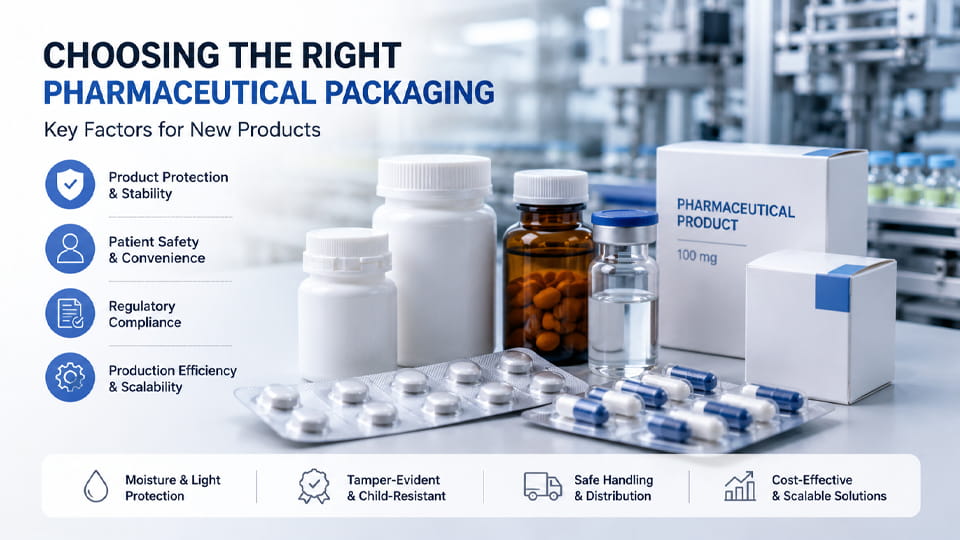
Why Packaging Selection Matters in Pharmaceuticals
Pharmaceutical packaging is vital, not optional. Unlike regular consumer packaging, pharma packaging must protect the drug’s integrity over its entire shelf life. WHO and regulatory guidelines emphasize that packaging must shield medicines from moisture, light, oxygen and other external threats. In other words, it “preserves the stability and quality of medicinal products” and prevents spoilage or tampering.
Key functions of packaging include:
- Product protection: Keep out moisture, oxygen, light, heat and contaminants. For example, a USP guidance notes that solid pills “need to be protected from water vapor” since moisture can change drug potency or dissolution. High-barrier materials (aluminum foil, coated films, amber glass) are often used where sensitivity is high.
- Regulatory compliance: Packaging must meet FDA, EMA and WHO GMP requirements. This includes proper container closure integrity (CCI), validated materials, and features like tamper-evident seals. Child-resistant packaging is required for many drugs to prevent accidental ingestion. Serialization and traceability (unique barcodes on each pack) are now mandatory in major markets (FDA DSCSA, EU FMD).
- Patient safety and compliance: The package design should prevent dosing errors and misuse. Tamper-evident labels and child-proof caps “protect against accidental poisoning”. User-friendly features (easy-open, dosing aids, calendar blisters) help patients take medicines correctly.
- Brand and communication: Secondary packaging (cartons, labels) delivers instructions, warnings, and branding. According to experts, labels must be durable and clear to avoid mix-ups. Indeed, one analysis found nearly 50% of drug recalls are linked to packaging/labeling problems.
In short, packaging is an active safeguard. Failing to choose the right package can lead to degraded APIs, patient harm, and regulatory headaches. The right packaging “protects drug quality” and thus underpins product efficacy and reputation.

Step 1: Understand Your New Pharmaceutical Product Characteristics
The first step is a thorough product audit. Ask: What is the dosage form (tablet, capsule, powder, liquid, injectable, etc.)? What sensitivities does the drug have (moisture, oxygen, light, heat)? Does it need special dosing control (metered-dose inhaler, dropper, preloaded syringe)?
- Dosage form: Tablets and capsules are typically solid-dose and often packaged in blister packs or bottles. Liquids/suspensions go into bottles or vials. Injectables require sterile vials, ampoules or pre-filled syringes. Gases/inhalers use specialized canisters. Powders or granules can be packed in sachets, stick packs or bottles.
- Chemical/physical sensitivities: Is the drug hygroscopic or oxidation-prone? Highly moisture-sensitive drugs (e.g. effervescent tablets) need high-barrier packaging like Alu-Alu blister or desiccant-lined bottles. Light-sensitive compounds need opaque or tinted containers. Reactive drugs require inert materials (e.g. glass, certain polymers).
- Shelf-life and stability: Consider any required temperature control (refrigeration) or vacuum/sterile conditions. Some vaccines or biologics may require cold-chain packaging or specialized vials.
Key point: Primary packaging must be inert and protective. It should not leach or absorb the drug, and it must maintain a sealed environment. For example, FDA notes that solid oral containers should have a “low rate of water vapor permeation, and the closure system should establish a seal”. Performing compatibility and extractables testing with candidate packaging components is crucial.
Checklist for product audit:
- Dosage form/type (tablet, capsule, liquid, etc.)
- Storage/stability conditions (temperature, humidity, light)
- Dosing/administration requirements (dropper, pump, unit-dose)
- Patient use considerations (child vs adult medicine, mobility, senior-friendly)
- Regulatory constraints (e.g. is patient information part of primary pack?)
This understanding will drive your choice of primary packaging (the package in direct contact with the drug). Next, we discuss those options.
Step 2: Choose the Appropriate Primary Packaging
Primary packaging is the immediate container that holds the drug. It directly touches the medication. Common primary packaging types include blister packs, bottles (plastic/glass), vials/ampoules, pouches, tubes, etc. Each has pros/cons:
- Blister Packs (Alu-Alu or Alu-PVC): Ideal for unit-dose solid forms (tablets, capsules). They provide excellent moisture/light barrier, especially the Alu-Alu (cold-form foil) type. Blisters ensure each dose is sealed until use, improving compliance and reducing cross-contamination. Modern blisters can be made child-resistant. Equipment: High-speed blister packing machines handle forming, feeding, heat-sealing and cutting (e.g. JinluPacking’s Alu-Alu blister machines).
- Bottles (Plastic or Glass): Common for multiple-unit packaging (syrups, capsules, tablets). Bottles are cost-effective for large volumes. Glass bottles (Type I borosilicate) offer excellent chemical inertness and can be amber-tinted for light protection. Plastic bottles (HDPE, PP) are lightweight and shatterproof but usually have higher moisture permeability. Bottles often use child-resistant caps. Equipment: Counting/filling machines fill and cap bottles, and can insert desiccants or foil seals (see on counting lines). Jinlu’s bottle filling lines and automatic capping machines integrate these steps.
- Sachets & Stick Packs: Used for powders, granules, or single-dose liquids (e.g. antibiotics, ORS). These are flexible foil or laminate pouches sealed on all sides. Sachets offer excellent barrier (often with aluminum foil) and convenience. Equipment: Sachet packing machines form, fill, and seal these pouches in one go.
- Vials & Ampoules: Standard for sterile injectables (solutions, lyophilized powders). Vials (glass or plastic) with rubber stoppers maintain sterility. Ampoules (glass) are hermetically sealed until use. Both provide high purity and are appropriate for needles/syringes. Equipment: Vial filling lines, capping and crimping machines are used (often with laminar flow areas for sterility).
- Others: Tubes (metal or plastic) are common for ointments/creams. Pre-filled syringes or inhalers (MDIs/DPIs) involve custom device packaging. These often require specialized filling and assembly equipment.
Each option’s suitability depends on your product:
- Cost vs. Protection: Table below compares primary pack types:
| Type |
Best For |
Protection Level |
Cost |
Equipment |
| Blister Pack |
Tablets, Capsules |
Very high (Moisture/Light) |
Medium |
Blister Packing Machine |
| Bottle |
Tablets, Syrups, Pills |
Medium (good with inserts) |
Low |
Bottle Filling/Capping Line |
| Sachet/Stick |
Powders, Granules |
High (Foil barrier) |
Medium |
Sachet Packing Machine |
| Vial/Ampoule |
Injectables, Serums |
Very high (Sterile glass) |
High |
Vial Filling & Sealing Line |
Choose the primary pack that matches the dosage form and barrier needs. For example, a moisture-sensitive tablet may require an Alu-Alu blister or an amber glass bottle with desiccant. More ordinary OTC tablets could go in a plastic bottle with a fibertight cap (plus child-resistant feature).
Tip: If unit-dose compliance is important (e.g., hospital distribution or travel packs), blister sheets or stick packs are often preferred. For flexibility (dosages can be changed), bottles are better.
Step 3: Consider Stability and Shelf-Life Requirements
Packaging decisions are inseparable from stability. The wrong container can cause degradation or label failure. Key considerations:
- Barrier properties: Use materials that block critical factors. For humidity-sensitive drugs, high-barrier foils or glass are needed. For instance, cold-form aluminium blisters provide essentially zero moisture ingress. The FDA/ICH stability guidance notes that products in truly impermeable containers (e.g., foil blisters or sealed glass) can be tested under normal conditions without special humidity studies. Conversely, semi-permeable packages (like some plastics) require careful humidity evaluation.
- Light protection: Light-sensitive APIs need opaque or amber packaging. For example, amber glass bottles or metallized pouches shield UV. A common practice is to wrap clear vials in aluminum overwrap if needed.
- Compatibility: Ensure packaging materials don’t react with the drug. Glass is inert, but some plastics can leach or absorb compounds. Perform extractables/leachables studies on primary components. Regulatory guidances (FDA, EMA) expect container closure integrity (CCI) testing throughout shelf life.
- Shelf-life determination: Stability studies (ICH Q1A/R2) must use the proposed container closure system. If shelf-life trials show degradation, you may need to adjust packaging (e.g. switch to a better barrier) or label handling/storage instructions.
- Advanced features: Some packages integrate desiccants or oxygen scavengers. Multi-layer laminates (PET/aluminum/PE) are often used for global distribution. For very high-precision protection, active packaging (embedded moisture-absorbers) can be used.
Checklist for stability compatibility:
- Choose high-barrier primary material if needed (Alu-Alu, glass, laminates).
- Verify sealing method (heat seal, caps) achieves low moisture vapor transmission (MVTR).
- Conduct accelerated stability (40°C/75%RH) as per ICH to ensure no moisture ingress or chemical changes.
- Plan container closure integrity (vacuum or dye ingress testing) especially for liquid/sterile products.
- Ensure packaging can withstand distribution shocks (drop/vibration testing with secondary/tertiary packaging).
By selecting a packaging that meets stability requirements upfront, you avoid costly reformulation or repackaging later.
Step 4: Evaluate Patient Convenience and Compliance
Beyond protection, modern packaging should help patients use their medicine correctly. Packaging design directly influences adherence and safety. Consider:
- Opening/Ease-of-use: Elderly patients may struggle with tight caps. Offering senior-friendly caps or easy-peel seals can be beneficial. For unit-dose drugs, calendar blisters (labeled days or times) can remind patients to take the correct pill.
- Dosing aids: If applicable, include measuring cups/spoons for liquids, droppers for ophthalmics, or measured-dose pumps. Clear markings on the container (graduations, color bands) improve accuracy.
- Portability: If patients travel or carry meds, compact sachets or small bottles are useful. Tamper-evident features reassure safety.
- Compliance features: Some primary packs are designed for compliance: e.g., pill dispensers with built-in alarms, or smart blister cards that track usage. If high adherence is critical, consider such innovations.
- Labels and inserts: Ensure clear, multilingual instructions on the carton or leaflet. Good packaging aids pharmacists and patients with legible labels, dosage charts, and storage icons.
Essentially, ask: Will the patient find this package easy and safe to use? If not, they may misuse or abandon the product. Including patient-centric features (child locks, easy-open, clear labeling) also satisfies regulators who emphasize patient safety.
Step 5: Ensure Regulatory Compliance
Pharma packaging is heavily regulated. Key compliance issues:
- Child-resistant (CR) requirements: Many countries (US, EU, AU) mandate CR packaging for high-risk oral drugs. The WHO notes that “child-resistant closures have been developed” to protect children. Ensure that oral solid and liquid prescription drugs use certified CR caps or push-turn mechanisms if required by law. (E.g. US 16 CFR 1700 or EU standards EN 14375).
- Tamper-evident seals: FDA and others require evidence that a package hasn’t been opened. Tamper bands, shrink wraps, or breakaway seals are common on bottles; foil seals are common on jars. Even blister packs should be difficult to open without obvious damage.
- Labeling: Primary and secondary packages must carry all required information (drug name, strength, dosage form, batch/lot number, expiry, storage conditions, manufacturer). Fonts must be legible and compliant with pharmacopeial guidelines. For example, FDA 21 CFR 201.15 covers label durability.
- Serialization and traceability: Regulations like the FDA’s DSCSA (US) and EU Falsified Medicines Directive require unique codes (e.g. 2D barcodes) on every saleable unit. The packaging design must accommodate printing or etching of serial numbers and datamatrix codes on blister strips or bottle labels. Your packaging line may need a coding printer and vision system, and integration with a track-and-trace database.
- Good Manufacturing Practices (GMP): Packaging lines must meet GMP (cleanability, material traceability, etc.). All primary packs used must be GMP-qualified (e.g. ISO 15378 for packaging materials). Machines should be IQ/OQ/PQ qualified. (See below for Jinlu Packing equipment).
Key regulatory tip: Don’t treat compliance as an afterthought. For example, failing to include a tamper-evident feature can block product registration. Review country-specific rules early – e.g. USP <661> for plastic containers, CFR 211 for packaging controls. Always verify that the chosen packaging and packaging equipment can meet these standards.
Step 6: Balance Packaging Cost and Production Efficiency
At this stage, evaluate total cost of ownership (TCO) for packaging options. Consider:
- Material cost: Flexible pouches and blisters may cost more per unit than simple bottles. Alu-Alu blister foil is pricier than PVC foil. Glass bottles cost more than plastic.
- Equipment throughput: High-barrier formats like blisters might run slower than bottle lines, impacting needed equipment count. Conversely, bottle fillers can achieve very high speeds (several thousand bottles/hour) but need unscramblers, cappers, and labelers in a line.
- Line complexity: More complex packaging (e.g. unit-dose blisters) requires specialized machines. Check if capital investment and maintenance fit your budget.
- Labor: Fully-automated lines reduce manual labor but increase capital. Semi-auto machines cost less but need more operators.
- Logistics: Secondary/tertiary packaging also cost. Large glass bottles are heavier to ship. Bulky cartons increase freight costs.
- Waste and yield: More processing (e.g. blister punching) may generate scrap. Evaluate wasted materials (trim from blisters, broken bottles, etc.).
Perform a rough cost comparison: e.g. cost per final pack including materials and processing. Also consider speed (units per hour) and required batch size.
A TCO checklist:
- Compare per-unit packaging material cost.
- Evaluate needed machine throughput vs demand.
- Calculate labor and energy costs for each line.
- Include waste disposal/recycling costs.
- Factor in risk of rework (e.g. if packaging fails, cost of relabel or repack).
- Future scale-up: if volumes double, does this solution scale?
Often the lowest-cost material isn’t best if it leads to recalls or rejections. Striking a balance is crucial: sometimes paying more for better barrier or automation pays off in higher yield and compliance.
Step 7: Ensure Packaging Can Scale to Future Demand
Consider not just the immediate launch, but the long-term lifecycle of the product:
- Pilot vs. Commercial: For initial clinical or small-market batches, you may use manual or semi-auto lines. For large-scale production, a fully automated line will be needed. Ensure that your choice (or the vendor’s proposal) allows modular upgrades.
- Equipment modularity: Can you add lanes or units to increase speed? For example, some blister machines can add more rotary pockets. Bottling lines can add parallel fillers.
- Integration: Think end-to-end: counting/filling → sealing → cartoning → case packing → palletizing. If you partner with Jinlu Packing or similar, they can design a turnkey packaging line that includes serialization, cartoning, case packing, etc.
- Regulatory scaling: Any change in packaging components (e.g. a new bottle supplier) requires regulatory re-approval if it affects stability or compliance. Plan packaging supplier quality control and backup vendors.
- Future products: If your company may produce other dosage forms (e.g. a gel in future), choose flexible equipment. Modular capsule fillers or blister machines that can handle various formats can be a good investment.
Involving packaging engineers or a consultant early can prevent bottlenecks later. As one industry expert notes, “Packaging should be considered in parallel with formulation development, not as an afterthought.” The right early decisions will make scale-up and line expansion smoother.
Common Packaging Selection Mistakes to Avoid
- Leaving Packaging Selection Too Late: Don’t decide packaging only after formulation is locked. Early stability studies should use final packaging, not dummy jars.
- Skipping Stability Tests: Never assume a container will work; always test your drug in the actual container/closure under ICH conditions. An otherwise stable formula can degrade if packaging is poor.
- Focusing Only on Cost: Cheap materials may save money upfront but cost more in recalls or shortened shelf-life. Balance cost with protection.
- Ignoring Patient Factors: A standard bottle might fit cost targets, but if patients can’t open it or adhere, the product will underperform in the market.
- Underestimating Regulatory Needs: Failing to include a tamper-evident seal or child-resistant closure when required can halt approval. Always consult guidelines.
- Neglecting Supply Chain: Consider packaging supply lead times and shelf life. Some specialty materials (like oxygen-scavenging liners) may have long lead times.
By avoiding these errors and cross-functional review (R&D, QA, Production, Regulatory), you ensure your chosen packaging is feasible, compliant, and effective.
Recommended Packaging by New Pharmaceutical Product Type
| Product Type |
Recommended Primary Packaging |
| Tablets/Capsules |
Unit-dose blister packs (Alu-Alu or PVC/Alu) or bulk bottles. Child-resistant caps for bottles. Ideal equipment: blister packing machine or tablet/capsule counting & bottling line. |
| Oral Powders/Granules |
Sachets or stick packs (for single dose); or bottles (for bulk). Sachet packaging machines for unit-dose, auger fillers for bottles. |
| Liquids/Syrups |
Plastic or glass bottles with screw caps (often with foil seal and child-resistant cap). For high purity, Type I glass. Equipment: liquid filling line (pumps, in-line capping). |
| Injectables |
Glass vials or ampoules (sterile) or pre-filled syringes. Use sterile vial filling and crimping machines in a cleanroom. |
| Creams/Ointments (Semisolids) |
Tubes or jars (aluminum/plastic tubes, glass/plastic jars). Tubes with tamper-evident seals. Semi-auto or auto tube filling machines. |
| Effervescent Tablets |
Aluminium tubes or bottles (to keep dry); often with desiccant. Aluminium foil blister packs also common. Tubing machines (for tablets) or blister machines. |
| Suppositories |
Blister trays (typically Alu/PVC or Alu/Alu) or boxes of individually wrapped units. Blister packers or thermoformers. |
| Inhalers/Nasal Sprays |
MDI cans or DPI cartridges (device-specific). Coordination with device manufacturer; custom filling/can-filling equipment. |
This mapping helps ensure each drug form gets the appropriate protection. For example, blister packs are excellent for solid oral doses, whereas glass vials are a must for sterile injectables. The table also suggests equipment: e.g. blister packing machines, bottle filling and capping lines, sachet packing machines, vial fillers, and so on.
How Jinlu Packing Helps Pharmaceutical Companies
Jinlu Packing is a leading pharmaceutical packaging machinery manufacturer. We offer turnkey solutions for new drug packaging lines. Key offerings:
- Blister Packaging Machines: High-speed blister machines for PVC/Alu or Alu-Alu packs. Custom designs to fit your tablet/capsule format and speed requirements.
- Bottle Filling & Capping Lines: Automated bottle filling, capping, and labeling systems. Our counting and filling lines can integrate unscramblers, desiccant inserters, foil sealers, and cappers for tablet/gummy bottles.
- Cartoning Machines: Horizontal and vertical cartoners to erect cartons around blisters, bottles, or sachets. Features like 100% code scanning for serialization and quick changeovers.
- Serialization/Coding Systems: We can equip lines with inkjet/laser coders and vision inspection to print and verify batch, expiry, and unique codes.
- Complete Packaging Lines: From product feeding to case packing, we can design a fully integrated line meeting cGMP and serialization needs. Our machines are built for easy cleaning (SUS316L stainless steel) and include IQ/OQ documentation.
- Support & Compliance: We assist with machine qualification (IQ/OQ/PQ) and offer on-site installation and training worldwide.
By working with us, you get not just equipment, but packaging expertise. We ensure your chosen packaging method (blister line, bottle line, etc.) is optimized for your product and regulatory needs, making your product launch smoother.
Conclusion
Choosing the right packaging for a new pharmaceutical product is a multi-faceted decision. It requires balancing drug stability, patient safety, compliance, cost, and scalability. Remember: the best packaging is the one that keeps your product safe and effective until it reaches the patient. It’s not just about being attractive or cheap—it’s about quality. By carefully analyzing product properties, testing packaging options, and following regulations, manufacturers can avoid costly recalls and ensure their medicine remains potent, pure, and safe. With a well-chosen packaging strategy (and the right machinery), you protect both your customers and your brand’s reputation.
FAQs About Choosing Packaging for a New Pharmaceutical Product
Why is packaging important for a new pharmaceutical product?
Packaging does much more than contain a medicine. It protects the pharmaceutical product from moisture, oxygen, light, contamination, and physical damage. Proper packaging also helps ensure regulatory compliance, patient safety, product stability, and shelf life throughout distribution and storage.
What factors should be considered when selecting pharmaceutical packaging?
Manufacturers should evaluate several factors, including:
• Dosage form (tablet, capsule, liquid, powder, injectable)
• Moisture and oxygen sensitivity
• Light protection requirements
• Shelf-life targets
• Regulatory requirements
• Patient convenience
• Packaging costs
• Production efficiency
• Future scalability
The ideal packaging solution should balance product protection, compliance, and operational efficiency.
What is the best packaging for tablets and capsules?
Blister packs and bottles are the most common options.
• Blister packaging provides excellent protection against moisture and contamination while offering unit-dose convenience.
• Bottles are cost-effective for high-volume production and are commonly used for tablets, capsules, and dietary supplements.
The best choice depends on the product’s stability requirements and target market.
How does packaging affect drug stability?
Packaging materials directly influence a drug’s exposure to environmental factors such as humidity, oxygen, and light. Poor packaging can accelerate degradation, reduce potency, and shorten shelf life. That’s why stability testing is typically performed using the final packaging configuration intended for commercial distribution.
How can pharmaceutical companies ensure packaging compliance?
Manufacturers should verify that packaging materials, labels, closures, and packaging equipment comply with applicable regulations such as FDA, EU GMP, serialization, and child-resistant packaging requirements. Working with experienced pharmaceutical packaging equipment suppliers can help simplify validation and compliance processes.
When should packaging be considered during pharmaceutical product development?
Packaging should be evaluated as early as possible during product development. Waiting until commercialization can create stability issues, regulatory delays, packaging redesign costs, and production challenges. Early packaging selection allows manufacturers to conduct accurate stability studies and develop a more efficient commercial packaging strategy.
How do I choose the right pharmaceutical packaging machinery for a new product?
Start by evaluating:
• Product type and dosage form
• Packaging format (blister, bottle, sachet, vial)
• Required production capacity
• Automation level
• Regulatory requirements
• Future expansion plans
Choosing scalable pharmaceutical packaging equipment can help reduce future investment costs and support long-term business growth.
References:
1.Container Closure Systems for Packaging Human Drugs and Biologics —— U.S. Food and Drug Administration
2.ICH Q8 Pharmaceutical Development —— ICH Database
3.Good Manufacturing Practices for Pharmaceutical Products —— WHO
4.USP Q&A: Standards for Plastic Packaging Systems for Drug Products —— usp.org
5.Container Closure Integrity Testing—Practical Aspects and Approaches in the Pharmaceutical Industry —— pda.org
