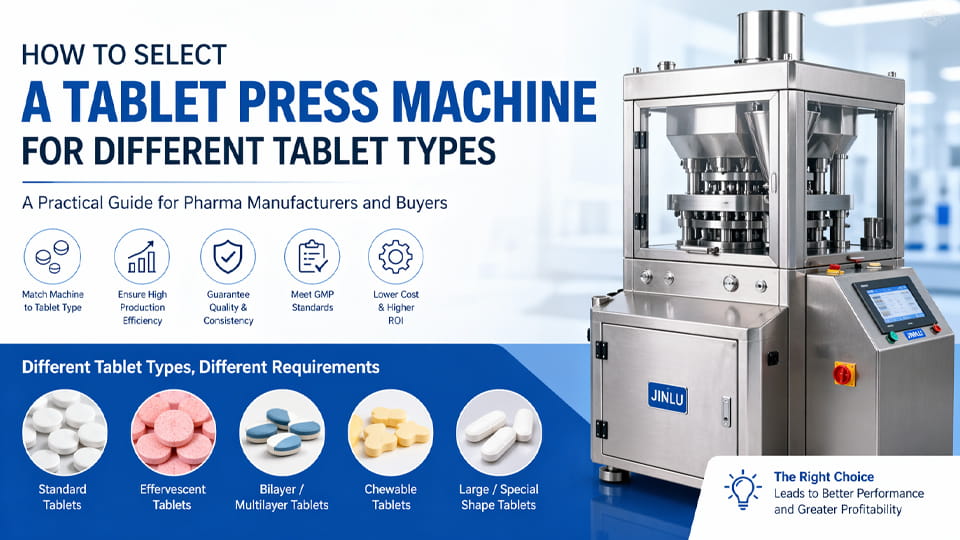
How to Select a Tablet Press Machine for Different Tablet Types: A Complete Buyer’s Guide (2026)
How to Select a Tablet Press Machine for Different Tablet Types: A Complete Buyer’s Guide (2026)
April 22, 2026
No Comments
Choosing the right tablet press machine is critical for any pharmaceutical or nutraceutical manufacturer. Tablet presses come in various types (single-punch, rotary, bi-layer, etc.) and speeds, each suited to certain tablet formulations and production volumes. Tablets themselves vary widely – from simple round pills to effervescent or bi-layer tablets – and each type imposes specific requirements on tooling, compression force, feeding, and environmental control.
This guide helps industry buyers match their tablet type to the ideal machine. We cover tablet categories (standard, effervescent, bi-layer, chewable, large/irregular), machine categories (single-punch, rotary, high-speed, bi/multi-layer presses), and key selection factors like output capacity, tablet size, tooling compatibility, feeder design, compression force, and compliance with GMP. We include a comparison table mapping tablet types to recommended machines and features, common pitfalls to avoid, and tips on choosing a reliable supplier. By the end, you’ll know how to balance speed, flexibility and quality – and find a press that fits your tablets and throughput needs.
Understanding Tablet Types and Their Requirements
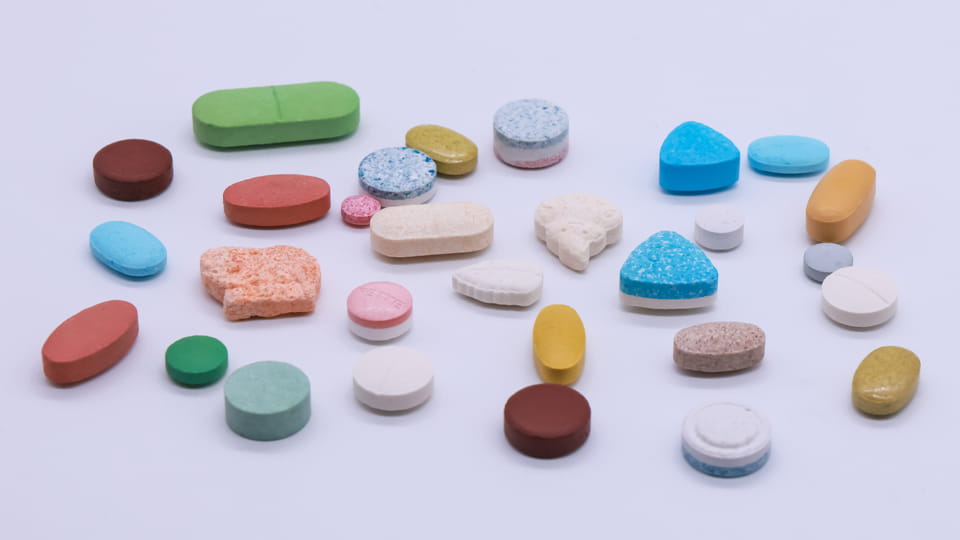
Different tablet products demand different press features. Below are common tablet categories and what they imply for equipment:
Standard Tablets (Single-layer, Round, Caplet, etc.): These are typical pharma or supplement pills. They use B-tooling (19 mm punch, tablets up to ~13 mm) on most rotary presses. Moderate compression force (around 60–100 kN) is usually needed for uniform hardness. Standard machines handle multiple shapes (round, oval, oblong) without special hardware. For example, the Jinlu ZP-17D press (an all-purpose model) produces up to 37,800 tablets/hr with a 25 mm max diameter and 100 kN force, covering most standard tablets.
Effervescent Tablets (Fizzy, Effervescent): These tablets (used in medicines, drink mixes, cleaners) contain acid-base agents (citric acid + sodium bicarbonate) that react in moisture. They require high compression (to keep the tablet intact) and often larger dies. A heavy-duty rotary press (often with D-tooling) is recommended. Critically, effervescent powders absorb moisture quickly, so environmental control is key. Specialized effervescent presses include features like in-line dehumidifiers, sealed compression chambers, and corrosion-resistant components to prevent premature reactions. For example, Jinlu’s large-size presses (up to 400 kN force, 60 mm diameter) were specifically designed to handle effervescent and detergent tablets.
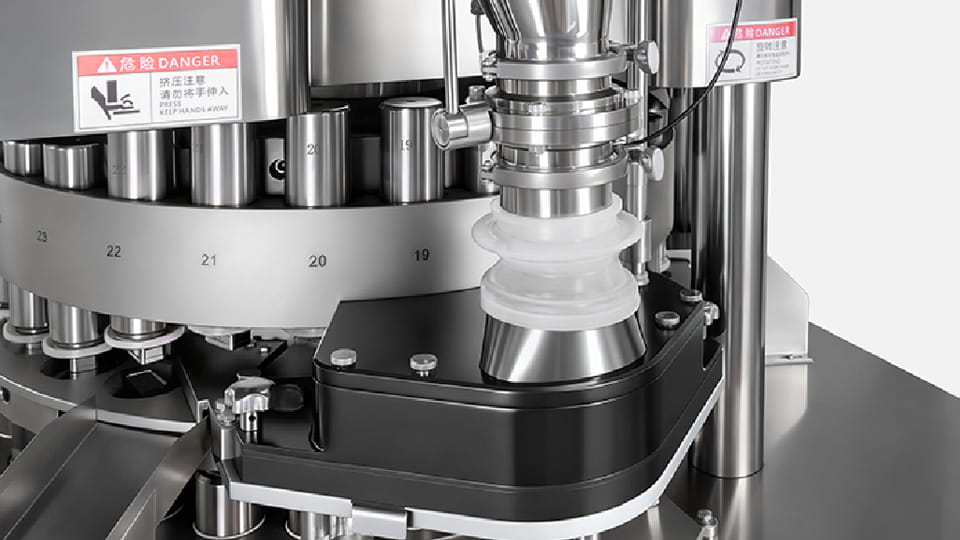
Bilayer / Multilayer Tablets: When a tablet has two or more layers (different drugs, colors, or release profiles), you need a bi-layer or multi-layer press. These machines have two or more hoppers and feeders feeding sequentially into one turret. They compress the first layer, then add the second (and third, if needed). Key features include dual force-feeders (to prevent layer mixing), independent compression stations, and in-process sampling ports. For instance, the JL ZP-27/73D tri-layer press outputs up to 395,000 tablets/hr (with 50 mm diameter) and 150 kN pressure. Its three synchronized hoppers allow up to three layers per tablet (color-coded or varied formulation). A figure of a multi-layer press (see below) illustrates the turret and hoppers.
Figure: A multi-layer rotary tablet press (e.g. JL ZP-27/73D) can press 2-3 layers per tablet at very high speed (up to 395,000 tablets/hr). Specialized force-feeders and enclosed chambers help fill each layer uniformly.
Chewable / Soft Tablets: Chewable tablets (vitamins, antacids) need a softer texture and better taste. They typically compress under lower pressure to avoid hardness, and often use BB-tooling (shorter 19 mm punches for small tablets). The powder formula (e.g. mannitol, sweeteners, lubricants) tends to be sticky or soft. Machine requirements include gentle compression (lower kN), slow turret speed (higher dwell time), and anti-sticking tooling coatings. In practice, a standard rotary press with appropriate tooling (or a dedicated “chewable tablet press”) is used. The punches often have special shapes (hearts, etc.) for marketing.
Large or Irregular Tablets: Some products (effervescent cleaning tablets, large veterinary tablets) are huge – up to 60 mm across or odd shapes. These require D-tooling (25.4 mm punch max) and very sturdy presses (high torque, up to 400 kN). Speed must be lower; output ranges are modest (e.g. 20,000–45,000 tabs/hr) to ensure quality. These “big tablet” presses often have a special turret size and heavy-duty cams. They can also handle some multi-color or multi-layer as a bonus. Jinlu’s large-size presses out for effervescent/detergent use. The trade-off is capacity: a 60 mm tablet at 400 kN might only produce ~30k/hr, but it’s the only way to form such a pill without cracking.
In summary, define your product first: tablet diameter, thickness, layers, and formulation (flowability, moisture sensitivity, friability). Each dimension and property narrows the machine choice. A general rule: dimension and hardness drive machine size, not just target output. Don’t buy by “100k tabs/hour” banners; start by matching tablet specs to turret and tooling.
Types of Tablet Press Machines
Tablet presses broadly fall into two main categories: single-punch (eccentric) and rotary (multi-station), with specialized variants.
Single-Punch (Eccentric) Presses: These simple machines have just one punch and die, manually or motor-driven. They’re ideal for R&D, pilot batches, and small-scale production. A single-station press requires manual powder feed (via hopper or die-fill) and punches one tablet at a time. Benefits: very low cost, easy maintenance, and no need for complex control systems. Downsides: extremely low throughput (a few hundred pills/hr) and limited to simple formulations. We include this type for completeness, but most industrial buyers will lean toward rotary machines unless output needs are very small.
Rotary Tablet Presses: These are the workhorses for medium to large production. A rotary press has a rotating turret holding many punches/dies (common turret sizes are 8, 16, 20, 37, 45, 62, 80 stations). Powder is fed from a hopper via a rotating feed frame. One rotation can compress dozens of tablets. Industrial rotaries achieve anywhere from ~20,000 up to hundreds of thousands of tablets per hour. Standard rotaries can handle typical tablets: they provide continuous high throughput and precise control of weight/hardness. Two subtypes are:
Standard Rotary Press: Offers high efficiency and consistent results for medium volumes. They often include pre-compression rollers (to densify powder before final compression), and can run at moderate speeds (e.g. 60–120 rpm on a 45-station turret yields ~162k–243k tabs/hr).
High-Speed or Multilayer Rotary Press: Geared for very high-volume production. These often have servo motors, double turrets (one stationary, one rotating to double capacity), and advanced features like force-feeding systems (to push sticky powder into dies). They may also be configured for bi-layer/multi-layer in one go. For example, RichPacking notes high-speed presses include multi-layer compression and precise speed control to maximize output. Jinlu’s “ZP-26-40D” series is an example of a high-speed rotary.
Bi-Layer / Multi-Layer Presses: These are specialized rotaries designed with two or more hoppers and synchronized compression stations. A common configuration is dual press stations at each turret position – one compresses the first layer, another adds the second layer, then ejection. They often have extra cams and force-feeders. Use these when you must combine two formulations in one tablet (e.g. an immediate-release layer over a sustained-release layer). Key features include independent layer weight control and automatic sampling of each layer. Jinlu’s ZP-27/73D and similar models can output tri-layer tablets (even a three-color design) in one machine. If your product has any layered design, a multi-layer press is mandatory.
Double-Sided (Tablet Press) / Segmented Turret: A less common advanced variant. These machines have punching stations on both sides of the turret, allowing two tablets per rotation (effectively doubling capacity). They are high-speed machines mostly found in very large pharma plants. They often include separate hoppers for each turret side, but otherwise look like two rotary presses back-to-back.
Chewable Tablet Presses: These are usually just standard rotary machines fitted with special chewable tablet tooling. JinLuPacking notes chewable presses utilize special tooling to create tablets with a softer texture and pleasant taste. In practice, you may simply adjust the formulation and use rubber coating, but the machine itself might have lower compression force settings and additional dust cover to handle sugar-based powders.
In all cases, look for modern automation and control features: a PLC/HMI touchscreen, pressure/weight sensors, recipe storage, and automatic weight reject, especially if you need regulatory compliance. Good machines also have safety interlocks, dust extraction, and easy access doors (we cover these under selection factors below).
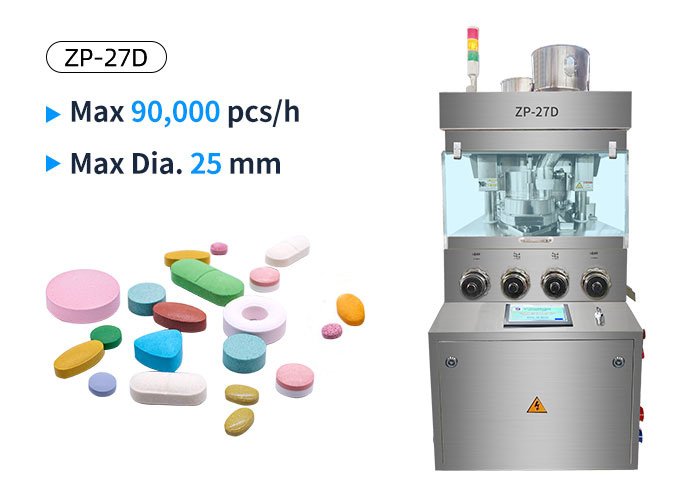
ZP-27D Rotary Tablet Compression Machine
Key Selection Factors
Once you know your tablet, evaluating specific machine specs is next. Key factors include:
Production Capacity (Throughput): How many tablets per hour do you need? Rotary presses are rated by tablets/hr or turret rpm. More punch stations = higher throughput. For example, a 45-station press at 60 rpm ≈ 162,000 tabs/hr. But beware the trade-off: pushing speed too high can cause fill/weight variation. Balance turret speed with dwell time (thicker tablets need slower speed for hardness). Pro Tip: If you need >50k/hr or multi-SKU batches, a rotary press with ≥45 stations is advisable for stable performance. Single-punch units or small rotaries only make sense for <10k/hr or R&D.
Tablet Size and Shape: The tablet diameter and thickness essentially determine machine class. Each model has a maximum die bore and fill depth. For example, small bench-top presses (e.g. “ZP-7”) cap out around 6–12 mm tablets, while larger turrets handle up to 60 mm (with D-tooling). Always match the die size and turret compatibility first: “choosing a press without your tablet dimensions is like buying a car without knowing passenger count”. Also, very thick tablets need more force and often more dwell time; a small press might not be able to compress a 8 mm thick caplet properly even if the diameter fits.
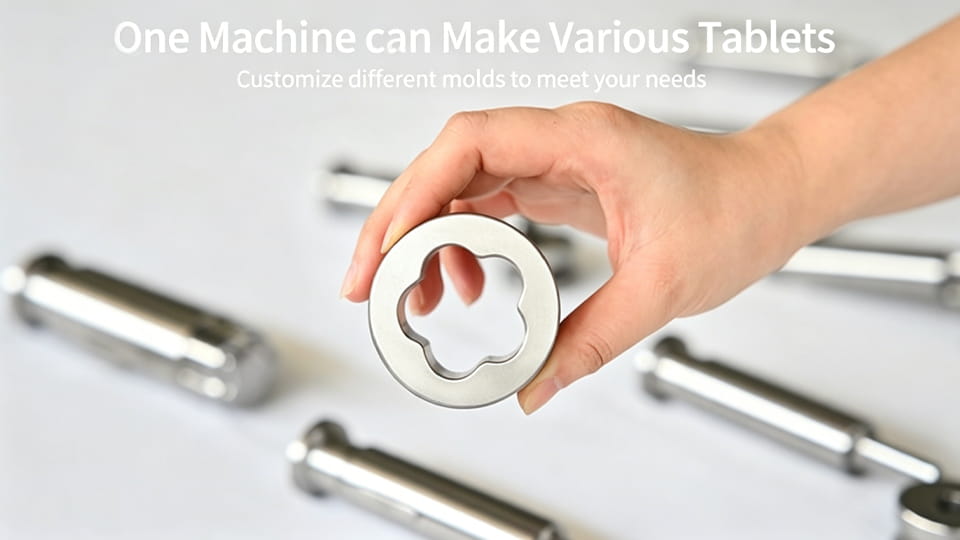
Tooling Compatibility: Punches and dies define tablet geometry. Check what tooling standard the press uses (common standards are B, D, and BB tooling). For instance, if you need to make chewable vitamins (small, 6–8 mm), BB-tooling is ideal; if you have standard 12–13 mm pills, B-tooling suffices. Veterinary or large detergents (25 mm+ tablets) require D-tooling. Also consider tooling material/coating: hardened steel (e.g. GCR-15) is used for most, but wet or acidic mixes may need stainless or TiN-coated tools. Jinlu’s ZP-17D press uses GCR-15 steel tooling able to withstand 100 kN. We recommend anti-stick coatings (TiN/CrN) and force-feeders especially if you produce effervescent or sticky formulations.
Figure: Punches and dies (tablet tooling) come in different sizes/materials. For example, Jinlu’s standard press uses GCR-15 steel punches rated up to 100 kN pressure. Tooling must match tablet size: e.g. BB-tooling for 6–8 mm chewables, B-tooling for ~12 mm pharm tablets, D-tooling for large 25+ mm tablets.
Powder Flow and Feeding: Challenging powders (very fine, cohesive, or low-bulk-density) may not flow well by gravity. Check if the machine has a force feeder (agitators or paddles that push powder into the die). Force-feeding prevents weight variation when the turret moves fast. Sticky or moist powders (e.g. herbal extracts) especially benefit from force feeders and smooth hopper design. Also consider pre-compression: a small pre-compression roller can de-air or pre-compact material to reduce capping/lamination. In summary, ensure the press’s hopper and feed frames suit your powder’s flow; ask if they’ve ran your formulation before.
Compression Force: Tablet hardness and formulation density dictate required force. Standard pharma tablets need around 60–100 kN. Very hard or large tablets (like 60 mm effervescents) may need hundreds of kN (JL’s large machines go up to 400 kN). Over-specifying force is better than under; too little force gives soft, easily broken tablets. RichPacking notes 60–100 kN is typical, and “higher force improves hardness and uniformity.” Also check if the machine has pressure transducers to monitor real-time compression. If you need both soft chewables and hard pills on one machine, make sure the force range can be dialed down low and up high.
Automation & Control (PLC/HMI): In modern facilities, manual dials are outdated. A good press will have a PLC and touchscreen HMI for recipes and data logging. Look for features like automatic over/under-weight rejection, pressure sensors, and digital readouts of punch positions. Data tracking (batch files, CMS21 CFR Part 11 compliance) is important for pharma quality systems. Remote access or IoT modules allow tech support and predictive maintenance alerts. The Jinlu ZP-27/73D press, for example, comes with a Siemens touch-screen HMI to store compression recipes and make control easy.
GMP Compliance & Materials: Especially for pharma, the press design must meet cGMP. That means contact surfaces should be stainless steel (often 316L) and polishable, with minimal dead corners for cleaning. Sealed, enclosed compression zones prevent powder escape. Quick-release hoppers and turrets speed cleaning and reduce cross-contamination risk. Check for available IQ/OQ/PQ documentation from the supplier. Machines often come with CE, cGMP, or FDA design certificates. For sensitive products (like effervescents), look for corrosion-resistant materials (chromium plating or stainless) in the press internals.
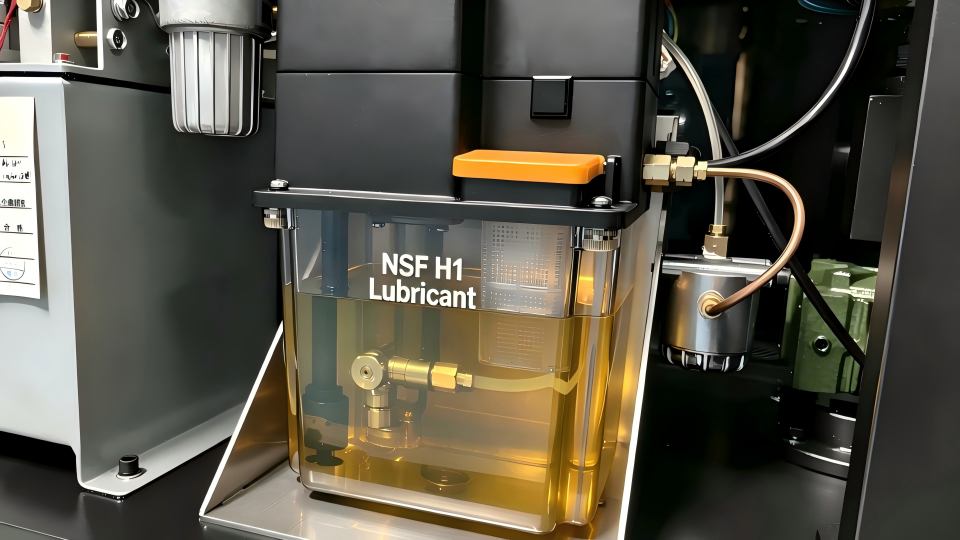
Changeover & Maintenance: Downtime is very costly. Look at how easy it is to change tooling or clean the machine. Features to check: modular design, tool-less disassembly, and lubrication systems. RichPacking points out that removable turret, hopper, and feeders, plus timed auto-lubrication, can dramatically cut maintenance time. A quick-die change system should allow swapping punches in under 20 minutes. Transparent safety doors and ergonomic layout help operators. An example: some modern presses use vacuum wands inside the turret to suck out residual powder between runs. Ask if the supplier has service contracts, training, and spare parts availability.
Total Cost of Ownership (TCO): Beyond sticker price, calculate lifecycle cost. A cheaper machine may wear faster or require more labor. Factor in energy use, spare part needs, and expected lifespan. For instance, a well-built press with readily available parts can save up to 20% per year in downtime costs. Also ask about warranty length and what’s covered.
Supplier Expertise & Service: Buying a tablet press is a long-term partnership. Check the supplier’s track record (10+ years experience in pharma equipment is ideal). Do they have references in your target market (Europe, US, etc.)? Can they assist with factory layout, recipe trials, and validation? After-sales support (installation, commissioning, training, 24/7 remote help) is crucial. For example, Jinlu Packing offers free formula testing and has a 3-year warranty on many machines. Buying from a full-line supplier (capsule fillers, counters, blister machines) can simplify integration and validation – as RichPacking notes, having one vendor simplifies maintenance management. Jinlu’s site shows they also supply capsule filling machines, counting machines, blister packers, etc., which can be useful if you plan a full production line.
Noise, Dust and Safety: Tablet presses can be loud and dusty. Check noise level (should be <80 dB) and if the press has HEPA dust filters and sealed chutes. Safety interlocks (doors stop motion, E-stop) and overload sensors protect operators and equipment. Excessive vibration or spilled dust can harm GMP status.
Future-Proofing: Look for upgrade paths. Industry is moving toward Pharma 4.0: servo-driven precision, Ethernet/IP connectivity for MES, predictive maintenance, and modular add-ons. Buying a press with open architecture means it can fit new sensors or software later, saving retrofit costs. For example, some presses now offer camera inspection or automatic sampling modules. Ensure at least the basics: the ability to integrate into SCADA or MES.
Matching Tablet Types with Recommended Machines
The table below summarizes which press type and features suit each tablet category:
25 mm (D) tooling, very high force (up to 150–400 kN), sealed chamber, force feeder, dehumidification options. Stainless or coated parts (acid-resistant). Lower speed, specialized feeder.
Bilayer / Multilayer
Bi-layer or tri-layer press (specialty rotary)
2+ hoppers & feeders, dual compression cams, in-line weight sampling. Pre-compress for each layer, VFD control, synchronized turrets. Able to handle thin intermediate layers. Uses standard or custom punch shapes.
Chewable / Soft
Standard rotary (B or BB tooling)
BB-tooling (short punches, ~6–8 mm), low compression force (~30–60 kN), gentle compression profile, anti-sticking coating. Possibly larger dwell time (slow RPM). Smooth feed and dust cover (sugar dust).
Large/Irregular
Large-die rotary press (D-tooling)
25+ mm punches (D tooling), very high force (100–400 kN), robust frame, low turret speed (~10–60 RPM), specialized cams. Often heavy cam turrets to accommodate large die travel. Handles complex shapes.
By matching your tablet’s dimensions and type with the above, you can shortlist models. Always cross-check: e.g. a 40 mm effervescent tablet goes to the Large D-tool press row, not a standard press.
Common Mistakes to Avoid
Even experienced buyers slip up. Here are pitfalls to watch for:
Choosing by Output/Price First: Don’t pick a machine just because it boasts “200,000 tabs/hr” or a low price. If your tablet is too large or thick, the fast machine won’t accept the die or will overload the system. Remember: tablet size dictates machine, not vice versa. Always start with tablet diameter and thickness.
Ignoring Tablet Dimensions: Relatedly, never ignore the crucial specs. Failing to provide your supplier with the tablet’s diameter and thickness can lead them to suggest an undersized press. Confirm the press’s max die bore and maximum fill depth yourself.
Oversizing Capacity: Some buyers think “better to oversize than undersize.” But an oversized press can cost 2–3× more, consume more floor space, and run inefficiently at 10% load. Worse, it may have longer clearances (shorter dwell time) making thin tablets too soft. A competitive supplier should recommend the smallest adequate model, or at most one size up for future growth.
Ignoring Tooling & Formulation: Check that the press can use the exact tooling you need. Tooling design errors cause weight variation or sticking. Also assess your powder: if it’s sticky (herbal, sugar-based), ensure coated punches and a force feeder are specified.
Underestimating Maintenance and Parts: New presses require lubrication and occasional refurbishment. Make sure you budget for spare punches, rollers, belts, etc. As RichPacking warns, failing to plan for spare parts is a common mistake. Also consider how easy it is to get replacement parts in your region.
Neglecting Compliance & Installation: Don’t forget validation documents (IQ/OQ/PQ) if you’re a pharma operator. Ensure you have a plan for installation, training, and validation testing. Relying on the supplier’s support here is safer.
Not Testing First: Ideally, run a test or pilot with your actual formula on the machine model. Many good suppliers (including Jinlu Packing) offer free testing or formula trials. If you skip testing, you may discover issues only after shipping, wasting months.
In short, focus on your tablet profile and product goals, not just glossy specs. Mistakes like “I just wanted the fastest machine” often backfire.
How to Choose the Right Supplier (and Why Jinlu Packing)
After narrowing machine specs, evaluate suppliers carefully. Important criteria:
Experience & References: Ideally choose a supplier with 5–10+ years in tablet equipment and clients in your industry/region. Ask for case studies or references (especially global big pharma names). Jinlu Packing, for example, is a Fortune-500 supplier with 30+ years machinery experience (see their client logos).
Technical Support: Will they help determine the right model? A good supplier will ask for tablet specs (diameter, thickness, formulation details) before quoting – as LinCi emphasizes, a manufacturer should never guess. Check if they offer factory acceptance tests (FAT) and are willing to ship sample tooling to confirm fit.
After-Sale Service: On-site commissioning, training, and timely spare-part shipping are crucial. Some suppliers promise remote 24/7 support. Prefer vendors with local reps or a network of service centers. Clarify warranty terms (at least 1 year on whole machine, 3 years on major parts is good).
Integration Capability: If you’re building a line, see if the press can integrate with upstream/downstream equipment. For instance, can it link to a tablet counter or blister line? RichPacking notes Rich’s presses connect to counting and blister machines. Jinlu similarly offers a full suite (counters, cartoners, blister packers), so they can advise on turnkey lines.
Company Credibility: Check certifications (CE, ISO). Also confirm financial stability.
Examples and References: Jinlu’s site has case studies (e.g. A tablet press in Pakistan) and certifications (cGMP, CE, RoHS, UL logos shown). Use these to gauge competence. Also review trade forum feedback or ask peers.
Trial Quote/Contact: Finally, when contacting suppliers, provide a concise spec sheet: tablet shape/dimensions, expected output, unit weight, main ingredients (for wear/corrosion), and any co-processed excipients. Ask them to confirm the die bore and turret size needed for your product. A red flag is a vendor that immediately quotes a model by price without asking your specs.
Whenever possible, choose a supplier with local presence or a known distributor – this simplifies warranty service. Many Tier-1 pharma use suppliers like Fette, Bosch (Milstein), or Cadmach for presses; among Chinese manufacturers, Jinlu Packing, RichPacking, and others compete on global scale. The key is verifying claims: for example, Jinlu advertises output ranges and pressures, but you should cross-check these against your requirements.
Conclusion and Next Steps
Choosing the right tablet press machine is about aligning technology to your production strategy. For reliable, compliant tablet manufacturing, focus on the total performance – precision, durability, and support – not just the price tag. Jinlu Packing offers a range of GMP-compliant rotary presses (single, multi-layer, high-speed) and supporting equipment. Contact us with your tablet specs (diameter, thickness, layers, output) to get a custom recommendation and quote. Let our experts guide you to the right machine and tooling, and help you avoid common pitfalls. We can even run sample tests with your formula. For a detailed quote or project consultation, request a quote or speak to our sales team today.
Learn more about Jinlu’s product lineup: Capsule Filling Machines, Blister Packing Machines, and Tablet Counting Machines can all be integrated with your tablet press. Check our capsule filling machine page or tablet counting machines for details.
FAQs on How to Select a Tablet Press Machine
What is a tablet press machine and how does it work?
A tablet press machine is a pharmaceutical device used to compress powders or granules into tablets with a defined shape, weight, and hardness. It works by filling material into a die cavity and applying compression force using upper and lower punches to form a solid tablet.
Can one tablet press handle both pharma and nutraceutical (e.g. vitamins) products?
Often yes, if powders have similar flow and lubrication. However, sticky herbal powders or sugar require special coatings or force feeders. Make sure tooling and feeder settings can be changed for different recipes.
How do I choose the right tablet press machine for different tablet types?
The key is to match the machine with your tablet characteristics, including size, shape, formulation, and production volume. For example, effervescent tablets require high compression force and larger tooling, while bilayer tablets need multi-layer feeding systems. Choosing based only on price often leads to production issues later.
What factors affect tablet quality during compression?
Several factors impact tablet quality, including: • Powder flowability • Compression force • Tooling condition • Moisture content Poor powder flow or improper feeding can lead to uneven tablet weight and defects.
What are common problems in tablet press machines?
Typical issues include: • Uneven tablet weight • Sticking or picking on punches • Tablet cracking or low hardness • Powder leakage These problems are often caused by poor material flow, incorrect pressure settings, or worn tooling.
Common mistakes first-time buyers make?
Buying an oversized press thinking “more is better”; ignoring tooling compatibility; underestimating maintenance needs; and skipping tests or spare parts budgeting. Avoid these by carefully matching the machine to your tablet specs and total production plan.
Can I integrate a tablet press into a full line?
Yes. Good suppliers (like Jinlu Packing) design presses to interface with tablet counters, capsule fillers, blisters, and cartoners for turnkey production. If you plan a multi-step line, discuss conveyor integration and automation with the vendor upfront.
Should I test my material before buying a tablet press machine?
Absolutely. A trial run using your actual formulation is highly recommended. It allows you to evaluate tablet hardness, weight consistency, and defect rates under real production conditions before making a final investment decision.
What is the difference between B tooling and D tooling?
B tooling is commonly used for standard tablets (smaller size), while D tooling is designed for larger tablets such as effervescent or veterinary products. Choosing the correct tooling is critical because it directly affects tablet size, shape, and machine compatibility.
Petty Fu, Founder of Jinlupacking, brings over 20 years of expertise to the pharmaceutical machinery sector. Under his leadership, Jinlu has grown into a trusted supplier integrating design, production, and sales. Petty is passionate about sharing his deep industry knowledge to help clients navigate the complexities of pharma packaging, ensuring they receive not just equipment, but a true one-stop service partnership tailored to their production goals.