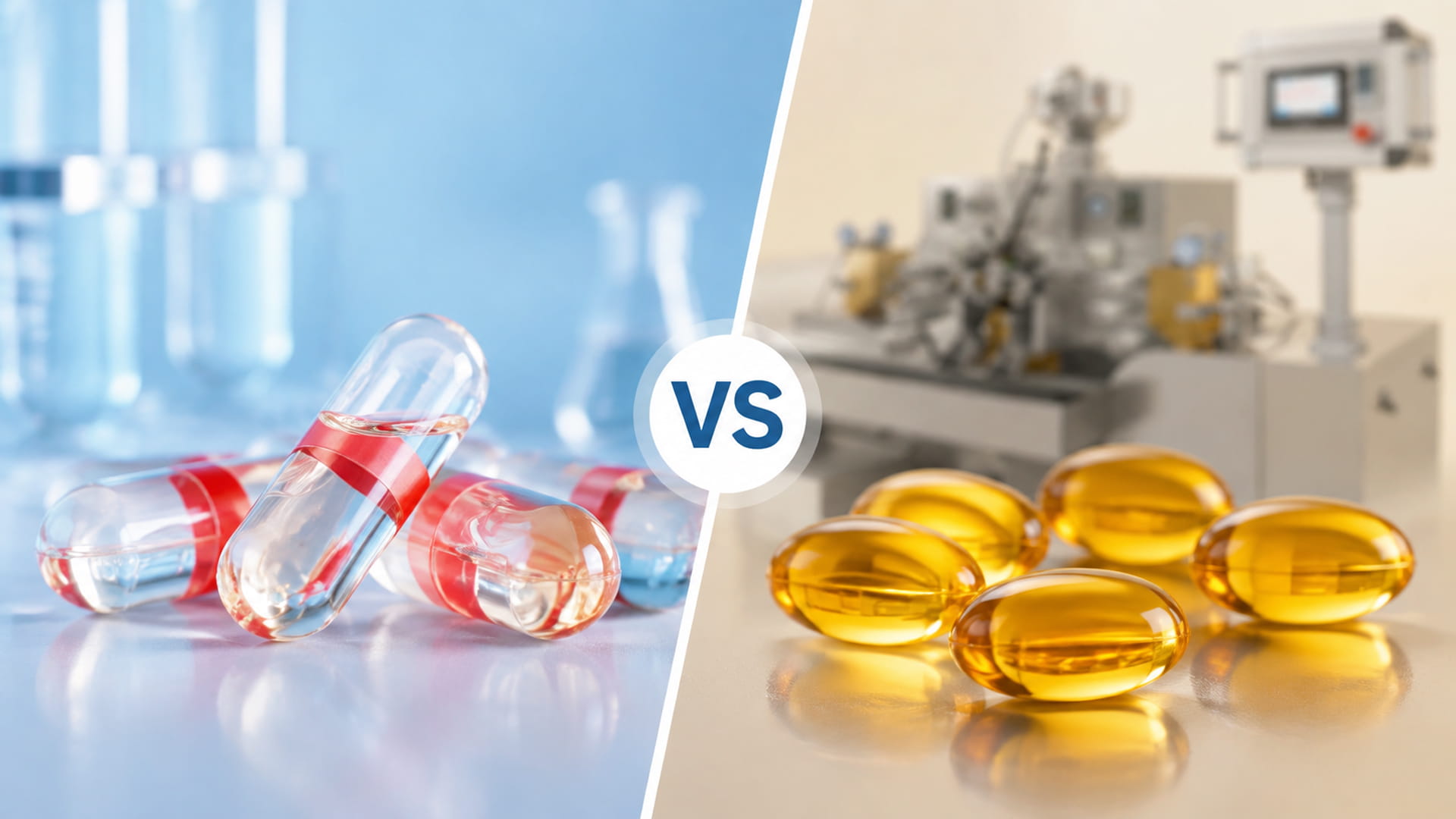
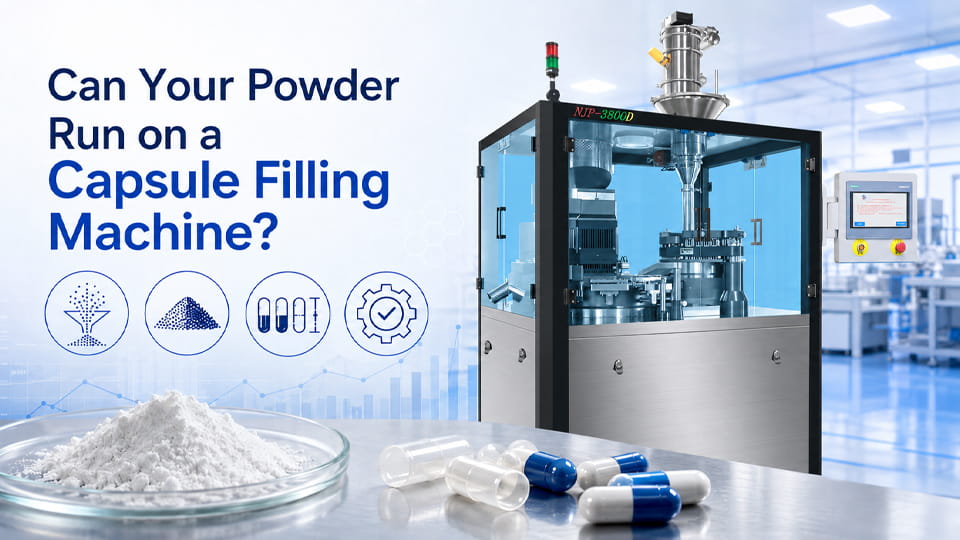
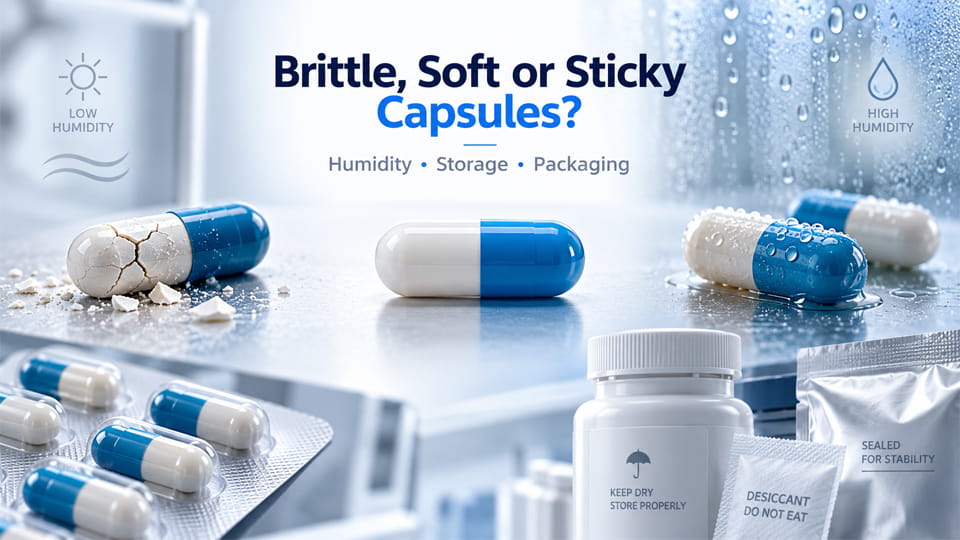
Before discussing capsule materials, manufacturing methods, or packaging equipment, it is helpful to understand what empty capsules actually are and why they are so widely used. From prescription medicines to nutraceuticals and herbal supplements, empty capsules provide pharmaceutical manufacturers with a flexible, accurate, and efficient dosage solution. Their compatibility with automated capsule filling and packaging lines also makes them an essential part of modern pharmaceutical production. Whether you are selecting empty gelatin capsules, evaluating plant-based alternatives, or planning a new capsule packaging line, understanding the fundamentals will help you make better production and purchasing decisions.
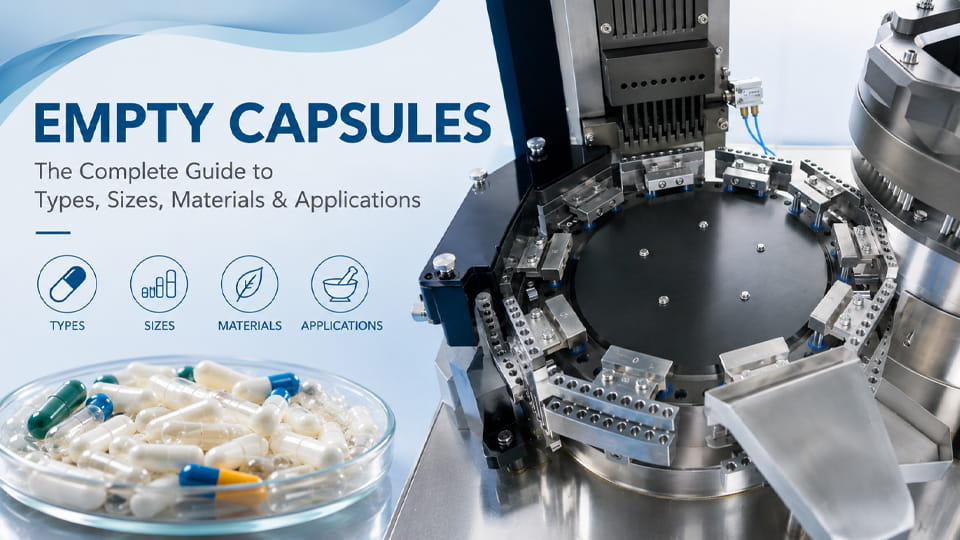
In pharmaceutical manufacturing, empty capsules (also called blank capsules or empty pill capsules) are the basic hollow shells used to create oral dosage forms. They act as containers for powders, granules or pellets of medication and supplements. An empty capsule typically consists of two main parts – the cap and the body – which fit and lock together to form a closed shell. (The cap is the shorter top half, and the body is the longer bottom half.) Modern capsule designs include a locking mechanism (such as matching snap-rings or grooves on the cap and body) to ensure the capsule stays tightly closed after filling. This prevents the capsule from accidentally opening during processing, shipping or handling.
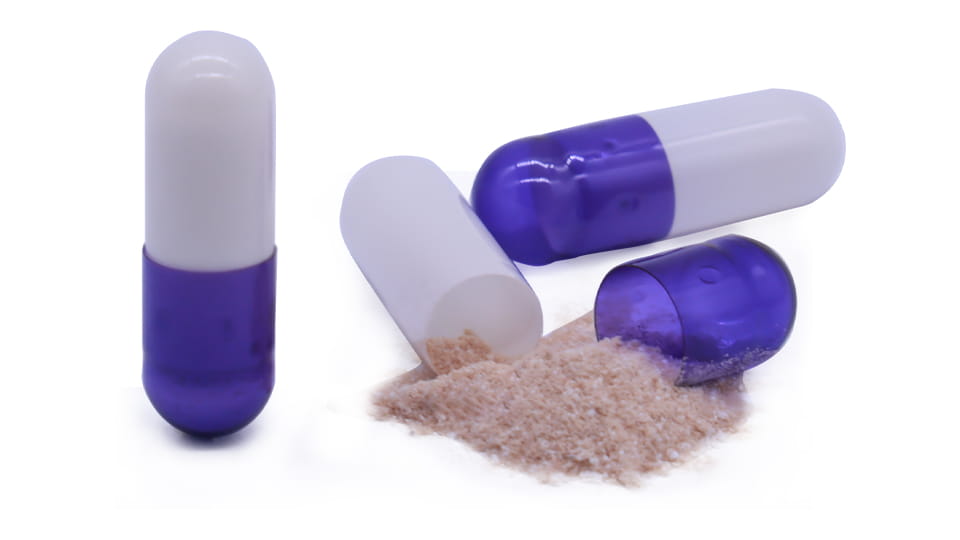
In practice, empty capsules serve as a convenient “empty vessel” for medicine. They are commonly made of gelatin or plant-based materials, and are loaded with API or supplements during production. After filling, the cap and body snap together to keep the contents secure. Under a microscope, you can see the capsule cap, capsule body, and often an interlocking ring or double-snap design at the join (as shown below):
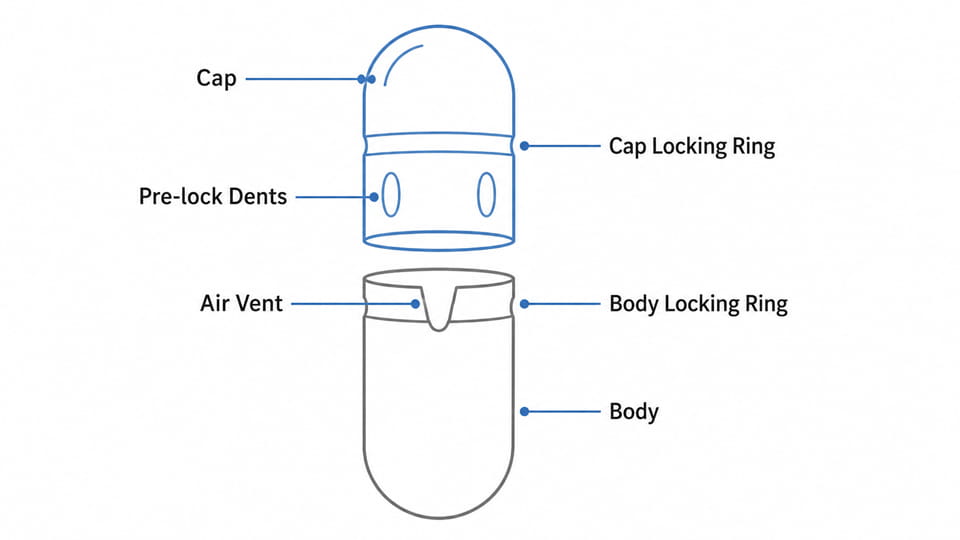
In summary, an empty capsule is a ready-to-fill shell consisting of a cap and a body that click or lock together. These hard shells are elastic enough to assemble but rigid enough to survive high-speed filling and packaging lines. They come pre-assembled or as loose caps and bodies (often supplied in bulk trays), and are filled at separate stages in the plant.
There are several types of empty capsules, distinguished mainly by their shell material. The most common are:
Modern pharma has expanded beyond animal gelatin. “As science and technology have advanced, new materials and process improvements have led to the development of empty capsules made of HPMC, hydroxypropyl starch, and pullulan, in addition to gelatin”. In practice, when someone asks for “empty gelatin capsules”, they usually mean hard two-piece capsules of the common material. But capsule suppliers today offer both gelatin and HPMC (vegetarian) capsules in a range of colors and sizes to meet different needs. (When ordering, you may also see them called empty pill capsules, empty medicine capsules, or empty capsule shells.)
Each material has pros and cons. Gelatin is traditional, low-cost and dissolves easily, but not suitable for strict vegetarians. HPMC and other vegan options cost a bit more but suit broader consumer bases. Pullulan has very good moisture protection, which can improve shelf-life of some drugs or supplements.

Empty capsules come in a range of sizes to accommodate different dose volumes. The standard sizes are numbered from 000 (the largest) down to 5 (the smallest). Size 000 is very large – about 1.37 mL internal volume – whereas size 5 is tiny (~0.21 mL). Choosing the right capsule size depends on the fill weight and density of the powder or granules:
Table 1 Typical sizes of hard gelatin capsules
| Size designation | Fill volume (mL) | Fill volume (oz) | Height of locked capsule (mm) | Outer diameter (mm) |
|---|---|---|---|---|
| 000 | 1.37 | 1/20 | 26.1 | 10.0 |
| 00 | 0.95 | 1/30 | 23.3 | 8.5 |
| 0 | 0.68 | 1/40 | 21.7 | 7.7 |
| 1 | 0.50 | 1/55 | 19.4 | 6.9 |
| 2 | 0.37 | 1/75 | 18.0 | 6.4 |
| 3 | 0.30 | 1/100 | 15.9 | 5.8 |
| 4 | 0.21 | 1/135 | 14.3 | 5.3 |
| 5 | 0.13 | 1/220 | 11.1 | 4.9 |
The fill volume of each size is typically provided by the capsule manufacturer. For example, a standard chart shows capsule volumes from 1.37 mL (size 000) down to 0.21 mL (size 5). This volume corresponds to a certain weight based on powder density. In fact, Table 2.1 in a pharmaceutical reference lists the volumes and approximate weights for various sizes based on typical tapped densities. When formulating, manufacturers calculate the needed capsule size by the target dose weight and the material’s density (powder tap density).
Applications by size: Nutraceuticals (like multivitamins or herbal supplements) often use larger capsules (0 or 000) because they need to deliver large amounts of herbs or vitamins. Many tablets converted to capsules (over-encapsulation for clinical trials) use standard capsule sizes 1 or 0. Conversely, very small capsules (sizes 3–5) might be used for high-potency drugs, or for easy swallowing by children.
In summary, empty capsules are available in sizes 000 to 5. A general guideline is: the smaller the number, the larger the capsule (i.e. 000 is biggest, 5 is smallest). Manufacturers and capsule suppliers provide size charts so that formulators can pick a capsule that meets the volume requirement of the intended dose. Proper size selection ensures that each capsule holds the correct amount of API for consistent dosing.
Empty hard capsule shells (capsule bodies and caps) are produced by a dip-coating process. The basic steps are as follows (see clinical pharmaceutics references for details):
All these manufacturing steps are automated and closely controlled for quality. In fact, a published capsule manufacturing guide summarizes these stages: “Step 1: preparation of gelatin solution; Step 2: dip-coating onto metal pins; Step 3: rotation of the coated pins; Step 4: drying of the coated pins; Step 5: stripping and trimming; Step 6: joining of the trimmed capsule shell; Step 7: printing”. (Printing step: After assembly, capsules are often printed with product codes or logos, then inspected and packaged.)
Throughout this process, extensive quality control checks are performed (gelatin bloom strength, viscosity, microbial limits, etc.) to ensure uniform shells. Modern capsule lines can make millions of shells per day, with very consistent weight and dimensions.
When selecting a capsule type and size, first consider the active ingredient and formulation, then the production method.
Choose by Ingredient/Formulation:
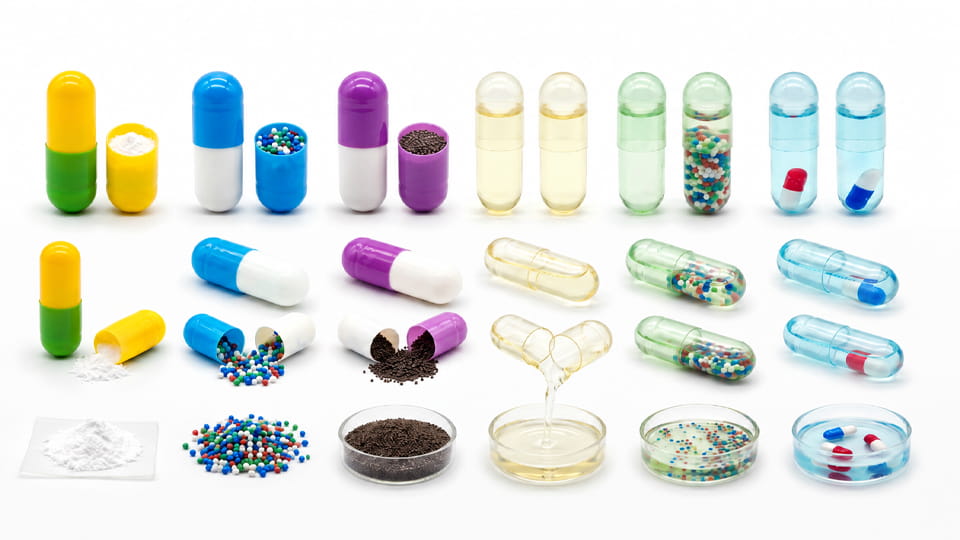
Choose by Equipment and Scale:
In summary, pick the capsule material that fits your API (stability, dietary needs) and then choose the capsule size for your dose. Also ensure compatibility with your filling equipment (manual vs. automatic). Modern capsule fillers (like those from Jinlu) are engineered to handle all standard capsule types. For example, tested setups show that gelatin, HPMC and pullulan shells all run smoothly on the same high-speed machines.
Empty capsules are used across many industries. Key applications include:

These examples show the versatility of empty capsules. They are a universal dosage form for any powdered or granular product that needs to be swallowed in a precise dose.
Filling empty capsules with product can be done in several ways, depending on scale:


In all filling methods, special care is taken for very light or sticky powders (flow enhancers, lubrication). Dust collection and electrostatic control (ionizers) are important for operator safety and fill accuracy. For large operations, capsule filling machines are a key part of the process chain – they turn the “empty capsules” into finished products at scale.
Once capsules are filled, the dosage forms must be packaged efficiently. There are a few common packaging solutions for hard capsules:
In practice, a pharmaceutical plant may combine these solutions. For example, a high-speed production line might start with an automatic capsule filler, then route capsules to a counting-capping machine, and finally send bottles to a cartoner. Alternatively, for unit doses, the capsules from the filler go to an inline blister machine.
Key point: Packaging equipment should be chosen to match the capsules. Blister machines must handle the size and shape of the capsules (to ensure reliable feeding into the cavities). Counting machines should be compatible with capsule fragility and speed requirements. Many machine vendors (like Jinlu) offer customization: for instance, adjusting feeders or chute guides to suit your capsule size and material. As the manufacturer advertises, their blister packers are built to GMP standards and can pack tablets, capsules, and other forms at high speed.
Ultimately, integrated packaging lines – combining capsule filling, counting, blistering/capping, and cartoning – provide the most efficient solution for large-scale production. They automate the flow from empty capsule to finished packaged product.
Empty capsules (the two-piece shells for pills and supplements) are a foundational element in pharmaceutical production. Understanding their materials, sizes, and design features (like locking mechanisms) helps you choose the right shell for your product. Equally important is knowing the manufacturing and filling process: capsules are made by dip-coating (gelatin/HPMC) and then filled on automated machines that separate, dose, and close each capsule. Finally, proper packaging – via blister machines or counting lines – ensures the filled capsules stay intact and compliant through distribution.
If you’re a pharmaceutical or nutraceutical manufacturer looking for reliable equipment, consider a one-stop solution provider that understands capsules. Companies like Jinlu Packing offer integrated capsule filling and packaging lines that meet cGMP standards. They can help tailor the line to your specific capsule type and output needs. Contact an expert today to discuss how to streamline your capsule production and packaging.
Empty capsules are empty capsule shells used to contain pharmaceutical ingredients, powders, granules, or nutritional supplements. They usually consist of a capsule cap, capsule body, and locking mechanism, allowing manufacturers to produce accurate and convenient oral dosage forms.
Hard capsules are typically made from gelatin (animal-derived) or vegetarian alternatives like HPMC (cellulose) and pullulan (fermented tapioca starch). In practice, “empty capsule” usually refers to one of these two-piece shells ready for filling.
The main types of empty capsules include hard gelatin capsules, HPMC capsules, and pullulan capsules. Hard gelatin capsules are commonly used for pharmaceutical drugs, while HPMC and plant-based capsules are popular for nutraceutical and vegetarian products.
The main types of empty capsules include hard gelatin capsules, HPMC capsules, and pullulan capsules. Hard gelatin capsules are commonly used for pharmaceutical drugs, while HPMC and plant-based capsules are popular for nutraceutical and vegetarian products.
Empty capsules are available in different sizes, including 000, 00, 0, 1, 2, 3, 4, and 5. Larger sizes such as 000 and 00 are often used for supplements, while smaller sizes are commonly used for pharmaceutical medicines with lower dosage requirements.
The most common hard-shell sizes in pharma and supplements are sizes 0 and 1. These offer a good balance of fill volume and swallowability. (However, very high-dose formulas may use 00 or 000, and pediatric doses may use size 3–5.)
Standard two-piece capsules are designed for solids (powders, granules). They can leak with liquid fills. For oils or liquids, softgel capsules or specialized liquid capsules are typically used. (Note: there are liquid-filled hard capsules technology, but those still use a powder barrier inside.)
Properly stored capsules have a long shelf life. Both gelatin and HPMC capsules can last several years (often 2–5 years) if kept sealed in cool, dry conditions. Over time, moisture loss or gain can affect them, so storage recommendations must be followed.
Empty capsules are manufactured through several steps, including raw material preparation, capsule shell formation, drying, quality inspection, and packaging. The process ensures consistent capsule size, strength, and quality for pharmaceutical production.
Yes. Because of the raw materials and processing, HPMC and pullulan capsules cost significantly more to manufacture than gelatin capsules. This is reflected in the pricing of empty veggie capsules.
References:
1.Hard Gelatin Capsules: Formulation & Manufacturing —— studylib.net
2.Locking hard gelatin capsule —— Google Patents
3.HPMC capsules: current status and future prospects —— National Library of Medicine
4.Hard gelatin capsules —— pharmacy180.com
5.A Comprehensive Review On: Capsule —— International Journal of Pharmaceutical Sciences (IJPS)