What Is a User Requirements Specification (URS) in Pharma?A Complete Guide for Pharmaceutical Equipment
What Is a User Requirements Specification (URS) in Pharma?A Complete Guide for Pharmaceutical Equipment
August 17, 2026
No Comments
A User Requirements Specification (URS) in pharmaceutical manufacturing is the foundational document that defines what a system or piece of equipment must accomplish to meet quality, performance, and regulatory needs. It is written by the equipment owner (the pharma company) and outlines the required functions, capacities, materials, and GMP features of the equipment. A URS ensures that all stakeholders (production, engineering, QA) agree on the requirements before procurement or design begins. It provides a baseline for supplier proposals and becomes the reference throughout design, testing, and validation.
Key Takeaways
URS defines what pharmaceutical equipment needs to achieve, including its intended use, capacity, performance, quality, safety, and operational requirements.
A good pharmaceutical URS should contain clear and measurable requirements that can be verified later.
For packaging machinery, the URS may cover product specifications, package formats, production speed, materials, utilities, automation, cleaning, safety, and documentation.
URS is not the same as a design specification. The URS defines the required outcome; the equipment manufacturer develops the technical solution.
URS can provide a reference for equipment procurement, supplier evaluation, DQ, FAT/SAT, IQ, OQ, and PQ.
A clear URS helps reduce misunderstandings between the pharmaceutical manufacturer and equipment supplier before the machine is designed and built.
For a packaging machine project, the earlier the buyer defines requirements such as product type, packaging format, target speed, and GMP expectations, the easier it becomes to evaluate suitable equipment.
What Is a User Requirements Specification (URS) in Pharma?
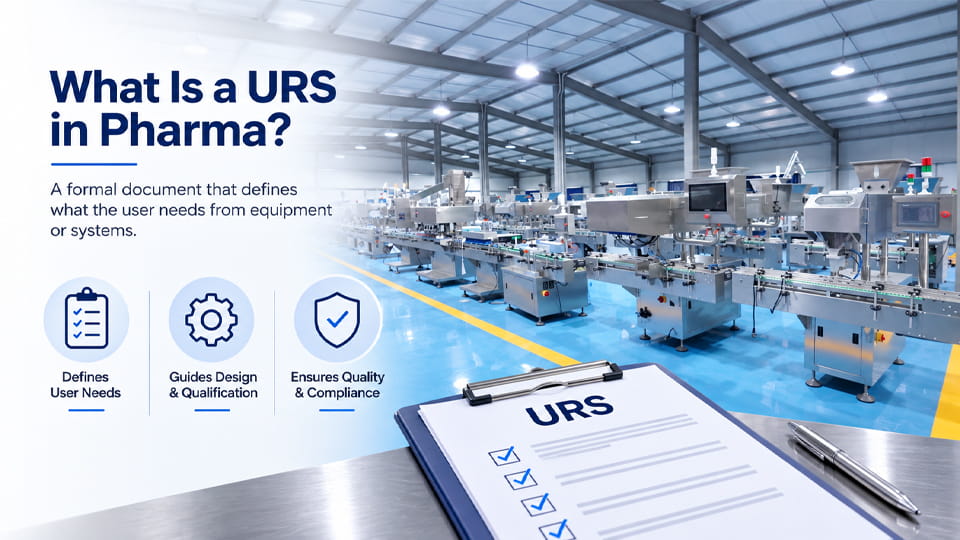
A User Requirements Specification (URS) is a formal document that captures the user’s needs and expectations for a piece of equipment or system in the pharma industry. It describes what the equipment must do – e.g. target production rate, product formats, accuracy, and regulatory functions – without prescribing how to achieve it. The URS acts as a bridge between process engineers or production users and equipment suppliers. It communicates the user’s vision and constraints so that suppliers can design, quote, and build a system to meet those needs.
For example, a URS might specify:
The intended use (e.g. “Pack 10–60 count tablet blisters”).
Performance criteria (e.g. “≥ 100,000 blisters per hour”).
Regulatory and GMP requirements (e.g. “Hygienic design, cleanability to <10 ppm residue”).
Materials of construction (e.g. “All product-contact parts in 316L stainless steel”).
Utilities and environment (e.g. “Operates in Class C cleanroom, requires 380V power, 6 bar air”).
By defining requirements clearly up front, the URS becomes the cornerstone for all later stages – design review, supplier evaluation, testing, and validation. Regulatory guidance (e.g. EU Annex 15, FDA 21 CFR Part 11, GAMP5) explicitly expects documented user requirements as the starting point for equipment qualification. In practice, writing a URS forces cross-functional teams (production, QA, validation, engineering) to align on exactly what the equipment must do for the product to be made correctly.
Why Is URS Important in Pharmaceutical Manufacturing?
A well-crafted URS is crucial for GMP-compliant project success. Key reasons include:
Clarity of Requirements: A URS documents all expectations (output, quality, safety, etc.) in one place. This avoids confusion and ensures the supplier knows exactly what is needed. Without a URS, requirements can be vague or overlooked, leading to costly redesigns.
Basis for Design Qualification (DQ): The URS serves as the baseline for design qualification. It allows you to verify that the proposed design meets all requirements. EU GMP Annex 15 explicitly states that “the requirements of the user requirements specification should be verified during the design qualification”.
Validation & Testing: Every qualification activity traces back to the URS. FDA guidance explains that Installation Qualification (IQ) verifies the equipment’s installation against approved specs “defined in the URS (e.g., materials of construction)”. Operational Qualification (OQ) tests that the equipment operates as intended, and Performance Qualification (PQ) confirms it consistently meets the specifications defined in Stage 1 (the URS). In short, whether at FAT, SAT, IQ, OQ or PQ, each test verifies one or more URS requirements.
Risk Management & GMP Compliance: By including critical quality attributes (CQAs), GMP design features, and regulatory requirements in the URS, teams can address risks early. For instance, specifying hygienic design criteria up front prevents contamination issues later. Industry best practices emphasize incorporating QA, safety, and compliance needs in the URS so “the final system meets both business and compliance needs”.
Communication & Supplier Selection: The URS is a common reference between the pharma company and equipment vendors. It allows suppliers to prepare proposals that directly match the user’s needs. It also helps evaluate bids – machines can be checked against the URS (via FAT/SAT) to see which one meets your requirements best.
Cost and Schedule Control: Clear requirements mean less chance of scope creep or missed features. This reduces the risk of project delays and costly rework.
FAT/SAT plans, and IQ/OQ/PQ deliverables with pass criteria.
Verification Note: Every URS item should be clear and measurable. For example, specify exact numbers (e.g. “100 bottles/min” or “max 30 °C chamber temp”) so that tests like FAT/OQ can objectively verify them. Always include acceptance criteria (e.g. “seals must hold 0.01 MPa for 5 seconds”) where applicable.
What Should a Pharmaceutical URS Include?
A pharmaceutical URS typically covers these areas:
Intended Use & Scope: Describe the process step (filling, sealing, labeling, etc.), the products and packaging formats, and how the equipment fits into the overall process. This sets the context for everything else.
Capacity and Throughput: Define target output (units/hour or batch size). For example: “Pack 50,000 unit-dose blister packs per 8-hour shift.” Include any startup/shutdown conditions or turndown ranges.
Product and Packaging Details: Specify the product characteristics (tablet size, weight, moisture sensitivity) and the packaging format (bottle type, blister card dimensions, carton size). If multiple products or sizes are used, list each.
Material of Construction: List required materials and standards. In pharma, stainless steel (304/316L) and FDA-grade polymers are common for contact parts. Include surface finish requirements (e.g. Ra ≤0.8 μm) and any linings or coatings.
GMP and Design Features: Include hygienic design criteria (e.g. no dead legs or crevices, drainability). Reference any applicable standards or guidelines (EU GMP Annex 11, ISO, ASTM). For computerized systems, note data integrity needs (audit trail, electronic signatures per 21 CFR 11).
Utilities and Environment: Detail required utilities (power: voltage/phases, compressed air pressure/flow, cooling water, vacuum, etc.) and environmental conditions (cleanroom class, temperature/humidity ranges).
Controls and Data: Describe automation needs: PLC/HMI platform, languages, recipe management, alarms, and connectivity (Ethernet/SCADA/MES). State any data storage or reporting requirements (batch records, OEE tracking).
Safety Requirements: List safety features (e.g. light curtains, emergency stops, interlocked guards) and relevant safety standards (CE, UL). Include any ergonomic or operator safety requirements (lockout/tagout, LOTO zones).
Documentation and Services: Require delivery of user manuals, as-built drawings, calibration records, material certificates, software backups, and training for operators/maintenance personnel.
Testing and Qualification: Specify FAT (Factory Acceptance Test) criteria and the scope of IQ/OQ/PQ. For example: “Supplier shall perform a FAT at their site demonstrating compliance to all URS points and provide a FAT report.”
URS Requirements for Pharmaceutical Packaging Equipment
Packaging machinery has some special URS considerations. In addition to the general items above, include:
Packaging Speeds: Specify target rates (e.g. 200 bottles/min, 50 cartons/min, 80 blisters/min). If multiple machines/lines are integrated, clarify throughput for each.
Product Range: List all product variants that must be handled (tablet vs. capsule, different bottle diameters, cap styles, etc.). If the line handles multiple formats, include required changeover times and any format parts needed.
Package Formats: For blisters, specify card sizes, cavity layout, foil type (PVC/PVDC thickness, Alu/PVdC). For bottles, give container types and fill volumes. For cartons, specify dimensions and closure type. These details ensure the machine is configured correctly.
Material Handling: Detail any feeders, separators, or sieves needed for solid dosage. For powders/liquids, specify dosing tolerances and reservoir needs.
Materials: As always, all product-contact parts should be suitable for pharma (e.g. SS316L). If corrosive or acidic products are involved, note any special coatings or materials.
Cleaning & Changeover: If frequent product changeovers are expected, require quick-release parts or CIP (Cleaning-In-Place) features. For sterile lines, specify cleanroom classification and sterilization methods.
Controls: e.g. “The line shall use an Allen-Bradley PLC with SCADA interface, supporting recipe control.” Specify any label serialization or connectivity to upstream/downstream equipment.
Integration: If part of a larger line, require compatibility (e.g. conveyors, batch tracking, barcode scanners). Document any interfaces (electrical, mechanical, communication) needed.
Utilities: Packaging lines often need compressed air (e.g. 5 bar at X NL/min) and may use vacuum or nitrogen. Give minimum requirements.
Safety: With multiple operators around, include light curtains or two-hand controls at loading/reject stations. The URS should reflect your site’s safety rules (e.g. CE compliance).
For example, a blister machine URS might include: “Heat-sealing capability up to 200 °C, accommodate PVC/PVDC film 300 µm thick, integrated blister feeder and trim conveyor, 4-track blister format with changeover <15 min, all contact parts in SS316L, output ≥80 blisters/min at 100% efficiency.” Such specifics let the machine builder meet your exact needs.
How Does URS Fit Into the Qualification Process?
The URS is the starting point of the equipment qualification lifecycle. A simplified flow is:
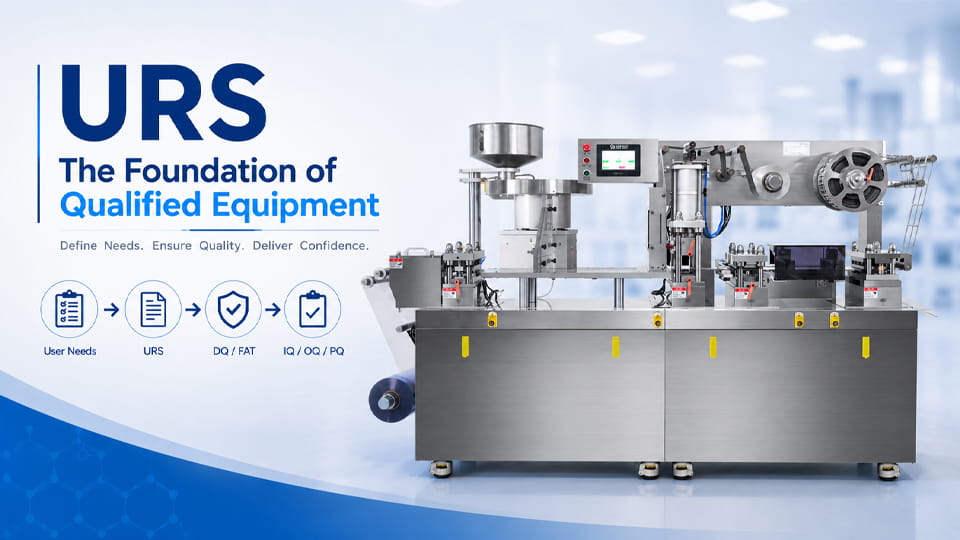
URS → DQ: Once the URS is approved, the equipment design (drawings, specs) is reviewed in Design Qualification to ensure all URS requirements are met. In a design review, engineers and QA walk through the design outputs comparing them to each URS item.
URS → FAT/SAT: Factory Acceptance Testing (FAT) is done at the vendor’s site to demonstrate the machine meets the URS before shipping. Annex 15 even suggests verifying URS compliance at the vendor site if justified. After installation, Site Acceptance Testing (SAT) confirms everything still works in-place (sometimes FAT and SAT steps overlap).
URS → IQ: Installation Qualification checks that the installed equipment matches the URS specs. For example, FDA guidance states IQ should verify that “all aspects of a facility, utility, or equipment that can affect product quality… adhere to approved specifications as defined in the URS (e.g., materials of construction)”. In practice this means checking piping, electrical, and structural details against the URS.
URS → OQ/PQ: Operational Qualification tests that the machine operates as intended. FDA notes OQ verifies the equipment “operate[s] as intended throughout the anticipated operating ranges”. Performance Qualification then shows consistent output meeting URS-defined criteria. In other words, under OQ/PQ you run the machine with real materials and confirm metrics (speed, yield, defect rate, etc.) per the URS.
At each stage, test protocols are traced back to URS requirements. If the URS says “Dispense 100 ml ±2%,” then OQ tests will measure dispensed volume to meet that. A URS transforms vague goals into objective tests.
URS vs Functional Spec vs Design Spec
It’s important to know how these documents differ:
Document
Defines (Scope)
Author
User Requirements Specification (URS)
What users need the system to do (functional and regulatory needs).
The Pharma company (owner)
Functional Specification (FS)
How the system will meet the URS (functions, software modules, features).
The URS answers what questions: “What performance, safety, and compliance features are required?” It leaves solution methods open.
The Functional Spec breaks down the URS into system functions (e.g. “The control system shall auto-stop on alarm and record error codes”).
The Design Spec provides the actual design (CAD drawings, PLC code, vendor/manufacturer details).
Avoid over-specifying in the URS. For example, don’t mandate a specific PLC brand or motor type unless absolutely required. The URS should focus on needs, not design detail. As industry experts note, including excessive technical details in the URS can limit flexible solutions. Those details belong in the Functional/Design specs instead.
Who Is Responsible for Preparing the URS?
Generally, the pharmaceutical user (buyer) is responsible for the URS. A cross-functional team usually drafts it:
Production/Process Engineers: Define intended use, throughput, and process integration.
Quality Assurance/Validation: Provide GMP requirements, data integrity needs, and regulatory criteria.
Maintenance/Engineering: Specify utilities, spare parts, maintenance access, and installation space.
Regulatory/QA: Ensure annexes or guidelines (Annex 15, Annex 1 for sterile, etc.) are addressed.
Procurement: Coordinates the document format and may clarify technical points.
The equipment vendor may give input (what’s feasible, typical performance, etc.), but the final URS must come from the user. Involving all stakeholders early (production, QA, engineering, validation) is a best practice. For example, QA might catch a sanitation requirement, and Process might specify a feed size. The URS should integrate these perspectives so it truly reflects your needs.
How to Write a Good Pharmaceutical URS
Follow these steps to create a clear, testable URS:
Define the Intended Use: Start with a brief system description and purpose (e.g. “URS for a liquid filling machine in product ABC line”). This sets the stage.
List Applicable Regulations/Standards: Include relevant guidance (EU GMP Annex 15/11, 21 CFR Part 11, GAMP 5, etc.) so compliance needs aren’t missed.
Be Specific and Measurable: State requirements with exact values or tests. Instead of “high speed”, specify “minimum 500 bottles/hour at 80% fill”. Each requirement should be objectively verifiable.
Detail Product and Process Needs: Describe product variants, material properties, environmental conditions. For example: “Tablet diameter 6–10 mm; operate in 20–25 °C, 40–60% RH.”
Specify Materials and Design Criteria: Clearly define contact materials (e.g. SS316L), finishes (Ra), cleanliness classes, etc. This lets IQ checks confirm “as-built” specs.
Include Utilities and Space Requirements: Document power supply, air pressure/flow, water quality, weights, and any special foundation or room requirements.
Describe Controls and Data Handling: Specify control system preferences (PLC brand, HMI language), recipe count, alarm/event logging (audit trail for CFR 21 Part 11), etc. If the line must integrate with MES, note it.
Outline Safety Features: List required safety interlocks, guarding, emergency stops, and compliance to safety standards (CE, UL). Don’t overlook operator safety (e.g. lighting, ladders, lockout/tagout).
Plan for FAT/SAT: Indicate that the machine will undergo FAT and SAT, and which acceptance criteria will be tested (e.g. “All URS points will be included in FAT protocol with measured results”).
Review and Revise: Ensure all requirements are clear, unambiguous, and traceable. Assign unique IDs if helpful for tracking. Involve QA/Validation to verify nothing critical is missing.
Key best practices: engage users from all groups, use simple language, and avoid ambiguous terms. A good URS uses bullet lists or tables, and each item has criteria for testing. As one industry source puts it: each requirement should be “specific and testable”. This way, you can directly link each FAT/IQ/OQ step back to a URS item.
Common Mistakes When Writing a URS
Too Vague: Requirements like “easy to use” or “high speed” without numbers are untestable. Always quantify or specify acceptance criteria.
Design-Centric Language: Writing “PLC must be Siemens” or “use three motors” oversteps the URS. Keep the focus on needs (what, not how).
Missing Verification Method: If you can’t say how to test it, it needs clarification. For example, “must seal properly” should include a leak test spec.
Overlooking GMP/Data Integrity: Forgetting to mention alarms, data backup, or Part 11 compliance can cause audit issues.
Ignoring Utilities/Environment: Common omissions are air pressure, power phases, room class, or even total weight (floor load).
Skipping Cleaning/Changeover: In pharma, CIP and fast changeover are often critical. Omitting them can lead to later redesigns.
Not Involving All Stakeholders: If QA or production isn’t involved, requirements (e.g. cleanability, operator needs) may be missed.
Unrealistic Expectations: Overpromising throughput or underestimating temperatures can backfire. Base numbers on real process data.
No Version Control: Treating URS as an editable draft can confuse teams. Once finalized, it should be a controlled document.
A URS that is either too generic or too detailed can both cause trouble. Aim for clear, unambiguous user needs.
Pharmaceutical Packaging Machine URS Example
Below is a simplified example of URS entries for a blister packaging machine. (Actual values would come from your specific products and targets.)
Requirement
Example (Blister Packaging Machine)
Machine Type
Automatic rotary blister packing machine
Products
Tablets (6–10 mm Ø) and capsules (8–12 mm Ø)
Blister Material
PVC/PVDC film 300 μm, or Alu/PVdC foil 20/30 μm
Number of Tracks
4-track machine (for blister cycles)
Output Speed
≥ 80 filled blisters per minute
Sealing
Heat-seal with upper/lower tooling; sealing temperature 170–200 °C; sealing force 3 kN
Changeover
Format change in < 30 minutes between products
Construction
SS316L stainless steel for product-contact parts, Ra ≤ 0.8 μm
Control System
Allen-Bradley PLC with 10″ HMI; recipe storage for up to 20 formats
Utilities
400 VAC, 5 bar compressed air (100 NL/min), 50 Hz power
Safety
CE-compliant guards and E-stops; interlocked access doors
Documentation
User manual, wiring diagrams, FAT/IQ/OQ protocols, calibration docs
Qualification Support
FAT at vendor site covering all URS points; supplier provides IQ/OQ/PQ docs
Note: These are illustrative examples. Your actual URS would include values relevant to your product sizes, cleanroom grade, regulatory requirements, and validation plan.
DPP-270Pro Liquid Blister Packaging Machine
URS Checklist for Equipment Procurement
Before finalizing the URS, ensure you have covered:
Intended use / process step
Product types and packaging formats
Production capacity and operating range
Materials of construction and surface finishes
GMP/hygienic design features
Cleaning and CIP requirements
Utilities and environmental conditions
Controls and data integrity (HMI, SCADA, CFR21 Part 11)
Safety and guarding requirements
Documentation (manuals, drawings, certificates)
FAT/SAT and qualification deliverables
Maintenance, spare parts, and training needs
Regulatory references (e.g. Annex 15, Annex 1)
A complete checklist helps catch missing pieces before suppliers bid on the project.
Conclusion
A User Requirements Specification (URS) is the starting point for any pharma equipment project. It defines the user’s needs and becomes the foundation for compliant equipment design and validation. By spelling out what the equipment must do – with clear, measurable criteria – the URS guides procurement, supplier proposals, and qualification tests.
For pharmaceutical packaging lines, a strong URS ensures your blister packers, tablet counters, cartoners, and bottling machines deliver the needed output and meet GMP design standards. When your production, QA, and engineering teams collaborate on the URS, you minimize misunderstandings and set up a smooth path to FAT, IQ, OQ, and PQ.
If you’re preparing a URS for a packaging machine or line, remember: define what you need, make it measurable, and link it to GMP requirements. Jinlu Packing specializes in pharmaceutical packaging machinery – from blister packing and capsule filling to cartoning and bottling lines. With a clear URS in hand, we can tailor our equipment proposals and validation support to your exact requirements.
Contact Jinlu Packing for expert assistance in specifying and qualifying your next pharmaceutical packaging machine. Our experienced team can help translate your URS into a compliant, high-performance solution.
FAQs on User Requirements Specification (URS) in Pharma
What is a User Requirements Specification (URS) in pharmaceuticals?
A URS is a written document that details the user’s expectations for a machine or system before it is designed or purchased. It lists the performance, functionality, and compliance needs the equipment must meet. In other words, it tells suppliers exactly what the process requires.
Why is the URS important in the pharmaceutical industry?
The URS ensures that equipment is developed according to GMP, safety, and data integrity requirements. It provides clarity on what is needed so that designers can build compliant, high-quality systems. Without a clear URS, equipment might miss key requirements, leading to costly reworks or regulatory non-compliance.
Who typically writes the URS?
Usually the people who run the process (production or product specialists) draft the URS, with input from engineering, QA, and validation teams. This ensures all perspectives are covered. Final review and approval should involve QA to confirm regulatory needs are met.
When should the URS be created?
The URS should be prepared before buying or building the equipment – right after the decision that a new system is needed, and before detailed design or vendor selection.
What should be included in a URS?
Key sections of a pharma URS typically cover the project scope, functional requirements (what it does), performance requirements (how well it does it), regulatory compliance needs, data integrity, and acceptance criteria. It may also include sections on safety, maintenance, documentation, training, etc.
What is the difference between a URS and a Functional Requirement Spec (FRS)?
A URS defines what the user needs (business needs, high-level functions). The FRS (or functional spec) comes later and describes how the system will do it. Think of URS as “we need X output and Y accuracy”, whereas FRS would detail the technical solution or workflow to achieve that. Generally, do not duplicate functional specifications in the URS.
How does the URS link to validation (IQ/OQ/PQ)?
The URS is the baseline for all validation tests. Each qualification activity traces back to requirements in the URS. For instance, if the URS requires 10,000 bottles/hour, the PQ (Performance Qualification) will test that output. Annex 15 explicitly states URS requirements should be verified during DQ and serve as reference throughout IQ/OQ/PQ.
Can a vendor write the URS for us?
While a vendor can clarify how they will meet requirements, the URS should remain user-owned. It must reflect your specific process and GMP priorities, not just what a supplier has built before. You may get vendor input on technical feasibility, but the final URS should be validated by your team (QA/validation) to avoid bias.
Is a URS required by regulators?
Yes. GMP guidelines (EU Annex 15, FDA 21 CFR, etc.) require documented specifications for equipment. Annex 15 explicitly calls for a URS or similar spec at the start of qualification. Similarly, FDA’s Part 11 and GAMP5 emphasize having clear documented requirements. During audits, regulators will expect to see a URS or specification for each critical machine.
What happens if we skip the URS?
Skipping or writing a poor URS often leads to design gaps and compliance issues. You may end up with machines that don’t meet production needs or lack critical GMP features. Pharmaguideline warns that a vague URS causes “excessive costs associated with redesigning and qualifying equipment due to lack of clarity”. Always start with a good URS – it’s the most efficient path to a compliant, on-spec system.
Petty Fu, Founder of Jinlupacking, brings over 20 years of expertise to the pharmaceutical machinery sector. Under his leadership, Jinlu has grown into a trusted supplier integrating design, production, and sales. Petty is passionate about sharing his deep industry knowledge to help clients navigate the complexities of pharma packaging, ensuring they receive not just equipment, but a true one-stop service partnership tailored to their production goals.