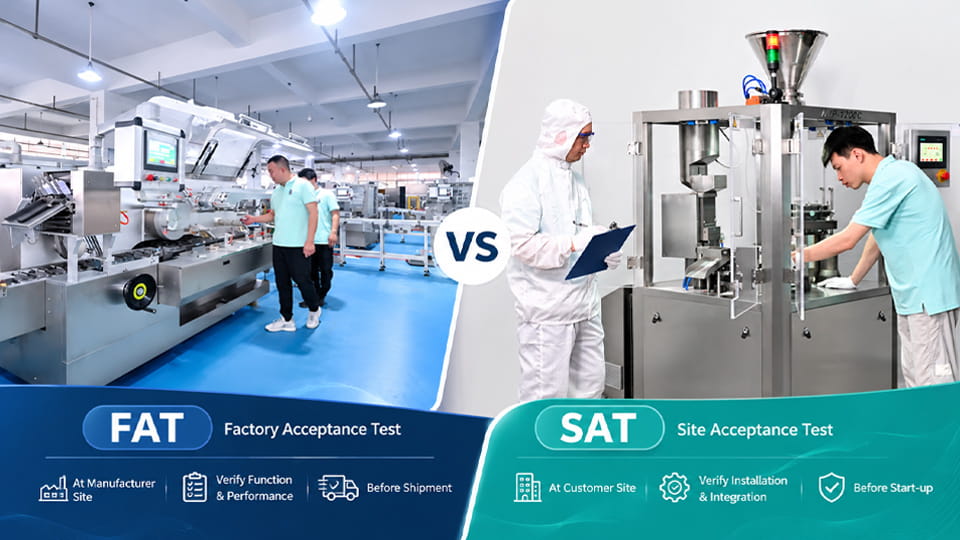
Factory Acceptance Testing (FAT) and Site Acceptance Testing (SAT) are two complementary validation stages for pharmaceutical equipment. FAT is done at the equipment manufacturer’s facility (before shipping) to verify all specifications and functions meet the customer’s requirements. SAT is performed after installation at the customer’s site to confirm the machine works correctly in the actual production environment. Together, FAT and SAT help catch issues early (saving time and cost) and ensure GMP compliance. This article explains FAT vs SAT in detail – covering what each test verifies, key differences, how they fit into the IQ/OQ/PQ lifecycle, sample checklists for packing lines (blister, capsule, tablet, cartoning), and buyer best-practice questions.
What Is a Factory Acceptance Test (FAT)?
A Factory Acceptance Test (FAT) is a formal, documented evaluation of equipment at the manufacturer’s site, conducted before the unit is shipped to the customer. It verifies that the machine has been built to the agreed User Requirements Specification (URS) and is functioning correctly. During FAT, the vendor and customer (or their representatives) execute an approved FAT protocol of test cases and checklists. Typical objectives include demonstrating compliance with specifications, catching defects early, and giving the buyer confidence that “the equipment is ready to ship”.
What Does FAT Verify?
In FAT, the focus is on standalone performance and adherence to design. It generally includes:
- Visual and Construction Checks: Inspect mechanical assembly, frame alignment, wiring, and build quality against drawings. Confirm serial numbers and model IDs.
- Electrical and Control Testing: Verify power connections, PLC/HMI software versions, sensors and actuators. Check that control screens, recipes, and alarms respond correctly.
- Function Tests (No-Load or Dry Runs): Run each major machine function (motors, drives, feeders, heaters) across its full range. For example, cycle speeds at minimum and maximum, test heaters/pressure ramps, and actuate interlocks intentionally.
- Performance Checks: Use representative production materials if possible. For a filling or packaging machine, run product samples and verify throughput, accuracy, changeover, and other performance targets. (Using the customer’s actual products during FAT is strongly recommended to reveal material-specific issues.)
- Safety and Interlocks: Test emergency stops, light curtains, guards, pressure relief valves, etc., to confirm that all safety systems respond as intended under fault conditions.
- Documentation Review: Confirm that all required documents are ready: operation manuals, electrical and pneumatic diagrams, maintenance guides, spare parts lists, calibration certificates, etc.
- Acceptance Criteria: All tests are evaluated against pre-agreed acceptance criteria (often drawn from the URS). Any deviations or open points are recorded in a punch-list for resolution.
A successful FAT ends with a signed FAT report, itemizing passed tests and listing any issues to fix before shipment. Essentially, FAT ensures “the system is ready to be shipped” by verifying its core functions under controlled factory conditions.
When and Who Does FAT Occur?
The FAT typically takes place after the machine is fully assembled but before it leaves the manufacturer’s floor. It follows design qualification (if any) and precedes delivery. Key participants usually include vendor engineers and technicians, and representatives from the buying company (QA/validation engineers, production staff). The buyer’s team should arrive prepared, often bringing the URS, test protocols, and any specialized materials to run. The FAT is the buyer’s last chance to catch major discrepancies under the supplier’s control.
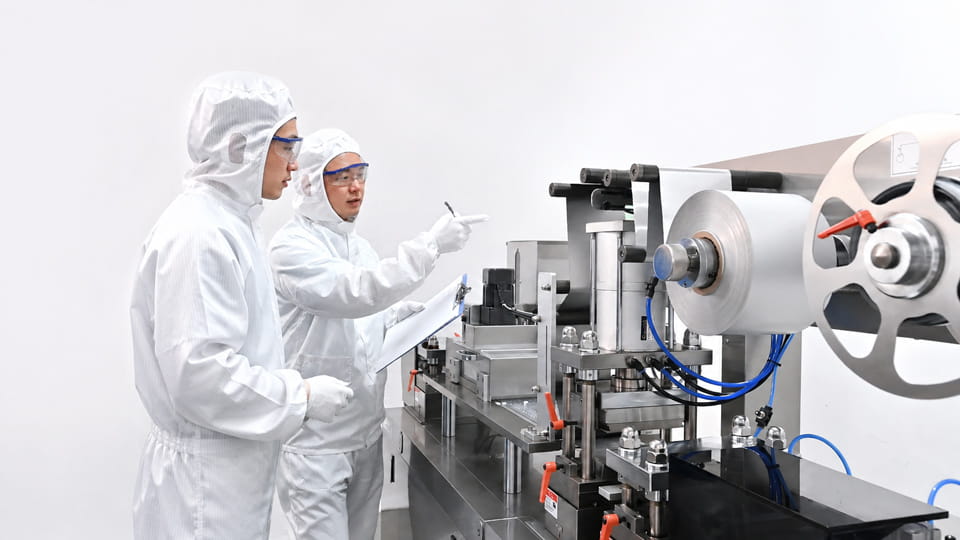
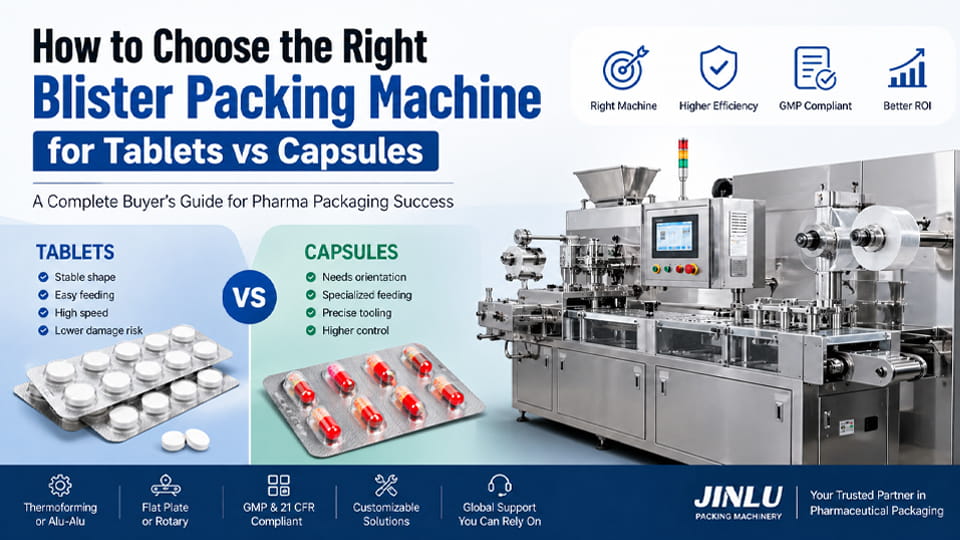
Figure: A pharmaceutical blister packaging machine undergoing acceptance testing. In a rigorous FAT, every subsystem (forming, sealing, feeding, controls) is checked against the URS. A subsequent SAT then repeats key functional tests after installation in the end-use environment.
What Is a Site Acceptance Test (SAT)?
A Site Acceptance Test (SAT) is a documented test performed at the customer’s facility after the equipment is delivered and installed but before it is released for production. SAT re-verifies that the machine meets requirements in its actual operating context. In SAT, the equipment is checked for proper installation, utilities hookup, system integration, and final performance.
What Does SAT Verify?
SAT typically includes:
- Installation Qualification (IQ) Checks: Verify that the equipment is installed per the approved plan. This includes confirming correct location, leveling, utilities (power voltage, pneumatic pressure, water, etc.), grounding, and ambient conditions. All machine components and documentation must be present and installed correctly.
- Utility Verification: Ensure that site utilities meet machine requirements. For example, measure actual voltage, air pressure/flow, chilled water temperature, or steam pressure from the facility supply. Confirm they stay within the acceptable range specified by the machine.
- Integration Testing: Check interfaces with upstream/downstream equipment and building systems. Verify communication links (e.g. to LIMS, MES, SCADA) if applicable. Confirm that conveyors align, hand-off between machines is smooth, and any networked alarms or data collection works under site conditions.
- Repeat Functional Tests Under Real Conditions: Perform core functions again, now with the machine connected to utilities and using actual production materials if possible. For example, run a batch of real tablets or capsules through the machine to confirm it still meets speed and quality criteria. Ensure that any adjustments made for site conditions are effective.
- Safety and Environmental Checks: Re-test safety interlocks and protective devices under real installation settings. Verify that environmental requirements (cleanroom class, temperature, humidity) are met and do not adversely affect machine operation.
- Final Acceptance Criteria: Confirm that all SAT acceptance criteria (often drawn from URS and site protocols) are satisfied. Document any remaining deviations in a punch list. Collect operator sign-offs and formal acceptance documentation.
A successful SAT ends with an SAT report or certificate signed by both vendor and customer. It provides documented evidence that “the equipment/system has been delivered in good condition and has not been affected by transportation” and now operates correctly on site. In practice, a thorough SAT gives confidence that the machine is ready for the next phase of validation (IQ/OQ/PQ) or routine production.
FAT vs SAT: 10 Key Differences
- Location: FAT is done at the manufacturer’s site; SAT at the owner’s (client’s) site.
- Timing: FAT occurs before shipment (post-assembly), whereas SAT is after installation (pre-commissioning).
- Environment: FAT is in a controlled factory setting (sometimes not under cleanroom conditions); SAT is in the actual production environment with real ambient conditions.
- Utilities: In FAT, utilities (air, water, power) may be simulated at nominal values by the vendor; in SAT, the machine uses live site utilities (actual air, water, electrical supply).
- Integration: FAT tests the machine in isolation (sometimes with dummy loads). SAT tests include integration with surrounding equipment (e.g. upstream loader, downstream packer, data systems).
- Test Scope: FAT scripts tend to be more exhaustive (full functional checks, max speeds) to “shake out” issues on the vendor floor. SAT scripts focus on confirming core performance under site conditions and checking fixes from FAT.
- Documentation Detail: FAT protocols are usually very detailed with line-item tests (often written to UW). SAT protocols may reference the URS and FAT results, so they can be more streamlined.
- Acceptance Criteria: FAT acceptance is based strictly on factory-test criteria agreed upfront. SAT acceptance includes any additional site criteria (e.g. full-line integration, environmental factors).
- Objective: The goal of FAT is to “prove” the machine was built correctly. The goal of SAT is to “confirm” it still works after transit and installation.
- Impact: Issues found at FAT can be addressed at the vendor (lower cost). Issues found at SAT often require downtime and can delay production. A thorough FAT minimizes costly SAT surprises.
In short, FAT and SAT are sequential checkpoints: FAT catches defects early in the factory; SAT catches any remaining issues once the machine is on-site. Both are crucial for GMP compliance and risk management.
FAT vs SAT at a Glance
| Feature |
FAT (Factory Acceptance Test) |
SAT (Site Acceptance Test) |
| Where & When |
At vendor’s facility, before shipping. |
At customer’s site, after installation. |
| Purpose |
Verify the machine meets design/URS specs and works stand-alone. |
Verify the machine functions correctly in the actual production line (utilities, environment, integration). |
| Environment |
Controlled factory conditions (vendor utilities). |
Real plant conditions (actual air, power, temperature). |
| Testing Scope |
Detailed functional tests against contract specs; simulate process using representative materials if possible. |
Check installation (IQ), then repeat core functionality and performance with final product/setup; test integration with upstream/downstream equipment. |
| Acceptance Criteria |
Based on the user requirements and agreed test plan (e.g. speed, accuracy). |
Confirms site-adjusted performance (e.g. consistent production quality, utility parameters) meet criteria. |
| Documentation |
Formal FAT protocol, test records, punch-list, final FAT report. |
Formal SAT protocol (often simpler), deviation log/punch-list, sign-off, and traceability to URS. |
| Outcome |
“Equipment approved for shipment” (or list of fixes). |
“Machine accepted on site” (or list of remaining issues to fix). |
This table highlights the key distinctions: FAT is all about proving the machine is built to spec before it leaves the factory, while SAT proves it still meets requirements after installation in its working environment. Both are typically required under GMP/Annex 15 guidance.
FAT vs SAT vs IQ vs OQ vs PQ
FAT and SAT are part of the larger qualification lifecycle for GMP equipment. In a typical project flow, you start with the User Requirements Specification (URS) and Design Qualification (DQ), then proceed to FAT, delivery, installation, SAT, and finally IQ/OQ/PQ on site. The mermaid diagram below illustrates this sequence:
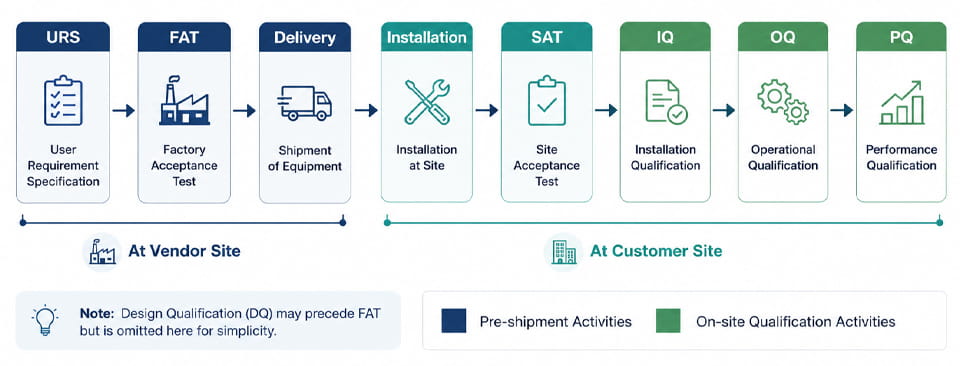
Figure: Qualification lifecycle flow. After defining URS, a Factory Acceptance Test (FAT) is performed at the vendor site. Then the equipment is shipped and installed, followed by a Site Acceptance Test (SAT). Finally, Installation Qualification (IQ), Operational Qualification (OQ), and Performance Qualification (PQ) are executed on site (note: DQ may precede FAT but is omitted here for simplicity).
This flow is supported by GMP guidance. For example, under EU GMP Annex 15 and ISPE C&Q practices, documented FAT results can often be leveraged into IQ/OQ, reducing duplication. In fact, ISO/ISPE guidelines note that FAT “activities contribute directly to Design Qualification (DQ) and Installation Qualification (IQ) evidence,” helping compress overall qualification time. In practice, a rigorous FAT with proper documentation means your IQ team can reuse those findings (e.g. installation checks already done) rather than re-testing the same points.
FAT Protocol Checklist (Pharma Packaging)
A comprehensive FAT protocol for pharmaceutical packaging machinery typically includes the following elements:
- Pre-approved FAT Protocol: A written document (based on the URS) that lists each test case, acceptance criteria, and responsibility. This is approved by both buyer and seller before testing.
- Visual Inspection: Check that the machine matches final approved drawings, with no missing parts or damage. Verify component serial numbers and model.
- Mechanical & Electrical Inspection: Confirm all structural components (frames, guards, conveyors) and electrical components (motors, cables, panels) are correctly installed and labeled.
- Alarm and Interlock Tests: Trigger each alarm condition and verify proper response. Activate each safety interlock (E-stop, door guard, light curtain) to ensure the machine stops or alerts as designed.
- Control/Software Checks: Confirm PLC/HMI settings, software versions, recipe handling, and user access levels work. Test operator interfaces and control logic against requirements.
- Instrument Calibration Verification: Verify that all sensors and instruments have valid calibration certificates and are within spec before use.
- Performance Runs with Product: Run the machine at all specified operating speeds using representative product or worst-case materials. Measure key outputs (fill weights, throughput, sealing quality, count accuracy, etc.) against acceptance criteria.
- Changeover Demonstrations: If multiple formats/SKUs are required, demonstrate changeover procedures and timing as per contract.
- Utility Simulation: Simulate site utility conditions (e.g. run motors at lower voltage, apply lower air pressure) to ensure the machine can handle expected utility variances.
- Documentation Review: Ensure all manuals, schematics, maintenance guides, and spare parts lists are complete and handed over.
- Punch List and Sign-Off: Document any open issues in a punch list. After retesting fixes, include the final “FAT Acceptance” signature page in the FAT report.
Following this checklist helps catch deviations in the factory. For example, industry experts warn against vague FAT records – only quantitative, equipment-specific test data should be accepted. Accepting mere supplier “pass” statements or incomplete checklists can mask problems. Always record measured values and trace them to the specific machine serial number.
SAT Protocol Checklist (Pharma Packaging)
A SAT protocol for pharmaceutical packing machines usually covers:
- Pre-Installation Checks: Verify the site is ready (cleanroom, foundation level), utilities are in place (power, compressed air, vacuum, water), and installation drawings match the machine.
- Installation Verification: Confirm all mechanical components are properly assembled on site (no damage from shipping). Check that utilities connect correctly (voltage, pressure, flow) and that environmental conditions (temperature, humidity, classification) meet equipment requirements.
- No-Load Function Tests: Run key functions empty or with dummy product to ensure wiring and motors remained intact after transport. Verify safety interlocks once more under site conditions (e.g. plant air rather than factory air).
- Utility Hookup Test: Measure actual utility parameters at the machine (e.g. confirm actual air pressure and flow meet spec).
- Integration Testing: If applicable, test communication between this machine and upstream/downstream equipment (e.g. check that a counting machine correctly signals the cartoner to index).
- Production Performance Test: Run the machine with real product or mock product (as per the URS). For example, feed the actual tablet blisters or capsules through the line to confirm yield and quality are as required. This is essentially a site PQ run.
- Operator Training & Handover: Ensure operators can run the machine. Review operating procedures and have operators perform basic tasks under observation.
- Issue Resolution: Record any SAT deviations or findings in a log and verify corrective actions. Only after all critical points are closed does the machine get formal acceptance.
- Final Sign-Off: Complete a SAT report or certificate, sign it, and include final run data. This becomes evidence for compliance.
In short, the SAT protocol re-confirms all critical functionality under real conditions. It’s the last checkpoint before commissioning. For example, Jinlupacking notes that a thorough SAT often generates baseline data that can go straight into the IQ/OQ protocols, avoiding retesting of utilities and environment.
FAT and SAT for Pharmaceutical Packaging Machines
Pharma packaging lines (blister, capsule, tablet, cartoning machines) have their own FAT/SAT emphasis. Here are some typical points:
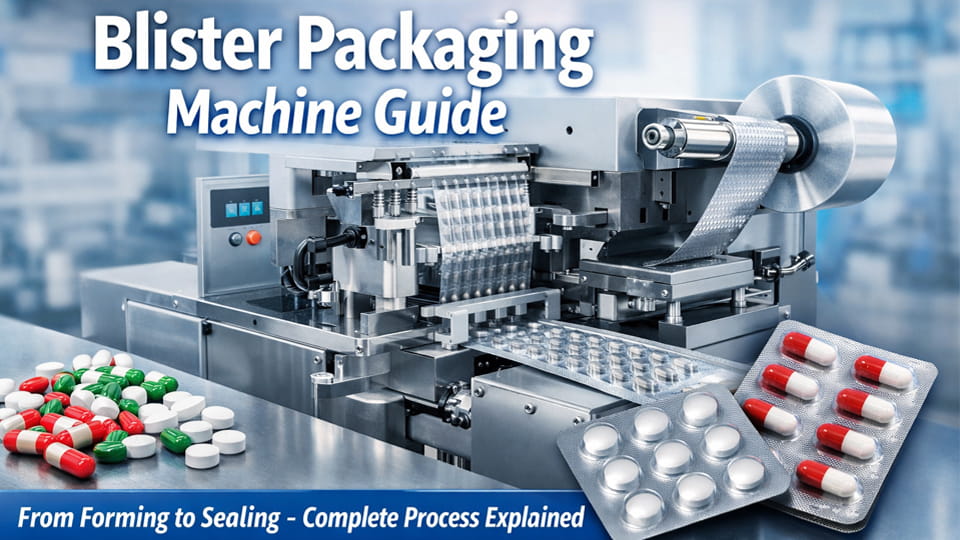
- Blister Packaging Machine: FAT should verify the forming and sealing stations. For example, measure temperature uniformity on the thermoforming platen (±2 °C across the mold) and sealing die (±3 °C) under worst-case speeds. Test seal integrity (peel tests per ASTM F88). Check blister feeding accuracy, indexing, film alignment, and that the reject system removes misformed blisters. SAT will then repeat these tests with the actual blister foil and tablets at site and confirm the machine still meets seal strength and throughput specs under local humidity/temperature.
- Capsule Filling Machine: FAT check points include capsule orientation and feeding (verify caps and bodies load properly), powder fill accuracy (measure weight fill at low/high range), detection systems (check sensor alignment for empty, double, or wrong orientation), and locking integrity (ensure capsules are closed tightly). Verify turret indexing and servo accuracy without product. SAT will then test filling accuracy with the customer’s capsules and powder blend, and confirm the end-of-line reject mechanism works when real rejects occur.
- Tablet Press Machine: During FAT, tests include tooling calibration (tablet weight, thickness, hardness across turret positions), feed frame and hopper operation, and press force consistency. Run the press under load at the lowest and highest compression forces to check ram speed. SAT re-verifies tablet specs using actual granulation at the desired batch size, confirms that the lubrication and sound levels are acceptable, and checks safety gates and overload relays on site.
- Counting and Cartoning Machines: For counting machines, FAT focuses on accuracy and speed with mock products, verifying sensors and reject chutes. For cartoners, FAT verifies carton forming, in-feed timing, output speed, and sealing quality. SAT will test continuous operation: feeding actual blister packs or bottles into a cartoner and ensuring the output cartons are correct. It also checks that the counting machine and cartoner synchronize properly (e.g. no missed bottles).
In all cases, both FAT and SAT check that the machine runs at the specified speed and yields the right count/weight/quality with the actual product. Skipping tests (for example, not running real product at FAT) can lead to failures at SAT. As one expert warns, “running a FAT with the OEM’s generic materials is not the same as running it with yours” – if you don’t test real materials in FAT, site issues often emerge later.
Why Can a Machine Pass FAT but Fail SAT?
Even if a machine passes every item on the FAT checklist, it can still fail SAT if conditions change. Common reasons include:
- Utility Differences: The voltage, air pressure, or supply quality at the plant may be outside the range used in FAT. A conveyor motor might trip at SAT if the line voltage is slightly low, for example.
- Environmental Change: Temperature or humidity differences can affect processes. One case had a blister machine pass FAT at moderate humidity (45% RH) but fail seal integrity on-site at 80% RH.
- Product Variations: If the supplier didn’t use the exact product or packaging material in the FAT run, the machine might behave differently with the real product. (We advise pushing the OEM to run your materials at FAT.)
- Installation Issues: Errors in setup, alignment, or fastening during shipping can introduce new faults that SAT must catch. For example, a loose encoder or a jostled guide rail may not be noticed until site testing.
- Integration Problems: The machine might not communicate properly with other line equipment or the plant’s control system unless those interfaces are tested at SAT.
- Unclosed Punch List: If the vendor did a partial release (e.g. “we will fix this after delivery”), an unresolved FAT issue might only surface at SAT.
In short, FAT tests the machine in isolation; SAT tests it in context. Every difference in site conditions or setup is a potential failure mode. A well-executed SAT, however, is the final check to uncover such issues before full production.
What Should Buyers Ask a Supplier about FAT and SAT?
When selecting a machine supplier, industry buyers often use FAT/SAT readiness as a key qualifier. For example, Jinlu’s supplier audit guide recommends asking:
- Document Availability: “Can you supply full equipment documentation, including manuals, drawings, FAT/SAT reports, and IQ/OQ templates?”. (A compliant vendor provides these proactively.)
- Validation Support: “Will you assist with installation and qualification? Do you provide on-site support or training during FAT/SAT?”. (Ensure they send engineers to FAT and SAT.)
- Process Participation: “Who will lead the FAT and SAT? Can my QA/validation team participate or witness the tests?”
- Use of Samples: “Will you run my actual product and packaging materials in the FAT?” (As noted, using real materials is critical.)
- Deviation Handling: “If something fails at FAT, how will it be fixed? Will you retest on-site before shipment?”
- Change Control: “How do you manage post-order changes? Can minor URS updates be accommodated in the protocols?”.
- Experience & References: “Have you delivered this model to other pharma customers? Can we see case studies or contact references?”.
- Spare Parts and Service: “What is your spare-parts support policy? Do you offer extended warranties or local service?”.
These questions help gauge the supplier’s validation maturity. An experienced vendor should readily answer that they deliver machines “audit-ready” with complete FAT/SAT/IQ/OQ packages.
FAT/SAT Acceptance Checklist
To ensure a smooth acceptance process, buyers can use this quick FAT/SAT checklist:
- Agree on Scope Upfront: Include FAT and SAT plans in the purchase order or URS, defining exactly which tests will be performed and what criteria must be met.
- Witness Tests: Attend the FAT (ideally in person) to verify each test is performed. If remote witnessing, ensure live video of readouts.
- Use Final Drawings/Specs: Confirm the machine is tested against the latest URS and drawings (not older revisions).
- Bring Calibration Evidence: Ensure instruments used at FAT/SAT are calibrated and their certificates are in the documentation package.
- Collect Raw Data: Require that all measured values (weights, forces, voltages, etc.) are recorded, not just “pass/fail” marks.
- Close Deviations Promptly: Any discrepancy found should have an agreed fix and re-test before acceptance. Do not accept “we’ll fix this later” without evidence.
- Traceability: Maintain a traceability matrix linking each URS point to FAT/SAT test cases and results.
- Final Sign-Off: Do not release the machine until all FAT punch-list items are resolved and the FAT report is signed. Repeat for SAT.
- Post-FAT Pre-Shipment Check: Optionally, conduct a pre-shipment inspection to confirm that nothing changed after FAT (We suggest this final check after machine is packed).
- Documentation Archive: Keep copies of all FAT and SAT protocols and reports in your validation files. These become part of the Equipment Qualification records.
Following such a checklist avoids surprises. For instance, Seeing a supplier’s packing photos or generic QC notes after the fact is not proof of compliance. The strongest evidence is a complete set of FAT/SAT records tied to the specific machine.
Conclusion
FAT and SAT are both essential checks to ensure your pharmaceutical packaging machines perform reliably and comply with GMP. By thoroughly testing equipment at the vendor’s site (FAT) and again after installation (SAT), you minimize costly surprises and validate that all URS points are met.
Ready to streamline your acceptance tests? Jinlu Packing delivers pharma-grade equipment (blister packers, capsule fillers, tablet presses, counting and cartoning lines, etc.) with full FAT/SAT support. Every machine is shipped with a complete FAT/SAT protocol and IQ/OQ/PQ kit to make your qualification faster and smoother. Contact Jinlu today to discuss your URS and set up FAT/SAT plans for your new equipment, or visit our product pages for Capsule Filling Machines, Blister Packing Machines, Tablet Presses, Counting Machines, Cartoning Machines and more. Our team will help you plan FAT/SAT steps and provide turn-key validation documentation so your project stays on time and compliant.
Get in touch with Jinlu’s experts for FAT/SAT guidance and ensure your new packaging line is validation-ready from day one.
FAQs on FAT vs SAT in Pharma
What is the difference between FAT and SAT?
FAT (Factory Acceptance Test) is performed at the equipment manufacturer’s facility before shipment to verify that the machine meets the agreed specifications and functional requirements. SAT (Site Acceptance Test) is performed at the customer’s facility after installation to confirm that the equipment works correctly with the actual site utilities, environment, and connected systems.
Why is FAT important before shipping pharmaceutical equipment?
FAT allows the buyer and supplier to identify design, manufacturing, control, or performance issues before the machine leaves the manufacturer’s facility. Problems found at this stage are generally easier to investigate and correct because the equipment, engineering team, tools, and test environment are readily available. A well-planned FAT can therefore reduce commissioning delays and avoid unnecessary rework at the customer’s site.
Is FAT required before SAT?
FAT is commonly performed before SAT, but whether it is mandatory depends on the project, contract, equipment, and quality requirements. FAT verifies the equipment before shipment, while SAT verifies the equipment after installation at the customer’s site. For pharmaceutical machinery, the two tests can complement each other rather than replace one another.
Can equipment pass FAT but fail SAT?
Yes. Passing FAT does not guarantee that equipment will pass SAT. FAT is usually performed under controlled factory conditions, while SAT evaluates the machine after transportation, installation, connection to actual utilities, and integration with other equipment. Differences in power supply, compressed air, environmental conditions, product feeding, or line integration can create issues that were not visible during FAT.
What should a FAT checklist include?
A pharmaceutical equipment FAT checklist should be based on the agreed specifications and may include equipment identification, mechanical inspection, electrical systems, PLC/HMI functions, alarms, safety interlocks, machine operation, performance testing, documentation, and agreed acceptance criteria. For packaging machinery, the checklist may also cover production speed, feeding accuracy, sealing, coding, rejection, and other machine-specific functions.
What should a SAT checklist include?
A SAT checklist should focus on the equipment after installation at the customer’s site. Depending on the machine, it may include installation status, electrical connections, compressed air and other utilities, machine operation, safety devices, alarms, communication with upstream and downstream equipment, production performance, and operator functions. The SAT should use acceptance criteria agreed before testing rather than relying only on an informal machine demonstration.
Who should attend FAT and SAT?
FAT usually involves the supplier’s engineers and the buyer’s representatives (QA/validation, engineering, operations). SAT should include the installing vendor or service team, QA/validation, and the customer’s operations staff. Third-party consultants or inspectors are sometimes included.
What documentation is required for FAT and SAT?
Each requires a pre-approved protocol that outlines all tests, acceptance criteria, and responsibilities. During testing, fill in the protocol with real-time data and observations. Deliverables include the executed protocol, a punch-list of any deviations, and a signed final report or certificate. For SAT, also prepare a traceability matrix linking tests back to URS requirements.
What is the difference between FAT, SAT, IQ, and OQ?
FAT and SAT are acceptance tests, while IQ and OQ are typically parts of an equipment qualification strategy. FAT checks the equipment at the manufacturer’s facility before shipment; SAT checks it after installation at the customer’s site. IQ (Installation Qualification) focuses on whether the equipment has been installed according to approved requirements, while OQ (Operational Qualification) verifies that it operates as intended across specified operating ranges. The exact sequence and documentation depend on the company’s validation strategy and project requirements.
Is FAT part of GMP validation?
FAT can support a pharmaceutical equipment qualification and validation strategy, but FAT itself should not automatically be treated as equivalent to GMP qualification. Its role depends on the equipment, project requirements, risk assessment, and applicable quality system. In some projects, appropriate FAT testing can provide documented evidence that is leveraged during later qualification activities, potentially reducing unnecessary duplication when justified.
References:
1.Automation systems in the process industry – Factory acceptance test (FAT), site acceptance test (SAT), and site integration test (SIT) —— ANSI/ISA-62381-2026 / IEC 62381:2024
2.Engineering SOP -FAT : Factory Acceptance Test & SAT : Site Acceptance Test —— pharmastate.academy
3.FAT and SAT Testing in Pharma Equipment —— Scribd
4.Qualification studies at SAT acceptance stage of the pharmaceutical containers washing machine —— ResearchGate
5.Factory and Site Acceptance Test Checklist —— Scribd



One Response
It’s interesting how the distinction between FAT and SAT can impact pharmaceutical operations. During our client inspections, we frequently discover moisture issues that can compromise equipment performance. When we use thermal imaging, we find hidden leaks that could lead to costly downtime. We always advise property owners to consider thorough assessments before finalizing equipment acceptance. Have you noticed any trends in how companies are addressing these challenges during the acceptance testing phase?