In tablet manufacturing, hardness and friability are two key quality measures. Hardness (breaking force) tells us how much pressure a tablet can take before it cracks. Friability measures how easily a tablet’s surface chips or erodes when tumbled or handled. In other words, hardness checks internal strength, while friability checks surface durability. Both properties affect downstream processing – from how tablets are compressed to how they are coated and finally packed. This article breaks down why friability vs hardness matters, how each is tested, and how they influence tablet compression, coating, and packaging quality in real production lines.
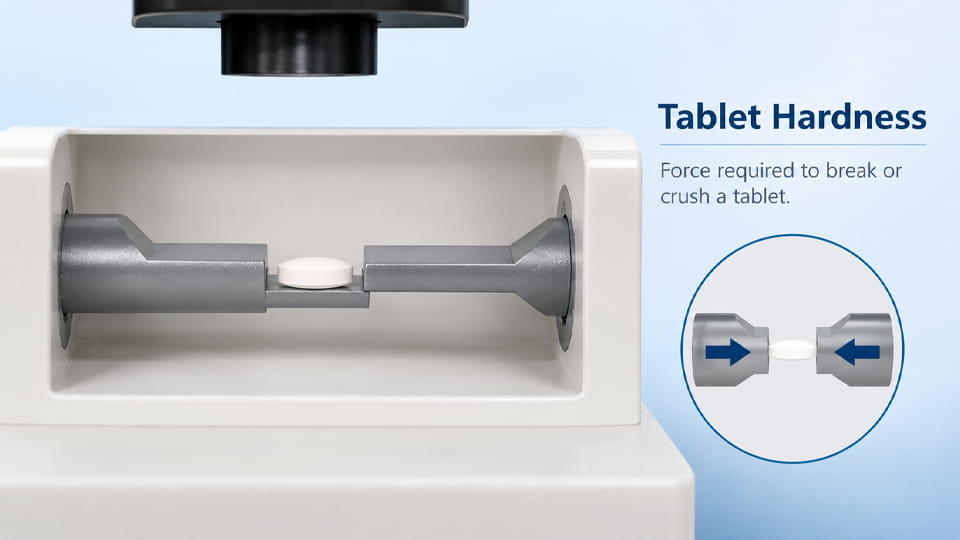
Tablet hardness (technically “tablet breaking force”) is the force required to break a tablet by compression. In practice, hardness is measured by placing the tablet between two anvils or platens and applying force until it fractures. Modern hardness testers (manual or digital) measure the peak force in kilograms or newtons. Tablet breaking force is critical for quality control: a tablet must be strong enough to withstand handling, packaging, and shipping without breaking. The U.S. and European pharmacopeias specify standardized methods for hardness (breaking force) testing. Some industry literature prefers the term “breaking force” over “hardness,” since in material science “hardness” typically means resistance to surface indentation, whereas tablet testing measures compression strength.
Tablet hardness is influenced by formulation and process parameters. Higher compression force generally yields harder tablets, while formulation factors like binder and lubricants also affect hardness. For example, increasing a binder (e.g. PVP or HPMC) usually increases tablet strength, whereas too much lubricant (magnesium stearate) can weaken interparticle bonding. The tablet’s size, shape, and porosity also play roles: thicker or denser tablets often require more force to break.
Too low a hardness (under-compression) causes tablets to crack, crumble or chip easily. Too high a hardness, however, can have downsides: very hard tablets may disintegrate slowly or dissolve too slowly in the body. A tablet that is too hard can also be difficult for patients to swallow. Thus, tablet design must balance mechanical strength with performance. In practice, manufacturers set an acceptance range (e.g. 4–10 kg or so) for breaking force during production.
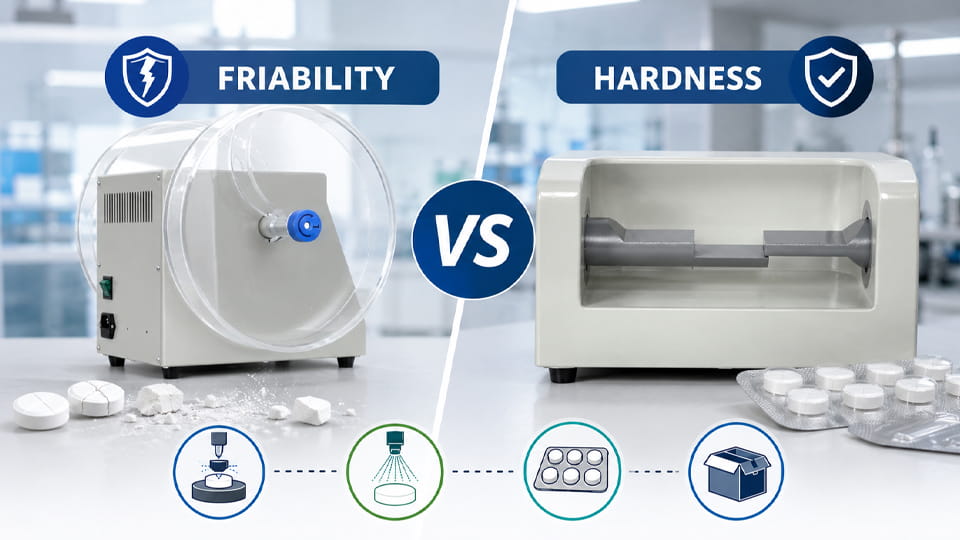
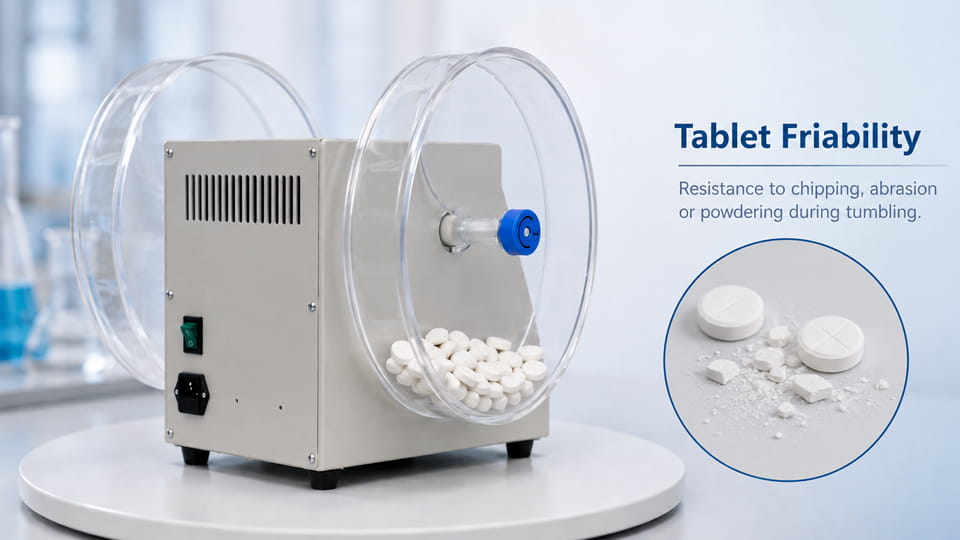
Tablet friability is a measure of how easily a tablet crumbles or loses mass when subjected to mechanical stress, such as tumbling or impact. Friability testing involves placing dedusted tablets in a rotating drum (Roche friabilator), typically at 25 rpm, and subjecting them to 100 revolutions. Each revolution tumbles and drops the tablets a fixed height to simulate stress during handling and transport. After the test, tablets are collected, and any loose dust is removed. The tablets are weighed before and after to determine weight loss percentage, which is reported as friability. For example, the USP <1216> and Ph.Eur. monographs describe this procedure.
The lower the friability, the more resistant the tablet is to abrasion or chipping. An acceptable friability limit is conventionally ≤1.0% weight loss. Tablets that lose more than this threshold, or that visibly crack or break during the test, fail the friability criterion. Tablet friability specifically addresses post-compression durability – it simulates the physical stress tablets face in coating pans, conveyors, bottle fillers, blister lines, and packaging. High friability manifests as chips on tablet edges, visible cracks, or excess dust. Friability is thus a quality attribute linked closely with packaging and handling robustness.
These tests sound similar but probe different stresses. In simple terms:
Imagine two tablets: one tested at 20 kP (kiloponds) of crush force (very hard) and one at 5 kP (soft). You might think the 20 kP tablet is indestructible, but if its edges are brittle, it could still lose 2–3% mass in a friability drum – twice the acceptable limit. In practice, a tablet can be “extremely hard—requiring significant force to crush—yet surprisingly brittle.”. This shows why both tests are needed. The table below summarizes the difference:
In short: hardness resists crushing, while friability resists chipping. A robust tablet design balances both: it must survive the press and machines without dusting, yet still dissolve properly.
| Parameter | Tablet Hardness (Breaking Force) | Tablet Friability |
|---|---|---|
| What It Measures | Resistance to a single applied force (compression or tension) causing fracture | Resistance to repeated abrasion, impact, and chipping (weight loss when tumbled) |
| Typical Stress Type | One-time large compressive or three-point flexural load until failure | Multiple tumbles/falls (usually 100 rotations) simulating handling shocks |
| Main Purpose | Evaluate tablet’s breaking strength (formulation robustness under compression) | Evaluate durability during conveying, coating, and packaging |
| Test Output | Breaking force value (e.g. in Newtons or kp) | Percent weight loss after test (and visual inspection for damage) |
| Link to Quality | Sets compression parameters; ensures tablets won’t crack under force | Sets packaging line settings; ensures tablets survive coating/transport |
| Replaceable by Other Test? | No. Different stress; needs its own measurement. | No. Different test rationale; cannot substitute hardness test. |
The table above highlights that hardness and friability measure different aspects. Hardness (breaking force) is a one-time stress test, whereas friability tests repeated low-level shocks. Importantly, a tablet can be hard yet fragile or vice versa. For example, a tablet with high breaking force may still fail the friability test if its edges chip easily or if internal bonding is uneven. In short, hardness and friability are related but not interchangeable – both must be evaluated.
Tablet hardness testers apply a controlled force to a single tablet until it fractures. In a typical tester, two flat anvils (platens) grip the tablet – one stationary, one moving. The tester records the force at break. Manual testers (spring-based like Monsanto) and modern digital testers (with load cells and electronic readouts) are common. Electronic testers provide precise, repeatable measurements and often measure diameter and thickness simultaneously. During testing, factors like tablet orientation (for flat-faced tablets) or special fixtures (for unusual shapes) are carefully controlled to ensure consistent results. The measured breaking force informs quality control: batches are accepted only if hardness falls within the defined range for that formulation.
A friabilator or friability tester tumbles a sample of tablets in a transparent drum to simulate handling. Key steps (per USP/Ph.Eur.) are: 1. Dedust and weigh a tablet sample (e.g. 6.5 g or 10 tablets). 2. Place tablets in a rotating drum with a lifting tab inside. 3. Rotate at 25 rpm for 100 revolutions (4 minutes). 4. Remove tablets, remove loose dust, reweigh. 5. Calculate % weight loss: .
If any tablet is cracked or broken after tumbling, the batch fails immediately. Otherwise, if total weight loss >1%, the test is repeated in triplicate and an average is used. In practice, passing tablets show minimal chips or dust. Friability results guide decisions before coating and packaging: high loss prompts reformulation or process change.
Test methods assume uncoated tablets. Coated tablets can also be tested, but they often have lower friability simply due to the shell. Conversely, effervescent or highly porous tablets may require special humidity control during testing. Tablet shape and size affect tumbling behaviour; for irregular shapes, the drum base can be tilted ~10° to ensure random movement. In all cases, compendial standards (USP, Ph.Eur.) specify apparatus and procedure. Modern lab practice also checks calibration of hardness and friability testers and runs QC with standard reference tablets regularly.
Both properties depend on formulation and processing. Key factors include binder type/concentration, compression force, and tablet shape. For example:
Because so many variables matter, manufacturers set target ranges rather than single values. There is no universal “perfect” hardness; it depends on the product’s dosage form, intended use, and packaging. A chewable vitamin and a film-coated painkiller may have very different optimal hardness levels, even if they weigh the same.
The compression stage on the tablet press largely determines hardness. In practice:

In short, optimizing compression parameters and formulations is essential. As JinluPacking’s troubleshooting guide notes, “if tablets are too soft, they may chip, break, or exhibit high friability. If too hard, they may resist coating or dissolve slowly.”. By tuning the compression force and binder content, manufacturers can aim for tablets that withstand process stresses without overshooting on hardness.
Tablet coating (film or sugar coating) is very sensitive to the core tablet’s strength. During coating, tablets tumble in a rotating pan and spray solution on them. This tumbling applies mechanical stress and moisture. Here’s how hardness and friability come into play:
Once tablets are pressed and coated, they move to packaging lines – blister machines, cartoners, or bottle-filling lines. Tablet strength is crucial here too:

To achieve top-quality tablets that meet coating and packaging demands, keep these points in mind:
In practice, the goal is a tablet that is “hard enough to survive handling but not so hard that it fails dissolution tests.”. Many manufacturers chart compression force, hardness, and friability in real time to spot trends early (for example, sudden drift in hardness might signal a change in powder feed or humidity).
In summary, hardness and friability are two sides of the same coin for tablet quality. Hardness ensures a tablet’s core strength under compression, while friability gauges surface robustness against abrasion. Properly balanced, they guarantee that tablets sail through coating pans and packaging machines without chipping or breaking. Tablets that are too soft will generate dust and coating defects, while tablets that are too hard can resist coating solutions or yield a poor patient experience.
For pharma manufacturers and packaging engineers, paying attention to both tests is critical. Make sure to integrate friability and hardness testing into your quality checkpoints, and adjust formulation/compression as needed. By doing so, you’ll minimize costly rejections and ensure smooth operation on your blister packing lines, cartoning machines, or bottling lines.
Ready to optimize your tablet production and packaging line? JinluPacking’s team has decades of experience in pharmaceutical compression and packaging. Whether you need a high-speed tablet press, deduster, or a custom blister packaging solution, we can help ensure your tablets stay intact from press to patient. Contact us to discuss how our machines and expertise can support your production goals.
No. Hardness (breaking force) measures the force needed to fracture a tablet under a single load. Friability measures the tablet’s durability under repeated abrasion, expressed as % weight loss in a drum test. They assess different properties.
Yes. A tablet might have a high breaking force (hard) but still chip at the edges if its particle bonding is poor. Such a tablet could break easily when tumbled, yielding high friability. Conversely, a tablet with moderate hardness could pass friability if it is shape-robust. Thus both tests are needed.
The common industry standard is ≤1.0% weight loss after friability testing. Many manufacturers set 0.5–1% as the specification for ordinary tablets. Some products (e.g. very large or unusual tablets) may have special criteria, but 1% is a typical guideline.
Hardness can significantly influence dissolution. An overly hard tablet may disintegrate slowly, delaying drug release. Regulatory tests have shown that very hard tablets (compressed at high forces) can fall outside dissolution spec because the tablet matrix is too tight. Conversely, a very soft tablet might disintegrate quickly but could break apart prematurely. Optimal hardness ensures timely disintegration without breakage.
Common causes include insufficient binder, improper granulation moisture, inadequate compression, excess lubricant, and brittle excipients. For example, tablets with too little binder material or over-dried granules tend to be more friable. A typical solution is to adjust the formulation (e.g. more effective binder) or optimize the wet granulation and drying process.
Not always. Higher compression generally increases hardness and can reduce friability initially, but it has limits. Excessive force may lead to capping, lamination or altered dissolution. Also, if the formulation is flawed (e.g. poor binding), simply cranking up pressure may not solve friability. It’s best to optimize both formulation and force together.
Because they address different mechanical stresses. Hardness ensures the tablet can survive a single crushing force (important for compression and cutting), while friability ensures it can survive repeated knocks (important for coating, handling, and packaging). Only by evaluating both can manufacturers be confident that tablets will maintain integrity through the entire production and delivery chain.
Equipment design is critical. For example, high-speed cartoners use sensors and cushioned chutes to slow tablets gently (preventing breakage on impact). Vacuum conveyors with smooth bends reduce shock. Bottling lines often have flexible tubes and slow transitions. Well-designed tablet handling systems reduce vibration, drops, and friction, directly lowering breakage and dust generation.
References:
1.Tablet hardness testing —— Wikipedia
2.ICH 4 QB Annex 9 Tablet friability – Scientific guideline —— European Medicines Agency
3.Q4B Annex 9: Tablet Friability General Chapter —— U.S. Food and Drug Administration
4.Dependence of Friability on Tablet Mechanical Properties and a Predictive Approach for Binary Mixtures —— Experts@Minnesota
5.Effect of moisture and crushing strength on tablet friability and in vitro dissolution —— Wiley Online Library