
Mua hàng máy móc dược phẩm không chỉ là về tốc độ, sự chính xác, tự động hóa, và kích thước máy. Trước khi thiết bị đến nhà máy của bạn, bạn cũng cần biết liệu trang web có thể hỗ trợ nó hay không.
Điều đó có nghĩa là kiểm tra yêu cầu tiện ích thiết bị dược phẩm: năng lượng điện, khí nén, trống, Nước, làm mát, khí thải, và mọi dịch vụ dành riêng cho quy trình như hơi nước hoặc nitơ.
Một chiếc máy có thể hoàn hảo về mặt cơ học nhưng vẫn không đạt được hiệu suất định mức nếu điện áp sai, áp suất không khí giảm trong thời gian sản xuất cao điểm, công suất chân không thấp, hoặc nước làm mát quá ấm. Để mua sắm, kỹ thuật, và các đội sản xuất, lập kế hoạch tiện ích nên bắt đầu trước khi đặt hàng—không phải trong quá trình cài đặt.
Bài học chính
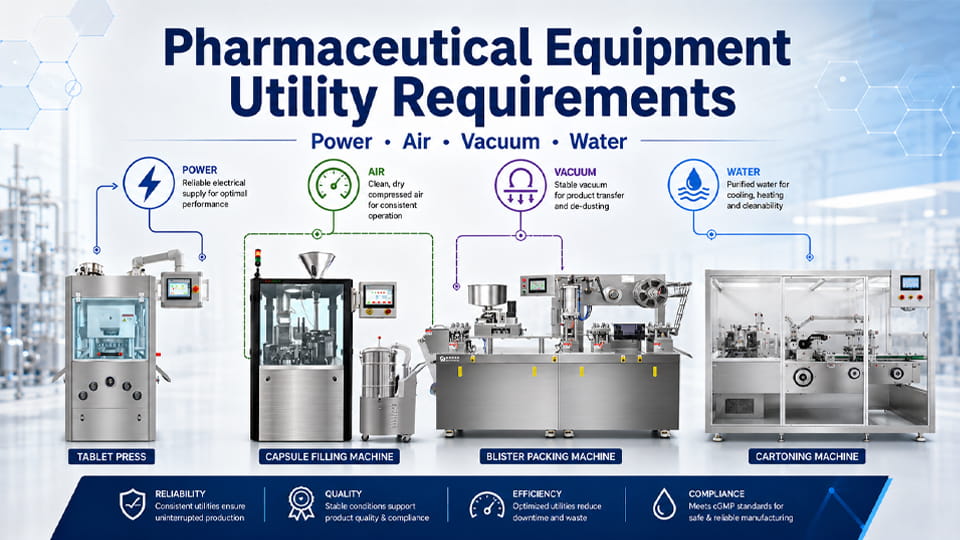
Yêu cầu về tiện ích của thiết bị dược phẩm là các dịch vụ tại chỗ mà máy cần để hoạt động như thiết kế. Năng lượng điện gần như phổ biến. Tùy thuộc vào máy và quy trình, bạn cũng có thể cần khí nén, trống, nước làm mát, xử lý nước, khí thải, hơi nước, nitơ, thoát nước, hoặc điều kiện môi trường được kiểm soát. Danh sách chính xác phụ thuộc vào thiết bị, quá trình, tùy chọn, và mục đích sử dụng.
Không phải mọi tiện ích đều tự động là một tiện ích quan trọng theo nghĩa GMP. Câu hỏi quan trọng là liệu tiện ích có thể ảnh hưởng đến chất lượng sản phẩm hay không?, hiệu suất quá trình, hoặc nguy cơ ô nhiễm.
FDA Q7 xác định các tiện ích như steam, khí đốt, khí nén, sưởi ấm, thông gió, và điều hòa không khí là những hệ thống cần được đánh giá chất lượng và giám sát thích hợp khi chúng có thể ảnh hưởng đến chất lượng sản phẩm. Nó cũng giải quyết vấn đề thông gió, lọc, khí thải, bụi, độ ẩm, nhiệt độ, kiểm soát áp lực, và sự phù hợp với nước.
Hướng dẫn của WHO tuân theo nguyên tắc sử dụng dự kiến tương tự: các tiện ích như HVAC, Nước, nitơ, và khí nén phải phù hợp với mục đích sử dụng và không được ảnh hưởng tiêu cực đến chất lượng sản phẩm hoặc trở thành nguồn gây ô nhiễm..
Dành cho người mua, điểm thực tế rất đơn giản: Yêu cầu về máy và khả năng sử dụng của nhà máy phải phù hợp trước khi lắp đặt.
Tiện ích ảnh hưởng trực tiếp đến hiệu suất thiết bị và chất lượng sản phẩm. Sự không phù hợp về tiện ích thường xảy ra do việc mua sắm, sản xuất, kỹ thuật, và nhóm xác nhận tập trung vào các phần khác nhau của dự án. Các Hướng dẫn GMP của FDA (Q7A) tuyên bố rõ ràng rằng “tất cả các tiện ích có thể ảnh hưởng đến chất lượng sản phẩm (VÍ DỤ., hơi nước, khí đốt, khí nén, sưởi ấm, thông gió, và điều hòa không khí) phải có trình độ chuyên môn và được giám sát thích hợp”. Nói cách khác, nếu nguồn cung cấp khí nén hoặc nước của bạn bị hỏng, nó có thể làm dừng máy hoặc thậm chí làm ô nhiễm sản phẩm. Ví dụ, Lọc khí nén không đủ có thể đưa dầu hoặc vi khuẩn vào viên nang hoặc gói vỉ. Tương tự như vậy, điện áp quá thấp hoặc đường dẫn khí bị tắc có thể khiến động cơ và van hoạt động kém.
Xác nhận tiện ích sớm giúp ngăn chặn ba kết quả tốn kém:
Đây cũng là lý do tại sao việc lập kế hoạch sử dụng tiện ích lại thuộc về vòng đời thiết bị sớm hơn nhiều so với mong đợi của nhiều người mua.. Trong quá trình cài đặt (SAT/IQ), tiện ích là trọng tâm chính. Danh sách kiểm tra lắp đặt thiết bị đóng gói Jinlu xác minh rõ ràng “tiện ích (điện áp, áp suất khí nén, Nước, vân vân.)” so với thông số kỹ thuật của máy. Trong thử nghiệm chấp nhận trang web (ĐÃ NGỒI), kỹ sư sẽ đo điện áp thực tế, áp suất/lưu lượng không khí, nhiệt độ nước, vân vân. từ nguồn cung cấp thiết bị để xác nhận rằng chúng nằm trong phạm vi do máy chỉ định. Tóm lại, việc kết hợp các tiện ích với thông số kỹ thuật của thiết bị là rất quan trọng để tránh những điều bất ngờ: máy không thể chạy ở tốc độ tối đa hoặc có thể bị hỏng nếu, nói, không khí thực vật chỉ 3 thanh thay vì yêu cầu 6 thanh, hoặc nếu động cơ sử dụng sai điện áp.
Bắt đầu với yêu cầu năng lượng thiết bị dược phẩm được nêu trên bảng dữ liệu cuối cùng—không phải thông số kỹ thuật được sao chép từ mẫu khác.
Xác nhận điện áp, đơn- hoặc nguồn điện ba pha, Tính thường xuyên, công suất lắp đặt/định mức, nhu cầu tối đa, kết nối chính, và bất kỳ nguồn cung cấp riêng biệt nào cho các thiết bị phụ trợ. Thiết bị xuất khẩu thường có thể được cấu hình cho các thị trường khác nhau. Ví dụ, Danh sách chất làm đầy viên nang NJP-2600D của JinLu 220/380 V, 50/60 Công suất tùy chỉnh Hz và 8.0 kW tổng công suất; danh sách máy vỉ DPP-260R của nó 380/220/110 V, 50/60 Hz và 5.5 kW. Những ví dụ này cho thấy lý do tại sao người mua không bao giờ nên thừa nhận một “điện áp dược phẩm tiêu chuẩn”.
Cũng riêng biệt công suất lắp đặt từ mức tiêu thụ hoạt động bình thường. Công suất lắp đặt hoặc định mức rất hữu ích cho việc quy hoạch cơ sở hạ tầng điện, nhưng nhu cầu thực tế thay đổi khi máy sưởi, động cơ, máy bơm chân không, băng tải, và chu kỳ mô-đun tùy chọn. Hỏi nhà cung cấp thiết bị dược phẩm cho nhu cầu tối đa/cao điểm và tải chạy dự kiến nếu có. Cáp cuối cùng, máy cắt, sự bảo vệ, nối đất, và thiết kế cách ly phải tuân theo các quy định về điện của quốc gia đến và thiết kế điện đủ tiêu chuẩn của dự án.
Điểm chính:
Xi lanh khí nén, van, cái kẹp, từ chối thiết bị, chức năng làm sạch, và cơ chế xử lý sản phẩm đều có thể phụ thuộc vào khí nén.
Thiết bị dược phẩm cần bao nhiêu khí nén?
Không có yêu cầu chung về không khí trong máy dược phẩm. Chỉ định cả áp suất vận hành—thường được biểu thị bằng bar hoặc MPa—và mức tiêu thụ tính bằng NL/phút, L/phút, Nm³/giờ, hoặc một điều kiện tham chiếu được xác định rõ ràng khác. Hai máy có thể yêu cầu áp suất như nhau nhưng lưu lượng rất khác nhau, vì vậy việc xác định kích thước máy nén chỉ dựa trên áp suất là không đáng tin cậy.
Không khí chất lượng vấn đề tách biệt với áp lực và số lượng. ISO 8573-1:2010 phân loại độ tinh khiết của khí nén theo hạt, Nước, và dầu; kể từ tháng 8 2026, ấn bản đó vẫn được xuất bản trong khi bản sửa đổi đang được phát triển. ISO làm không quy định một loại độ tinh khiết phổ quát cho mọi ứng dụng dược phẩm, vì vậy loại yêu cầu phải dựa trên mục đích sử dụng và nguy cơ ô nhiễm.
Chỉ định lọc, hạt cho phép, tổng dầu, độ ẩm, Và điểm sương áp lực (PDP) khi có liên quan. PDP mô tả nhiệt độ tại đó hơi ẩm sẽ ngưng tụ ở áp suất hệ thống; PDP thấp hơn có nghĩa là khí nén khô hơn. Đối với không khí có thể ảnh hưởng đến sản phẩm tiếp xúc hoặc các bề mặt quan trọng, thiết lập các yêu cầu và xác minh chất lượng tại điểm sử dụng. Hướng dẫn kiểm tra của FDA thảo luận cụ thể về việc xem xét hệ thống khí nén và lọc hạt tại điểm sử dụng trong các hoạt động dược phẩm liên quan.
Có nên không không dầu? Thỉnh thoảng, nhưng “máy nén không dầu” không được thay thế thông số kỹ thuật về chất lượng không khí có thể đo lường được. Xác định loại dầu được chấp nhận tại thời điểm sử dụng, đánh giá rủi ro tiếp xúc với sản phẩm, và sử dụng phương pháp sấy phù hợp, lọc, giám sát, và trình độ chuyên môn. Mục tiêu là kiểm soát lượng khí được phân phối—không chỉ đơn giản là nhãn máy nén.
Điểm chính:
MỘT hệ thống chân không dược phẩm có thể hỗ trợ tách viên nang, định lượng bột có hỗ trợ chân không, xử lý vỉ hoặc vật liệu, hút hút, chuyển giao sản phẩm, hoặc loại bỏ bụi. của JinLu Máy làm viên nang NJP-2600D, Ví dụ, sử dụng bơm chân không để tách nắp/thân viên nang.
Luôn yêu cầu hai tham số:
Mức độ chân không cho bạn biết áp suất thấp như thế nào, hoặc áp suất chênh lệch bao nhiêu, quá trình này đòi hỏi. Tốc độ bơm/lưu lượng chân không cho bạn biết hệ thống có thể loại bỏ bao nhiêu khí theo thời gian. Do đó, các nhà sản xuất máy bơm xuất bản chúng một cách riêng biệt; Họ, Ví dụ, chỉ định cả tốc độ bơm tính bằng m³/h và áp suất có thể đạt được cho thiết bị chân không của nó.
Một máy bơm tích hợp rất đơn giản và giữ cho một máy tương đối độc lập. Một hệ thống trung tâm có thể giảm số lượng máy bơm và tập trung bảo trì, nhưng tổn thất đường ống, nhu cầu đồng thời, phân chia ô nhiễm, và hậu quả của sự thất bại phải được đánh giá. Hỏi nhà cung cấp máy về độ chân không cần thiết ở kết nối máy—không chỉ là thông số đánh giá trên nhãn máy bơm.
Điểm chính:
Thiết bị dược phẩm cần nước gì?
Chất lượng nước phụ thuộc vào tác dụng của nước. Nước làm mát vòng kín, nước uống được, Nước tinh khiết, và WFI không thể thay thế cho nhau thông số kỹ thuật. Xác định xem nước tiếp xúc với sản phẩm hay bề mặt tiếp xúc với sản phẩm, hỗ trợ làm sạch hoặc xử lý, hoặc chỉ loại bỏ nhiệt; sau đó chỉ định chất lượng phù hợp, nhiệt độ, áp lực , chảy, và yêu cầu giám sát.
WHO tuyên bố rằng loại nước dùng cho dược phẩm thích hợp phải được lựa chọn theo tiêu chuẩn ứng dụng dự định, sản phẩm, và giai đoạn sản xuất; WFI có liên quan đến việc sử dụng cụ thể có rủi ro cao hơn so với mọi máy dược phẩm. Tương tự, FDA Q7 yêu cầu nước xử lý phải phù hợp với mục đích sử dụng.
Điều này đặc biệt quan trọng đối với yêu cầu về nước của thiết bị dược phẩm. Nước làm mát máy có thể chỉ lưu thông qua bộ trao đổi nhiệt hoặc tấm làm mát và không bao giờ chạm vào sản phẩm. Tuy nhiên, FDA Q7 yêu cầu chất lỏng làm nóng và chất làm mát phải được kiểm soát để chúng không tiếp xúc bất lợi hoặc ảnh hưởng đến sản phẩm.
Làm mát/làm lạnh, hơi nước, và xả
MỘT máy đóng vỉ, hệ thống sơn, hoặc thiết bị tạo nhiệt khác có thể cần nước làm mát hoặc máy làm lạnh bên ngoài tùy theo thiết kế. Trước khi lựa chọn máy làm lạnh, đạt được nhiệt độ đầu vào cần thiết, chảy, áp lực , tải loại bỏ nhiệt, Khả năng tương thích nước/glycol, và kích thước kết nối. Không nên chỉ tính kích thước từ kW điện của máy.
Hơi nước là không phải là tiện ích tiêu chuẩn cho mọi máy đóng gói. Nó trở nên có liên quan đặc biệt trong hệ thống sưởi, dọn dẹp, khử trùng, lớp phủ, hoặc hệ thống xử lý. Khi hơi nước có thể ảnh hưởng đến chất lượng sản phẩm, FDA và ISPE coi nó như một tiện ích cần có sự kiểm soát thích hợp.
Cuối cùng, đừng quên hút bụi và xả khí. Nén máy tính bảng, viên nang, tạo hạt, và xử lý bột có thể tạo ra lượng bụi cần phải hút hoặc ngăn chặn cục bộ. FDA Q7 kêu gọi thông gió đầy đủ, lọc, và xả ở nơi thích hợp, bao gồm kiểm soát bụi và nguy cơ lây nhiễm chéo.
Điểm chính:
Ngoài bốn tiện ích chính, xem xét các dịch vụ phổ biến này:
Ma trận sau đây là một công cụ lập kế hoạch, không phải thông số kỹ thuật của máy. “Thông thường” có nghĩa là thường xuyên gặp phải; “Phụ thuộc vào mô hình” có nghĩa là cấu hình cuối cùng, sản phẩm, hoặc quá trình quyết định.
| Thiết bị | Quyền lực | Khí nén | chân không | Nước / Máy làm lạnh | Khí thải / Bụi |
| Báo chí máy tính bảng | Yêu cầu | Chung | Phụ thuộc vào mô hình | Thường bị hạn chế | Chung |
| Máy làm đầy viên nang | Yêu cầu | Chung | Chung | Thường bị hạn chế | Chung |
| Máy đóng gói vỉ | Yêu cầu | Chung | Phụ thuộc vào mô hình | Phụ thuộc vào mô hình | Phụ thuộc vào mô hình |
| Máy tính bảng/viên nang | Yêu cầu | Phụ thuộc vào mô hình | Thường bị hạn chế | Thường thì không | Phụ thuộc vào mô hình |
| Máy đóng thùng | Yêu cầu | Chung | Phụ thuộc vào mô hình | Thường thì không | Thường bị hạn chế |
| Máy phủ | Yêu cầu | Chung | Phụ thuộc vào mô hình | Phổ biến/phụ thuộc vào quá trình | Chung |
| Máy tạo hạt / hệ thống giường chất lỏng | Yêu cầu | Chung | Phụ thuộc vào quy trình | Phụ thuộc vào quy trình | Chung |
Dữ liệu của nhà sản xuất hỗ trợ sự thay đổi thay vì một số ngành duy nhất: JinLu liệt kê các nguồn cung cấp điện có thể tùy chỉnh trên toàn bộ Máy làm đầy viên nang Và máy đóng gói vỉ, và công bố khí nén 6 bar cho một máy ép viên và các giá trị lưu lượng cụ thể cho máy nạp viên nang.
Đối mặt với nhà cung cấp hữu ích ví dụ về đặc tả tiện ích có thể trông như thế này:
| Tính thiết thực | Yêu cầu minh họa | Người mua nên xác minh những gì |
| Quyền lực | 380 V, 50 Hz, 3-giai đoạn | Cung cấp địa phương, sức chịu đựng, sự bảo vệ |
| Nguồn điện lắp đặt | 8 kW | Nhu cầu cao điểm và phụ trợ |
| Khí nén | 6 thanh ở đầu vào máy | Áp lực trong thời gian sản xuất cao điểm |
| Tiêu thụ không khí | 200 NL/phút | Lưu lượng bình thường và tối đa |
| Chất lượng không khí | ISO 8573-1 lớp học: TBD của URS | hạt, nước/PDP, dầu |
| chân không | −60 kPa(g), 80 m³/h | Mức độ yêu cầu Và chảy |
| Nước làm mát | 15–20°C, 5 L/phút | Tải nhiệt, áp lực , nhiệt độ trở lại |
| Khí thải | 500 m³/h | Áp suất tĩnh và lọc |
| Kết nối | Nhà cung cấp xác định | Kích cỡ, bên, độ cao, lắp |
Đây là những giá trị minh họa có chủ ý, không phải thông số kỹ thuật cho bất kỳ mô hình JinLu hoặc bên thứ ba nào. Số liệu cuối cùng phải đến từ bảng tiện ích đã được phê duyệt của máy đã chọn. Các tờ giấy thực tế của nhà sản xuất cho thấy các giá trị có thể thay đổi rộng đến mức nào.
Đối với một dòng mới, không thêm mọi giá trị bảng tên một cách mù quáng và không chỉ kích thước cho một máy.
Đối với mỗi tiện ích, xây dựng lịch trình tải:
Nhu cầu thiết kế ≈ Σ (nhu cầu thiết bị × hệ số sử dụng đồng thời dự kiến) + dự trữ hợp lý
Sử dụng mức tiêu thụ vận hành tối đa của nhà cung cấp khi máy có thể chạy liên tục ở mức tải đó. Xác định riêng người dùng không liên tục. Sau đó kiểm tra một kịch bản sản xuất đáng tin cậy nhất—ví dụ:, máy vỉ, thùng carton, quầy tính tiền, và các thiết bị loại bỏ bằng khí nén đều hoạt động trong khi dây chuyền khác bắt đầu.
Trước khi cài đặt, xác minh tất cả các tiện ích tại địa điểm phù hợp với thông số kỹ thuật của thiết bị. Một danh sách kiểm tra có thể bao gồm:
Ví dụ: Trước khi vận chuyển, nhà cung cấp có thể cung cấp danh sách Bảng thông số kỹ thuật thiết bị “Không khí: 6.0 thanh, 200 NL/phút; chân không: –60 kPa; Quyền lực: 380VAC 3 pha, 10 kW.” Sử dụng điều này để thiết lập mạch và đường ống. Trong quá trình cài đặt IQ, đo từng nguồn cung cấp để xác nhận nó đáp ứng các thông số kỹ thuật đó.
Một URS kỹ lưỡng phải liệt kê rõ ràng tất cả các tiện ích và điều kiện cần thiết. Trong mục “Tiện ích và Môi trường”, chỉ định giá trị chính xác (ví dụ. “Khí nén: 6.0 thanh ±0,2, 100 NL/phút, Lớp ISO 8573‑1 1.0. Điện: 400 V, 3-f, 50 Hz, 15 kW.”). Hướng dẫn quy định (Phụ lục EU GMP 15) yêu cầu xác minh các yêu cầu URS trong quá trình Thẩm định thiết kế. Trong thực tế, bao gồm các thông số kỹ thuật tiện ích rõ ràng trong URS/bản vẽ hợp đồng buộc cả người mua và nhà cung cấp phải đồng ý trước về nhu cầu. Nó cũng làm cho IR/WH/PQ kiểm tra đơn giản – mỗi lần kết nối tiện ích có thể được truy nguyên về một mục URS.
Luôn xác nhận danh sách tiện ích với nhà cung cấp của bạn trước khi đặt hàng. Các nhà cung cấp nên cung cấp một Bảng yêu cầu tiện ích hoặc bảng dữ liệu cho từng máy. Xem lại những điều này trong cuộc họp khởi động hoặc thêm chúng vào đơn đặt hàng. Ví dụ, yêu cầu nhà cung cấp đưa thông số kỹ thuật tiện ích vào Dữ liệu nhà cung cấp (như một phần của FAT). Trong kỳ thi SAT, xác minh thực tế từng kết nối: đo điện áp của trang web, áp lực , và tuân theo thông số kỹ thuật của nhà cung cấp. Giữ tài liệu đăng xuất (thường là một phần của báo cáo IQ) rằng “các tiện ích được kết nối và đáp ứng thông số kỹ thuật” - đây là kỳ vọng của GMP (IQ thường bao gồm việc kiểm tra sức mạnh, khí nén, kết nối nước).
Nếu có gì không khớp (ví dụ. trang web chỉ có 200 V nhưng máy cần 400 V), giải quyết ngay lập tức – cung cấp máy biến áp hoặc yêu cầu nhà cung cấp cấu hình lại máy. Nhớ, các vấn đề không khớp về tiện ích dễ khắc phục hơn trước khi bắt đầu sản xuất hơn là sau đó.
Tóm lại, Lập kế hoạch tiện ích cẩn thận cũng quan trọng như việc chọn đúng máy. Một dây chuyền thiết bị chỉ có thể chạy với tốc độ và chất lượng như dự kiến nếu quyền lực, không khí, trống, và nước có sẵn ở các thông số kỹ thuật chính xác. Sử dụng bảng của hướng dẫn này, danh sách kiểm tra và công thức để ước tính nhu cầu của bạn và đưa chúng vào URS. Làm việc với bạn nhà cung cấp thiết bị (chẳng hạn như Jinlu Đóng gói) để ghi lại từng yêu cầu tiện ích và xác minh nó tại chỗ.
Sẵn sàng đơn giản hóa việc lập kế hoạch tiện ích? Các chuyên gia của Jinlu Packing có thể tư vấn về kết nối nguồn và tiện ích cho tất cả các sản phẩm của chúng tôi máy đóng gói dược phẩm. Truy cập các trang sản phẩm của Jinlu – ví dụ: Máy làm đầy viên nang, Máy ép viên, Máy đóng gói vỉ, Đếm máy, Máy đóng thùng, Máy đóng gói gói hoặc Máy đóng gói túi làm sẵn – để biết thông số kỹ thuật tiện ích và thông tin liên hệ. Để được hỗ trợ thêm, liên lạc với đội của chúng tôi để đảm bảo cơ sở của bạn sẵn sàng sử dụng để cài đặt suôn sẻ và vận hành tuân thủ.
Cơ bản là năng lượng điện, khí nén, trống, và nước/làm mát. Nhiều dây chuyền đóng gói còn sử dụng hơi nước sạch (cho máy tiệt trùng), khí trơ (N₂ cho gói gối), và hút bụi. Hướng dẫn quy định (ví dụ. FDA Q7A) gọi rõ ràng hơi nước, khí đốt (không khí/nitơ), HVAC, vân vân. là các tiện ích phải đủ tiêu chuẩn.
Hầu hết các thiết bị là điện công nghiệp 3 pha. Thông thường 380–400 VAC (50 Hz) hoặc 480 VAC (60 Hz) với dây trung tính hoặc nối đất. Một số thiết bị nhỏ hơn có thể chạy trên 220–240 VAC một pha. Điều quan trọng là phải xác nhận chính xác điện áp và pha (Máy Jinlu thường hỗ trợ 380/220/110 VAC 50/60 Hz). Đồng thời kiểm tra xem máy có 50 Hz so với 60 Hz hoặc nếu nó có thể chấp nhận cả hai (càng nhiều càng tốt).
Nó phụ thuộc vào máy và số lượng đơn vị. Một máy đóng vỉ hoặc đóng thùng có thể cần khoảng 50–200 NL/phút (ở mức ~5–6 thanh). Máy làm đầy viên nang hoặc máy đếm có thể sử dụng 30–100 NL/phút. Áp suất thường là ~ 5–6 bar (0.5–0,6 MPa). Kiểm tra thông số kỹ thuật của từng máy để biết lưu lượng (thường được tính bằng NL/phút hoặc SCFM) và áp lực. Tính tổng chúng cho dòng của bạn (nhớ yếu tố đa dạng). Luôn cung cấp thêm một ít thể tích trong hệ thống máy nén của nhà máy để đáp ứng nhu cầu cao điểm.
Tiêu chuẩn dược phẩm yêu cầu không chứa dầu, không khí khô. Thông thường ISO 8573-1 Lớp học 2 (hoặc tốt hơn) được khuyến nghị cho không khí trong khu vực dược phẩm. Điều này có nghĩa là về cơ bản 0 dầu (Lớp học 0 chứng nhận), điểm sương của nước ≤–40 °C, và bộ lọc hạt chặt chẽ (ví dụ. 0.01 ừm). Chỉ định những điều này trong URS của bạn. Ví dụ: “Khí nén: 6.0 thanh, 99.995% không dầu, điểm sương –40 °C, 0.01 Bộ lọc µm tại điểm sử dụng” là một yêu cầu rõ ràng.
Nói chung là không, trừ khi đó là một quá trình tiệt trùng. Để rửa hoặc làm mát, nước uống thông thường có thể chấp nhận được. Hướng dẫn của FDA cho biết nước xử lý tối thiểu phải đáp ứng tiêu chuẩn nước uống được của WHO (nước uống) tiêu chuẩn. Chỉ sử dụng PW hoặc WFI chất lượng cao hơn nếu thiết bị liên quan trực tiếp đến sản phẩm tiêm hoặc nếu hơi nước sạch được tạo ra từ sản phẩm tiêm. Luôn làm rõ trong URS: “Cung cấp nước: có thể uống được (NSF đã được phê duyệt) để làm mát; không tiếp xúc với nước với sản phẩm.”
Dành một phần cho “Tiện ích và Môi trường” và liệt kê các con số chính xác. Ví dụ: “Điện: 400 VAC, 3f, 50 Hz, 15 kW. Không khí: 6.0 thanh ±0,2, 100 NL/phút. chân không: –70 kPa (cơ bụng). Nước: 30 psi, 20 L/phút.” Hướng dẫn Jinlu URS nhấn mạnh rằng các tiện ích (điện áp, áp suất/lưu lượng không khí, nước làm mát, trống, vân vân.) phải được chỉ định. Đưa các yêu cầu này vào đơn đặt hàng để nhà cung cấp có thể đảm bảo chúng ở mức FAT/SAT.
Cuối cùng, người mua/cơ sở phải đảm bảo các tiện ích tại địa điểm đáp ứng các thông số kỹ thuật, nhưng nhà cung cấp nên ghi lại những gì cần thiết. Trong thời gian FAT, nhà cung cấp có thể mô phỏng các tiện ích; nhưng SAT/IQ là nơi bạn (người dùng) xác nhận với nguồn cung cấp thực tế. GMP yêu cầu các bài kiểm tra IQ được ghi lại cho các tiện ích. Trong thực tế, đội bảo trì/kỹ thuật chuẩn bị địa điểm, và QA hoặc kỹ thuật sẽ xác minh các tiện ích vào ngày lắp đặt.
Bất kỳ sự không phù hợp nào đều được coi là “không phù hợp”. Ví dụ, nếu nguồn điện của trang web sai, bạn sẽ cần một thợ điện để sửa đổi bảng điều khiển (hoặc nhà cung cấp thay đổi máy biến áp). Nếu áp suất không khí thấp, bạn có thể cần một bộ tăng cường hoặc bộ điều chỉnh. Không khởi động máy trong những điều kiện này - máy có thể không chạy hoặc có thể làm hỏng thiết bị. Khắc phục sự cố hoặc yêu cầu nhà cung cấp điều chỉnh thiết kế. Lý tưởng nhất, những vấn đề như vậy được phát hiện trong SAT và được giải quyết trước khi vận hành.
Đúng. Sử dụng dầu cấp thực phẩm trong hệ thống chân không hoặc khí nén; đảm bảo tất cả các chất bôi trơn đều tương thích với việc sử dụng dược phẩm. Dán nhãn các dòng tiện ích rõ ràng (ghi nhãn ống giúp tránh sai lầm). Cung cấp các điểm dừng khẩn cấp và đảm bảo có thể tắt tiện ích trong phòng sạch. Tránh tắc nghẽn trong đường ống (không có vùng trì trệ). Và hãy nhớ rằng kiểm tra chất lượng tiện ích là một phần của GMP – ví dụ:. Thanh tra FDA sẽ xem xét chứng chỉ khí nén và kiểm tra nước của bạn.
Tài liệu tham khảo:
1.Hướng dẫn thực hành tốt: Tiện ích quan trọng Tuân thủ GMP —— ispe
2.Tiện ích quan trọng —— ispe
3.Q7A Hướng dẫn thực hành sản xuất tốt cho hoạt chất dược phẩm —— CHÚNG TA. Cục Quản lý Thực phẩm và Dược phẩm
4.Phòng sạch và môi trường được kiểm soát liên quan —— ISO 14644-1:2015