
GMP contre GMPc est l'une des questions les plus courantes dans fabrication pharmaceutique-et pour cause. Bien que les deux termes soient étroitement liés, ils ne sont pas identiques. Comprendre la différence est essentiel pour les fabricants de produits pharmaceutiques, acheteurs d'équipement, directeurs de production, et des équipes qualité car ces normes influencent chaque étape de la production, de la conception des installations et de la validation des processus à la sélection des équipements et à la qualité des produits. En particulier, le " Actuel " dans Bonnes pratiques de fabrication actuelles (cgMP) reflète l'attente selon laquelle les fabricants adoptent continuellement des technologies de pointe, systèmes, et des pratiques de qualité plutôt que de s'appuyer sur des méthodes obsolètes.
Que vous investissiez dans une nouvelle ligne de conditionnement de bouteilles, mise à niveau d'une ligne de production existante, ou préparation aux inspections réglementaires, compréhension GMP contre GMPc peut vous aider à prendre des décisions plus éclairées. Dans ce guide, nous expliquerons les principales différences entre GMP et cGMP, décrire leur exigences de conformité, et montrer à quel point c'est moderne équipement d'emballage pharmaceutique prend en charge plus sûr, plus efficace, et une fabrication entièrement conforme.
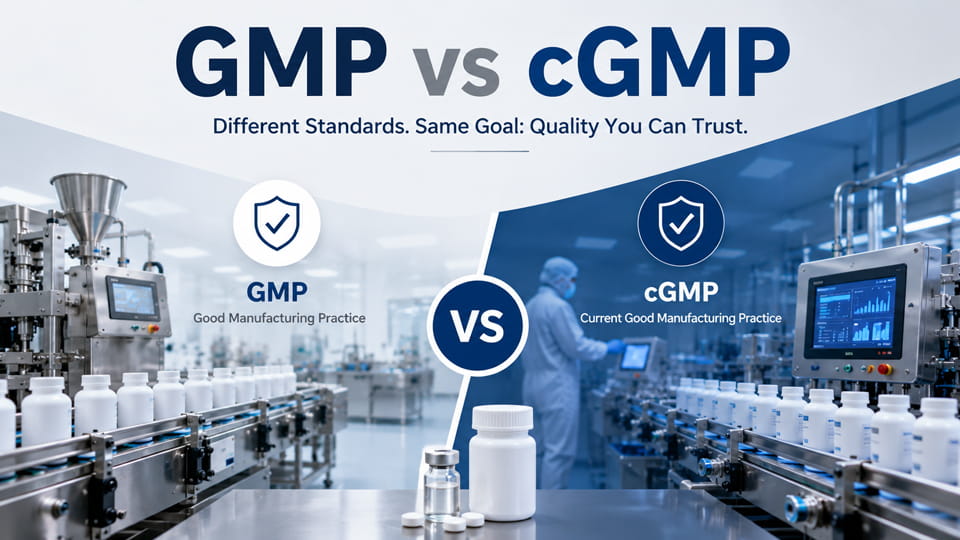
Bonne pratique de fabrication (GMP) est un cadre mondial d’assurance qualité pour l’industrie pharmaceutique. L'OMS définit les BPF comme l'aspect de l'assurance qualité qui garantit que les produits sont systématiquement produits et contrôlés selon des normes de qualité appropriées.. De la même manière, l'Agence européenne des médicaments (Ema) décrit GMP comme le minimum norme qu'un fabricant de médicaments doit respecter en matière de production. En pratique, GMP couvre la conception des installations, équipement, matières premières, formation du personnel, procédures écrites, et tests. L’objectif est de garantir que chaque lot est de haute qualité, adapté à l'usage prévu, et correspond à ses spécifications.
Alors que l'OMS, L'EMA et d'autres régulateurs l'appellent « GMP," Ce terme est essentiellement interchangeable avec cGMP en dehors des États-Unis.. En fait, Les directives de l’OMS indiquent que les BPF sont « également appelées « BPFc » ou BPF « actuelles » » dans certains contextes.. Pour de nombreux fabricants internationaux, respecter les directives BPF signifie obtenir les mêmes résultats de qualité que ceux que la FDA mettra plus tard en avant avec cGMP.
Bonnes pratiques de fabrication actuelles (cgMP) est le terme utilisé par la FDA pour désigner ces réglementations aux États-Unis. La FDA définit les cGMP comme les systèmes qui garantissent une conception appropriée, surveillance et contrôle des processus et des installations de fabrication. Comme GMP, cGMP vise à garantir que les produits pharmaceutiques ont l'identité, force, qualité et pureté qu'ils revendiquent. En fait, les réglementations de la FDA couvrent explicitement tout, depuis la propreté et l'équipement des installations jusqu'aux qualifications du personnel et à la tenue des dossiers. (21 Pièces CFR 210 et 211).
La distinction essentielle est que le « C » dans cGMP signifie actuel. Cela signifie que les entreprises doivent utiliser des technologies à jour, équipement et procédures. Comme le note la FDA, des systèmes et des équipements « haut de gamme » 10 ou 20 il y a des années, ils pourraient désormais ne pas respecter les BPFc, parce que les normes de qualité et la technologie évoluent avec le temps. En bref, cGMP comporte les mêmes exigences de qualité que GMP, mais met l'accent sur l'amélioration et la modernisation continues.. La conformité aux BPFc est assurée par les inspections de la FDA, et le non-respect de ces normes rend légalement un médicament « frelaté ».,» même s'il passe les tests en laboratoire.
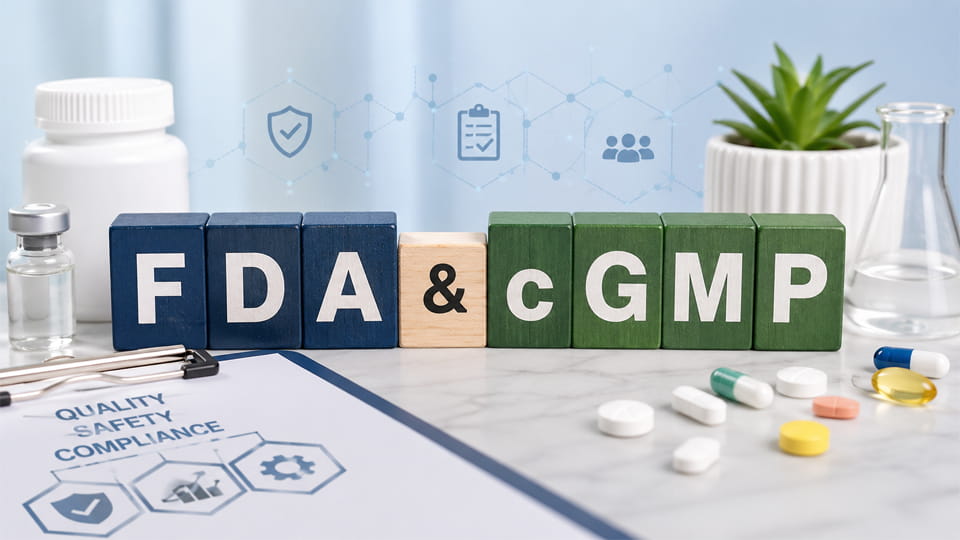
Alors que GMP et cGMP visent le même résultat (sûr, médicaments de haute qualité), les différences résident dans l'accent et l'utilisation. Le tableau ci-dessous résume les principales distinctions:
| Aspect | GMP (Bonne pratique de fabrication) | cgMP (BPF actuelle, FDA) |
| Terminologie | « Bonnes pratiques de fabrication » – utilisées par l'OMS, Ema, PHOTOS, etc.. | « Bonnes pratiques de fabrication actuelles » – le terme utilisé par la FDA |
| Contexte réglementaire | Norme mondiale appliquée par de nombreux pays (OMS, PHOTOS, BPF de l'UE) | Réglementations spécifiques aux États-Unis (21 CFR 210-211) |
| Se concentrer | Répond constamment aux normes de qualité établies | Répond aux normes et maintient la technologie/les processus à jour |
| Exigence technologique | Généralement statique (répond aux normes de base) | Doit utiliser les derniers équipements et méthodes validés |
| Documentation | SOP et enregistrements détaillés requis | Une documentation encore plus rigoureuse (enregistrements électroniques, pistes d'audit) |
| Validation | Validation du processus et du nettoyage attendue | Qualification des équipements (IR/WH/PQ) et validation du processus obligatoire |
| Système qualité | Système de gestion de la qualité standard | QMS amélioré basé sur les risques; cycles d'amélioration continue |
| Inspections & Mises à jour | Inspections périodiques pour vérifier la conformité aux BPF | Même, mais la FDA s'attend à des mises à jour continues; ce qui était conforme peut devenir obsolète |
| Portée réglementaire | MOI/MOI: conformité imposée par l'EMA & agences nationales | NOUS: conformité imposée par la FDA; le non-respect entraîne des poursuites judiciaires |
En substance, cgMP est BPF plus l’attente de suivre le rythme des meilleures pratiques modernes. Comme l’explique une analyse de l’industrie, cGMP « se concentre sur l'amélioration continue et signifie que les normes et technologies les plus récentes sont utilisées pour garantir la qualité., alors que les BPF sont considérées comme un ensemble de principes ». En termes pratiques, cGMP répond à toutes les exigences GMP, mais en insistant davantage sur le fait que les entreprises doivent activement processus de mise à niveau et documentation.
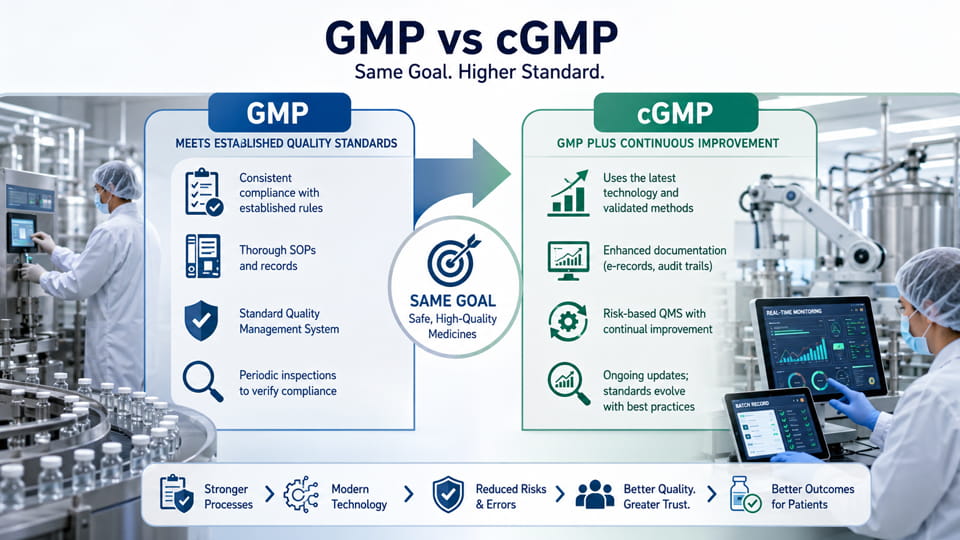
Le « courant » dans cGMP n’est pas qu’un mot à la mode: cela signale que les installations, les machines et les systèmes qualité ne doivent jamais devenir obsolètes. Par exemple, si une méthode de production ou un équipement plus ancien s'avère inférieur, Les normes cGMP signifient que l'entreprise doit mettre en œuvre des solutions plus récentes. Cette approche stimule l’innovation: les entreprises qui adoptent les BPFc investissent dans les enregistrements électroniques des lots, systèmes d'inspection automatisés, surveillance des données en temps réel et autres avancées qui améliorent la qualité et réduisent les erreurs.
La lettre « c » dans cGMP souligne un point simple mais crucial: la conformité signifie l'utilisation actuel connaissance et technologie. C’est important car la science et les équipements pharmaceutiques évoluent rapidement. Quelle était une méthode de nettoyage valide 20 il y a quelques années ne répond peut-être plus aux normes de contamination d’aujourd’hui, et de nouveaux outils (comme les systèmes numériques de gestion de la qualité) offrent une meilleure traçabilité que les journaux papier.
Les régulateurs s'attendent régulièrement à ce que les fabricants améliorer activement. Par exemple, Les directives de la FDA indiquent que les équipements doivent être construits et situés de manière à faciliter le nettoyage et à prévenir la contamination – ce qui implique que les conceptions doivent s'adapter à mesure que nous en apprenons davantage sur le contrôle de la contamination.. Si une meilleure stérilisation ou du matériel devient disponible, cGMP appelle à les intégrer. Points forts de Jinlupacking: « Le « courant » du cGMP souligne que les fabricants doivent utiliser des technologies et des systèmes à jour.," lequel favorise l’amélioration continue dans les processus de fabrication.
En pratique, cela signifie que les installations doivent disposer d'un système qualité qui examine et révise les processus lorsque les réglementations ou les normes de l'industrie sont mises à jour.. La partie 21CFR de la FDA 11 (pour systèmes informatisés) est un exemple: il a été ajouté pour traiter les enregistrements et les signatures électroniques. Sous cGMP, les sociétés pharmaceutiques ont dû intégrer des connexions uniques, des pistes d'audit et des fonctionnalités de sécurité dans leurs équipements et logiciels informatisés. Si une entreprise avait continué à utiliser uniquement des journaux papier, cela ne répondrait pas aux normes actuelles.
Un autre domaine clé est l’intégrité des données. Les régulateurs examinent désormais les enregistrements électroniques des lots, exigeant que toutes les modifications soient traçables jusqu'aux utilisateurs autorisés. Un guide de conformité référencé note que 21 Partie CFR 11 "exige des connexions utilisateur uniques, des pistes d’audit et des signatures électroniques pour garantir l’intégrité des données ». Ce n'était pas une partie originale de GMP il y a des décennies. Donc, cGMP signifie aujourd'hui mettre à niveau les équipements et les contrôles afin que chaque action dans une ligne de production (modifications des paramètres de la machine, alertes qualité) est enregistré et protégé.
En résumé, « actuel » en cGMP signifie ne jamais se reposer sur de vieux lauriers. Cela pousse les entreprises à valider régulièrement les nouveaux équipements, recycler le personnel sur de meilleures méthodes, et adopter les dernières pratiques de qualité. Cela se traduit par une amélioration constante de la sécurité et de la conformité des produits.. Qualityze note qu'une des principales raisons pour lesquelles le cGMP est important est qu'il « favorise l’amélioration continue » – s’assurer que les entreprises utilisent toujours les technologies les plus récentes pour garantir la qualité.

Qu'il soit appelé GMP ou cGMP, certaines exigences fondamentales sont universelles dans la fabrication et le conditionnement pharmaceutiques. Ces éléments communs sont essentiels pour la conformité à la FDA, Règles de l'OMS ou de l'EMA:
Les régulateurs comme l'OMS déclarent que les BPF définissent « des mesures et des activités de qualité pour la production et le contrôle des médicaments ».,» et assure tout depuis les « processus [être] clairement défini, validé et examiné » pour que le personnel et les locaux soient « adaptés à la production ». En pratique, cela couvre tout ce qui est indiqué ci-dessus.
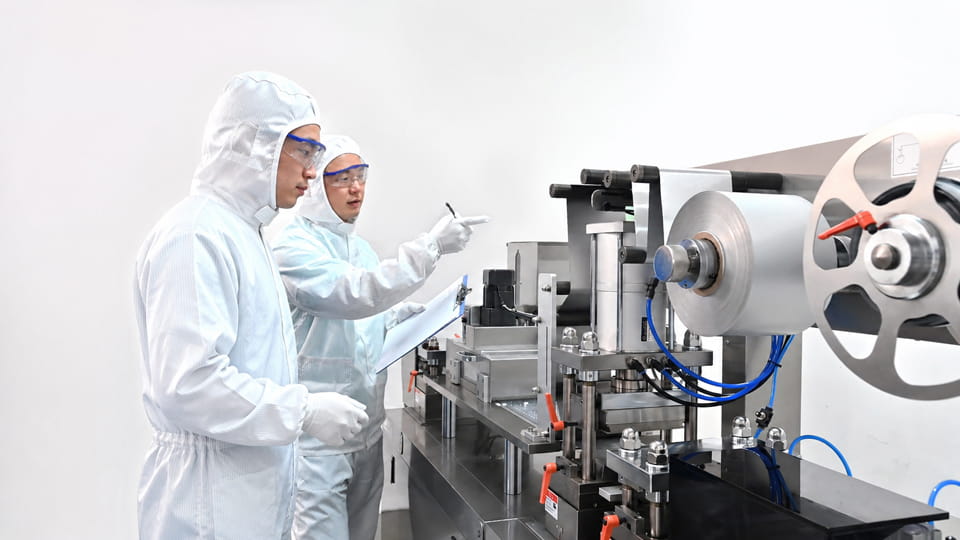
Dans les zones de conditionnement, les normes se traduisent souvent par des règles de conception spécifiques (comme Notes du guide de conformité de Jinlu). Par exemple, les machines d'une ligne GMP doivent être facilement nettoyable (acier inoxydable lisse, pas de fissures ni de points morts) et entièrement validé. Documentation telle que la qualification d'installation (QI), Qualification opérationnelle (QO), et qualification des performances (PQ) est requis avant et pendant la production. Sans ces contrôles, un audit signalerait une non-conformité.
La norme à respecter dépend de votre marché:
Par exemple, La FDA recommande explicitement que les installations vendant à l'échelle mondiale se conforment aux BPF en vigueur. De même, L'EMA déclare que "Tout fabricant de médicaments destinés au marché de l'UE doit se conformer aux BPF de l'UE, quel que soit l'endroit où il se trouve.". En pratique, Les principales sociétés pharmaceutiques construisent des installations répondant aux normes cGMP de la FDA, puis s'adaptent aux variations locales. (comme le langage d'étiquetage ou de documentation).
Finalement, le choix n'est pas soit/ou: les produits pharmaceutiques modernes doivent respecter à la fois la lettre et l’esprit des BPF. Que vous l'appeliez GMP ou cGMP, les pratiques terrain – salles blanches, matériel validé, CQ rigoureux, et des dossiers complets – font tous partie de la même culture de qualité.
Quand sélection de machines d'emballage pharmaceutique, les acheteurs doivent rechercher des fonctionnalités qui prennent spécifiquement en charge les principes GMP/cGMP:
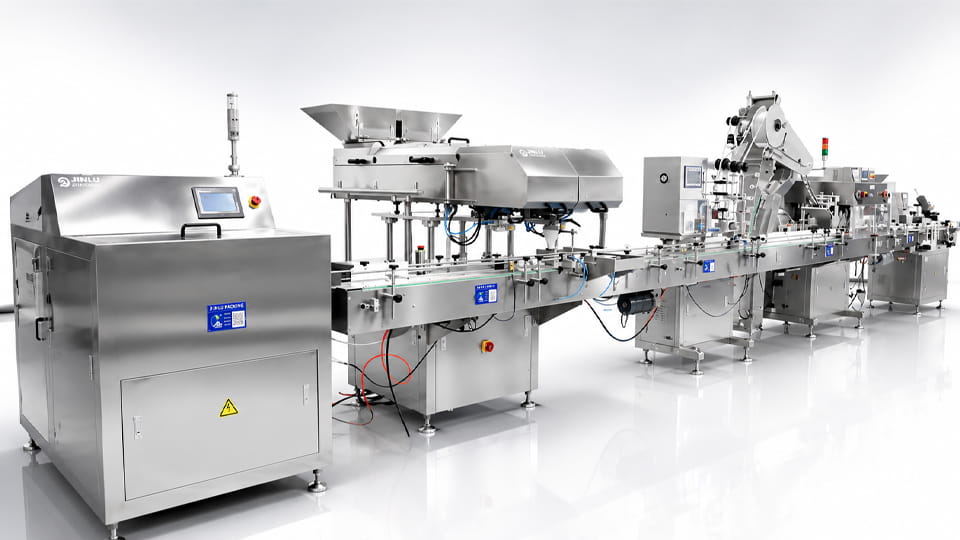
Chiffre: Une ligne moderne de conditionnement de bouteilles pharmaceutiques intègre le décryptage, remplissage, plafonnement, scellage et étiquetage avec inspection intégrée. Ces machines utilisent une construction sanitaire en acier inoxydable et des capteurs pour le contrôle qualité.
En garantissant ces fonctionnalités, les responsables des achats peuvent être sûrs que leur ligne d'emballage prendra en charge une production conforme. Notes originales de Jinlu, nos machines sont fabriquées avec les meilleurs matériaux et une construction sophistiquée selon les normes CE et GMP, et notre emballeuse de sachets répond aux exigences de production de cGMP.
Le respect des BPF et surtout des BPFc apporte des avantages significatifs:
En résumé, La conformité aux BPF/BPFc n’est pas seulement un fardeau réglementaire : elle protège les patients, construit la confiance, et garantit une entreprise fiable. Cela donne également aux entreprises un avantage en améliorant leur efficacité et en permettant une distribution mondiale..

GMP et cGMP sont les pierres angulaires de la qualité pharmaceutique, s'assurer que chaque produit est fabriqué de manière sûre et cohérente. En résumé, GMP fournit le cadre essentiel de l’hygiène, documentation et validation, alors que cgMP ajoute l'exigence d'amélioration continue et de technologie moderne. Pour les équipements d'emballage, cela signifie investir dans l'automatisation, machines validées fabriquées à partir de matériaux sanitaires.
Et la cueillette de Jeinlu, nous construisons nos machines en gardant ces normes à l'esprit. En choisissant l'équipement conforme aux BPF de Jinlu, comme notre Machines de remplissage de capsule automatique, Presses à comprimés, Emballeurs sous blister, Encartonneuses et Machines à compter – vous pouvez construire un projet entièrement validé, ligne de production prête pour l'audit. Chaque machine est livrée avec la documentation et la conception hygiénique nécessaires aux inspections GMP et FDA..
Prêt à garantir que votre production réponde (c)Normes BPF? Contactez les experts de Jinlu dès aujourd’hui pour discuter des besoins de votre ligne de conditionnement ou demander un devis. Notre équipe vous aidera à adapter le package d'équipement approprié pour maintenir la conformité de vos produits., sûr et de haute qualité.
BPF fait référence aux exigences de base des « bonnes pratiques de fabrication » pour la production de médicaments.. cGMP signifie « GMP actuel," c'est-à-dire ces exigences ainsi que l'attente d'une amélioration continue. Dans le GMPc, les fabricants doivent utiliser des équipements à jour, méthodes et systèmes qualité. Autrement dit, cGMP ajoute que les processus sont régulièrement revus et modernisés.
Le « c » signifie « actuel »,» soulignant qu'une entreprise doit toujours respecter les dernières réglementations et normes. Cela garantit que les fabricants ne s’appuient pas sur des pratiques obsolètes. Comme l'explique Scilife, cGMP signifie utiliser des systèmes et des technologies modernes pour répondre aux attentes réglementaires d'aujourd'hui, plutôt que des méthodes plus anciennes qui pourraient ne plus être adéquates.
Oui. Les États-Unis. Réglementations FDA (21 Pièces CFR 210 et 211) sont écrits comme cGMP. Par la loi, tout produit pharmaceutique pour les États-Unis. le marché doit être produit selon les bonnes pratiques de fabrication en vigueur. Le non-respect peut entraîner des lettres d’avertissement ou des arrêts.
Si seules des pratiques BPF obsolètes sont utilisées, l'entreprise risque d'échouer aux inspections. Les régulateurs attendent des preuves de la technologie et des validations actuelles. Sous cGMP, il ne suffit pas de simplement respecter les anciennes directives. Par exemple, l'utilisation de registres papier au lieu d'enregistrements électroniques validés pourrait être citée. En pratique, La conformité cGMP signifie même si un processus a un historique GMP, il doit être revu en tenant compte des normes actuelles.
La plupart des marchés pharmaceutiques dans le monde ont intégré des exigences de type BPF. Sur 100 les pays ont adopté les normes BPF de l’OMS dans leur législation nationale. La terminologie varie (certains disent GMP, un peu de GMPc, certains simplement « GMP »), mais pratiquement tous les grands régulateurs (FDA, Ema, OMS) exiger un système qualité équivalent aux cGMP.
L’OMS elle-même fait généralement simplement référence aux « BPF »," mais le définit au sens large. Dans les documents de l'OMS, « BPF (également appelé cGMP ou « GMP actuel »)" décrit l'assurance qualité pour garantir que les produits sont systématiquement fabriqués selon les normes de qualité. Donc, L'OMS utilise les termes de manière interchangeable. Le concept d'être « à jour » est intégré dans toutes les directives BPF modernes, même si l’OMS n’utilise pas toujours le « c ».
Absolument. La conception des équipements est essentielle pour respecter les BPF. Par exemple, les machines doivent être faciles à nettoyer (inoxydable, pas de crevasses cachées) et devrait prendre en charge l'automatisation et la capture de données. Un équipement mal conçu peut entraîner une contamination ou des confusions. Inversement, le bon équipement (comme les machines de Jinlu) est construit avec des fonctionnalités GMP pour garantir la conformité.
La validation de l'équipement documente que les machines fonctionnent comme prévu. QI (Qualification d'installation) vérifie que la machine est correctement configurée selon la conception. QO (Qualification opérationnelle) teste que chaque fonction fonctionne dans des conditions variables. PQ (Qualification des performances) prouve que l'équipement atteint systématiquement les résultats requis pendant la production réelle. Il s'agit d'exigences BPF standard pour montrer que l'équipement est apte à l'emploi..
Des machines conformes automatisent les contrôles de qualité et enregistrent les données. Par exemple, les remplisseuses de capsules automatisées pèsent avec précision les doses et rejettent les mauvaises capsules, éliminer les erreurs humaines et la contamination. Les systèmes de données intégrés enregistrent automatiquement les informations sur les lots avec des pistes d'audit, satisfaire aux règles d'intégrité des données. En sélectionnant des équipements dotés de ces fonctionnalités, une entreprise rend la conformité cGMP beaucoup plus réalisable.
Les machines de Jinlu sont conçues pour la production pharmaceutique en tenant pleinement compte des besoins BPF. Ils fournissent des modèles et une assistance complets IQ/OQ/PQ, construction en acier inoxydable de haute qualité, et automatisation avancée (tels que les systèmes de vision intégrés et la conception sanitaire) pour vous assurer que votre ligne reste conforme. Leur service comprend des tests FAT/SAT sur site et une assistance à la documentation pour rationaliser votre processus de qualification..
Références:
1.Q&A sur les exigences CGMP -- NOUS. Administration des aliments et des médicaments
2.Directives de qualité: fabrication —— Agence européenne des médicaments
3.Bonnes pratiques de fabrication actuelles (CGMP) Règlements -- NOUS. Administration des aliments et des médicaments
4.Bonnes pratiques de fabrication -- OMS
5.TRS 986 – Annexe 2: Bonnes pratiques de fabrication de l'OMS pour les produits pharmaceutiques: Grands principes -- OMS
6.EudraLex – Volume 4 – Bonne pratique de fabrication (GMP) lignes directrices —— Commission européenne
7.Directives BPF —— ispe.org