

Bonne pratique de fabrication (GMP) les directives dictent des règles strictes pour équipement d'emballage pharmaceutique pour garantir la qualité des produits et la sécurité des patients. Les principales exigences incluent la conception hygiénique des machines, matériaux non réactifs, qualification complète de l'équipement (IR/WH/PQ), nettoyage validé, automatisation pour réduire les erreurs, intégrité des données (21 CFR Partie 11) et traçabilité des produits (sérialisation). Ce guide couvre la FDA, Normes EMA/UE et OMS, présente une liste de contrôle BPF et explique comment choisir et entretenir Machines d'emballage conformes aux BPF.
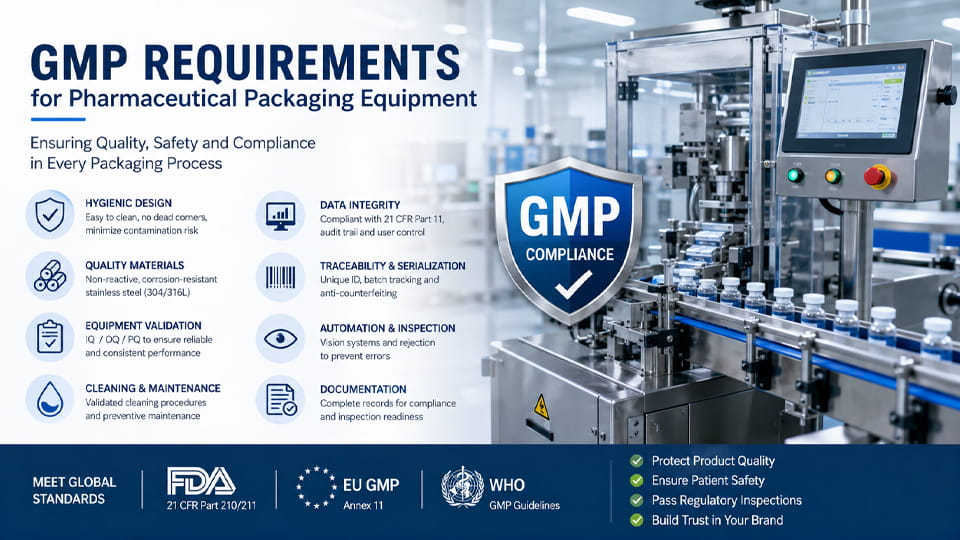
GMP (Bonne pratique de fabrication) est le cadre de qualité garantissant que les produits pharmaceutiques sont produits et contrôlés de manière cohérente. Dans l'emballage, GMP désigne des conceptions et des processus qui évitent les confusions ou la contamination.. Les agences de réglementation comme la FDA (21 CFR210/211), Ema (BPF UE Partie I, Annexes) et l'OMS (directives de qualité pharmaceutique) tous nécessitent un équipement utilisé dans l'emballage pour répondre aux principes BPF. L'objectif est de protéger le produit identité, force, qualité et pureté (pas de réactions chimiques indésirables ou de contamination). Les régulateurs mondiaux soulignent également que les processus et équipements d'emballage doivent être validé/qualifié tout comme les étapes de fabrication des médicaments, et que seul un personnel formé opère selon des procédures écrites.
Les machines d'emballage doivent avoir sanitaire, conception nettoyable. Cela signifie acier inoxydable (par exemple. 304 ou 316L alimentaire) construction, surfaces lisses, plans inclinés pour éviter les pièges à poussière, et pas de jambes mortes ni de cavités cachées. Les directives de la FDA indiquent que l'équipement « doit être construit et situé de manière à faciliter le nettoyage » et « à empêcher la contamination par d'autres… opérations ». De la même manière, les BPF de l'UE exigent que les équipements de fabrication soient « facilement et soigneusement nettoyés » avec des procédures écrites détaillées.. En pratique, les machines GMP modernes utilisent souvent des supports en porte-à-faux ("balcon") des conceptions qui isolent les moteurs et les systèmes de lubrification de la zone de produit. Toutes les zones doivent être accessibles pour inspection, essuyage, et écouvillonnage. Par exemple, Jinlupacking note que les blisters conformes utilisent des surfaces inclinées et de l'acier SUS316L sur toutes les pièces en contact avec le produit pour éviter les pièges à particules..
Toutes les pièces en contact avec le produit doivent être non réactif et non absorbant, afin qu'ils ne lessivent pas ou ne lient pas les ingrédients actifs. Les CGMP de la FDA exigent que « toute surface d'équipement en contact avec… des produits médicamenteux réactifs, additif, ou absorbant de manière à altérer la… qualité du produit médicamenteux ». De même, Les BPF de l'UE déclarent que les pièces de contact « ne doivent pas être réactives », additif ou absorbant… que cela affectera la qualité du produit ». En pratique, cela signifie utiliser de l'acier inoxydable de qualité propre (SUS316L) ou plastiques de qualité pharmaceutique, et lubrifiants de qualité alimentaire. Tous les raccords, les joints et les flexibles doivent être compatibles avec les médicaments et produits de nettoyage utilisés. Par exemple, les joints de qualité hospitalière et les tubes en PTFE sont préférés pour éviter la corrosion ou les résidus. Le résultat est un équipement d’emballage qui ne peut pas contaminer ou dégrader le produit.
GMP exige la qualification complète de l'équipement. Après l'installation, une machine nouvelle ou modifiée doit subir Qualification d'installation (QI), Qualification opérationnelle (QO), et Qualification des performances (PQ).
Les inspecteurs de la FDA soulignent que « les nouveaux équipements doivent être correctement installés… et nettoyés avant utilisation selon des procédures écrites » avec « un nettoyage documenté et validé ».. Fournir des équipements conformes aux BPF signifie fournir un ensemble complet de documentation de validation (Par exemple, Protocoles et rapports IQ/OQ/PQ). Cela se fait souvent via FAT/SAT et un solide support fournisseur.. Par exemple, le blog Hikma note que les machines conformes à la FDA nécessitent « de l'acier inoxydable SUS316L pour toutes les pièces de contact » et « une documentation IQ/OQ/PQ à toute épreuve » pour réussir l'audit.. Autrement dit, sans QI/OQ/PQ documenté, l'équipement n'est pas considéré comme validé GMP.
(Diagramme de sirène: flux des étapes de validation IQ → OQ → PQ)
Les lignes de conditionnement doivent avoir processus de nettoyage validés. Après chaque analyse de produit ou de lot, l'équipement est nettoyé selon les procédures opérationnelles standard (Sops). Les régulateurs exigent que les procédures de nettoyage soient documentées, vérifié, et périodiquement revalidé. Les lignes directrices de l'OMS sur les BPF indiquent que la conception de l'équipement doit être prise en compte lors de la planification de la validation du nettoyage., puisque la conception peut influencer l’efficacité. Seules les surfaces de contact nécessitent une validation approfondie – les zones non contactées peuvent être exclues. Articles critiques (comme des trémies ou des buses réutilisables) nécessitent souvent une utilisation dédiée ou mono-produit pour simplifier le nettoyage. En pratique, les entreprises définissent des limites d'acceptation pour les résidus et effectuent des tests par écouvillonnage ou par rinçage. Les FAQ de la FDA recommandent d'utiliser des méthodes telles que le carbone organique total (Table des matières) ou des tests spécifiques pour confirmer l'élimination des résidus.
La maintenance et l'étalonnage sont également obligatoires. GMP prévoit une maintenance préventive régulière: les pièces défectueuses ou usées doivent être réparées avant qu'elles n'entraînent des risques de contamination. Calibrage de l'équipement (poids, Balance, capteurs) doit suivre des procédures écrites avec des enregistrements (21 CFR211.68). Par exemple, Les directives de la FDA indiquent que les appareils de mesure et de contrôle « doivent être calibrés et vérifiés à des intervalles définis » avec des enregistrements conservés.. Cela garantit que la machine continue de fonctionner conformément aux spécifications (Par exemple, volume de remplissage correct, placement des étiquettes).
Les fonctionnalités automatisées prennent en charge GMP en réduisant les erreurs humaines. Les machines modernes incluent souvent des systèmes de vision, lecteurs de codes à barres, ou trieuses pondérales pour l'inspection en ligne. Par exemple, des scanners automatisés d'étiquettes/codes-barres vérifient que chaque emballage est correctement étiqueté et identifiable – une étape essentielle des BPF. L'intégration avec les systèmes MES/ERP peut enregistrer des données par lots. Le rejet automatisé élimine les packs sous-remplis ou défectueux. Robotique (pour la manipulation de bouteilles ou le pick and place) améliorer la cohérence. En pratique, de nombreuses lignes GMP incluent des fonctionnalités d'appareil telles que des verrouillages (Par exemple, la machine ne fonctionne pas si une porte est ouverte), protections de changement automatique, et des capteurs pour attraper les bourrages. Tous les logiciels doivent avoir des comptes d'utilisateurs sécurisés (voir la section suivante).
Les BPF pharmaceutiques nécessitent une forte intégrité des données. Aux États-Unis et sur de nombreux marchés, les contrôles informatisés doivent être conformes à 21CFRPart11: cela inclut les connexions uniques, pistes d'audit, et signatures électroniques. Tous les enregistrements de lots, les alarmes et les modifications doivent être horodatées et protégées contre toute falsification. Par exemple, La FDA prévient que les balances avec calibrage automatique nécessitent toujours des contrôles externes, et le logiciel de contrôle doit savoir qui a modifié les paramètres et quand. Les principales exigences incluent un accès basé sur les rôles (opérateurs vs gestionnaires), journaux d'audit inaltérables des modifications de paramètres, et approbation numérique des étapes critiques. L'Annexe 11 de l'UE exige également des systèmes validés et des pistes d'audit pour tout système informatisé pertinent pour les BPF.. En substance, l'IHM/l'automate de la machine doit empêcher les modifications non autorisées. Une bonne intégrité des données signifie également des copies électroniques des SOP, enregistrements de lots et journaux de maintenance.
Réglementations récentes (par exemple. Directive européenne sur les médicaments falsifiés, DSCSA américaine) exiger des identifiants uniques sur chaque package principal. Les équipements d'emballage GMP doivent prendre en charge cela en imprimant/gravant des codes-barres 2D ou des codes QR.. La traçabilité consiste à lier chaque code sérialisé à un lot de production. L'équipement doit s'intégrer à un logiciel de sérialisation ou à des caméras pour garantir que chaque unité reçoive un code unique conforme aux règles du pays.. Il ne s’agit pas seulement de BPF mais aussi de loi du marché. En pratique, les fabricants installent souvent un codeur laser ou jet d'encre et le connectent à une base de données qui vérifie l'authenticité de chaque code. La ligne de conditionnement final doit permettre le rappel ou le suivi de tout lot via son code.
GMP couvre non seulement les machines mais toutes les opérations d'emballage. Les contrôles clés incluent:
En suivant ces contrôles de processus, les entreprises veillent à ce qu’aucune confusion ou contamination ne se produise lors de l’emballage.
| Exigence | Points clés |
| Conception | Hygiénique, conception en porte-à-faux ou balcon; pas de zones mortes; en pente, surfaces accessibles |
| Matériels | Qualité pharmaceutique (316L) acier inoxydable; joints/lubrifiants non réactifs; soudures lisses |
| Validation | QI complet, QO, PQ (installation, qualification opérationnelle et de performance) |
| Nettoyage | Procédures de nettoyage validées; documentation/SOP; nettoyer sur place le cas échéant |
| Entretien | Calendriers de maintenance préventive; journaux de pièces de rechange; étalonnage (avec des enregistrements) |
| Automation | Systèmes de vision, détecteurs de métaux, rejeter les portes, scanners d'étiquettes pour réduire les confusions et les erreurs |
| Intégrité des données | 21 Conformité CFRPart11: pistes d'audit, signatures électroniques, contrôles d'accès des utilisateurs |
| Traçabilité | Sérialisation (2Codes-barres/UID D); codage par lots; liaison des codes aux enregistrements de lots |
Différentes machines ont différents défis GMP:
Machines d'emballage en cloque: Ceux-ci forment et scellent des poches en plastique/aluminium. Points clés des BPF: La zone de formage et de thermoscellage doit être fermée ou dans une zone propre pour éviter toute contamination.. Les rouleaux et matrices de thermoscellage ne doivent pas avoir d'arêtes vives., et le système de vide (si présent) ne doit pas libérer de particules dans les ampoules. Pour les médicaments sensibles, les blisters peuvent fonctionner dans des environnements contrôlés (hottes à flux laminaire ou salles blanches).
Encartonneuses: Ces cartons dressés, insérer des produits (clochards, bouteilles, sachets), et fermez les cartons. Besoins BPF: impression et numérisation précises des codes de lot sur chaque carton (100% vérification), et un contrôle strict des magasins de cartons (pour éviter toute confusion entre différents produits). Le contrôle de la poussière peut être un problème lors de l'alimentation des cartons et des dépliants; c'est pourquoi des filtres ou des trémies fermées sont utilisés.
Étiqueteuses: Ils appliquent des étiquettes ou des dépliants sur les emballages. Problèmes BPF: synchronisation (pour que les étiquettes correspondent au bon produit); caméras de vérification pour détecter les étiquettes mal appliquées ou manquantes; et des surfaces d'étiquetage propres (les adhésifs ne doivent pas contaminer le produit).
Compte & Machines de remplissage: Compteurs de tablettes, charges de capsule, et les remplisseuses de bouteilles traitent des solides ou des liquides en vrac. GMP exige que toutes les pièces de contact soient nettoyables (parfois CIP pour les systèmes liquides), et tous les remplissages pour être précis. Les défauts tels que les sous-remplissages doivent être automatiquement rejetés (via une trieuse pondérale). Pour les liquides, les buses scellées et le dégazage peuvent empêcher les bulles.
Machines à sachets/pochettes: Pour poudres ou granulés. Ils ont souvent besoin de fonctionnalités de nettoyage des sachets (pour enlever la poudre renversée), et inspection en traction de la résistance du joint. Les couteaux à couper les bords doivent être protégés.
Dans tous les cas, rechercher validation spécifique à l'équipement: Par exemple, une machine blister nécessite un test d'étanchéité sous vide (pour garantir un blister véritablement scellé), et un encartonneur a besoin d'une validation par test de chute (pour montrer les cartons, tiens le coup). Les fabricants fournissent souvent de la documentation (par exemple. un exemple de plan OQ) pour chaque type de machine. Lorsqu'on envisage un ligne clé en main, s'assurer que le fournisseur a de l'expérience dans l'intégration de ces machines d'une manière conforme aux BPF (par exemple. Intégration démontrée par Jinlu de blister+cartoner+étiqueteuse avec un contrôle transparent).
[jl_youtube src= »https://www.youtube.com/embed/1Bb_J6rluac »]
Lors de la sélection de machines pour votre ligne pharmaceutique, s'assurer qu'il est conçu et pris en charge pour les opérations GMP:
👉 Pour des solutions personnalisées conformes aux BPF, contacter Jinlu Emballage ou demandez un devis détaillé. Nous proposons des produits certifiés machines d'emballage sous blister, encartonneuses, étiqueteuses et des packages de documentation complets. Notre équipement est conçu pour répondre aux normes cGMP et intègre des fonctionnalités telles que des convoyeurs en acier inoxydable., outillage à changement rapide, et modules de sérialisation automatisés.
Les exigences BPF pour les équipements d'emballage pharmaceutique couvrent tous les aspects de la machine et du processus – depuis la qualité de l'acier et la conception hygiénique jusqu'à la validation., nettoyage, automation, et contrôles de données. Les mettre en œuvre correctement garantit la sécurité de vos produits, traçable, et prêt pour l'audit. Investir dans des équipements et des processus conformes ne répond pas seulement aux réglementations (FDA/EMA/OMS) mais minimise également rappelle et renforce l'assurance qualité. Choisissez des machines conçues pour GMP, et votre ligne de production sera à la fois efficace et prête à être inspectée.
Les principales exigences BPF incluent la conception hygiénique (acier inoxydable, pas de zones mortes), validation (IR/WH/PQ), procédures de nettoyage validées, entretien et étalonnage réguliers, contrôles automatisés pour éviter les erreurs, et une intégrité robuste des données (21 CFR 11) et traçabilité (sérialisation) mesures. Ceux-ci garantissent l’absence de contamination ou de confusion des produits.
La validation IQ/OQ/PQ fournit une preuve documentée que l'équipement est construit et fonctionne comme prévu. IQ vérifie la bonne installation; OQ teste chaque fonction et limite; PQ montre que la machine produit un rendement constant dans des conditions réelles. Sans cette documentation, les régulateurs considèrent l’équipement comme « non validé » et toute donnée de lot suspecte.
L'équipement GMP utilise des produits de haute qualité, matériaux non corrosifs (comme l'inox 316L) pour toutes les pièces en contact avec le produit. Il a lisse, soudures et surfaces nettoyables. Les caractéristiques incluent des protections faciles à retirer, Capacités CIP, et roulements étanches. Les panneaux de commande doivent être scellés ou blindés. Essentiellement, rien dans la conception ne doit introduire de risque de contamination ou de corrosion.
La partie 11 régit les enregistrements et signatures électroniques. Pour machines d'emballage, cela signifie que le logiciel/l'IHM doit imposer les connexions des utilisateurs, disposer d'une piste d'audit sécurisée de tout changement (qui a fait quoi, quand), et permettre la signature électronique des rapports de lots. Il garantit les données par lots (remplir les montants, numéros de lot, etc.) ne peut pas être modifié sans laisser de trace. Les systèmes API modernes ont souvent 21 CFR 11 modes intégrés pour un usage pharmaceutique.
La sérialisation consiste à attribuer un identifiant unique à chaque unité emballée (généralement un code 2D) et l'enregistrer dans une base de données. Règlements (Par exemple, FMD de l'UE, DSCSA américaine) exigent désormais la sérialisation sur les emballages primaires et secondaires pour prévenir la contrefaçon et permettre les rappels. Les lignes GMP doivent avoir des codeurs et des scanners pour appliquer et vérifier ces codes. Cela permet une traçabilité complète de chaque boîte/bouteille jusqu'à son lot de production..
La conformité aux BPF garantit que les médicaments sont correctement emballés, prévenir la contamination, confusions, et erreurs d'étiquetage. Il contribue à maintenir la qualité des produits et protège la sécurité des patients tout au long de la chaîne d'approvisionnement..
Les principales réglementations BPF comprennent:
• FDA 21 Partie CFR 210/211 (USA)
• BPF de l'UE (Volume EudraLex 4)
• Directives BPF de l'OMS
Les fabricants doivent se conformer aux réglementations de leur marché cible.
Lors de la sélection de l'équipement, considérer:
• Conception et matériaux conformes aux BPF
• Disponibilité des documents de validation (IR/WH/PQ)
• Fonctionnalités d'intégrité et de traçabilité des données
• Conformité aux normes FDA/UE/OMS
Choisir le bon fournisseur garantit des audits plus fluides et une conformité à long terme.
Références:
1.Questions et réponses sur les exigences actuelles en matière de bonnes pratiques de fabrication | Équipement -- NOUS. Administration des aliments et des médicaments
2.Annexe 9 Lignes directrices sur l'emballage des produits pharmaceutiques —— gmp-compliance.org
3.21 Partie CFR 211 – BONNES PRATIQUES DE FABRICATION ACTUELLES POUR LES PRODUITS PHARMACEUTIQUES FINIS —— Institut d'information juridique
4.Principes fondamentaux BPF pour les produits pharmaceutiques -- OMS