Qu'est-ce que la validation des emballages dans l'industrie pharmaceutique? Un guide complet pour les fabricants pharmaceutiques
Qu'est-ce que la validation des emballages dans l'industrie pharmaceutique? Un guide complet pour les fabricants pharmaceutiques
avril 29, 2026
Sans commentaires
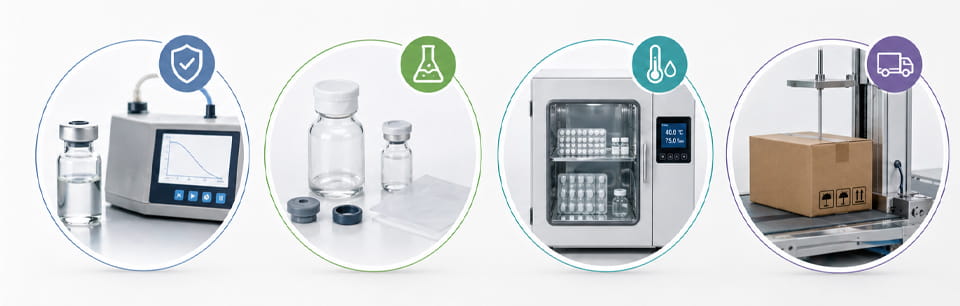
Dans l'industrie pharmaceutique, validation de l'emballage est un sous-ensemble critique de validation du processus axé sur la garantie que les équipements et les processus d'emballage protègent systématiquement la qualité des produits pharmaceutiques. Il s’agit d’un programme de qualification documenté (Installation, Opérationnel, Performance) et tests (par exemple. intégrité de la fermeture du conteneur, stabilité, transport) prouver que les systèmes d'emballage fonctionnent comme prévu dans les conditions BPF. Une validation efficace des emballages garantit la sécurité des patients (en empêchant la contamination, dégradation ou confusion) et assure la conformité réglementaire (FDA, Ema, OMS, je, ISO). Ce guide explique le définition, mesures, essais, normes, et meilleures pratiques pour la validation d'emballages pharmaceutiques, et montre comment l'équipement automatisé (comme Les machines de Jinlu Packing) est conçu pour répondre à ces exigences strictes.
Définition de la validation des emballages
Validation des packagings dans le domaine pharmaceutique démontrer avec des preuves documentées que le processus d'emballage (équipements et matériaux) produit de manière fiable un emballage qui protège le produit médicamenteux. En pratique, il applique les mêmes concepts de validation rigoureux que ceux utilisés dans la fabrication (IR/WH/PQ) à primaire, secondaire, et emballage tertiaire opérations. Selon les directives BPF de l’OMS, « Les processus et équipements d’emballage nécessitent une validation/qualification de la même manière que toute autre partie du traitement au sein d’une installation pharmaceutique. ». Autrement dit, la validation de l'emballage garantit la système de fermeture de conteneur, étiquetage, et lignes de conditionnement répondre systématiquement aux spécifications de qualité et aux exigences réglementaires. L’objectif est de maintenir la force du médicament, pureté et stabilité grâce à l'emballage, distribution et durée de conservation, tout en évitant les confusions, contrefaçons, ou des dommages.
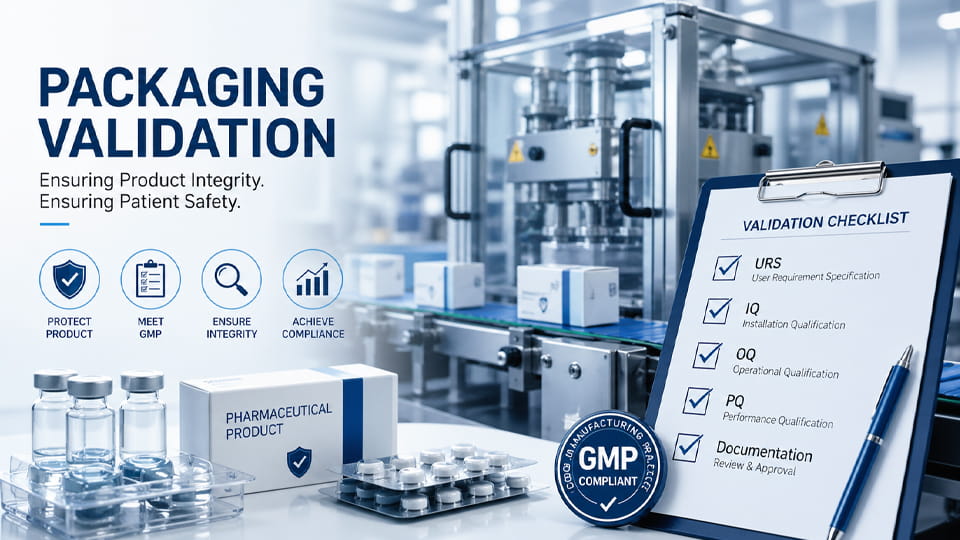
Les livrables typiques de la validation des emballages comprennent un Spécification des exigences des utilisateurs (URS) (la conception & critères de qualité), Protocoles d'installation/opérationnels/qualification des performances, et dossiers de tests. Le processus de validation couvre:
Emballage primaire (le récipient ou la barrière entrant directement en contact avec le médicament, par exemple. flacons, cavités vésiculeuses, sachets)
Emballage secondaire (par exemple. cartons, étiquettes, inserts, sérialisation qui regroupe les packages principaux)
Emballage tertiaire (conteneurs d'expédition en vrac, palettes, emballage chaîne du froid pour le transport)
Chaque niveau doit protéger le produit. Par exemple, la TGA australienne définit « emballage primaire » (le conteneur qui recouvre immédiatement la marchandise) et distingue emballage secondaire comme boîte extérieure ou emballage. Finalement, la validation des emballages est liée aux BPF – garantissant que les contenants et les fermetures ne modifient pas le médicament et « assurer une protection adéquate contre les facteurs externes » pendant le stockage et l'utilisation.
Pourquoi la validation des emballages est essentielle dans le secteur pharmaceutique
L'emballage pharmaceutique est la dernière défense pour la qualité des médicaments. La validation des processus d'emballage est vitale car:
Garantit la sécurité et l’intégrité des produits: Un emballage correctement validé empêche la contamination, pénétration d'humidité, ou une exposition à l'oxygène qui pourrait dégrader les ingrédients actifs. Par exemple, des fuites ou des défaillances des joints pourraient permettre aux microbes ou aux gaz de pénétrer, gâcher la stérilité ou la puissance.
Conformité réglementaire: Agences (FDA, EMA/I, OMS) nécessitent un emballage validé. NOUS. FDA 21 CFR 211.94 interdit les fermetures qui altèrent la qualité des médicaments et impose les fermetures « assurer une protection adéquate contre les facteurs externes prévisibles ». Annexe BPF de l'UE 1 insiste de même sur le fait que « les conteneurs doivent être fermés par des méthodes correctement validées » (avec 100% tests d'intégrité pour les produits fermés par fusion). L'OMS déclare explicitement que les systèmes d'emballage doivent être qualifiés comme tout autre processus BPF.. Le non-respect peut signifier rappelle, importer des rejets ou des citations d'audit.
Prolonge la durée de conservation: Les matériaux d'emballage et les scellés validés dans des conditions de stabilité aident à établir des déclarations précises sur la durée de conservation. Les lignes directrices ICH Q1A précisent même que les études de stabilité doivent être réalisées dans le « système de fermeture de conteneur » proposé pour le produit. Si l'emballage échoue, les données de stabilité ne sont pas valides.
Sérialisation et lutte contre la contrefaçon: Les emballages pharmaceutiques modernes incluent souvent la sérialisation, scellés inviolables, et fonctionnalités anti-contrefaçon. Valider ces fonctionnalités (par exemple. scannabilité des codes-barres, intégrité des bandes inviolables) contribue à sécuriser la chaîne d’approvisionnement. Une erreur d'étiquetage ou de sérialisation peut bloquer la sortie du produit.
Qualité et rentabilité: Des lignes validées efficaces réduisent les défauts (erreurs de remplissage, erreurs d'étiquette, cartons écrasés) et ferraille. Inspections automatisées (systèmes de vision pour le contrôle des scellés/étiquettes) font souvent partie de contrôles validés. Dans l'ensemble, les processus d'emballage validés minimisent les risques pour les patients et garantissent un approvisionnement constant en produits efficaces, médicaments authentiques.
Facteurs clés pour la validation
Sécurité des patients: Un emballage inapproprié peut nuire aux patients (par exemple. injectables contaminés). La validation documente la barrière de sécurité.
Atténuation des risques réglementaires: Les processus non validés présentent un risque élevé de rappels ou de sanctions. Les régulateurs attendent des données de qualification pour chaque ligne de production.
Distribution mondiale: Répondre aux normes internationales (FDA/EMA/OMS) nécessite un emballage validé sur tous les marchés.
Continuité des activités: Défaillances d'emballage lors de la distribution des déchets et du temps. La validation garantit « bon du premier coup » opération sous GMP.
Préparation à l'audit: Les audits effectués par les autorités qualité ou les régulateurs des clients examineront les dossiers de validation des emballages et les qualifications des équipements dans le cadre des inspections BPF..
Portée de la validation des emballages pharmaceutiques
La validation de l'emballage couvre toutes les étapes de l'emballage. Typiquement, nous distinguons:
Validation de l'emballage primaire: Focus sur la fermeture du conteneur (flacons, ampoules, cavités vésiculeuses, bouteilles). Les tests incluent l’intégrité du joint, compatibilité des matériaux (extractibles/lixiviables) et performances de fermeture des conteneurs. Pour les produits stériles, tests d'intégrité de la fermeture des conteneurs (CCIT) sont obligatoires pour assurer le maintien de la stérilité.
Validation de l'emballage secondaire: Couvre l'emballage extérieur immédiat (cartons, étiquettes, dépliants, déshydratants). Cela inclut les contrôles de lisibilité/exactitude des étiquettes, tests de chute de cartons, et tests de compression de boîtes (pour les transports). La vérification des étiquettes garantit que les bonnes informations sur le patient sont appliquées de manière cohérente.
Validation des emballages tertiaires: Implique un emballage en vrac/de transport. Ici, tests de performance comme les vibrations, baisse, et cyclage thermique (chaîne du froid) simuler les contraintes d'expédition pour vérifier que les palettes et les cartons d'expédition maintiennent l'intégrité et l'étiquetage du produit pendant la distribution. Protocoles standards comme ASTM D4169 (simulation de transport) sont souvent utilisés.
Chaque niveau nécessite une évaluation des risques et des tests appropriés: Par exemple, primaire l'emballage peut impliquer USP <1207>-tests d'intégrité de style, alors que secondaire les tests d'emballage peuvent inclure la résistance du carton et l'adhérence des étiquettes, et tertiaire l'emballage utilise les protocoles de test ISTA/ASTM. Tout doit être documenté dans le plan de validation.
Étapes clés du processus de validation des emballages
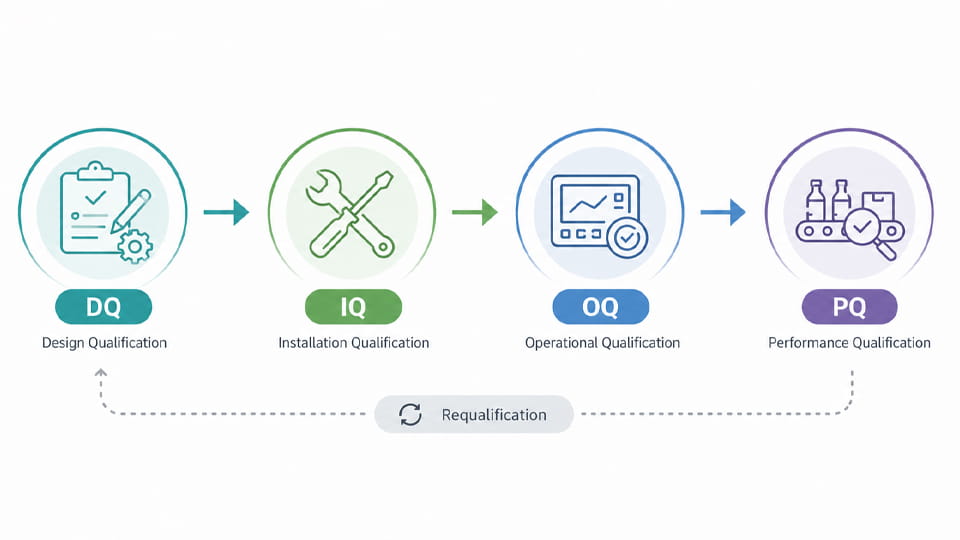
La validation des emballages suit généralement le cycle de vie de la qualification des équipements/processus, souvent décrit comme DQ/QI/OQ/PQ. Ces étapes garantissent qu'une ligne de conditionnement nouvelle ou modifiée répond aux exigences à chaque étape.
Qualification de conception (QD): Première phase où la conception est évaluée par rapport à l'URS (Spécification des exigences des utilisateurs) et directives BPF. Tous les aspects de la conception (fonctions de la machine, matériels, nettoyabilité, compatibilité avec le produit/les matériaux d'emballage) sont examinés. Les documents incluent l'URS et les spécifications de conception (Spécification de conception fonctionnelle FDS, Spécifications de conception matérielle/logicielle). Souvent une évaluation des risques (par exemple. DFMEA) est fait pour anticiper les modes de défaillance des emballages.
Qualification d'installation (QI): Vérifie que la machine/la ligne est installée correctement selon les spécifications du fournisseur. IQ comprend une liste de contrôle vérifiant l'emplacement correct, utilitaires (pouvoir, air, eau), conditions environnementales, et un assemblage correct. Tous les composants sont présents et intacts. L'étalonnage des appareils de mesure est vérifié. Livrables: Protocoles et rapport de QI, certificats d'étalonnage.
Qualification opérationnelle (QO): Vérifie que la machine fonctionne comme prévu dans toutes les conditions spécifiées. Paramètres critiques (plages de vitesse, températures, pressions, niveaux de vide, couple, etc.) sont mis au défi aux réglages min/max ou dans le pire des cas. Les tests en OQ peuvent inclure l'étanchéité à des vitesses extrêmes, fonctions capteur/alarme, changements de vitesse du convoyeur, précision de l'étiqueteuse, précision de la pompe de remplissage. Le protocole OQ enregistre que chaque test fonctionnel répond aux critères d'acceptation.
Qualification des performances (PQ): Démontre que dans des conditions normales de production, la ligne produit systématiquement des produits répondant aux spécifications de qualité. Le PQ est effectué sur les quantités/lots de production réels. Cela comprend l'exécution de la ligne pendant une durée ou une quantité définie et l'échantillonnage de la sortie.. Activités typiques: utiliser plusieurs blisters, des bouteilles ou sachets et effectuer des tests de contrôle qualité sur des échantillons (Par exemple, intégrité de la fermeture du conteneur (CCIT), contrôles de poids, inspection visuelle des défauts, force d'étanchéité). PQ montre que la ligne peut fonctionner en continu tout en maintenant la qualité du produit.
Le tableau ci-dessous résume les étapes DQ – IQ – OQ – PQ:
Scène
But
Documents clés
Exemples d'activités/tests
Qualification de conception (QD)
Vérifier que la conception du système d'emballage est conforme à URS/GMP
URS (spécification des exigences), spécifications de conception (FDS/HDS/SDS), l'évaluation des risques
Revue de conception, contrôles de compatibilité des matériaux, DFMEA
Qualification d'installation (QI)
Confirmer la bonne installation de l'équipement
Protocole/liste de contrôle du QI, journal d'installation, certificats d'étalonnage
Vérifier les utilitaires, assemblage d'équipement, étalonnage
Qualification opérationnelle (QO)
Vérifier les fonctions de l'équipement dans les limites définies
Protocole OQ, plans de tests fonctionnels, Sops
Paramètres de test (vitesse, temp., pression); vérifications des scellés
Qualification des performances (PQ)
Assurer une qualité constante pendant les cycles de production
Protocole PQ, enregistrements de lots, critères de libération
Cycles de production; test d'échantillon (CCIT, remplir le poids, inspection visuelle)
Comme le montre le diagramme, la validation de l'emballage est un processus du cycle de vie, de la conception à la performance. Noter que requalification peut être nécessaire après des changements majeurs ou périodiquement.
Tests clés dans la validation des emballages
Plusieurs tests spécialisés sont couramment effectués lors de la validation des emballages:
Test d'intégrité de la fermeture du conteneur (CCIT)
Le CCIT est indispensable pour les produits stériles et même non stériles. Il évalue si le système de fermeture des conteneurs (par exemple. flacon+bouchon+capuchon, ampoule, sceau blister) forme une barrière parfaite. Les méthodes incluent la désintégration du vide, chute de pression, pénétration de colorant, ou défi microbien. Comme l'explique une source de l'industrie, « Tests d'intégrité de la fermeture des conteneurs (CCIT) est un test qui évalue l’adéquation des systèmes de fermeture des conteneurs pour maintenir une barrière stérile contre les contaminants potentiels.. Documents réglementaires (USP <1207>, FDA, Annexe EMA 1) mettre l’accent sur les tests d’intégrité des fermetures pour garantir l’absence de fuites ou de brèches. Par exemple, USP <1207> fournit des lignes directrices sur la sélection des méthodes de test d'étanchéité pour certifier les emballages scellés.
Tests de compatibilité des matériaux (Extractibles/lixiviables)
Matériaux d'emballage (plastiques, caoutchoucs, encres, adhésifs) ne doit pas interagir négativement avec le produit médicamenteux. Extractibles et lixiviables les études simulent un contact à long terme: les extractibles sont des produits chimiques extraits de leur emballage dans des conditions difficiles, et les substances lixiviables sont celles qui migrent réellement dans le produit dans des conditions normales.. Ces tests garantissent que l'emballage n'introduit pas d'impuretés toxiques ou affectant la stabilité.. Directives pharmacopées et FDA (par exemple. USP <661>, Q3E) décrire les tests E/L pour les systèmes de fermeture de conteneurs. En pratique, on vérifie que le polymère, revêtements, et les matériaux d'étiquetage répondent aux normes de la pharmacopée (par exemple. Type de verre USP, Spécifications des fermetures en caoutchouc ISO). L'OMS note que les normes de la pharmacopée pour les fermetures (comme des bouchons en caoutchouc) sont « exigences minimales » et met l'accent sur les études de stabilité pour prouver l'adéquation.
Tests de stabilité dans les emballages
Selon ICH Q1A, études de stabilité doit être effectué sur le produit médicamenteux dans sa configuration finale d’emballage. Lors de la validation, l’impact de l’emballage sur la stabilité est évalué: Par exemple, l'emballage final est soumis à un vieillissement accéléré (température/humidité élevée) et des conditions en temps réel pour garantir l'absence de dégradation (par exemple. pénétration d'humidité dans les blisters, perméation de l'oxygène dans les bouteilles). Tests indiquant la stabilité (chimique et microbien) sont effectués. Un emballage qui ne parvient pas à protéger le produit sous contrainte invalide les allégations relatives à la durée de conservation. Ainsi, la validation comprend la confirmation que l'emballage choisi répond aux exigences de durée de conservation (cela chevauche les protocoles de stabilité réglementaire).
Tests de transport et de distribution
Emballage tertiaire les tests simulent les conditions réelles d'expédition. Les tests standard incluent des tests de hauteur de chute, vibration (simulation camion/rail), compression (poids d'empilage), et cycles de température (spécialement pour la chaîne du froid). Par exemple, ASTM D4169 (pour les produits emballés) ou les protocoles ISTA peuvent être utilisés. Un plan de validation d'emballage robuste vérifie que les cartons, les caisses et les caisses protègent les colis primaires pendant la manipulation: vérifier qu'il n'y a pas de casse, décollement des étiquettes, ou des dommages causés par l'humidité se produisent dans les conditions de distribution. Pour la chaîne du froid, la cartographie des températures et les expéditeurs isolés validés sont testés pour maintenir les plages de température requises tout au long du transit..
Normes et lignes directrices réglementaires
La validation des emballages pharmaceutiques doit répondre à de multiples attentes réglementaires:
Règlements cGMP: Aux États-Unis, FDA 21 Partie CFR 211 (sous-partie J) régit les conteneurs et les fermetures. Section 211.94(annonce) précise que les contenants/fermetures ne peuvent pas altérer la qualité du médicament et doivent protéger contre une contamination prévisible.
BPF de l'UE: Lignes directrices européennes (EudraLex Vol.. 4) exiger que « les conteneurs doivent être fermés par des méthodes correctement validées » (Annexe 1) et que les processus d'emballage suivent les BPF (Annexe 15 à la validation). Annexe BPF de l'UE 11 impose la validation du système informatisé (y compris les lignes de conditionnement avec commandes électroniques).
BPF de l'OMS: Série de rapports techniques de l’OMS 902 (Annexe 9) indique explicitement que l'équipement d'emballage doit être validé comme toute autre étape de traitement. L'OMS fournit également des conseils sur l'intégrité des emballages (similaire à l'UE/ICH).
Lignes directrices du PCI: Bien que le PCI (Q7, Q8, Q9, Q10) ne pas disposer d'un document de validation d'emballage spécifique, ils imposent la gestion des risques (Q9) et qualité dès la conception (Q8/Q10) principes qui s'appliquent. Par exemple, l'évaluation des risques (Je Q9) devrait couvrir les attributs de l'emballage (type de fermeture, contrôle des étiquettes) qui affectent les CQA des produits.
Normes: Pour les produits stériles, ISO 11607 (pour emballage de dispositifs médicaux stérilisés en phase terminale) est souvent utilisé par analogie; Partie 2 de l'ISO 11607 définit les exigences de validation pour les processus de formage/scellage, ce qui est pertinent pour les plaquettes thermoformées ou les ampoules de médicaments parentéraux. Pharmacopées (USP, Ph.. EUR.) contiennent également des chapitres sur les tests d'emballage (par exemple. USP <381> pour fermetures en caoutchouc, <1207> pour les tests d'étanchéité).
En résumé, toute ligne de conditionnement doit être conforme à la pharmacopée nationale et aux normes régionales BPF. Les listes de contrôle de conformité citent généralement la FDA, BPF de l'UE, OMS et normes ISO pertinentes, et nécessitent souvent des SOP et des plans directeurs de validation entièrement documentés couvrant l'emballage..
Défis courants dans la validation des emballages
La validation des emballages pose des défis uniques par rapport aux processus de fabrication:
Type de données et échantillonnage: Le succès d’une ligne de conditionnement est souvent déterminé par résultats discrets (par exemple. réussite/échec pour un sceau, larme) plutôt que des mesures continues. Comme le note un expert, « le type de données obtenues… crée un défi important. Le succès ou l’échec est souvent déterminé par des défauts (larmes, trous, taches, ou des joints qui fuient)… Ce manque de données mesurables (variable) les données nécessitent souvent des échantillons de très grande taille pour qu’un processus d’emballage soit statistiquement validé.. Autrement dit, vous aurez peut-être besoin de nombreux échantillons pour démontrer la fiabilité.
Variété technologique: Il existe de nombreuses technologies d'emballage (ampoules, encartonneuses, étiqueteuses, emballeurs de caisses, etc.) de différents fournisseurs. Chacun a des profils de risque différents, rendre impossible un plan de validation unique.
Contrôle des modifications: Les lignes de conditionnement traitent souvent de nombreux types de produits (comprimés, liquides, poudres) et tailles de conditionnement sur le même équipement (en utilisant des parties ou des formats de modification). Chaque changement peut nécessiter une revalidation ou une mise entre parenthèses dans le plan de validation. Gérer cela (le matrice de validation) peut être complexe.
Contrôles environnementaux: Quelques emballages (par exemple. emballage blister de médicaments sensibles à l'humidité) nécessite une humidité contrôlée ou une atmosphère inerte. La validation de ces contrôles ajoute de la complexité.
Intégration avec le processus en amont: La validation du packaging dépend de la cohérence en amont. Si la taille des granules du médicament varie, le changement de machine d'emballage peut être affecté (par exemple. remplir de confiture). Cette interdépendance peut compliquer l’analyse des causes profondes des échecs d’emballage..
Sérialisation/Suivi: Une réglementation moderne (par exemple. DSCSA, FMD de l'UE) nécessitent une sérialisation et une traçabilité. S'assurer que les lignes automatisées suivent correctement chaque unité (et valider cette capture de données) ajoute une couche supplémentaire de qualification (validation du logiciel, tests de scanner de codes à barres, vérifications de la base de données).
Ambiguïté réglementaire: Paradoxalement, il existe peu de directives explicites de la FDA/EMA uniquement sur la « validation des emballages ».," Les entreprises doivent donc souvent interpréter les directives générales de validation des BPF et des processus pour l'emballage.. Cela peut entraîner une incertitude quant à la portée exacte ou aux tests nécessaires..
Malgré ces défis, le principe sous-jacent demeure: traiter l’emballage comme n’importe quel autre processus critique, avec une qualification approfondie et des contrôles qualité rigoureux. Comme le conclut l’article de l’ISPE, validation de l'emballage "différer(s) peu de la validation des processus utilisés pour la fabrication de médicaments..
Meilleures pratiques pour la validation des emballages pharmaceutiques
Pour surmonter les défis et assurer une validation réussie, suivez ces bonnes pratiques:
Évaluation précoce des risques: Utiliser la gestion des risques liés à la qualité (Je Q9) dès la phase de conception. Identifier les attributs critiques de l’emballage (par exemple. stérilité, preuve d'inviolabilité, protection contre la lumière) et prioriser les tests en conséquence. Un mode d'échec & Analyse des effets (AMDEC) est recommandé lors du DQ pour planifier la portée de la validation.
Spécification des exigences utilisateur (URS): Documentez clairement toutes les exigences dès le départ: capacité de production, formats de paquets, points d'intégration (par exemple. relier une blistereuse à une encartonneuse), conditions environnementales, exigences de nettoyage. Un URS bien défini maintient la validation sur la bonne voie.
Procédures opérationnelles standard (Sops): Maintenir des SOP détaillées pour le fonctionnement de l'équipement, nettoyage, passage, et maintenance. La validation doit faire référence à ces SOP pour garantir une utilisation cohérente.
Inspection et contrôles automatisés: Intégrer des contrôles de qualité en ligne (par exemple. systèmes de vision pour l'inspection des impressions/étiquettes, trieuses pondérales, lecteurs de codes à barres, détecteurs de fuites). Ce ne sont pas seulement des outils d'AQ mais aussi une partie de la validation en détectant les défauts en temps réel.
Documentation complète: Préparer un plan directeur de validation décrivant la stratégie, et assurer tous les protocoles de qualification (IR/WH/PQ) avoir des critères d'acceptation clairs. Tenir des journaux détaillés de toutes les exécutions, écarts, et reteste. Utilisez des listes de contrôle pour vous assurer que rien n’est oublié.
Formation et personnel: Les opérateurs et le personnel de contrôle qualité doivent être formés à la fois sur l'équipement et sur les procédures de validation.. Seul un personnel qualifié doit effectuer des tests de validation et enregistrer les résultats.
Logiciels et enregistrements électroniques: Pour les contrôles informatisés, suivre la FDA 21 CFR Partie 11/Annexe BPF 11: valider le logiciel, pistes d'audit, signatures électroniques (assurer la sécurité, sauvegardes). Même les lignes de conditionnement non stériles disposent souvent d'automates/IHM qui nécessitent une validation.
Conception pour la validation: Dans la mesure du possible, choisissez des machines dotées de fonctionnalités qui simplifient la validation: par exemple. servomoteurs à commandes numériques (pour précis, paramètres reproductibles), cadres hygiéniques en acier inoxydable (pour un nettoyage facile), pièces faciles à changer (pour réduire l'effort de nettoyage entre les formats), et conception modulaire (limiter le nombre de configurations nécessitant des tests).
Vérification continue: La validation de l’emballage n’est pas « une fois et effectuée ». Mettre en œuvre des déclencheurs de révision ou de revalidation périodiques (par exemple. après un gros entretien, mises à niveau de l'équipement, ou dérive significative du procédé). Utiliser le contrôle statistique des processus (CPS) sur les indicateurs clés (variation du poids de remplissage, taux de défauts) pour détecter rapidement les tendances.
Intégrité des données: Appliquer les principes ALCOA+: toutes les données de validation (dossiers de tests, Rapports de contrôle qualité, étalonnages) doit être imputable, lisible, contemporain, original, et précis. Utilisez des cahiers reliés ou des systèmes électroniques validés.
En intégrant la réflexion sur la validation à chaque étape – de la conception à l’exploitation quotidienne – les fabricants peuvent garantir que les lignes de conditionnement fournissent des produits qui répondent aux attentes en matière de qualité et de conformité..
Rôle des machines d'emballage dans la validation
Le choix et la conception des équipements d'emballage influencent fortement le succès de la validation. Les machines d'emballage de haute qualité sont conçues pour répondre aux exigences GMP et permettre une qualification facile. Par exemple, Jinlu Emballage les machines automatisées sont construites avec des fonctionnalités qui rationalisent la validation:
Précision et cohérence: Jinlu machines à cloques, les encartonneuses et les remplisseuses utilisent des servomoteurs et une mécanique précise pour garantir une pression de thermoscellage constante, remplir des volumes, et indexation. Cette répétabilité est cruciale pour réussir les tests OQ et PQ (par exemple. le dispositif d'alimentation servo-entraîné fournit « positionnement précis » sur leur ligne blister).
Conception hygiénique: Les matériaux et les surfaces sont en acier inoxydable ou en plastique conforme à la FDA, conçu pour un nettoyage facile. Lisse, les surfaces inclinées empêchent les pièges à poussière. Cela prend en charge la conformité GMP et simplifie la validation du nettoyage..
Adaptabilité aux formats: Jinlu propose des alimentateurs et des rails de guidage personnalisés pour différents types de colis (voir Mangeoires personnalisées sur les pages produits). Avoir le bon outillage réduit les variations et accélère le changement de format, ce qui réduit les besoins de requalification lors du changement de format.
Contrôles intégrés: Les lignes Jinlu modernes disposent de commandes PLC/IHM capables de générer des enregistrements de lots électroniques.. Par exemple, la machine de remplissage de liquide est dotée d'un API/IHM Siemens AI pour simple, opération traçable. Ces commandes numériques prennent en charge l'enregistrement des données (en accord avec 21 CFR Partie 11/Annexe 11) – crucial pour valider que les points de consigne et les alarmes fonctionnent comme prévu.
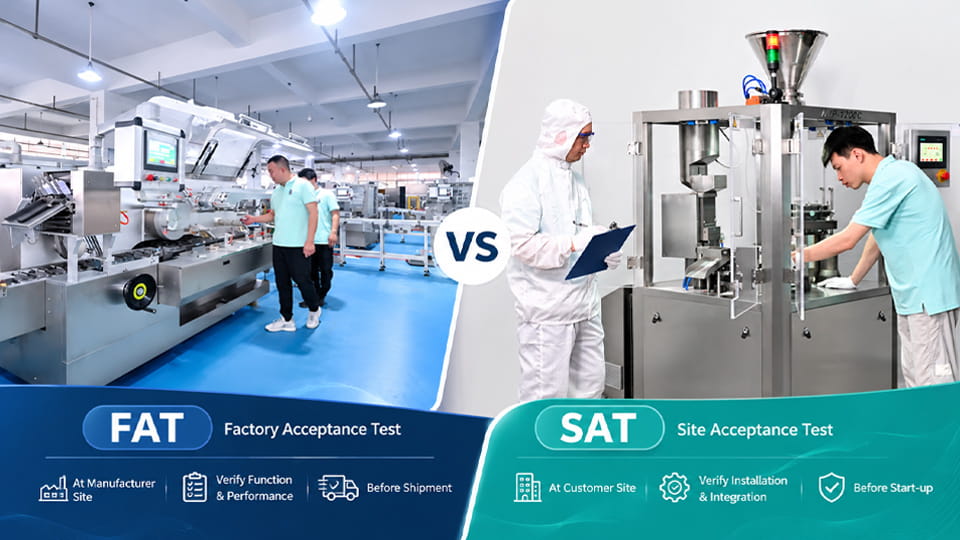
Documents de validation: Jinlu fournit une documentation complète (Fiches techniques, manuels, etc.). Par exemple, liste de leurs pages produits « Ensemble complet de documents techniques » et ils mettent l'accent sur la fourniture d'une documentation détaillée de conception et de test. Un fournisseur disposé à fournir un test d'acceptation en usine (GRAISSE) Les protocoles ou les kits IOQ allègent considérablement le fardeau de validation de l'utilisateur.
Certifications de qualité: Jinlu machines carry CE, cGMP et autres certifications, indiquant qu'ils répondent à certaines normes de qualité et de sécurité (voir le logo cGMP sur les images des spécifications du produit). L’utilisation d’équipements certifiés peut rationaliser l’examen réglementaire.
En pratique, une ligne de conditionnement validée peut inclure: un Jinlu machine d'emballage sous blister lié à un encartonneuse et lignes de comptage/remplissage. Chaque équipement doit être qualifié (IR/WH/PQ). Les systèmes de Jinlu sont conçus pour fonctionner ensemble de manière transparente (par exemple. « Ligne d'encartonnage blister hautement automatisée » jusqu'à 320 cartons/min), réduire les problèmes d'intégration lors de la validation. Nous proposons également des études de cas (par exemple. un complet ligne de comptage et d'embouteillage, ou un encartonnage automatique & ligne d'étiquetage) qui démontrent des solutions validées de bout en bout.
Machine d'emballage sous blister à rouleaux DPH-270Max
En partenariat avec Jinlu ou des fabricants similaires, les entreprises bénéficient d'équipements « conforme aux BPF », prend en charge un cycle de vie de validation complet, et est livré avec un support après-vente (mise en service, entraînement) pour garantir que la ligne reste validée.
Conclusion
Validation des emballages est essentiel pour la qualité et la conformité pharmaceutiques. En traitant les opérations d’emballage avec autant de rigueur que les étapes principales de fabrication, les entreprises veillent à ce que leurs produits parviennent aux patients en toute sécurité. Le processus s'étend sur la définition (URS, l'évaluation des risques), qualification (DQ/QI/OQ/PQ), essai (CCIT, stabilité, transport), et une surveillance continue. Il est régi par la réglementation GMP (FDA, Ema, OMS) et les normes de l'industrie.
Les équipements d’emballage automatisés modernes – tels que les machines Jinlu Packing – jouent un rôle clé dans la validation. Conçu pour la précision, hygiène et traçabilité électronique, ils aident les fabricants à répondre efficacement aux critères de validation. Lors de la sélection des lignes de conditionnement, considérer les fournisseurs qui fournissent une documentation de validation et une assistance complètes.
Finalement, une validation approfondie de l'emballage est « la garantie ultime pour la qualité des produits et la sécurité des patients », s'aligner sur les exigences réglementaires et les objectifs commerciaux.
Prêt à valider votre ligne de conditionnement?Contactez les experts de Jinlu Packing pour discuter de solutions d'emballage conformes aux BPF ou demander un devis.
FAQ sur la validation des emballages dans l’industrie pharmaceutique
Quelle est la différence entre la validation des emballages et la validation des processus?
La validation du processus fait généralement référence aux étapes de production de la substance médicamenteuse ou du produit médicamenteux en vrac. (par exemple. mélange, granulation, compression). La validation des emballages applique spécifiquement les principes de validation aux opérations d'emballage (scellage, étiquetage, remplissage de cartons, etc.). Cependant, les deux suivent le même cycle de vie DQ/IQ/OQ/PQ et les mêmes exigences GMP. Essentiellement, la validation de l'emballage garantit le processus d'emballage (pas seulement le processus de fabrication) répond systématiquement aux exigences de qualité.
Quels tests sont requis pour la validation des emballages pharmaceutiques?
Les tests clés incluent l'intégrité de la fermeture du conteneur (CCIT) pour vérifier les scellés, compatibilité des matériaux (études sur les extractibles/lessivables), tests de stabilité (médicament dans son emballage final sous stress), et tests de distribution (choc, vibration, température de transit). Des contrôles supplémentaires couvrent l’exactitude des étiquettes, systèmes d'inspection visuelle, poids/contrôle pondéral, et tous tests spécifiques au contrat (par exemple. résistance du film stérile). Tous les tests doivent avoir des critères d'acceptation prédéfinis et être documentés.
Combien de temps prend habituellement la validation des emballages?
Le calendrier dépend de la complexité (nombre de formats, équipement, Sites). Un IQ/OQ/PQ sur une seule ligne peut durer de quelques semaines à quelques mois. Facteurs: le nombre de tests de paramètres OQ, tailles d'échantillon requises en PQ, et le temps d'exécution des tests (par exemple. la stabilité dans des conditions accélérées prend des semaines). Planifier des activités parallèles (comme préparer des protocoles pendant que l'équipement arrive) peut gagner du temps.
Quels documents régissent la validation des emballages?
Les principales références sont les réglementations BPF: 21 Partie CFR 211 (FDA américaine), EudraLex Vol.. 4 (BPF de l'UE, Annexe 1 et 15), et Annexe BPF de l'OMS 9. ICH Q7/Q10 fournissent des principes généraux de validation, ICH Q9 couvre la gestion des risques pour les décisions d'emballage, et ISO 11607-2 s'applique à la validation du processus de conditionnement stérile. Normes pharmacopées (USP, Ph.. EUR.) et les directives locales (par exemple. NMPA chinois, Inde Annexe M) influencent également les exigences en matière d'emballage. Alignez-vous toujours sur les réglementations du marché cible.
Comment Jinlu Packing prend-il en charge la validation des emballages?
Les machines d'emballage de Jinlu sont construites pour GMP. Ils fournissent des documents de conception (URS, FDS), certificats d'étalonnage, et prise en charge OQ/PQ. Leur équipement (machines à cloques, encartonneuses, lignes de remplissage) dispose d'un servocommande précis et d'une conception hygiénique pour répondre aux spécifications de validation. Comme indiqué sur le site de Jinlu, les machines portent les logos cGMP/CE et sont livrées avec des ensembles de documentation technique. Jinlu propose également un support d'installation et de validation, solutions personnalisées, et formation pour aider à mettre en œuvre des lignes de conditionnement validées. Pour plus d'informations, voir les pages de la machine d'emballage sous blister ou de la machine de cartonnage de Jinlu.
Petit Fu, Fondateur de Jinlupacking, amène 20 années d'expertise dans le secteur des machines pharmaceutiques. Sous sa direction, Jinlu est devenu un fournisseur de confiance intégrant la conception, production, et ventes. Petty est passionné par le partage de ses connaissances approfondies de l'industrie pour aider ses clients à naviguer dans les complexités de l'emballage pharmaceutique., s'assurer qu'ils reçoivent non seulement du matériel, mais un véritable partenariat de services à guichet unique adapté à leurs objectifs de production.