UN ligne de conditionnement clé en main est un système entièrement intégré, système d'emballage de bout en bout livré par un seul fournisseur. Il couvre chaque étape de la production – de l’alimentation initiale du produit à l’emballage primaire, emballage secondaire, et le conditionnement/palettisation en fin de ligne – et est remis prêt à fonctionner selon une seule spécification des exigences de l'utilisateur. (URS). En pharmacie, des lignes clé en main assurent responsabilité en un seul point, mise en service plus rapide, et une conformité totale aux BPF dès la conception. Cet article explique les modules d'une ligne de conditionnement clé en main, comment ça marche (organigramme), avantages clés, et en quoi cela diffère d'une configuration multi-fournisseurs. Nous couvrons également les applications pharmaceutiques typiques, conseils de sélection des fournisseurs (avec un exemple des capacités de Jinlu), et FAQ.
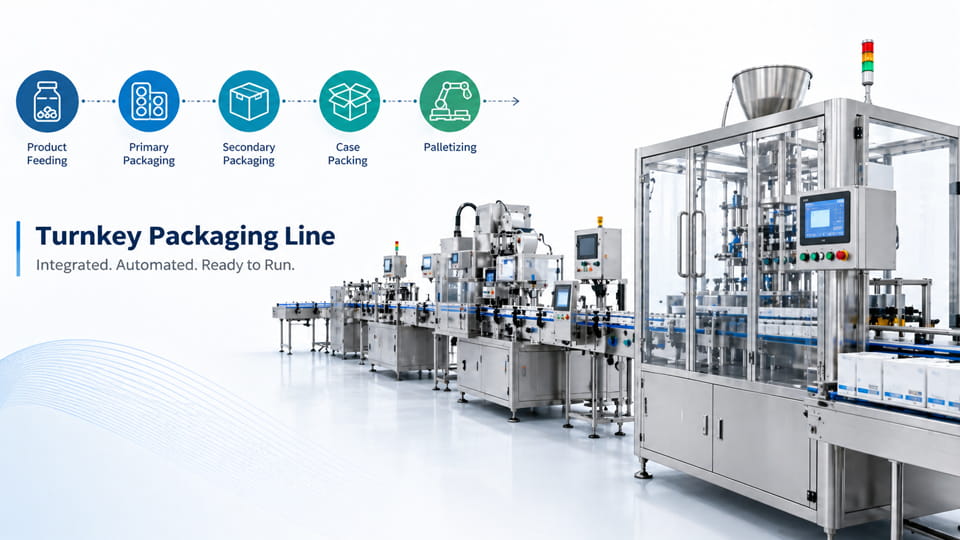
Une véritable ligne clé en main va au-delà des machines à coudre ensemble : un seul fournisseur conçoit, construit, livre, et valide l'ensemble du système dans le cadre d'un seul contrat. Par contre, une approche traditionnelle pourrait acheter des machines individuelles auprès de différents fournisseurs et essayer de les intégrer plus tard, ce qui entraîne souvent des retards, frais supplémentaires, et les maux de tête de validation. La solution clé en main comprend l'automatisation depuis la manipulation des produits en vrac jusqu'à l'emballage final des caisses., avec des contrôles unifiés, connectivité des données, et documentation. Par exemple, Jinlupacking définit une ligne blister clé en main comme revêtement alimentation par comprimés, formage/scellage de blisters, impression/codage, mise en carton, et mise en caisse le tout livré comme un seul système validé. En pratique, ce concept s'étend à tout format pharmaceutique (comprimés, gélules, bouteilles, flacons, sachets, etc.) – ce qui signifie qu'un fournisseur livre un complet, système d'emballage prêt à l'emploi plutôt qu'une collection de machines distinctes.
Que comprend une ligne de conditionnement clé en main?
Une ligne de conditionnement clé en main regroupe tous les modules nécessaires pour passer du produit pharmaceutique brut (par exemple. comprimés, gélules, poudre, liquide) entièrement emballé conditionnements unitaires et cartons en boîte. Les modules clés incluent généralement:

- Alimentation du produit & Manutention: Aliments automatisés ou systèmes de bols qui prennent des comprimés/capsules/flacons/pochettes en vrac et les introduisent un par un dans la ligne à un débit contrôlé. Pour les solides, il peut s'agir d'un alimentateur à plateau vibrant ou d'un redresseur de capsules; pour bouteilles, un redresseur et un convoyeur; pour liquides, une station d'orientation/accumulation. Une alimentation appropriée garantit un flux constant dans la première machine d'emballage.
- Emballage principal: Le premier niveau de colis qui contient directement le produit. Cela varie selon le type de produit: blisters pour comprimés/capsules (thermoformage et scellage de feuilles/PVC sous blister); machines de remplissage de liquides pour flacons/ampoules (remplisseuses à piston ou péristaltiques avec bouchage ou sertissage); remplisseurs de tubes pour gels/crèmes; machines à sachets ou stick-pack pour poudres ou granulés; remplisseurs de sachets préfabriqués; remplisseuses et boucheuses de bouteilles pour liquides oraux; etc.. Chaque conditionneur primaire est conçu pour la forme posologique et le matériau de remplissage spécifiques.. Par exemple, les formeurs de blisters chauffent le film PVC pour créer des poches pour les pilules, sous forme froide (De tout le temps) les machines à blister pressent le papier d'aluminium pour les médicaments sensibles à l'humidité. Chaque étape primaire doit correspondre précisément aux spécifications du produit et du film/sachet/bouteille..
- Emballage secondaire (Cartonnage): Après emballage primaire, enveloppes de machines secondaires, boîtes, ou cartonne les emballages primaires. Les machines courantes incluent encartonneuses, qui érigent des cartons pliants et insèrent des plaquettes thermoformées ou des flacons ainsi que des dépliants d'information pour les patients. Il y a des charges latérales (horizontal) et chargement par le haut (verticale) encartonneuses selon format. D'autres équipements secondaires peuvent inclure étiqueteuses (appliquer des étiquettes conformes sur les bouteilles/cartons), fardeleuses, ou enveloppes de manches regrouper des packs. Par exemple, une plaquette thermoformée sort du blister et est automatiquement introduite dans un encartonneuse où un carton est érigé, la notice patient est insérée, et le carton est scellé. Le timing entre le blister et l’encartonneuse est étroitement synchronisé dans une ligne clé en main pour éviter les bourrages – ceci est géré par des commandes PLC (voir Intégration ci-dessous).
- Emballage de fin de ligne: Il s’agit d’emballeurs tertiaires pour la manutention en vrac – encaisseuses et palettiseurs. L'encaisseuse prend des cartons remplis (ou bouteilles) et les charge dans des caisses d'expédition en carton ondulé (Cartons RSC), puis scelle l'affaire. Les palettiseurs empilent les caisses sur des palettes. Ensemble, ils préparent le produit pour la distribution. Les encaisseuses modernes incluent souvent des stations de contrôle du poids et d'application d'étiquettes pour vérifier le contenu et appliquer les étiquettes principales.. Dans une véritable solution clé en main, même ces étapes finales sont intégrées afin que les données (comme les numéros de lot, poids, identifiants de palette) passe par l'enregistrement du lot. Par exemple, à la station d'emballage des caisses, le système peut peser chaque caisse et appliquer une étiquette avec l'identifiant de la caisse, le relier au lot sérialisé.
- Inspection & Contrôle de qualité: Des équipements de vision et de test intégrés garantissent la conformité à chaque étape. Les stations typiques comprennent codage/inspection de suivi et de traçabilité (impression et vérification des codes de lots, dates d'expiration, DataMatrix, etc.) et systèmes d'inspection en ligne (vision de la caméra, détecteurs de métaux, trieuses pondérales ou rayons X). Par exemple, une ligne de blister clé en main imprimera un code de lot et un DataMatrix 2D sur chaque carte blister et le vérifiera immédiatement avec une caméra. Le système rejette tout blister avec un code manquant ou illisible sans arrêter toute la ligne. Sans une ligne véritablement intégrée, une imprimante boulonnée peut ne pas suivre le rythme de manière fiable, conduisant à des échecs d’audit. Autres fonctionnalités de contrôle qualité telles que les contrôles de niveau de remplissage, tests d'intégrité des joints (par exemple. testeurs d'étanchéité pour flacons), et les contrôles finaux du poids des cartons sont souvent intégrés. Tous les capteurs et détecteurs sont reliés au PLC/HMI central, s'assurer que tout défaut signale un blocage dans cette unité exacte au sein du contrôleur principal, pas un ordinateur séparé.
- Intégration & Contrôle d'automatisation: Au-delà des modules physiques, une ligne clé en main comprend le système d'automatisation complet – un réseau de contrôle basé sur PLC, une interface opérateur (IHM), et une conception électrique/logicielle entièrement intégrée pour toute la ligne. Plutôt que chaque machine ait son propre contrôleur, toute la ligne fonctionne généralement sous une seule architecture PLC (par exemple. Siemens S7 exécutant toutes les stations) et une IHM de supervision. Cela permet d'adapter les vitesses de ligne d'une machine à l'autre, tampons minimisés, et données enregistrées de manière centralisée. Tous les paramètres de recette, vitesses, et les recettes sont accessibles à partir d'un écran tactile unifié. Surtout, le fournisseur d'intégration écrit un seul ensemble de logiciels de contrôle, effectue un test d'acceptation en usine (GRAISSE) sur toute la ligne, et fournit un package de validation (IR/WH/PQ). Cela garantit que la ligne « ne touche pas » à la production en une seule étape.. Dans une véritable ligne clé en main, la mécanique, électrique, et les systèmes logiciels sont tous livrés ensemble par l'intégrateur, afin que « le carton fonctionne sous un contrôle PLC unifié, pas trois protocoles de fournisseurs distincts ».
En résumé, un système d'emballage clé en main pour l'industrie pharmaceutique comprend tout de l'alimentation en vrac à l'emballage final des caisses, plus un équipement de codage/inspection et un système de contrôle unifié. Cela couvre trois niveaux d’emballage (primaire, secondaire, tertiaire) en une seule ligne cohérente. L'approche clé en main signifie que vous obtenez un projet d'ingénierie – un URS, un FAT/SAT, un ensemble de documents de validation – plutôt que plusieurs machines à assembler sur votre site.
Comment fonctionne une ligne de conditionnement clé en main?
Une ligne clé en main est soigneusement conçue comme un flux de processus continu. Les produits entrent en gros, subir un emballage primaire et secondaire, et sortie sous forme de caisses palettisées. La séquence entière est chorégraphiée par le système de contrôle. Vous trouverez ci-dessous un diagramme de flux de processus simplifié:
- Produit en vrac → Alimentateur/Orientation: Les comprimés ou capsules en vrac sont introduits dans la ligne via des alimentateurs vibrants ou des dérouleurs, qui orientent correctement les produits. Dans les lignes de bouteilles, les redresseurs disposent les bouteilles vides sur un convoyeur. Cette étape dose le produit dans le premier emballeur à la vitesse exacte nécessaire.
- Emballage principal: Le produit entre dans son premier conteneur. Par exemple, les comprimés vont dans un emballeuse sous blister où le film est transformé en pochettes et scellé avec du papier d'aluminium. Les liquides peuvent être versés dans des flacons et bouchés. Les poudres peuvent être distribuées dans des sachets stick. Les paramètres (vitesse, volume de remplissage, températures des joints) sont tous préprogrammés. Chaque étape enregistre des données (par exemple. poids de remplissage, force d'étanchéité). Dans une ligne clé en main, ces machines sont physiquement boulonnées ensemble, Ainsi, le produit passe facilement de l'un à l'autre, sans intervention manuelle..
- Codage & Inspection en cours de processus: Immédiatement après l'emballage primaire, la ligne imprime les codes de sérialisation et de lot sur chaque unité. Une caméra de vision lit et vérifie les codes en temps réel. Si un code est erroné ou un pack est endommagé, un rejet ou un contournement en ligne le supprime automatiquement. Cela garantit 100% traçabilité. Une imprimante autonome ne garantirait pas cette intégration étroite. Le système de contrôle enregistre toutes les données d'impression dans un enregistrement de lot électronique (21 Partie CFR 11 conformité).
- Emballage secondaire (Cartonnage/Étiquetage): Suivant, packs primaires (cartes blister, flacons, pochettes) emménager dans un encartonneuse ou poste d'étiquetage. Un cartonneur érige un carton, insère le produit et la notice imprimée, puis ferme et scelle la boîte. Encore, ceci est lié à l'automate principal: l'encartonneuse ne fonctionne qu'aussi vite que le blister fournit le produit (les tampons sont minimisés). Les lignes modernes utilisent des encartonneuses à deux têtes ou à plusieurs voies pour correspondre à la production de blisters à grande vitesse. Étiquettes (si séparé) sont automatiquement appliqués avec les mêmes codes de lot/expiration. Parce que toutes les machines partagent des recettes et des réglages de vitesse dans une seule IHM, changements (par exemple. nouvelle taille de carton ou code produit) sont gérés de manière uniforme.
- Emballage de caisse & Palettisation: Enfin, les cartons scellés sont acheminés vers une encaisseuse automatisée. Ici, des caisses en carton sont érigées, des groupes de cartons sont chargés (souvent en couches), et l'affaire est scellée. Le système vérifie généralement le poids des caisses et applique une étiquette de caisse liée aux cartons sérialisés à l'intérieur.. Les palettiseurs empilent ensuite les caisses sur des palettes et peuvent les emballer sous film rétractable.. Chaque palette est également étiquetée et retracée. Le logiciel d’automatisation relie tout cela ensemble: vous obtenez un historique complet depuis l'entrée en masse jusqu'à l'ID de palette, assurer la traçabilité réglementaire.
Sur toute la ligne, la stratégie de contrôle unifiée est essentielle: un système PLC garantit que la vitesse de la ligne est équilibrée, L'OEE est optimisé, et tout défaut arrête uniquement la section concernée, des machines pas sans rapport. Les temps d'arrêt dus à la configuration de la ligne ou à des commandes incompatibles sont pratiquement éliminés dans une ligne clé en main correctement conçue. Une ligne intégrée élimine les temps d'arrêt causés par la disposition de la ligne, conception, emplacements de la machine ou du système de contrôle, concentrer les arrêts uniquement sur les défauts réels de la machine. En pratique, cela signifie que le processus d'emballage se déroule en continu sous un seul « cerveau »,» ce qui se traduit par une productivité et une prévisibilité plus élevées.
[jl_youtube src= »https://www.youtube.com/embed/zRe4BB8i9n0″]
Principaux avantages d'une ligne de conditionnement clé en main
L'adoption d'une ligne de conditionnement clé en main présente plusieurs avantages par rapport aux installations fragmentaires:
- Point de responsabilité unique: Un seul fournisseur conçoit, ingénieurs, et livre toute la ligne, et assume la responsabilité de sa performance. Vous signez un contrat et un package de validation couvrant toutes les stations. Cela réduit considérablement la complexité de la gestion. Si quelque chose ne va pas au démarrage ou pendant la production, vous traitez avec un seul intégrateur plutôt que de négocier des correctifs entre plusieurs fournisseurs. Comme le prévient Jinlupacking, "L'erreur la plus coûteuse... est d'acheter les bonnes machines auprès des mauvais fournisseurs". Avec une solution clé en main, le fournisseur « est propriétaire de l’ensemble du processus – mécanique, électrique, et intégration de logiciels ».
- Mise en service plus rapide & Délai de mise sur le marché: Parce que la ligne est construite et déboguée au même endroit (l'usine du fournisseur) et expédié entièrement assemblé, la mise en service est beaucoup plus rapide. L'intégrateur gère un FAT/SAT simple protocole pour toute la ligne. En revanche, les projets multifournisseurs connaissent souvent de longs retards car les machines arrivent séparément et des problèmes d'intégration apparaissent sur site. Les projets clé en main vont généralement de la livraison à la mise en production en semaines, pas des mois. Par exemple, Les lignes clés en main standard peuvent être intégrées en 45 à 60 jours, même les lignes complexes en 90 à 120 jours. Ce calendrier compressé signifie que vous pouvez atteindre vos objectifs de lancement plus rapidement.
- Débit garanti & Efficacité: Une ligne clé en main est conçue pour atteindre vos vitesses cibles de bout en bout. Puisque toutes les machines et convoyeurs sont conçus ensemble, le débit est optimisé (pas de goulot d'étranglement invisible). Le fournisseur peut garantir un certain rendement (par exemple. « 200 ampoules/min ») pour la gamme complète, pas seulement des machines individuelles. Cela signifie une efficacité globale de l'équipement plus élevée. (OEE). La conception clé en main offre systématiquement des niveaux de performances OEE optimisés en évitant les problèmes d'arrêt et de démarrage, ainsi que la famine ou le blocage dans la ligne.. En pratique, une ligne conçue par un fournisseur correspondra aux vitesses et utilisera une seule IHM pour l'ensemble du processus, éviter les tampons coûteux ou les transferts manuels requis dans des systèmes disjoints.
- Prêt pour la conformité et la validation: Les lignes clé en main sont construites avec les BPF pharmaceutiques à partir de zéro. Des fonctionnalités de conception telles que cadres tout en acier inoxydable (SUS316L si nécessaire), aménagement sanitaire (pas de jambes mortes), et la capacité CIP/SIP peut être spécifiée et fournie. Plus important encore, la documentation est complète: vous recevez un dossier de validation complet (GRAISSE, QI, QO, PQ) couvrant toute la ligne. Comme notes, un projet clé en main en comprend un IR/WH/PQ pour toutes les gares. La ligne répond intrinsèquement aux normes GMP (21 Partie CFR 211, Annexe UE 1, etc.) et exigences en matière de dossiers électroniques (21 Partie CFR 11 pour l'enregistrement des données). Par exemple, la station de scellage des blisters enregistrera la température/la pression/le séjour par lot dans un enregistrement électronique, et l'encaisseur intégrera les données de sérialisation sur chaque caisse. Avec un fournisseur clé en main, vous n'avez pas besoin de rassembler les certificats de plusieurs fournisseurs : toute l'ingénierie de conformité est unifiée.
- Coût total de possession réduit (TCO): Alors que les lignes clé en main nécessitent souvent des investissement initial, ils économisent de l'argent au fil du temps. Parce que tous les équipements partagent des pièces de rechange et des normes électriques communes, les stocks de rechange sont plus simples. Les contrats de service et les pièces de rechange peuvent souvent être conclus avec une seule source, ce qui peut réduire les coûts globaux de maintenance. Selon une analyse de l'industrie, une ligne clé en main a généralement « des coûts initiaux plus élevés, coût total de possession inférieur. En revanche, les lignes multifournisseurs peuvent entraîner des coûts d'intégration cachés, plusieurs listes de pièces de rechange, requalification répétée, et temps d'arrêt coûteux lors du dépannage. Un contrat de support SLA unique pour l'ensemble de la ligne signifie également un service plus rapide. Sur quelques années, les acheteurs constatent souvent que payer un peu plus d'avance pour une intégration complète est compensé par une disponibilité plus élevée et un support prévisible.
- Évolutivité et personnalisation: Les fournisseurs clé en main peuvent adapter la ligne à votre gamme de produits exacte et à la configuration de votre usine.. Besoin d'une ligne pouvant passer des flacons de 3 ml aux flacons de 10 ml? Un intégrateur clé en main intégrera les changements (recettes partagées, pièces à changement rapide) dès le début. Ils s'adapteront également à la géométrie de la ligne (par exemple. Forme en U pour les espaces restreints) et inclure toutes les fonctionnalités demandées (chargement robotisé, isolateur, etc.). Ce niveau de personnalisation signifie que vous obtenez exactement ce dont vous avez besoin – un avantage si votre gamme de produits ou la taille de votre installation est unique.. Par exemple, Offres d'emballage Jinlu lignes clé en main sur mesure qui correspondent aux exigences d’espace et de processus d’un client.
Pris ensemble, ces avantages rendent les lignes de conditionnement clé en main très attractives pour l'industrie pharmaceutique. Vous évitez une grande partie des risques et des incertitudes liés à l’achat d’équipement fragmenté.. Comme le dit un expert, un véritable contrat clé en main, c'est "un FAT/SAT, un package de validation, et une équipe sur site jusqu'à ce que la production cGMP soit lancée » – une formule claire pour protéger votre calendrier de lancement.
Clé en main vs multi-machine: Comparaison côte à côte
Le tableau ci-dessous compare une ligne clé en main à fournisseur unique avec une configuration multi-fournisseurs traditionnelle.. Il montre pourquoi l'approche clé en main est souvent préférée dans les secteurs réglementés.:
| Fonctionnalité |
Ligne clé en main (Fournisseur unique) |
Système multifournisseur |
| URS & Conception |
Un URS couvre toute la ligne; le fournisseur est responsable de la conformité. Toutes les lacunes de conception sont comblées. |
Documents URS séparés par machine; l'acheteur doit gérer l'intégration. |
| Contrôles & Intégration |
Automate unifié, un écran IHM; un protocole de communication gère toutes les stations. |
Chaque machine utilise son propre contrôleur/PLC. Intégration réalisée par l'acheteur/intégrateur après livraison, souvent avec un middleware coûteux. |
| FAT/SAT |
Documentation unique FAT et SAT pour la gamme complète au débit cible. |
FAT par machine; La ligne complète SAT peut nécessiter un effort supplémentaire ou être manquante. L'acheteur coordonne plusieurs rapports de tests. |
| Validation (IR/WH/PQ) |
Un plan directeur et un dossier de validation. Aucune incertitude de transfert en matière de qualification. |
Paquets de validation individuels par machine; l'acheteur doit aligner les protocoles et les données en interne. |
| Garantie de débit |
Le fournisseur garantit une vitesse de bout en bout (pas de goulots d'étranglement inattendus). |
Chaque machine est évaluée séparément. Ligne globale souvent limitée par l'unité la plus lente, découvert seulement après l'assemblage. |
| Traçabilité |
Sérialisation transparente de bout en bout & piste d'audit du pack principal au dossier. |
Les données ne sont généralement pas liées entre les machines. Transferts de données personnalisés ou journaux manuels nécessaires, risquer des lacunes. |
| Responsabilité |
Contact de service unique et SLA pour toute la ligne. Un intégrateur résout tout problème. |
Plusieurs fournisseurs; en cas de temps d'arrêt, chacun rejette la faute sur les autres. L'acheteur doit résoudre les problèmes d'intégration. |
| Temps de mise en service |
Démarrage rapide: généralement quelques semaines entre la livraison et la production. |
Intégration lente: retards courants de 2 à 3 mois ou plus à mesure que les automates et les vitesses sont réconciliés. |
| Coût total de possession |
Prix initial plus élevé mais pièces de rechange/assistance prévisibles. Coût total de possession réduit sur 3 ans. |
Coût initial réduit; des coûts à long terme plus élevés en raison de temps d'arrêt supplémentaires, revalidation, stocks de rechange, et correctifs d'intégration. |
Tableau: Principales différences entre clé en main (fournisseur unique) lignes et assemblages multifournisseurs.
Cette comparaison (adapté des données de l'industrie) montre pourquoi de nombreuses sociétés pharmaceutiques préfèrent les solutions clé en main malgré leur devis initial plus élevé. Avec un seul intégrateur système responsable de tout, vous évitez les reproches et les dépassements de calendrier qui affectent les projets multi-fournisseurs.
Applications des lignes de conditionnement clé en main en pharmacie
Les lignes de conditionnement clé en main peuvent être configurées virtuellement tout produit pharmaceutique. Les applications courantes incluent:
- Lignes de comprimés et de capsules: Lignes de blister hautement automatisées (Blistereuses PVC ou Alu-Alu + encartonneuses) ou lignes de bouteilles (compteurs de tablettes + remplissage/bouchage + étiquetage + mise en carton). Par exemple, une ligne de production de comprimés peut inclure une presse à comprimés, une machine à compter plusieurs têtes (remplir des bouteilles), une boucheuse à induction, Étiquetage, et une encartonneuse – le tout intégré dans un seul système. Lignes blister clé en main (comprimé à carton) et lignes de bouteilles clé en main (compteur de comprimés vers l'encaisseuse) sont typiques des médicaments à dose solide.
- Liquide & Lignes injectables: Lignes complètes pour liquides stériles (flacons, ampoules, seringues) sont un projet clé en main populaire. Ceux-ci incluent souvent un lave-stérilisateur, remplissage, arrête les inserts, sertisseuse (pour flacons), ou remplissage/bouchage sous vide (pour ampoules), plus convoyeur de chargement du lyophilisateur, laver/sécher, et intégration d'autoclave si besoin. Après avoir rempli, la ligne passe à l'inspection, étiquetage, et cartonnage. Par exemple, une ligne de seringues intégrée peut s'assembler automatiquement, étiquette, et des seringues en carton, comme indiqué par un fournisseur de solutions. En résumé, des lignes de remplissage stériles clé en main garantissent que toutes les étapes, du remplissage aseptique au carton final, sont validées ensemble.
- Emballage de poudre et de granulés (Sachets/Packs de bâtonnets): Nous voyons fréquemment des solutions clé en main pour les poudres unidoses (antiacides, réhydratation orale, etc.) et mélanges (produits nutraceutiques). Ces lignes combinent une remplisseuse de sticks ou de sachets avec une encartonneuse et une encaisseuse multivoies.. Par exemple, Jinlu ligne d'encartonnage de stick-packs à plusieurs voies intègre quatre machines (remplisseurs de stick pack, poids, convoyeur de regroupement, et encartonneuse) pour poudres, granulés, liquides ou gels. Un tel système clé en main peut être personnalisé à partir de 2 à 16 voies, répondre aux besoins de production élevés tout en garantissant une conception GMP.
- Dose solide en pochettes/sacs: Certains médicaments (par exemple. comprimés ou poudres) sont emballés dans des pochettes préfabriquées. Une ligne de pochettes clé en main comprendrait une unité de comptage (pour comprimés ou capsules) ou remplisseur de tarière (pour la poudre), une machine de remplissage de sachets, scellage, puis cartonnage secondaire et mise en caisse. Ces lignes sont moins courantes mais suivent le même principe d'intégration complète.
- Dispositif médical & Kits combinés: L'intégration clé en main s'étend à l'assemblage d'appareils et aux kits. Par exemple, une ligne pourrait assembler des stylos injecteurs, étiquetez-les et emballez-les dans des coquilles ou des cartons, y compris l'inspection automatisée.
- Traitement stérile et aseptique: En biotechnologie/pharma, des suites de remplissage-finition aseptiques entières peuvent être livrées clé en main, y compris les isolateurs ou RABS (barrières d'accès restreint), lignes de remplissage automatisées, et systèmes CIP/SIP intégrés. Ce sont des projets à grande échelle (parfois appelé « installation dans une boîte ») mais suivez le modèle clé en main: une société d'ingénierie gère tous les services publics, salle blanche, et équipement.
En pratique, les systèmes d'emballage clé en main sont les plus répandus dans pharmaceutique et santé, mais sont également largement utilisés dans des industries connexes comme les nutraceutiques, produits de beauté, et même de la nourriture propre, des processus automatisés sont nécessaires. Au sein de l'industrie pharmaceutique, tout produit qui exige une vitesse élevée, précision, et traçabilité BPF – comprimés, gélules, flacons, seringues, sachets – peuvent être traités par une ligne clé en main.
Comment choisir le bon fournisseur de ligne de conditionnement clé en main
Choisir le bon fournisseur est aussi crucial que choisir la ligne elle-même. Voici les critères clés pour les acheteurs:
- Expérience de l'industrie & Références: Recherchez un fournisseur ayant une expérience avérée dans les projets d’emballage pharmaceutique. Ils auraient dû études de cas ou des références clients pour des lignes similaires à la vôtre. Un fournisseur familier avec la réglementation pharmaceutique (cgMP, Inspections FDA/EMA) comprendra mieux vos besoins. Demandez des exemples d'installations de lignes clés en main passées et de résultats de performances..
- Capacité de personnalisation: Chaque produit et chaque installation est différent. Un bon intégrateur adaptera les machines à vos besoins (par exemple. mangeoires personnalisées, composants spéciaux stérilisables, ou des matériaux de niche). Des points forts de Jinlu, ils « proposent des lignes clé en main adaptées aux besoins d’espace et de processus ». Renseignez-vous sur la façon dont le fournisseur gère les produits uniques, exécutions multi-SKU, ou contraintes de salle blanche. Voir s'ils peuvent modifier la mise en page (Forme en U pour les espaces restreints) ou de l'équipement (plusieurs voies, trémies personnalisées).
- Validation & Prise en charge de la conformité: Le fournisseur doit fournir un package de validation complet. Confirmez qu'ils fourniront des tests d'acceptation en usine et des protocoles IQ/OQ prêts à l'emploi. Ils devraient également garantir le respect: Par exemple, Jinlu souligne que leurs gammes sont conçues pour être conformes aux BPF et sont accompagnées d'une documentation.. Vérifiez que le système prendra en charge les exigences réglementaires (enregistrements électroniques sous 21 Partie CFR 11, traçabilité, nettoyabilité). Idéalement, le fournisseur aide avec les dépôts réglementaires (par exemple. fournissant l'USP <1207> plans de tests d'étanchéité, Annexe 1 compatibilité).
- Service après-vente & Soutien: Un service rapide et des pièces de rechange sont essentiels. Le fournisseur a-t-il une représentation locale ou des équipes de service mondiales? Peuvent-ils offrir une assistance à distance? Comme le conseille un guide, voyez si une entreprise peut expédier rapidement des pièces ou envoyer des ingénieurs pour minimiser vos temps d'arrêt. Durée de la garantie, garanties de temps de réponse (ANS), et la disponibilité des pièces pour votre région sont essentielles. Les fournisseurs aiment Jinlu met souvent en avant les garanties de 3 ans et 24/7 soutien. Un fournisseur disposant de manuels multilingues et de dépôts de pièces détachées près de chez vous est préférable.
- Coût total & Empreinte: Au-delà du prix de la vignette, considérer le coût total du cycle de vie. Un fournisseur qui prévoit une maintenance facile (pièces de rechange standard, pièces modulaires) peut économiser de l'argent à long terme. Vérifiez également l’empreinte physique de la ligne et les besoins des services publics.: un bon intégrateur adaptera l'aménagement à votre installation (par exemple. ligne tournante, convoyeurs mezzanines). Ne payez pas trop cher pour la capacité inutilisée : adaptez la vitesse et la taille de la ligne à votre volume actuel et projeté.. Inversement, s’assurer qu’il y a de la place pour se développer si la demande augmente.
- Informations d'identification d'entreprise: Vérifiez les certifications du fabricant: ISO 9001 (gestion de la qualité) et ISO 13485 (qualité des dispositifs médicaux) sont des bonus. Pour les préoccupations spécifiques au secteur pharmaceutique, s'assurer qu'ils reconnaissent les exigences CE et les normes électriques/CEM applicables. (Le marquage CE est obligatoire en Europe et souvent requis ailleurs pour démontrer la conformité de base en matière de sécurité.)
Exemple: Machines d'emballage Jinlu, par exemple, nous commercialise comme un « de bout en bout » fournisseur de ligne pharmaceutique. Notre équipe peut fournir charges de capsule, emballeurs de blisters, machines à compter, encartonneuses, etc., tous construits selon les normes GMP. Nous travaillons en étroite collaboration avec les clients sur la mise en page et l'automatisation. Lors de l'évaluation de Jinlu ou de tout autre fournisseur, demandez des devis détaillés basés sur votre URS et comparez leur approche d'intégration proposée.
Conclusion
En résumé, un ligne de conditionnement clé en main est un forfait tout compris, solution à fournisseur unique pour emballage pharmaceutique, gérer tout, de l'alimentation en vrac à la palettisation finale. Il garantit une efficacité élevée, Conformité BPF, et une gestion de projet simple en fournissant un système intégré sous un URS et un plan de validation unifiés. Les principaux avantages incluent un démarrage plus rapide, meilleure performance de la ligne, et responsabilité centralisée. Pour les fabricants pharmaceutiques, une approche clé en main réduit considérablement les risques et les maux de tête liés à l'intégration multi-fournisseurs. Lors de l’évaluation des offres clé en main, se concentrer sur l’expertise des fournisseurs, personnalisation, et prise en charge de la validation GMP. Avec le bon partenaire (par exemple. Les solutions de bout en bout de Jinlu Packing ou fournisseurs clés en main similaires), vous pouvez obtenir une douceur, processus d'emballage conforme et prêt à fonctionner dès le premier jour.
FAQ sur les lignes de conditionnement clé en main
Quelle est la différence entre une ligne clé en main et une ligne de conditionnement intégrée?
Essentiellement, ils font référence au même concept: une ligne clé en main est un système de conditionnement intégré livré prêt à fonctionner. La différence réside davantage dans la formulation. Une ligne « clé en main » souligne qu'un seul fournisseur gère l'ensemble du projet dans le cadre d'un seul contrat., alors qu'une « ligne intégrée » souligne que plusieurs machines sont liées ensemble en un seul système. Les deux impliquent une automatisation complète du début à la fin. Cependant, parfois, la « ligne intégrée » peut encore impliquer plusieurs fournisseurs; « clé en main » signifie explicitement un seul fournisseur. Le principal avantage du clé en main est la responsabilité unique et la validation unifiée..
Est-ce qu'une ligne de conditionnement clé en main convient à une petite entreprise pharmaceutique ou à une entreprise pharmaceutique de niche?
Oui, les lignes clé en main peuvent être adaptées à des opérations plus petites. Les intégrateurs modernes sont très flexibles dans leur conception. Pour les espaces limités (par exemple. un petit R&D usine ou ligne pilote sous 40 m²), les fournisseurs proposent des configurations compactes – telles que des machines monoblocs ou des lignes de convoyeurs en forme de U – pour minimiser l'encombrement. Même si votre production est modeste, une ligne clé en main semi-automatique ou à voie unique peut apporter d'importants gains d'efficacité (et une mise à l'échelle future plus facile) en réduisant les étapes manuelles. Il est vrai que le coût initial peut paraître élevé pour une petite ligne., mais vous gagnez du temps sur la validation et obtenez un retour sur investissement plus rapide grâce à l'efficacité. En bref, Les solutions clé en main ne sont pas réservées aux grandes usines : elles doivent simplement être dimensionnées par le fournisseur..
Combien de temps faut-il pour mettre en place une ligne de conditionnement clé en main?
Les projets de ligne clé en main prennent du temps à être correctement conçus, mais l'intégration est globalement plus rapide que les configurations multi-fournisseurs. Pour une ligne moyennement complexe, vous pouvez vous attendre à 3 à 6 mois après la finalisation de la conception (URS) aux tests en usine, puis encore quelques semaines sur place pour l'installation et le SAT. Certains fournisseurs signalent que des modules clé en main standard sont prêts en 45 à 60 jours, avec des lignes hautement personnalisées dans la plage de 90 à 120 jours. Vous travaillerez en étroite collaboration avec le fournisseur pendant cette période: définition des paramètres du produit, approuver les mises en page (souvent en CAO 3D), puis témoin du FAT dans leur usine. Gardez également à l’esprit le temps nécessaire à la préparation du chantier (utilitaires, salle blanche). En tout, une ligne clé en main est souvent réalisée en moins d'un an pour des projets de taille moyenne, alors qu'une mosaïque de machines distinctes pourrait durer bien au-delà de cette période.
Quelles certifications ou normes dois-je rechercher dans une ligne de conditionnement pharmaceutique?
L'équipement d'emballage lui-même doit répondre aux normes de sécurité industrielle et électriques (Par exemple, Marquage CE en Europe, UL ou CSA en Amérique du Nord, et directives CEM/LVD). En pharmacie, il n'existe pas de certificat unique « GMP » pour les machines, mais la conception doit suivre les principes GMP (conception sanitaire, logiciel prêt pour la validation, etc.). Donc, s'assurer que le fournisseur fournit un package de validation pour la ligne (Rapports FAT, Protocoles QI/OQ). Le logiciel doit prendre en charge la FDA 21 Partie CFR 11 (pour les enregistrements électroniques) et Annexe BPF de l'UE 11. De nombreux fabricants (comme Jinlu) mettre en avant le marquage CE sur leurs machines, qui est légalement tenu de vendre en Europe. En plus, demander l'ISO 9001 (gestion de la qualité) certification du fabricant, et tout audit qualité client pertinent. En pratique, la conformité signifie que votre ligne répond 21 CFR 211 (contrôles d'emballage) et annexe 1 (produits stériles) normes dès la conception.
Quelles industries utilisent couramment des lignes de conditionnement clé en main?
Hormis les produits pharmaceutiques, des lignes de conditionnement clé en main sont utilisées partout où, un emballage automatisé est nécessaire. Cela inclut les nutraceutiques (vitamines, suppléments), produits de beauté, nourriture (en particulier les aliments pour bébés ou les confiseries), et produits chimiques. Par exemple, un fabricant de produits alimentaires pourrait installer une ligne de produits surgelés clé en main similaire dans son concept à une ligne pharmaceutique – intégrant le portionnement, emballage primaire, emballage en carton, et palettisation. Dans le domaine de la santé en particulier, toute entreprise cherchant à rationaliser sa production – des grandes sociétés pharmaceutiques aux biotechnologies de niche – peut bénéficier d’une automatisation clé en main.
Les systèmes d’emballage clé en main sont-ils personnalisables?
Absolument. Les lignes clé en main sont souvent conçues pour le produit de chaque client, volume, et l'espace. Les fournisseurs proposent régulièrement des voies personnalisées, configurations de machines, et fonctionnalités spéciales (par exemple. prélèvement et placement robotisé, isolateurs, purge à l'azote) dans le cadre du forfait. Le terme « clé en main sur mesure » est parfois utilisé pour souligner cette flexibilité.. Ce qui n'est pas personnalisable, c'est la nature du contrat unique: même si vous ajoutez des machines personnalisées ou modifiez les mises en page, tout est livré clé en main. Cela signifie que le fournisseur fournit toujours un système intégré.
Références:
1.21 Partie CFR 211 – Sous-partie G – Contrôle de l'emballage et de l'étiquetage —— Institut d'information juridique
2.Sec. CPG. 450.500 Exigences en matière d'emballage inviolable pour certains médicaments à usage humain en vente libre -- NOUS. Administration des aliments et des médicaments
3.Six lignes directrices pour l'intégration d'une ligne de conditionnement clé en main —— Monde de l'emballage
4.Annexe BPF de l'UE 15: Qualification et Validation —— gmp-compliance.org
5.Annexe 9 Lignes directrices sur l'emballage des produits pharmaceutiques -- OMS
