

Acheter un machine de conditionnement de médicaments est une décision majeure pour toute entreprise pharmaceutique, donc poser les bonnes questions dès le départ peut faire gagner du temps, argent, et des maux de tête plus tard. Moderne lignes de conditionnement pharmaceutique sont complexes (intégrant souvent charges de capsule, machines à cloques, systèmes de comptage, encartonneuses, et plus), et ils doivent répondre à des normes BPF et réglementaires strictes. En fait, des études montrent que près de la moitié de tous rappels de médicaments impliquent des erreurs d’emballage ou d’étiquetage. Dans ce guide, nous avons rassemblé les questions et considérations les plus importantes pour les acheteurs pharmaceutiques. Vous apprendrez à évaluer la conformité (BPF/FDA/OMS), formats (comprimés, liquides, clochards, etc.), vitesse et niveau d'automatisation, besoins de nettoyage et de validation, sérialisation/traçabilité, TCO (coût total de possession), et support fournisseur. Nous incluons également un outil pratique Liste de contrôle de l'acheteur et mettre en évidence les erreurs courantes en matière d'approvisionnement. Que vous dirigiez un petit emballeur sous contrat ou une grande usine de fabrication, cela vous aidera à comparer systématiquement les machines et à éviter des pièges coûteux.
Pourquoi c'est important: En pharmacie, la conformité n'est pas négociable. L'équipement doit être conforme à la FDA, UE, et les normes cGMP de l'OMS avant même d'exploiter le produit. Les pièces de contact de la machine doivent être de qualité pharmaceutique (typiquement en acier inoxydable 316L ou 304) avec lisse, surfaces soudées – pas de rouille, fosses, ou des espaces où la poudre peut se cacher. La conception doit être hygiénique (par exemple. modules en porte-à-faux, surfaces inclinées) il est donc facile à nettoyer et à inspecter. Demandez au fournisseur d'équipement d'emballage pharmaceutique pour les documents: vous devriez recevoir des protocoles pour QI (Qualification d'installation), QO (Qualification opérationnelle), et PQ (Qualification des performances). Ceux-ci valident que la machine est correctement installée, fonctionne à tous les paramètres prévus, et fonctionne de manière constante sous des charges de production réelles. Sans enregistrements IQ/OQ/PQ, l’équipement n’est pas « qualifié » pour Utilisation des BPF. Confirmer également le système qualité et les certifications du fournisseur: Est-ce qu'ils suivent l'ISO 9001? Peuvent-ils fournir des certificats de matériaux (par exemple. Joints en silicone conformes à la FDA) et marquages CE/UL si nécessaire? Enfin, s'assurer que la conception prend en charge l'intégrité des données (par exemple. 21 Partie CFR 11 pour journaux électroniques) et stérilisation si nécessaire.
Image: Une ligne de production moderne d’emballages de médicaments, illustrant la nécessité de machines intégrées et d'une conception conforme aux BPF.
Toutes les machines ne traitent pas tous les produits. Vous devez être très clair sur vos types de produits. Par exemple, comprimés et gélules utilisent souvent des lignes de comptage/remplissage de bouteilles ou des conditionneurs blister, alors que médicaments liquides besoin de machines dédiées au remplissage et au scellage de liquides. Poudres/granulés peut être conditionné en sachets ou en stick packs. Vous trouverez ci-dessous un guide simple – vos besoins peuvent combiner plusieurs machines en une seule ligne:
| Forme posologique & Format | Type de machine typique |
| Comprimés solides (lâche, en bouteilles) | Comptage automatique & Ligne de remplissage de bouteilles |
| Comprimés solides (bandelette ou ampoules) | Machine d'emballage en cloque (PVC/Alu-PVC) |
| Capsules (gel dur) | Machine de remplissage de capsules + (ligne de blister ou de bouteille) |
| Liquides/Sirops (flacons ou bouteilles) | Machine de remplissage et de bouchage de liquide |
| Poudres/granulés (stick ou sachet) | Machine à sachets ou à stick-packs |
| Gels mous/gommes | Machine à compter + Blister ou mise en bouteille |
| Cartons (secondaire) | Encartonneuse pour la boxe finale |
Les machines de conditionnement de médicaments sont souvent vendues comme lignes intégrées. Par exemple, une ligne de capsules peut alimenter le produit d'un filler dans un machine à compter, puis à travers un emballeuse sous blister ou carton.
Demandez à votre fournisseur de machines d'emballage de médicaments: "La ligne peut-elle faire fonctionner mes produits?» Pour chaque format, vérifier la compatibilité des matériaux – par ex.. une machine à blister devrait faire fonctionner votre feuille et vos films (PVC, ANIMAL DE COMPAGNIE, ALU-ALU) aux bonnes températures. Les lignes de bouteilles doivent s'adapter à différentes hauteurs de bouteilles et types de bouchons.. Si vous prévoyez plusieurs produits (par exemple. gélules et comprimés), vous aurez besoin de pièces de rechange ou même de machines différentes. Certaines machines sont multiformat, mais confirmez toujours quel changement est requis (voir la section suivante).
La vitesse nominale d'une machine doit correspondre à vos objectifs de production. Découvrez combien d'unités par minute/heure la machine peut emballer de manière fiable. Assurez-vous de considérer filet sortir (après les rejets) et pas seulement le maximum. Pensez aux besoins actuels et croissance future. Par exemple, une ligne de plaquettes thermoformées de taille moyenne pourrait être évaluée à 40,000 ampoules par heure; une grande ligne entièrement automatique pourrait dépasser 100,000 par heure. Cependant, une machine à très grande vitesse qui tombe souvent en panne peut être pire qu'une machine légèrement plus lente, stable.
Estimez votre volume journalier ou annuel et choisissez une machine capable de gérer les pointes. Gardez à l’esprit les tendances du secteur: de nombreuses sociétés pharmaceutiques gèrent désormais des lots plus petits avec des changements fréquents, donc une vitesse extrêmement élevée pour un seul SKU est moins critique que la flexibilité. Si vous exécutez plusieurs équipes, investir dans un débit plus élevé peut être rentable plus rapidement grâce aux économies de main d'œuvre. Mais si les lots sont petits ou personnalisés, une machine qui permet des changements rapides de recettes et des changements sans outil (voir la rubrique 4) sera plus précieux que la vitesse brute.
Décidez du degré d’automatisation dont vous avez réellement besoin. Machines semi-automatiques obliger les opérateurs à charger les conteneurs, démarrer des cycles, ou effectuer des tâches manuelles (par exemple. déposer des comprimés dans des plaquettes thermoformées). Lignes de conditionnement pharmaceutique entièrement automatiques faire tout, de l'alimentation à la scellement, avec une intervention humaine minimale. Les machines semi-automatiques coûtent moins cher au départ et peuvent convenir aux travaux à faible volume ou par lots. Les lignes entièrement automatiques coûtent plus cher mais permettent d'économiser de la main d'œuvre et de réduire les erreurs humaines.
| Fonctionnalité | Semi-automatique | Entièrement automatique |
| Implication des opérateurs | Oui – chargement/déchargement, etc.. | Minime – une personne supervise toute la ligne |
| Vitesse de production | Modéré | Haut |
| Passage | Ralentissez (réglages manuels) | Plus rapide (souvent sans outil, axé sur les recettes) |
| Investissement initial | Inférieur | Plus haut |
| Complexité de la validation | Similaire (IQ/OQ/PQ toujours nécessaires) | Similaire |
| Idéal pour | Petites courses, pilotes de laboratoire | Grandes séries, 24/7 production |
Les systèmes pharmaceutiques entièrement automatisés comprennent souvent des trémies d'alimentation, étiqueteuses automatiques, casquettes, et convoyeurs tous synchronisés. Ils intègrent également des contrôles d'erreurs (balances, systèmes de vision) en temps réel. Un équipement semi-automatique pourrait convenir à un fabricant sous contrat débutant, mais les plans de croissance conduisent souvent les acheteurs à opter pour une automatisation complète.
Les gammes pharmaceutiques changent de produits plus souvent que vous ne le pensez, et chaque changement nécessite un nettoyage en profondeur (et souvent une revalidation). Une bonne conception de la machine rendra cela rapide. Rechercher sans outil pièces amovibles, composants légers (une seule personne peut les gérer), et des cadres ouverts qui permettent au contrôle qualité voir s'il reste des résidus. Il ne doit y avoir aucune cavité cachée où les pilules ou la poudre peuvent s'accumuler.. Le fournisseur doit fournir des SOP claires pour le nettoyage, démontage et remontage. Valider les procédures de changement: peut produire recettes être stocké afin que vous puissiez rappeler tous les paramètres pour un SKU donné?
En pratique, une machine qui peut être nettoyée et validée rapidement améliore directement la productivité. Si vous avez des médicaments qui nécessitent un changement entre, dire, une substance contrôlée et un produit vitaminé, vous effectuerez un nettoyage et souvent un test de validation propre (test de produit dans le pire des cas) à chaque fois. Renseignez-vous sur nettoyage sur place (CIP) options ou autres caractéristiques hygiéniques.
Une réglementation moderne (NOUS. DSCSA, FMD de l'UE, etc.) exiger sérialiser chaque unité vendable de médecine. Avant d'acheter, confirmer que la ligne peut intégrer des imprimantes de codage (jet d'encre/laser) et des scanners de vision pour appliquer et vérifier les codes-barres 2D ou les codes QR sur les colis. Le système de contrôle doit capturer chaque numéro de série et le lier aux données de lot. En pratique, les acheteurs demandent souvent: « Cette machine peut-elle rejeter tout article sans étiquette ou codé de manière invalide ??» et "Y a-t-il un espace et un câblage réservés pour ajouter un codeur ou une caméra plus tard ??». Même si vous n’exportez pas aujourd’hui, Construire une ligne prête à être sérialisée est plus intelligent que de la moderniser plus tard.
Au-delà de la sérialisation, envisager l'intégration numérique. La machine prend-elle en charge la communication industrielle standard (Ethernet/IP, OPC-UA, Modbus, etc.) pour qu'il puisse alimenter votre MES/ERP? Peut-il générer des pistes d'audit et des enregistrements de lots électroniques pour le contrôle qualité? Les usines intelligentes modernes attendent des données en temps réel: disponibilité, rejeter les comptes, alarmes, etc.. Une ligne pharmaceutique « intelligente » permet de détecter rapidement les problèmes et répond aux exigences en matière d’intégrité des données. (pas de journaux manuels). Demander si l'IHM/l'automate peut être mis en réseau, s'il existe des journaux d'événements, et si le service à distance (via VPN ou IoT) est offert. La préparation au numérique assure la pérennité de votre ligne et améliore la traçabilité.
Le prix de la vignette n’est qu’un début. Les acheteurs intelligents calculent TCO sur la durée de vie de la machine. Le TCO inclut le prix de base plus expédition, installation, IR/WH/PQ, entraînement, des pièces de rechange, consommation d'énergie, entretien, et les coûts des temps d'arrêt. Par exemple, une étude a révélé qu'une ligne de conditionnement de médicaments fabriquée en Chine, coûteuse mais fiable, permettait d'économiser bien plus en trois ans qu'une ligne moins chère, moins bien soutenu. Faire un tableau (comme ci-dessous) pour comparer les fournisseurs:
| Facteur de coût | Description | Commentaires |
| Prix d'achat | Machine, accessoires, livraison | Une fois (mais peut varier considérablement) |
| Installation & Mise en service | Préparation du site, étalonnage, IR/WH/PQ | Les étapes manquées ici peuvent augmenter les coûts futurs |
| Entraînement | Opérateur & formation à l'entretien | Une bonne formation réduit les erreurs de l’opérateur |
| Des pièces de rechange & Composants | Pièces d'usure (ceintures, capteurs, etc.) | Demander la liste; la haute disponibilité évite les temps d'arrêt |
| Énergie/Utilitaires | Électricité, air, vide, etc.. | Des machines efficaces peuvent réduire les OPEX |
| Entretien & Temps d'arrêt | Entretien programmé & correctifs imprévus | Un service rapide et une conception à faible panne minimisent cela |
| Assistance/Services | Dépannage à distance, visites sur place | Un SLA de service solide vaut son pesant d’or |
| Consommables & Outils | Scellés, lubrifiants, buses de rechange, etc.. | Souvent négligé mais peut s'additionner |
Si deux fournisseurs proposent des machines similaires, explorez ce que comprend chaque liste. Une machine plus chère pourrait durer plus longtemps, avoir des pièces de rechange moins chères, ou utiliser moins d’air comprimé – réduisant ainsi son coût réel. Assurez-vous de demander à chaque fournisseur la durée de la garantie et ce qui est couvert (parties, travail, voyage pour les techniciens).
Même la meilleure machine a besoin d’entretien. Vérifiez les antécédents du fournisseur de la machine d'emballage de médicaments et la configuration du service. Une machine fiable possède des fonctionnalités telles que des codes d'erreur clairs sur l'IHM, une armoire électrique bien étiquetée, et un plan de maintenance préventive simple. Demandez le MTBF (temps moyen entre les pannes) données ou études de cas. Découvrez également comment sont gérées les pièces détachées: sont des pièces disponibles dans le commerce ou personnalisées? À quelle vitesse pouvez-vous obtenir les composants critiques – le lendemain ou les semaines suivantes? Pour les acheteurs internationaux en particulier, le soutien local est essentiel. L'étude de JinLu Packing a montré qu'une livraison et un service rapides de pièces peuvent éviter des pertes à six chiffres dues aux temps d'arrêt..
[jl_youtube src= »https://www.youtube.com/embed/1Bb_J6rluac »]
Vidéo: Une ligne automatisée de remplissage et d’embouteillage. Évaluer les fonctionnalités de fiabilité (capteurs d'erreur, armoires claires) et facilité d'entretien lors du choix des équipements.
Tous les constructeurs de machines de conditionnement de médicaments ne comprennent pas les nuances pharmaceutiques. Idéalement, choisissez un fournisseur ayant fait ses preuves dans pharmaceutique/BPF. Renseignez-vous sur leur liste de clients et leurs projets récents. Ont-ils approvisionné votre région ou des marchés réglementés (FDA américaine, Je suis l'EMA)? Est-ce qu'ils font du FAT (Tests d'acceptation en usine) et rapports FAT? Peuvent-ils gérer un processus de qualification si nécessaire? Les fournisseurs réputés disposeront d'un système de gestion de la qualité d'ingénierie et pourront proposer une personnalisation (par exemple. inspections visuelles spécifiques pour l'étiquetage OTC vs RX).
Il faut également penser à la logistique: où est leur usine? Si c'est à l'étranger, existe-t-il des partenaires de distribution ou des installateurs dans votre pays? Qui s'occupe des douanes et de l'expédition? Souviens-toi, la machine la moins chère ne vaut pas grand-chose si elle se trouve sur un navire en raison de documents manquants ou si elle n'est pas prise en charge localement.
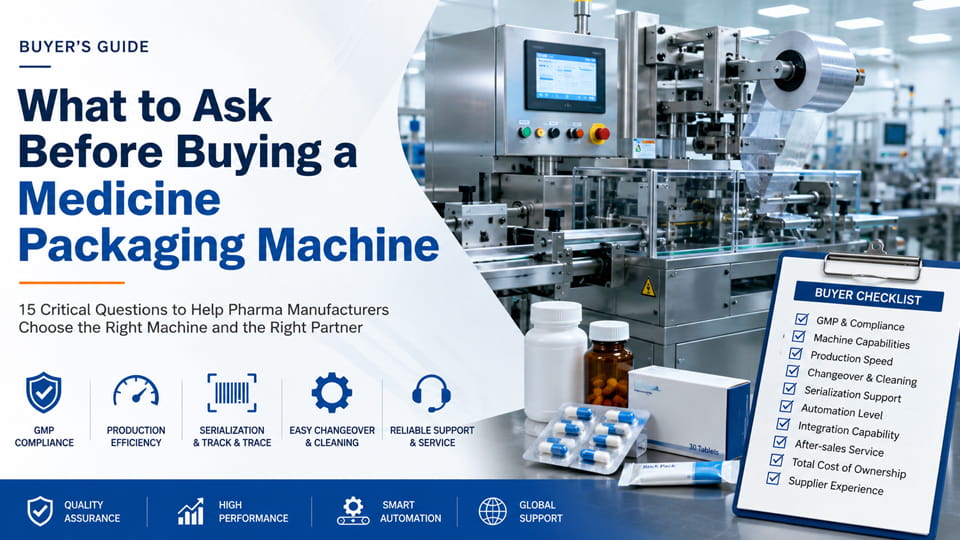
Pour conclure, voici une liste de contrôle que vous pouvez utiliser lors de réunions ou d'appels d'offres:
Ces questions, alors que nombreux, veillera à ce que vous couvriez les points les plus critiques et comparerez les fournisseurs sur un pied d’égalité.
Investir dans la bonne machine de conditionnement de médicaments signifie équilibrer les performances, conformité, et le coût sur de nombreuses années. En posant ces questions, vous clarifierez vos exigences et éviterez les surprises. Souviens-toi, le meilleur choix n'est pas toujours la machine la moins chère, mais celui qui correspond à votre processus et vous maintient conforme avec un temps d'arrêt minimal.
Si vous avez besoin de conseils, consulter des experts en automatisation de l’emballage – par exemple, Emballage Jinlu offre une conception et un support de bout en bout pour les lignes pharmaceutiques, de la disposition des lignes GMP à la documentation de validation. Contactez-nous pour discuter de votre projet: nous pouvons fournir une proposition personnalisée ou organiser une démonstration en direct. Assurons-nous que votre investissement apporte à la fois réussite réglementaire et efficacité opérationnelle..
Avant d'acheter une machine de conditionnement de médicaments, vous devriez poser des questions sur la conformité aux BPF, vitesse de production, types d'emballage, aide à la validation, matériaux de machines, temps de changement, Disponibilité des pièces de rechange, et service après-vente. Il est également important de vérifier si la machine peut prendre en charge les futures exigences d’expansion de la production et de sérialisation..
La bonne machine dépend de votre type de produit, volume de production, format d'emballage, et exigences de conformité. Par exemple, les machines d'emballage sous blister sont couramment utilisées pour les comprimés et les gélules, tandis que les machines à sachets ou à stick pack sont meilleures pour les poudres et les granulés. Les acheteurs doivent également prendre en compte le niveau d'automatisation, frais d'entretien, et capacité d'intégration de ligne.
Un fabricant fiable de machines d'emballage pharmaceutique doit fournir des documents et des certifications tels que:
• Certification CE
• Documentation de conception conforme aux BPF
• Protocoles IQ/OQ/PQ
• Documents FAT/SAT
• Certificats de matériaux
• 21 Partie CFR 11 soutien (le cas échéant)
Ces documents aident les usines pharmaceutiques à réussir les audits et à répondre aux exigences réglementaires.
La conformité aux BPF contribue à garantir la sécurité des produits, qualité constante, et approbation réglementaire. Une machine conforme aux BPF est conçue pour réduire les risques de contamination, améliorer la nettoyabilité, et prendre en charge une documentation et une traçabilité appropriées. Ceci est particulièrement important pour les fabricants de produits pharmaceutiques exportant vers des marchés réglementés..
Les équipements d'emballage pharmaceutique modernes peuvent prendre en charge de nombreux formats d'emballage, y compris:
• Blisters
• Bouteilles
• Sachets
• Packs de bâtons
• Pochettes
• Cartons
La meilleure option dépend de votre forme posologique, exigences du marché, et les objectifs de production.
La sérialisation devient essentielle dans de nombreux pays en raison des réglementations en matière de traçabilité pharmaceutique telles que DSCSA et EU FMD.. Une machine dotée d'une capacité de sérialisation peut imprimer et vérifier des codes uniques, aider les fabricants à prévenir les produits contrefaits et à améliorer le suivi de la chaîne d'approvisionnement.
Les machines semi-automatiques sont généralement plus abordables et adaptées aux petits volumes de production ou aux startups. Les machines de conditionnement pharmaceutique entièrement automatiques conviennent mieux à la production à grande échelle car elles améliorent l'efficacité, réduire les coûts de main-d'œuvre, et minimiser l'erreur humaine.
Le prix dépend de plusieurs facteurs, y compris le type de machine, niveau d'automatisation, vitesse de production, et exigences de personnalisation. Une machine semi-automatique de base peut coûter beaucoup moins cher qu'une ligne de conditionnement pharmaceutique entièrement automatisée avec prise en charge de la sérialisation et de la validation.. Les acheteurs doivent se concentrer sur le coût total de possession plutôt que uniquement sur le prix d'achat initial..
Oui. De nombreuses machines de conditionnement pharmaceutique modernes peuvent se connecter à des machines de comptage, systèmes d'étiquetage, encartonneuses, convoyeurs, et systèmes ERP/MES. L'intégration contribue à améliorer l'automatisation et l'efficacité globale de la production.
Un fournisseur professionnel devrait offrir:
• Assistance à l'installation
• Formation des opérateurs
• Dépannage en ligne
• Fourniture de pièces de rechange
• Conseils de maintenance préventive
• Assistance technique à distance
Un bon service après-vente peut réduire considérablement les temps d'arrêt et améliorer la stabilité de la production à long terme.
Références:
1.Bonnes pratiques de fabrication actuelles (CGMP) Règlements -- NOUS. Administration des aliments et des médicaments
2.Bonnes pratiques de fabrication de l'OMS pour les produits biologiques, Annexe 2, Non SRT 999 -- OMS
3.Bonnes pratiques de fabrication —— Agence européenne des médicaments
4.Dix questions fréquemment posées sur la sérialisation —— Société internationale de génie pharmaceutique