
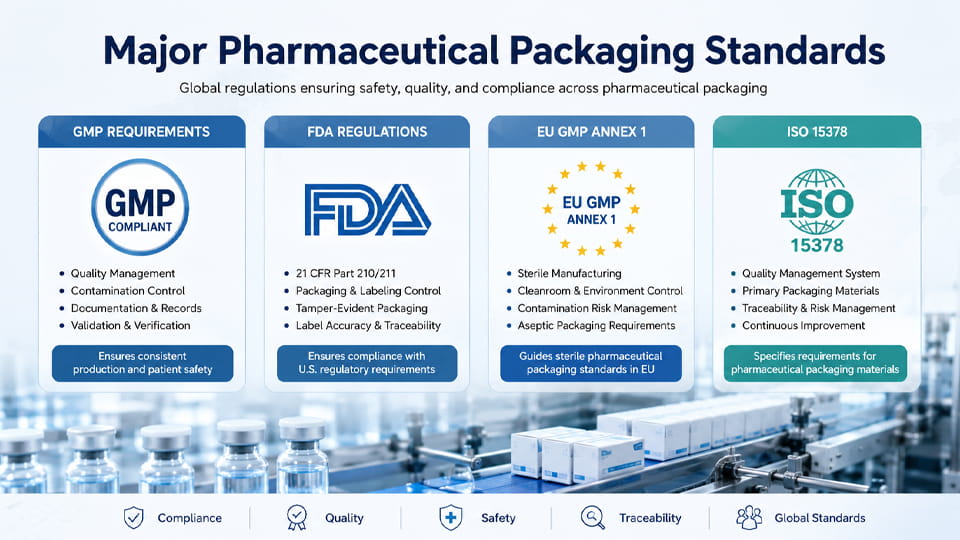
Emballage pharmaceutique doit prévenir la contamination et assurer la traçabilité, selon des normes mondiales strictes. Bonnes pratiques de fabrication (GMP) nécessitent une conception d’équipement hygiénique, matériaux non réactifs, et qualification complète (IR/WH/PQ) des machines. Les principales réglementations comprennent FDA 21 Pièces CFR 210/211, qui imposent des équipements nettoyables et des journaux d'entretien, BPF de l'UE (EudraLex Vol4) (Partie I Ch.3 et annexe 1) pour emballage stérile, et ISO 15378, la norme QMS pour les matériaux d'emballage primaire. Couverture des exigences essentielles compatibilité des matériaux, nettoyage/CIP validé, sérialisation, et intégrité des données (21 CFR Partie 11/Annexe UE 11). Ce guide explique ces normes et comment choisir des machines d'emballage conformes aux BPF (cloque, remplissage de bouteilles, mise en carton, étiquetage, etc.) pour la sécurité, produits pharmaceutiques traçables.
L’emballage pharmaceutique est aussi crucial que le médicament lui-même : il protège l'identité du produit, puissance et stérilité. L'OMS note que l'emballage doit protéger les médicaments des produits chimiques indésirables, contamination biologique ou physique et, pour produits stériles, « la stérilité doit être maintenue ». En pratique, cela signifie chaque blister, la bouteille ou l'emballage en carton doit être produit et étiqueté correctement selon les BPF pour éviter toute confusion ou contamination.. Régulateurs mondiaux (FDA, Ema, OMS) exiger que les processus et équipements d’emballage soient validés et contrôlés, tout comme la fabrication de médicaments. En bref, normes d'emballage pharmaceutique existent pour garantir la sécurité des patients en gardant les médicaments corrects, pur et traçable tout au long de la distribution.

GMP est le cadre général pour la qualité des médicaments. Pour l'emballage, Mandats BPF conception hygiénique et contrôles stricts pour éviter la contamination croisée et les confusions. L'équipement doit être conçu pour être « facilement et soigneusement nettoyé », comme le disent les régulateurs. Par exemple, Les directives de la FDA précisent que l'équipement « devrait être construit et situé de manière à faciliter le nettoyage… éviter la contamination ». Les lignes directrices de l'OMS/PIC/S mettent également l'accent sur la validation des équipements et des processus avec une conception sanitaire.. En substance, BPF pour l'emballage nécessite: nettoyable en acier inoxydable (souvent SUS316L) équipement, protocoles de nettoyage documentés, qualification complète (IR/WH/PQ) et des enregistrements d'étiquetage précis. Ces pratiques protègent l'identité et la qualité du produit à chaque étape de conditionnement..
Aux États-Unis, FDA 21 Pièces CFR 210 et 211 couvrir la fabrication et le conditionnement des médicaments. Partie 211 (Sous-partie D/E) comprend des règles spécifiques sur la conception des équipements, nettoyage et calibrage. Par exemple, tout l'équipement doit fonctionner conformément aux spécifications et être nettoyé conformément aux procédures écrites. Partie 211 nécessite également d'identifier et d'étiqueter les composants pour éviter les confusions, et maintenir des enregistrements de lots complets pendant l'emballage. Surtout, 21 Partie CFR 11 s'applique aux contrôles informatisés sur lignes de conditionnement: il impose des connexions utilisateur uniques, pistes d’audit et signatures électroniques pour garantir l’intégrité des données. En pratique, cela signifie que les machines d'emballage modernes doivent crypter les données des lots, restreindre l'accès des utilisateurs, et enregistrez chaque changement, en conformité avec les règles de la FDA.
Le guide BPF de l'UE (EudraLex Vol. 4) s'aligne étroitement sur les principes de la FDA pour les équipements. Partie I Chapitre 3 (Locaux et équipements) exige que l'équipement soit "facile à nettoyer" avec pièces de contact non réactives. Annexe 15 (UE) exige une qualification complète (IR/WH/PQ) de toutes les machines. Pour les systèmes informatisés, Annexe UE 11 (non montré ici) exige également une validation et des pistes d’audit sécurisées, comme la part de la FDA 11. Une mise à jour clé est Annexe BPF de l'UE 1 (Produits stériles), pleinement applicable à partir de 2024. Annexe 1 élève la barre en matière d'emballage stérile: cela nécessite une stratégie documentée de contrôle de la contamination (CSC) et normes de salle blanche de haute qualité (ISO 5/7 notes), ainsi que les technologies barrières (isolateurs/RABS) et méthodes de stérilisation validées. Intégrité de la fermeture du conteneur (CCI) les tests et les contrôles sur les matières extractibles/lixiviables sont également soulignés pour minimiser les risques de contamination. Toutes les lignes de produits injectables stériles basées dans l'UE ou exportées doivent répondre à ces critères..
ISO 15378 est la norme internationale pour matériaux d'emballage primaire des médicaments. Il spécifie un système de gestion de la qualité (SGQ) aligné sur l'ISO 9001, en référence aux BPF. Autrement dit, ISO 15378 se concentre sur la conception, fabrication et fourniture de composants d'emballage pharmaceutique (feuille blister, bouteilles, flacons, etc.), s'assurer qu'ils répondent systématiquement aux exigences des clients et aux exigences réglementaires. Alors que l'ISO 15378 s’adresse aux fournisseurs de matériaux plutôt qu’aux fabricants d’équipements, les fabricants de machines doivent s'adapter aux matériaux conformes (par exemple. plastiques ou stratifiés approuvés) et fournir de la documentation (certificats de traçabilité des matières) afin que l'emballage primaire final soit certifié ISO‑15378. Atteindre la norme ISO 15378 la certification démontre l'engagement envers des matériaux d'emballage de qualité GMP dans votre production.
Les machines de conditionnement pharmaceutique doivent répondre à des critères techniques stricts pour être conformes aux normes ci-dessus. Le tableau ci-dessous résume les principales exigences:
| Exigence | Points clés |
| Conception hygiénique | Équipement en acier inoxydable (par exemple. 316L), soudures lisses, surfaces inclinées. Cadres en porte-à-faux (lecteurs isolés) pour éliminer les zones cachées, permettant le nettoyage. |
| Compatibilité des matériaux | Toutes les pièces en contact avec le produit doivent être non réactives/non absorbantes (316LSS, PTFE, plastiques de qualité pharmaceutique) ils ne peuvent donc pas lessiver ou lier les actifs. Utilisez des lubrifiants et des joints de qualité alimentaire (PTFE, EPDM) résistant aux produits de nettoyage. |
| Validation de l'équipement | Complet IR/WH/PQ pour chaque machine: qualification d'installation documentée, tests fonctionnels, et tests de performances lors d'un lot simulé ou réel. Chaque machine nouvelle ou modifiée doit être qualifiée avant utilisation. |
| Nettoyage & Désinfection | Procédures de nettoyage/NEP validées pour chaque changement de produit. Les SOP de nettoyage doivent être rédigées, exécuté et revalidé périodiquement. Seules les zones en contact avec le produit nécessitent un échantillonnage de validation. |
| Entretien & Étalonnage | Maintenance préventive programmée pour remplacer les pièces usées. Procédures d'étalonnage (par exemple. pour balances, débitmètres) avec des enregistrements (pour la FDA 21 CFR 211.68) assurer l'exactitude. Contrôles réguliers des capteurs et des actionneurs conformément aux SOP. |
| Automation & Sécurité | Fonctionnalités de prévention des erreurs telles que l'inspection visuelle, la lecture des codes-barres et les portes de rejet automatisées réduisent les erreurs humaines. Verrouillages (par exemple. capteurs de porte) arrêter les machines sur les bourrages. Pour les lignes d'étiquetage, les caméras vérifient l'application correcte de l'étiquette. |
| Intégrité des données | Les contrôles doivent être conformes à la FDA 21 CFR Partie 11/Annexe UE 11: comptes d'utilisateurs sécurisés, des pistes d'audit inaltérables, et signature électronique des dossiers. Intégration MES/ERP pour l'archivage des enregistrements par lots. Journaux numériques des réglages et des écarts. |
| Sérialisation & Traçabilité | L'équipement doit prendre en charge l'impression ou la gravure d'identifiants uniques (par exemple. 2Codes DataMatrix D) sur chaque colis principal. L'intégration avec les systèmes de suivi et de traçabilité garantit que chaque code est lié à un lot/lot. La ligne doit permettre les retraçages et rappels par code. |
Par exemple, après avoir installé un nouveau ligne de blister ou remplisseuse de bouteilles, GMP nécessite des tests IQ/OQ/PQ documentés pour prouver chaque fonction (volume de remplissage, qualité d'étanchéité, rejette) répond aux spécifications. De la même manière, après chaque lot, la machine doit être nettoyée par une procédure validée. Les régulateurs exigent que ces processus de nettoyage soient "documenté, vérifié, et périodiquement revalidé ». Nettoyage sur place automatisé (CIP) les systèmes pour les charges liquides ou le nettoyage à base de solvants pour les solides sont courants. Surfaces critiques (trémies, buses, scellés) sont testés ou mesurés par écouvillonnage (par exemple. Carbone Organique Total) pour confirmer qu'il ne reste aucun résidu. En bref, vous devez être en mesure de démontrer par la documentation que chaque opération de remplissage/emballage a fait appel à un, appareil sanitaire.
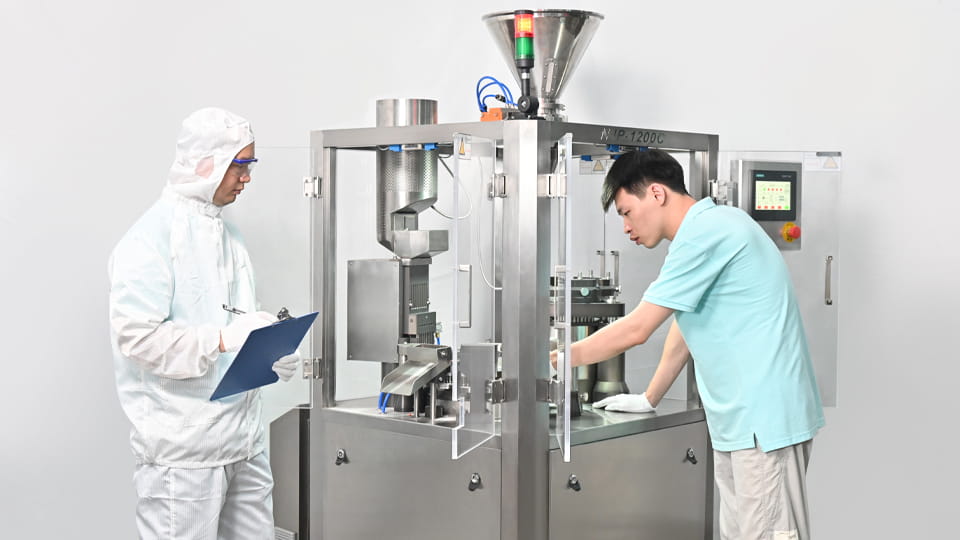
Lignes de production pharmaceutique utiliser une variété de machines spécialisées. Les principales caractéristiques liées aux BPF des équipements courants comprennent:
Chacune de ces machines doit être sélectionnée en gardant à l'esprit la conception GMP (surfaces lisses en acier inoxydable, CIP, Air HEPA si nécessaire). Pour des exemples détaillés, voir les pages produits de Jinlu Packing, qui mettent en évidence les caractéristiques de conformité telles que les cadres en porte-à-faux et les certifications CE/GMP.
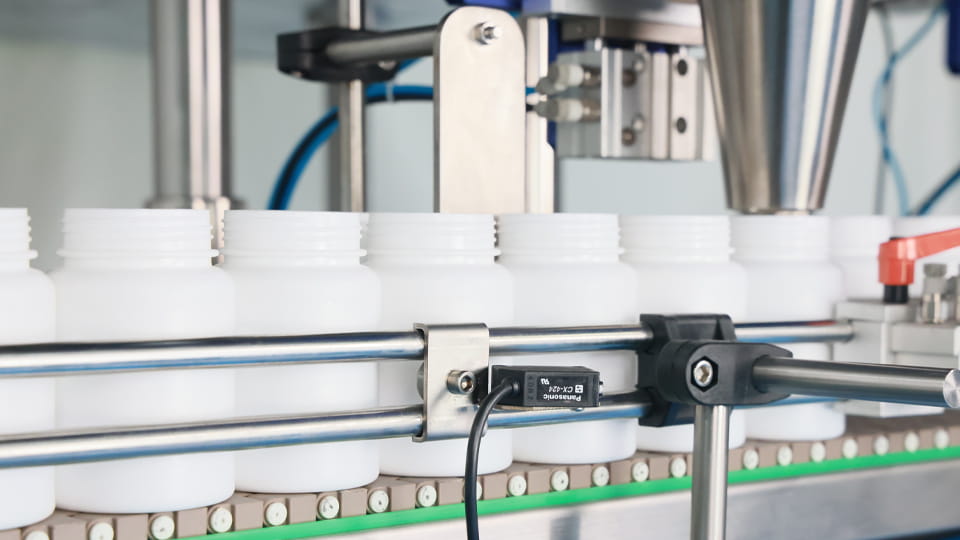
Le respect des normes d’emballage pharmaceutique présente des défis: les exigences réglementaires varient selon le marché, et chaque nouveau médicament peut nécessiter des spécifications d'emballage différentes (par exemple. fermetures à l'épreuve des enfants, revêtements spécifiques). La validation et la documentation ajoutent du temps et des coûts : chaque nouvelle taille d'emballage ou changement de produit peut déclencher une revalidation.. Règles de sérialisation (DSCSA aux États-Unis, La fièvre aphteuse dans l'UE, etc.) sont complexes et évolutifs, nécessitant des mises à jour régulières du logiciel et une formation du personnel. Exigences des salles blanches (pour produits stériles) augmentent également les coûts des installations. Enfin, suivre et prouver la conformité (via des enregistrements de lots et des pistes d'audit) signifie un logiciel et une tenue de registres robustes. Relever ces défis nécessite une collaboration étroite entre l'ingénierie, Assurance qualité et fournisseurs, et en choisissant adaptable, matériel bien supporté.
Lors de la sélection de machines pour un ligne de conditionnement pharmaceutique, suivre une liste de contrôle BPF:
L'avenir de l'emballage pharmaceutique est de plus en plus numérique et durable. Sérialisation et suivi & Tracer va s'étendre à l'échelle mondiale, tirer éventuellement parti de la blockchain pour sécuriser les chaînes d'approvisionnement. Emballage intelligent (Étiquettes RFID, Capteurs NFC) peut commencer à surveiller les conditions de stockage ou les événements de falsification. L'équipement tend vers Industrie 4.0 – des lignes dotées de capteurs IIoT et de systèmes de vision basés sur l'IA qui prédisent les défauts ou comptent les pilules de manière plus fiable. Robotique pour l'emballage final (traitement des dossiers, palettisation) et barrières aseptiques avancées (par exemple. systèmes aseptiques fermés) sont également en croissance. Du côté des matériaux, il y a une demande en faveur de composants d’emballage recyclables ou biodégradables, les machines doivent donc gérer de nouveaux types de films. Dans l'ensemble, automation, la connectivité des données et la sécurité environnementale sont des tendances clés qui façonnent les emballages pharmaceutiques de nouvelle génération.
Le respect des normes d'emballage pharmaceutique est non négociable pour les fabricants de médicaments. En comprenant les BPF, Exigences FDA et ISO – et en choisissant des machines conçues pour y répondre – vous protégez la qualité des produits et la sécurité des patients.. La conformité exige une conception rigoureuse (surfaces lisses en 316L, Nettoyage CIP/COP), validation complète (IR/WH/PQ) et une documentation continue (journaux de maintenance et d'audit). Avec des réglementations comme celles de la FDA 21 CFR et annexe de l’UE 1, les lignes pharmaceutiques ne peuvent pas se permettre de raccourcis.
Pour solutions d'équipement d'emballage, travailler avec des fournisseurs expérimentés. Emballage Jinlu, Par exemple, se spécialise dans les blisters conformes aux BPF, lignes de remplissage de liquides, cartonnage et plus. Nos machines sont dotées de conceptions en porte-à-faux, Matériaux de qualité FDA et prise en charge de la sérialisation prête à l'emploi. Contacter Jinlu Emballage dès aujourd'hui pour garantir que votre prochaine ligne d'emballage répond aux normes mondiales GMP avec un support de validation complet.
Les normes d'emballage pharmaceutique sont les exigences réglementaires qui garantissent que les emballages de médicaments ne contaminent pas ou ne mélangent pas les produits.. Il s'agit notamment des directives BPF d'agences telles que la FDA et l'EMA., qui imposent la conception d’équipements hygiéniques, validation du nettoyage et documentation complète. Normes comme ISO 15378 se concentrer sur la gestion de la qualité des matériaux d'emballage eux-mêmes. Ensemble, ils garantissent que l'emballage protège la qualité des médicaments et contient des informations précises..
FDA 21 Partie CFR 211 couvre les opérations de conditionnement. Cela nécessite que l'équipement soit entretenu, nettoyé et calibré afin de ne pas affecter l'identité ou la pureté du médicament. Par exemple, Les directives de la FDA stipulent que l'équipement « doit être construit pour faciliter le nettoyage » et prévient que les matériaux ne doivent pas réagir avec le médicament.. Les systèmes informatiques en ligne doivent également être conformes aux 21 Partie CFR 11 (enregistrements électroniques et pistes d'audit).
ISO 15378 est une norme ISO spécifique aux matériaux d'emballage primaire des produits pharmaceutiques. Il augmente l'ISO 9001 avec les exigences GMP, s'assurer que les fournisseurs de matériaux d'emballage disposent d'un système de gestion de la qualité qui répond systématiquement aux normes juridiques et aux clients. Même s’il ne réglemente pas directement les équipements, l'utilisation de matériaux certifiés ISO 15378 sur les machines GMP permet de répondre aux attentes réglementaires et aux exigences de qualité des clients.
Annexe 1 du Guide BPF de l'UE couvre les médicaments stériles. Il fixe des règles strictes pour la fabrication aseptique, y compris l'emballage des injectables. Les points clés comprennent la mise en œuvre d'une stratégie de contrôle de la contamination (CSC), utiliser des salles blanches classées (ISO 5/7), technologie d'isolateur ou de barrière, et valider les étapes de stérilisation/désinfection. Annexe 1 la conformité garantit que même pendant l'emballage, les médicaments stériles restent exempts de microbes et de particules, ce qui est essentiel pour la sécurité des patients.
D'abord, vérifier sa conception et ses matériaux: il doit utiliser de l'acier inoxydable 316L sur toutes les pièces en contact avec le produit et ne comporter aucune crevasse cachée. Assurez-vous que le fournisseur fournit une documentation complète sur les IQ/OQ/PQ.. Recherchez des fonctionnalités telles que la capacité CIP ou un nettoyage facile.. Confirmez qu'il dispose d'une capacité d'enregistrement électronique des lots (21 Partie CFR 11) et prise en charge de la sérialisation (2Codage D). Enfin, examiner les marques de certification (CE, GMP) et demandez des références ou des rapports d’audit. Une machine véritablement GMP sera accompagnée d'un support de validation et d'une documentation complète de conformité..
Lois sur la sérialisation (par exemple. la loi américaine sur la sécurité de la chaîne d'approvisionnement en médicaments, Directive européenne sur les médicaments falsifiés) exiger un code unique sur chaque emballage individuel pour le tracer tout au long de la chaîne d'approvisionnement. L'équipement d'emballage doit imprimer ou graver ces codes (généralement des codes-barres 2D) sur chaque blister ou flacon. Cela garantit que les contrefaçons peuvent être détectées et que les lots peuvent être rapidement rappelés si nécessaire.. En pratique, la sérialisation est intégrée à la ligne de conditionnement via un codeur et une caméra de vérification, avec un logiciel reliant chaque code aux enregistrements de lots pour une traçabilité complète.
Une encartonneuse GMP doit être lisse, surfaces hygiéniques et alimentation en carton fermée pour minimiser la poussière. Il doit intégrer des scanners d’étiquettes et de codes pour vérifier le code de lot et le contenu de chaque carton.. Vérifiez que la machine peut effectuer le dégagement de ligne (vidange/inspection entre produits) conformément aux directives de la FDA, et qu'il permet un nettoyage facile des applicateurs de colle pour cartons. Par exemple, de nombreuses encartonneuses incluent des pinces à carton sous vide et des systèmes de vision pour attraper les bourrages de carton ou les inserts manquants, respecter les règles de prévention des confusions dans 21 CFR 211.
Références:
1.21 Partie CFR 211 – BONNES PRATIQUES DE FABRICATION ACTUELLES POUR LES PRODUITS PHARMACEUTIQUES FINIS —— Institut d'information juridique
2.ISO 15378:2017 Matériaux d'emballage primaire pour médicaments —— iso.org
3.Annexe BPF de l'UE 1: Fabrication de produits médicinaux stériles —— gmp-compliance.org
4.Loi sur la sécurité de la chaîne d'approvisionnement en médicaments (DSCSA) --NOUS. Administration des aliments et des médicaments