What Is Packaging Validation in the Pharmaceutical Industry? A Complete Guide for Pharma Manufacturers
What Is Packaging Validation in the Pharmaceutical Industry? A Complete Guide for Pharma Manufacturers
April 29, 2026
No Comments
In the pharmaceutical industry, packaging validation is a critical subset of process validation focused on ensuring that packaging equipment and processes consistently protect drug product quality. It involves a documented program of qualification (Installation, Operational, Performance) and testing (e.g. container-closure integrity, stability, transport) to prove that packaging systems perform as intended under GMP conditions. Effective packaging validation safeguards patient safety (by preventing contamination, degradation or mix-ups) and ensures regulatory compliance (FDA, EMA, WHO, ICH, ISO). This guide explains the definition, steps, tests, standards, and best practices for pharmaceutical packaging validation, and shows how automated equipment (like Jinlu Packing’s machines) is designed to meet these stringent requirements.
Definition of Packaging Validation
Packaging validation in pharma means demonstrating with documented evidence that the packaging process (equipment and materials) reliably produces a package that protects the drug product. In practice, it applies the same rigorous validation concepts used in manufacturing (IQ/OQ/PQ) to primary, secondary, and tertiary packaging operations. According to WHO’s GMP guidance, “Packaging processes and equipment need validation/qualification in the same way as any other part of processing within a pharmaceutical facility.”. In other words, packaging validation ensures the container-closure system, labeling, and packaging lines consistently meet quality specifications and regulatory requirements. The goal is to maintain drug strength, purity and stability through packaging, distribution and shelf life, while preventing mix-ups, counterfeits, or damage.
Typical deliverables in packaging validation include a User Requirements Specification (URS) (the design & quality criteria), Installation/Operational/Performance Qualification protocols, and testing records. The validation process covers:
Primary packaging (the container or barrier directly contacting the drug, e.g. vials, blister cavities, sachets)
Secondary packaging (e.g. cartons, labels, inserts, serialization that group primary packages)
Tertiary packaging (bulk shipping containers, pallets, cold-chain packaging for transport)
Each level must protect the product. For example, the Australian TGA defines “primary packaging” (the container that immediately covers the goods) and distinguishes secondary packaging as the outer box or wrapper. Ultimately, packaging validation ties back to GMP – ensuring that containers and closures do not alter the drug and “provide adequate protection against external factors” during storage and use.
Why Packaging Validation Is Critical in Pharma
Pharmaceutical packaging is the final defense for drug quality. Validating packaging processes is vital because:
Ensures Product Safety and Integrity: Properly validated packaging prevents contamination, moisture ingress, or oxygen exposure that could degrade active ingredients. For example, leaks or seal failures could allow microbes or gases in, spoiling sterility or potency.
Regulatory Compliance: Agencies (FDA, EMA/ICH, WHO) require validated packaging. U.S. FDA’s 21 CFR 211.94 forbids closures that alter drug quality and mandates closures “provide adequate protection against foreseeable external factors”. EU GMP Annex 1 similarly insists that “containers should be closed by appropriately validated methods” (with 100% integrity testing for fusion-closed products). The WHO explicitly states packaging systems must be qualified like any other GMP process. Non-compliance can mean recalls, import rejects or audit citations.
Extends Shelf Life: Packaging materials and seals validated under stability conditions help set accurate shelf-life claims. ICH Q1A guidance even specifies that stability studies be done in the “container closure system” proposed for the product. If packaging fails, stability data is invalid.
Serialization and Anti-Counterfeiting: Modern pharma packaging often includes serialization, tamper-evident seals, and anti-counterfeiting features. Validating these features (e.g. scannability of barcodes, integrity of tamper tapes) helps secure the supply chain. An error in labeling or serialization can block product release.
Quality and Cost Efficiency: Efficient validated lines reduce defects (misfills, label errors, crushed cartons) and scrap. Automated inspections (vision systems for seal/label check) are often part of validated controls. Overall, validated packaging processes minimize patient risk and ensure consistent supply of effective, authentic medicines.
Key Drivers for Validation
Patient Safety: Improper packaging can harm patients (e.g. contaminated injectables). Validation documents the safety barrier.
Regulatory Risk Mitigation: Unvalidated processes are high-risk for recalls or sanctions. Regulators expect qualification data for every production line.
Global Distribution: Meeting international standards (FDA/EMA/WHO) requires validated packaging across markets.
Business Continuity: Packaging failures at distribution waste product and time. Validation ensures “right-first-time” operation under GMP.
Audit Readiness: Audits by Quality Authorities or customer regulators will review packaging validation records and equipment qualifications as part of GMP inspections.
Scope of Pharmaceutical Packaging Validation
Packaging validation addresses all packaging stages. Typically, we distinguish:
Primary Packaging Validation: Focuses on the container closure (vials, ampoules, blister cavities, bottles). Tests include seal integrity, material compatibility (extractables/leachables) and container closure performance. For sterile products, container closure integrity tests (CCIT) are mandatory to ensure sterility maintenance.
Secondary Packaging Validation: Covers the immediate outer pack (cartons, labels, leaflets, desiccants). This includes label legibility/accuracy checks, carton drop tests, and box compression tests (for transport). Label verification ensures the right patient info is applied consistently.
Tertiary Packaging Validation: Involves bulk/transport packaging. Here, performance tests like vibration, drop, and thermal cycling (cold chain) simulate shipping stresses to verify that pallets and shipping cartons maintain product integrity and labeling during distribution. Standard protocols like ASTM D4169 (transport simulation) are often used.
Each level requires risk assessment and appropriate testing: for example, primary packaging might involve USP <1207>-style integrity tests, while secondary packaging tests might include carton strength and label adhesion, and tertiary packaging uses ISTA/ASTM test protocols. All must be documented in the validation plan.
Key Steps in the Packaging Validation Process
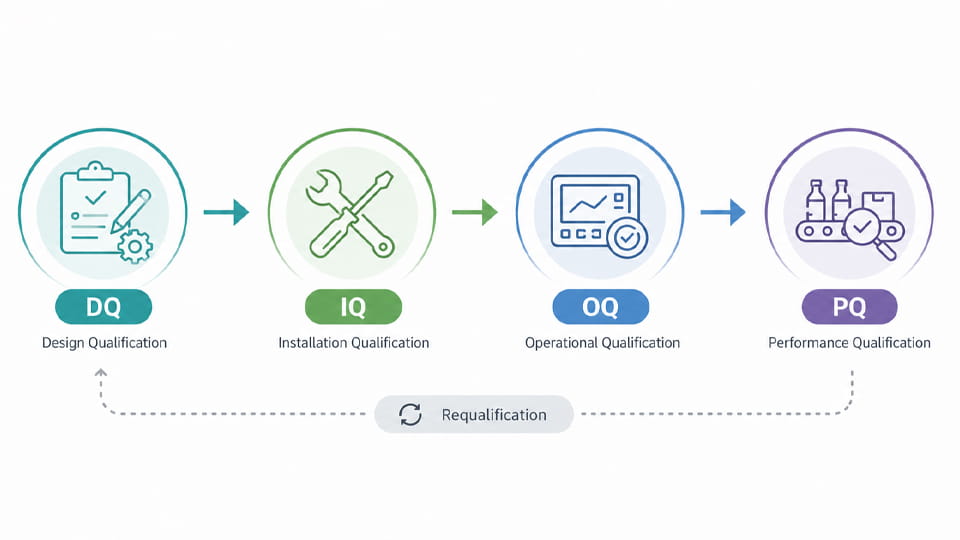
Packaging validation typically follows the equipment/process qualification life cycle, often described as DQ/IQ/OQ/PQ. These stages ensure a new or modified packaging line meets requirements at each stage.
Design Qualification (DQ): Early phase where the design is assessed against the URS (User Requirements Specification) and GMP guidelines. All design aspects (machine functions, materials, cleanability, compatibility with product/packaging materials) are reviewed. Documents include the URS and design specifications (Functional Design Specification FDS, Hardware/Software Design Specs). Often a risk assessment (e.g. DFMEA) is done to anticipate packaging failure modes.
Installation Qualification (IQ): Verifies the machine/line is installed correctly per vendor specs. IQ includes checklist verifying correct location, utilities (power, air, water), environmental conditions, and proper assembly. All components are present and undamaged. Calibration of measuring devices is checked. Deliverables: IQ protocols and report, calibration certificates.
Operational Qualification (OQ): Verifies the machine operates as intended under all specified conditions. Critical parameters (speed ranges, temperatures, pressures, vacuum levels, torque, etc.) are challenged at min/max or worst-case settings. Tests in OQ might include sealing at extreme speeds, sensor/alarm functions, conveyor speed changes, labeler accuracy, filling pump accuracy. The OQ protocol records that each functional test meets acceptance criteria.
Performance Qualification (PQ): Demonstrates that under normal production conditions, the line consistently produces product meeting quality specs. PQ is done on actual production quantities/batches. It includes running the line for a defined time or quantity and sampling the output. Typical activities: running multiple blister cartons, bottles or sachets and performing QC tests on samples (e.g., container closure integrity (CCIT), weight checks, visual defect inspection, seal strength). PQ shows the line can operate continuously while maintaining product quality.
The table below summarizes the DQ–IQ–OQ–PQ stages:
Design review, material compatibility checks, DFMEA
Installation Qualification (IQ)
Confirm proper installation of equipment
IQ protocol/checklist, installation log, calibration certificates
Verify utilities, equipment assembly, calibration
Operational Qualification (OQ)
Verify equipment functions within defined limits
OQ protocol, functional test plans, SOPs
Test parameters (speed, temp, pressure); seal checks
Performance Qualification (PQ)
Ensure consistent quality during production runs
PQ protocol, batch records, release criteria
Production runs; sample testing (CCIT, fill weight, visual inspection)
As the diagram shows, packaging validation is a life-cycle process from design through performance. Note that requalification may be needed after major changes or periodically.
Key Tests in Packaging Validation
Several specialized tests are commonly performed during packaging validation:
Container Closure Integrity Testing (CCIT)
CCIT is essential for sterile and even non-sterile products. It assesses whether the container closure system (e.g. vial+stopper+cap, ampoule, blister seal) forms a perfect barrier. Methods include vacuum decay, pressure decay, dye ingress, or microbial challenge. As one industry source explains, “Container Closure Integrity Testing (CCIT) is an assay that evaluates the adequacy of container closure systems to maintain a sterile barrier against potential contaminants.”. Regulatory documents (USP <1207>, FDA, EMA Annex 1) emphasize testing closure integrity to ensure no leaks or breaches. For example, USP <1207> provides guidelines on selecting leak test methods to certify sealed packages.
Material Compatibility Testing (Extractables/Leachables)
Packaging materials (plastics, rubbers, inks, adhesives) must not adversely interact with the drug product. Extractables and leachables studies simulate long-term contact: extractables are chemicals driven out of packaging under harsh conditions, and leachables are those that actually migrate into the product under normal conditions. These tests ensure the packaging does not introduce toxic or stability-affecting impurities. Pharmacopeial and FDA guidance (e.g. USP <661>, Q3E) outline E/L testing for container closure systems. In practice, one checks that the polymer, coatings, and label materials meet pharmacopeial standards (e.g. USP glass type, ISO rubber closure specs). The WHO notes that pharmacopoeial standards for closures (like rubber stoppers) are “minimum requirements” and emphasizes stability studies to prove suitability.
Stability Testing in Packaging
As per ICH Q1A, stability studies must be done on the drug product in its final packaging configuration. During validation, packaging’s impact on stability is assessed: for example, the final packaging is subjected to accelerated aging (high temp/humidity) and real-time conditions to ensure no degradation (e.g. moisture ingress in blister packs, oxygen permeation in bottles). Stability-indicating assays (chemical and microbial) are performed. Packaging that fails to protect the product under stress invalidates shelf-life claims. Thus, validation includes confirming that the chosen packaging meets shelf-life requirements (this overlaps with regulatory stability protocols).
Transport and Distribution Testing
Tertiary packaging tests simulate actual shipping conditions. Standard tests include drop height tests, vibration (truck/rail simulation), compression (stacking weight), and temperature cycling (especially for cold chain). For example, ASTM D4169 (for packaged products) or ISTA protocols may be used. A robust packaging validation plan verifies that cartons, cases and crates protect primary packages during handling: verifying that no breakage, label peeling, or moisture damage occurs under distribution conditions. For cold chain, temperature mapping and validated insulated shippers are tested to maintain required temperature ranges throughout transit.
Regulatory Standards and Guidelines
Pharmaceutical packaging validation must meet multiple regulatory expectations:
cGMP Regulations: In the US, FDA’s 21 CFR Part 211 (subpart J) governs containers and closures. Section 211.94(a–d) specifies that containers/closures cannot alter the drug’s quality and must protect against foreseeable contamination.
EU GMP: European guidelines (EudraLex Vol. 4) require that “containers should be closed by appropriately validated methods” (Annex 1) and that packaging processes follow GMP (Annex 15 on validation). EU GMP Annex 11 mandates computerized system validation (including packaging lines with electronic controls).
WHO GMP: WHO’s Technical Report Series 902 (Annex 9) explicitly states packaging equipment needs validation like any other processing step. The WHO also provides guidance on package integrity (similar to EU/ICH).
ICH Guidelines: Although ICH (Q7, Q8, Q9, Q10) don’t have a specific packaging validation document, they mandate risk management (Q9) and quality-by-design (Q8/Q10) principles that apply. For example, risk assessment (ICH Q9) should cover packaging attributes (closure type, label control) that affect product CQAs.
Standards: For sterile products, ISO 11607 (for terminally sterilized medical device packaging) is often used by analogy; Part 2 of ISO 11607 defines validation requirements for forming/sealing processes, which is relevant for parenteral drug blister packs or ampoules. Pharmacopeias (USP, Ph. Eur.) also contain packaging test chapters (e.g. USP <381> for rubber closures, <1207> for leak testing).
In summary, any packaging line must comply with the national pharmacopeia and regional GMP standards. Compliance checklists typically cite FDA, EU GMP, WHO and relevant ISO standards, and often call for fully documented SOPs and validation master plans covering packaging.
Common Challenges in Packaging Validation
Packaging validation poses unique challenges compared to manufacturing processes:
Data Type and Sampling: Packaging line success is often determined by discrete outcomes (e.g. pass/fail for a seal, tear) rather than continuous measurements. As one expert notes, “the type of data obtained…creates a significant challenge. Success or failure is often determined by defects (tears, holes, smudges, or leaking seals)… This lack of measurable (variable) data often requires very large sample sizes for a packaging process to be statistically validated.”. In other words, you may need many samples to demonstrate reliability.
Technology Variety: There are many packaging technologies (blisterers, cartoners, labelers, case packers, etc.) from different suppliers. Each has different risk profiles, making a one-size validation plan impossible.
Change Control: Packaging lines often run many product types (tablets, liquids, powders) and pack sizes on the same equipment (using change parts or formats). Each change may require re-validation or bracketing in the validation plan. Managing this (the validation matrix) can be complex.
Environmental Controls: Some packaging (e.g. blister packaging of moisture-sensitive drugs) requires controlled humidity or inert atmosphere. Validating these controls adds complexity.
Integration with Upstream Process: Packaging validation depends on upstream consistency. If drug granules vary in size, packaging machine changeover may be affected (e.g. fill jam). This interdependence can complicate root-cause analysis of packaging failures.
Serialization/Tracking: Modern regulations (e.g. DSCSA, EU FMD) require serialization and traceability. Ensuring automated lines properly track each unit (and validating that data capture) adds an extra layer of qualification (software validation, barcode scanner tests, database checks).
Regulatory Ambiguity: Paradoxically, there’s limited explicit FDA/EMA guidance solely on “packaging validation,” so companies must often interpret general GMP and process validation guidelines for packaging. This can cause uncertainty about the exact scope or needed tests.
Despite these challenges, the underlying principle remains: treat packaging like any other critical process, with thorough qualification and robust QC checks. As the ISPE paper concludes, packaging validation “differ(s) little from the validation of processes used for drug manufacture.”.
Best Practices for Pharmaceutical Packaging Validation
To overcome challenges and ensure a successful validation, follow these best practices:
Early Risk Assessment: Use Quality Risk Management (ICH Q9) from the design phase. Identify critical packaging attributes (e.g. sterility, tamper evidence, light protection) and prioritize tests accordingly. A Failure Mode & Effects Analysis (FMEA) is recommended during DQ to plan validation scope.
User Requirements Spec (URS): Clearly document all requirements upfront: production capacity, pack formats, integration points (e.g. linking a blister machine to a cartoner), environmental conditions, cleaning requirements. A well-defined URS keeps validation on track.
Standard Operating Procedures (SOPs): Maintain detailed SOPs for equipment operation, cleaning, changeover, and maintenance. The validation should reference these SOPs to ensure consistent use.
Automated Inspection and Controls: Incorporate in-line quality checks (e.g. vision systems for print/label inspection, checkweighers, barcode scanners, leak detectors). These are not just QA tools but also part of the validation by detecting defects in real time.
Comprehensive Documentation: Prepare a validation master plan outlining the strategy, and ensure all qualification protocols (IQ/OQ/PQ) have clear acceptance criteria. Keep detailed logs of all runs, deviations, and retests. Use checklists to ensure nothing is overlooked.
Training and Personnel: Operators and QC staff must be trained on both equipment and validation procedures. Only qualified personnel should conduct validation tests and record results.
Software and Electronic Records: For computerized controls, follow FDA 21 CFR Part 11/GMP Annex 11: validate software, audit trails, electronic signatures (ensure security, backups). Even non-sterile packaging lines often have PLCs/HMIs that need validation.
Design for Validation: Whenever possible, choose machines with features that simplify validation: e.g. servo drives with digital controls (for precise, reproducible parameters), hygienic stainless-steel frames (for easy cleaning), easy-change parts (to reduce cleaning effort between formats), and modular design (to limit the number of configurations requiring testing).
Ongoing Verification: Packaging validation is not “once and done.” Implement periodic review or revalidation triggers (e.g. after major maintenance, equipment upgrades, or significant process drift). Use statistical process control (SPC) on key metrics (fill weight variation, defect rate) to catch trends early.
Data Integrity: Apply ALCOA+ principles: all validation data (test records, QC reports, calibrations) must be attributable, legible, contemporaneous, original, and accurate. Use bound notebooks or validated electronic systems.
By embedding validation thinking at every stage – from design to daily operation – manufacturers can ensure packaging lines deliver products that meet quality and compliance expectations.
Role of Packaging Machines in Validation
The choice and design of packaging equipment heavily influence validation success. High-quality packaging machines are engineered to meet GMP requirements and support easy qualification. For example, Jinlu Packing’s automated machines are built with features that streamline validation:
Precision and Consistency: Jinlu’s blister machines, cartoners and fillers use servo motors and precise mechanics to ensure consistent heat-sealing pressure, fill volumes, and indexing. This repeatability is crucial for passing OQ and PQ tests (e.g. the servo-driven feeding device provides “accurate positioning” on their blister line).
Hygienic Design: Materials and surfaces are stainless steel or FDA-compliant plastics, designed for easy cleaning. Smooth, sloped surfaces prevent dust traps. This supports GMP compliance and simplifies cleaning validation.
Adaptability to Formats: Jinlu offers custom feeders and guide rails for different package types (see Custom feeders on product pages). Having the right tooling reduces variation and speeds format changeover, which cuts down requalification needs when switching formats.
Integrated Controls: Modern Jinlu lines have PLC/HMI controls that can generate electronic batch records. For example, the liquid filling machine has an AI Siemens PLC/HMI for simple, traceable operation. Such digital controls support data logging (in line with 21 CFR Part 11/Annex 11) – crucial for validating that setpoints and alarms function as designed.
Validation Documentation: Jinlu provides full documentation (Datasheets, manuals, etc.). For instance, their product pages list “Full set of technical documents” and they emphasize supplying detailed design and testing documentation. A supplier willing to furnish Factory Acceptance Test (FAT) protocols or IOQ kits greatly eases the user’s validation burden.
Quality Certifications: Jinlu machines carry CE, cGMP and other certifications, indicating they meet certain quality and safety standards (see the cGMP logo on the product spec images). Using certified equipment can streamline regulatory review.
In practice, a validated packaging line might include: a Jinlu blister packing machine linked to a cartoning machine and counting/filling lines. Each equipment must be qualified (IQ/OQ/PQ). Jinlu’s systems are designed to work seamlessly together (e.g. “highly automated blister cartoning line” up to 320 cartons/min), reducing integration issues during validation. We also offer case studies (e.g. a complete counting and bottling line, or an automatic cartoning & labeling line) that demonstrate end-to-end validated solutions.
DPH-270Max Roller Blister Packing Machine
By partnering with Jinlu or similar manufacturers, companies benefit from equipment that is “cGMP compliant”, supports a full validation lifecycle, and comes with after-sales support (commissioning, training) to ensure the line remains validated.
Conclusion
Packaging validation is essential for pharmaceutical quality and compliance. By treating packaging operations as rigorously as core manufacturing steps, companies ensure their products reach patients safely. The process spans definition (URS, risk assessment), qualification (DQ/IQ/OQ/PQ), testing (CCIT, stability, transport), and continuous monitoring. It is governed by GMP regulations (FDA, EMA, WHO) and industry standards.
Modern automated packaging equipment – such as Jinlu Packing’s machines – play a key role in validation. Designed for precision, hygiene and electronic traceability, they help manufacturers meet validation criteria efficiently. When selecting packaging lines, consider suppliers who provide complete validation documentation and support.
Ultimately, thorough packaging validation is “the final safeguard for product quality and patient safety”, aligning with both regulatory demands and business goals.
Ready to validate your packaging line?Contact Jinlu Packing’s experts to discuss GMP-compliant packaging solutions or request a quote.
FAQs On Packaging Validation in Pharmaceutical Industry
What is the difference between packaging validation and process validation?
Process validation typically refers to the steps producing the drug substance or bulk drug product (e.g. mixing, granulation, compression). Packaging validation specifically applies validation principles to the packaging operations (sealing, labeling, carton filling, etc.). However, both follow the same DQ/IQ/OQ/PQ lifecycle and GMP requirements. Essentially, packaging validation ensures the packaging process (not just the manufacturing process) consistently meets quality requirements.
What tests are required for pharmaceutical packaging validation?
Key tests include container closure integrity (CCIT) to verify seals, material compatibility (extractables/leachables studies), stability tests (drug in final package under stress), and distribution tests (shock, vibration, temperature for transit). Additional checks cover label accuracy, visual inspection systems, weight/checkweighing, and any contract-specific tests (e.g. sterile film strength). All tests should have predefined acceptance criteria and be documented.
How long does packaging validation usually take?
The timeline depends on complexity (number of formats, equipment, sites). A single-line IQ/OQ/PQ could range from a few weeks to a couple of months. Factors: the number of OQ parameter tests, required sample sizes in PQ, and time for test execution (e.g. stability at accelerated conditions takes weeks). Planning parallel activities (like preparing protocols while equipment arrives) can save time.
What documents govern packaging validation?
The primary references are GMP regulations: 21 CFR Part 211 (US FDA), EudraLex Vol. 4 (EU GMP, Annex 1 and 15), and WHO GMP Annex 9. ICH Q7/Q10 provide general validation principles, ICH Q9 covers risk management for packaging decisions, and ISO 11607-2 applies to sterile pack process validation. Pharmacopeial standards (USP, Ph. Eur.) and local guidelines (e.g. Chinese NMPA, India Schedule M) also influence packaging requirements. Always align with the target market regulations.
How does Jinlu Packing support packaging validation?
Jinlu’s packaging machines are built for GMP. They provide design documents (URS, FDS), calibration certificates, and OQ/PQ support. Their equipment (blister machines, cartoners, filling lines) features precise servo control and hygiene design to meet validation specs. As shown on Jinlu’s site, machines carry cGMP/CE logos and come with technical documentation sets. Jinlu also offers installation and validation support, custom solutions, and training to help implement validated packaging lines. For more info, see Jinlu’s Blister Packing Machine or Cartoning Machine pages.
Petty Fu, Founder of Jinlupacking, brings over 20 years of expertise to the pharmaceutical machinery sector. Under his leadership, Jinlu has grown into a trusted supplier integrating design, production, and sales. Petty is passionate about sharing his deep industry knowledge to help clients navigate the complexities of pharma packaging, ensuring they receive not just equipment, but a true one-stop service partnership tailored to their production goals.