In the pharmaceutical industry, quality and patient safety are paramount. Every tablet, vial, or blister pack must be produced under strict controls to ensure it is effective, pure, and safe. That’s where GxP compliance comes in. GxP is an umbrella term meaning “Good x Practice,” where “x” can be Manufacturing, Laboratory, Clinical, Distribution, etc. Essentially, GxP guidelines are regulatory quality systems that pharmaceutical companies must follow to document and control all processes. Together, these rules ensure that medicines are consistently produced and controlled to high-quality standards throughout development, manufacturing, testing, packaging, and distribution.
Regulators like the FDA (U.S. Food and Drug Administration), EMA (European Medicines Agency), WHO, and others enforce GxP standards. For example, the FDA’s Current Good Manufacturing Practice (CGMP) rules (21 CFR Parts 210–211) set minimum requirements for manufacturing, packing, and holding drugs to make sure they are safe and have the correct ingredients and strength. Similarly, WHO and EU guidelines cover GMP/GLP/GDP/GVP globally. In practice, pharma companies develop Quality Management Systems and Standard Operating Procedures (SOPs) around GxP principles. Every batch of product has traceable records from start to finish. Even equipment must be qualified (with Installation/Operational/Performance Qualification – IQ/OQ/PQ) and validated to meet GxP requirements.
What Does GxP Mean in Pharmaceuticals?
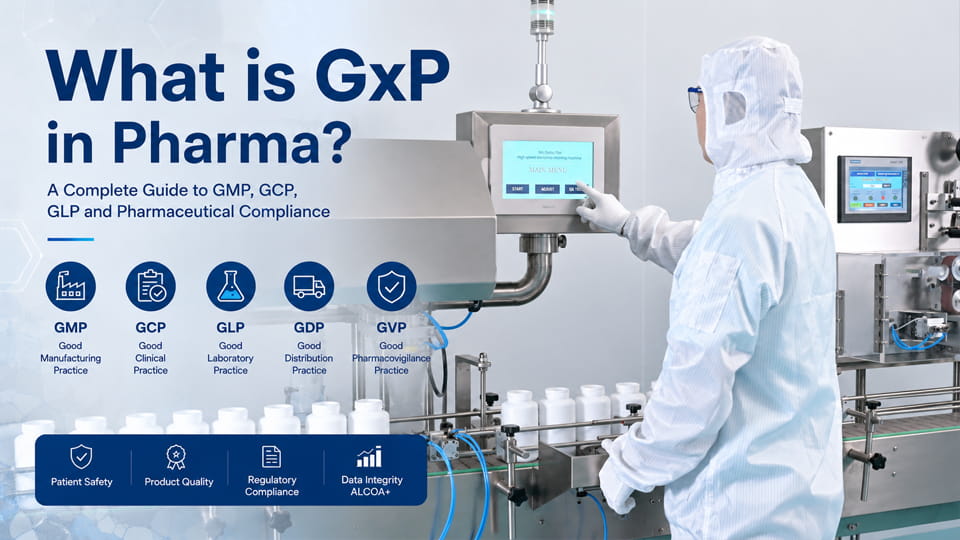
The acronym GxP stands for Good “x” Practice, where the “G” is “Good” and the “P” is “Practice.” The “x” represents various disciplines. GxP is not a single regulation but a group of quality guidelines. Key GxP disciplines include:
- Good Manufacturing Practice (GMP): Ensures products are consistently produced and controlled according to quality standards. GMP covers manufacturing, equipment, facilities, personnel, and documentation to minimize contamination, mix-ups, and errors.
- Good Laboratory Practice (GLP): Governs the conduct of non-clinical laboratory studies (like toxicology tests) to ensure data integrity and reproducibility. GLP ensures lab tests are well-documented, auditable, and reliable.
- Good Clinical Practice (GCP): The international standard for designing, conducting, monitoring, and reporting clinical trials. GCP protects patient rights, integrity of data, and ensures trial results are credible.
- Good Distribution Practice (GDP): Sets the standards for storage, handling, and transportation of pharmaceutical products. GDP ensures that medicine quality is maintained throughout the supply chain – for example, by controlling temperature, avoiding contamination, and tracking batches.
- Good Pharmacovigilance Practice (GVP): Provides guidelines for drug safety monitoring and reporting adverse events after a product is marketed. GVP helps pharmaceutical companies and regulators detect, assess, and prevent negative side effects.
Each GxP area is enforced by specific regulations or guidelines (e.g., FDA 21 CFR for GMP/GLP/GCP, EU EudraLex for GMP/GDP/GVP, ICH guidelines, WHO, etc.). While the details differ, the common goal is to ensure drug products are safe, effective, and high-quality at every step.
Table: Main GxP Disciplines(Types of GxP Regulations)
| GxP Type |
Full Name |
Product Lifecycle Stage |
Focus/Purpose |
| GLP |
Good Laboratory Practice |
Drug Research |
Governs non-clinical lab studies (like toxicity tests) to ensure data quality and traceability. GLP sets standards for lab procedures, data recording, and reporting. |
| GCP |
Good Laboratory Practice |
Clinical Trials |
International standards for clinical trials (ICH-GCP). Covers trial design, informed consent, monitoring, and accurate reporting of results. |
| GMP |
Good Clinical Practice |
Manufacturing |
Ensures drugs are consistently made and controlled in manufacture/packaging. Includes facility/equipment standards, personnel training, QC testing. |
| GDP |
Good Distribution Practice |
Warehousing & Logistics |
Ensures proper storage and transport of medicines (e.g., correct temperature, secure handling) so quality is maintained through the supply chain. |
| GVP |
Good Pharmacovigilance Practice |
Post-Market Monitoring |
Guidelines for ongoing safety monitoring of marketed drugs (adverse event reporting, risk management, communication with authorities). |
Why is GxP Important in the Pharmaceutical Industry?
GxP compliance is essential because lives literally depend on it. Its primary purposes are:
- Patient Safety: Following GxP minimizes risks such as contamination, mix-ups, or dosing errors. For example, GMP rules (like proper sanitation and process control) help prevent cross-contamination between products. Without GxP, substandard medicines could harm patients or lack efficacy. Regulatory bodies emphasize that “GxP rules exist for one reason: to protect patients”.
- Product Quality and Consistency: GxP frameworks ensure that every batch of a drug meets the same specifications. This includes consistent potency, purity, and stability. By enforcing rigorous controls (e.g. calibration of instruments, validated methods, in-process testing), manufacturers can guarantee that each vial or tablet matches its label claims.
- Regulatory Compliance and Trust: Adhering to GxP is legally mandatory. Agencies like FDA, EMA, MHRA, PMDA, and WHO rely on GxP inspections and audits. Companies that demonstrate strong GxP practices build confidence with regulators. Non-compliance can lead to warning letters, fines, product recalls, or worse. As one industry guide notes, regulators conduct audits to “verify compliance with GxP standards” which underscores product integrity and patient safety.
- Data Integrity: A critical aspect of GxP is ensuring data are accurate and trustworthy. Modern regulations (e.g. FDA’s 21 CFR Part 11, EU Annex 11) require electronic records to be secure, time-stamped, and tamper-proof. Key principles like ALCOA+ (Attributable, Legible, Contemporaneous, Original, Accurate, plus Complete, Consistent, Enduring, Available) are used to judge data quality. In practice, this means implementing audit trails on software, locking master documents, and regularly reviewing batch records. Robust data integrity is a GxP cornerstone; without it, even well-made products would not be trusted.
In short, GxP is the bedrock of pharmaceutical quality management. It assures that every step — from lab testing to final packaging — is done under controlled, documented conditions. For example, one guide observes that “GxP compliance ensures medicines and biologics are developed, manufactured, and tested according to stringent standards,” preventing costly contamination or labeling errors. Thus, GxP not only protects patients but also underpins a reliable brand reputation and market access for pharmaceutical companies.

Understanding GMP – The Most Important GxP Standard
While all GxP areas are critical, GMP (Good Manufacturing Practice) is often seen as the foundation for pharmaceutical production compliance. GMP covers the entire manufacturing process of drug products, including raw materials, equipment, facilities, processes, and packaging lines. Its core goal is to minimize risk of product contamination or deviation by enforcing strict controls and documentation. Key elements of GMP include:
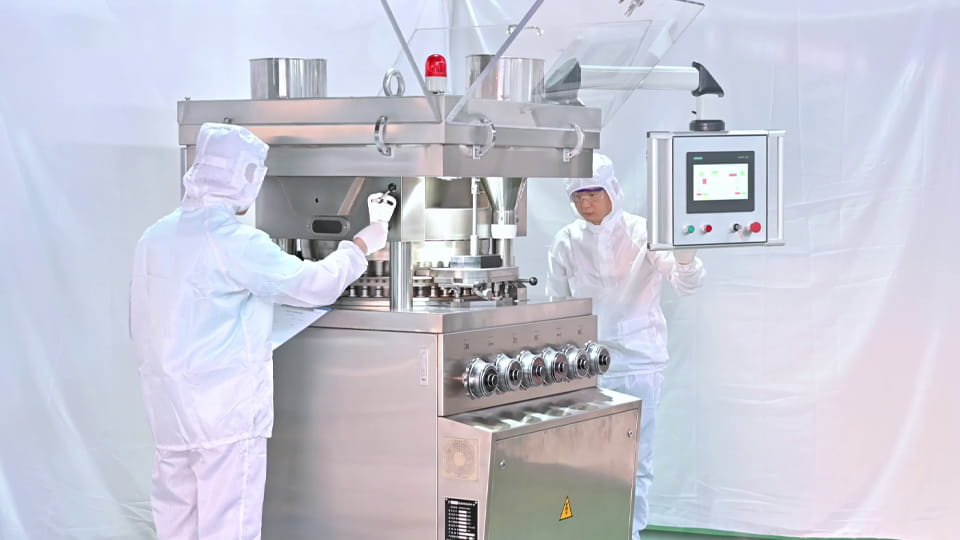
- Facility and Equipment Design: Equipment should be designed for hygienic operation. This means using pharma-grade materials (e.g. 316L stainless steel), smooth welds, no dead zones, and easy access for cleaning. For packaging machines, this might entail cantilevered conveyors, quick-release parts, and enclosed guards. Proper layout prevents mix-ups and facilitates cleaning validation (validated cleaning procedures).
- Utilities and Calibration: All utilities (water, compressed air, electrical) must meet quality specs. Instruments and sensors (scales, flow meters, temperature probes) require regular calibration under written procedures. The FDA explicitly expects calibration records for critical equipment. For example, a filled-bottle line would have its volumetric pumps calibrated to ensure each dose is accurate.
- Validation and Qualification: GMP mandates that equipment and processes are qualified and validated. This involves Installation Qualification (IQ), Operational Qualification (OQ), and Performance Qualification (PQ) to prove the system works as intended (discussed in detail below). For instance, a new blister packing machine must be IQ/OQ/PQ tested to confirm the sealing temperature, seal integrity, and indexing system meet specifications. Every critical machine (capsule fillers, cartoners, liquid filling lines) must follow this validation lifecycle.
- Standard Operating Procedures (SOPs): Detailed, written SOPs are mandatory for manufacturing steps, cleaning, maintenance, and quality controls. Operators must be trained on these SOPs and any changes must be controlled through a formal change-control system. Auditors look for up-to-date SOPs and training records.
- Good Documentation Practices: GMP emphasizes that “if it’s not documented, it didn’t happen.” All procedures, batch records, cleaning logs, and QC tests must be recorded legibly and contemporaneously. A completed Batch Manufacturing Record (BMR) must include materials reconciliation, equipment settings, in-process checks, and any deviations/corrections. Modern trends push electronic batch records (eBR) with audit trails under 21 CFR Part 11.
- Quality Control (QC) and Batch Release: QC testing (e.g. potency, sterility, identification) is performed on raw materials and finished products. Only after the QA/QC departments review all documentation and test results is a batch released. This final check is a key part of GMP.
Jinlu Packing’s blog on GMP packaging highlights several of these requirements. For example, it notes that preventive maintenance and calibration are mandated by GMP (21 CFR 211.68 requires defined intervals and records). It also emphasizes automation & error prevention: modern GMP packaging lines use vision inspection, barcode scanning, and interlocks to avoid human errors. Data integrity and computer controls are also covered under GMP: all computerized systems on the line (e.g. PLCs, vision systems, HMIs) must comply with 21 CFR Part 11 – meaning unique logins, audit trails, electronic signatures, and secure record-keeping. In practice, this means the machine’s control software will log every parameter change with a timestamp and user ID, and will require a manager’s electronic signature to approve a batch.
GMP Checklist for Packaging Equipment
It helps to view GMP requirements in a checklist form. For packaging machinery, manufacturers typically ensure:
- Design & Materials: Hygienic construction (stainless steel parts, FDA-approved seals), no “dead” areas, sloped surfaces, easy disassembly for cleaning.
- Validation: Complete IQ/OQ/PQ on each machine. Documented testing of functions (sealing, filling, weighing) and performance. (See Equipment Qualification section below.)
- Cleaning: Validated cleaning procedures with swab or rinse tests (typically using TOC or specific assays) and records.
- Maintenance & Calibration: Preventive maintenance schedules with logs. Calibration of metering pumps, scales, sensors to ensure accuracy.
- Controls & Automation: Vision inspection systems (e.g., metal detectors, checkweighers) to detect defects, sensors to prevent misfeeds, interlocks to stop if doors open.
- Data Integrity: 21 CFR Part 11 compliance – audit trails, user access controls, electronic signatures, secured data. All records (SOPs, batch data, deviations) stored unalterably.
- Traceability: Support for serialization/UIDs, barcoding, linking each primary pack to batch records, enabling recall if needed. (Jinlu machines often integrate label printers or code readers for traceability.)
- Environmental & Line Controls: Appropriate cleanroom standards if needed, documented line clearance checks between batches, proper labeling and materials handling to prevent mix-ups.
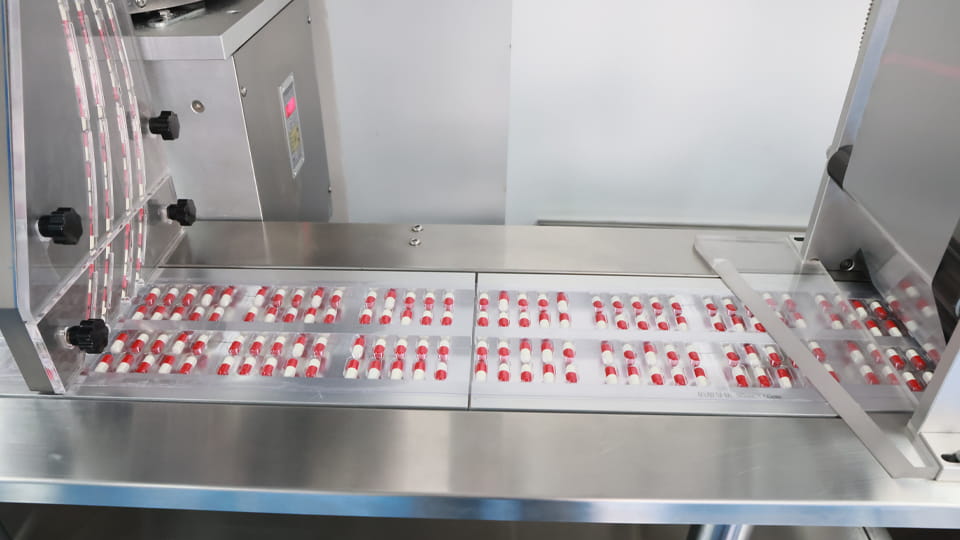
By following these controls, manufacturers can be confident their packaging equipment will operate within GMP guidelines. For example, capsule filling machines and blister packing machines from Jinlu are built with GMP-ready features (smooth GMP surfaces, CIP capability, etc.) to meet these demands.
GxP Requirements for Pharmaceutical Equipment Manufacturers
Packaging equipment suppliers play a vital role in GxP. Buyers expect machines that are not only robust and efficient, but also built to facilitate regulatory compliance. Key requirements include:
- Qualification Support (IQ/OQ/PQ): Vendors should provide protocols and assistance for qualification. This means documented Installation Qualification (IQ) to show the machine was installed correctly, Operational Qualification (OQ) to prove it functions per specs, and Performance Qualification (PQ) to verify it consistently produces acceptable output. For example, Jinlu Packing delivers each machine with an IQ/OQ/PQ kit and full FAT/SAT protocols. These templates can often be adapted by the buyer’s QA team, saving time during validation. The vendor might also participate in qualification runs or provide certified equipment checklists.
- Documentation Package: Along with the machine, suppliers should deliver a full set of documents. Typical items include the User Manual, Master Parts List, Electrical Schematics, and Maintenance Instructions. Importantly, FAT (Factory Acceptance Test) and SAT (Site Acceptance Test) reports document that the machine passed factory and on-site tests. Calibration certificates for any measuring devices should be included. In practice, a compliant documentation package will also list system specifications, cleaning SOPs, risk assessments, and any change control history.
- Data Integrity Features: Modern equipment should offer electronic controls that align with GxP data standards. This includes secure user accounts (role-based access), mandatory electronic signatures for critical actions, and full audit trails of any changes to parameters. For example, an HMI screen might require the shift supervisor’s login to start production, and every recipe or setting change is timestamped. Machines may also support digital batch record output, integrating with MES/ERP systems.
- Validation and Testing Tools: Some vendors include software tools for data logging, calibration, or validation. This could be pre-installed software for conducting sensor tests, or built-in functionality to lock parameters during PQ runs. These features reduce manual effort during validation.
- Hygienic and Safety Design: Equipment must be easy to clean and maintain. Features like quick-release parts, no-product zones, and CIP (Clean-In-Place) options help meet cleaning validations. Materials in contact with product should be inert (e.g. 316L SS, FDA-approved plastics). Safety guards and interlocks protect operators, but also ensure compliance (e.g. machine halts when opened).
- After-Sales Support: GxP compliance is ongoing. Manufacturers may require periodic requalification or recalibration. Suppliers should offer lifecycle services: spare parts (for fast replacement of validated parts), maintenance contracts, and updates to validation documentation if changes occur. A supplier’s willingness to provide qualification services on-site (IQ/OQ/PQ) can greatly smooth compliance efforts.
Equipment Qualification Checklist: The table below summarizes typical steps and documents for qualifying a new pharmaceutical machine:
| Phase |
Key Activities |
Typical Documents |
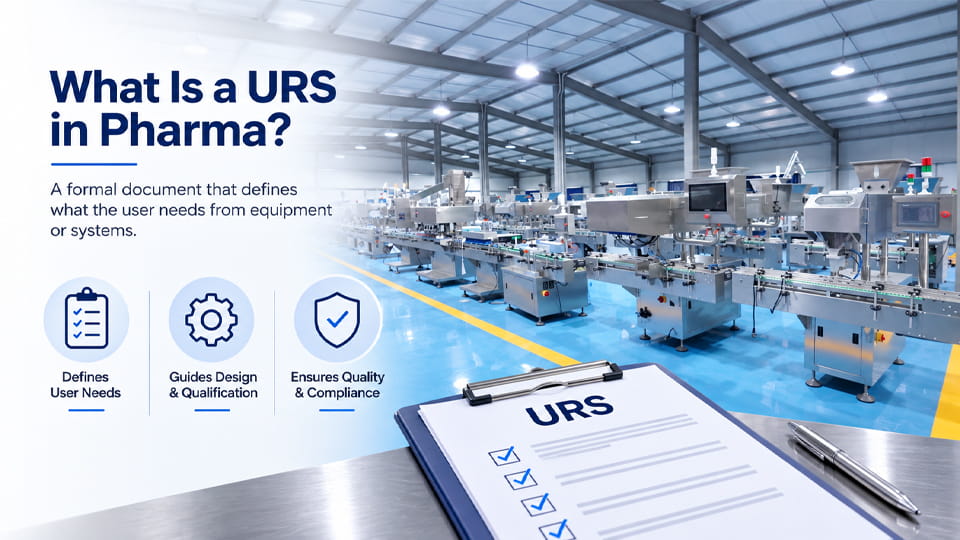
| User Requirements (URS) |
Define critical specifications (e.g. output rate, accuracy) |
User requirements spec |
| Design Qualification (DQ) |
Verify vendor’s design meets URS |
Design spec review report |
| Factory Acceptance (FAT) |
Factory tests of major functions, often mirror IQ/OQ tests |
FAT report |
| Installation Qualification (IQ) |
Confirm correct install: utilities, mechanical setup, documentation (drawings, certificates) |
IQ protocol & checklist |
| Operational Qualification (OQ) |
Test all functions: empty-run performance, controls, alarms, safety features |
OQ protocol & results |
| Performance Qualification (PQ) |
Run full production with real product: check output quality, consistency, stress conditions |
PQ protocol, run records, sample test results |
| Final Release |
Review all qualification records; QA approval to place machine into GMP production |
Qualification summary report |
(Note: Jinlu’s machines come with IQ/OQ/PQ templates and a full Factory Acceptance documentation package, which customers can adapt as needed.) This structured approach — from user requirements to PQ — is required by regulations like EU GMP Annex 15 and FDA guidelines. Skipping any step can result in a compliance gap.
Common GxP Compliance Challenges
Even with clear rules, companies often face hurdles in GxP compliance. Some frequent challenges include:
- Incomplete Validation or Documentation: One of the most serious gaps is using equipment without full IQ/OQ/PQ records. “Skipping validation,” or having partial qualification, is considered a “fatal GMP gap”. Similarly, missing or sloppy batch records and SOPs undermine compliance: inspectors are trained to look for documentation. As one expert put it: “If it isn’t written down, it didn’t happen.” Poor record-keeping (lost files, illegible notes, outdated versions) is a common red flag.
- Equipment Maintenance and Calibration Lapses: Regulators repeatedly find issues like expired calibration due dates or postponed repairs. A broken sensor or an uncalibrated scale will lead to suspect data or product. (For example, Sokol’s analysis notes that forgotten calibrations and worn-out parts are “simple failures” that can trigger a batch hold.) Ensuring strict maintenance logs, using digital trackers for calibration schedules, and empowering staff to flag problems quickly are best practices to overcome this.
- Data Integrity Problems: Modern GMP lines rely on electronic systems. Failures in data controls can break GxP. Examples include disabled audit trails, weak passwords, copied/pasted data instead of original entries, or failure to review electronic logs. Companies must enforce ALCOA+ principles — e.g., making sure all data entries are Attributable (linked to a user), Legible (clear), Contemporaneous (recorded in real time), Original/Accurate, and Complete/Consistent. Training operators and automating where possible (e.g. computer-locked records) help prevent manual overwrites or omissions.
- Change Control and CAPA Deficiencies: A robust change management process is needed for any changes (equipment upgrades, new SOPs, new raw materials). A common mistake is failing to document a change or skipping re-validation after a modification. Similarly, failure to properly investigate deviations (writing off issues as mere “human error” without root-cause analysis) can let problems persist. Regulatory bodies expect strong CAPA (corrective and preventive action) systems to address any deviations.
- Training and Culture Issues: GxP requires that all personnel be trained and aware of quality procedures. Inadequate training programs or high turnover can lead to unintentional violations. Building a quality culture (where staff feel responsible for compliance and are encouraged to report issues) is vital but often slow to develop.
In summary, the challenges are often organizational: documentation, maintenance, training, and data practices. Overcoming them means investing in systems (like Electronic Document Management or Calibration Tracking software), disciplined SOPs, and frequent internal audits. Companies that proactively address these areas will find GxP compliance smoother during official inspections.
How Pharmaceutical Companies Achieve GxP Compliance
Achieving GxP compliance is a project spanning the entire organization. Below is a typical sequence of steps (illustrated in the flowchart) that a pharma company follows to build a compliant system:
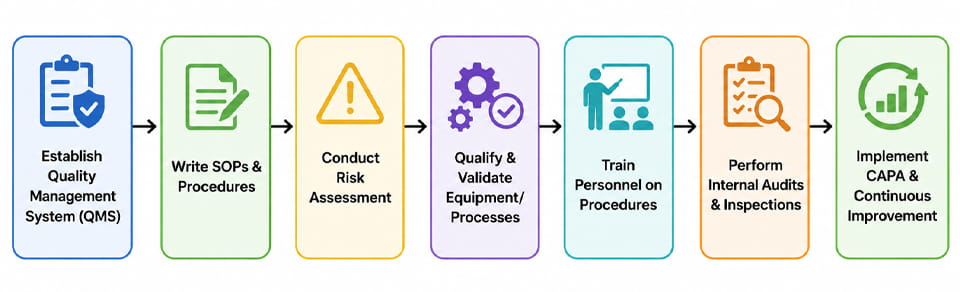
- Quality Management System (QMS): Start by defining the organizational structure for quality (e.g. quality manual, policies). This includes assigning quality roles and responsibilities.
- Develop SOPs & Documentation: Draft and approve standard procedures for production, testing, change control, deviations, etc. Ensure each process is clearly documented.
- Risk Assessment: Perform formal risk assessments (e.g. FMEA) to identify critical process parameters and controls. This informs where to focus validation and monitoring.
- Equipment/Process Qualification (IQ/OQ/PQ): As in the previous section, qualify all manufacturing equipment and processes. Maintain detailed validation protocols and reports.
- Training: Train operators, engineers, and QA/QC staff on the approved procedures, the GxP principles, and the use of equipment.
- Internal Audits: Conduct routine self-inspections or mock audits to check adherence and spot issues (e.g. check batch records, environmental logs, calibration status).
- CAPA: Whenever a deviation or finding is identified (internally or by a regulator), investigate root cause, apply corrective actions, and update procedures to prevent recurrence.
- Continuous Improvement: Use data (e.g. trend analysis from manufacturing reports or complaint logs) to drive quality improvements and optimize processes.
Each step loops back as necessary – e.g., a change found during audit leads to updating SOPs and retraining. Companies also use Quality Risk Management (QRM) and Quality by Design (QbD) principles to make this approach systematic. The flowchart above illustrates this cyclical process.
The Relationship Between GxP and Packaging Equipment
Modern pharmaceutical packaging lines are complex and must embody GxP principles directly. Every machine on the line – from bottle unscramblers to blister machines to cartoners – must be designed and used in a way that upholds GMP. Here are key connections:
- Hygienic Design: Packaging machines are built to avoid contamination. For example, a blister packaging machine will have an enclosed forming section and smooth feed tracks, so product does not contact floor or dusty surfaces. Tools and parts for product contact areas are typically stainless steel or medical-grade plastic, aligning with GMP materials requirements.
- Validation-Ready: Packaging equipment must be fully qualifiable. Suppliers often design machines for easy validation: accessible areas for sensors (for calibration checks), ability to run empty and full runs, and stable performance. Customers expect machines to have specifications (SOPs and manuals) that tie directly into IQ/OQ/PQ activities.
- Batch Records and Traceability: Every step on a GMP line is documented. Automated packaging machines often integrate with software to record batch numbers, line speeds, and output. For example, a bottling line might automatically label each bottle with a batch code and timestamp. Those codes are linked back to the production run. Systems can also record weight or count rejects (e.g. underfilled capsules flagged by an in-line checkweigher). This data becomes part of the electronic batch record. In short, packaging machines help maintain traceability of every unit, which is a regulatory requirement.
- 21 CFR Part 11 Compliance: As mentioned earlier, computerized controls on packaging equipment (like the Human-Machine Interface and PLC) should comply with electronic record rules. This means operators log in with unique IDs, and no parameters can be changed without authorization. Data logs (e.g. settings, test results) must be secure and time-stamped. Many modern machines now include user access levels (operator vs. supervisor) and audit log features to meet these needs.
- Error Reduction and Automation: Automated packing reduces manual touches, which reduces human error (a GxP focus). For instance, capsule filling machines from Jinlu can run at high speed with precise dosing, minimizing the need for manual correction. Likewise, automated cartoners ensure consistent sealing. For compliance, this means less chance of mis-picked components or wrong labels – crucial when packaging different products side by side.
- Regulatory Features: New regulations like DSCSA (USA) or FMD (EU) demand serial numbers on individual packs. Packaging machines are often equipped with 2D code printers and vision cameras to apply/verify these codes. Such features show how market laws (in the name of GxP traceability) shape equipment functions.
- Compliance Support: Jinlu’s equipment, for example, is GMP-ready and often comes with support for qualification and traceability. A typical capsule filler might feature a CIP (clean-in-place) system and a removable feed hopper for sterilization. A blister line may include guard doors with safety interlocks to prevent operation when opened. These design details directly support GMP.
By choosing packaging machinery with GxP in mind, pharmaceutical companies make compliance smoother. For instance, installing a Jinlu capsule filling machine or cartoning machine means the buyer already has a machine built to pharma standards, with documentation (like FAT/SAT) ready for validation. Ultimately, well-designed equipment is a keystone of a compliant manufacturing process.

Conclusion
GxP is the foundation of pharmaceutical quality. It’s not just a set of rules, but a company-wide commitment to making safe, effective medicines. At its core, GxP ensures that “pharmaceuticals are made right.” Good Manufacturing Practice (GMP) is the most prominent part of GxP for drug production, covering hygienic equipment design, validated processes, and rigorous documentation. Other components like GLP, GCP, GDP, and GVP address different stages (lab studies, trials, distribution, and pharmacovigilance, respectively), but all share the goal of protecting patients.
Pharmaceutical packaging equipment plays a vital role in GxP compliance. Machines like capsule fillers, blister packers, and cartoners must be built and validated to meet GMP standards – for example, being easy to clean, supporting electronic batch records, and maintaining traceability. By choosing GMP-ready machinery and following qualification protocols (IQ/OQ/PQ), companies can integrate GxP principles into their production lines.
Ready to ensure GxP compliance in your production line? Consider Jinlu Packing’s advanced packaging equipment, which is designed for GMP environments. Contact Jinlu to request a quote or learn more about our GMP-compliant capsule filling machines, blister packers, and cartoning lines.
FAQs about GxP in Pharma
What does GxP stand for?
GxP stands for “Good Practice”. It is a general term for various quality guidelines in pharmaceuticals. The “x” can be M (Manufacturing), L (Laboratory), C (Clinical), D (Distribution), etc. In other words, Good Manufacturing Practice (GMP), Good Laboratory Practice (GLP), Good Clinical Practice (GCP), etc..
Is GMP part of GxP?
Yes. GMP (Good Manufacturing Practice) is one of the major components of GxP. GxP is the umbrella, and GMP specifically refers to manufacturing. So when we talk about GxP compliance, GMP is often the largest focus because it governs production and packaging. Other parts like GLP or GVP are also in the GxP family.
What is the difference between GxP and GMP?
GxP is the broad category of all “Good Practices” in pharma (covering development through distribution). GMP is just one of those practices, focused on production. Think of GxP as the whole quality framework, and GMP as the section dealing with manufacturing floor standards.
Who regulates GxP compliance?
Regulatory agencies enforce GxP. In the USA, the FDA oversees cGMP and GLP, and FDA/NIH oversee GCP in clinical trials. In Europe, EMA (and national bodies like MHRA) enforce EU GMP and GCP guidelines. WHO publishes international GxP guidance that many countries adopt. Each country may have its own version, but FDA, EMA, WHO are the primary authorities referenced globally.
What is 21 CFR Part 11 and why is it important for GxP?
21 CFR Part 11 is a US FDA regulation on Electronic Records and Electronic Signatures. For GxP, it means any computerized system that generates records (like a machine HMI or LIMS software) must have controls so that records are secure, time-stamped, and cannot be tampered with. For example, a blister packing machine’s control system will need secure logins and an audit trail for parameter changes. Compliance with Part 11 is mandatory in the US and guides other regions (EU Annex 11) on electronic systems.
Do pharmaceutical packaging machines need to comply with GxP?
Absolutely. Any equipment used to manufacture or package drugs must meet GxP design and validation criteria. This means packaging machines (capsule fillers, blister machines, liquid fillers, cartoners, etc.) should have hygienic design, validated operation, and data integrity features. For instance, a packaging line must follow documented cleaning procedures (a GMP requirement) and use systems that record batch data. In many cases, packaging equipment vendors advertise “GMP-compliant” or “FDA-ready” machines. When selecting equipment, manufacturers ask for features like stainless-steel contact parts, easy cleaning, and full IQ/OQ/PQ protocols. Jinlu’s equipment, for example, is designed with these standards in mind to support a GxP-regulated environment.
References:
1.Good Manufacturing Practices —— WHO
2.TRS 986 – Annex 2: WHO good manufacturing practices for pharmaceutical products: Main principles —— WHO
3.WHO Guidelines for Pharmaceutical Production —— WHO
4.Guidance on good manufacturing practice and good distribution practice: Questions and answers —— European Medicines Agency
5.MHRA Guidance on GxP Data Integrity —— gov.uk
6.GAMP Good Practice Guide: Operation of GxP Computerized Systems —— ispe.org