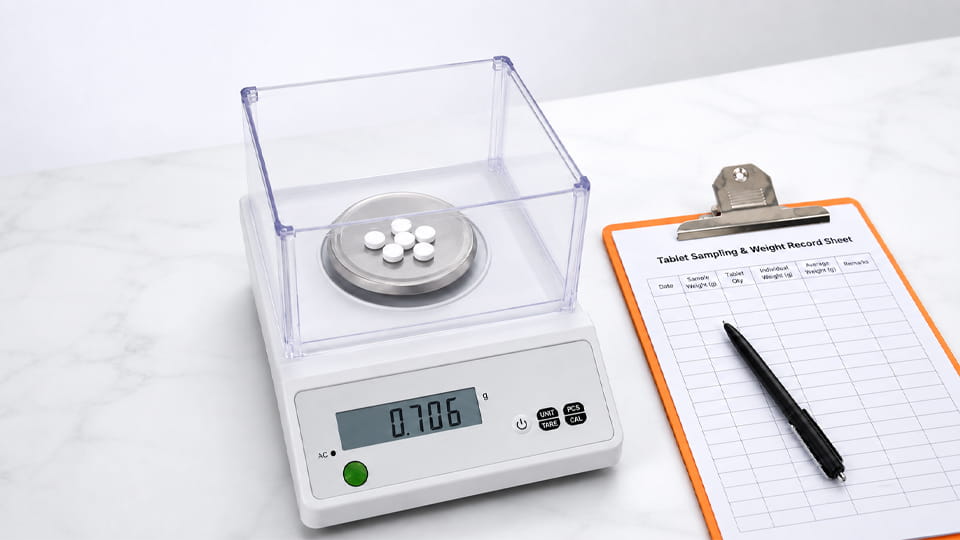
Imagine you’ve cranked up the speed on your rotary tablet press machine (a pill pressing machine or tablet compression machine) to boost output – and suddenly tablets start turning out soft, cracked, or capping. What happened? In a high-speed rotary press, dwell time – the time each tablet spends under maximum compression – has shrunk. Dwell time is simply the period during which the punch head flat is in full contact with the compression roller. In practical terms, it’s the milliseconds of squeeze each tablet gets. Control dwell time well, and you get strong, consistent tablets; rush it, and you risk defects.
Dwell time in tablet compression is a critical parameter. It directly influences tablet hardness, tensile strength, and defect rates (like capping, lamination, or friability). It also ties into press speed and tooling choices. In this article, we’ll break down what dwell time is, how it’s calculated, why it matters for tablet quality, and how you can manage it on your rotary tablet machine (tablet making machine). We’ll share industry insights and recent studies to give you a clear picture – without the textbook jargon. Let’s dive in.
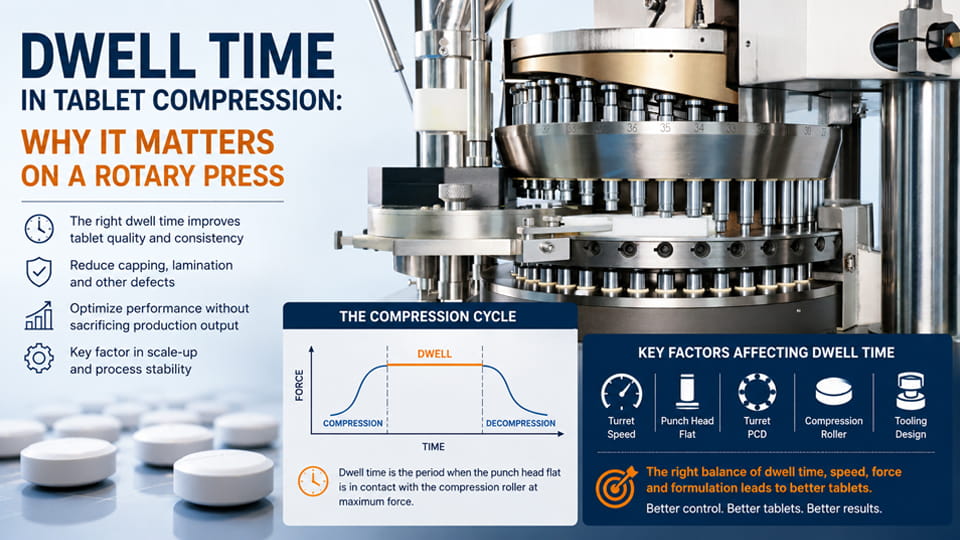
Dwell time is the time that the punch head flat remains in contact with the compression roller during tablet formation. A common definition is: the period during which the compression force is above about 90% of its peak value. In a rotary tablet press machine, that happens just after powder filling and pre-compression, when both punches lock under full force and compress the powder.
For example, a JinLu tablet machine press (410 mm PCD) running at 50 RPM with a standard 9.525 mm punch flat gives about 8.9 ms of dwell. If you swap to an extended 15 mm flat (same speed), dwell jumps to ~14.0 ms – roughly a 50% increase. You can see how tool design plays a big role.
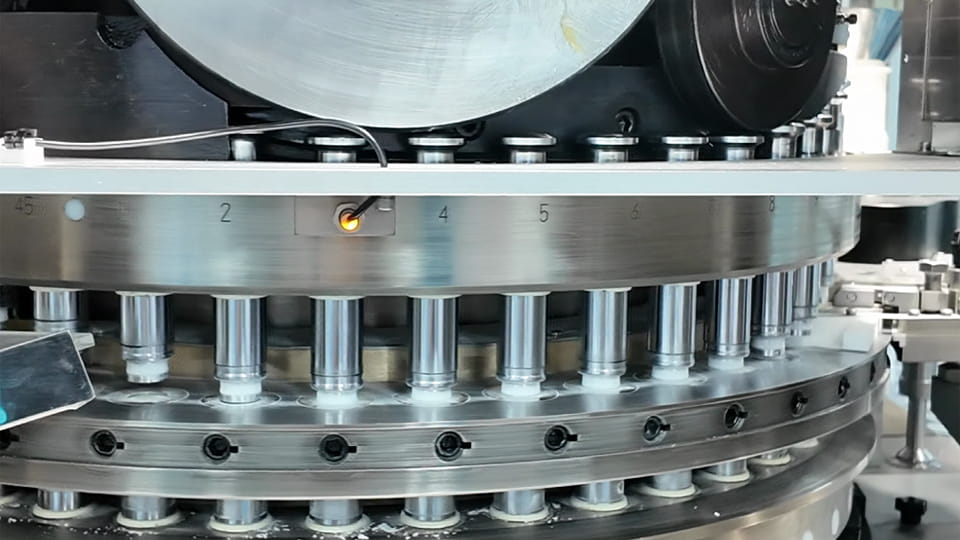
In a rotary tablet press, turret speed (RPM) and dwell time are inversely linked. The faster the turret spins, the shorter the dwell time per punch. Think of it like a camera shutter: the quicker it moves, the less time each shot gets to expose. In a multi-station tablet machine , all punches pass under the roller once per turret rotation, so:
For example, a press at 30 RPM might give 15 ms dwell (just as an illustration), but at 60 RPM it would only be ~7.5 ms. Many tablet makers note this trade-off: speed up the machine, and tablets can get softer or start capping unless you adjust something else. As one Jinlu guide points out, “higher turret speed means shorter compaction time, so more pre-compression may be needed to compensate for lost dwell”. In short, pushing RPM for output comes at the expense of dwell time – a key quality vs. quantity balance.
Dwell time matters because it controls how long the powder bed is under maximum pressure. Longer dwell allows particles to deform, rearrange, and bond more thoroughly. Too short, and tablets may not form strong bonds. Here are the main reasons dwell time is a critical parameter in tablet compression:
Key point: Dwell time is one of the key factors (with compression force and formulation) that determines tablet quality. Manufacturers often solve problems by tweaking dwell: “Many tablet formulations are dwell-sensitive and require more time under compression to ensure they come off the press without any faults”. In sum, proper dwell time helps achieve target hardness while avoiding defects like capping or cracking.
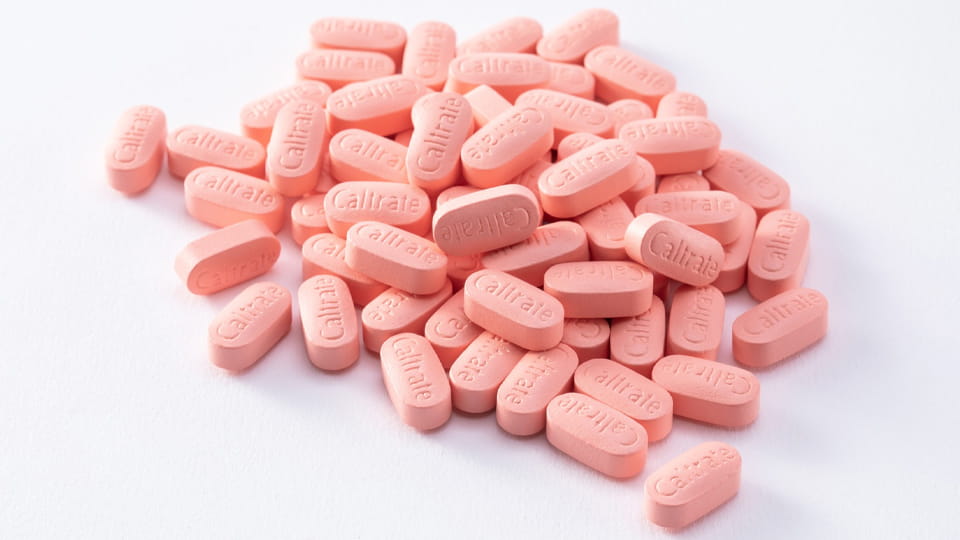
When dwell time is too short for a given formulation, common tablet defects can appear. In plain terms, the powder doesn’t get enough squeeze time. Some effects include:
However, it’s important to note the effect can be material-dependent. A recent study using a compaction simulator found that within the actual dwell-time range of modern presses (roughly 10–100 ms), the impact on tablet strength can be “marginal to non-existent depending on the material”. In other words, for some materials, there’s a threshold beyond which extra dwell doesn’t change much. This study even concludes that in practice only strain rate (speed) matters on a realistic timescale. But in general, if your tablets start showing cracks, soft spots, or uneven properties when you speed up the press, shortened dwell time is often the culprit.
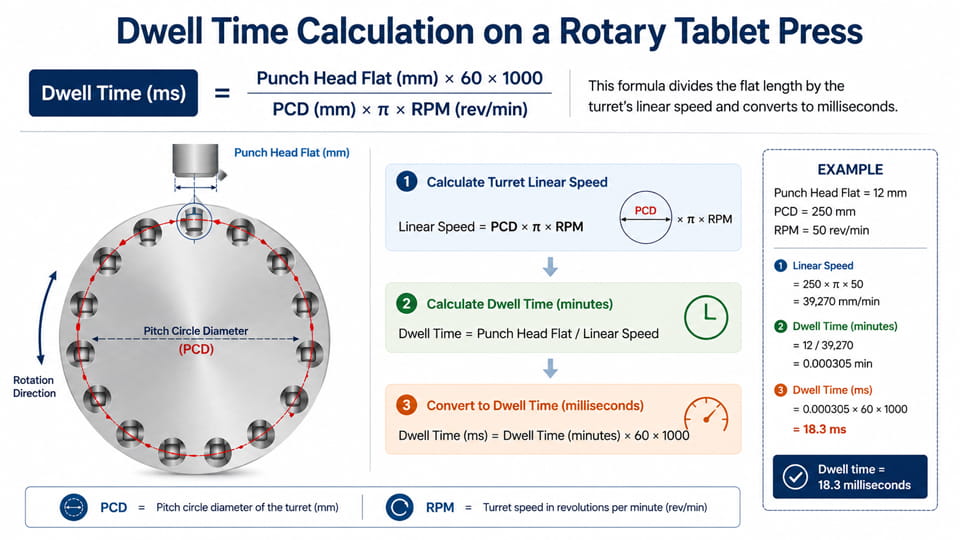
Since dwell time depends on punch geometry and speed, we can calculate it with a simple formula. Industry references give the geometric dwell time (GDT) as:
Dwell time (ms) = (Punch head flat diameter (mm) × 60 × 1000) / (π × PCD (mm) × RPM)
Where PCD is the pitch circle diameter of the turret, and RPM is the turret speed in revolutions per minute. This formula basically divides the flat length by the turret’s linear speed and converts to milliseconds.
For example, a JinLu technical bulletin shows that on a 410 mm turret at 50 RPM, a standard 9.525 mm flat yields about 8.88 ms, while a 15.0 mm extended flat yields about 13.98 ms. That matches the formula above. In practice, you often see charts or calculators based on this formula; larger punch flats and bigger turrets (larger PCD) give longer dwell at the same RPM.
Example: Suppose you have a punch with a 6 mm flat on a press with 350 mm PCD running at 120 RPM. Plug into the formula:
Dwell (ms) ≈ (6 × 60,000) / (π × 350 × 120) ≈ (360000) / (131946) ≈ 2.7 ms.
Only 2.7 ms dwell! Drop the RPM to 60, and dwell doubles to ~5.4 ms. Or increase the head flat to 12 mm, and dwell doubles again. These simple calculations help R&D and production engineers understand how design choices affect dwell.
Beyond turret speed, several factors influence actual dwell time on a press:
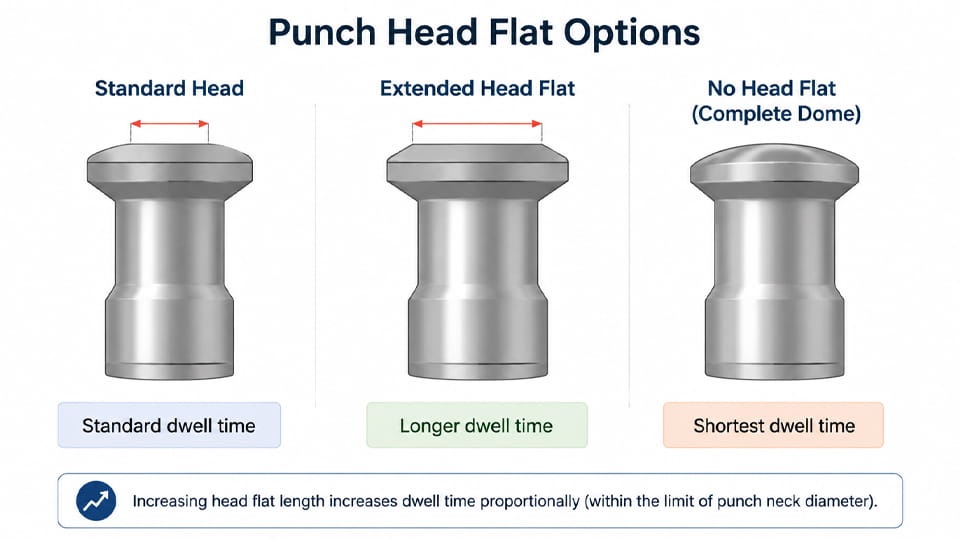
In short, to increase dwell time without slowing the turret, you typically increase the punch head flat (or use extended/elliptical punches) or use a press with a larger turret diameter. Modern tooling vendors (like JinLu) offer extended flat punches that fit existing cams. The easiest fix is often this – as JinLu points out, “increasing the diameter of the head flat is the easiest way to prolong dwell time without decreasing the turret speed”.
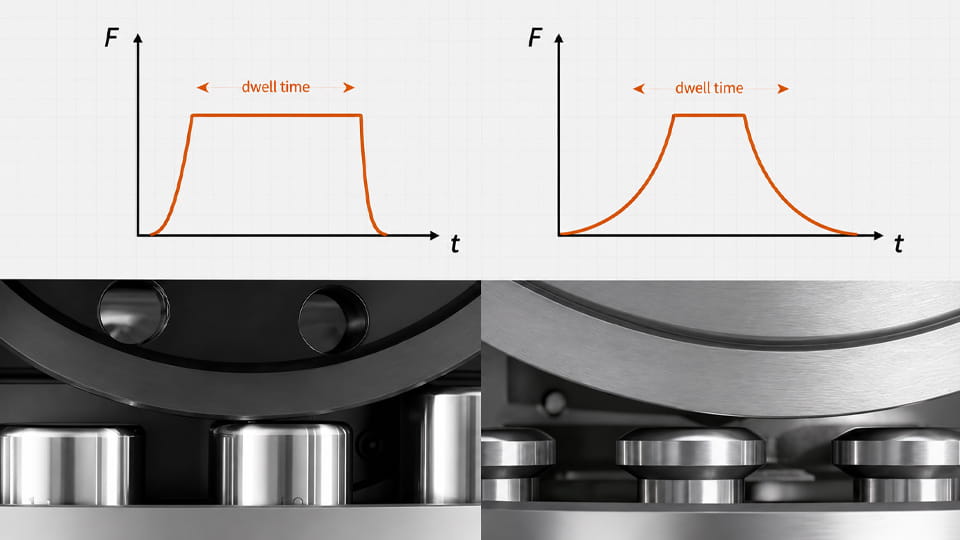
It’s useful to distinguish geometric dwell (computed from equipment geometry) from force-based dwell (the actual time a tablet sees peak force). Geometric dwell is what you calculate with the formula above. But in practice, the maximum force is not instant – it ramps up slightly, especially with elastic materials or at different compression rates.
Recent R&D highlights this: a 2024 study compared the geometric dwell (GDT) to the dwell-time measured by a compaction simulator (DTF) when force is above 90%. They found that DTF varies with both compression force and formulation. In other words, if you set the press at a certain RPM, the actual “time above 90% force” may be shorter than the GDT if the tablet is stiff or if the force ramp is slow. The difference in DTF between formulations shrank as the compression force was increased, meaning high force tends to use more of the available geometric time.
Implication: Geometric calculations are a good baseline, but for precise predictions (especially in R&D and scale-up) one must consider actual compression behavior. Many experts suggest measuring force-vs-time profiles for a formulation if dwell is critical. Still, for most production needs, geometric dwell and extended tooling changes are sufficient to set up the process.
Slowing down the press is the obvious way to lengthen dwell, but it cuts throughput. Here are strategies to get more dwell while keeping output high:
In short: Extended head flats and optimized tooling are the go-to fix. As one industry expert says, “Elliptical head flat tooling… increases dwell time on an existing press without any expensive modifications”. This lets you keep the same turret speed and cams while boosting dwell. Jinlu’s own products tout “longer dwell time pressing” designs for just this reason.
It’s tempting to think “just apply more force” to make up for short dwell, but that has limits. More force can sometimes improve tablet strength, but it also raises stress on tooling and can worsen capping if it traps air. Jinlu notes increasing dwell time may reduce the force needed for a given tablet hardness. Conversely, if you crank up force without dwell, you risk ejection issues and embossing defects.
Modern research adds a nuance: instead of dwell time alone, strain rate (related to compression speed) is often the key driver at production scales. The takeaway: simply jacking up force does not always equal a better tablet, especially if dwell is very short. A balanced approach—moderate compression force with sufficient dwell—is usually best for quality and tool life.
Scaling up from an R&D or pilot press to a commercial rotary press is notoriously tricky. One main reason: the dwell time on the lab press (often slow-speed or single-station) is usually much longer than on the high-speed production press. If a formulation is dwell-sensitive, a recipe that looked fine in the lab might cap or soften at scale.
To handle this, experts advise:
In summary, always check tablet strength when moving to production speed. If tablets weaken at high RPM, the lost dwell is likely the culprit. Some R&D teams even adjust formulations (binders, lubricants) to reduce dwell sensitivity before scale-up.
Since dwell time ties directly to press design, it factors into equipment selection. For high-speed production, consider:
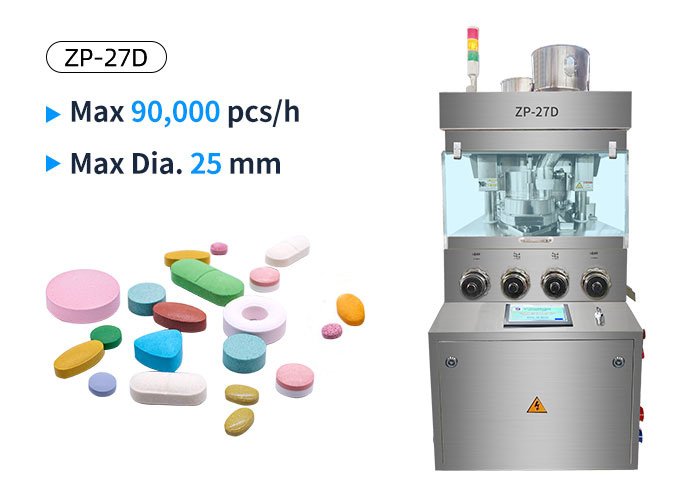
Ultimately, ask yourself: do you need 100k tablets/hour at 8 mm diameter, or will 60k suffice for the same yield? Choosing the right press is a trade-off between speed and dwell, and the best machine is one that gives you the needed quality at your desired output.
Dwell time – the milliseconds of squeeze in tablet compression – might be a small thing, but it has a big impact. It affects tablet hardness, friability, and defects like capping or lamination. In high-speed tablet manufacturing, dwell time connects the dots between press speed, tooling design, and tablet quality. A short dwell can spell soft or defective tablets; a well-managed dwell can make tough formulations work at scale.
The good news is that dwell time is also manageable. By understanding the factors (turret RPM, punch flat size, press design) and applying fixes like extended punches or optimized pre-compression, you can hit both your quality and production targets. Remember to calculate expected dwell using the punch flat and turret specs, and always validate at scale with real measurements. As recent research confirms, strain rate and formulation are also key – but even then, proper dwell time often makes a qualitative difference.
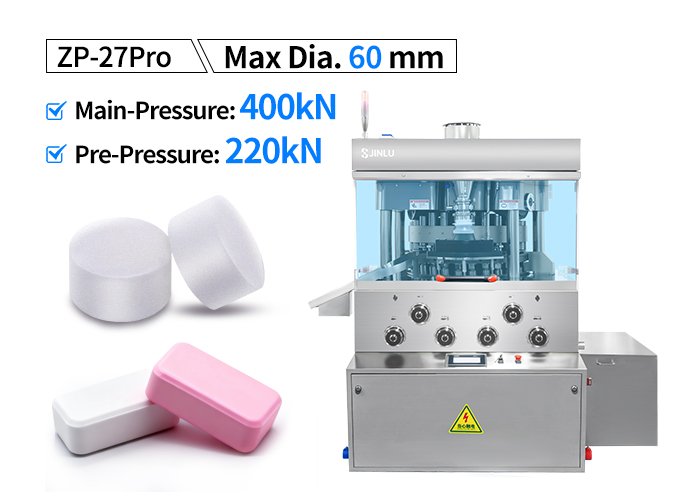
If your production has dwell-sensitive issues, take action. Try larger head flats, adjust pre-compression, or consult with equipment experts. Jinlu Packing’s high-speed rotary tablet presses and tooling are designed with these factors in mind – for example, the 400kN pill tablet press machine incorporates a “Longer Dwell Time Pressing Design” to ensure full compression. Our engineers can help you find the right machine and setup so that dwell time helps you, not hurts you.
Ready to optimize your tablet production? Contact Jinlu Packing today. Our team can review your formulation and press parameters, suggest the ideal turret speed or tooling changes, and even run trials on our in-house presses. We offer a range of rotary tablet press machines – from benchtop models to high-output systems – all engineered for reliable dwell time control. Don’t let short dwell undermine your tablets. Reach out now and let’s ensure every pill that comes off your press is strong, intact, and exactly what you need.
Dwell time in tablet compression is the period during which the flat portion of a punch head remains under the main compression roller during tablet formation. It is usually measured in milliseconds (ms). On a rotary tablet press, dwell time is mainly influenced by punch head geometry, turret speed, and press geometry.
Dwell time is important because it affects how a formulation responds to compression, particularly at higher production speeds. A shorter dwell time can reduce the time available for consolidation and may contribute to lower tablet strength or defects such as capping and lamination in dwell-sensitive formulations. However, its effect depends on the formulation and should be evaluated together with compression force, strain rate, tooling, and other process parameters.
Increasing turret speed generally reduces dwell time because the punch heads move across the compression rollers faster. Lowering the turret RPM increases dwell time but also reduces tablet production throughput. Therefore, tablet manufacturers need to balance press speed with tablet quality and process capability rather than simply running the tablet press at its maximum RPM.
A commonly used geometric calculation is:
Dwell time (ms) = (Punch head flat × 60 × 1000) / (PCD × π × RPM)
Here, punch head flat and PCD are measured in millimeters, while RPM represents turret speed. For example, with a 12 mm punch head flat, 250 mm PCD, and 50 RPM, the calculated geometric dwell time is approximately 18.34 ms. This calculation describes geometric dwell time; actual force-based dwell time can differ depending on the press and compression conditions.
The main factors include turret speed, punch head flat geometry, pitch circle diameter (PCD), tooling design, and tablet press geometry. Increasing turret speed generally shortens dwell time, while a larger punch head flat generally increases the geometric dwell period. Press design and tooling configuration also influence the actual compression profile.
Longer dwell time can improve tablet strength for some formulations by allowing more time under compression, but it does not automatically produce harder tablets in every case. Tablet hardness and tensile strength also depend on formulation properties, compression force, strain rate, tooling, and other process conditions. Therefore, dwell time should be optimized for the specific formulation rather than maximized by default.
Insufficient dwell time can contribute to capping or lamination in formulations that are sensitive to compression speed and short compression periods. However, these defects can have multiple causes, including air entrapment, elastic recovery, formulation properties, inadequate precompression, compression force, lubrication, and tooling condition. Dwell time should therefore be investigated as part of a broader compression troubleshooting process.
Options may include using tooling with a larger punch head flat, optimizing punch and compression-roll geometry, using appropriate precompression, or selecting a rotary tablet press designed to provide a suitable compression profile. Simply reducing turret speed is the most direct way to increase geometric dwell time, but it also lowers throughput. The best solution depends on the formulation, tooling, tablet size, and required production rate.
Dwell time is specifically associated with the period when the flat portion of the punch head is in contact with the compression roller and the punch is not changing its vertical position relative to the roller. Compression time is a broader term that can describe the period over which compression occurs. Therefore, dwell time should not automatically be treated as identical to total compression time.
Dwell time is important during scale-up because changing from an R&D or laboratory tablet press to a production rotary tablet press can change turret speed, punch geometry, compression conditions, and the time available for compaction. If the production press operates with a substantially different compression profile, tablet hardness, tensile strength, friability, or defect rates may change. Comparing relevant compression conditions during scale-up can therefore help identify potential problems before full-scale production.
References:
1.Investigation on the effects of dwell time and loading strain rate on powder compaction and tablet properties: A compaction simulator study —— ScienceDirect
2.Dwell time on tableting: dwell time according to force versus geometric dwell time —— Taylor & Francis Online
3.Influence of extended dwell time during pre- and main compression on the properties of ibuprofen tablets —— National Library of Medicine
4.Influence of the Punch Head Design on the Physical Quality of Tablets Produced in a Rotary Press —— National Library of Medicine
5.Role of dwell on compact deformation during tableting: an overview —— Monash University
6.Compression physics in the formulation development of tablets —— National Library of Medicine