Cold Forming vs Thermoforming: Which medical blister packaging Is Right for Pharma?
Cold Forming vs Thermoforming: Which medical blister packaging Is Right for Pharma?
August 26, 2026
No Comments
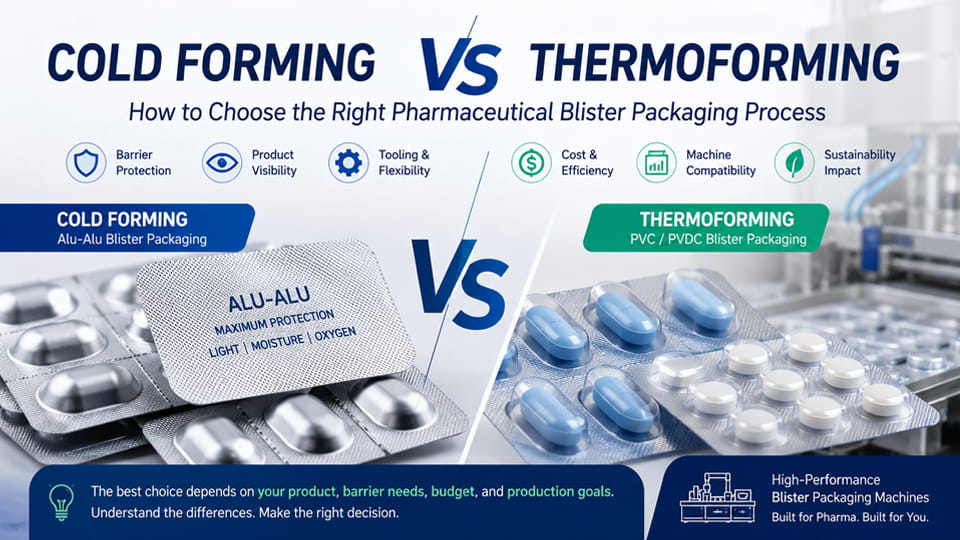
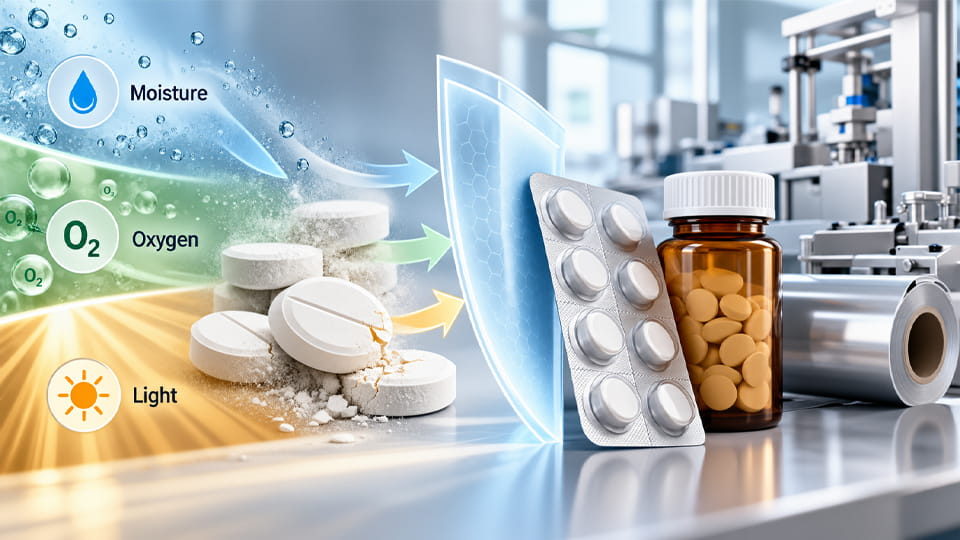
Pharmaceutical products are often sealed in blister packs for unit-dose protection and shelf appeal. In blister packaging, the two main forming methods are thermoforming and cold forming. Thermoforming heats a plastic web (like PVC or PET) until it’s pliable and then vacuums or presses it into molds. Cold forming, by contrast, uses high-pressure stamping on a multi-layer aluminum-based laminate at room temperature. Each method uses different materials and gives very different results: thermoformed blisters are transparent and lower-cost, while cold-formed (Alu-Alu) blisters are opaque but offer much higher barrier protection. This guide breaks down how they work, key differences (barrier, cost, speed, etc.), and how to choose the right method and machine for your product.
What Is Thermoforming?
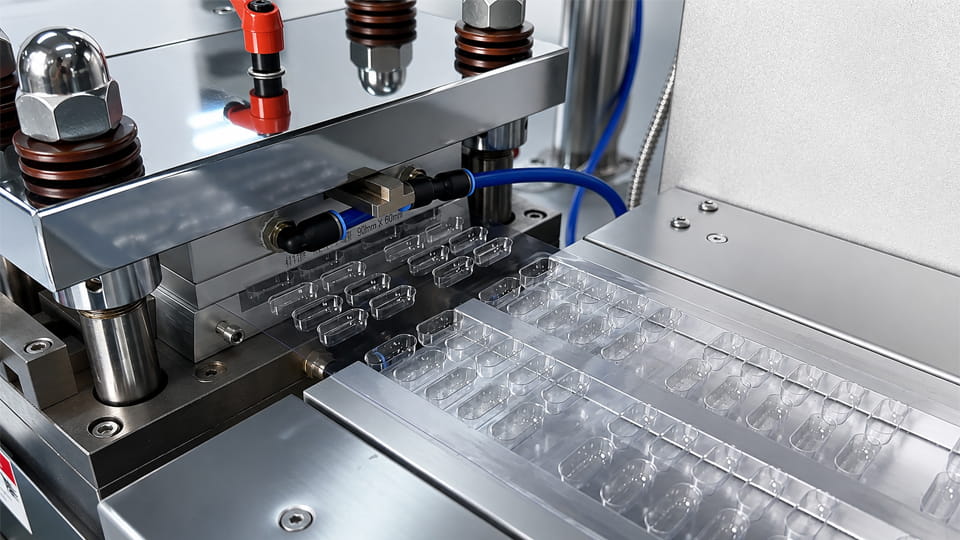
Thermoforming blister packaging heats a plastic sheet until it softens and then forms it into cavities by vacuum or pressure. A temperature-controlled unit (often 150–180 °C) heats PVC or another thermoplastic film, which is then shaped over a mold. Once the film cools, the formed cavities are filled with product and sealed with a foil or paper lidding.
This process is highly adaptable: common forming films include PVC, PET, PP, or co-polymers, sometimes with barrier coatings (PVDC, COC, PCTFE, etc.). Thermoforming offers high design flexibility – blister shapes can be deep or complex (using plug assists) without changing the base materials. It’s also cost-effective for large runs: thermoplastic films are inexpensive and machines run at high speeds. The main advantage is affordability and throughput – as one source notes, “the principal advantages of PVC are low cost and the ease of thermoforming”.
Thermoforming Advantages
Lower material cost: Plastic films (even with barrier coatings) are much cheaper than multi-layer metal foils. This makes unit costs lower for large production.
Higher speed: Thermoforming machines typically cycle faster. For example, a modern thermoforming blister line can run well over 150 packs/min, higher than typical cold-form speeds.
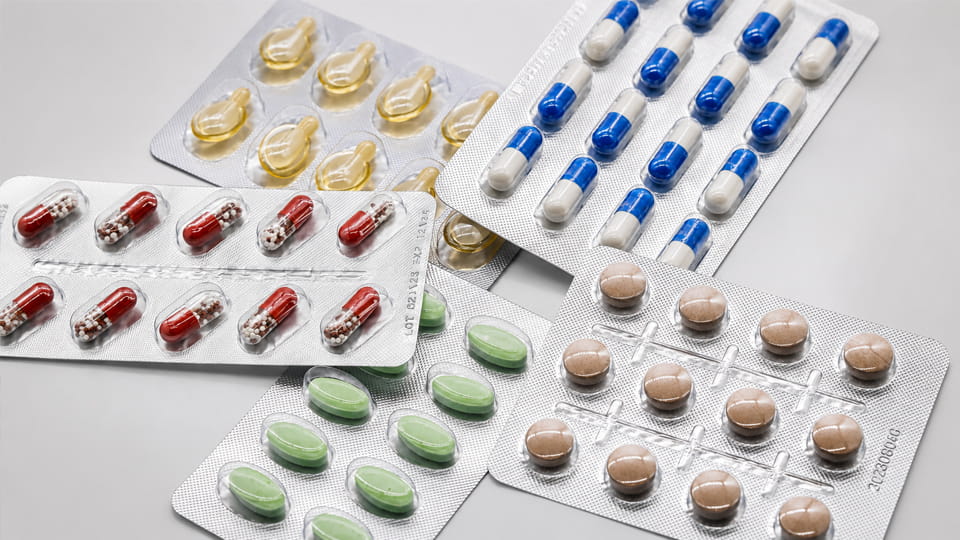
Product visibility: Clear PVC/PET packs let users see the pills or tablets inside. This transparency is good for consumer appeal (e.g. retail vitamins) and for visual inspection.
Design flexibility: Complex cavity shapes or deep draws can be achieved with heated film (often aided by vacuum or plug-assist). It also integrates easily with fast-fill and high-speed sealing processes.
Thermoforming Limitations
Barrier protection: A plain PVC film offers only a moderate moisture and oxygen barrier. Uncoated PVC has a high water vapor transmission rate (e.g. ~3 g/m²·day at 90%RH). To improve shelf-life, thermo packs must use costly multi-layer films (e.g. PVC/PVDC or PVC/PCTFE laminates) or thicker films. Even then, the barrier usually remains below what aluminum foil achieves.
Light sensitivity: Clear films allow UV and visible light through. That means thermoformed blister packs are not ideal for light-sensitive drugs – they offer virtually no UV protection unless you add UV-blocking additives.
Limited shelf life: For highly moisture-sensitive or reactive APIs, thermoformed packs (even with coatings) often give shorter stability. Wikipedia notes: “the disadvantages [of PVC] are the poor barrier against moisture ingress and oxygen”.
Rigid tooling costs: While machines are generally cheaper, deep-draw thermoforming may require precision molds and plug-assist dies, adding to tooling expense.
What Is Cold Forming?
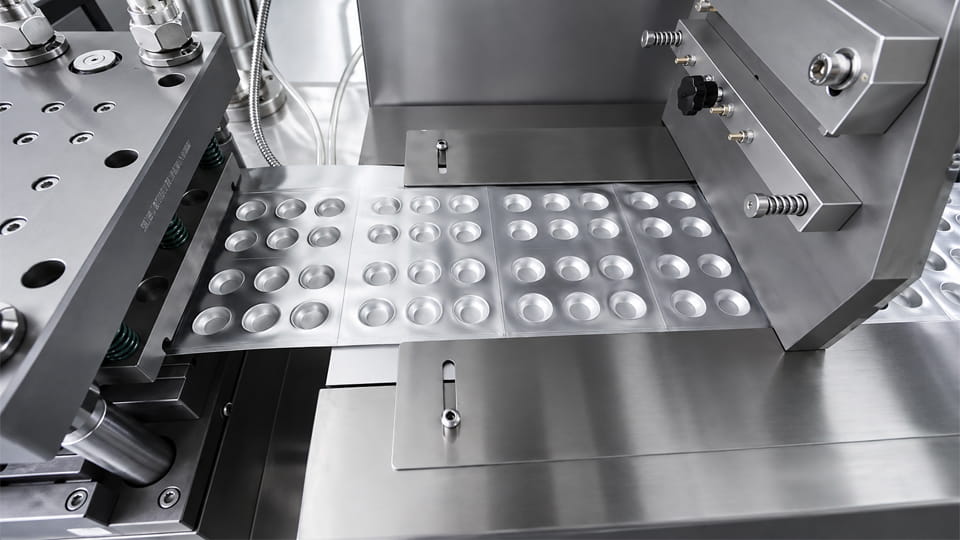
Cold forming (often called Alu-Alu blister packaging) uses a multi-layer aluminum-based film as the forming web. A typical cold-form laminate is PVC/Aluminum/Polyamide, with the aluminum layer on the outside. In this process, the film is not heated. Instead, a robust high-pressure punch stamps the foil into cavities at room temperature. The aluminum stretches but plastically deforms, and it holds the cavity shape once the stamp is removed. Each filled cavity is then sealed (often with an aluminum or foil-backed paper lidding).
Since cold forming doesn’t heat the material, it avoids any thermal stress on sensitive drugs. The result is a blister that is fully opaque (no view of the contents) but provides an excellent barrier. The aluminum foil stops nearly all moisture, oxygen, and light from reaching the drug, which can greatly extend shelf life.
Cold Forming Advantages
Superior barrier: The aluminum layers make the blister almost impermeable. As Wikipedia notes: “The principal advantage of cold form foil blisters is that the use of aluminum offers a near complete barrier for water and oxygen, allowing an extended product expiry date”. This is why Alu-Alu blisters are used for hygroscopic, oxygen-sensitive, or light-sensitive pharmaceuticals.
Moisture and light protection: Cold-formed blisters keep moisture, oxygen and light out. For example, multi-layer foils entirely block UV/visible light and form an airtight seal around each dose. This locks in potency for drugs that degrade quickly in humid air or bright light.
Material flexibility: The forming web (PVC/Alu/PA) still has a PVC side, which keeps the pocket shape and provides some elasticity, while the aluminum provides protection. This makes the cavity strong and shallow, which is often enough for most tablets and capsules.
Cold Forming Limitations
Higher material cost: Aluminum laminates are much more expensive than plastic films. The foil has multiple layers (e.g. 9–15 μm Al plus 80–100 μm of other layers) and specialized compositions, so raw material cost per pack is high. A source specifically notes “the cost to cold form blister packs tends to be higher than thermoforming”.
Slower speed: Because of the stamping process and the need to handle foil (which isn’t stretchable like plastic), cold-form machines run at lower speeds. As one summary points out, cold-form foil blisters suffer from “slower speed of production compared to thermoforming”.
No visibility: Both sides of the blister are aluminum (or the top is aluminum), so users cannot see the product at all. This limits use to products that don’t require visual confirmation on the shelf. (It also means compliance packs must have good print labeling, since you can’t visually check contents.)
Machine wear: Cold-forming tools and dies take heavy loads, so machines must be very robust. The punch and counter-die must be precisely made and often need thicker steel, adding maintenance.
Larger pack size: Because aluminum can’t stretch as much as plastic, cold-formed cavities are usually shallower or have larger surrounding borders. Wikipedia notes an Alu-Alu pack typically ends up “larger size of the blister card” and less steep pocket walls.
Cold Forming vs Thermoforming: Key Differences
The table below highlights the main differences between thermoforming and cold forming blister packaging:
Factor
Thermoforming
Cold Forming (Alu-Alu)
Forming process
Heat plastic film until soft, then vacuum/pressure-form into cavities.
High-volume OTC meds, vitamins, standard tablets; when visibility & cost matter.
Moisture- or light-sensitive drugs (antibiotics, biologics), long shelf life needed.
Each factor above reflects the trade-offs between the two methods. Thermoforming tends to use cheaper materials and run faster, while cold forming uses expensive metal foils for top-tier protection.
Detailed Comparison: 8 Key Factors
To summarize, here are eight major factors that set thermoforming and cold forming apart:
Forming Method:
Thermoforming: Plastic sheet is heated, then vacuum/pressure-formed over a mold.
Cold Forming: Metal laminate is stamped cold with high pressure; aluminum holds the shape.
Materials:
Thermoforming: Uses films like PVC, PET, PP (often with barrier coatings PVDC/COC/COP). For example, many blister lines use non-plasticized PVC (RPVC) as the forming web.
Cold Forming: Uses an aluminum-based laminate (typically PVC/aluminum/nylon). This “cold form foil” is specially engineered for high-barrier forming.
Moisture & Gas Barrier:
Thermoforming: A bare PVC film has poor barrier (WVTR ~3 g/m²·day, OTR ~20 mL/m²·day). Multi-layer PVC films (coated with PVDC or coextruded with PCTFE/COC) can improve this, but never to the level of metal foil. Wikipedia notes PVC’s disadvantage is “poor barrier against moisture and oxygen”.
Cold Forming:Excellent. Aluminum foil creates an almost impermeable barrier. As noted, cold-formed blisters give a “near complete barrier for water and oxygen”, greatly extending expiry.
Light Protection:
Thermoforming: Clear films let all light through (unless you use special pigmented films or add UV-blocking agents). This is why clear PVC blisters are not recommended for light-sensitive drugs.
Thermoforming: Typically higher. Because plastic films feed quickly and forming cycles are fast, these lines often exceed 150–200 packs/min (on high-end rotary machines).
Cold Forming: Generally slower. The stamping and handling of foil limits throughput. Even top cold-form machines are usually under 100 packs/min for deep Alu-Alu designs.
Cost (Material & Equipment):
Thermoforming: Plastic raw films cost much less per linear meter than 3-layer foil. Machineries are simpler (just heating plates and vacuum stations), so initial machine cost is generally lower. One source summarizes, PVC’s “principal advantages” are its low cost and easy forming.
Cold Forming: Higher. The specialty foil is expensive, and machines must be beefier. Studies note “cold form blister packaging equipment … is particularly suited for moisture-sensitive products,” but at a premium cost.
Product Visibility:
Thermoforming: Yes – product is visible through clear plastic. Good for retail display or easy dose checking.
Cold Forming: No – completely opaque.
Typical Applications:
Thermoforming: Standard OTC and prescription tablets/capsules where high barrier isn’t critical (e.g. painkillers, vitamins). Bulk pharmaceuticals, supplements, or any product needing a quick high-speed line. Also used for medical blister packaging of non-sterile devices.
Cold Forming: Premium or critical drugs (e.g. antibiotics, sensitive APIs, vacuum-packed enzymes) and any product requiring maximum moisture/light protection and long shelf-life. Often seen in PTP (push-through) packs for very stable dosing, or for products distributed globally with variable climates.
These differences show that thermoforming excels in speed, cost and visibility, while cold forming excels in protection and stability. In practice, designers weigh these factors against the product’s requirements.
Choosing the Right Method: Guidance for Pharma Machinery Buyers
When selecting between cold forming and thermoforming (and the corresponding blister packaging machine), ask:
Product Stability Needs: Is your API or formulation highly sensitive to moisture, oxygen or light? If yes, cold-formed (Alu-Alu) blisters are usually required. If your product is relatively stable (e.g. standard tablet), thermoforming is likely sufficient.
Desired Shelf Life: Does the product need an extended expiry (18+ months)? Cold-form packs can significantly extend shelf life due to their superior barrier. For short shelf-life (<1 year) products, PVC packs are often acceptable.
Production Volume and Speed: Do you need very high throughput? Thermoforming lines generally run faster, so they suit large-scale production. For smaller runs of very valuable drugs, the slower cold-form method may be acceptable.
Cost Constraints: If budget is tight and barrier requirements moderate, thermoforming is more economical. For example, Jinlupacking notes that “the cost to cold form blister packs tends to be higher than thermoforming”. Factor both material and equipment cost in your TCO analysis.
Regulatory / Market Needs: Some markets or formulations may require certain packaging. For example, a regulatory spec might mandate Alu-Alu foil for a particular antibiotic, or marketing may favor see-through packaging for a branded vitamin.
Machine Compatibility: Consider if you want one machine for both methods or separate lines. Some modern machines (like Jinlu’s DPP-180PRO Blister Machine) can be configured for either thermo- or cold-forming, but many companies use dedicated lines to optimize each process.
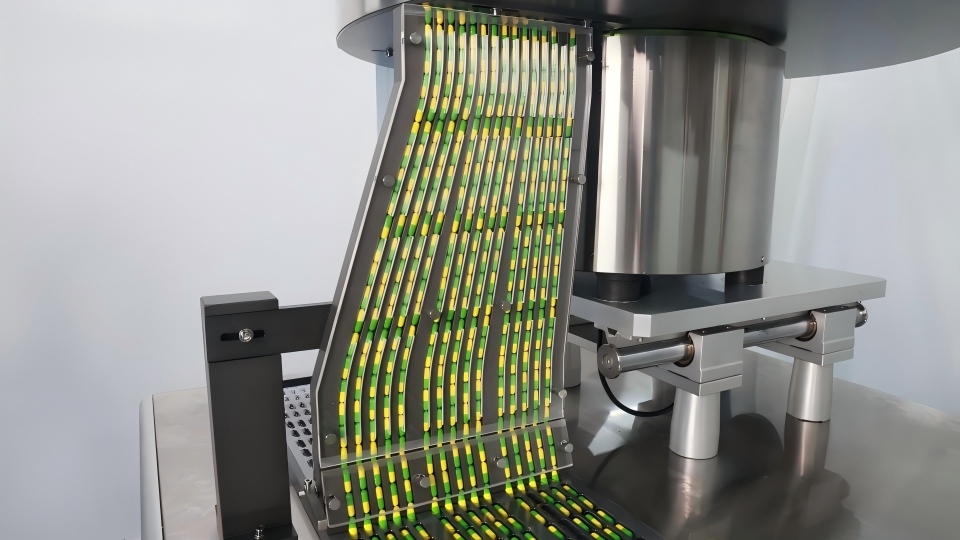
DPP-180pro Blister Machine for Capsule Tablet
A quick rule of thumb: Use thermoforming for standard meds where customer visibility and cost are key; use cold forming for high-barrier needs where protection is paramount.
When to Choose Thermoforming
Your product is not extremely moisture- or light-sensitive (basic OTC tablets, vitamins).
High production speed and low cost are priorities.
You want transparent packaging so the product can be seen.
The expected shelf life is relatively short or moderate.
You plan to use standard plastic films (PVC, PVDC/PVDC-coated, COC, etc.).
Your blister packaging machine is set up for heated forming stations.
When to Choose Cold Forming
Your product is highly moisture/oxygen-sensitive or light-sensitive (e.g. hygroscopic tablets, sterols, certain biologics).
You need the absolute best barrier and longest shelf life.
You have a smaller run or are willing to trade speed for protection.
You can accept opaque packaging (or use heavy labeling to differentiate).
The budget allows for higher material cost (alu-foil laminates).
Your machinery (or supplier) supports the cold-form process with sturdy metal dies.
For example, many pharmaceutical cold-form blister packs carry the label “Alu-Alu” on the foil. These are chosen precisely when maximizing drug stability is the goal.
Cost Comparison
Cost is a major consideration. Material costs: PVC film (even with a PVDC coating) is far cheaper than a 3-layer aluminum laminate. On a per-unit basis, a thermoformed pack’s material might be only a few cents, while an equivalent Alu-Alu foil pack can be multiples of that. One industry source confirms that “the cost to cold form blister packs tends to be higher than thermoforming”.
Machine costs and OEE: Thermoforming machines are generally simpler (heating units and vacuum chambers) and often cheaper to maintain. Cold-form machines need heavy punches and sometimes dual feed (for inner and outer foils), which can increase capital costs. However, if cold forming prevents product losses (e.g. from spoilage), the higher upfront cost might be justified. Always consider total cost of ownership, including downtime, maintenance, and material waste, not just line speed.
Machine Selection and Packaging Lines
Your choice also dictates the packaging line. Blister packing machines are engineered for one process or the other. A thermoforming blister machine will have heating and vacuum stations; a cold-forming blister machine will have a large press and foil feeders. Some hybrid machines (often in research or low-scale use) can switch modes, but a given line is usually optimized for one method.
For example, the Jinlu DPH-270Max Roller Blister Machine is capable of both methods, but most production lines will be dedicated. If you choose thermoforming, ensure your blister packaging equipment supports your chosen film (PVC thickness, coating type) and has sufficient temperature control. If you choose cold forming, make sure your machine can handle Alu-Alu foil rolls and has the required stamping force.
When talking to suppliers, mention your product needs: say if you need “a blister packing machine for Alu-Alu blister packaging” or “a thermoforming blister packing machine for PVC/PVDC films.”
How to Decide: A Quick Checklist
Evaluate Product Sensitivity: Check if your drug needs protection from moisture, oxygen, or light. If any of these are critical, cold forming is likely required.
Shelf-Life Goals: Is extended expiration needed? For 2+ year shelf life, the Alu-Alu barrier is the safest choice.
Visual Requirements: Do you want customers to see the product? If yes, favor thermoforming (transparent).
Production Volume & Cost: For very high volume and cost-sensitivity, thermoforming usually wins. If volume is lower and product cost is high, cold forming’s slower speed may be acceptable.
Machine Capabilities: Confirm that your blister machine can handle the chosen material. Many manufacturers can furnish both types, but you need the correct tooling and line setup.
If in doubt, consult an expert: packaging engineers will often model the specific drug’s stability in different materials. But a good heuristic is that cold forming (alu-alu) gives the best protection at higher cost, and thermoforming (plastic) gives the best visibility and throughput at lower cost.
Conclusion
Cold forming and thermoforming each have clear pros and cons. Thermoforming (PVC-based) is fast, transparent, and cost-effective, making it ideal for many routine pharmaceuticals. Cold forming (alu-alu) is slower and costlier, but it delivers unbeatable moisture, oxygen and light protection for high-value, sensitive drugs. In practice, thermoforming packs are used for standard tablets, vitamins and OTC products, while cold-form packs are chosen for moisture-sensitive or long-expiry medications.
Ultimately, your decision should be driven by product requirements. If ultimate barrier is essential, you’ll likely opt for an alu-alu blister pack on a cold-forming blister packing machine. If you need speed, visibility and cost savings, a PVC thermoform pack on a thermoforming blister machine is likely sufficient.
Feel free to contact our packaging specialists for guidance. We can recommend the right automatic blister packing machine and process for your product – whether you need a high-speed thermoforming blister line or a cold-form (alu-alu) blister machine.
Stay compliant and cost-efficient with the right choice of blister packaging!
FAQs About Cold Forming vs Thermoforming Blister Packs
What is the difference between cold forming and thermoforming?
Thermoforming uses heat to shape plastic film into blister cavities, while cold forming mechanically presses an aluminum-based laminate into shape without heat. Thermoforming is typically faster and more cost-effective, while cold forming provides stronger barrier protection.
Is cold forming better than thermoforming?
Not necessarily. Cold forming is better for products that require strong protection from moisture, oxygen, or light, while thermoforming is often preferred for stable products where cost, speed, and product visibility are priorities.
Which is cheaper, cold forming or thermoforming?
Thermoforming is generally less expensive. Plastic forming materials usually cost less than the aluminum-based laminates used for cold-form Alu-Alu blister packaging, although the total cost also depends on machine speed, tooling, and production requirements.
Which provides better moisture protection?
Cold forming generally provides better moisture protection. Its aluminum-based laminate offers a very strong barrier, making it suitable for moisture-sensitive pharmaceutical products. The actual requirement should be confirmed through product stability and packaging studies.
Which is faster, cold forming or thermoforming?
Thermoforming is generally faster than cold forming. Its forming process is well suited to high-volume production, while cold forming typically runs at lower speeds because the aluminum laminate requires mechanical forming.
Why is Alu-Alu blister packaging used for sensitive medicines?
Alu-Alu blister packaging provides excellent protection against moisture, oxygen, and light. It is therefore commonly considered for pharmaceutical products with high sensitivity to environmental exposure or demanding shelf-life requirements.
Is thermoforming suitable for pharmaceutical blister packaging?
Yes. Thermoforming is widely used for tablets and capsules when the product does not require the highest level of barrier protection. Materials such as PVC and PVC/PVDC can provide different levels of moisture protection depending on the formulation and package specification.
What is the difference between an Alu-Alu blister pack and a thermoform blister?
An Alu-Alu blister pack uses an aluminum-based forming laminate and is opaque, while a thermoform blister usually uses a plastic film and can be transparent. Alu-Alu offers stronger barrier protection, while thermoforming generally offers better visibility and lower cost.
Can one blister packaging machine handle both cold forming and thermoforming?
Not usually without specific machine design or configuration. The two processes require different forming systems, tooling, and material handling. If both formats are needed, the machine manufacturer should confirm compatibility before purchase.
How do I choose between a cold forming and thermoforming blister machine?
Start with the product’s sensitivity, required shelf life, packaging material, production volume, and target cost. Choose cold forming when high barrier protection is critical; choose thermoforming when speed, visibility, and cost efficiency are more important.
Petty Fu, Founder of Jinlupacking, brings over 20 years of expertise to the pharmaceutical machinery sector. Under his leadership, Jinlu has grown into a trusted supplier integrating design, production, and sales. Petty is passionate about sharing his deep industry knowledge to help clients navigate the complexities of pharma packaging, ensuring they receive not just equipment, but a true one-stop service partnership tailored to their production goals.