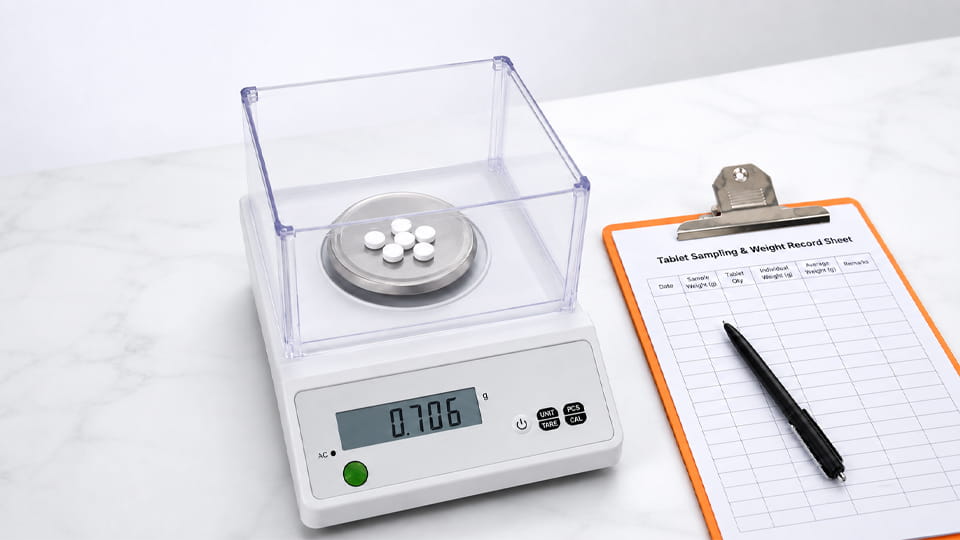

In tablet production, you may see a batch with very tight tablet weight variation, yet the laboratory results show a content uniformity problem. How can tablet weight look consistent while the amount of API in individual tablets still varies?
The answer becomes especially important for low-dose tablets. When a tablet contains only a few milligrams of API, even a small change in API distribution can create a relatively large difference in dose, while the total tablet weight remains almost unchanged. In other words, consistent tablet weight does not automatically mean consistent API content.
This is where the difference between content uniformity and weight variation matters. In this article, we’ll look at how the two are evaluated, why low-dose formulations are more sensitive to blending and segregation problems, and how feeding, die filling, and tablet press settings can affect the result. We’ll also cover USP <905> requirements and practical troubleshooting steps for the common situation of normal tablet weight but failed content uniformity.
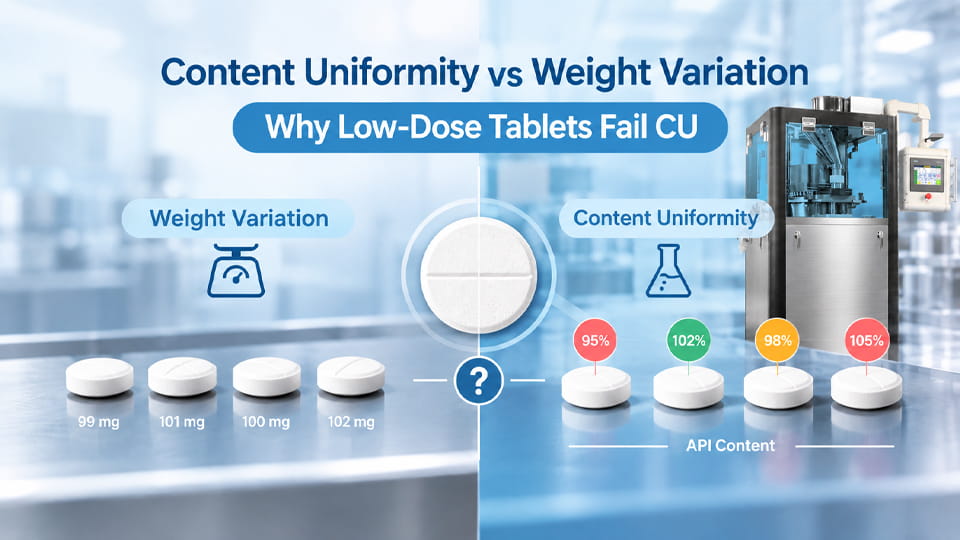
Tablet Weight Variation and Content Uniformity are two quality tests in tablet manufacturing, but they measure different things:
Put simply, weight variation checks mass consistency, while content uniformity checks drug dose consistency. For high-dose tablets (where the API makes up most of the weight), the two tests often align. But for low-dose tablets, you can have identical weights with very different API amounts.
| Test | What It Measures | When It’s Used |
|---|---|---|
| Weight Variation | Uniformity of total tablet mass | Used for high-dose or large tablets (per USP limits) |
| Content Uniformity | Uniformity of API content per tablet | Required for low-dose or potent drugs (API <25 mg or <25% of tablet mass) |
As the table shows, the key difference is what is being measured. Pharmacopoeias (USP, Ph.Eur., etc.) generally allow weight variation testing only when the API is high enough (≥25 mg and ≥25% of tablet weight); otherwise content uniformity testing is mandatory. In practice, this means many low-dose or potent formulations must undergo CUT.
The Weight Variation Test (also called “Uniformity of Weight”) simply verifies that the tablet-to-tablet weight differences fall within a strict range (for example, ±5% for tablets >324 mg). Weigh a sample of tablets (usually 20), calculate the average, and confirm that no more than 2 tablets deviate beyond the limit. If they do, or one tablet deviates by more than 2× the limit, the batch fails.
Weight variation is a quick in-process check on the compression process and feeder system. The assumption is: if every tablet weighs nearly the same, and the blend is uniform, then each tablet should contain the same API mass. This holds for high-dose tablets where the API is a large fraction. But it does not directly measure drug content. In other words, WVT is an indirect proxy for dose consistency, relying on the blend being well-mixed.
In contrast, the Content Uniformity Test (USP 905) directly measures how much API is in each tablet. A set (typically 10) of tablets are individually tested (e.g. HPLC assay), and each result is compared to the label claim. USP <905> allows each tablet’s content to be 85–115% of label and the batch to meet a statistical acceptance value (AV) that depends on mean and variability.
Content uniformity is the true test of dose accuracy. It catches any uneven API distribution that weight alone would miss. By definition, it is more sensitive for low-dose drugs. In practice, if a low-dose tablet “passes” weight variation but fails the assay, the batch is still non-compliant. USP and ICH guidance require strict CUT for these cases.

Figure: Weight variation evaluates dosage-unit mass, while content uniformity directly evaluates the drug substance content of individual units. Identical tablet weights can still hide differences in API content when the API is not uniformly distributed.. (Example: two 100 mg tablets both weighing 100 mg may have 1 mg vs 3 mg API.)
The heart of the problem is simple math and physics: small absolute API differences are huge percentage differences when the dose is tiny. A tiny variation in the blend can become a large variation in dose.
For example, imagine a 100 mg tablet formulated to contain 2 mg of API (2% of total weight). If one tablet happens to grab 1.8 mg of API and another 2.2 mg, they’re still within ±2 mg of the 100 mg weight (±2%). The weight variation test (±5% allowed) sees no problem. But in dosage terms, one tablet is at 90% of label (1.8 mg vs 2.0 mg) and another at 110% (2.2 mg). That could easily fail CUT acceptance (especially if any single tablet falls outside 85–115%).
| Tablet | Weight (mg) | Actual API (mg) | Percent of Label |
|---|---|---|---|
| A | 100 | 1.8 | 90% |
| B | 100 | 2.2 | 110% |
In this illustration, both tablets pass weight variation (100 mg each), but the API content ranges from 90% to 110% of target. If a tablet’s content fell below 85% or above 115%, the batch fails CUT. This discrepancy happens because the API is a tiny fraction of the tablet. Even small absolute fluctuations in how the API is dispersed (due to blend heterogeneity or segregation) lead to large percent errors in dose.
In contrast, if the API were 50 mg per tablet (50% of weight), a 0.4 mg shift is only <1% weight change – insignificant in both weight and content tests. But at 2 mg, that same 0.2 mg shift becomes 10% of dose. This is why consistent weight alone cannot guarantee dose uniformity in low-dose tablets.

Regulatory guidelines spell out when each test is allowed. Under USP <905> (Uniformity of Dosage Units), a tablet may use the simpler Weight Variation test only if the API dosage is both at least 25 mg and at least 25% of the tablet mass (for uncoated or thinly coated tablets). If either condition isn’t met (e.g. a 10 mg API in a 200 mg tablet is only 5% API), content uniformity testing is required.
In practice, most low-dose tablets fall into the Content Uniformity regime. Under USP rules, you would assay a sample of 10 tablets and calculate the acceptance value (AV). Briefly, AV = |M − X̄| + k·RSD, where M is target (usually 100%) and X̄/RSD are the mean and relative standard deviation of the assays. The USP cutoffs are typically equivalent to each tablet being 85–115% of label and the AV ≤ 15 (this ensures ≤6% RSD if all tablets are within 85–115%).
Key point: If your tablet’s API is below the 25 mg/25% thresholds, you cannot rely on weight variation alone. Even if you’re not strictly under 25% by weight, extremely low-dose APIs or potent actives (like hormones) usually require CU testing. Many companies also choose CU for sustained-release or narrow therapeutic index drugs.
When content uniformity fails while weight seems fine, it usually traces back to mixing and material handling issues. Common culprits include:
In short, any stage that upsets the uniform mix – blending, transferring, feeding – risks content uniformity. Low-dose formulations don’t tolerate even small errors. (For example, the FDA emphasizes that “adequacy of mixing to assure uniformity and homogeneity” must be part of process controls.) Addressing these root causes usually means revisiting formulation design and process steps.

The choice and setup of the tablet press itself is critical, especially for low-dose products. Key press-related factors include:
In practice, one of the best preventive measures is selecting a tablet forming machine and tooling suited for powders with segregation risk. For example, rotary tablet presses with adjustable force-feeders and stepless speed controls give you more leverage. Our Tablet Press Machine can output up to 950,000 tablets/hour while maintaining precision filling. It supports high-speed operation but also allows customization (molds, feeder configuration, speed syncing) for difficult formulations. When troubleshooting CU issues, inspecting the press setup – feeder adjustment, paddle condition, die cleanliness – is essential.

If your batch shows normal weight distribution but poor CU assay results, a targeted investigation can identify the weak link. Here’s a troubleshooting outline:
Use a table like below for clarity:
| Indicator / Symptom | Possible Cause | Check / Action |
| CU fail, WV pass | Inhomogeneous mix (segregation) | Test blend uniformity; re-mix or re-process blend |
| CU drifting (start vs end) | API settling in hopper/feed frame | Sample tablets along run; mix/hopper refill frequency |
| Occasional outlier tablets | Lumps or hopper blockages | Inspect feed system; clean hopper walls; re-sieve blend |
| High tablet-to-tablet variability | Feeder/residence time mismatch | Slow press; adjust feeder paddle speed; check turret balance |
| Good blending but CU still off | API sticking to punch/die, or assay error | Clean tooling; verify assay accuracy; consider adsorption issues |
By systematically isolating variables, you can usually find whether it’s a formulation issue (blend) or a machine/feed issue. Sometimes the fix is as simple as running the tablet press slower or adding an extra mixing step.
Preventing CU failures starts in development. Here are proven strategies:
The general motto is: “blend it right or batch it wrong.” Investing time to optimize the mix and feeder settings during development can save a batch from failing in QC.
To stay on track, here is a quick checklist for each stage of low-dose tablet production:
Following this checklist helps catch problems before they escalate into failed batches.
Not all tablet presses are built the same. For low-dose products, look for these features:
Before purchasing or upgrading a tablet machine, conduct material trials. Jinlu Packing, for example, offers trial runs with customer’s actual powders. We simulate production on a demo press to optimize the feeder settings, paddle configuration, and turret speed for your formulation. This hands-on approach often identifies and resolves segregation issues early.
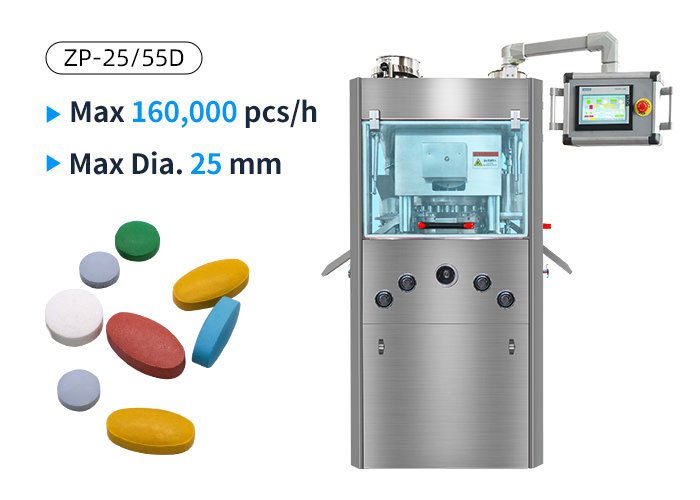
When writing a procurement spec, mention the phrases “rotary tablet press machine,” “force feeder,” and “automatic tablet press machine” to find machines with these capabilities. (For instance, see our Tablet Press Machine which is designed to handle a wide range of formulations with precision and high throughput.)
In low-dose tablet manufacturing, “close enough” on weight is not good enough on dose. A batch can look perfect by weight specs yet be unsafe by content. The key is recognizing that weight variation and content uniformity are different quality checks. Industry regulations (USP, FDA) make clear: when the drug amount is small, you must test the drug itself in each tablet.
To avoid “surprises” in QC, address uniformity from the start: optimize blending, minimize segregation, and use the right equipment. Equip your rotary press with a good feeder, tune the process, and always confirm with assays. By understanding the root causes and following best practices, manufacturers can confidently produce low-dose tablets that pass both weight and content tests. For manufacturers facing these challenges, our high-performance tablet presses and technical support are ready to help. Contact Jinlu Packing for custom solutions that ensure your low-dose tablet formulations meet all quality standards.
Weight variation checks that each tablet has nearly the same total weight, assuming even mixing. Content uniformity actually measures the drug amount in each tablet. So even if weights match, API content can vary if the blend isn’t perfectly uniform.
Yes. Especially in low-dose tablets, two tablets might weigh the same but contain different API amounts. Weight variation passing means the tablet masses are consistent, not that the drug dose is consistent.
For low-dose or potent drugs, a tiny difference in ingredient distribution can cause large percent dose errors. Content uniformity ensures dose accuracy for patient safety, which weight checks alone can miss.
Generally when the API dose per tablet is below 25 mg or constitutes less than 25% of tablet weight. In those cases, USP requires a content uniformity assay; weight variation cannot be substituted.
Common causes include inadequate mixing, segregation of the blend (during hopper discharge or feeding), differences in particle size or density, and inconsistent die filling. Any step that disturbs the even API distribution can lead to poor CU.
Segregation can separate API from excipients (e.g. fines drifting away from coarse granules). As a result, some dies may over-fill or under-fill with API, causing some tablets to have too much drug and others too little.
Only in high-dose tablets where the API is most of the tablet. For low-dose products, weight variation is not a reliable predictor of content uniformity. It’s possible to have perfect weights and still fail content tests.
Strategies include optimizing the formulation (granulation, excipient choice), improving blending and material handling (minimize segregation), and fine-tuning press settings (force-feeder, slower speeds). In-process controls and diligent testing also help catch issues early.
Yes, run too fast and powder may not fill the die uniformly, especially for poor-flow mixes. Slower speeds (or a well-coordinated feed system) improve fill consistency. Modern presses allow adjusting speed and feed independently to optimize uniformity.
Automatic or high-end presses can help by maintaining tight control of feed and weight, but they can’t guarantee CU if the blend is bad. Good equipment (like a rotary press with forced feeding) is necessary but must be paired with a good formulation and process controls.
References:
1.Risk-Based Blend and Content Uniformity Assessment: A Case Study —— U.S. Food and Drug Administration
2.§ 211.110 Sampling and testing of in-process materials and drug products. —— eCFR
3.Blend Uniformity and Content Uniformity in Oral Solid Dosage Manufacturing: an IQ Consortium Industry Position Paper —— PubMed
4.Blend Segregation in Tablets Manufacturing and Its Effect on Drug Content Uniformity-A Review —— PubMed
5.Improving the content uniformity of a low-dose tablet formulation through roller compaction optimization —— PubMed