
Granulation is a key step in tablet manufacturing that transforms fine powders into larger, uniform granules. Without granulation, many powders (APIs and excipients) have poor flowability and compressibility, leading to problems like segregation, uneven die filling, and weak tablets. In practice, most formulations cannot be directly compressed because raw powders tend to be too fine and inconsistent. Granulation (wet or dry) improves powder flow, dust control, blend uniformity and binding, which in turn yields tablets of consistent weight, hardness and active distribution. Although direct compression is simpler (fewer steps, lower cost), it demands exceptional raw-material properties. This article explains why granulation is usually needed before tableting, covers the benefits and trade-offs of wet vs dry granulation, and offers practical guidance on selecting the right process.
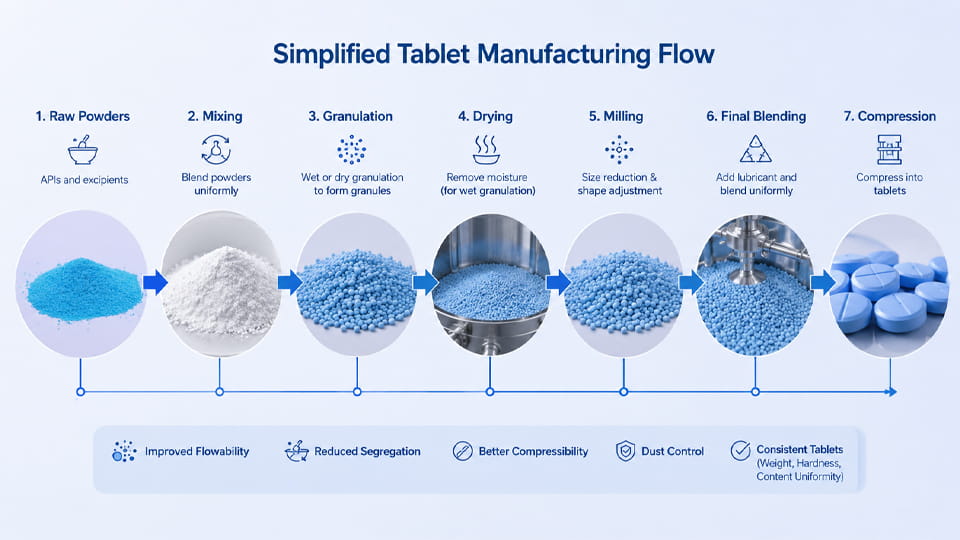
Figure: Simplified tablet manufacturing flowchart. Raw powders + excipients are mixed, granulated (wet or dry), dried (if wet), milled, blended with lubricant, then compressed into tablets.
Granulation is a particle-engineering process that “transforms fine powders into larger, uniform particles called granules”. In pharmaceutical manufacturing, granulation (wet or dry) is used to agglomerate powders into granules with better flowability, compressibility, and uniformity. For example, a high-shear mixer granulator (wet granulator) adds binder solution to the powder, forming a damp mass, which is then dried (commonly in a fluid-bed dryer) and milled into granules. Alternatively, dry granulation uses mechanical pressure (roller compaction or slugging) to compress and break the powder into granules.
Both wet and dry granulation aim to produce granules that are dense, free-flowing and homogeneous. These granules feed into the tablet press more reliably than loose powder. Granules also generate less dust and tend to compress into stronger tablets. In short, granulation is a critical step to ensure tablets meet quality attributes (uniform weight, strength, dose accuracy) when raw powders alone are not ideal for direct tableting.
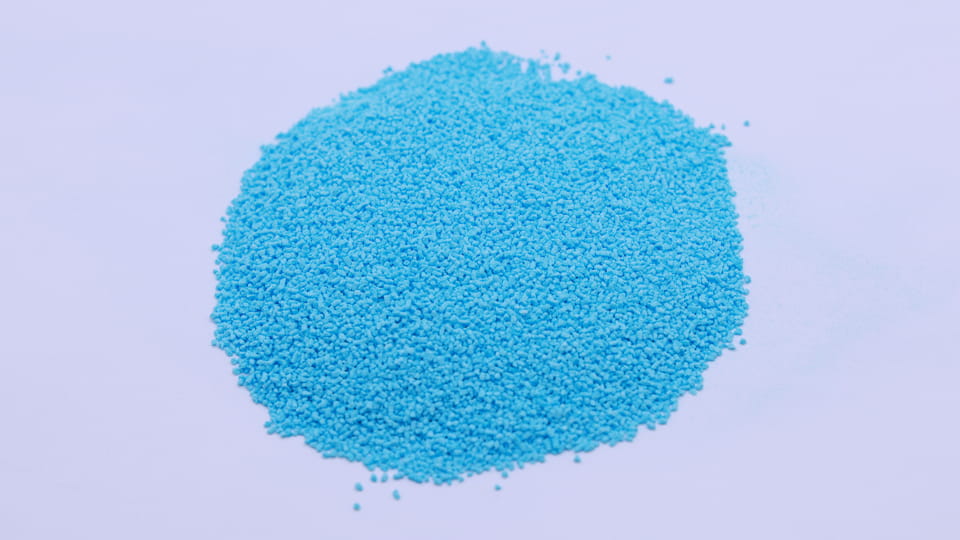
Theoretically yes (for some formulations): Certain APIs and excipients (e.g. microcrystalline cellulose, spray-dried lactose) have excellent inherent flowability and compressibility. These rare formulations can be direct-compression (DC) tableted without prior granulation. Direct compression is the simplest route: blend powders + lubricant, then feed directly into a tablet press. It avoids extra equipment and steps (no drying), saving time and cost.
But in practice, most powders cannot: Most small-molecule APIs are very fine and cohesive, with poor flow and compression properties. If powders fail to flow smoothly, the die cavity will underfill or overfill, causing tablet weight variation. If powders don’t compress well, tablets will be soft, capping or breaking. Small doses (few mg APIs) mixed with large excipient volumes often suffer segregation (fine API separates from coarse carrier). In short, except for highly specialized direct-compression excipients, most pharmaceutical blends need granulation to fix flow/compressibility issues.
Direct compression is only viable when the blend already has very good flow and compaction. For instance, binary mixtures of very free-flowing excipients with a high-dose tablet may work. Direct compression is also chosen for drugs that are extremely heat- or moisture-sensitive, since it skips wetting and drying steps. However, this demands careful excipient selection (e.g., direct-compression lactose, MCC, co-processed excipients) and often custom formulations.
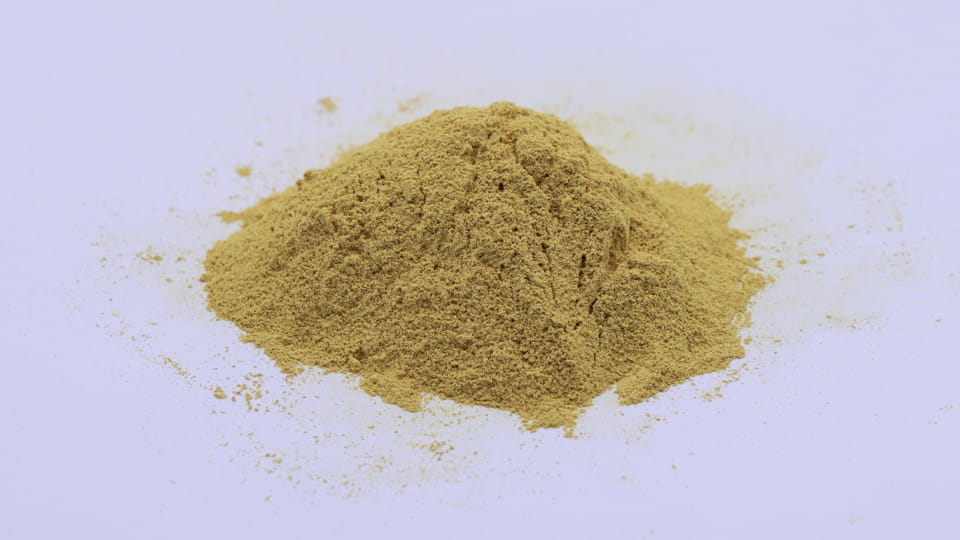
In summary, granulation solves the major flow/compression challenges of raw powders. Without it, tablets would have unacceptable variation in weight, hardness and dose. The trade-off is extra steps (mixing, drying, milling), but for most pharmaceutical products, granulation is the reliable way to guarantee product quality.
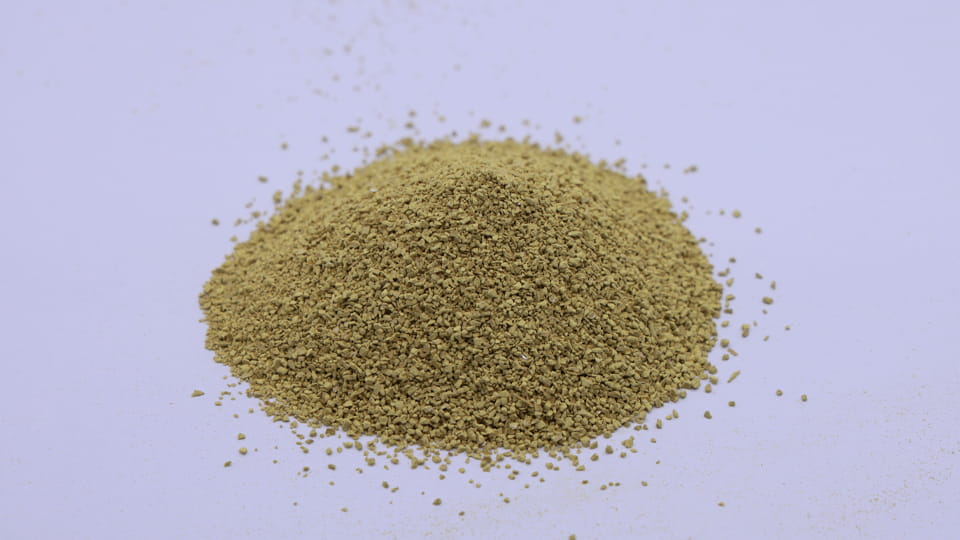
Direct compression (DC) is the simplest, most cost-efficient tablet process, and it is preferred when it will work. DC minimizes steps (only mixing and compaction), requires less equipment (blender + press) and avoids drying. It’s the go-to method if the API and excipients are already very free-flowing, highly compressible, and blend uniformly. Highly soluble excipients like lactose or spray-dried sugar alcohols, combined with a high-dose API, often allow DC. It’s also chosen for moisture/heat-sensitive drugs that would degrade in a wet process.
However, meeting those material requirements is challenging. Excipients for DC must be “critically” selected to exhibit excellent flow and compressibility. If those conditions aren’t met, DC tablets suffer from weight variation and low strength. Thus, DC is really only suitable for about 10–20% of formulations; most require the engineering step of granulation.
Advantages of direct compression: fewer unit operations, lower capital/equipment cost, no drying step (saves time/energy), and the simplest validation. It’s also often used in fixed-dose combination products with a high fraction of directly compressible fillers. But for any blend with poor flow or segregation risk, granulation is usually unavoidable.
Both routes can make tablets, but they differ widely in complexity and performance. The table below summarizes key differences:
| Parameter | Direct Compression (DC) | Granulation (Wet/Dry) |
| Process complexity | Low (mix-blend then press) | Higher (mix, granulate, dry, mill, then press) |
| Equipment | Blender, tablet press | High-shear granulator or compactor, dryer, mill, tablet press |
| Flowability requirements | Must be excellent | Granulation improves flow markedly |
| Compressibility | Limited by raw powder properties | Enhanced by granule binding |
| Content uniformity | Harder to achieve (segregation risk) | Better (segregation minimized) |
| Dust generation | High (fine powders) | Low (granules, less fines) |
| Suitable for most APIs | No (few exceptions) | Yes (broad range, esp. poor-flow APIs) |
| Tablet quality | Moderate (depends on formulation) | High (consistent weight, strength) |
Overall, granulation is more complex and costly, but it delivers superior powder properties. DC is lean and cost-effective, but only when raw materials inherently meet strict criteria.
Once granulation is needed, the next question is wet vs dry. Each has pros and cons.


Choosing wet vs dry: If your API can handle moisture/heat and the product demands top-notch uniformity, wet granulation is preferred. If energy and capital are limited or the drug is sensitive, dry granulation is attractive. In practice, wet granulation is most common for traditional tablets, while dry granulation is used for specific cases (e.g. metformin, aspirin).
Key equipment in the tablet-making line aligns with the chosen process. For wet granulation, a high-shear mixer granulator (wet granulator machine) is used to mix powder and binder, followed by a fluid-bed dryer to dry the granules. For dry granulation, a roller compactor (dry granulator machine) is used to compact the powder into ribbons. The granules (from wet or dry) are then milled if needed and finally fed into a rotary tablet press, which compresses them into tablets. After compression, tablets may go to a tablet coater or packaging machine.
| Equipment (Jinlu example) | Primary Function |
| High-Shear Mixer Granulator | Mixes powders and liquid binder to form wet granules. (Wet granulation) |
| Fluid Bed Dryer | Dries wet granules uniformly (often after high-shear mixing). |
| Roller Compactor (Dry Granulator) | Compacts powder into ribbons or slugs for dry granulation. |
| Rotary Tablet Press | Compresses powder or granules into tablets at high speed. |
Each of the above is available from Jinlu Packing (see High-shear Mixer Granulator, Roller Compactor (Dry Granulator), and Rotary Tablet Press Machine in our product catalog).
Signs a Formula Needs Granulation: If you notice problems like inconsistent weight, dusting of the powder, tablet capping, or segregated blends during trials, granulation is likely needed. For example, if blending the API with excipient yields a very fluffy, light mixture, it often won’t compress well. Also, very low-dose APIs (<<50 mg) typically require granulation to ensure uniform distribution. In short, if any bulk property (flow, density) is poor in a feasibility mix, plan to granulate.
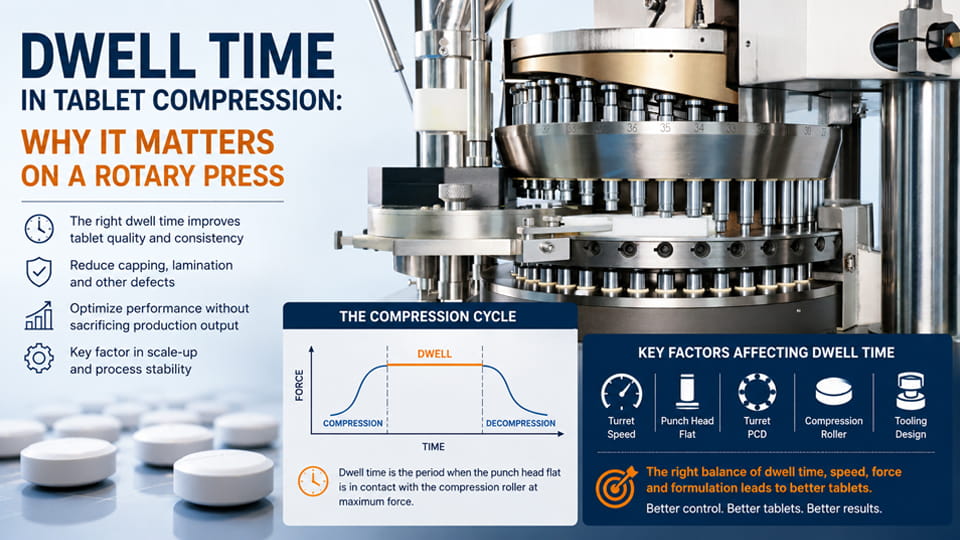
Tips to Improve Flowability/Compressibility: In addition to granulation, formulators can try: size engineering (milling or coarser grades to avoid excessive fines), glidants (e.g. 0.5–2% colloidal silica or talc added just before tableting to reduce friction), or lubricants (magnesium stearate) judiciously. Sometimes spray drying or using spherical agglomerates can help. Reducing moisture content and controlling humidity also prevents clumping. Proper mixer design (e.g. vacuum feeding) can mitigate dust. Finally, optimizing tablet press parameters (fill depth, dwell time) helps compensate for marginal flow.
Production at High Speed: On a modern rotary press, even small flow issues cause weight drift. Real-time weight feedback and frequent calibration become essential. High-speed machines often use twin-stage compression (pre-compression roll) and paddle-type feeders to improve fill consistency. If you must tablet a poorly flowing powder, consider upgrading to a machine with forced feeders or twin filling cams. Always validate that content uniformity holds at full speed. A well-granulated feed drastically simplifies high-speed runs – granules maintain consistent filling even at 200,000 tablets per hour.
In summary, “granulation before tableting” is needed because most APIs and excipients cannot be directly pressed into quality tablets. Granulation fixes fundamental powder issues – flow, dust, segregation and compressibility – that raw powders cannot handle. While direct compression has its place for very specialized formulations, the granulation step provides insurance for consistent tablet quality. By choosing the appropriate granulation technique (wet vs. dry) and optimizing process parameters, manufacturers ensure tablets meet all specifications (uniform weight, hardness, dissolution) at the required scale. Granulation is not just an extra expense – it’s the key to reliable, high-speed tablet production.
Whether you are building a new tablet production line, upgrading existing equipment, or evaluating the best process for a specific formulation, selecting the right granulation technology is an important decision.
At Jinlu Packing, we help pharmaceutical manufacturers, nutraceutical producers, and contract manufacturing organizations (CMOs) choose suitable solutions for wet granulation, dry granulation, tablet compression, coating, and packaging. Our engineering team can provide practical recommendations based on your production capacity, formulation characteristics, GMP requirements, and automation goals.Send us your User Requirement Specification (URS), production targets, or product details, and we’ll help you identify the most suitable granulation and tablet manufacturing solution for your project.
Granulation before tableting is used to improve powder flowability, compressibility, and content uniformity. Fine powders often do not flow consistently into the tablet press die, which can result in weight variation, poor tablet hardness, and manufacturing defects. By converting powders into uniform granules, manufacturers can achieve more stable and efficient tablet production.
Yes, some formulations can be compressed directly without granulation. This process is known as direct compression. However, direct compression only works when the active pharmaceutical ingredient (API) and excipients have excellent flowability and compressibility. Many pharmaceutical powders require granulation to achieve consistent tablet quality.
The main benefits include:
• Improved powder flowability
• Better compressibility
• Reduced ingredient segregation
• Improved content uniformity
• Lower dust generation
• Enhanced tablet hardness
• Higher production efficiency
These advantages help manufacturers produce tablets with consistent quality and fewer production issues.
Poor flowability can cause inconsistent die filling during compression. As a result, tablets may have varying weights, inconsistent drug content, and higher rejection rates. Poor powder flow can also reduce tablet press efficiency and increase downtime.
Granulation involves converting powders into granules before compression, while direct compression skips the granulation step and compresses the blended powder directly.
Granulation generally provides better flowability, compressibility, and content uniformity, whereas direct compression offers a simpler and more cost-effective process when the formulation is suitable.
Wet granulation is typically used when powders have poor flow characteristics, poor compressibility, or a tendency to segregate. It is also commonly selected when manufacturers need to improve tablet hardness and content uniformity. Wet granulation is one of the most widely used methods in pharmaceutical tablet production.
Dry granulation is preferred for formulations that are sensitive to heat or moisture. Since no liquid binder is used, it helps protect moisture-sensitive or thermally unstable APIs while still improving powder flowability and compressibility.
Yes. Granulation can improve particle bonding during compression, resulting in stronger tablets with better mechanical integrity. Properly granulated materials often produce tablets with higher hardness and lower friability while reducing defects such as capping and lamination.
Granulation helps distribute the API more evenly throughout the formulation and reduces segregation during handling and transportation. This is especially important for low-dose formulations, where even small variations in API distribution can affect product quality and regulatory compliance.
Common pharmaceutical granulation equipment includes:
• High Shear Mixer Granulators
• Fluid Bed Granulators
• Roller Compactors
• Oscillating Granulators
• Fluid Bed Dryers
The choice of equipment depends on the formulation characteristics, production scale, and whether wet granulation or dry granulation is required.
References:
1.Q7A Good Manufacturing Practice Guidance for Active Pharmaceutical Ingredients —— U.S. Food and Drug Administration
2.Annex 2 WHO good manufacturing practices for pharmaceutical products: main principles —— WHO
3.A critical review on granulation of pharmaceuticals and excipients: Principle, analysis and typical applications —— ScienceDirect
4.Direct Compression Versus Granulation —— www.pharmtech.com
5.A compressibility and compactibility study of real tableting mixtures: The impact of wet and dry granulation versus a direct tableting mixture —— ScienceDirect
6.Influence of granulation and compression process variables on flow rate of granules and on tablet properties, with special reference to weight variation —— ScienceDirect
7.Particle Engineering of Excipients for Direct Compression: Understanding the Role of Material Properties —— National Library of Medicine