

Pharmaceutical capsules can be surprisingly delicate. Even a tiny bit of moisture or light can ruin their potency long before the expiration date. A humidity swing in storage, a sunny window on the shelf, or a leaky seal on the pack can cause gelatin or HPMC capsule shells to harden or soften unexpectedly, altering release or bioavailability. Oryginalne notatki Jinlu, “even small amounts of humidity can compromise product stability, reduce efficacy, and shorten shelf life long before visible signs of damage appear.”. Innymi słowy, moisture control isn’t just a packaging issue – it’s a core quality requirement.
For manufacturers and packagers, the key questions are: How sensitive is the capsule product? Does it need an ultra-high barrier pack (like Alu-Alu foil), or is a standard PVC blister sufficient? Do we add desiccants in the bottle, or rely on the film alone? And crucially, how will we test stability to ensure the chosen pack actually works? In this guide we walk through each step of the decision process, covering barrier materials, desiccant use, ochrona przed światłem, and stability testing. Our goal is to give you a practical roadmap – from risk assessment to packaging equipment – so you can confidently protect moisture- or light-sensitive capsules and meet both regulatory and production needs.
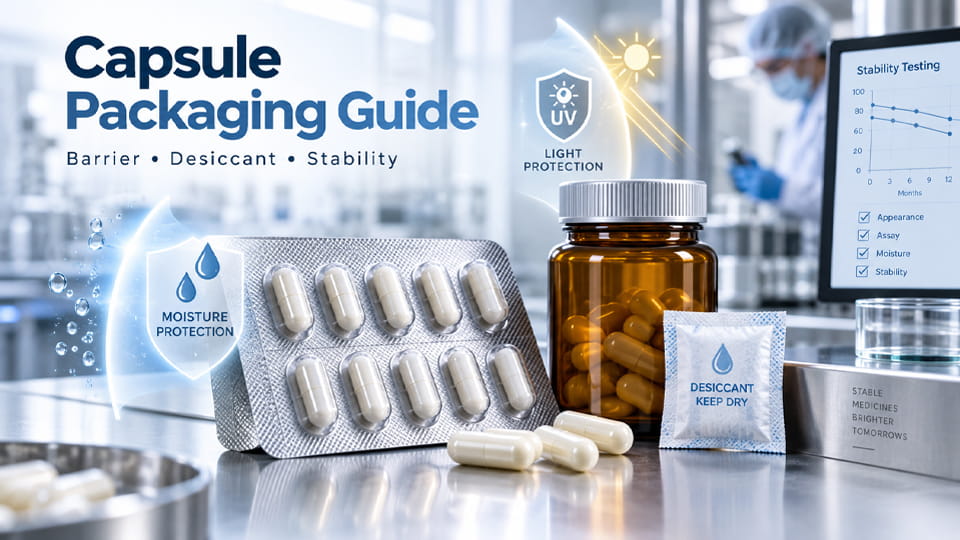
Capsule formulations are often sensitive to environmental factors. Moisture can cause tablet and capsule shells to absorb water, making them swell, soften or even crack. Jak zauważa jeden z przewodników branżowych, “pills can soften, Otoczki kapsułek mogą wchłaniać wilgoć, and many medications may become unstable before their expiration date if the packaging fails to function properly.” A humid environment can trigger chemical breakdown of the active ingredients. Światło (especially UV) can also trigger photodegradation of certain Pszczoła. Proper packaging acts like a protective shield: it keeps humidity and oxygen at bay and blocks damaging light. Na przykład, amber glass provides excellent UV protection, and aluminum foil-based packs block nearly all light. The choice of barrier material depends on the capsule type (Żelatyna, HPMC, miękki żel), the fill properties (dry powder vs oily liquid), and the intended shelf-life.
Otoczki kapsułek (żelatyna lub HPMC) and their drug fills react to humidity. In dry air, kapsułki lose moisture and become brittle; in humid air, Oni swell and stick. Na przykład, a hygroscopic powder inside a gelatin shell can draw water from the shell until the shell’s moisture drops below normal, causing cracks. Odwrotnie, high humidity softens the shell and may cause caps and bodies to deform or stick during filling. Osłonki żelatynowe (13–16% initial moisture) are particularly sensitive, whereas HPMC or pullulan shells start at 3–8% moisture and tolerate humidity swings better. W rzeczywistości, we limit humidity shifts in storage (USP notes gelatin, HPMC and pullulan all contain water) and use barrier packaging to maintain equilibrium.
Many drugs degrade under UV or even visible light. Light can oxidize actives or fade dyes, so “light-sensitive” APIs (like some vitamins, steroids or dyes) demand light-blocking packaging. Wytyczne regulacyjne (ICH Q1B) calls for photostability testing of the finished product. W prostych słowach, if a drug is known to be photolabile, put it in an amber or opaque container. Na przykład, amber PET or glass bottles filter out much of the UV/blue spectrum. Aluminum-based packaging (blister foil or foil pouches) blocks essentially all light. When evaluating risk, ask “will light exposure shorten shelf life?Jeśli tak, always use opaque or foil barrier packaging.
Before selecting packaging, assess the key risks:
Also define your shelf-life and storage conditions. Na przykład, if you aim for 24 months at 25°C/60%RH, you may need a tighter barrier than for a 12-month stability under controlled humidity. Pamiętać, regulatory guidance (Mam pytanie 1A(R2)) requires stability testing on the final packaged produkt. So choose packaging that can demonstrably maintain your intended label claim.
To compare options, here’s a Packaging Materials Comparison (values approximate):
| Tworzywo | Typical Barrier (WVTR/OTR) | Plusy | Wady | Use Case (trwałość) | Cost/Notes |
| PVC Film (250 μm) | WVTR ≈ 3.0 g/m²/day; OTR ≈ 20 mL/m²/day | – Bardzo niski koszt<br>- Jasne (good visibility)<br>- Łatwe termoformowanie | – Moderate moisture/oxygen barrier<br>- Fails in high humidity<br>- Shorter shelf-life (<1yr) | Stable pills, Produkty OTC, short-term drugs | Niski |
| PVC/PVDC Laminate | WVTR ≈ 0.25–0.65 g/m²/day; OTR ≈ 0.1–1 mL/m²/day | – High moisture/oxygen barrier<br>- Clear appearance<br>- Widely approved | – Higher cost than PVC<br>- Heavier multilayer<br>- Requires careful forming (PVDC layer) | Moisture-sensitive capsules (np. shelf-life 2–3yr) | Średni |
| PCTFE (Aklar) Film | WVTR ≈ 0.1 g/m²/day (very low); OTR ~ 0 | – Ultra-high moisture barrier (almost foil-like)<br>- Inert, przezroczysty | – Very high cost<br>- Proprietary film (limited supply)<br>- Wymaga specjalnego sprzętu | Extremely hygroscopic or sterile products (szczepionki, zastrzyki) | Wysoki |
| Aluminum/Alu-Alu | WVTR ≈ 0; OTR ≈ 0 (essentially impermeable) | – Ultimate barrier against moisture/light/oxygen<br>- Relatively cheap foil material | – Całkowicie nieprzezroczysty (no product visibility)<br>- Requires specialized blister tooling | Highly sensitive products, short-term moist hatches | Wysoki (foil heavy) |
| Alu-PVC Blister | Barrier similar to PVDC (foil blocks moisture) | – Excellent light and moisture barrier (via foil)<br>- Moderate cost vs full foil | – No transparency (foil lid)<br>- Heavy, needs thermoformer | Moisture/light-sensitive unit doses (np. high-end Rx) | Medium-High |
| HDPE Bottle | WVTR moderate (~1–3 g/m²/day); OTR moderate (~2 mL/m²/day) | – Bardzo niski koszt<br>- FDA-approved, obojętny<br>- Wytrzymały, Rozbij się | – Only moderate barrier<br>- Moisture ingress over time<br>- Relies on cap seal quality | Opakowanie zbiorcze (witaminy, OTC); use with desiccant for sensitive products | Niski |
| PET Bottle | WVTR moderate (better than HDPE); OTR better than HDPE | – Better clarity and rigidity than HDPE<br>- Better oxygen barrier | – More expensive than HDPE<br>- Still not adequate for very hygroscopic drugs | Nutraceutyki, stable medicines (often with oxygen absorber) | Średni |
| Amber Glass Bottle | WVTR = 0; OTR = 0 (glass is impermeable) | – Excellent moisture/oxygen barrier<br>- Amber glass blocks UV<br>- Chemicznie obojętny | – Heavy and fragile<br>- Wyższy koszt materiału<br>- No light inside (but partial benefit) | Light/moisture-sensitive or high-value products (hormony, antybiotyki) | Wysoki |
Notatki: A 250 μm PVC film has about 3.0 g/m²/day WVTR, whereas heavy PVC/PVDC laminates can drop below 0.3 g/m²/day. PCTFE (Aklar) liners are used precisely because they act as “moisture barriers in pharmaceutical blister packaging”. Aluminum foil packs (Alu-Alu) stop moisture completely, at the expense of visibility. Choose the material that meets your moisture, tlen, and light requirements at a reasonable cost.
A high-barrier package slows moisture ingress, but sometimes adding a desiccant packet is still useful. Osuszacze (silica gel, glina, itp.) actively absorb humidity in the container’s headspace. Use desiccant when:
Jednakże, desiccants must be sized by calculation, not guesswork. An oversized desiccant can over-dry the package and draw moisture out of the capsule shell, making it brittle. To determine capacity, estimate how much water can enter the package over time (using the package’s WVTR, ambient RH and shelf life) and choose a desiccant that absorbs that amount. Na przykład, combine product moisture sensitivity, packaging permeability and storage humidity to compute total grams of water ingress. Then pick silica gel or molecular sieves with that capacity.
Podsumowując: Barrier material and desiccant serve different roles. A strong barrier material blocks outside moisture; a desiccant “mop up” any moisture that does get in or was present at packing. Many capsule-bottle systems use one packet per bottle (sized to the headspace volume) as standard practice. But always validate with stability tests – if test batches show moisture creep, increase desiccant; if they show excessive drying, dial it back. Pamiętać, more desiccant is not always better.
Light-sensitive capsules present a somewhat different challenge. Tutaj, celem jest exclude light as much as possible. The packaging should prevent UV and visible light from reaching the product. Common strategies include:
ICH Q1B emphasizes testing samples under forced light exposure, ideally in the “immediate container or as marketed”. If results show significant photodegradation, stronger protection is needed. Na przykład, if testing shows that transparent blister is insufficient, the drug may need to be shipped in foil packets instead.
W rzeczywistości, make sure your packaging design explicitly addresses the light sensitivity. If you use an amber glass bottle, it’s wise to still include a warning label like “Protect from light” and perhaps ship inside a box. Jeśli używasz pęcherzy, an Alu-Alu version automatically solves the problem.
When writing stability protocols, remember to include photostability testing under normal and intense light. Often this means comparing the drug stored in clear vs. tinted packaging. The results will guide whether your chosen pack is adequate or if additional filtering measures are needed.
You must validate your packaging with stability studies in the final container. Per ICH Q1A(R2), this typically means long-term testing at 25°C/60%RH (12–24+ months) and accelerated at 40°C/75%RH (6 miesiące). For light-sensitive products, add a photostability arm as described above. At each timepoint, examine:
Below is an example stability matrix for 4 packaging options. Adjust storage times to match your intended shelf-life.
| Packaging Option | Long-term (25°C/60% wilgotności względnej, 24 mo) | Accelerated (40°C/75% wilgotności względnej, 6 mo) | Photostability (1.2M lux+UV) | Key Endpoints |
| Blister Alu-Alu | Minimal moisture ingress expected; likely no disintegration issues | High stress: verify very low moisture uptake | Tak (since package is opaque) | Assay (%API), zawartość wilgoci, rozpuszczenie, shell integrity |
| PVC/PVDC Blister | Some moisture uptake possible if seal imperfect; monitor accordingly | Check moisture gain, potential potency loss | Tak (film is clear) | Assay, zawartość wilgoci, twardość, wygląd |
| HDPE Bottle + Środek osuszający | Monitor that desiccant is not saturated; measure residual moisture and potency | Expect higher moisture ingress; evaluate desiccant efficacy | If amber/opaq., else yes | Assay, zawartość wilgoci (sponge loss), kruchość kapsułki |
| Nieprzejrzysty (Amber/PET) + Środek osuszający | Similar to HDPE+desic case; amber PET adds some oxygen barrier | Podobny; amber PET resists UV | Often skip (amber blocks UV) | Assay, zawartość wilgoci, rozpuszczenie, wygląd |
Interpretation: According to ICH Q1A, if accelerated conditions cause unacceptable degradation, the product will likely degrade somewhat at 25°C too, which might shorten shelf-life. Photostability failures indicate a need for more protection. Always aim that the final chosen pack passes all relevant tests.
Besides chemical assays, perform package integrity testing. Na pęcherze, you might do a vacuum decay or dye ingress test. Do butelek, test closures (np. check foil seals on caps). This confirms the container-closure system is intact.
All the foregoing decisions mean little unless your linia pakująca can reliably implement them. Here we touch on equipment considerations on a high level; for specifics, Jinlu’s solutions can supply the needed machinery.
For high-barrier blister packs (PCV/PVDC, PCTFE, or cold-form foil), potrzebujesz thermoforming or cold-form blister machine capable of handling the chosen material. Kluczowe punkty:
A linia do pakowania butelek for capsules typically includes: rozszyfrator, maszyna licząca (to drop capsules into bottles), wkładka wysuszona (jeśli jest używany), maszyna do zamykania, Uszczelniacz indukcyjny, etykietownik, itp. Things to consider:
Jinlu’s bottle line guide highlights these steps. A typical capsule line is fully automatic from unscrambling to capping. One supplier notes a counting-filling line “can be connected with bottle unscrambler, wkładka wysuszona, maszyna do zamykania, maszyna do zgrzewania folii aluminiowej i maszyna do etykietowania”, covering all the key functions. If you work with Jinlu or other OEMs, specify your barrier pack scheme so they can recommend the appropriate machines and configurations (Na przykład, recommending an induction sealer with a heated platen for Alu-Alu bottle lids, or a specialized track for sachet insertion).
No matter the format, seal integrity is non-negotiable do kontroli wilgoci. Modern lines often include automated leak detection. Na pęcherze, pressure decay or tracer dye tests might be done on samples. Do butelek, vacuum leak testers can inspect every bottle. Dodatkowo, jar vacuum sensors can detect an improperly sealed bottle at the induction sealer.
Package line QC is part of ensuring the barrier will perform as intended. Proper calibration of machines (np. temperatura uszczelniania, ciśnienie, czas przebywania) jest krytyczny. Jinlu's Maszyny pęcherzy, na przykład, allow precise control of oven zones to match PVDC film specs. Pracuj ze swoim pharmaceutical machine vendor to validate these settings during machine qualification.
Podsumowując, choose equipment that is designed for high-barrier packaging and capsule filling, and plan for inspection and control of sealing. With the right machines in place, you’ll reliably produce capsule packages that meet the stringent requirements of moisture- and light-sensitive formulations.
Below is a simplified decision flowchart for choosing packaging. It highlights the major considerations – adjust as needed for your product:
This flowchart captures key choices. If capsules are moisture- lub światłoczułe, lean toward the tightest barriers (np. aluminum blisters, amber bottles). If they are non-sensitive, simpler packaging (standard PVC blisters or HDPE bottles) can work. Also consider format: single-dose blisters vs multi-dose bottles. Wreszcie, always validate with stability studies and make the final selection based on empirical data.
Wilgoć- and light-sensitive capsules demand a data-driven packaging strategy. Start by understanding your product’s risks – quantify how humidity and light affect it. Then select a primary barrier (blister film or bottle/closure) at the level needed, and consider a desiccant if any moisture is likely to slip through. Krytycznie, validate your choice by stability testing the product in the actual final package. If the data show your capsules remain within spec through the desired shelf life, you’ve succeeded.
I zbieranie Jeinlu, we supply both the knowledge and the machines to achieve this. Our high-speed blister machines (including models for Alu-Alu packs) and capsule bottling lines (with desiccant inserters and induction sealers) are designed for sensitive formulations. We encourage you to leverage our experience: request a line trial or TŁUSZCZ, and examine real samples (testy integralności uszczelnienia, WVTR reports, itp.) for confidence before full production. Protecting your product’s stability is as much an art as a science, but with the right materials, sprzęt, i testowanie, you’ll ensure those capsules stay potent and effective through delivery to the patient. Skontaktuj się z Jinlu już dziś to discuss how our packaging solutions can meet your formulation’s unique needs.
Moisture-sensitive capsules should be packaged using high-barrier materials, such as PVC/PVDC, PCTFE, or Alu-Alu blisters, or properly sealed bottles with desiccants when needed. Controlled humidity during production and validated sealing conditions also help protect capsule stability.
The best moisture-sensitive capsule packaging depends on the formulation, wymagany okres trwałości, i warunki przechowywania. Alu-Alu blisters provide strong moisture protection, while high-barrier plastic blisters or sealed HDPE bottles with desiccants may also be suitable when supported by stability testing.
Alu-Alu blisters generally provide a stronger moisture barrier and opaque light protection than transparent PVC/PVDC blisters. Jednakże, PVC/PVDC may offer sufficient protection at a lower packaging cost. The final choice should be based on the product’s stability data and barrier requirements.
Nie zawsze. Desiccants help absorb moisture inside a sealed package, while barrier materials limit moisture entering from outside. A properly sealed high-barrier package may not require a desiccant, depending on the capsule formulation, initial moisture content, and shelf-life requirements.
Tak. Excessive drying can reduce the moisture content of gelatin capsule shells, making them brittle and more likely to crack. Manufacturers should determine desiccant type and capacity through moisture analysis and stability testing rather than simply adding more desiccant.
Light-sensitive capsules should be packaged in materials that limit exposure to damaging wavelengths, such as Alu-Alu blisters or suitable opaque bottles. Amber glass and protective cartons may also help, but their effectiveness should be confirmed through photostability testing.
Blister packs protect capsules individually, keeping unopened doses sealed after another capsule is removed. Bottles are practical for larger quantities and can accommodate desiccants, but repeated opening exposes the remaining capsules to ambient humidity. Both formats require stability evaluation.
Moisture barrier testing measures how much water vapor passes through packaging materials or systems. Package integrity testing checks for leaks or sealing defects. Both are important because even a high-barrier material cannot adequately protect capsules if the finished package has a defective seal.
Capsule stability is evaluated through accelerated and long-term studies using the proposed commercial packaging. Manufacturers monitor moisture content, wygląd, analiza, produkty degradacji, and dissolution as appropriate. Light-sensitive products may also require photostability testing under ICH Q1B.
Przed zakupem, test the machine with your actual capsules and selected packaging materials. Verify cavity dimensions, Karmienie kapsułki, temperatura uszczelniania, ciśnienie, czas przebywania, and package integrity. A factory acceptance test helps confirm machine performance but does not replace product stability studies.
Referencje:
1.Systemy zamykania pojemników do pakowania leków dla ludzi i produktów biologicznych —— NAS. Administracja Żywności i Leków
2.Testowanie stabilności nowych substancji i produktów leczniczych —— Mam pytanie 1A(R2)
3.Badanie stabilności aktywnych składników farmaceutycznych i gotowych produktów farmaceutycznych —— KTO
4.A study on gelatin capsule brittleness: moisture tranfer between the capsule shell and its content —— PubMed
5.Właściwości sorpcji i desorpcji wilgoci żelatyny, Kapsułki twarde HPMC i pullulan —— PubMed
6.Enhancing the Dissolution Stability of Hard Gelatin Capsules Using Activated Carbon as a Packaging Component —— ScienceDirect