Protein Powder Packing Machine: How to Choose the Right Equipment for Pouches, 瓶 & スティックパック
8月 28, 2026
コメントはありません
Packing protein powder efficiently is essential for supplement and food manufacturers. Whether you’re filling large tubs of whey protein for retail or tiny single-serve小袋for on-the-go customers, choosing the right包装機械makes all the difference. 自動化された protein powder packingline can dose, 埋める, and seal hundreds of containers per hour with consistent accuracy. このガイドでは, we’ll explain why high-speed machines are key to efficient powder packaging, compare the main packaging formats (瓶, ポーチ, スティックパック), and walk through the features to look for when selecting the right equipment. Think of this as your friendly “machinery overview” – what an operations manager or procurement engineer would ask when sourcing a newpowder packaging line.
Why Use an Automatic Packing Machine for Protein Powder?
Even small protein powder brands quickly outgrow hand-packing with scoops. An automatic packaging machine can dramatically boost production rates (頻繁 10× or morethan manual) while ensuring fill weights are spot-on. 例えば, fully integrated powder packaging lines can output on the order of200 1分あたりの単位, versus ~15 units when packed by hand. This slashes labor needs (often reducing workforce by 60–80%) and speeds up lines toward world-class productivity.
Beyond speed, automated machines improveconsistency and hygiene. With servo-controlledオーガーフィラー そして 重量チェッカー, every tub or pouch is filled within tight tolerance. This reduces giveaway (wasting extra powder) and customer complaints. Enclosed machines also keep powder contained, preventing contamination and messy cleanup. For dietary or pharmaceutical companies, ミーティング CGMPor FDA standards is vital – built-in dust extraction and sealed enclosures help maintain a clean-room environment. 要するに, for any reasonably sized protein powder producer, a packing machine is not a luxury but a necessity to scale up profitably and safely.
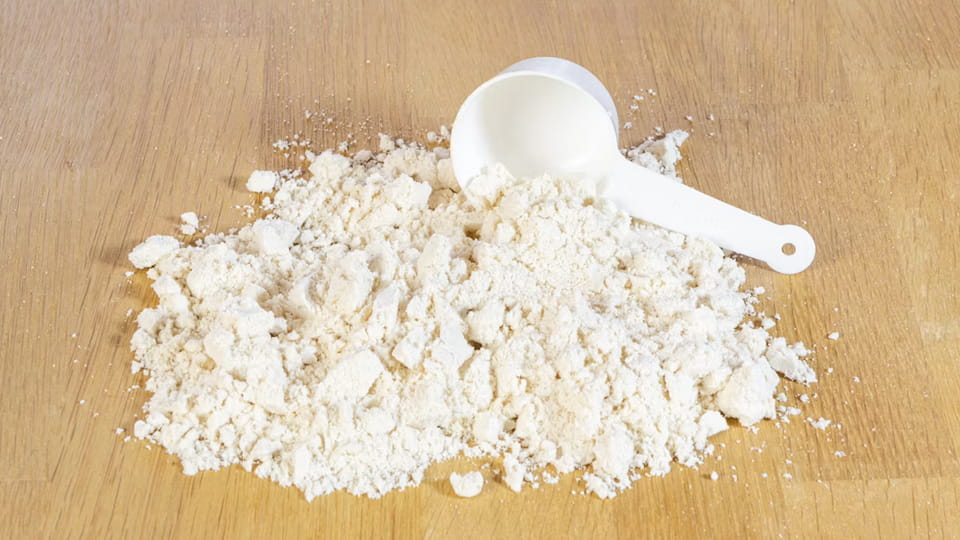
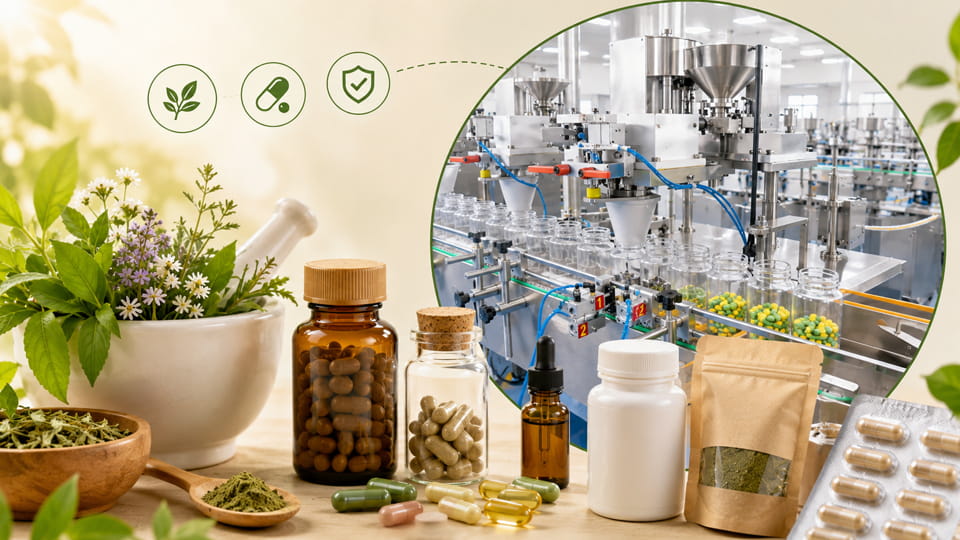
形: Protein powder is a fine, free-flowing substance that can easily become dusty. 高精度オーガーフィラーare commonly used to dose powder into jars, pouches or sachets.
Main Packaging Formats for Protein Powder
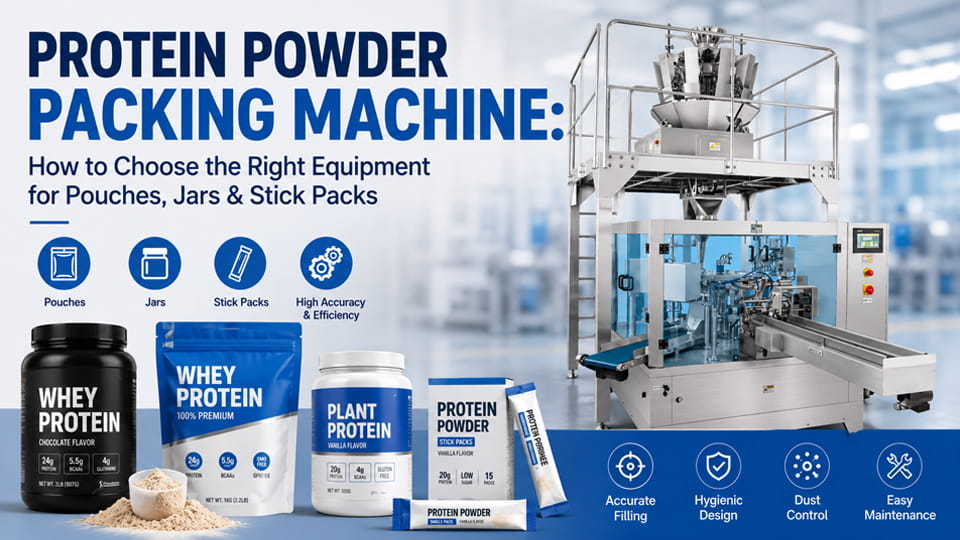
The first decision is thecontainer format. Protein powder commonly ships in one of three forms: jars/tubs (hard containers), スタンドアップポーチ (バッグ), または stick packs/sachets (single-serve sticks). Each has its use-cases:
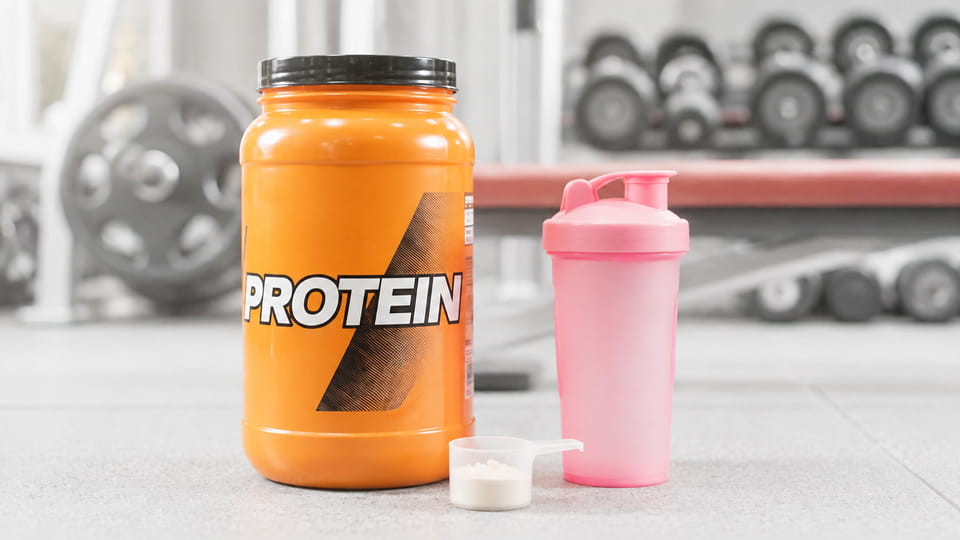
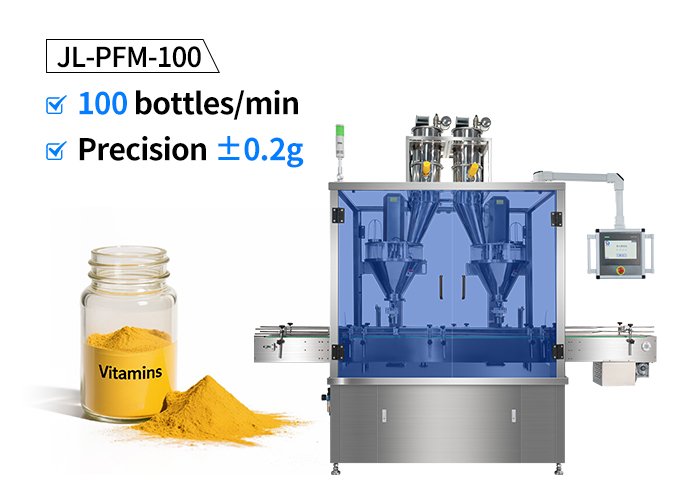
瓶 & Tubs (硬質コンテナ): Classic large-format packaging (例えば. 500 g, 1 kg, 2 kg tubs). These often have screw-on lids and may include scoops inside. Customers expect durable, resealable jars for bulk or high-value powders (like whey mass-gainer or specialty supplements). Packaging lines use anauger filling machineto dose powder into the jar, then a capping station and induction sealer for freshness. Jars can run at5–50 units/mindepending on automation level. An example is Jinlu’sパウダーフィリングマシン, which achieves ±0.1 g accuracy for powders. Jars suit brands wanting a premium look and easy resealability.
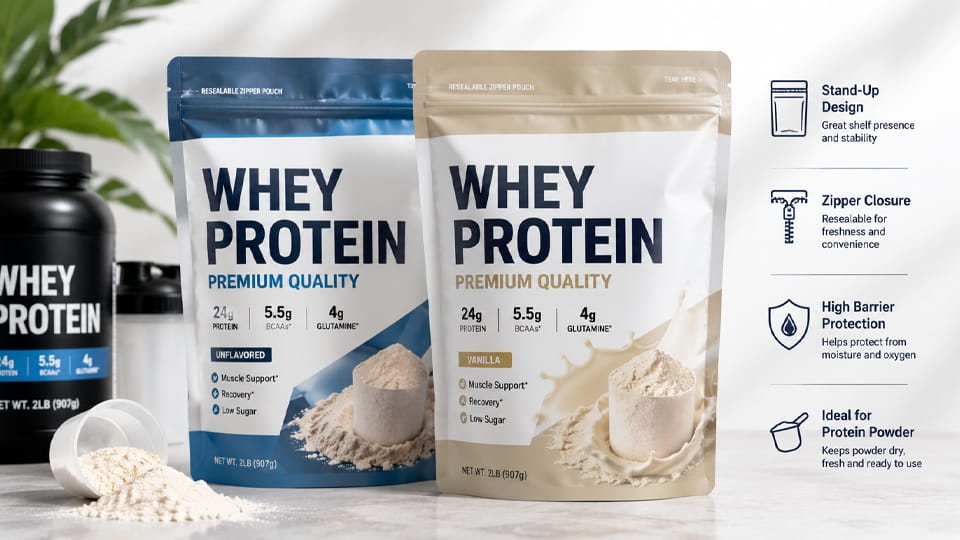
スタンドアップパウチ & Zipper Pouches: フレキシブルパウチ (doypacks or gusseted stand-ups) are now very popular for protein powders. They range from small trial sizes (100–250 g) up to larger retail sizes (1–2 kg). Pouches often have reclosablezipper seals, ideal for preserving freshness. Filling these typically requires a事前のポーチパッキングマシン. The machine picks up empty pre-made bags, それらを開きます, fills with powder, and heat-seals the top. ジンル 既製パウチ機械run ~60–70 bags/min with±0.4%の精度and support various bag styles (ジッパー, 注ぎ口, 平底). Pouches save on plastic vs. jars and are lightweight for shipping. They also allow attractive printed packaging. This format is great for retail shelves, direct-to-consumer e-commerce, or grocery stores.
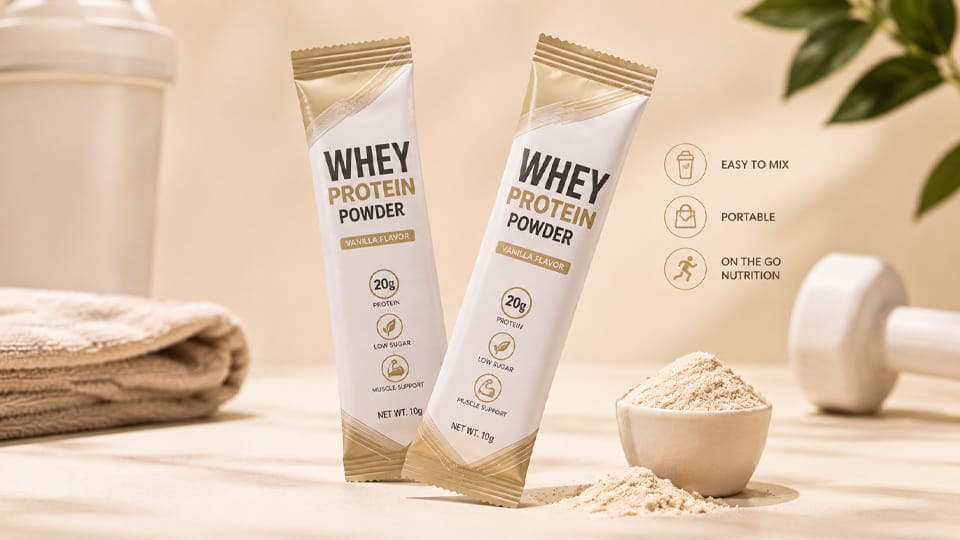
スティックパック/サシェ (Single-Serve Packs): These are long, slim sealed strips containing a single serving (often 10–30 g of powder). Think of on-the-go protein packets that gym-goers tear open. スティックパック (sometimes called sachets) are made from laminates or foil film and filled on aスティックパック機. Theymaximize portabilityand convenience – ideal for samples, travel packs, or promotions. Multi-lane stick pack machines can produce hundreds of packets per minute. 例えば, ジンル スティックパッカーreach up to240 スティック/分 (across lanes) and fill each to ±0.02 g precision. This format minimizes packaging weight and waste for small portions but does not reseal. It’s best for single-use or trial servings.
Each format has trade-offs (下の表を参照してください). Choosing the wrong container can mean extra material costs or cumbersome operation. Read on to learn more about the machines and factors for each format.
Types of Protein Powder Packing Machines
Once you know the package type, the next question is which machine will fill it. Here are the main equipment types:
オージェ充填機 (パウダーフィリングマシン)– Used for open-mouth containers like jars, 浴槽, bottles or even small bags. The machine’s long screw (オーガー) rotates to dispense a precise powder volume into each container. Auger fillers can achieve very high accuracy (often ±0.1–1% of fill weight). They often integrate extras: vacuum de-aeration to remove air from the powder, 金属探知機, and capper units after filling. 例えば, Jinlu’s auger fillers come with a vacuum sleeve to prevent spills and can insert measuring scoops automatically. Use these for bulk protein powders or any jar/bottle filling needs.
パウダーフィリングマシン
縦型フォーム-充填-シール (VFFS) 機械– A common packaging system for forming bags from roll stock film. The machine forms a flat bag (pillow or gusseted) フィルムロールから, fills it with the product, and then heat-seals the top. VFFSマシンcan be used for plain powder bags (without zipper). They are very efficient for high-speed runs (例えば. small or medium sizes at high volume). しかし, they don’t create zipper pouches unless fitted with a zipper applicator. (Advanced VFFS can apply zippers in-line, but this is specialized.)
既成パウチ包装機– Ideal forスタンドアップジッパーポーチor other preformed bags. The machine has a pick-and-place mechanism: it picks an empty pouch from a stack, それを開きます (often using air jets or grippers), then an auger or weigh-filler deposits the powder inside, and finally the pouch is heat-sealed. Because the pouch is already made, sealing is very reliable and the finished package looks high-quality. Jinlu’s premade pouch machines run around 50–60 bags/min with high accuracy. They handle a wide range of pouch styles (ジッパー, 注ぎ口, ドイパック). The trade-off is the cost of buying pre-made bags instead of film. Premade machines are best for medium-to-high volume runs of retail-ready bag packaging.
Highest output for small packs, low material cost per unit
Multi-lane Stick Pack
Stick sachets (複数)
Mass-production of small packets
Very high throughput (複数車線)
Choosing the right machine is crucial. The next sections break down their operating steps and what to consider when selecting one.
How Does a Protein Powder Packing Machine Work?
Although machines vary by type, the core process for filling protein powder is similar: (1) Feeding the powder → (2) Dosing by weight → (3) Filling the package → (4) Sealing the package → (5) Outputting the finished package.
Powder Feeding:A supply hopper holds the bulk powder. For very fine powders, a vacuum elevator or screw feeder may lift the powder into a main hopper above the filling unit. Often avibrating table or agitatorkeeps the powder flowing steadily (preventing clumps or bridging at the outlet). Good machines have cone-shaped hoppers and vibration or brushes to discourage arching (橋渡し).
Weight Dosing: アン オーガーフィラー (スクリュー) or multi-head weigher measures each dose. For auger filling, a servo motor rotates the screw in a feed hopper to meter powder. The volume moved correlates to the fill weight. The system can be open-loop (calibrated volumetrically) or closed-loop (with a scale to adjust on-the-fly). Proper auger tooling (pitch, 長さ, スピード) is chosen based on powder flow. JinluPacking のメモによると, bridging prevention and hopper design are key – a well-engineered hopper can reduce powder bridging from ~85% down to 12% of runs.
Package Positioning:If filling a jar or bottle, an unscrambler or feeder organizes the empty containers. If filling a bag, the bag is either formed (VFFS) or picked/opened (premade pouch or stick pack machine). Accurate pouch opening (often with vacuum grippers or air jets) ensures the powder doesn’t spill outside.
充填:The powder is dispensed into the container. Many machines then use avibrator or vacuum de-aeration stageto shake the filled container lightly, settling the powder and removing trapped air. This improves density and allows more powder per package, and reduces dust.
シール・キャッピング:Bags are heat-sealed with rollers or jaws. Jars are capped (automatically press-on or screw-on). Sometimes an誘導シーラーapplies an aluminum freshness seal under the cap (especially common in nutraceuticals). The sealing must be dust-free – often a final quick brush or air-knock removes powder from the lip.
Quality Check & 出力:A checkweigher or vision system can verify final weight and seal. Packages then exit the machine to collecting conveyors or directly into cases.
In all steps, 防塵 重要です. Packaging many pounds of protein creates airborne dust. Top systems have local dust extraction hoods and HEPA filters to capture particulates, keeping machinery clean and protecting workers. If left unchecked, dust can coat seals or contaminate other products. Many pouch packing machines even include options fornitrogen flushing, replacing oxygen inside the bag to extend shelf life of protein powder.
Why Auger Fillers Are Key for Protein Powder
For any dry powder, particularly sticky or fine ones like protein, the auger (スクリュー) is often the best choice for dosing. Unlike volumetric cup fillers, の オーガーフィラーcan precisely meter difficult powders into open containers or bags. Here’s why augers excel:
高精度:With the right calibration, modern auger systems can hit±0.1–1% accuracy. The screw’s pitch, length and rotation speed are tuned to the powder’s bulk density and fill weight. Servo-driven augers allow dynamic adjustment. 例えば, Jinlu’s auger fillers use servo drives to achieve filling precision of 0.01 g.
Handles Challenging Powders:Protein powders often bridge or rat-hole (form a vault) in hoppers if not vibrated. Augers combined with vibratory feeders, brushes or agitators can break these bridges. If powders are sticky (like whey) or electrostatic, some machines offerlonger screwsor coated screws to mitigate sticking. The long auger variant (as Jinlu offers) is designed to move sticky powders without jamming.
Dust Minimization:Auger fillers for powders usually operate in semi-enclosed hoppers. Many havesleeve nozzlesthat insert into the jar or bag before/while dosing. Jinlu’s machines use a suction sleeve that wraps around the fill area to capture stray dust, virtually eliminating spills. Combined with external dust hoods, this keeps the filling zone tidy.
Integrated Features:On jar lines, auger fillers can be paired with autoscoop inserters. These devices drop a measuring spoon into the jar before powder (common with whey protein tubs). The auger then fills around the scoop. 充填後, a capper seals the jar. Jinlupacking 氏が指摘するように, auger-based jar fillers often include exactly these features – scoop placement, キャッピング, and even labeling in one integrated line.
要約すれば, if your primary product is apowdered ingredient, an auger filler is usually the best foundation. It’s versatile and can be integrated with the rest of your line easily. 例えば, a typical jar line might be: bottle unscrambler → auger filler → scoop inserter → capper → induction sealer → labeler → checkweigher.This handles everything from bulk protein supplements to fine nutraceutical powders.
Key Factors to Consider When Choosing a Machine
Selecting the “right” equipment depends on many details of your product and plant. Here are the critical factors procurement and engineering teams should weigh:
パッケージの種類 & サイズ:Are you filling jars, 浴槽, スタンドアップバッグ, またはスティック小袋? And what fill weights? (例えば. 20 g single serve vs 1,000 g bulk.) Smaller packets require different machines (stick packers or small-pouch packers) than large tubs (auger fillers andキャップ). Make sure the machine is rated for your minimum and maximum package dimensions and weights.
生産能力:How many units per minute or per shift do you need? Project future growth too. A machine might handle 20 jars/min or 200 pouches/min – big difference. High-speed lines often use multiple lanes (especially stick packers or VFFS) to multiply output. 例えば, a 4-lane stick packer can produce 4× the single-lane rate. Confirm if quoted speeds are tested with your powder (some vendors list theoretical max that only achievable with ideal conditions).
粉体の特徴:Is your protein powder free-flowing (like some whey protein isolates) or more cohesive (pea protein isolates, collagen blends)? Does it generate static? Is it hygroscopic (absorbs moisture)? These affect the choice of filling tech. Poor-flow powders might needfluidizing nozzlesor vacuum assist. If static is an issue, look for anti-static measures (ionizing bars, conductive hoppers). Discuss with the manufacturer whether they have experience with similar powders – many will test your product first.
精度要件: のために 栄養補助食品, customers often care about exact dosage. If you must be within ±1% of target weight, go for systems with multi-head weighers or high-precision augers. Some volumetric fillers just can’t guarantee tight tolerances with variable powder flow. Remember that protein powders can vary in bulk density by ~±25% from batch to batch, so a weighing hopper with real-time feedback is safer.
オートメーション & 統合:Do you need fully automatic lines (one person supervises multiple machines) or is semi-automatic okay? Do you need to integrate with upstream/downstream equipment (bucket elevators, 金属探知機, 箱詰め業者)? Also consider if you need additional features like coding/labeling machines, nitrogen flushing, or CIP (定位置クリーン). More automation increases cost but saves labor long-term.
切り替え & 柔軟性:How often will you switch products or pack sizes? If you have many SKUs (different pouch sizes or powder blends), look for quick-changeover features. This could include adjustable guides, quick-change auger tools, and recipe memory. Multi-format machines (like some Jac linear fillers or multihead weighers) let you handle both powders and granules by swapping hoppers.
構造材料 & 洗浄性:Especially for food/pharma, ステンレス鋼 304 または 316contact parts are a must. デザインは衛生的でなければなりません (no powder traps). Easy cleaning between runs is important if flavors change. Many manufacturers offer trolleys or hydraulic cylinders to tilt hoppers out for cleaning, and cover washers or CIP loops.
予算 & サポート:Packaging machines range from modest (~$20k for simple stand-alone auger fillers) to six-figures for full automatic lines. Get quotes that include installation, トレーニング, and a service plan. Consider the vendor’s track record: do they specialize in powder? Do they offer testing with your product? A machine is only as good as its support – check for CE/FDA certification if you need it.
By walking through these points, you can match features to needs. Often it helps to work with a packaging consultant or themachine vendorto validate assumptions (例えば. test runs at a demo center).
Packaging Options Compared: Jar vs Pouch vs Stick Pack
Let’s compare the three formats head-to-head. This can clarify which suits your application:
長所:Ultra-portable, minimal packaging material, easy dosing. High line speed (especially with multi-lane machines, can hit hundreds of sticks/min total).
短所:No reseal. Not suitable for large volumes (packets of powder lose freshness faster). More precise filling needed at tiny weights.
機械:Stick packers (single or multi-lane). Modern machines can do 200+ スティック/分 (total) 簡単に. Low per-unit material cost (just a small laminated film).
要素
Jar/Tub
スタンドアップポーチ
Stick/Sachet
Typical Fill Range
Medium–Large (≥250g)
Small–Large (100g–2kg)
小さい (5–50g)
携帯性
中くらい
高い (collapsible)
非常に高い
Reseal
はい (screw cap)
はい (ジッパー)
いいえ
梱包コスト
高い
適度
Low per unit
生産速度
適度 (10-50/分)
高い (50-80/分)
非常に高い (multilane)
ブランディング
良い (label on jar)
Very Good (print on bag)
良い (stick pack print)
最適な用途
Bulk products
Retail/Online sales
Single-serving promotions
Choosing the wrong format can limit your market or efficiency. 例えば, if customers want a gym-ready travel pack, a 2kg jar won’t sell. 逆に, putting a 2 kg protein mix into 200 sachets is impractical. So align format with the product use-case early on.
Common Challenges in Protein Powder Packaging
Packing fine powders at speed can bring pitfalls. Here are issues to watch for and how machines address them:
一貫性のない充填重量:Variations in bulk density or flow can cause some packs to underfill or overfill. Overfilling wastes product. The fix: use precise dosing (multi-head weighers or closed-loop auger with load cell), and calibrate per batch. A well-chosen auger (right pitch/length) 重要です. Automated checkweighers also catch outliers immediately.
Powder Dusting:Fine powder tends to billow when filling. Without control, it leaves residue and can clog seals. Solutions includedust extraction nozzlesat the fill point, vacuum nozzles around bag openings, and even in-line vacuum conveyors. Many pouch machines have built-in dust removal around the sealing jaws. Static charge aggravates dust escape; some lines add antistatic ionizers to neutralize clinging particles.
Powder Bridging or Rat-Holing:This is when powder forms an arch in the hopper, stopping flow. It’s especially common with sticky or cohesive powders. Good hopper design can nearly eliminate it. Optimized hoppers can cut bridging incidence from ~85% to ~12%. Look for machines with sloped walls, internal agitators, or banana-beaters to keep product moving. Sometimes just increasing hopper diameter or adding a vibrator solves it.
Seal Defects (Open or Leaky Seals):If powder is on the bag lip when sealing, the seal may fail. Machines typically vibrate/brush the bag after filling to settle powder away from the edges. A horizontal back-seal on stick packs with temperature control (as Jinlu uses) ensures a tight, air-proof seal. Regular cleaning of sealing jaws is vital.
Incorrect Tooling:Using the wrong auger screw or funnel can ruin performance. Ensure the filler’s parts match your powder’s granule size. Some machines allow quick-swap auger bits for different recipes.
Product Giveaway:To avoid underfills, some companies overfill by default, which wastes expensive protein powder. The cure is calibration. Modern fillers can “learn” the fill weight (by briefly weighing each fill) and auto-adjust. This keeps giveaway minimal.
Many of these issues are avoidable with the right machine features. As the experts say, always analyze your specific powder and do test runs: “address the root cause rather than just treating symptoms”.
Building a Complete Protein Powder Packaging Line
For a production manager, it’s helpful to visualize the entire line setup for each format:
Jar/Tub Line:
Bottle Unscrambler/Depalletizer:orients and feeds empty jars.
Auger Filler:fills powder. 必要に応じて, Scoop Inserterdrops a scoop inside each jar.
Vibration Table or Vacuum Stage:settles powder and removes air.
キャッパー:automatically places and tightens screw caps.
誘導シーラー:applies foil seal under cap.
ラベラー:wraps or pads label on jar.
重量チェッカー:verifies fill weight and integrity, rejects off-weight jars.
カートナー (オプション):boxes the jars for shipping.
Pouch Line (既製):
Pouch Feeder/Magazine:stacks premade empty pouches (often with automatic reloading).
Pouch Picking/Opening:robotically opens each pouch.
Auger Filler/Multihead Weigher:dispenses the powder into the open pouch.
Zipper Closer (必要に応じて):closes the interlocking zipper flap.
Heat Sealer:seals bag across the top.
Date Coder/Printer:stamps batch and date on pouch.
重量チェッカー & 拒否する:double-check weight.
Cartoning Unit:bunches pouches into boxes.
Stick Pack Line:
Film Unwinder:feeds multilane film to forming shoulder.
Forming Unit:creates multiple long tubes (レーンごとに 1 つ).
Auger Filler:fills each tube through an auger, supported by vibrator.
Horizontal Sealer:seals the filled tubes into a long continuous strip.
Cutting Unit:slices the strip into individual stick sachets.
検査 & 数える:verifies count and weight.
箱詰め & ケースパッカー:for large volume, packs stick packets into boxes or display packs.
Each configuration can be tailored. 例えば, a stick pack line may feed output into aサシェーカートニーマシンthat aligns and inserts them into paperboard cartons. (Jinlu even offers integrated stick-packing-cartoning turnkey systems.)
The key for operations managers is ensuring every part of the line is balanced. The filler should not be 30% slower than the sealer, 例えば. When quoting machines, vendors usually specify maximum speeds; verify those with your product.
結論
正しい選択 protein powder packing machinecomes down to matching the powder’s quirks and your packaging goals with the right equipment. Do you need large, resealable tubs or dozens of single-serve sticks? Will you mainly sell in retail with premium pouches, or dump bins with bulk tubs? Each path has a suitable solution. The smartest approach is often a custom or semi-custom line – one that integrates an auger filler with the exact feeders and sealers your product requires.
いかなる場合でも, the right equipment will pay back quickly. Automated lines boost throughput, reduce giveaways, and ensure every pouch or jar meets quality standards – all critical in competitive supplements production. If you’re planning a new powder packaging line (or upgrading an old one), talk to experienced suppliers. 例えば, Jinlu Packing offers everything from粉末充填機for jars topremade pouch packers そして スティックパッカー. We can help pick the right combination of machines and features for your protein powder products.
次のステップに進む準備ができています?Contact Jinlu’s packaging expertto get a tailored recommendation. A well-designed protein powder packing line will make your production smooth, your product consistent, and your buyers happy.
FAQs About Protein Powder Packing
What machine is used to pack protein powder?
A protein powder packing machine typically uses an auger filling system to measure and dispense the powder before sealing it into a jar, ポーチ, 小袋, or stick pack. The exact machine depends on the packaging format. Jars and tubs commonly use an auger filler with downstream capping, while pouches can use premade pouch or VFFS equipment, and single-serve products can use a dedicated stick pack machine.
Is an auger filling machine suitable for protein powder?
はい. Auger filling is commonly used for protein powder because the screw-based dosing system can provide controlled powder feeding and repeatable fill weights. The auger configuration should be selected according to the powder’s bulk density, 流動性, particle characteristics, 目標充填重量, and required production speed.
For fine powders, dust control and hopper design are also important because poor powder handling can affect both filling consistency and sealing quality.
What is the best packaging for protein powder?
There is no single best packaging format for every protein powder product. Jars or tubs are suitable for larger retail packs, while stand-up pouches can reduce package weight and are useful for a wide range of fill sizes. Sachets and stick packs are better suited to single-serving products, travel formats, and protein powder small packs.
The right choice depends on fill weight, ターゲット市場, 携帯性, 生産量, resealability, 梱包コスト, and the available packing equipment.
What is the best machine for single-serve protein powder?
For single-serve products, a stick pack machine or sachet packing machine with an auger dosing system is often a practical choice. These machines can produce compact protein powder packs in relatively small fill weights and are suitable for products designed for gyms, 旅行, サンプリング, and on-the-go consumption.
The required number of lanes depends on the target output, 充填重量, powder characteristics, and available production space.
Can the same protein powder packing machine fill both pouches and jars?
Not usually with the same complete packaging configuration. Pouches and jars require different packaging handling systems, even though both may use an auger filler for powder dosing. A jar line needs container handling, 充填, キャッピング, and often labeling, while a pouch line requires pouch feeding or film forming, 充填, and heat sealing.
For manufacturers handling both formats, it is usually better to evaluate the filling system and packaging machinery as separate modules or as a coordinated packaging line.
How accurate is a protein powder filling machine?
Filling accuracy depends on the powder’s characteristics, 目標充填重量, dosing method, auger design, マシンの設定, and production conditions. Manufacturers should not select a machine based only on a quoted accuracy figure; it is better to conduct a product test using the actual protein powder and target fill weight.
For high-value protein powders, consistent dosing is important because both underfilling and overfilling can affect product compliance, material costs, 生産効率と.
How do you prevent protein powder from getting into the seal area?
The main approach is to control the powder during filling and keep the sealing area clean. 機械や製品によって異なります, this can involve controlled auger feeding, suitable filling-nozzle design, 集塵, anti-dribble measures, and appropriate pouch-sealing settings.
This matters because powder trapped in the seal area can reduce seal quality and lead to leakage or rejected packs. Dust-control and sealing performance should therefore be evaluated together rather than treated as separate machine functions.
What factors should I consider when choosing a protein powder packing machine?
The main factors include: • powder flowability and bulk density • target fill weight • packaging format • required production output • filling accuracy • dust control • sealing requirements • cleaning and changeover time • number of SKUs • future production expansion The machine should be tested with the actual protein powder whenever possible. A machine that performs well with one powder formulation may require different dosing or feeding parameters for another.