×

オンラインサービス

💬WhatsApp: +86 1801179332
💡
  • ブログ
  • GMP と cGMP: 重要な違い & 医薬品包装機器のコンプライアンス

GMP と cGMP: 重要な違い & 医薬品包装機器のコンプライアンス

GMP と cGMP is one of the most common questions in 医薬品製造—and for good reason. Although the two terms are closely related, they are not identical. Understanding the difference is essential for pharmaceutical manufacturers, equipment buyers, production managers, and quality teams because these standards influence every stage of production, from facility design and process validation to equipment selection and product quality. 特に, の Current現在の優れた製造業 (CGMP) reflects the expectation that manufacturers continuously adopt up-to-date technologies, システム, and quality practices rather than relying on outdated methods.

Whether you’re investing in a new bottle packaging line, upgrading an existing production line, or preparing for regulatory inspections, understanding GMP と cGMP can help you make more informed decisions. このガイドでは, we’ll explain the key differences between GMP and cGMP, outline their コンプライアンス要件, and show how modern 医薬品包装装置 supports safer, より効率的な, and fully compliant manufacturing.

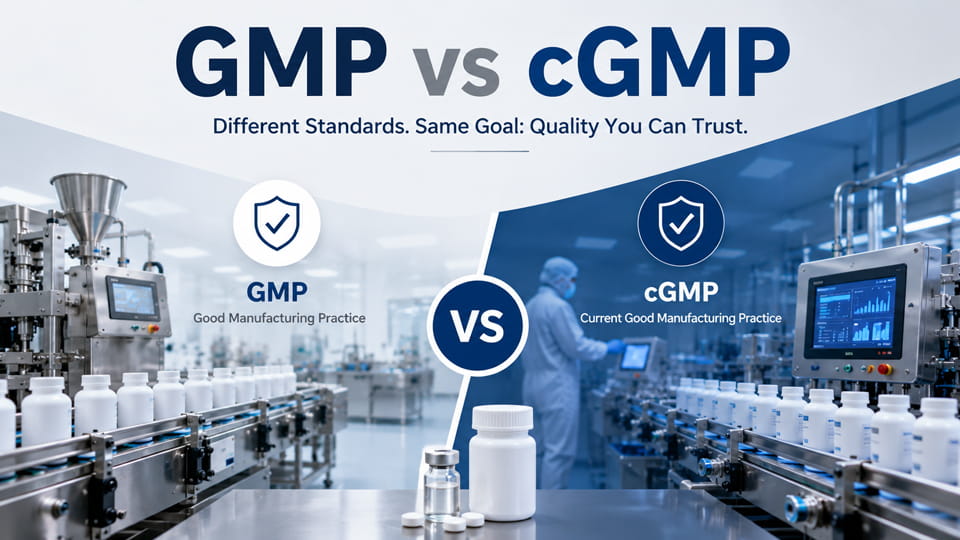
GMP と cGMP


What is GMP?

優れた製造業 (GMP) is a global quality assurance framework for the pharmaceutical industry. WHO defines GMP as the aspect of quality assurance that ensures products are consistently produced and controlled to appropriate quality standards. 同様に, 欧州医薬品庁 (エマ) describes GMP as the minimum standard that a drug maker must meet in production. 実際に, GMP covers facility design, 装置, 原材料, 人事訓練, written procedures, そしてテスト. The goal is to ensure each batch is high-quality, suitable for its intended use, and matches its specifications.

While WHO, EMA and other regulators call it “GMP,” this term is essentially interchangeable with cGMP outside the US. 実際には, WHO’s guidance notes that GMP is “also referred to as ‘cGMP’ or ‘current’ GMP” in some contexts. For many international manufacturers, meeting GMP guidelines means having the same quality outcomes that FDA later emphasizes with cGMP.

What is GMP


What is cGMP?

現在の優れた製造業 (CGMP) is the FDA’s term for these regulations in the United States. The FDA defines cGMP as the systems that assure proper design, monitoring and control of manufacturing processes and facilities. Like GMP, cGMP aims to make sure that drug products have the identity, 強さ, quality and purity they claim. 実際には, the FDA’s regulations explicitly cover everything from facility cleanliness and equipment to personnel qualifications and record-keeping (21 CFR部品 210 そして 211).

The critical distinction is that the “C” in cGMP stands for current. This means companies must use up-to-date technologies, equipment and procedures. FDAが指摘しているように, systems and equipment that were “top-of-the-line” 10 または 20 years ago may now fall short under cGMP, because quality standards and technology advance over time. 要するに, cGMP carries all the same quality requirements as GMP but adds an emphasis on continual improvement and modernization. Compliance with cGMP is enforced through FDA inspections, and failure to meet these standards legally renders a drug “adulterated,” even if it passes laboratory tests.

FDA & CGMP


GMP と cGMP: 重要な違い

While GMP and cGMP aim for the same outcome (安全, high-quality drugs), the differences lie in emphasis and usage. The table below summarizes the core distinctions:

側面 GMP (優れた製造業) CGMP (Current GMP, FDA)
Terminology “Good Manufacturing Practice” – used by WHO, エマ, 写真/S, 等. “Current Good Manufacturing Practice” – the FDA’s term
Regulatory Context Global standard applied by many countries (誰が, 写真/S, EU GMP) US-specific regulations (21 CFR 210–211)
Focus Meets established quality standards consistently Meets standards そして keeps technology/processes up-to-date
Technology Requirement Generally static (meets baseline standards) Must use the latest validated equipment and methods
ドキュメント Thorough SOPs and records required Even more rigorous documentation (e-records, 監査証跡)
検証 Process and cleaning validation expected Equipment qualification (IR/WH/PQ) and process validation mandatory
Quality System Standard Quality Management System Enhanced risk-based QMS; continual improvement cycles
Inspections & アップデート Periodic inspections to verify GMP compliance Same, but FDA expects ongoing updates; what was compliant may become outdated
Regulatory Scope EU/EU: compliance enforced by EMA & national agencies 私たち: compliance enforced by FDA; noncompliance leads to legal action

本質的には, CGMP is GMP プラス the expectation of keeping pace with modern best practices. As one industry analysis explains, cGMP “focuses on continuous improvement and means the most up-to-date standards and technologies are being employed to assure quality, whereas GMP are considered a set of principles”. 実務的には, cGMP carries all the GMP requirements, but with extra emphasis that companies must actively upgrade processes and documentation.

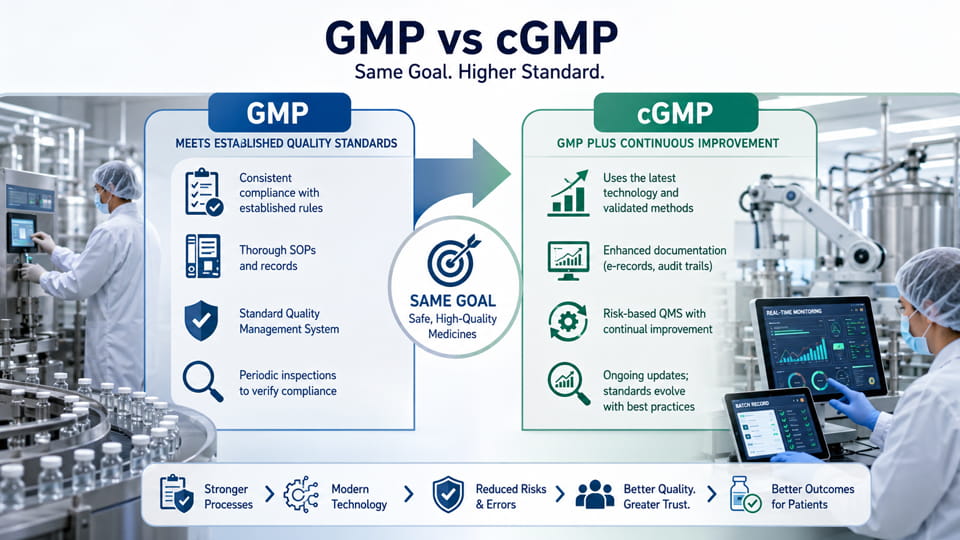
GMP vs cGMP-Key Differences

The “Current” in cGMP isn’t just a buzzword: it signals that facilities, machines and quality systems should never become outdated. 例えば, if an older production method or piece of equipment is found to be inferior, cGMP standards mean the company should implement newer solutions. This approach drives innovation: companies adopting cGMP invest in electronic batch records, automated inspection systems, real-time data monitoring and other advances that raise quality and reduce errors.


Why “Current” Matters in cGMP

The letter “c” in cGMP underscores a simple yet critical point: compliance means using current knowledge and technology. This matters because pharmaceutical science and equipment evolve rapidly. What was a valid cleaning method 20 years ago may no longer meet today’s contamination standards, and new tools (like digital quality management systems) offer better traceability than paper logs.

Regulators routinely expect that manufacturers will actively improve. 例えば, FDA guidance notes that equipment should be built and located to ease cleaning and prevent contamination – implying that designs must adapt as we learn more about contamination control. If better sterilization or materials become available, cGMP calls for incorporating them. Jinlupacking highlights: “The ‘Current’ in cGMP emphasizes that manufacturers must use up-to-date technologies and systems,” which promotes continuous improvement in manufacturing processes.

実際に, this means facilities must have a quality system that reviews and revises processes when regulations or industry standards update. The FDA’s 21 CFR Part 11 (for computerized systems) is one example: it was added to address electronic records and signatures. Under cGMP, pharmaceutical companies had to incorporate unique logins, audit trails and security features into their computerized equipment and software. If a company had continued using only paper logs, it would not meet current standards.

Another key area is data integrity. Regulators now scrutinize electronic batch records, requiring that all changes be traceable to authorized users. A referenced compliance guide notes that 21 CFRパート 11 “mandates unique user logins, audit trails and electronic signatures to ensure data integrity”. That was not an original part of GMP decades ago. したがって, cGMP today means upgrading equipment and controls so that every action in a production line (machine settings changes, quality alerts) is recorded and protected.

要約すれば, “current” in cGMP means never resting on old laurels. It drives firms to regularly validate new equipment, retrain staff on better methods, and embrace the latest quality practices. This results in consistently improving product safety and compliance. Qualityze notes that a major reason cGMP is important is that it “promotes continuous improvement” – making sure companies are always using the newest technology to ensure quality.

cGMP Matters in pharmaceutical manufacturing


Common GMP/cGMP Requirements

Whether called GMP or cGMP, certain core requirements are universal in pharmaceutical manufacturing and packaging. These common elements are essential for compliance under FDA, WHO or EMA rules:

  • Trained, Qualified Personnel: Staff must have appropriate education and training. Job roles and responsibilities are defined. Personal hygiene (例えば. gowns, gloves, hairnets) is mandatory in production areas to prevent contamination.
  • Hygienic Facility Design: Manufacturing areas should be clean, controlled environments. Cleanrooms and air filters are often used for sterile products. Surfaces (floors, walls) are easy to clean. Flow of personnel and materials is designed to prevent mix-ups (例えば, separate air paths for raw materials vs. finished goods).
  • Validated Equipment & プロセス: All equipment must be qualified (IR/WH/PQ) 使用前に, and every critical process must be proven to work reliably. Procedures (standard operating procedures) are written, approved, and followed. 例えば, the FDA requires that “all equipment must operate within specifications and be cleaned per written procedures”.
  • Documented Quality System: Detailed batch records, equipment logs, and SOPs are kept. Any deviations, changes or corrective actions (キャパ) 文書化されている. Under cGMP, this includes electronic records with audit trails. Complete traceability is maintained from raw materials to final product.
  • Contamination Control: Measures are in place to avoid cross-contamination. This includes dedicated equipment or cleaning between batches, validated cleaning protocols, and the use of high-grade materials (例えば. ステンレス鋼) that do not shed particles.
  • 設備のメンテナンス & 較正: Regular preventive maintenance is scheduled, and all instruments (天秤, センサー) are calibrated with records, as required by 21 CFR 211.68.
  • Quality Control Testing: Raw materials and finished products are tested for identity, potency and purity according to protocols. Any out-of-specification result must be investigated.
  • Packaging Controls: Specific to packaging, GMP calls for label inspection (correct labels, バッチ番号) and line clearance procedures to prevent mix-ups. 包装設備 must be qualified just like any other processing machinery.

Regulators like the WHO state that GMP defines “quality measures and activities for both the production and control of drugs,” and ensures everything from “processes [being] 明確に定義された, validated and reviewed” to personnel and premises being “suitable for production”. 実際に, this covers everything listed above.

In packaging areas, the standards often translate to specific design rules (as Jinlu’s compliance guide notes). 例えば, machines in a GMP line must be easily cleanable (滑らかなステンレス鋼, no cracks or dead-legs) and fully validated. Documentation such as Installation Qualification (IQ), 運用資格 (OQ), およびパフォーマンス資格 (PQ) is required before and during production. Without these controls, an audit would flag non-compliance.

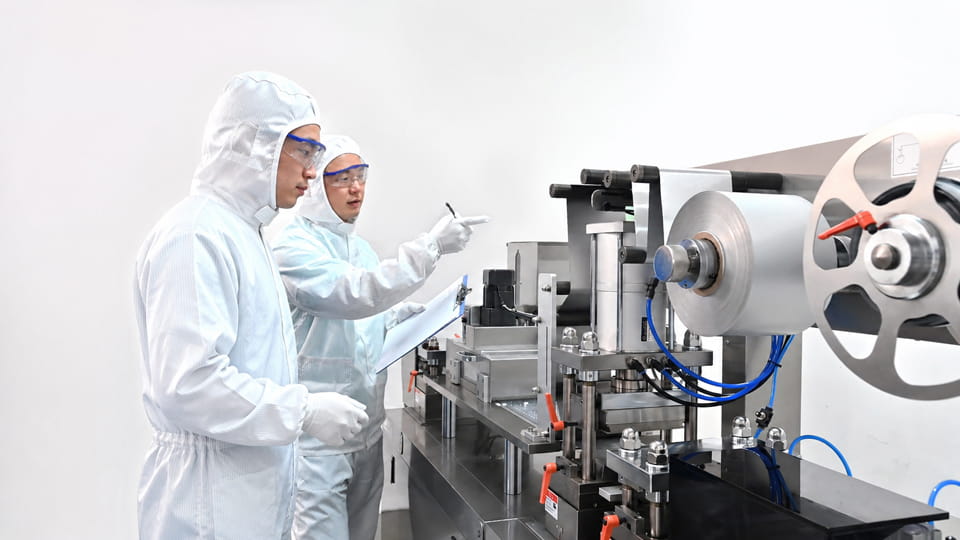
Workers in protective suits operating blister pack machine in cleanroom


GMP と cGMP: Which Standard Should You Follow?

The standard you must meet depends on your market:

  • アメリカ合衆国 (FDA): Must follow US cGMP (21 CFR parts 210–211) for any drug product sold domestically.
  • 欧州連合: Must comply with EU GMP (EudraLex ボリューム 4) for any medicine marketed in the European Union. EMA coordinates inspections to ensure this standard worldwide.
  • WHO/GMP-PIC/S: 多くの国 (中国も含めて, インド, Canada, 等) base their regulations on WHO or PIC/S GMP guidelines. These are very similar to EU GMP in principle.
  • Multiple markets: If you export globally, the safest route is to design processes around the strictest standard – usually FDA’s cGMP. FDA regulations often encompass or exceed other requirements, so a cGMP-compliant facility will generally meet EU/WHO requirements too.

例えば, FDA explicitly recommends that facilities selling globally comply with current GMP. 同じく, EMA states that “any manufacturer of medicines intended for the EU market must comply with EU GMP no matter where they are located.”. 実際に, top pharma companies build facilities to meet FDA cGMP as a baseline and then adjust for local variations (like labeling or documentation language).

最終的に, the choice isn’t either/or: modern pharmaceuticals are expected to meet both the letter and spirit of GMP. Whether you call it GMP or cGMP, the on-the-ground practices – clean rooms, validated equipment, rigorous QC, and thorough records – are all part of the same quality culture.


Features to Look For in cGMP-Compliant Equipment

When selecting pharmaceutical packaging machinery, buyers should look for features that specifically support GMP/cGMP principles:

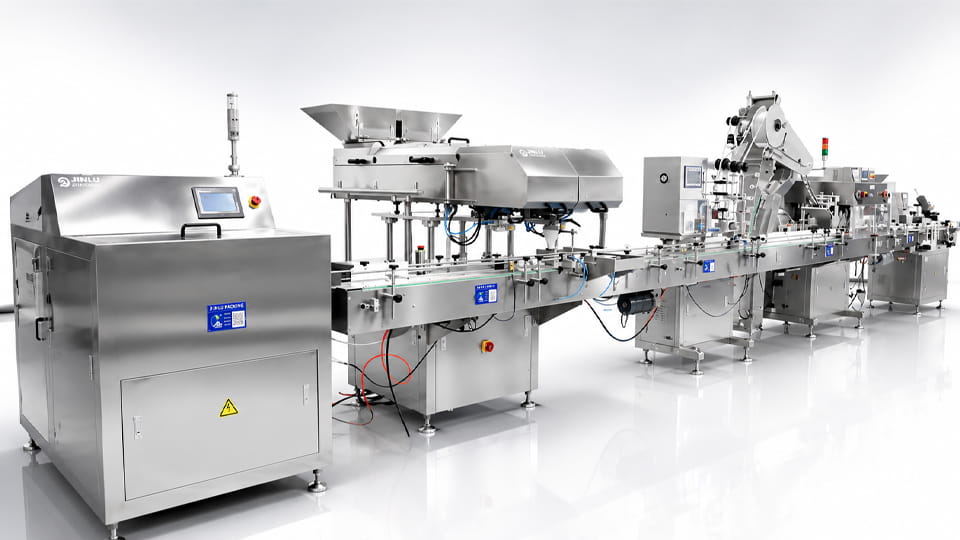
A modern pharmaceutical bottle packaging line integrates unscrambling, 充填, キャッピング, sealing and labeling with built-in inspection

形: A modern pharmaceutical bottle packaging line integrates unscrambling, 充填, キャッピング, sealing and labeling with built-in inspection. These machines use sanitary stainless steel construction and sensors for quality control.

  • All-Stainless Construction: Machines should be built with food/pharma-grade stainless steel (SUS304 or 316L) on all parts that touch product. Non-contact parts can be other materials, but product zones must avoid plastics or low-grade metals. Stainless is non-reactive and easy to sanitize.
  • 衛生設計: Look for smooth, sloped surfaces with no cracks, crevices or dead legs. バルブ, nozzles and seams should be welded cleanly. Preferrable designs are open and cantilevered so areas can be accessed easily. Equipment should have CIP (定位置クリーン) or COP (clean-out-of-place) features when relevant.
  • Full Validation Package: The supplier should provide detailed IQ/OQ/PQ documentation. This includes checklists and test scripts for installation and performance. Without proven validation records, the equipment cannot be considered GMP-ready.
  • オートメーション & Error-Proofing: Features like vision cameras, 重量チェッカー, 金属探知機, barcode scanners and rejection mechanisms are important. These catch errors (wrong fill volume, キャップがありません, bad label) リアルタイムで. また, electric panel and software should have secure user accounts and audit logs for any change.
  • Sanitary Parts and Materials: All contact components (パンプス, コンベア, ホッパー) should be FDA/USP-grade. 例えば, seals and gaskets might be PTFE, and lubricants should be pharma-grade. The goal is no extractables or contaminants that could leach into the product.
  • 精度 & Data Recording: High-accuracy dosing and speed control matter. Many cGMP lines provide digital batch recording. Check that the equipment can log production data (速度, 重み, 温度) automatically and interface with digital quality systems. This supports CFR Part 11 コンプライアンス.
  • Modular Design for Cleaning: Machines should allow quick disassembly of parts for cleaning or validation. 例えば, removable nozzles or trays that can be sterilized. The less time needed to clean, the lower the risk of human error.
  • Inline Code Printing: Built-in inkjet or laser coders ensure each package has date, batch and serial codes. Under recent regulations (EU 口蹄疫, 米国 DSCSA), this is mandatory for traceability. Equipment should allow integration of coding systems and scanners.
  • 品質認証: CEを探す, CGMP, ISO and other certifications as indicators that the equipment meets certain standards. 例えば, Jinlu’s machines often come with CE, ul, and a “cGMP” logo certification (meaning they are designed to comply with GMP guidance).

By ensuring these features, procurement managers can have confidence their packaging line will support compliant production. オリジナルのジンルノート, our machines are crafted with the best materials and sophisticated construction according to CE and GMP standards, and our pouch packer meets the production requirements of cGMP.


Benefits of GMP/cGMP Compliance

Complying with GMP and especially cGMP brings significant benefits:

  • 患者の安全: The foremost goal is protecting patients. Rigorous GMP controls ensure each drug dose is safe, pure and effective. As the FDA states, cGMP regulations ensure that a product “is safe for use and has the ingredients and strength it claims”. By preventing contamination and dosage errors, compliant production upholds health. WHO also emphasizes that proper packaging under GMP keeps medicines “correct, pure and traceable”, directly contributing to patient well-being.
  • 一貫した品質: When GMP/cGMP systems are in place, manufacturers produce each batch consistently. Qualityze explains that Part 210/211 “guarantees consistency” of identity, 強さ, purity and quality, so every tablet or capsule works the same. This consistency is crucial for drugs, since small variations can mean big effects on patients.
  • Regulatory Approval & Market Access: Many countries will not accept pharmaceuticals that do not meet GMP. 私たち. FDA, EU EMA and WHO recognize GMP as mandatory. Qualityze notes that compliance “facilitates international trade” because many countries recognize or base their rules on FDA cGMPs. Being GMP/cGMP-certified opens global markets and prevents costly import holds or export bans. 実際には, WHO reports over 100 countries have incorporated WHO GMP into their laws.
  • Consumer and Stakeholder Trust: Products made under strict quality systems build confidence. Qualityze states that adherence to cGMP “fosters public trust and confidence” because consumers rely on regulatory oversight for safety. For a pharma company, a GMP certification or track record signals commitment to quality – an important advantage in business and public relations.
  • Lower Risk of Recalls and Liability: Stringent controls reduce the chance of defects. Qualityze highlights that strong cGMP compliance “minimizes the likelihood of manufacturing defects,” thereby lowering recalls and serious adverse events. Recalls are expensive and damage reputations; GMP helps companies identify issues early or avoid them altogether.
  • 継続的な改善: The “current” aspect of cGMP means companies keep updating processes. This builds a culture of innovation. Qualityze points out that cGMP’s emphasis on modern technologies encourages better efficiency and product quality over time.
  • 監査の準備状況: Following GMP/cGMP means all processes are documented and controlled. This makes audits – by FDA, EMA or internal teams – smoother. 例えば, properly validated equipment and complete batch records allow a company to quickly demonstrate compliance during inspection.
  • Legal Protection: ついに, compliance is a legal requirement. Products not made under cGMP can be considered “adulterated” under law. 対照的に、, meeting GMP/cGMP shields companies from enforcement actions. As an official guide reminds, 21 CFRパート 210/211 provide the legal basis for FDA enforcement, and non-compliance can have severe consequences.

要約すれば, GMP/cGMP compliance is not just a regulatory burden – it protects patients, builds trust, and ensures a reliable business. It also gives companies an edge by improving efficiency and enabling global distribution.

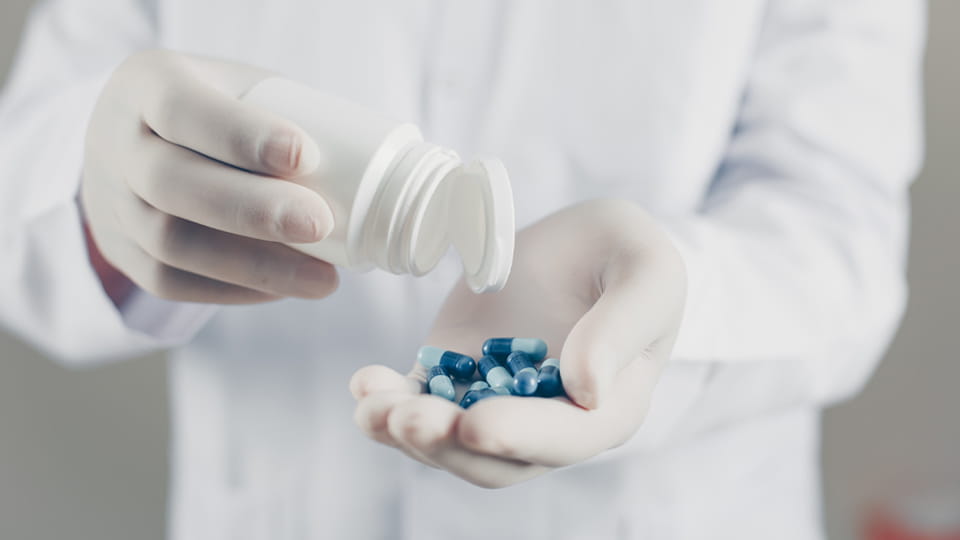
worker with gloves holding finished capsules and bottle


結論

GMP and cGMP are the cornerstones of pharmaceutical quality, ensuring that every product is manufactured safely and consistently. 要約すれば, GMP provides the essential framework of hygiene, documentation and validation, その間 CGMP adds the requirement of continuous improvement and modern technology. For packaging equipment, this means investing in automated, validated machines made from sanitary materials.

ジンルーパッキングにて, we build our machinery with these standards in mind. By choosing Jinlu’s cGMP-compliant equipment – like our 自動カプセル充填機, 打錠機, Blister Packagers, 箱詰め機 そして 計数機 – you can build a fully validated, audit-ready production line. Each machine comes with the documentation and hygienic design needed for GMP and FDA inspections.

Ready to ensure your production meets (c)GMP基準? Contact Jinlu’s experts today to discuss your packaging line requirements or request a quote. Our team will help tailor the right equipment package to keep your products compliant, safe and high-quality.


FAQs on GMP vs cGMP

What is the main difference between GMP and cGMP?

GMP refers to the baseline “Good Manufacturing Practice” requirements for drug production. cGMP stands for “current GMP,” meaning those requirements plus the expectation of continuous improvement. In cGMP, manufacturers must use up-to-date equipment, methods and quality systems. 言い換えると, cGMP adds that processes are regularly reviewed and modernized.

Why does the “c” in cGMP matter?

The “c” stands for “current,” emphasizing that a company must always meet the latest regulations and standards. It ensures manufacturers do not rely on outdated practices. As Scilife explains, cGMP means using modern systems and technologies to meet today’s regulatory expectations, rather than older methods that might no longer be adequate.

Does the FDA require cGMP even if a product meets other GMP standards?

はい. 米国. FDA regulations (21 CFR部品 210 そして 211) are written as cGMP. By law, any pharmaceutical product for the U.S. market must be produced under current Good Manufacturing Practices. Non-compliance can lead to warning letters or shutdowns.

What happens if a company only follows old GMP guidelines?

If only outdated GMP practices are used, the company risks failing inspections. Regulators expect evidence of current technology and validations. Under cGMP, simply meeting older guidelines is not enough. 例えば, use of paper logs instead of validated electronic records could be cited. 実際に, cGMP compliance means even if a process has GMP history, it must be reviewed with today’s standards in mind.

Do all countries use GMP or cGMP?

Most pharmaceutical markets around the world have incorporated GMP-like requirements. 以上 100 countries have adopted the WHO’s GMP standards into national law. The terminology varies (some say GMP, some cGMP, some simply “GMP”), but virtually all major regulators (FDA, エマ, 誰が) require a quality system equivalent to cGMP.

What is WHO’s stance on GMP vs cGMP?

WHO itself usually refers simply to “GMP,” but defines it broadly. In WHO documents, “GMP (also referred to as cGMP or ‘current GMP’)” describes quality assurance to ensure products are consistently produced to quality standards. それで, WHO uses the terms interchangeably. The concept of being “current” is built into all modern GMP guidance, even if WHO doesn’t always use the “c.”

Can packaging equipment affect GMP compliance?

絶対に. Equipment design is critical for meeting GMP. 例えば, machines must be easy to clean (stainless, 隠れた隙間がない) and should support automation and data capture. Poorly designed equipment can lead to contamination or mix-ups. 逆に, the right equipment (like Jinlu’s machines) is built with GMP features to ensure compliance.

What is equipment validation (IR/WH/PQ)?

Equipment validation is documenting that machines work as intended. IQ (設置資格) verifies the machine is set up correctly per design. OQ (運用資格) tests that each function works under varying conditions. PQ (パフォーマンス資格) proves the equipment consistently achieves required outputs during actual production. These are standard GMP requirements to show equipment is fit for use.

How can pharmaceutical machinery help achieve cGMP compliance?

Compliant machinery automates quality controls and records data. 例えば, automated capsule fillers precisely weigh doses and reject bad capsules, eliminating human error and contamination. Integrated data systems automatically log batch information with audit trails, satisfying data integrity rules. By selecting equipment with these features, a company makes cGMP compliance much more achievable.

How can Jinlu Packing help my facility meet cGMP?

Jinlu’s machines are designed for pharmaceutical production with full consideration of GMP needs. They provide complete IQ/OQ/PQ templates and support, high-quality stainless construction, 高度な自動化 (such as integrated vision systems and sanitary design) to help ensure your line stays compliant. Their service includes on-site FAT/SAT testing and documentation support to streamline your qualification process.


参考文献:
1.Q&A on CGMP Requirements - 私たち. 食品医薬品局
2.品質ガイドライン: 製造 —— 欧州医薬品庁
3.現在の優れた製造業 (CGMP) 規則 - 私たち. 食品医薬品局
4.適正製造基準 - 誰が
5.TRS 986 – 別館 2: WHO の医薬品の適正製造基準: 主な原則 - 誰が
6.ユードラレックス – 音量 4 – 優れた製造業 (GMP) ガイドライン —— 欧州委員会
7.GMP Guidelines —— ispe.org

この記事をシェアする:
の写真 ペティフー
ペティフー

ペティフー, 金魯包装の創設者, もたらす 20 製薬機械分野における長年の専門知識. 彼のリーダーシップの下で, Jinlu はデザインを統合する信頼できるサプライヤーに成長しました, 生産, と販売. ペティは、クライアントが医薬品包装の複雑さを乗り越えられるよう、業界の深い知識を共有することに情熱を持っています。, 機器だけでなく確実に受け取れるようにする, しかし、生産目標に合わせて調整された真のワンストップ サービス パートナーシップ.

目次

お問い合わせを送信してください

返信を残す

あなたのメールアドレスは公開されません. 必須フィールドにマークが付いています *

無料見積もりを取得する

*私たちはあなたの機密性を尊重し、すべてのデータは保護されます. あなたの個人データは、JL ソリューションのためにのみ使用および処理されます。.