×

オンラインサービス

💬WhatsApp: +86 1801179332
💡
  • ブログ
  • 医薬品包装機器の GMP 要件とは何ですか? メーカー向けの完全なコンプライアンス ガイド

医薬品包装機器の GMP 要件とは何ですか? メーカー向けの完全なコンプライアンス ガイド

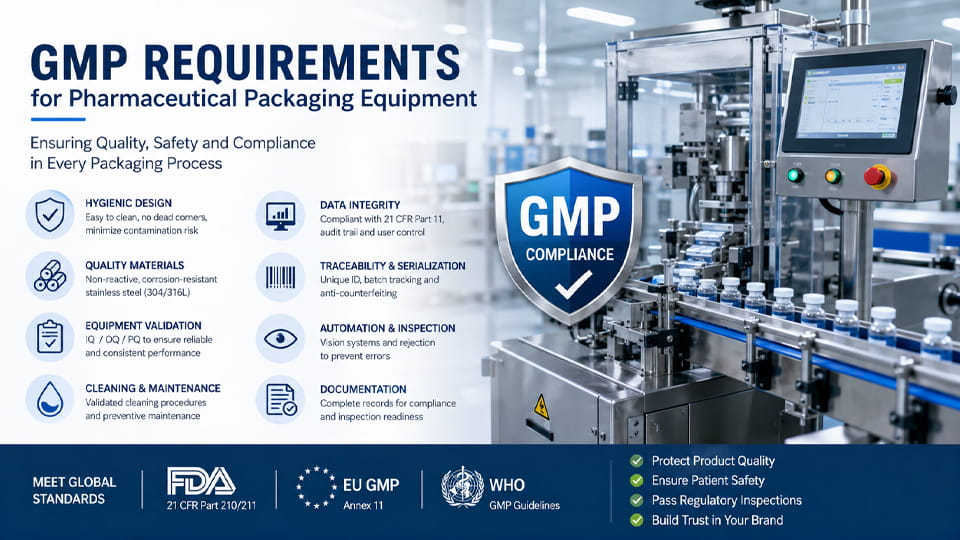
優れた製造業 (GMP) guidelines dictate strict rules for 医薬品包装装置 to ensure product quality and patient safety. Key requirements include hygienic machine design, non-reactive materials, full equipment qualification (IR/WH/PQ), 検証済みのクリーニング, automation to reduce errors, データの整合性 (21 CFR Part 11) and product traceability (連載化). This guide covers FDA, EMA/EU and WHO standards, presents a GMP checklist and explains how to choose and maintain GMP-compliant packaging machines.

医薬品包装機器の GMP 要件とは何ですか


What Is GMP in Pharmaceutical Packaging?

GMP (優れた製造業) is the quality framework ensuring pharmaceuticals are consistently produced and controlled. In packaging, GMP means designs and processes that prevent mix-ups or contamination. Regulatory agencies like the FDA (21 CFR 210/211), エマ (EU GMP Part I, Annexes) そしてWHO (pharmaceutical quality guidelines) all require equipment used in packaging to meet GMP principles. The goal is to protect product 身元, 強さ, quality and purity (no unwanted chemical reactions or contamination). Global regulators also emphasize that packaging processes and equipment must be validated/qualified just like drug manufacturing steps, and that only trained staff operate under written procedures.


Core GMP Requirements for Packaging Equipment

Hygienic Equipment Design

Packaging machines must have サニタリー, cleanable design. This means ステンレス鋼 (例えば. 304 or food-grade 316L) 工事, 滑らかな表面, sloped planes to avoid dust traps, and no dead-legs or hidden cavities. FDA guidance notes equipment “should be constructed and located to ease cleaning” and “prevent contamination from other…operations”. EU GMP similarly requires manufacturing equipment “easily and thoroughly cleaned” with detailed written procedures. 実際に, modern GMP machines often use cantilevered (“balcony”) designs that isolate motors and lubrication systems away from the product area. All zones must be reachable for inspection, wiping, and swabbing. 例えば, Jinlupacking notes that compliant blister machines use sloped surfaces and SUS316L steel on all product-contact parts to avoid particulate traps.

GMP cleanroom operator documenting stainless steel tablet counter operation parameters

Non-Reactive, High-Grade Materials

All product-contact parts must be non-reactive and non-absorptive, so they don’t leach or bind active ingredients. FDA’s CGMP requires that “any equipment surface in contact with…drug products reactive, additive, or absorptive so as to alter the…quality of the drug product”. 同じく, EU GMP says contact parts “must not be reactive, additive or absorptive…that it will affect the quality of the product”. 実際に, this means using clean-grade stainless steel (SUS316L) or pharma-grade plastics, and food-grade lubricants. All fittings, seals and hoses must be compatible with the drugs and cleaning agents used. 例えば, hospital-grade gaskets and PTFE tubing are preferred to avoid corrosion or residue. The result is packaging equipment that cannot contaminate or degrade the product.

Equipment Validation (IQ / OQ / PQ)

GMP mandates full equipment qualification. After installation, a new or modified machine must undergo 設置資格 (IQ), 運用資格 (OQ), そして パフォーマンス資格 (PQ).

  • IQ: Verify installation per design spec (all parts, wiring, certificates).
  • OQ: Test each function and limit (センサー, アラーム, control loops) under stress.
  • PQ: Demonstrate the equipment meets performance criteria during actual production (consistent sealing, 塗りつぶし精度, output speed).

FDA inspectors emphasize that “new equipment must be properly installed…and cleaned before use according to written procedures” with “cleaning documented and validated”. Delivering GMP-compliant equipment means providing a full validation documentation package (例えば。, IQ/OQ/PQ protocols and reports). This is often done via FAT/SAT and strong supplier support. 例えば, the Hikma blog notes that FDA-compliant machines require “SUS316L stainless steel for all contact parts” and “a bulletproof IQ/OQ/PQ documentation” for audit success. 言い換えると, without documented IQ/OQ/PQ, the equipment isn’t considered GMP-validated.

flow of IQ→OQ→PQ validation steps

(Mermaid diagram: flow of IQ→OQ→PQ validation steps)

クリーニング & メンテナンス (Cleaning Validation)

Packaging lines must have validated cleaning processes. After each product or batch run, equipment is cleaned per standard operating procedures (SOP). Regulators require cleaning procedures to be documented, verified, and periodically revalidated. WHO GMP guidance notes that equipment design should be considered when planning cleaning validation, since design can influence effectiveness. Only contact surfaces require thorough validation – non-contacted areas can be excluded. Critical items (like reusable hoppers or nozzles) often require dedicated or single-product use to simplify cleaning. 実際に, firms define acceptance limits for residues and perform swab or rinse tests. FDA FAQs recommend using methods like Total Organic Carbon (TOC) or specific assays to confirm residue removal.

Maintenance and calibration are also mandated. GMP expects regular preventive maintenance: faulty or worn parts must be repaired before they cause contamination risks. Equipment calibration (重み, 天秤, センサー) must follow written procedures with records (21 CFR 211.68). 例えば, FDA guidance says that measurement and control devices “should be calibrated and checked at defined intervals” with records kept. This ensures the machine continues to perform within specs (例えば。, correct fill volume, label placement).

Technician maintaining stainless steel capsule filling machine

オートメーション & Error Prevention

Automated features support GMP by reducing human error. Modern machines often include vision systems, バーコードスキャナ, or checkweighers for in-line inspection. 例えば, automated label/barcode scanners verify each package is correctly labeled and identifiable – a core GMP step. Integration with MES/ERP systems can record batch data. Automated rejection eliminates underfilled or defective packs. Robotics (for bottle handling or pick-and-place) boost consistency. 実際に, many GMP lines include device features like interlocks (例えば。, machine won’t run if a door is open), automatic changeover guards, and sensors to catch jams. All software should have secure user accounts (次のセクションを参照してください).

データの整合性 & 21 CFRパート 11 コンプライアンス

Pharmaceutical GMP requires strong data integrity. In the US and many markets, computerized controls must meet 21 CFR Part 11: this includes unique logins, 監査証跡, and electronic signatures. All batch records, alarms and changes must be time-stamped and protected from tampering. 例えば, FDA warns that scales with auto-calibration still need external checks, and control software must track who changed parameters and when. Key requirements include role-based access (operators vs managers), unalterable audit logs of parameter changes, and digital sign-off on critical steps. EU Annex 11 similarly demands validated systems and audit trails for any GMP-relevant computerized systems. 本質的には, the machine’s HMI/PLC must prevent unauthorized changes. Proper data integrity also means electronic copies of SOPs, batch records and maintenance logs.

連載 & トレーサビリティ

Recent regulations (例えば. EU Falsified Medicines Directive, 米国 DSCSA) require unique identifiers on each primary package. GMP packaging equipment must support this by printing/engraving 2D barcodes or QR codes. Traceability means linking each serialized code to a production batch. Equipment should integrate with serialization software or cameras to ensure every unit gets a unique code that complies with country rules. This is not only GMP but also market law. 実際に, manufacturers often install a laser or inkjet coder and connect it to a database that verifies each code’s authenticity. The final packaging line should allow recall or tracking of any batch via its code.


GMP Requirements for Packaging Process Control

GMP covers not just machines but all packaging operations. Key controls include:

  • Line Clearance: Before starting a new batch, clear out previous products, コンテナ, labels and documents. FDA 21 CFR 211.130 mandates written procedures to prevent mix-ups. Inspect the line and record that it’s free of other products. 実際に, two operators verify each other’s line clearance, checking no stray capsules, チラシ, or labels remain.
  • Label/Materials Handling: GMP requires correct labels for each product and strength. Each label and carton must be inspected for accuracy before use. パッケージ中, labels and packaging parts should be held in FIFO order and controlled by batch. Automated print-and-apply labelers should use pre-printed consumables matched to the product. Any leftover labels from a previous run must be destroyed or quarantined.
  • Batch Records: Complete and accurate Batch Manufacturing Records (BMR) must be kept. All steps of the packaging process (machine setup, component reconciliation, 工程内チェック) are documented. Deviations (例えば. ミスフィード, strength tests) are recorded with corrective actions.
  • 環境管理: Depending on product (sterile vs non-sterile), the packaging area may need cleanroom standards. GMP requires monitoring of air quality (HEPA filters if needed), 温度と湿度, with action if out of range. Operators wear appropriate gowning to prevent contamination.
  • 品質チェック: In-line weight checks, leak tests, or appearance inspections ensure each pack meets specs. Non-conforming packs are removed by reject gates.

By following these process controls, companies ensure no mix-ups or contamination occur during packaging.

GMP Requirements for Packaging Process Control


Regulatory Standards You Must Follow

  • FDA (US cGMP): 21 CFR Parts 210 そして 211 cover drug manufacturing/packaging. Subpart D/E outline equipment design, クリーニング, and calibration (例えば. 211.63–211.68). Also 21 CFR Part 11 on computerized systems.
  • EMA/EU GMP: EudraLex Volume 4, Part I Ch. 3 (装置) and Annex 15 (Qualification/Validation) are key. EU Part I Ch. 3 requires equipment “easily cleaned” and contact parts non-reactive. Annex 11 (computer systems) requires validation and audit trails.
  • WHOのGMP / PIC/S: WHO’s GMP and PIC/S mirror many of FDA/EU rules. WHO guidelines emphasize validation of equipment and processes, as well as sanitary design. WHO TRS 1019 highlights using worst-case products for cleaning validation. Many countries (including China, インド, 等) base GMP on PIC/S/WHO standards.
  • ISO規格: ISO 9001 (品質) and ISO 13485 (med-devices) are secondary, but may be required by some buyers. No specific ISO covers drug packaging equipment design, though ISO 14644 for cleanrooms can apply indirectly.
  • Industry Guidance: Bodies like EHEDG (衛生的なデザイン) and ISPE provide best practices. 例えば, EHEDG guidelines on welded joints and surface finishes align with GMP needs.


GMP Compliance Checklist for Packaging Equipment

Requirement Key Points
デザイン Hygienic, cantilever or balcony design; デッドゾーンなし; sloped, accessible surfaces
材料 Pharma-grade (316l) ステンレス鋼; non-reactive seals/lubricants; 滑らかな溶接
検証 Complete IQ, OQ, PQ (インストール, 運用およびパフォーマンスに関する資格)
クリーニング Validated cleaning procedures; documentation/SOPs; clean-in-place if applicable
メンテナンス Preventive maintenance schedules; spare parts logs; 較正 (with records)
オートメーション Vision systems, 金属探知機, reject gates, label scanners to reduce mix-ups and errors
データの整合性 21 CFR Part 11 compliance: 監査証跡, e-signatures, user access controls
トレーサビリティ 連載 (2D barcodes/UIDs); バッチコーディング; linkage of codes to batch records


Common GMP Compliance Mistakes to Avoid

  • Skipping Validation: Using new/modified equipment without IQ/OQ/PQ or incomplete documentation is a fatal GMP gap. All critical machines must be validated.
  • Poor Cleaning/SOPs: Inadequate cleaning validation (no worst-case or reuse of detergent data) leads to residue carryover. また, missing or outdated SOPs will fail an inspection.
  • Ignoring Calibration: Weighing scales, 流量計, sensors left uncalibrated or without schedule violate 21 CFR 211.68 and EU standards.
  • Line Clearance Lapses: Failing to physically remove old labels or products before a run causes mix-ups. Not double-checking labels can lead to mislabeling citations.
  • Weak Data Controls: Allowing easy overwrite of electronic batch data or having no audit trail. Not enforcing unique logins for operators can break 21 CFR 11 rules.
  • Underestimating Document Control: GMP requires all changes (例えば. recipe, PLC code) be controlled. Not logging deviations or rework properly is another common audit finding.

medical pills and tablets spilling out of a drug bottle


GMP Focus for Different Equipment Types

Different machines have different GMP challenges:

  • ブリスター包装機: These form and seal plastic/aluminum pockets. Key GMP points: The forming and heat-sealing area should be enclosed or in a clean zone to prevent contamination. Heat-seal rollers and dies must have no sharp edges, and the vacuum system (if present) must not release particulates into the blisters. For sensitive drugs, blister machines may run in controlled environments (laminar flow hoods or cleanrooms).

  • 箱詰め機: These erect cartons, insert products (水ぶくれ, ボトル, 小袋), and close the cartons. GMP needs: accurate printing and scanning of batch codes on every carton (100% verification), and tight control of carton magazines (to avoid mix-up between different products). Dust control can be an issue when feeding cartons and leaflets; hence filters or enclosed hoppers are used.

  • ラベル貼付機: They apply labels or leaflets to packs. GMP issues: 同期 (so labels match the right product); verification cameras to catch misapplied or missing labels; and clean labeling surfaces (adhesives should not contaminate product).

  • 数える & 充填機: Tablet counters, カプセル充填剤, and bottle fillers handle bulk solids or liquids. GMP requires all contact parts to be cleanable (sometimes CIP for liquid systems), and all fills to be accurate. Defects like underfills must be automatically rejected (via a checkweigher). 液体用, sealed nozzles and degassing can prevent bubbles.

  • Sachet/Pouch Machines: For powders or granules. They often need sachet-cleaning features (to remove spilled powder), and tensile inspection of seal strength. Edge-trimming knives must be guarded.

あらゆる場合において, 探す equipment-specific validation: 例えば。, a blister machine needs a vacuum leak test (to ensure a truly sealed blister), and a cartoner needs drop-test validation (to show cartons hold up). Manufacturers often provide documentation (例えば. an example OQ plan) for each machine type. When considering a turnkey line, ensure the supplier has experience integrating these machines in a GMP-compliant way (例えば. Jinlu’s demonstrated integration of blister+cartoner+labeler with seamless control).

[jl_youtube ソース=”https://www.youtube.com/embed/1Bb_J6rluac”]


How to Choose GMP-Compliant Packaging Equipment (Commercial Advice)

When selecting machinery for your pharma line, ensure it is designed and supported for GMP operations:

  • デザイン & 材料: Verify the equipment meets hygienic design standards (滑らかなステンレス鋼, cantilevered base). Ask if it has a balcony design isolating the drive system. Ensure contact parts are SUS316L or equivalent and all lubricants are pharma-grade.
  • 検証サポート: Choose suppliers who provide full validation documentation (IQ/OQ/PQプロトコル, FAT/SAT support). The equipment should come with calibration certificates and material certificates. Some vendors even supply binder kits to save validation time.
  • Regulatory Approvals: Look for CE marking, cGMP certification logos, and compliance statements. 例えば, Jinlu machines carry cGMP (中国) and CE/UL marks. Ask for FDA/WHO GMP or ISO audit reports if available.
  • 自動化機能: Check if the machine has built-in error-checking (例えば。, label printer with verification, torque sensors on cappers). Modern PLC/HMI systems should support batch record printing and integration. Confirm 21 CFR Part 11 compliance on the control software (user management, audit log).
  • After-Sales & IR/WH/PQ: Ensure the supplier offers installation assistance, オペレータートレーニング, and flexible service. A good machine builder will help you perform IQ/OQ/PQ and provide operating SOP templates. Look for warranties and spare-parts availability.
  • カスタマイズ: The ability to adapt the machine (feeder types, ガイド, skirt rails) is important. For blister feeds, a hopper or pick-and-place adjustability can optimize cleaning; for cartoners, having easy tool-less changeovers enables frequent line clearance.

👉 For custom GMP-compliant solutions, Jinlu Packing にお問い合わせください or request a detailed quote. We offer certified ブリスター包装機, 箱詰め機, ラベル貼り機 and full documentation packages. Our equipment is designed to meet cGMP standards and integrates features like stainless steel conveyors, quick-change tooling, and automated serialization modules.

Technologist expert in protective uniform taking parameters from blister machine in Pharma industry


結論

GMP requirements for pharmaceutical packaging equipment cover every aspect of the machine and process – from steel grade and hygienic design to validation, クリーニング, オートメーション, and data controls. Properly implementing these ensures your products are safe, traceable, and audit-ready. Investing in compliant equipment and processes not only meets regulations (FDA/EMA/WHO) but also minimizes 思い出す and strengthens quality assurance. Choose machines built for GMP, and your production line will be both efficient and inspection-ready.


よくある質問: GMP Requirements for Pharmaceutical Packaging Equipment

What are the key GMP requirements for packaging equipment?

Key GMP requirements include hygienic design (ステンレス鋼, デッドゾーンなし), 検証 (IR/WH/PQ), validated cleaning procedures, regular maintenance and calibration, automated controls to prevent errors, and robust data integrity (21 CFR 11) とトレーサビリティ (連載化) measures. These ensure no contamination or mix-up of products.

Why is IQ/OQ/PQ validation important?

IQ/OQ/PQ validation provides documented proof that equipment is built and works as intended. IQ verifies proper installation; OQ tests every function and limit; PQ shows the machine produces consistent output under real conditions. Without this documentation, regulators view the equipment as “unvalidated” and any batch data suspect.

What materials and features make equipment GMP-compliant?

GMP equipment uses high-grade, non-corrosive materials (like 316L stainless steel) for all product-contact parts. It has smooth, cleanable welds and surfaces. Features include easy-to-remove guards, CIP capabilities, and sealed bearings. Control panels should be sealed or shielded. 本質的には, nothing in the design should introduce contamination or corrosion risk.

How does 21 CFR Part 11 apply to packaging machinery?

Part 11 governs electronic records and signatures. For packaging machines, it means the software/HMI must enforce user logins, have a secure audit trail of any changes (who did what, when), and enable electronic signing of batch reports. It ensures batch data (fill amounts, ロット番号, 等) can’t be altered without trace. Modern PLC systems often have 21 CFR 11 modes built-in for pharmaceutical use.

What is serialization and why is it required?

Serialization is assigning a unique identifier to each packaged unit (通常は二次元コード) and recording it in a database. 規則 (例えば。, EU 口蹄疫, 米国 DSCSA) now require serialization on primary and secondary packs to prevent counterfeiting and enable recalls. GMP lines must have coders and scanners to apply and verify these codes. This allows full traceability of every box/bottle back to its production batch.

Why is GMP compliance important in pharmaceutical packaging?

GMP compliance ensures that medicines are packaged correctly, 汚染の防止, 取り違え, ラベル付けエラー. It helps maintain product quality and protects patient safety throughout the supply chain.

What global regulations define GMP for pharma packaging equipment?

Key GMP regulations include:
• FDA 21 CFRパート 210/211 (アメリカ合衆国)
• EU GMP (EudraLex Volume 4)
• WHO GMP guidelines
Manufacturers must comply with the regulations of their target market.

How to choose GMP-compliant pharmaceutical packaging equipment?

装備品を選ぶときは, 考慮する:
• GMP-compliant design and materials
• Availability of validation documents (IR/WH/PQ)
• Data integrity and traceability features
• Compliance with FDA/EU/WHO standards
Choosing the right supplier ensures smoother audits and long-term compliance.


参考文献:
1.現在の適正製造基準要件に関する質問と回答 | 装置 - 私たち. 食品医薬品局
2.別館 9 医薬品の包装に関するガイドライン —— gmp-compliance.org
3.21 CFRパート 211 – CURRENT GOOD MANUFACTURING PRACTICE FOR FINISHED PHARMACEUTICALS —— Legal Information Institute
4.GMP Main Principles for Pharmaceutical Products - 誰が

この記事をシェアする:
の写真 ペティフー
ペティフー

ペティフー, 金魯包装の創設者, もたらす 30 製薬機械分野における長年の専門知識. 彼のリーダーシップの下で, Jinlu はデザインを統合する信頼できるサプライヤーに成長しました, 生産, と販売. ペティは、クライアントが医薬品包装の複雑さを乗り越えられるよう、業界の深い知識を共有することに情熱を持っています。, 機器だけでなく確実に受け取れるようにする, しかし、生産目標に合わせて調整された真のワンストップ サービス パートナーシップ.

目次

お問い合わせを送信してください

返信を残す

あなたのメールアドレスは公開されません. 必須フィールドにマークが付いています *

無料見積もりを取得する

*私たちはあなたの機密性を尊重し、すべてのデータは保護されます. あなたの個人データは、JL ソリューションのためにのみ使用および処理されます。.