
Exigences en matière d'étiquetage pharmaceutique définir les informations qui doivent figurer sur l'emballage des médicaments pour étayer l'identification du produit, utilisation sûre, conformité réglementaire, et traçabilité. Selon le marché et le type de produit, une étiquette pharmaceutique peut inclure le nom du produit, ingrédient actif(s), force, forme posologique, quantité, numéro de lot ou de lot, date d'expiration, conditions de stockage, avertissements, et informations sur le fabricant ou l’autorisation de mise sur le marché. Aux États-Unis, les exigences sont établies par les réglementations de la FDA telles que 21 Partie CFR 201, alors que l'étiquetage des médicaments de l'UE est régi par la législation pharmaceutique européenne, y compris la directive 2001/83/CE. Les exigences exactes peuvent varier selon la catégorie de médicaments, format d'emballage, et marché cible, il n'existe donc pas de modèle d'étiquette unique qui fonctionne partout.
Pour les fabricants pharmaceutiques et les équipes de packaging, la conformité ne consiste pas seulement à créer l’illustration correcte. Les informations approuvées doivent également être appliquées, imprimé, inspecté, et contrôlé correctement tout au long de la production. Cela devient particulièrement important pour les blisters, bouteilles, cartons, et autres formats où l'espace est limité ou où des données variables telles que les numéros de lot et les dates de péremption doivent être ajoutées lors de l'emballage.. Moderne lignes de conditionnement peut utiliser étiqueteuses, systèmes de codage par lots, lecteurs de codes-barres ou DataMatrix, et des systèmes d'inspection visuelle pour aider à vérifier que les bonnes informations sont appliquées au bon produit. Dans ce guide, nous détaillerons les principales exigences en matière d'étiquetage pharmaceutique, comparer les principales exigences de la FDA et de l'UE, examiner les considérations particulières pour les différents formats d'emballage, et expliquer comment les équipements d'étiquetage et de codage peuvent prendre en charge un système plus fiable. processus d'emballage pharmaceutique.
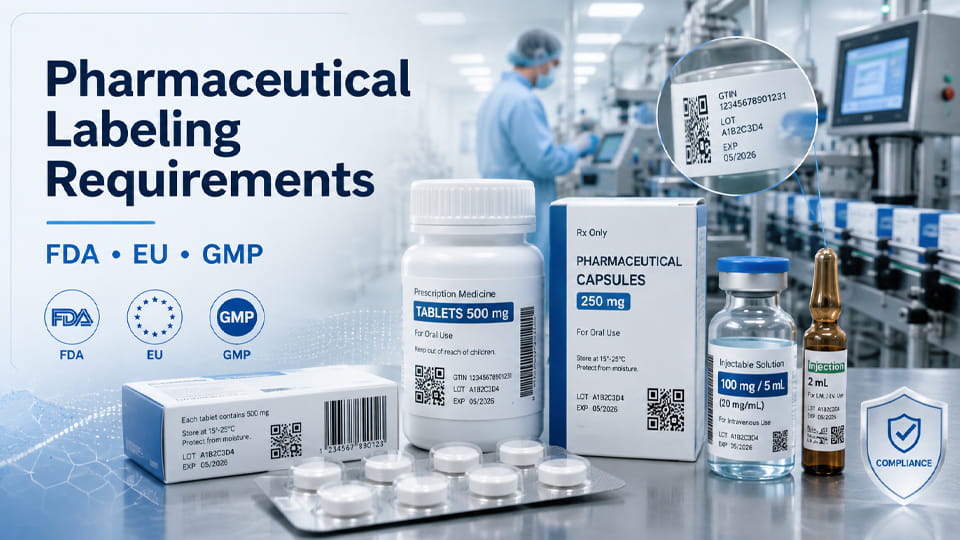
Les « exigences en matière d'étiquetage pharmaceutique » sont les règles qui régissent les informations qui doivent être imprimées sur l'emballage des médicaments.. Aux États-Unis, Directives de la FDA (et 21 Partie CFR 201) définir les déclarations et le format requis sur l'étiquette. Par exemple, Les directives de la FDA indiquent que tous les étiquetages de médicaments sur ordonnance doivent être conformes aux 21 CFR 201.56(d) & 201.57, couvrant le contenu et le format. Par règlement, « l'étiquetage » des médicaments sur ordonnance comprend trois éléments: les informations de prescription professionnelle (notice d'emballage), les étiquettes du carton et du contenant, et étiquetage des patients. En termes pratiques, les exigences en matière d'étiquetage garantissent que chaque emballage identifie clairement le médicament et son utilisation: la marque et le nom générique, ingrédient actif(s), force, forme posologique, quantité, et le nom/l'adresse du fabricant doivent apparaître, avec des informations de sécurité (avertissements, indications) et codes de traçabilité (lot, expiration). Ces règles protègent la sécurité des patients et permettent rappels de produits si nécessaire.
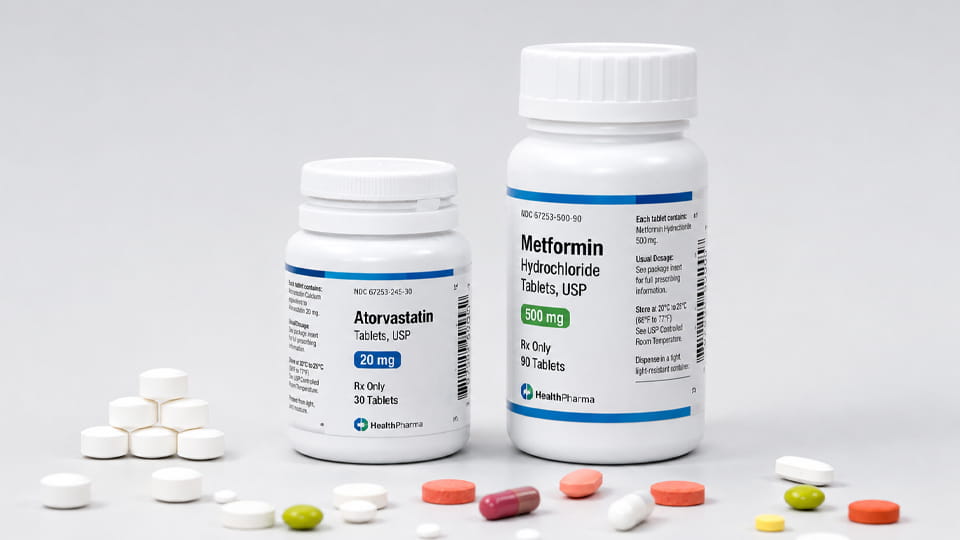
Autrement dit, les exigences en matière d'étiquetage établissent des normes minimales pour des informations lisibles et complètes sur l'emballage des médicaments. Ils visent à prévenir les erreurs médicamenteuses et à garantir que toute personne (patient, soignant ou inspecteur) peut vérifier le produit. Par exemple, La FDA répertorie explicitement la date de péremption et le code de lot comme obligatoires (voir l'encadré « L'étiquette vous le dit également » ci-dessous), et la législation de l'UE exige le lot et la date de péremption sur les cartons. Lignes directrices en matière de soins de santé (Ema, OMS) et les normes industrielles comme GS1 spécifient davantage les formats (par exemple. Codes-barres DataMatrix) pour soutenir la traçabilité mondiale. Dans l'ensemble, la conformité signifie que vos étiquettes doivent correspondre aux cases à cocher du tableau ci-dessous.
| Élément d'étiquette | But |
| Nom du produit (marque & générique) | Identifier le médicament par son nom, réduire la confusion. |
| Ingrédient actif(s) | Préciser la composition et les concentrations du médicament. |
| Force (dose) | Indiquer la posologie (par exemple. mg par comprimé/mL). |
| Forme posologique (comprimé, etc.) | Décrire la formulation (comprimé, capsule, liquide). |
| Contenu net (nombre/volume) | Afficher la quantité dans le colis (par exemple. 30 comprimés). |
| Numéro de lot/lot | Activer la traçabilité et le rappel si nécessaire. |
| Expiration (expiration) date | Assurez-vous que le médicament est utilisé avant qu’il ne perde son efficacité. |
| Nom du fabricant & adresse | Identifier la source de responsabilité. |
| Conditions de stockage | Instruire sur la température, lumière, humidité. |
| Avertissements/Précautions | Avertissements de sécurité (Par exemple, « Tenir hors de portée des enfants »). |
| Voie d'administration | Préciser l'utilisation (Par exemple, oral, injectable). |
| Utilisation/indication | (Facultatif) Indiquer ce qu'il traite (surtout. De gré à gré). |
| Codes réglementaires (N° NDC/MA.) | NOUS. Numéro d’autorisation de mise sur le marché NDC ou UE. |
| Avis inviolable | (Mention « inviolable » si nécessaire). |
| Code-barres/DataMatrix | Encode le GTIN, lot, expiration pour la numérisation. |
Chaque élément a une raison claire. Par exemple, le nom du produit et ses ingrédients aident les patients à obtenir le bon médicament; force, la forme et l'itinéraire garantissent un dosage correct; le stockage et les avertissements protègent la sécurité; le lot/lot et la date d'expiration assurent la traçabilité; et codes-barres (GS1 DataMatrix) laisser les machines analyser et vérifier le paquet. Autorités de régulation (FDA, Ema, etc.) nécessitent essentiellement tous ces éléments. Le tableau ci-dessus répertorie les champs courants et leur fonction. Dans tous les cas, les étiquettes doivent être lisibles (taille de police suffisante, contraste) et utiliser des formats standards (par exemple. Présentation « Drug Facts » de la FDA pour les médicaments en vente libre).
Aux États-Unis, Réglementations FDA (21 Partie CFR 201) et des lignes directrices détaillent le contenu des étiquettes des médicaments. Ordonnance (réception) drogues: Les principales exigences comprennent les (générique) nom du médicament (21 CFR 201.50), forme posologique, contenu net, et les directions (21 CFR 201.55). Les étiquettes doivent également afficher le nom et l'adresse du fabricant/emballeur/distributeur. (201.1), le Code National des Médicaments (201.2), et la mention « Rx Only » le cas échéant. Les identifiants critiques tels que le numéro de lot et la date d'expiration sont régis par 21 CFR 201.17-18. Par exemple, 201.17 impose l'emplacement de la date d'expiration sur l'emballage, et 201.18 nécessite un contrôle (parcelle) numéro d'identification. En pratique, La FDA insiste pour imprimer clairement le numéro de lot et la date d'expiration sur le contenant immédiat et le carton.. Par exemple, Les directives « Drug Facts » de la FDA indiquent explicitement que le lot (lot) le code et la date d'expiration doivent apparaître sur les étiquettes OTC, et la même logique s'applique aux médicaments Rx.
Médicaments en vente libre (Panneau d'informations sur les médicaments): Tous les médicaments en vente libre doivent porter l’étiquette standardisée « Drug Facts » de la FDA pour aider les consommateurs.. Ce panneau suit un format fixe avec des sections comme Ingrédient actif(s), But(s), Usages, Avertissements, Instructions, et ingrédients inactifs. L’objectif est la cohérence et la clarté (la même structure pour les analgésiques, médicaments contre les allergies, etc.). Par exemple, le « Ingrédient Actif(s)" La ligne répertorie la substance thérapeutique et la force, « Purpose » donne sa catégorie, et « Avertissements/Directions » fournissent des conseils d'utilisation. En plus de ces sections, chaque étiquette OTC doit indiquer une date d'expiration (ou règle d'expiration par défaut de 3 ans) et le code du lot, ainsi que le nom/adresse du fabricant et la quantité nette. La page de la FDA sur les faits sur les médicaments en vente libre le confirme: « L’Étiquette vous indique également… la date de péremption… Code de lot ou de lot… Nom et adresse du fabricant… Quantité nette ». Ne pas les inclure sur une étiquette OTC violerait les règles d'étiquetage de la FDA..
Les réglementations de la FDA répertorient de nombreuses déclarations d'étiquetage détaillées. Par exemple, 21 CFR 201.50-201.56 et 201.100-201.128 couvrir les étiquettes des contenants et les étiquettes des cartons. Certains faits saillants incluent:
Au-delà du CFR, Les directives de la FDA clarifient ces règles. Notamment, La FDA définit désormais l'étiquetage des médicaments sur ordonnance en trois parties: les informations de prescription professionnelle (notice d'emballage), l'étiquette physique sur le carton/conteneur, et toute brochure destinée aux patients. L’étiquette du contenant elle-même doit porter le nom établi du médicament, force, forme posologique, unités de dosage, numéro de lot, date d'expiration, CDN, et nom/adresse de l'entreprise – couvrant essentiellement toutes les cases à cocher de notre tableau ci-dessus. Ceux-ci garantissent que les pharmacies distribuent le bon produit et que les patients voient les informations clés en matière de sécurité..
Dans l'Union européenne, Directive 2001/83/CE (tel que modifié) et les réglementations connexes régissent l’étiquetage des médicaments. Les règles sont globalement similaires à celles des États-Unis, mais avec quelques différences. (par exemple. exigences linguistiques, détails de l'autorisation de mise sur le marché). Article 54 de 2001/83 précise ce qui doit figurer sur l'emballage extérieur (ou emballage immédiat si pas de suremballage). Il doit afficher le nom complet du produit, force, forme pharmaceutique, et voie d'administration. Il doit indiquer si le produit est destiné aux adultes ou aux enfants, le cas échéant., et énumérer tous les avertissements ou précautions spéciales (par exemple. température de stockage). Surtout, Article 54 nécessite la date de péremption et le numéro de lot sur l'emballage extérieur, accompagné de l'adresse du titulaire de l'autorisation de mise sur le marché (MAH) et le numéro d'autorisation de mise sur le marché UE. En pratique, cela signifie que les cartons européens doivent porter essentiellement les mêmes informations que les étiquettes américaines.: nom, ingrédients, force, quantité, avertissements, expiration, et lot, plus contact MAH.
Conseils et modèles EMA (Déclarations QRD) s'aligner sur ces règles. Pour les produits autorisés centralement, QRD (Examen de la qualité des documents) les modèles standardisent la formulation des déclarations clés. L’EMA s’est également récemment penchée sur la technologie moderne: il permet des codes QR en option ou une technologie de numérisation sur les étiquettes si approuvé. Marquages en braille (Article 56bis) sont nécessaires pour la plupart cartons de médicaments (indiquant le nom du produit, force, formulaire en braille) comme dispositif de sécurité pour les malvoyants. Chaque pays de l'UE exige également un étiquetage dans sa langue officielle(s). L'essentiel: Labels UE (primaire ou secondaire) doit transmettre tous les détails critiques du médicament en termes clairs (souvent plusieurs langues), similaire aux exigences américaines mais avec un accent supplémentaire sur l'identité du TAMM, numéros réglementaires, et dépliants multilingues.
Formats d'emballage primaire comme les blisters, les bouteilles et flacons posent des défis particuliers.
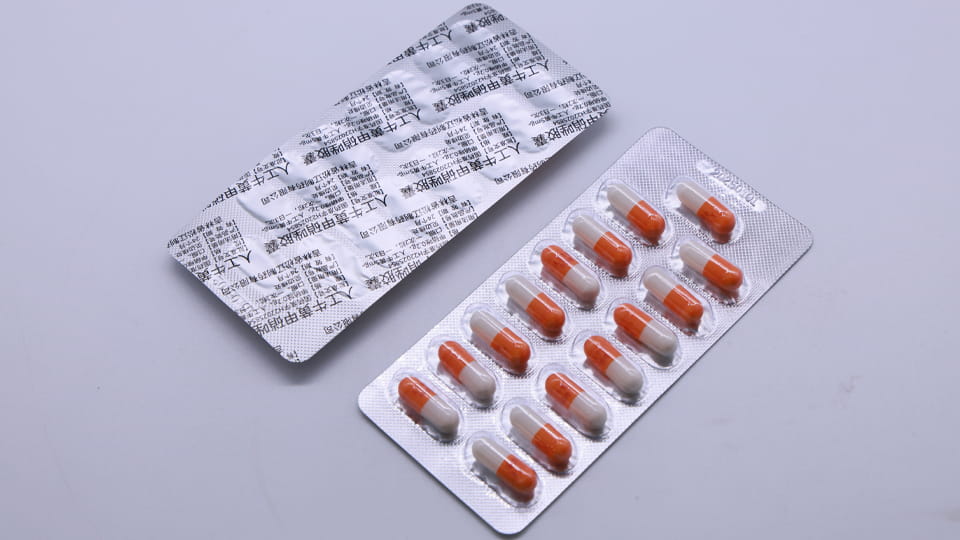
Packs de cloques: Par conception, une ampoule (bande de poches scellées) a un espace limité. Les régulateurs le reconnaissent: L'UE autorise souvent un étiquetage abrégé sur les cavités individuelles des blisters si tous les détails figurent sur le carton. (en utilisant une étiquette ou un dépliant « drapeau »). Aux États-Unis, étiquettes blister (par exemple. support en aluminium) doit toujours inclure le nom du médicament, force, numéro de lot et date de péremption. Notes de synthèse sur une industrie: "Emballage les étiquettes doivent inclure un nom propriétaire/générique, force, parcelle, expiration… et se conformer aux exigences de la FDA telles que la hauteur et le contraste minimum du texte. En pratique, les blisters ont souvent le nom et le code imprimés sur chaque cavité ou sur une étiquette en papier qui s'enroule autour. Parfois, une plaquette alvéolée porte une étiquette détachable couvrant plusieurs doses., mais il a toujours besoin des mêmes informations. L’inviolabilité est inhérente aux blisters scellés, mais si utilisé, une déclaration inviolable (par exemple. "ne pas utiliser si le sceau est brisé") est requis.
Bouteilles et flacons: Les bouteilles rondes utilisent généralement des étiquettes recto-verso. L'étiquette avant indique généralement le nom du produit, force et quantité pour une identification rapide, et la contre-étiquette a des instructions, avertissements et détails réglementaires. Machines d'étiquetage à la volée (voir ci-dessous) appliquez ces étiquettes sur les bouteilles. Un exemple tiré de la brochure de Jinlu Packing: l'étiqueteuse TBJ-120 est conçue pour les bouteilles rondes (20–110 mm de diamètre) et comprend un codeur à ruban en ligne pour l'impression des lots/expirations. Cela garantit que l'étiquette adhésive de chaque bouteille reçoit également le numéro de lot et la date d'expiration corrects, selon les besoins.. Pour les blisters et les flacons, la taille de la police et le contraste des couleurs doivent répondre aux normes légales (par exemple. FDA 21 CFR 201.15 sur la lisibilité). En bref, Les flux de travail d'étiquetage des blisters et des bouteilles sont conçus pour répondre aux mêmes règles de contenu : nom, ingrédients, lot et expiration - même si le mode de livraison (décollement, impression directe, ou un autocollant) diffère.
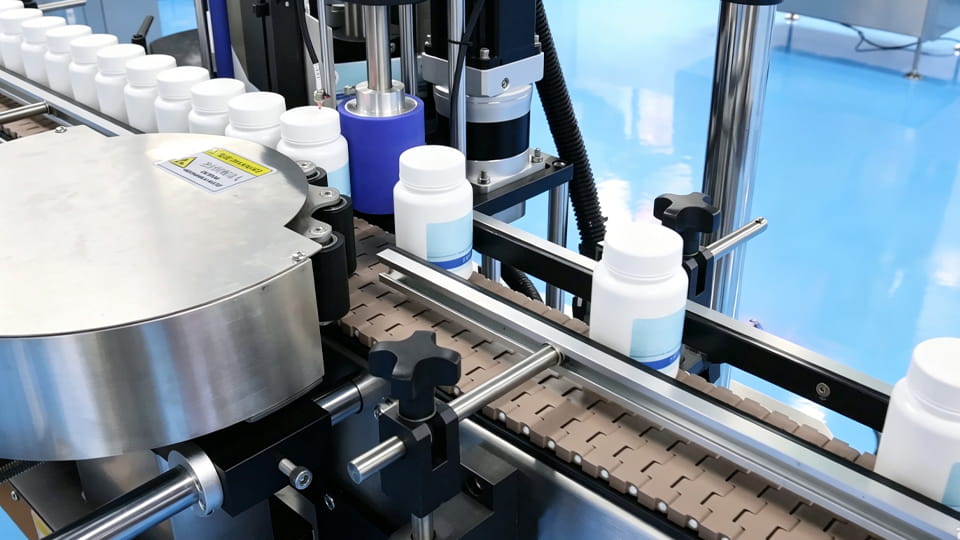
Chiffre: Flacons pharmaceutiques étiquetés sur une ligne de production. Les étiquettes des bouteilles doivent clairement afficher l'identité du produit (nom, ingrédient actif, force) et données réglementaires essentielles (numéro de lot, expiration, fabricant) afin que chaque flacon ou bouteille individuel puisse être vérifié.
L'impression des numéros de lot/lot et des dates de péremption est un élément essentiel de l'étiquetage. Dans les lignes pharmaceutiques, un équipement de codage dédié est utilisé pour imprimer ces informations à grande vitesse. Les technologies courantes comprennent Jet d'encre continu (CIJ) imprimantes, Jet d'encre thermique (SON) imprimantes, Surimprimantes à transfert thermique (BTT) et Codeurs laser.
Ces imprimantes sont généralement intégrées juste après l'étiquetage. Par exemple, une bouteille peut passer sous un codeur à jet d'encre immédiatement après l'application de l'étiquette, qui imprime le lot et l'expiration sur l'étiquette en ligne. La machine Jinlu TBJ-120 (au-dessus de) comprend un machine de codage de ruban tamponner des codes sur chaque étiquette. Quelle que soit la méthode, les données imprimées doivent être très lisibles et positionnées conformément à la réglementation (par exemple. près du bas du panneau d'affichage pour la date d'expiration). Formats lisibles par l'homme (comme AAMMJJ) doit correspondre à toutes les données du code-barres. Dans tous les cas, que ce soit par jet d'encre ou laser, l'objectif principal est le même: chaque emballage individuel doit porter son numéro de lot et sa date de péremption pour se conformer à la traçabilité GMP. Systèmes d'inspection (voir ci-dessous) vérifiera que chaque code imprimé est présent et correct.
Les réglementations modernes exigent souvent des codes lisibles par machine pour la traçabilité et la lutte contre la contrefaçon.. La norme mondiale est la GS1 DataMatrix 2D barcode, qui peut coder plusieurs éléments de données dans un petit symbole carré. Dans le domaine de la santé, la norme GS1 spécifie le codage de quatre attributs clés: GTIN (Numéro d'article du commerce mondial), date d'expiration, numéro de lot/lot, et numéro de série. Le GTIN identifie de manière unique le produit, tandis que les trois autres permettent le suivi et la vérification de chaque colis.
Aux États-Unis, le 2013 Loi sur la qualité et la sécurité des médicaments (DQSA) impose la sérialisation progressive des médicaments sur ordonnance. Par 2023, la loi sur la sécurité de la chaîne d'approvisionnement en médicaments exige un identifiant de produit sur chaque unité (qui comprend le lot et l'expiration) afin que les pharmacies puissent vérifier les produits à la réception. Dans l'UE, la directive sur les médicaments falsifiés (Directive 2011/62/UE) exige déjà des numéros de série uniques sur de nombreuses boîtes de médicaments sur ordonnance. Les colis UE doivent comporter un GS1 DataMatrix contenant le GTIN, le numéro de série attribué par le fabricant, date d'expiration et lot (identifiants d'application 17, 10). Les directives GS1 orientent explicitement les fabricants: "encodez votre GTIN, lot et date de péremption dans le code-barres GS1 DataMatrix et apposez-le sur le produit ». Certains marchés (Brésil, Inde, autres) adoptent également des exigences de sérialisation similaires.
Outre DataMatrix, les entreprises peuvent utiliser des codes QR ou RFID sur les étiquettes pour l'engagement des consommateurs ou la gestion des stocks, mais l'accent réglementaire reste mis sur les codes-barres 2D pour la conformité. Ces codes sont imprimés par des étiqueteuses spécialisées ou des codeurs sur l'emballage. Par exemple, une méthode consiste à demander à une imprimante laser ou à une imprimante d'étiquettes d'ajouter le DataMatrix après l'application de l'étiquette principale. Les systèmes de vision analysent ensuite le DataMatrix pour s'assurer qu'il se lit correctement. En encodant le lot et la date d'expiration dans le code barre, numériser à tout moment (distribution, distribution) vérifie instantanément ces valeurs. En résumé, la sérialisation signifie chaque emballage unitaire dispose d'un code scannable unique le reliant à ses données de production.
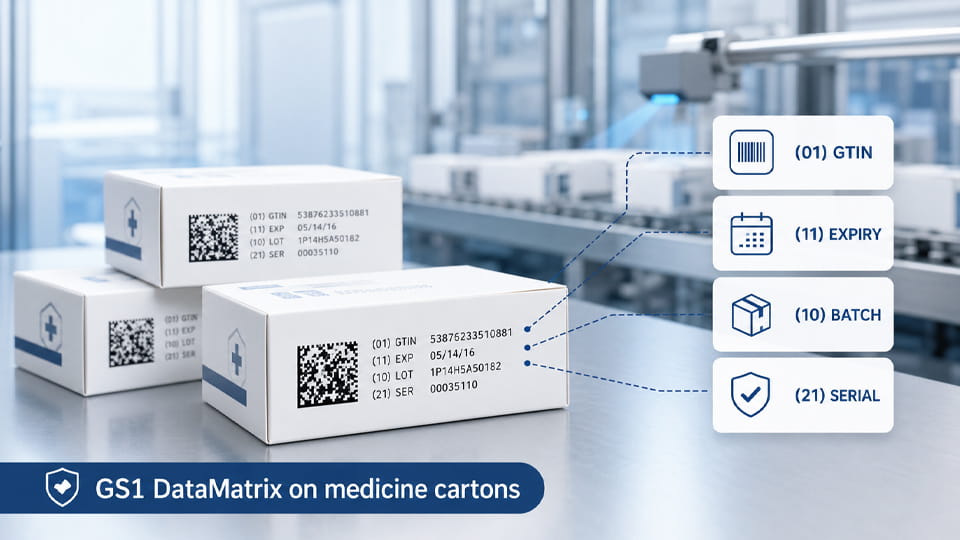
Chiffre: Code GS1 DataMatrix sur une boîte de médicaments contenant (01)GTIN, (11)expiration, (10)lot, (21)en série. Les emballages pharmaceutiques portent souvent un GS1 DataMatrix (2D barcode) avec le GTIN, date de péremption et numéro de lot/lot codés. Cela permet une analyse et une vérification à grande vitesse de toutes les données de suivi clés.
Les machines automatisées sont essentielles pour appliquer toutes les étiquettes et codes requis à la vitesse de la ligne. Un flux de travail typique d'emballage pharmaceutique avec étiquetage pourrait ressembler à ceci:
Remplissage/chargement de conteneurs → Étiqueteuse automatique → Lot & Codeur d'expiration → Marquage de codes-barres/sérialisation → Station d'inspection visuelle → Cartonnage / Emballage secondaire

Chiffre: Etiqueteuse automatique avec diviseur de bouteilles et codeur (Ils Étiqueteuse JL-TBJ-120). Les étiqueteuses automatiques appliquent des étiquettes adhésives sur les bouteilles, tandis qu'une imprimante intégrée tamponne le lot/expiration. Les étiqueteuses modernes peuvent fonctionner à grande vitesse (Par exemple, 120 bouteilles / minute) avec précision, et incluent souvent des imprimantes de code pour l'impression à jet d'encre/thermique du lot et de la date. Ces machines garantissent que les étiquettes et les codes sont appliqués de manière cohérente sur chaque conteneur..
En intégrant ces étapes, une ligne de conditionnement pharmaceutique garantit cela, du remplissage jusqu'à la mise en boîte finale, chaque unité est étiquetée correctement et traçable. Utiliser un système lié (ou une ligne de machines synchronisées) minimise les erreurs humaines. Pour inspection critique, les caméras de vision vérifient que chaque paquet est conforme. Finalement, équipement d'étiquetage de haute qualité (des alimentateurs de flacons aux applicateurs d'étiquettes en passant par les codeurs) rend le respect des règles d'étiquetage FDA/EMA réalisable à grande échelle.
Même avec précaution, des erreurs d'étiquetage peuvent survenir. Les problèmes courants incluent:
Les stratégies d'atténuation comprennent: protocoles de changement stricts (revérifiez les étiquettes lorsque vous changez de produit), contrôles en cours de processus (contrôles ponctuels manuels en ligne), et 100% inspection visuelle. Des lecteurs de codes automatisés vérifient que chaque code imprimé correspond au dossier de production. De nombreuses lignes disposent également de lecteurs de codes-barres de secours pour garantir la lisibilité des impressions de lot/expiration.. Garder les fichiers d'illustrations à jour et suivre les listes de contrôle linguistiques évite les erreurs de contenu.. Enfin, la fourniture d'étiquettes et d'encres doit correspondre aux exigences du système (par exemple. Encre résistante aux UV si nécessaire). Un processus d'assurance qualité robuste détectera les défauts d'étiquetage tôt avant la publication.
Utilisez cette liste de contrôle pour vous assurer que chaque étiquette et chaque emballage répondent aux exigences:
| Point de contrôle d'étiquetage | Complété? |
| Nom du produit (marque & générique) présent | ☐ |
| Ingrédient actif(s) répertorié (avec force) | ☐ |
| Force (dosage) clairement indiqué | ☐ |
| Forme posologique (comprimé, solution, etc.) compris | ☐ |
| Numéro de lot/lot imprimé et lisible | ☐ |
| Date de péremption imprimée et lisible | ☐ |
| Fabricant (nom & adresse) présent | ☐ |
| Conditions de stockage indiquées (par exemple. "Magasin <25°C”) | ☐ |
| Déclarations d'avertissement/prudence incluses | ☐ |
| Code-barres/DataMatrix (GTIN+expiration+lot) présent | ☐ |
| Contenu net (quantité ou volume) indiqué | ☐ |
| Codes réglementaires (CDN, numéro de licence) compris | ☐ |
| La taille et la lisibilité de la police sont conformes à la réglementation | ☐ |
| Déclaration inviolable (si nécessaire) | ☐ |
Examinez chaque point ci-dessus par rapport à vos étiquettes imprimées. Par exemple, La FDA exige explicitement la date de péremption et le numéro de lot, et les réglementations de l’UE imposent le nom du produit, force et contenu. Si un élément est manquant ou illisible, le colis n'est pas conforme. Cette liste de contrôle peut servir de tableau de référence pour les audits qualité..
Un étiquetage précis est un élément non négociable de la fabrication pharmaceutique. En comprenant les exigences ci-dessus, vous pouvez concevoir des étiquettes et des flux de travail conformes à la FDA, EMA et règles mondiales. N'oubliez pas les éléments clés de l'étiquette (identité du produit, ingrédients, informations de sécurité, et codage) et cochez-les avec la liste de contrôle de conformité. Les lignes d'emballage modernes utilisent des étiqueteuses automatisées, codeurs et systèmes de vision pour maintenir les taux d’erreur proches de zéro.
Si vous avez besoin d'un équipement robuste pour l'étiquetage et le codage, Considérez les solutions de Jinlu Packing. Jinlu propose une gamme de machines d'emballage pharmaceutique - depuis étiqueteuses automatiques de bouteilles (par exemple. la série TBJ) à codeurs de lots/expirations et complet lignes d'encartonnage – tous conçus pour Conformité BPF. Nos machines intègrent l'étiquetage, impression et inspection pour vous aider à répondre facilement aux exigences d'étiquetage. Par exemple, L'étiqueteuse de bouteilles rondes de Jinlu gère les bouteilles de 20 à 110 mm jusqu'à 120 bpm, application d'étiquettes et impression de codes de date/lot en un seul passage. Explorez les étiqueteuses et les encartonneuses de Jinlu pour plus de détails. En combinant de bons processus avec le bon équipement, vous pouvez vous assurer que chaque emballage de médicament est correctement étiqueté pour des raisons de sécurité et de conformité.
Les exigences en matière d’étiquetage pharmaceutique sont les règles qui définissent les informations qui doivent apparaître sur l’étiquette d’un médicament., récipient, carton, ou notice. Ils peuvent couvrir le nom du produit, ingrédients actifs, force, forme posologique, numéro de lot, date d'expiration, avertissements, conditions de stockage, détails du fabricant, et autres informations réglementaires. Les exigences varient selon les pays, type de drogue, et format d'emballage.
Une étiquette pharmaceutique devra peut-être inclure le nom du produit, ingrédient actif, force, forme posologique, contenu, numéro de lot ou de lot, date d'expiration, informations sur le fabricant ou l’autorisation de mise sur le marché, conditions de stockage, avertissements, et d'autres détails spécifiques au marché. Les informations exactes dépendent du cadre réglementaire applicable et de la catégorie de produit.
Aux États-Unis, les étiquettes des médicaments doivent être conformes aux réglementations d'étiquetage applicables de la FDA, y compris 21 Partie CFR 201. Les exigences diffèrent entre les médicaments sur ordonnance et les médicaments en vente libre. L'étiquetage des médicaments sur ordonnance respecte des exigences telles que 21 CFR 201.56 et 201.57, tandis que les produits OTC utilisent généralement le format standardisé Drug Facts sous 21 CFR 201.66.
Les exigences de l’UE en matière d’étiquetage pharmaceutique exigent généralement des informations clés telles que le nom du médicament., force, forme pharmaceutique, substances actives, contenu, excipients pertinents, date d'expiration, et numéro de lot. Des exigences supplémentaires peuvent s'appliquer en fonction du produit et du marché. Le cadre de l'UE comprend également des exigences relatives aux notices et aux caractéristiques d'accessibilité telles que le braille sur les emballages..
Oui, l'identification d'un lot ou d'un lot est un élément important de l'emballage et de la traçabilité pharmaceutiques. Par exemple, Les règles de l'UE exigent spécifiquement le numéro de lot sur certains emballages primaires, y compris les blisters, accompagné d'informations telles que le nom du produit et la date de péremption. Les exigences spécifiques peuvent varier selon le marché et le type de produit.
Une date de péremption est requise sur de nombreux emballages pharmaceutiques et constitue un élément clé de l'identification du produit et de son utilisation sûre.. Par exemple, Les exigences de l'UE précisent les informations sur la date de péremption pour les emballages immédiats tels que les blisters et les petites unités d'emballage.. Le format et l'emplacement exacts dépendent des exigences du marché applicables.
Les exigences en matière de blister dépendent du marché et de la configuration de l'emballage.. Selon les règles de l'UE, les plaquettes thermoformées placées à l'intérieur d'un emballage extérieur doivent contenir des informations clés, notamment le nom du médicament, titulaire d'une autorisation de mise sur le marché, date d'expiration, et numéro de lot. Les informations doivent également être lisibles, compréhensible, et indélébile.
La sérialisation pharmaceutique est l'attribution et la gestion d'un identifiant unique pour un emballage de médicament vendable individuel afin de prendre en charge l'identification et la traçabilité du produit.. La sérialisation fonctionne généralement avec des codes 2D et d'autres systèmes d'identification de produits, mais les exigences exactes dépendent du marché cible et des réglementations applicables.
Les équipements d'étiquetage et de codage pharmaceutiques courants comprennent les étiqueteuses automatiques, étiqueteuses de bouteilles, systèmes de codage par lots, imprimantes jet d'encre ou laser, lecteurs de codes à barres, systèmes d'inspection visuelle, et équipement de sérialisation. La bonne configuration dépend du format d’emballage, vitesse de production, conception d'étiquettes, exigences en matière de données variables, et niveau d'inspection requis.
Les fabricants doivent d'abord identifier les exigences de chaque marché cible et produit., puis approuvez les illustrations de l'étiquette et les données variables avant la production. La ligne de conditionnement doit également contrôler la sélection des étiquettes, impression par lots et date de péremption, données de code à barres ou de sérialisation, positionnement des étiquettes, inspection visuelle, et rejet des produits incorrects. Les procédures BPF doivent prendre en charge la documentation, dégagement de ligne, commande de changement, et traçabilité.
Références:
1.Foire aux questions sur l’étiquetage des médicaments sur ordonnance —— NOUS. Administration des aliments et des médicaments
2.Ressources sur l'étiquetage des cartons et des contenants —— NOUS. Administration des aliments et des médicaments
3.TRS 902 – Annexe 9: Lignes directrices sur l'emballage des produits pharmaceutiques —— OMS
4.Exigences en matière d'informations sur les produits —— Agence européenne des médicaments
5.Annexe à la ligne directrice de la Commission européenne sur les « Excipients dans l'étiquetage et la notice des médicaments à usage humain »’ —— Agence européenne des médicaments
6.21 CFR§ 201.66 – Exigences de format et de contenu pour les produits en vente libre (De gré à gré) étiquetage des produits pharmaceutiques. —— Institut d'information juridique