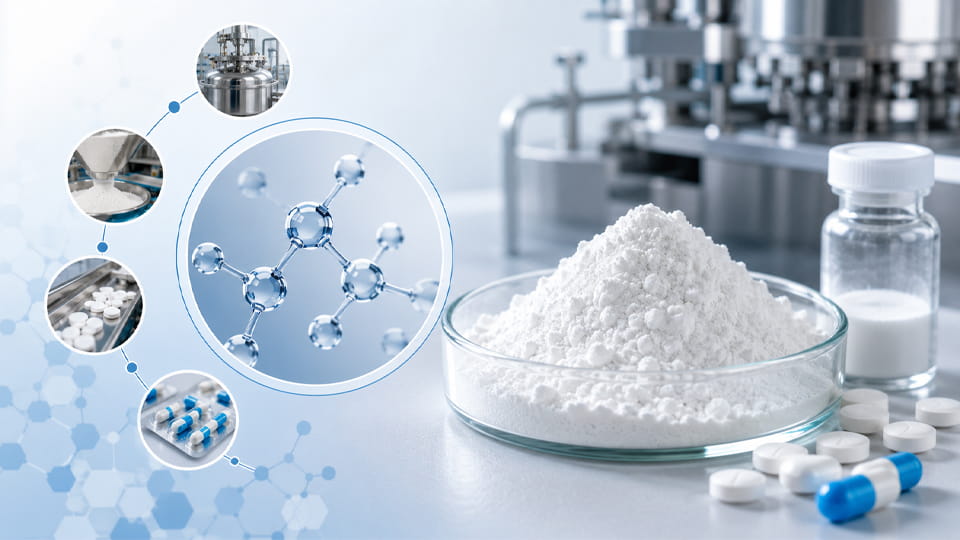
Si vous vous êtes déjà demandé ce qui fait réellement fonctionner un médicament, la réponse est généralement la API (Ingrédient pharmaceutique actif). Que ce soit une tablette, capsule, injection, ou du sirop, l'API est le composant responsable de la production de l'effet thérapeutique souhaité. En termes simples, c'est la partie du médicament qui traite la maladie, soulage les symptômes, ou donne le résultat médical souhaité, tandis que d'autres ingrédients, appelés excipients, soutiennent principalement la formulation et l'administration.. Pour les fabricants de produits pharmaceutiques, équipes d'approvisionnement, et responsables de production, comprendre les API est essentiel car elles impactent directement la qualité des produits, conformité réglementaire, procédés de fabrication, et finalement la sécurité des patients.
Que signifie l'API dans les produits pharmaceutiques?
Un API est le Ingrédient pharmaceutique actif - le substance médicamenteuse active dans un médicament qui procure son effet thérapeutique. En termes simples, c'est le produit chimique (ou biologique) composant qui fait le travail (par exemple. faire baisser la fièvre, tuer les bactéries, soulager la douleur). Par exemple, dans un comprimé d'acétaminophène, acétaminophène elle-même est l'API; les autres ingrédients (classeurs, charges, revêtements) sont excipients. Les États-Unis. Le National Cancer Institute définit une API comme « l’ingrédient principal d’un médicament qui provoque l’effet souhaité du médicament ».
En pratique, la fabrication de médicaments commence par un ou plusieurs API et les transforme en produit final (comprimé, capsule, liquide, etc.) sous des contrôles de qualité stricts. Comme le note une source, fabrication pharmaceutique essentiellement « signifie transformer les principes actifs pharmaceutiques (Apis) et excipients en formes posologiques (comme des tablettes, gélules, liquides, ou injectables) à travers diverses opérations unitaires (fraisage, granulation, compression, revêtement, remplissage, etc.)». Chaque étape doit être précise: les régulateurs exigent que chaque lot « contienne les ingrédients et la force qu’il prétend avoir ». En bref, sans API, il n’y aurait pas de médicaments – ce sont eux les épine dorsale de la formulation des médicaments.
Définition de l’ingrédient pharmaceutique actif (API)
- API (aussi appelé le substance médicamenteuse ou composant pharmacologiquement actif) est l'ingrédient d'un médicament qui le rend efficace. Par exemple, amoxicilline est l'API dans une pilule antibiotique (ça tue les bactéries).
- But: Les API fournissent le effet thérapeutique. Sans l'API, un « médicament » serait simplement une poudre ou un liquide inerte.
- Vue réglementaire: La FDA et l'EMA considèrent les API comme faisant partie du Réglementé CGMP Des lignes directrices comme Je Q7 garantir que les API sont fabriquées selon des normes de qualité strictes.
Les API sont souvent des poudres ou des concentrés de haute pureté; ils sont ensuite mélangés à des excipients et transformés en pilules, gélules, ou d'autres formes posologiques (voir ci-dessous). Le point clé est que Les API sont les médicaments actifs, alors que tout le reste dans la formulation aide simplement à administrer le médicament de manière sûre et efficace.
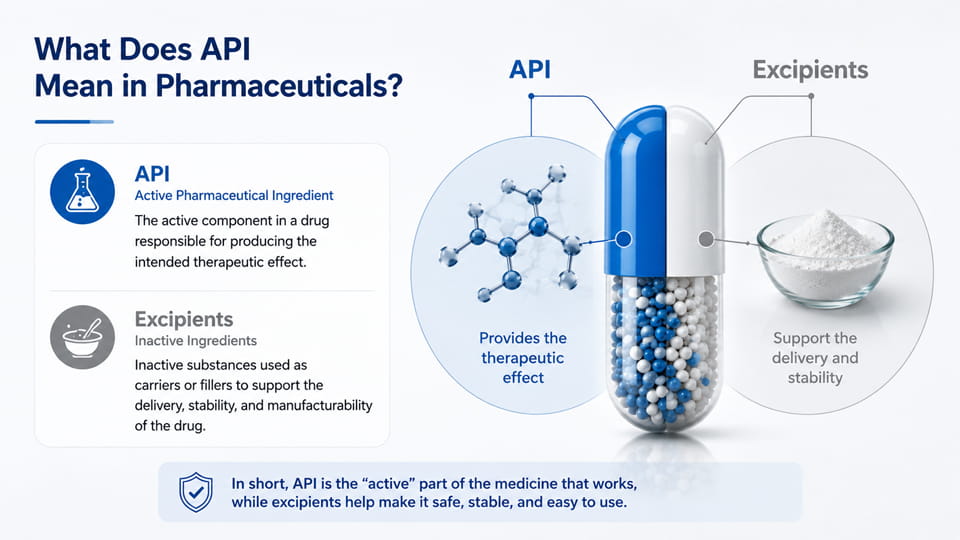
API contre. Excipients: Quelle est la différence?
| Fonctionnalité |
API (Ingrédient actif) |
Excipient (Ingrédient inactif) |
| Rôle/Fonction |
Fournit le effet thérapeutique (médicament actif) |
Sert de transporteur, liant, filler, stabilisateur, etc., pour l'API |
| Activité pharmacologique |
Oui – biologiquement actif. |
Non – pharmacologiquement inerte. |
| Quantité typique |
Généralement petite quantité (mg ou µg). |
En général en gros de formulation. |
| Exemples |
Paracétamol (acétaminophène), amoxicilline, atorvastatine, etc.. |
Lactose, cellulose microcristalline, stéarate de magnésium, etc.. |
| Importance |
Crucial pour l’efficacité; détermine la fonction du médicament. |
Assure la stabilité de la pilule, fabricabilité, et biodisponibilité. |
Autrement dit, Les API sont les parties « actives », alors que les excipients sont les parties « de support ». Comme l'explique une source de l'industrie: « Les API sont des médicaments en vrac qui sont pharmaceutiquement actifs et génèrent un effet pharmacologique souhaité., considérant que les excipients sont des substances pharmacologiquement inactives qui sont généralement utilisées comme support de l'IPA".
- Apis: Actif, puissant, et nécessitent généralement une manipulation prudente. Ils ne représentent souvent que quelques pour cent du poids d’un comprimé., mais sans eux, le médicament ne fait rien.
- Excipients: Inactif, poudres/liquides souvent comestibles ou inertes. Ils ajoutent du volume, aide à l'absorption, améliorer la stabilité, et rendre la fabrication possible. Par exemple, la poudre de lactose est une charge courante; la povidone est un liant; le stéarate de magnésium est un lubrifiant; divers revêtements contrôlent la libération.
Il faut les deux: API pour l'effet, excipients pour produire cet effet en toute sécurité, forme posologique stable. Comprendre la différence est essentiel dans la fabrication pharmaceutique.
Types d'API pharmaceutiques
Les API arrivent deux grandes catégories: petite molécule (synthétique) médicaments et produits biologiques.
- API synthétiques (Petites molécules): Ce sont des produits chimiques de faible poids moléculaire fabriqués par synthèse chimique. Ils comprennent des pilules classiques comme aspirine, paracétamol. La synthèse peut être linéaire (réactions à un pot) ou en plusieurs étapes. Les API synthétiques sont généralement des poudres cristallines (certains hygroscopiques) qui nécessitent des réactions chimiques et une purification précises. La plupart des médicaments génériques et de nombreux blockbusters entrent dans cette catégorie.. Par exemple, l'antihistaminique cétirizine et le médicament contre la tension artérielle losartan sont des API synthétiques à petites molécules. Leur production permet souvent un contrôle strict de la pureté et de la consistance.
- API naturelles (Sources dérivées/biologiques): Certaines API sont extraites de sources naturelles. Cela inclut les composés d'origine végétale (par exemple. digoxine de la digitale) ou vitamines fabriquées par fermentation (par exemple. vitamine C par fermentation microbienne). Fermentation (en utilisant des bactéries ou de la levure) peut produire des composés comme des antibiotiques (pénicilline) ou des statines hypocholestérolémiantes. Les API naturelles peuvent avoir plus de variabilité (en raison du matériel source) et nécessitent souvent une purification supplémentaire. Ils sont généralement moins courants dans les sociétés pharmaceutiques modernes axées sur la synthèse., mais se développent dans les nutraceutiques et les médicaments « botaniques ».
- API biotechnologiques/biologiques: Ce sont de grandes, molécules complexes fabriquées par des processus biologiques (culture cellulaire ou ADN recombinant). Ils comprennent anticorps monoclonaux (mAb), protéines thérapeutiques, vaccins, et biosimilaires. Par exemple, trastuzumab (Herceptine) et insuline sont des API biotechnologiques. Ils sont généralement produits par des cellules génétiquement modifiées (par exemple. bactéries, levure, ou cellules de mammifères) puis récolté et purifié. Les produits biologiques nécessitent une fermentation stérile et une purification complexe. Bien que nous nous concentrions principalement sur les API à petites molécules, la tendance de l'industrie est que les produits biologiques représentent désormais une part croissante des nouveaux médicaments.
Un moyen utile de se souvenir: Petites molécules sont chimiquement synthétisés et généralement des pilules; Produits biologiques à grosses molécules proviennent de systèmes vivants et sont souvent injectables. Chaque type a son propre parcours de fabrication et réglementaire, mais les deux sont des « API » tant qu’ils constituent l’ingrédient actif d’un médicament final..
Comment sont fabriquées les API?
La production d'API est un processus complexe, processus en plusieurs étapes impliquant une chimie ou une biologie minutieuse. Un simplifié organigramme de fabrication typique d'API (pour les API synthétiques à petites molécules) est montré ci-dessous:
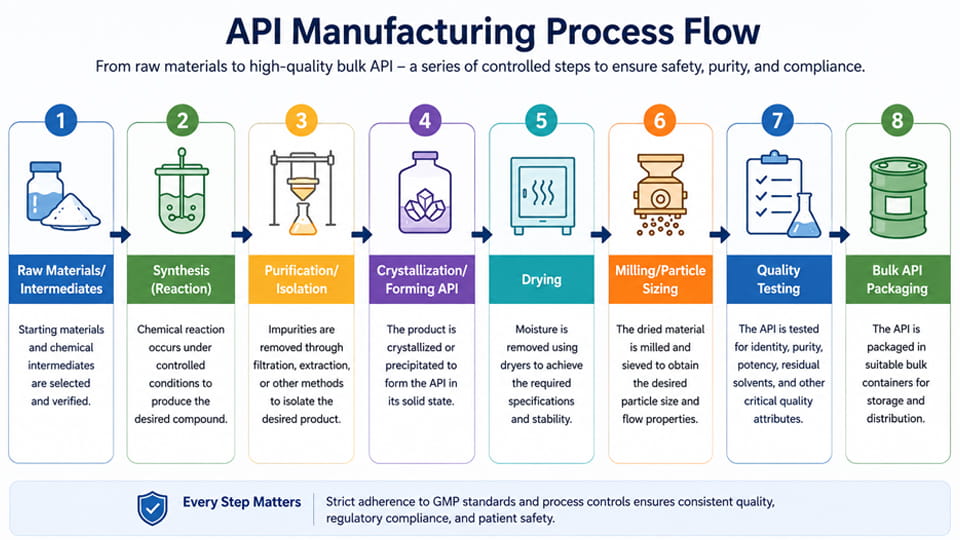
- Matières premières/intermédiaires: Le processus commence avec des éléments de base chimiques bruts (réactifs souvent disponibles dans le commerce ou intermédiaires préalablement synthétisés). Chaque étape chimique doit utiliser des ingrédients de haute qualité pour éviter les impuretés.
- Synthèse (Réaction): Les chimistes effectuent une ou plusieurs réactions chimiques (réacteurs discontinus ou réacteurs à flux) pour construire la molécule API. Cela peut impliquer plusieurs étapes (Par exemple, ajouter des groupes fonctionnels, former des anneaux). Conditions de réaction (solvant, température, catalyseurs) sont étroitement contrôlés. Pour les API biotechnologiques, cette étape est remplacée par une fermentation biologique/culture cellulaire pour produire la molécule.
- Purification/Isolement: Après chaque étape de réaction, le mélange est purifié pour éliminer les sous-produits indésirables. Les techniques incluent l'extraction liquide-liquide, filtration, chromatographie, cristallisation, etc.. Le but est d'isoler l'intermédiaire ou l'API sous une forme pure.
- API de cristallisation/formage: L'API finale est souvent cristallisée à partir d'une solution. Cela crée des cristaux solides de l'API avec un polymorphe et une pureté définis. La cristallisation améliore la pureté (les impuretés restent en solution) et donne de bonnes propriétés physiques.
- Séchage: Les cristaux humides sont séchés (par exemple. dans un sèche-linge) pour éliminer complètement le solvant. Le solvant résiduel doit respecter les limites réglementaires.
- Broyage/granulométrie: L'API séché peut être broyé ou tamisé pour obtenir la taille de particule souhaitée.. La taille des particules affecte la façon dont l'API se mélange et se dissout dans le produit médicamenteux final.
- Tests de qualité: A chaque grande étape (surtout l'API finale), le matériel est testé pour son identité, pureté, puissance, et solvants résiduels. Méthodes analytiques (HPLC, spectroscopie, etc.) confirmer qu'il répond aux spécifications.
- Emballage d'API en vrac: La poudre API finale est conditionnée dans des (souvent inerte) des contenants pour le protéger de l'humidité, lumière, et contamination. Ceux-ci sont étiquetés et stockés par Exigences BPF.
Chaque étape doit suivre cgMP (Bonnes pratiques de fabrication actuelles) règles. Par exemple, Je Q7 (et BPF de l'OMS) fournir des conseils spécifiques aux API. Comme le note l'OMS, « La rigueur des BPF dans la fabrication des API devrait augmenter à mesure que le processus passe des premières étapes de l'API aux étapes finales., purification, et emballage ». En pratique, cela signifie une documentation rigoureuse, nettoyage validé des équipements, personnel qualifié, et contrôles en cours de processus.
Technologie analytique des processus (TAPOTER) et l'automatisation sont de plus en plus utilisées pour suivre les réactions en temps réel. L'industrie s'oriente également vers fabrication continue où les matières premières circulent en continu à travers des étapes de réaction et de purification au lieu d'exécutions par lots. Les processus continus peuvent améliorer l’efficacité et la cohérence, bien que la production par lots reste courante.
En résumé: La fabrication d'API est une ligne de production hautement contrôlée, depuis les produits chimiques bruts ou les cultures cellulaires jusqu'à l'ingrédient actif fini, avec des portes de qualité strictes à chaque étape. Le résultat est une API groupée sécurisée, puissant, et prêt à être formulé en médicament.
Contrôle qualité API et exigences GMP
La qualité est primordiale dans la production d'API. Agences de régulation (FDA, Ema, etc.) exiger que les fabricants d'API suivent strictement Bonnes pratiques de fabrication (GMP) pour garantir que chaque lot répond aux normes de qualité. Pour les API, ICH Q7 est une ligne directrice clé qui décrit les BPF spécifiques aux ingrédients actifs. Certains aspects critiques comprennent:
- Documentation & Validation: Tous les processus doivent être bien documentés. Étapes critiques (comme une cristallisation finale) sont validés pour montrer qu'ils produisent de manière fiable des API de qualité acceptable. Les installations et équipements doivent être qualifiés.
- Tests de pureté et d'identité: Chaque lot d'API est testé pour vérifier son identité (c'est le bon produit chimique), pureté (exempt d'impuretés ou de sous-produits indésirables), et puissance (la bonne concentration de molécules actives). Par exemple, Les tests HPLC ou spectrométrie sont utilisés pour détecter même des traces d'impuretés. Toute contamination pourrait être nocive dans un produit médicamenteux.
- Contrôle des impuretés: Les fabricants fixent des limites acceptables pour certaines impuretés (métaux lourds, solvants résiduels, matières premières n'ayant pas réagi). Si les niveaux dépassent les seuils, le lot est rejeté ou retraité.
- Tests de stabilité: Les API doivent rester stables pendant le stockage. Etudes de stabilité (par exemple. vieillissement accéléré) assurez-vous que l'API ne se dégradera pas ou ne perdra pas sa puissance avec le temps. Conditionnement (voir la section suivante) reflète également cela.
- Traçabilité: Les matières premières et chaque étape du processus doivent être traçables. Si un problème survient dans un médicament final, les fabricants doivent retracer les enregistrements de production.
- Conformité aux BPFc: Les agences inspectent fréquemment les usines d'API. Comme le résume une source: Les directives BPF visent à garantir que chaque médicament contient « les ingrédients et la force qu’il prétend avoir ».. Cela signifie que les producteurs d'API doivent prouver que leur API est cohérente à chaque lot..
- Dépôts réglementaires: Les fabricants d'API soumettent des données sur leurs processus (Chimie, Fabrication, Contrôles – Section CMC dans les demandes de médicaments) aux autorités. Tout changement de processus (par exemple. une nouvelle impureté) peut nécessiter une nouvelle approbation.
Organisation Mondiale de la Santé (OMS) les orientations soulignent que la rigueur augmente vers les dernières étapes. Les premiers intermédiaires peuvent avoir moins de contrôles, mais une fois qu'un matériau de départ API est défini (le point à partir duquel les BPF s'appliquent), les étapes ultérieures (cristallisation, purification finale) sont tenus aux normes les plus élevées.
En bref, Le contrôle qualité de l’API est complet: « L'assurance qualité est un aspect essentiel de la fabrication des API » et GMP couvre tout « depuis l'approvisionnement en matières premières jusqu'aux tests du produit final ».. Cela garantit que l’API finale sera sûre et efficace une fois transformée en médicament..
API contre. Produit pharmaceutique fini (FPP)
Il est important de distinguer les API de la forme posologique finie (la finale, médecine prête pour le patient).
- API (Ingrédient actif / Substance médicamenteuse): La substance chimique ou biologique active pure, généralement sous forme de poudre ou de solution. Il a subi toutes ses étapes de fabrication jusqu'aux tests de pureté. C'est pas généralement administré seul aux patients (sauf sous forme IV), mais plutôt combiné avec des excipients et traité ultérieurement.
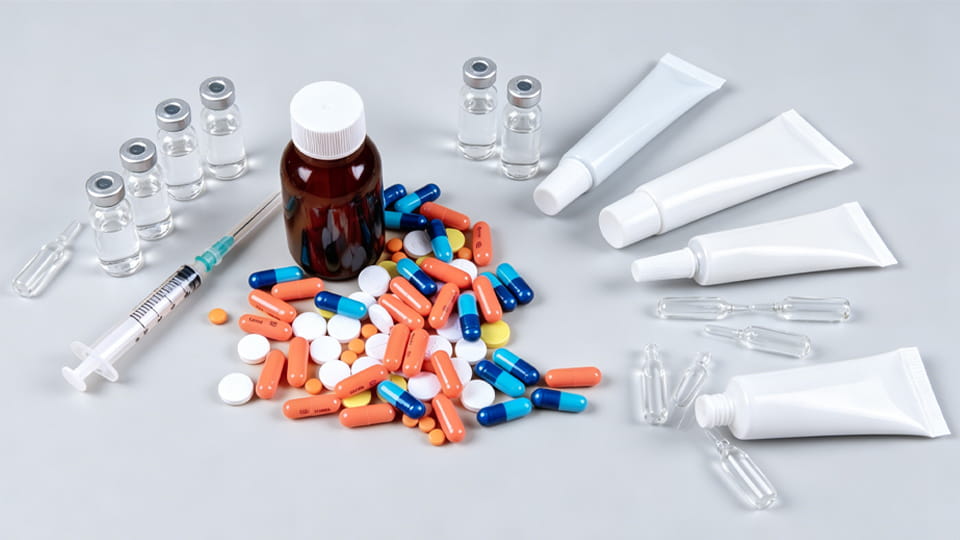
- Produit pharmaceutique fini (FPP, ou forme posologique finie): C'est le dernier médicament sur les étagères – les comprimés, gélules, sirops, injections, etc.. Il contient l'API plus tous les excipients requis, emballé pour l'administration.
Le FPP détermine comment l'API est fournie en pratique. Selon les définitions réglementaires, une forme posologique finie est « la forme finale, médicament entièrement fabriqué qui contient la substance médicamenteuse et tous les excipients requis, et est traité dans un format de livraison spécifique, comme une tablette, capsule, injection, etc.".
Différences clés:
- Formulaire: L'API est généralement une poudre brute ou un granulé; FPP est une tablette, capsule, liquide, etc..
- Utiliser: Les API sont gérées dans la fabrication; Les FPP sont utilisés par les prestataires de soins de santé et les patients.
- Étiquetage: Les FPP doivent porter un étiquetage complet (dosage, instructions, expiration, etc.); Les conteneurs API ont des étiquettes techniques pour une utilisation en fabrication.
- Règlement: Les FPP exigent une preuve de sécurité/efficacité chez les patients; Les API doivent répondre aux spécifications de pureté/puissance. Les deux doivent être conformes aux BPF, mais FPP est également confronté à des obstacles réglementaires supplémentaires (essais cliniques, approbation de commercialisation).
| Scène |
Définition/Exemple |
| API (Substance médicamenteuse) |
Le composé médicamenteux actif seul (par exemple. poudre de gentamicine). |
| Produit médicamenteux fini |
La forme du médicament (par exemple. injection de gentamicine) contenant l'API et les excipients. |
Ainsi, l'API est le agent médicinal de base, tandis que le produit fini correspond à la façon dont cet agent est formulé et emballé pour être utilisé. Une bonne fabrication garantit que « le produit pharmaceutique fini contient le bon API dans la bonne concentration ». Équipement d'emballage comme presses à comprimés ou charges de capsule puis convertissez les mélanges API-excipients en FPP, qui sont scellés dans des blisters, bouteilles, ou d'autres conteneurs.
Les défis de la fabrication d'API
Les producteurs d’API sont confrontés à plusieurs défis industriels:
- Conformité réglementaire: Les API doivent respecter les règles GMP (par exemple. Je Q7, Directives FDA/EMA). Se tenir au courant de l'évolution des réglementations à l'échelle mondiale peut s'avérer complexe. Le non-respect peut arrêter la production ou entraîner des amendes.
- Contrôle de qualité: Maintenir une qualité constante lot après lot est difficile. De petites variations dans les matières premières ou les conditions de réaction peuvent créer des impuretés. Des tests analytiques robustes sont nécessaires à chaque étape.
- Coûts de production élevés: Construire et exploiter des installations GMP (salles blanches, réacteurs, traitement des déchets) c'est cher. Les coûts incluent l’investissement en capital, personnel formé, et équipements spécialisés (par exemple. filtres pour API stériles). Réduire les coûts tout en maintenant la qualité est un combat constant.
- Risques liés à la chaîne d'approvisionnement: De nombreuses API s'appuient sur des fournisseurs dans des pays spécifiques (par exemple. matières premières d'Asie). Problèmes géopolitiques, les catastrophes naturelles ou les pandémies peuvent perturber les approvisionnements. Ces dernières années ont été marquées par des pénuries de matières premières clés, forcer des décisions d'approvisionnement urgentes.
- HPAPI (API très puissantes): Un sous-ensemble croissant d'API (par exemple. médicaments oncologiques, hormones) sont extrêmement puissants. Ils peuvent être toxiques à très faible dose, présentant des risques pour la santé des travailleurs. La fabrication des HPAPI nécessite confinement spécialisé: isolateurs fermés, échappement filtré, combinaisons de protection, etc.. Comme le note une étude de l’industrie, Les HPAPI présentent « des défis de gestion et nécessitent de lourds investissements dans un confinement spécialisé » pour protéger les employés et l’environnement.. En fait, de nombreuses entreprises construisent désormais des usines HPAPI dédiées pour un coût « de millions de dollars au-delà des installations GMP typiques ».. Des équipements tels que des réacteurs automatisés confinés et des broyeurs spécialisés sont nécessaires.
- Règlements environnementaux: La production d'API peut générer des déchets dangereux et utiliser des solvants. Des lois environnementales plus strictes poussent les fabricants à adopter la « chimie verte » (recyclage des solvants, procédés catalytiques) ou investir dans le traitement des déchets, ajoutant de la complexité et du coût.
- Concurrence sur le marché: Les expirations de brevets entraînent une concurrence générique, faire baisser les prix des API. Les fabricants d’API doivent donc être efficaces pour rester rentables. Inversement, développement nouveau Les API pour les médicaments innovants sont risquées et coûteuses.
- Coût des matières premières: Des prix fluctuants (par exemple. pour réactifs chimiques ou réactifs biotechnologiques) peut réduire les marges.
Ces défis signifient que les fabricants d'API doivent investir en permanence dans l'optimisation des processus., conformité, et résilience. Comme le conseille une source, la mise en œuvre de systèmes de qualité robustes et la mise à jour des réglementations sont des stratégies clés. En résumé: maintenir une qualité élevée sous la pression des coûts, et assurer la sécurité (spécialement pour les HPAPI), sont les principaux obstacles à la production d’API modernes.
Pourquoi l'emballage est important pour les médicaments basés sur API
Une fois qu’un API est fabriqué et formulé en médicament, conditionnement devient crucial pour protéger la qualité de ce produit et assurer la sécurité des patients. Un emballage fonctionnel protège le médicament (et son API) des facteurs environnementaux et garantit que la dose correcte est délivrée. Les principales considérations en matière d'emballage comprennent:
- Protéger la stabilité: De nombreuses API (et les produits pharmaceutiques finaux) sont sensibles à humidité, oxygène, lumière, et la température. Par exemple, l'humidité peut provoquer la dégradation des API ou la dissolution prématurée des comprimés. Pour lutter contre cela, les blisters utilisent souvent des films à haute barrière. Packs de cloques fournir une protection à dose unitaire: chaque comprimé/capsule est scellé dans sa propre pochette, le protégeant de l’humidité et de la contamination. Bouteille (ampoule) conditionnement utilise déshydratants et des flacons opaques ou ambrés pour protéger de l'humidité et de la lumière. En bref, le bon conteneur et les bons matériaux maintiennent l'API puissante jusqu'à son utilisation.
- Prévenir la contamination: Scellé, Emballage de sabotage garantit que le médicament reste stérile ou non contaminé. Pour les API injectables, des flacons aseptiques sont utilisés. Même pour les pilules, les blisters et les flacons doivent être scellés pour éviter toute altération.
- Dosage précis: Les blisters et les packs doseurs peuvent appliquer doses unitaires (un comprimé par cavité). Les bouteilles ont souvent des bouchons avec sécurité enfants (exigence réglementaire). Machines de remplissage/bouchage précises (comme les lignes d'embouteillage de Jinlu) garantit le comptage correct et la fermeture sécurisée. Des pilules mal comptées ou des capsules lâches peuvent entraîner- ou surdosage.
- Conformité & Information: L'emballage fournit un étiquetage et des informations sur les patients (instructions, date d'expiration). Les étiqueteuses appliquent rapidement des étiquettes précises. Un étiquetage clair aide les patients à prendre correctement leurs médicaments.
- Conformité réglementaire: L'emballage lui-même est réglementé (matériaux de qualité pharmaceutique, normes de propreté). Équipement pour le blister, embouteillage, étiquetage, et le cartonnage doit répondre à la conception hygiénique GMP et être validé. Par exemple, une machine d'emballage sous blister à grande vitesse doit sceller les films de manière fiable et sans fuites.
En pratique, machines d'emballage pharmaceutique liens directement vers les API. Par exemple:
- Machines d'emballage sous blister (comme celui de Jinlu [DPP-180Pro]) formulaire, remplir, et sceller les comprimés ou les gélules dans des plaquettes thermoformées. Chaque blister protège l'API de l'humidité/de l'air.
- Lignes de remplissage et de bouchage de bouteilles (comme la ligne d'embouteillage de comptage JL-16C) automatiser le remplissage des comprimés dans les bouteilles, insertion des sachets déshydratants, les boucher et les sceller. Ceux-ci protègent l'API de l'humidité et sécurisent le dosage.
- Encartonneuses (L'encartonneuse de Jinlu) puis emballez les blisters ou les flacons dans des boîtes étiquetées. Les cartons ajoutent une barrière supplémentaire, contenir des instructions imprimées, et dosages groupés pour une manipulation facile.
- Machines d'étiquetage (comme le Étiqueteuse JL-TBJ-120) appliquer des étiquettes conformes sur les bouteilles ou les cartons, assurer l'identité et la traçabilité des médicaments.
En intégrant ces systèmes, les usines pharmaceutiques garantissent que l'API (ingrédient actif) atteint le patient exactement comme prévu. Emballage pharmaceutique fonctionnel (clochards, bouteilles, fermetures inviolables) est « crucial » pour protéger les produits de l’humidité, oxygène, léger et pour la sécurité des patients.
Pour les entreprises comme Emballage Jinlu, cela signifie proposer des solutions de packaging complètes qui répondent aux besoins des API: Par exemple, blisters et lignes de comptage optimisés pour les comprimés sensibles à l'humidité, ou encartonneuses conçues pour manipuler des bouteilles de sirops ou des flacons. En bref, les machines d'emballage sont le dernier maillon de la chaîne qui maintient les API stables et efficaces jusqu'au point d'utilisation.
Conclusion
Le API (Ingrédient pharmaceutique actif) est le composant essentiel qui confère à un médicament son effet thérapeutique. De la fabrication et du contrôle qualité à la conformité réglementaire et à l'emballage final, la protection de l’intégrité de l’API est essentielle pour garantir la sécurité des produits, efficacité, et cohérence tout au long de la chaîne d’approvisionnement pharmaceutique.
À mesure que les produits pharmaceutiques deviennent plus avancés, un équipement d'emballage fiable joue un rôle de plus en plus important dans la protection des médicaments à base d'API. Que vous emballiez des comprimés, gélules, poudres, ou granulés, la bonne solution d'emballage permet de maintenir la qualité du produit tout en améliorant l'efficacité et la conformité de la production.
À la recherche d'un équipement de conditionnement pharmaceutique fiable? Jinlu Packing fournit des machines d'emballage sous blister, compter les lignes, systèmes de remplissage de bouteilles, encartonneuses, et complet solutions d'emballage clé en main adapté aux besoins des fabricants pharmaceutiques modernes. Contactez notre équipe pour discuter de votre prochain projet d'emballage.
FAQ sur les API dans les produits pharmaceutiques
Que signifie API dans le secteur pharmaceutique?
API signifie Ingrédient Pharmaceutique Actif. C'est la substance active d'un médicament qui délivre son effet thérapeutique.. Par exemple, l'API contenue dans un comprimé contre la grippe serait le composé qui combat le virus ou soulage les symptômes.
L'API est-elle la même chose qu'un médicament?
L'API est le cœur d'un médicament, mais en soi, ce n'est pas la forme finale du médicament. Le dernier médicament (pilule, capsule, injection) est appelé produit fini ou forme posologique finie. L'API doit être formulée avec des excipients (ingrédients inactifs) et transformé en un dosage avant qu'il ne devienne le médicament que les patients prennent réellement.
Quelle est la différence entre l'API et l'excipient?
Les API sont des substances actives qui provoquent l'effet pharmacologique souhaité. Les excipients sont des ingrédients inactifs qui n'affectent pas la maladie mais aident à formuler le médicament. (ajouter du volume, stabiliser, aide à l'absorption, etc.). En bref: Les API ont une activité thérapeutique; les excipients ne le font pas.
Comment sont fabriquées les API?
La fabrication d'API implique généralement une synthèse chimique (ou fermentation biologique), suivi d'une purification, cristallisation, séchage, et fraisage. Chaque étape est étroitement contrôlée pour garantir la pureté et la puissance. Ce processus suit les bonnes pratiques de fabrication (GMP). Un flux simplifié est: Matières premières → (Chimique ou biologique) Synthèse → Purification → Cristallisation → Séchage → Broyage → Tests qualité → Conditionnement (comme illustré ci-dessus).
Pourquoi la qualité des API est-elle importante?
La qualité de l'API est essentielle car elle affecte directement la sécurité et l'efficacité du médicament.. Les API impurs ou dégradés peuvent provoquer des effets indésirables ou une efficacité réduite. Les régulateurs exigent des tests de qualité rigoureux des API (identité, pureté, puissance) selon les directives GMP. Des API de haute qualité aident à prévenir les rappels de médicaments et garantissent que chaque dose fonctionne comme prévu.
Quels sont les exemples d'API?
Des exemples d'IPA incluent des substances médicamenteuses courantes comme le paracétamol (acétaminophène), ibuprofène, amoxicilline, atorvastatine, et metformine. En produits biologiques, des exemples sont l'insuline, Herceptine (trastuzumab), anticorps monoclonaux, et vaccins. Essentiellement, le nom d'une API est généralement le nom du médicament générique.
Quelles sont les exigences GMP pour la fabrication d'API?
GMP pour les API (par exemple. Je Q7) nécessite des installations qualifiées, processus validés, personnel formé, et des tests complets. Les fabricants doivent contrôler la contamination croisée, documenter toutes les étapes, et testez chaque lot pour la pureté et la puissance. L'OMS note que la rigueur des BPF s'accélère jusqu'aux étapes finales de l'API, s'assurer que chaque lot répond aux normes d'identité et de qualité.
Pourquoi l'emballage pharmaceutique est-il important pour les API?
Un emballage approprié protège les API du médicament final des facteurs environnementaux. Par exemple, les blisters et les systèmes de bouteilles maintiennent l'humidité et l'oxygène à l'écart, préserver la stabilité de l’API. Équipement d'emballage (machines à cloques, charges, casquettes, étiqueteuses, encartonneuses) garantit que le médicament contenant l’API est dosé avec précision, scellé, et étiqueté, maintenir la sécurité et la conformité.
Que sont les HPAPI et pourquoi sont-ils importants?
HPAPI (API très puissantes) sont des composés extrêmement actifs (souvent des médicaments contre le cancer ou des hormones) qui sont toxiques à très faibles doses. Ils nécessitent un équipement de traitement spécial (isolateurs, systèmes fermés) pour protéger les travailleurs. La demande de HPAPI augmente avec les thérapies ciblées, les industriels doivent donc investir dans le confinement et l'expertise.
Quel est le lien entre les API et les formes posologiques finies?
L'API est combinée avec des excipients et traitée pour obtenir la forme finale du médicament.. Par exemple, un comprimé est fabriqué en mélangeant de l'API avec des charges et en le compressant. Le produit fini délivre ensuite l'API au patient de manière pratique. Machines d'emballage (du remplissage à l'étiquetage) relie la production d'API au médicament prêt à la consommation.
Références:
1.Q7 Guide des bonnes pratiques de fabrication pour les ingrédients pharmaceutiques actifs Guide pour l'industrie — NOUS. Administration des aliments et des médicaments
2.Directives de qualité: substance active — Agence européenne des médicaments
3.Ingrédients pharmaceutiques actifs — OMS
4.TRS 957 – Annexe 2: Bonnes pratiques de fabrication de l'OMS pour les ingrédients pharmaceutiques actifs (substances médicamenteuses en vrac) – OMS