
Les médicaments ne viennent pas seulement en flacons ou en boîtes : ils arrivent formes posologiques. UN forme posologique est le physique formulaire dans lequel un médicament est préparé et administré. En pharmacie, cela signifie que le médicament ingrédient actif est combiné avec d'autres matériaux (excipients) et façonné en comprimé, capsule, liquide, crème, ou autre format. En termes simples, le définition de la forme posologique est « comment un médicament est formulé et administré » afin que la bonne dose atteigne votre corps en toute sécurité. Par exemple, un médicament courant pourrait être vendu comme 500 mg capsule ou un 250 mg comprimé à croquer – même médicament, différent forme posologique.
Comprendre les formes posologiques est essentiel pour quiconque travaille dans la fabrication ou l'approvisionnement pharmaceutique. Le choix de la forme affecte l'utilisation par le patient, stabilité du médicament, et méthodes de production. Dans ce guide, nous allons nous effondrer ce que signifie une forme posologique en pharmacie, pourquoi c'est important, et le types de formes posologiques tu rencontreras. Nous aborderons également la manière dont les équipements modernes (comme les presses à comprimés et les remplisseuses de gélules) facilite la production et le conditionnement de ces formulaires.
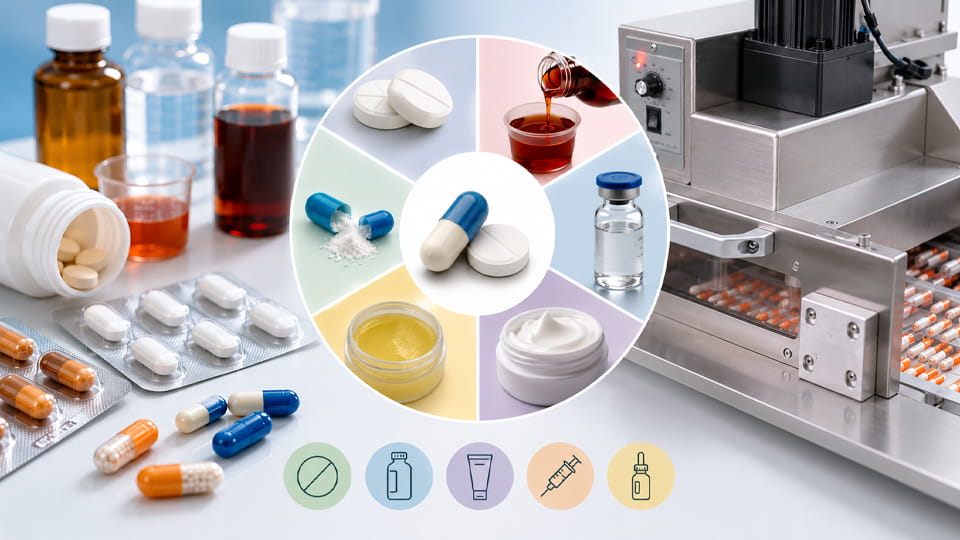
Par définition, un forme posologique est la forme physique d'un produit pharmaceutique. Autrement dit, c'est la façon dont le médicament actif et les ingrédients inertes sont combinés et présentés pour l'administration. Le glossaire du NIH le définit simplement comme suit : « la forme physique sous laquelle un médicament est fabriqué ou administré ». Une autre source explique que les formes posologiques sont des produits médicamenteux « présenté sous une forme spécifique pour une utilisation,» contenant un mélange de composants actifs et inactifs, configuré dans un formulaire particulier.
Considérez la forme posologique comme interface entre le médicament et le patient. Par exemple, le paracétamol se présente sous forme de comprimés, sirop, et même des suppositoires; ce sont toutes des formes posologiques différentes du même ingrédient actif. Chaque formulaire est un formulation posologique – une recette spécifique de médicament actif + excipients façonnés en quelque chose de pratique. Comme le dit un guide JinLuPacking, fabriquer une forme posologique solide, c'est « transformer les molécules médicamenteuses en une forme solide et stable » en mélangeant des principes actifs avec classeurs et des charges. La forme finie pourrait être un comprimé rond, une coque de capsule, ou un sachet de poudre – chacun étant conçu pour que le médicament puisse être délivré efficacement.
En pratique, quand les pharmaciens ou les industriels parlent forme posologique, ils prennent en compte des facteurs tels que:
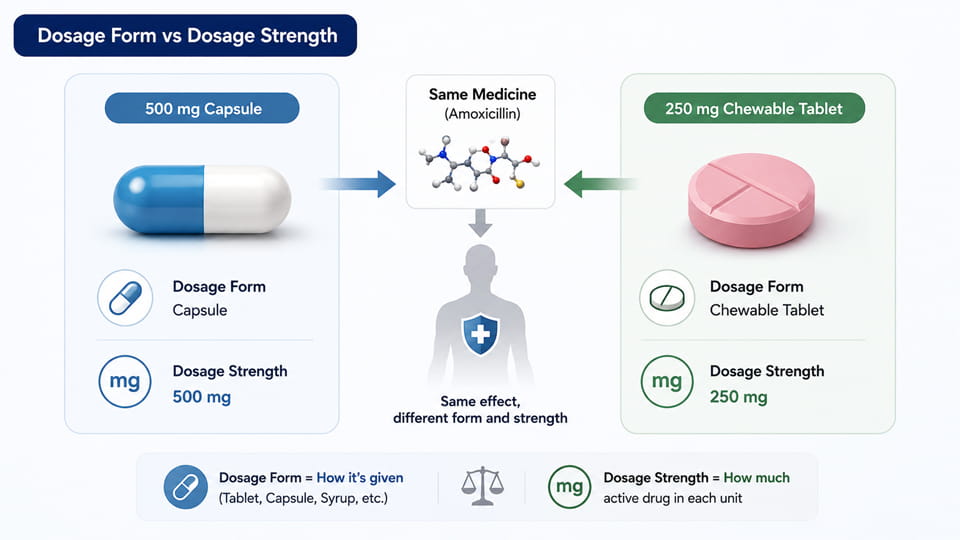
Par exemple, le même médicament (dire, amoxicilline) peut se présenter sous des « formes posologiques » comme un 500 mg capsule ou un 250 mg comprimé à croquer". Les deux délivrent de l'amoxicilline, mais la forme et la dose diffèrent. Cela met en évidence la différence entre la forme posologique (capsule ou comprimé) et résistance à la dose (500 mg contre 250 mg).
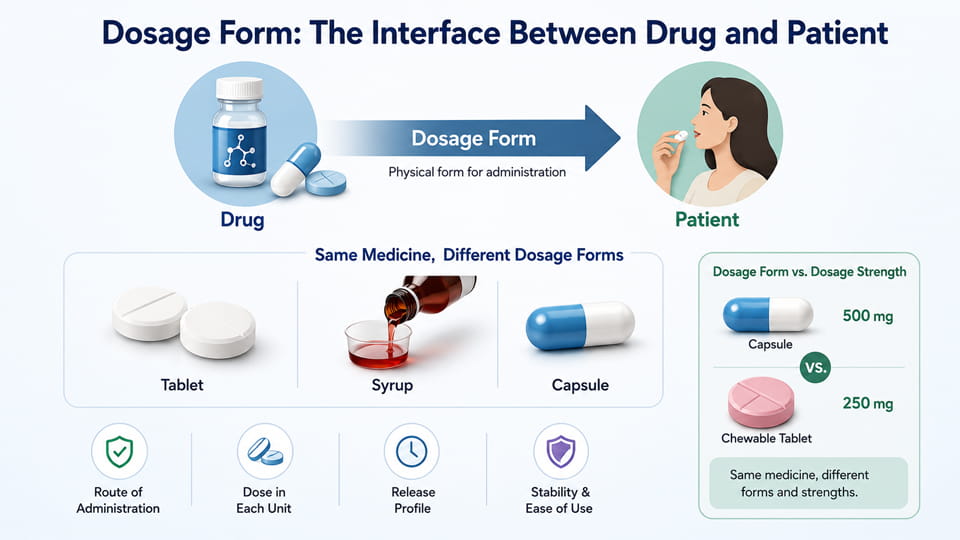
Le choix de la forme posologique appropriée est crucial pour plusieurs raisons:
En bref, les formes posologiques sont plus qu’un « simple emballage ». Ils jouent un rôle crucial dans l’efficacité d’un médicament et dans la facilité avec laquelle il peut être fabriqué et utilisé en toute sécurité..
Les médicaments peuvent être formulés sous de nombreuses formes, chacun adapté à des objectifs spécifiques. Voici les principales catégories:

Chiffre: Capsules et comprimés sont des exemples de formes posologiques solides utilisées pour l'administration orale.
Formes posologiques solides sont les le plus courant dans l'industrie pharmaceutique. Il s'agit notamment des tablettes (pilules de poudre comprimée), gélules (gélatine ou HPMC coquilles remplies de poudre ou de pellets), et poudres ou granulés en vrac. Les tablettes peuvent être conçues dans de nombreuses variétés (par exemple. à croquer, effervescent, version étendue) pour contrôler la rapidité avec laquelle le médicament est libéré dans le corps. Les capsules utilisent souvent une coque dissolvante qui se décompose dans l'estomac pour libérer le médicament..
Pourquoi les solides? Ils sont stables et pratiques. Les pilules solides durent généralement plus longtemps en rayon et ne nécessitent pas de réfrigération.. Chaque unité contient une dose précise de médicament, donc le dosage est précis. Pour la fabrication, les formes solides sont efficaces: moderne Machines de presse à tablette et machines de remplissage de gélules (comme ceux de JinLu) peut produire des centaines de milliers de pilules par heure. Les machines de conditionnement sous blister et les lignes de remplissage de bouteilles emballent ensuite ces comprimés ou capsules dans des produits finaux. (cartes blister, bouteilles, bandes, etc.).
Exemples de formes posologiques solides:
Remarque sur l'équipement: La production de formes solides nécessite des machines spécialisées. Par exemple, une presse à comprimés rotative (comme la presse à comprimés de JinLu) compresse la poudre en comprimés. Machines de remplissage de gélules (manuel ou automatique) déposer la poudre dans les coques des capsules. Après avoir formé, les comprimés/capsules peuvent être enrobés, compte, et matériel d'emballage.

Chiffre: Sirop est une forme posologique liquide courante, utile pour les patients qui ont du mal à avaler des solides.
Les formes posologiques liquides comprennent solutions, suspension, émulsions, et sirops. Ceux-ci sont idéaux lorsqu’il est difficile d’avaler des solides (comme pour les enfants ou les personnes âgées) ou lorsqu'un début rapide est nécessaire. Les exemples sont les sirops contre la toux (sucré pour masquer le goût de la drogue), gouttes orales, et solutions IV.
Pourquoi les liquides? Ils permettent dosage flexible (tu peux en mesurer une cuillerée) et fonctionne bien lorsqu'une absorption rapide est nécessaire. Par exemple, un médicament sous forme de solution pénètre dans la circulation sanguine plus rapidement qu'un comprimé. Les liquides contribuent également à garantir plus petit les patients reçoivent des doses précises et plus petites.
Remarque sur l'équipement: Les formes liquides nécessitent souvent des cuves de mélange et des machines de remplissage. Après avoir mélangé (par exemple. dans un granulateur mélangeur à grande vitesse ou un séchoir à lit fluidisé), le médicament liquide est rempli par machines de remplissage de bouteilles ou pompé dans des flacons (comme des ampoules). Par exemple, Offres JinLuPacking lignes de remplissage de bouteilles qui peut rincer, remplir, et boucher des centaines de bouteilles par minute pour les sirops ou les solutions.

Chiffre: Crèmes et onguents sont des formes posologiques topiques semi-solides appliquées sur la peau.
Les formes posologiques semi-solides sont principalement pour un usage topique - c'est, appliqué sur la peau ou les muqueuses. Celles-ci incluent crèmes, ondage, gels, lotions, et des pâtes. Par exemple, une crème antifongique ou une pommade à l'hydrocortisone permet au médicament d'agir directement sur un problème de peau. De nombreux cosmétiques (lotions pour la peau) sont également des formes posologiques topiques pour les ingrédients actifs.
Pourquoi les semi-solides? Ils livrent de la drogue localement avec des effets systémiques minimes. Le médicament pénètre dans la zone affectée sans traverser tout le corps., réduire les effets secondaires. Par exemple, les crèmes pour la peau restent principalement sur la peau.
Formulation et équipement: La fabrication de crèmes et de lotions nécessite de mélanger des phases huileuses et aqueuses avec des émulsifiants.. JinLu mélangeur émulsifiant sous vide est conçu pour combiner ces liquides non miscibles en une crème ou une lotion stable. Après avoir mélangé, un machine de remplissage de tubes ou une ligne de remplissage de pots conditionne le produit dans des tubes, bouteilles, ou des pots. As JinLu explains, un émulseur sous vide « combine des liquides non miscibles (huile & eau) en une émulsion stable » sous vide. Cette étape est essentielle pour des crèmes et des gels homogènes.
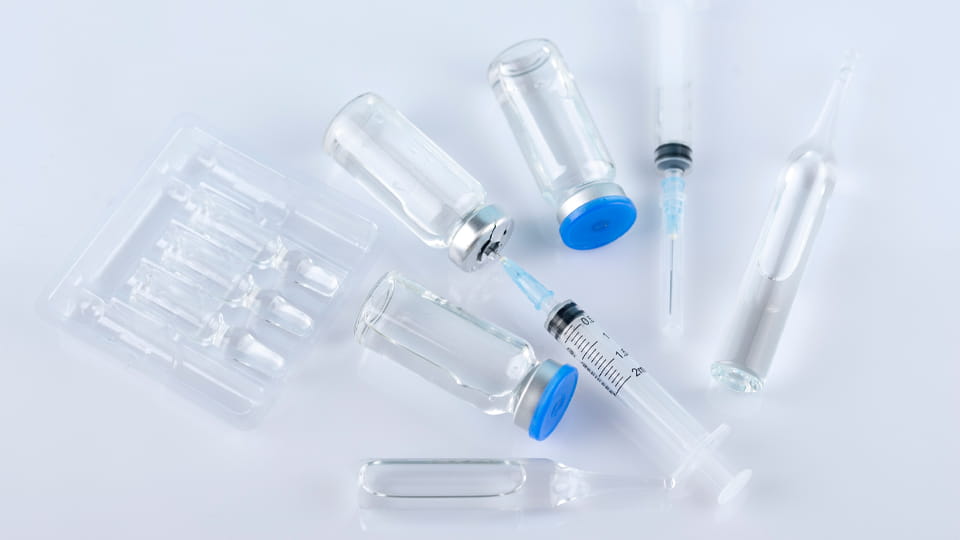
Chiffre: Injectable préparé en flacons ou en ampoules.
Outre l'oral et l'actualité, parentérale (injectable) formes sont critiques. Les injectables comprennent intraveineux (Iv), intramusculaire (JE SUIS), sous-cutané (CS) injections et perfusions. Ces formes posologiques liquides sont stériles et conçues pour contourner la digestion pour une action rapide. De nombreux médicaments qui sauvent des vies (par exemple. vaccins, insuline, certains antibiotiques) utiliser des formes injectables.
Chacune d'elles est une forme posologique spécialisée choisie pour des avantages spécifiques (vitesse, effet local, commodité). La conception globale d’une forme posologique est un élément essentiel de formulations pharmaceutiques – les ingénieurs et les pharmaciens adapteront la formulation (posologie et forme) pour répondre aux besoins des patients et aux propriétés des médicaments.
Les pharmaciens et les ingénieurs prennent en compte de nombreux facteurs lors de la sélection d'une forme posologique pour un médicament.:
Pas étonnant qu'il existe autant d'options de formes posologiques. Chacun équilibre la commodité, efficacité, et faisabilité. Une bonne formulation pharmaceutique trouve le « juste équilibre » entre les besoins du patient et les caractéristiques du médicament.
Il est important de ne pas confondre forme posologique avec résistance à la dose. Le forme posologique est à quoi ressemble le médicament et comment il est pris (comprimé, sirop, etc.), tandis que le résistance à la dose est quelle quantité de médicament actif contient chaque unité. Par exemple, deux versions de l’antibiotique amoxicilline pourraient être: 500 mg capsule et 250 mg comprimé à croquer. Ici, la capsule/le comprimé est la forme posologique, et les chiffres (500 mg, 250 mg) sont les dosages. Les deux délivrent de l'amoxicilline au patient, mais sous différentes formes et forces.
En pratique, les fabricants proposent plusieurs dosages pour chaque forme afin que les médecins puissent ajuster facilement les doses. Le formulaire (solide, liquide, etc.) répond principalement à la question « comment est-il donné?" question, tandis que la force répond « combien de médicament contient chaque dose ».
Formes posologiques sont le pont entre le développement de médicaments et l’utilisation par les patients. En pharmacie, ils veulent dire le spécifique formules – des comprimés, gélules, sirops, crèmes, injections, et plus encore – qui transportent les ingrédients actifs vers le corps. Choisir le bon formulaire est crucial: cela affecte la façon dont le médicament est absorbé, comme c'est facile pour les patients, et avec quelle efficacité il peut être produit et emballé.
Les équipements pharmaceutiques modernes permettent de fabriquer de manière fiable n’importe quelle forme galénique. Par exemple, JinLuPacking propose des solutions complètes: presses à comprimés à grande vitesse pour solides oraux, remplisseuses de gélules pour granulés, lignes de remplissage de liquides pour sirops et injectables, et machines d'emballage (emballeurs de blisters, boucheuses de bouteilles, machines à compter) pour finir le travail. Avec l'expertise et les machines appropriées, n'importe quelle forme posologique – qu'il s'agisse d'un comprimé stable ou d'une crème complexe – peut être produite avec une haute qualité.
En conclusion, compréhension définition de la forme posologique en pharmacie signifie reconnaître que la forme compte. Il détermine l’expérience du patient, action médicamenteuse, et méthodes de fabrication. En concevant et en choisissant des formes galéniques efficaces, les ingénieurs pharmaceutiques contribuent à garantir que les médicaments sont à la fois sûrs et pratiques pour les utilisateurs.
Prêt à discuter de vos besoins en production pharmaceutique? Que vous fabriquiez des tablettes, gélules, crèmes, ou sirops, notre équipe peut vous aider. Contact JinLuEmballage pour explorer des lignes de production et des solutions d'emballage personnalisées pour toute forme posologique. Nous offrons équipement clé en main des presses à comprimés à grande vitesse aux lignes automatisées de conditionnement sous blister et de remplissage de bouteilles – toutes conçues pour fournir des résultats constants., des formes galéniques de haute qualité pour vos produits.
Une forme posologique est la forme physique sous laquelle un médicament est produit et administré aux patients.. Il combine l'ingrédient pharmaceutique actif (API) avec des excipients pour créer des produits tels que des comprimés, gélules, liquides, crèmes, injections, ou des poudres. La bonne forme posologique permet de garantir un dosage précis, stabilité du produit, et une administration efficace des médicaments.
Beaucoup de gens confondent ces deux termes.
• La forme posologique fait référence à la forme physique du médicament., comme une tablette, capsule, sirop, ou de la crème.
• La force du dosage fait référence à la quantité d'ingrédient actif contenue dans chaque unité., tel que 250 mg ou 500 mg.
Par exemple, un 500 mg comprimé et un 500 Les gélules en mg ont le même dosage mais des formes posologiques différentes.
Les formes pharmaceutiques sont généralement divisées en plusieurs catégories:
• Formes posologiques solides (comprimés, gélules, poudres)
• Formes posologiques liquides (solutions, suspension, sirops)
• Formes posologiques semi-solides (crèmes, ondage, gels)
• Formes posologiques injectables
• Formes posologiques pour inhalation et transdermiques
Chaque type est conçu pour répondre aux différents besoins thérapeutiques et des patients.
La forme posologique correcte affecte directement:
• Absorption des médicaments
• Observance des patients
• Précision du dosage
• Stabilité du produit
• Efficacité de fabrication
Par exemple, les enfants peuvent préférer les formes posologiques liquides, tandis que les adultes choisissent souvent des formes posologiques en comprimés ou en capsules pour des raisons de commodité..
Les exemples courants de formes posologiques pharmaceutiques comprennent:
• Forme posologique en comprimé
• Forme posologique en capsule
• Solution buvable
• Sirop
• Suspension
• Solution injectable
• Crème
• Pommade
•Gel
• Poudre pour reconstitution
Chaque formulation pharmaceutique est développée sur la base du médicament’Propriétés et voie d'administration prévue.
La forme galénique orale solide est la forme galénique pharmaceutique la plus utilisée dans le monde..
Les formes posologiques en comprimés et en capsules sont populaires car elles offrent:
• Haute efficacité de production
• Longue durée de conservation
• Dosage précis
• Transport facile
• Fabrication rentable
C'est pourquoi la plupart des lignes de production pharmaceutique sont conçues pour la fabrication de doses orales solides..
Une ligne typique de fabrication de doses solides orales peut comprendre:
• Équipement de fabrication de tablettes
• Machine de remplissage de gélules
• Mélangeur à haut cisaillement
• Sécheur à lit fluidisé
• Machine d'enrobage de comprimés
• Compteuse de comprimés
• Machine d'emballage sous blister
• Ligne de remplissage de bouteilles
• Encartonneuse
Les lignes de production pharmaceutique modernes intègrent ces machines pour une production automatisée et conforme aux BPF..
les formulaires répondent à différents besoins. Par exemple, un antibiotique pourrait être disponible sous forme de comprimé (pour adultes), une suspension (pour les enfants), et une forme injectable (pour les patients hospitalisés). Chaque forme optimise la stabilité, commodité, ou absorption pour l’usage prévu.
la dose est la quantité de médicament prise en une seule fois (par exemple. 250 mg). La forme posologique est la forme physique contenant ce médicament (par exemple. un comprimé de 250 mg ou une gélule de 250 mg). Autrement dit, dose = quantité de médicament; forme posologique = comprimés, liquide, etc..
à quelle vitesse un médicament se dissout. Les comprimés doivent se désintégrer avant que le médicament ne soit absorbé, alors que les liquides agissent plus vite. Les comprimés à libération contrôlée ralentissent la dissolution pour prolonger l'effet. Les produits topiques sont absorbés par la peau, tandis que les injectables contournent complètement les barrières. Le choix de la forme est adapté aux propriétés du médicament et à son objectif thérapeutique.
Références:
1.Formes posologiques -- NOUS. Administration des aliments et des médicaments
2.Forme posologique et voie d'administration -- NOUS. Administration des aliments et des médicaments
3.Formes pharmaceutiques pharmaceutiques ——usp.org
4.Conception de formulations, défis, et considérations de développement pour une association à dose fixe (FDC) de formes posologiques solides orales —— tandfonline.com
5.Forme posologique —— Wikipédia
6.Formes posologiques orodispersibles: améliorations biopharmaceutiques et exigences réglementaires —— ScienceDirect