

Dans la fabrication pharmaceutique, un nettoyage efficace de l'équipement est essentiel pour maintenir la qualité du produit et prévenir la contamination croisée entre les lots. Un bien conçu validation de nettoyage Le processus aide les fabricants à prouver que leurs procédures de nettoyage peuvent éliminer systématiquement les résidus de produits et respecter Exigences BPF. Pour les équipes de production et les acheteurs de matériels, choisir machines pharmaceutiques avec des conceptions faciles à nettoyer peut également faciliter la validation, réduire les temps d'arrêt, et améliorer l'efficacité globale de la fabrication.
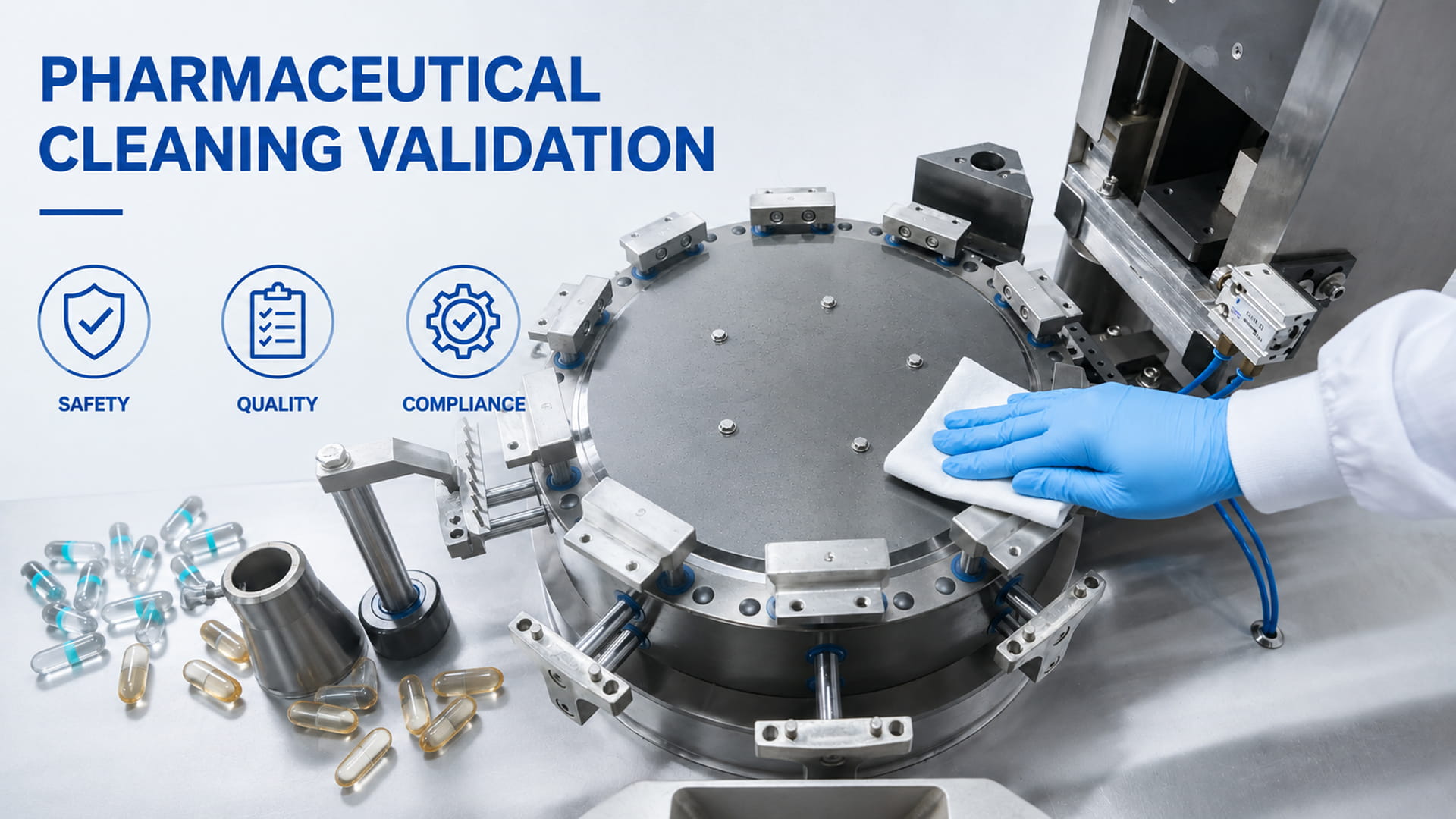
En termes simples, validation de nettoyage fournit des preuves objectives qu'une procédure de nettoyage répond systématiquement aux normes prédéfinies. Comme le dit une source industrielle, la validation du nettoyage est un « garantie documentée » ce nettoyage peut être effectué de manière fiable et répétée pour atteindre un niveau de propreté prédéterminé. En pratique, il s'agit de montrer que les résidus des produits précédents, produits de nettoyage, et les microbes sont éliminés à des niveaux acceptables sur toutes les surfaces en contact avec le produit.
Les régulateurs sont d’accord. Par exemple, FDA 21 CFR 211.67(un) nécessite chaque pièce d'équipement (dédié ou multi-usage) être « nettoyé… pour éviter… une contamination qui altérerait la sécurité, identité, force, qualité, ou la pureté du produit médicamenteux ». L'OMS explique également que l'objectif de la validation du nettoyage est de prouver que l'équipement est systématiquement nettoyé du produit., détergent, et les résidus microbiens à un niveau acceptable pour prévenir la contamination et la contamination croisée. Autrement dit, la validation du nettoyage concerne la sécurité des patients: s’assurer qu’un lot de produits ne peut pas « se propager » et contaminer le suivant.
Un programme approfondi de validation du nettoyage donne confiance aux fabricants (et l'assurance des régulateurs) que contamination croisée est contrôlé. Sans ça, résidus d'un puissant API ou l'allergène d'un lot pourrait se retrouver dans le produit suivant, potentiellement nuire aux patients ou causer un rappel. La FDA déclare explicitement que les entreprises «doit valider que les procédures de nettoyage sont adéquates pour garantir qu'aucune contamination croisée ne se produise». Ceci est particulièrement critique dans installations multiproduits (commun dans CDMO et fabricants de suppléments). Les directives de l'OMS soulignent que la validation du nettoyage est particulièrement importante dans les usines multiproduits, et doit être appliqué à tous les équipements de production et procédures d’assainissement.
Au-delà de la contamination, la validation du nettoyage consiste à garantir qualité du produit. Si l’équipement n’est pas correctement nettoyé, des produits chimiques résiduels ou une croissance microbienne pourraient compromettre identité, force, et la pureté des lots suivants. En bref, la validation du nettoyage garantit la qualité du produit et la santé des patients. C’est aussi un impératif réglementaire. Que vous soyez sous la juridiction de la FDA (21 Partie CFR 211) ou BPF de l'UE (EMA/I), les autorités exigent une validation documentée du nettoyage dans le cadre d'un programme BPF complet. La non-validation du nettoyage peut donner lieu à des lettres d'avertissement, le produit tient, et même rappelle.
Exigences réglementaires: FDA, Ema, OMS, PHOTOS. Toutes les principales directives exigent une validation du nettoyage, mais avec un accent légèrement différent. Dans le NOUS, CGMP de la FDA (Titre 21 CFR 211.67) énonce l'exigence de base: l’équipement doit être nettoyé pour éviter la contamination croisée. Les directives de la FDA recommandent d'utiliser des méthodes d'échantillonnage et d'analyse efficaces pour prouver la propreté. Notamment, la FDA précise que « les rinçages seuls… ne seraient pas acceptables » pour validation; les entreprises devraient tamponner directement les surfaces lorsque cela est possible. En pratique, cela signifie que vous combinez généralement l'échantillonnage par écouvillonnage et par rinçage pour couvrir toutes les zones..
Dans le UE, les EMA Annexe BPF de l'UE 15 (2015) et les directives de l'EMA exigent une validation du nettoyage dans le cadre de la validation du processus.. Annexe 15 déclare explicitement « Une validation du nettoyage doit être effectuée afin de confirmer l'efficacité de toute procédure de nettoyage pour tous les équipements en contact avec le produit. ». Il indique également que les limites de transfert doivent être justifiées par des considérations toxicologiques. (basé sur la santé) évaluation. Autrement dit, définir scientifiquement vos critères d’acceptation (voir ci-dessous) et documenter la justification. L'approche de l'UE met l'accent sur basé sur le risque, basé sur la santé stratégie: calculer le report maximum autorisé (mignon) ou exposition quotidienne autorisée (PDE) valeurs pour les résidus actifs.
OMS et PIC/S offrent également des conseils. Le OMS BPF TRS 1019 (2019) Annexe sur la validation précise que la validation du nettoyage « fournit des preuves documentées qu'une procédure de nettoyage approuvée fournira un équipement propre, adapté à l’usage auquel il est destiné ». Ce document de l'OMS (une référence commune dans le monde entier) souligne que la validation du nettoyage n'est pas nécessaire pour un nettoyage trivial (sols, murs) mais est nécessaire pour les équipements critiques de contact avec les produits dans les usines multiproduits. Le comité PIC/S (un consortium de régulateurs) définit également la validation du nettoyage comme la preuve que les résidus seront éliminés « en dessous du niveau de report maximal autorisé scientifiquement fixé ».
Ensemble, ces sources établissent le éléments essentiels: définir des limites de résidus acceptables, développer des procédures de nettoyage robustes, échantillon utilisant des méthodes validées, analyser avec des tests adaptés, et démontrer que chaque pièce d'équipement peut être nettoyée de manière cohérente jusqu'à ces limites.
La validation du nettoyage est essentiellement un projet. Voici un aperçu étape par étape du processus typique:
Les directives de la FDA sont claires : « les rinçages seuls ne seraient pas acceptables » comme seule méthode de vérification. En pratique, une combinaison d’échantillons sur écouvillon et de rinçage est utilisée. Choisir des sites d'échantillonnage représentatifs sur chaque équipement (généralement les endroits les plus difficiles à nettoyer). Avant de tester, validez que vos méthodes d’échantillonnage récupèrent suffisamment de résidus cibles (connues sous le nom d’études de récupération).
La validation du nettoyage se heurte souvent à des obstacles. Les principaux défis comprennent:
Dans l'ensemble, la meilleure défense est un approche basée sur les risques (comme encouragé par l'ICH Q9 et les directives de l'industrie). Concentrer les efforts de validation sur les domaines/produits à haut risque (API puissantes, équipement partagé) et documenter cet objectif.
Un facteur important pour une validation réussie du nettoyage est conception d'équipement. La FDA exige explicitement que l'équipement soit conçu pour faciliter le nettoyage. En pratique, rechercher:
En spécifiant ces caractéristiques de conception, vous réduisez considérablement le temps de nettoyage et les efforts de validation. Par exemple, Machines de remplissage de gélules Jinlu sont construits avec des trémies facilement détachables, goulottes en acier inoxydable, et pare-poussière fermés – le tout pour minimiser l'accumulation de résidus. De la même manière, cloque et machines d'emballage de sachets avec des panneaux d'accès sans outil qui aident les opérateurs à atteindre toutes les surfaces à nettoyer. Choisir le bon équipement dès le départ représente la moitié de la bataille en matière de validation du nettoyage.
Les remplisseurs de gélules méritent une mention spéciale. Ces machines manipulent des poudres et des capsules, un nettoyage minutieux est donc indispensable. Les points clés pour nettoyer une ligne de remplissage de capsules comprennent:
Les machines à capsules en service GMP sont souvent exécutées en environnements difficiles (poudre poussiéreuse). Les remplisseuses de capsules Jinlu résolvent ce problème en utilisant des revêtements antistatiques et des trémies fermées pour limiter la fuite de poudre., rendant le nettoyage plus sûr et la validation plus facile.
Pour lier tout cela ensemble, voici quelques bonnes pratiques générales:
Image: Un environnement de laboratoire d’analyse propre (emballage blister ou laboratoire d'assurance qualité). Une bonne validation du nettoyage nécessite à la fois des procédures de nettoyage appropriées et des tests précis (par exemple. HPLC, Table des matières) pour confirmer qu'il ne reste aucun résidu. Liste de contrôle de validation du nettoyage: Un tableau récapitulatif rapide des éléments clés.
| Article | Exigence |
| Équipement identifié | Répertorier toutes les machines en contact avec le produit |
| Procédure de nettoyage | Écrit, approuvé, et suivi (AMADOUER) |
| Plan d'échantillonnage | Méthodes (tamponner/rincer), emplacements, fréquence |
| Critères d'acceptation | Défini (Limites MACO/PDE) |
| Méthodes analytiques | Tests validés (HPLC, Table des matières, etc.) |
| Rapport de validation | Protocole terminé, résultats approuvés par l'AQ |
Une validation appropriée du nettoyage est essentielle pour la production pharmaceutique GMP. Il protège la qualité des produits et la sécurité des patients en empêchant la contamination croisée. Un équipement bien conçu réduit considérablement les problèmes de validation: pièces de contact lisses en acier inoxydable, zones mortes minimales, et un démontage rapide signifie que le nettoyage est plus rapide et plus cohérent. Et la cueillette de Jeinlu, nous concevons des remplisseuses de capsules, emballeurs de blisters, et les lignes de remplissage en gardant ces principes à l'esprit pour aider les fabricants à se conformer aux normes mondiales BPF.
En résumé, validation du nettoyage pharmaceutique il s'agit de prouver "faire le ménage" avec données et documentation. En suivant un processus structuré – sélection des produits les plus défavorables, fixer des limites (comme MACO), rédiger des SOP de nettoyage claires, échantillonner intelligemment, et tests avec HPLC/TOC – vous pouvez démontrer votre conformité aux régulateurs et aux équipes qualité. Souviens-toi: investir dans Équipement respectueux des BPF maintenant (inoxydable, conception ergonomique) pour gagner du temps en validant plus tard. Si vous recherchez des machines de remplissage ou de conditionnement de gélules conçues pour un nettoyage et une conformité faciles, considérez la gamme de Jinlu Packing machines de remplissage de gélules, emballeurs de blisters, et lignes de remplissage pharmaceutique. Notre équipement est conçu pour un changement rapide et un nettoyage en profondeur, vous aidant à garantir le bon déroulement de votre validation.
Prêt à rationaliser votre validation de nettoyage? Contacter Jinlu Emballage pour savoir comment nos machines de remplissage et de conditionnement de gélules conformes aux BPF peuvent répondre à vos besoins en matière de fabrication pharmaceutique.
La validation du nettoyage est un processus documenté utilisé pour prouver que les procédures de nettoyage des équipements pharmaceutiques peuvent éliminer systématiquement les résidus de produits., ingrédients pharmaceutiques actifs (API), produits de nettoyage, et les contaminants potentiels à un niveau acceptable.
Dans la fabrication pharmaceutique, la validation du nettoyage fournit la preuve que l'équipement est adapté à la production du lot suivant sans provoquer de contamination croisée ni affecter la qualité du produit.
La validation du nettoyage est importante car les équipements pharmaceutiques sont souvent utilisés pour fabriquer différents produits ou lots. Sans validation efficace, les résidus restants peuvent contaminer le produit suivant et avoir un impact sur sa sécurité, identité, force, ou pureté.
Un processus de validation du nettoyage correctement exécuté aide les fabricants:
• Prévenir la contamination croisée
• Répondre aux exigences de conformité BPF
• Améliorer la sécurité de la production
• Réduire les risques qualité lors des changements de produits
Le processus de validation du nettoyage comprend généralement l'évaluation de l'équipement, développement de procédures de nettoyage, définir des critères d'acceptation, échantillonnage, tests analytiques, et documentation de validation.
Les critères d'acceptation de la validation du nettoyage définissent les niveaux de résidus maximaux autorisés après le nettoyage., y compris les résidus API, produits de nettoyage, et les contaminants potentiels.
La plupart des équipements de fabrication pharmaceutique qui entrent en contact avec des produits nécessitent une validation de nettoyage, y compris les machines de remplissage de gélules, presses à comprimés, mélangeurs, et équipement de manutention de poudre.
Les deux méthodes d'échantillonnage courantes sont l'échantillonnage par écouvillonnage et l'échantillonnage par rinçage.. Les fabricants sélectionnent souvent des méthodes basées sur la conception des équipements, accessibilité, et caractéristiques des résidus.
La conception des équipements affecte directement l’efficacité du nettoyage. Machines à surfaces lisses, moins de zones mortes, et les pièces faciles à retirer sont plus faciles à nettoyer et à valider.
La fréquence de validation du nettoyage dépend de l'utilisation de l'équipement, modifications du produit, risques liés aux processus, et exigences réglementaires. Une revalidation peut être nécessaire après des modifications majeures apportées à l'équipement ou aux procédures de nettoyage..
La vérification du nettoyage confirme qu'une opération de nettoyage spécifique répond aux exigences, tandis que la validation du nettoyage prouve que le processus de nettoyage est fiable et reproductible dans le temps.
Les fabricants d'équipements peuvent soutenir la validation du nettoyage en proposant des conceptions de machines respectueuses des BPF, structures faciles à nettoyer, spécifications matérielles, et la documentation nécessaire à la qualification et à la validation.
Références:
1.Validation des processus de nettoyage —— NOUS. Administration des aliments et des médicaments
2.Questions et réponses sur les exigences actuelles en matière de bonnes pratiques de fabrication | Équipement —— NOUS. Administration des aliments et des médicaments
3.Guide: Cycle de vie de validation du nettoyage – Applications, Méthodes, & Contrôles —— ISPE
4.Guide de validation du nettoyage (Interface graphique-0028) —— Santé Canada
5.EudraLex – Volume 4 – Bonne pratique de fabrication (GMP) lignes directrices —— Commission européenne
6.Validation du nettoyage: Guide complet pour la santé – Approche basée sur le croisement chimique – Évaluation des risques de contamination —— PDAJPST