
Pour un sous-traitant pharmaceutique, le la meilleure machine de remplissage de gélules n'est généralement pas la machine avec la vitesse nominale la plus élevée. C'est la machine qui peut se déplacer de manière fiable entre vos produits réels avec la moindre perte totale de temps de production..
Cela signifie regarder au-delà des « capsules par heure ». Un CMO ou CDMO multi-produits doit prendre en compte tailles de capsules, comportement de la poudre, boulettes, micro-comprimés, produits combinés, exigences de nettoyage, changements d'outillage, endiguement, temps de l'opérateur, validation, et contrôle qualité en aval. Majeur fournisseurs d'équipements de remplissage de capsules faire valoir le même point de différentes manières: la flexibilité vient des systèmes de dosage interchangeables, large compatibilité des produits, changements courts, nettoyage facile, et contrôle du poids intégré, pas seulement la vitesse.
Pour la plupart des fabricants sous contrat plusieurs SKU à l’échelle commerciale, un flexible machine de remplissage de capsules entièrement automatique dans la plage de vitesse moyenne est souvent le meilleur point de départ. L’équipement semi-automatique reste judicieux lorsque les lots sont petits et changent fréquemment. Les machines à très grande vitesse ont du sens lorsque de grandes campagnes dominent le calendrier. Et si des composés puissants sont impliqués, le confinement peut primer sur tout autre critère de sélection. Des équipements de remplissage de capsules spécialisés sont disponibles avec OEB 4/OEB 5 systèmes de confinement et de nettoyage humide ou de lavage sur place, ce qui montre à quel point cette exigence est différente de l'achat d'un encapsulateur standard à usage général.
La règle pratique est simple:
Choisissez la machine de remplissage de gélules qui vous offre le rendement quotidien utilisable le plus élevé sur l'ensemble de votre gamme de produits, et non le rendement horaire théorique le plus élevé sur un seul produit simple..
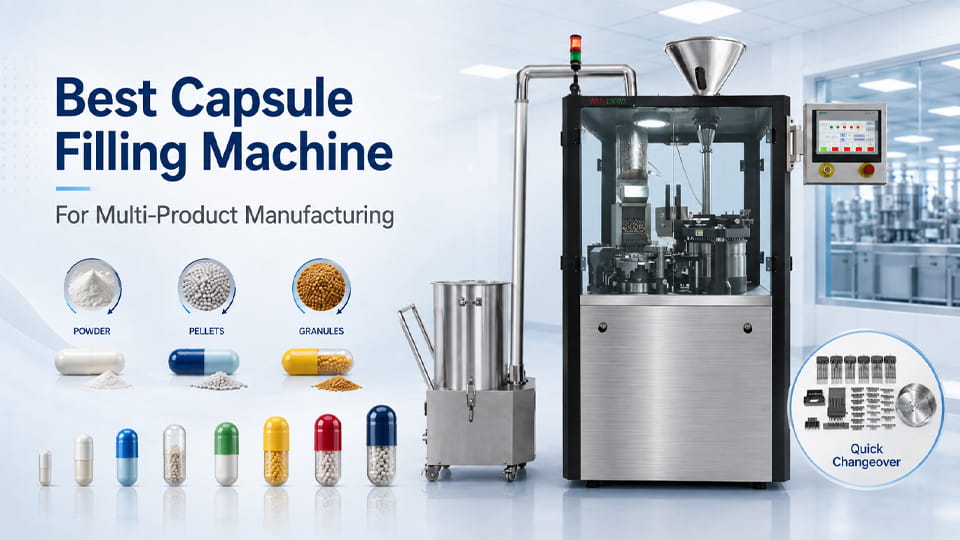
CMO pharmaceutiques (fabricants sous contrat) exécuter de nombreux SKU sur des lignes partagées. Ils doivent souvent basculer entre les produits, tailles de capsules, et formules rapidement. Une machine à usage unique (configuré pour une taille ou un produit) je ne peux pas répondre à cette variété sans plusieurs unités. Un remplisseur multi-tailles couvre les numéros 000 à 5 (la plus grande à la plus petite capsule dure) dans une seule machine. Cela permet aux directeurs marketing consolider l'équipement, économiser de l'espace et du capital. Cela accélère également les lancements de nouveaux produits: au lieu de commander une nouvelle machine d'encapsulation pour chaque SKU, une machine réglable peut produire plusieurs recettes.
Cependant, la flexibilité entraîne des compromis. Les changements deviennent un goulot d'étranglement si les échanges d'outils sont lents ou complexes (voir la section suivante). Nettoyage et validation sont également critiques: une machine de remplissage de capsules CMO doit être facile à désinfecter entre différents médicaments pour éviter la contamination croisée (matériel non dédié doit être nettoyé entre les lots). En bref, Les CMO ont besoin de remplisseuses de capsules conçues pour des changements de moule rapides, nettoyage en douceur, et un dosage précis afin qu'une seule machine puisse fabriquer de manière fiable de nombreux produits sous GMP règles.
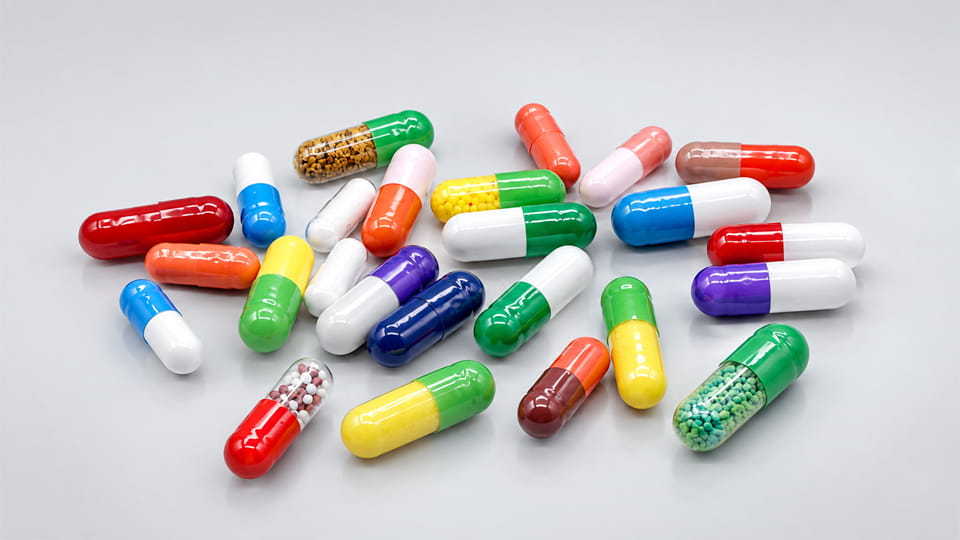
Lors de l'évaluation de machines pour un environnement multi-produits, se concentrer sur ces facteurs (tableau ci-dessous), puis lisez les détails après. Un choix bien équilibré minimise les compromis dans votre portefeuille.
| Facteur | Que rechercher |
| Gamme de tailles de capsules | Prend en charge toutes les tailles nécessaires (#000–Le n°5 est courant en pharmacie) sans mods spéciaux. Un changement rapide entre les tailles est tout aussi important. |
| Types de formulations | Gère vos poudres/granulés. Vérifiez s'il peut doser votre poudre API spécifique, pellets ou micro-comprimés. Certains modèles dosent même des liquides (nécessitant des buses spéciales). |
| Vitesse de production | Sortie nominale (gélules/heure) devrait dépasser votre taux de course le plus élevé. Mais notez que les vitesses indiquées supposent des conditions idéales (taille #00, poudre fluide). |
| Facilité de changement | Recherchez des outils modulaires et des conceptions à ajustement rapide. Les machines modernes peuvent échanger des jeux de moules <30 minutes (15 min dans les modèles avancés). |
| Conception de nettoyage/NEP | GMP nécessite un nettoyage validé entre les produits. Préférez les pièces de contact en acier inoxydable et la capacité CIP ou le démontage sans outil. |
| Précision de remplissage | Vérifier le système de dosage (vis/disque, épingles de bourrage) et spécifications de précision. Les bonnes charges atteignent une variation de poids d'environ 1 à 3 %. Les lignes haut de gamme font de la publicité >97% précision de remplissage. |
| Niveau d'automatisation | Les machines entièrement automatiques fonctionnent en continu avec un minimum de main d'œuvre (chargement/verrouillage automatique, Contrôles API), tandis que le semi-auto nécessite un opérateur mais coûte moins cher (voir ci-dessous). |
| Prise en charge des validations | Confirmez que la machine prend en charge les protocoles IQ/OQ/PQ, journaux de données et partie CFR21 11 si nécessaire. Vérifiez si le fournisseur fournit des documents de validation ou une assistance. |
| Empreinte & Évolutivité | Pour les CMO, l'espace au sol et la croissance future sont importants. Une seule machine flexible permet d'économiser de l'espace par rapport à plusieurs unités dédiées, mais assurez-vous qu'il peut évoluer (par exemple. ajouter des stations ou relier les remplisseurs si les volumes augmentent). |
Chaque facteur ci-dessus doit être adapté à votre situation. Par exemple, si vous manipulez du puissant Apis, le Conception de nettoyage/NEP devient extrêmement crucial (vous aurez besoin d’un confinement complet ou de nettoyages fréquents et validés pour protéger les opérateurs et prévenir la contamination croisée). Si vous changez fréquemment de taille de gélule, alors la « facilité de changement » est primordiale; comme indiqué ci-dessous, ignorer l'automatisation du changement de taille peut coûter des heures de temps d'arrêt.
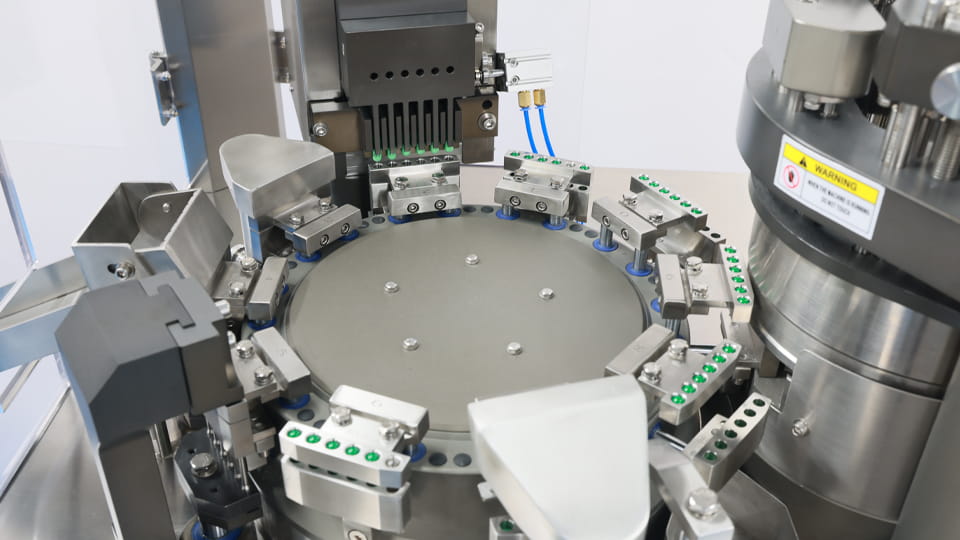
Un débit de capsules élevé est attrayant, mais l'efficacité réelle ne dépend pas seulement de la vitesse de pointe. Les fabricants citent souvent la capacité des machines dans des conditions idéales, mais la sortie réelle peut être beaucoup plus bas si votre produit est un défi. Par exemple, les poudres fines ou collantes peuvent bloquer une tarière, ou de petites capsules donnent un rythme plus lent. Tenez toujours compte des effets de la taille de la capsule, flux de poudre, et temps d'arrêt.
Pour la planification des capacités, commencez par la sortie requise (capsules par lot ou par an) et travailler à rebours. Déterminez le nombre d’heures de production que vous pouvez raisonnablement exécuter (par exemple. deux équipes contre un complet 24h/24 et 7j/7). Divisez ensuite vos capsules nécessaires par heures de fonctionnement pour obtenir un objectif de capsules/heure.. Comparez cela à la vitesse effective de la machine (souvent 80 à 90 % de sa note maximale). Note: Un surdimensionnement peut se retourner contre vous si d'autres équipements de ligne (compte, plafonnement, étiquetage) je ne peux pas suivre. Comme le dit un guide, l'installation d'un remplisseur à 150 000/h sur une ligne à 80 000/h a provoqué 47% temps d'inactivité, gaspiller de l'argent. Visez toujours un débit de ligne équilibré.
Pour capter l’efficacité, tiennent également compte des pertes de changement et de nettoyage. Même un changement de « 30 minutes » réduit la capacité s'il se produit entre chaque lot. Si votre ligne change fréquemment de SKU, incluez ces fenêtres de temps d'arrêt dans votre calcul. En pratique, cibler un filler dont efficace capacité (sortie du temps d'exécution réel) dépasse votre besoin maximal, vous disposez donc d'une marge de manœuvre pour les changements ou les ralentissements mineurs.
De longs changements de version peuvent éroder les avantages de toute machine flexible. Des machines de remplissage de gélules rotatives traditionnelles sont souvent nécessaires 4–6 heures pour un changement de taille. Les conceptions modernes utilisent des servomoteurs et des plaques de moule à verrouillage rapide pour réduire considérablement cette quantité – souvent pour 30–45 minutes pour un échange en taille réelle. Lors de l'évaluation, demandez aux fournisseurs de démontrer un changement de taille sur vos tailles de capsules.
La facilité de changement vient des composants modulaires: généralement la station d'alimentation en capsules, les plaques de moule supérieure/inférieure, le disque doseur et le grattoir, les tiges de remplissage, et les guides de décharge doivent tous être remplacés par une nouvelle taille. Les machines équipées de pinces sans outil ou de logements de moules indexés peuvent ici faire gagner du temps. Par exemple, La série NJP de Jinlu utilise un conception de moules modulaires qui permet des changements complets de moule en dessous 15 minutes. Dans un cas concret, passage d'une remplisseuse à came à un changement de passe à une coupe servo-entraîné de 6 heures pour 35 minutes, économiser sur \$120,000 par année.
En résumé, minimiser le changement: recherchez des machines à démoulage rapide, fonctionnalités de réglage prédéfinies, et des « recettes » stockées afin que les opérateurs n'aient pas à ajuster manuellement les décalages à chaque fois. Si vous vous attendez à des dizaines de changements de taille par trimestre, la vitesse de changement devrait être un critère de sélection primordial.
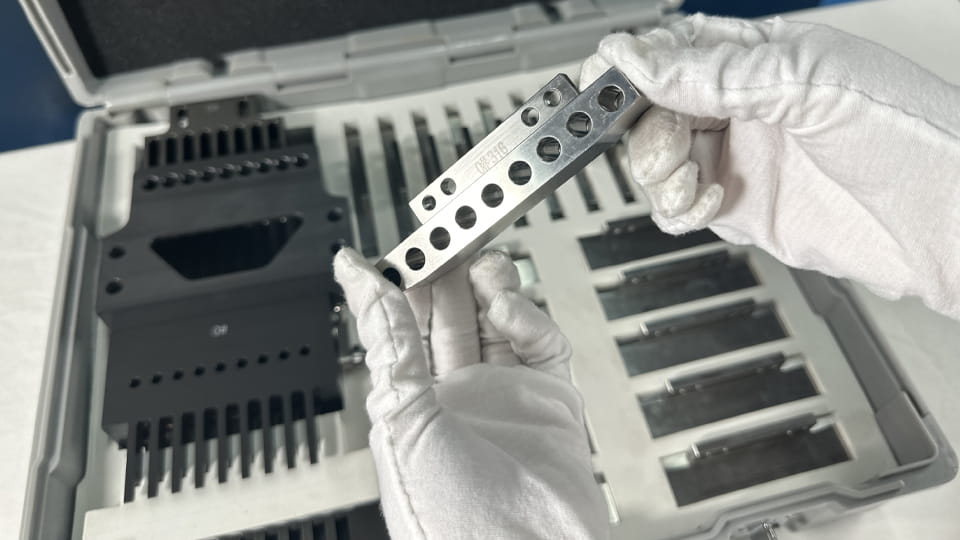
Un CMO pharmaceutique doit appliquer des contrôles stricts de nettoyage et de contamination lorsqu'il utilise plusieurs produits sur une seule machine.. Directives de la FDA (et une logique GMP simple) déclarer que les équipements non dédiés doivent être nettoyés entre différents produits pour éviter la contamination croisée. En fait, une lettre d'avertissement de la FDA a récemment indiqué qu'il est « inacceptable, du point de vue des BPF, de fabriquer des médicaments en utilisant le même équipement… également utilisé pour fabriquer des produits non pharmaceutiques » sans un nettoyage rigoureux..
Pour répondre à ces exigences, choisissez un remplisseur de gélules avec conception sanitaire: construction lisse en acier inoxydable 316L, bords arrondis, crevasses minimes, et roulements scellés si possible. De nombreuses machines prennent désormais en charge Nettoyage sur place (CIP): boules de pulvérisation intégrées et systèmes de nettoyage à circulation qui vous permettent de laver les surfaces internes sans démontage complet. Si le CIP n'est pas disponible, vérifiez que toutes les trémies, disques de dosage, et les plateaux d'alimentation peuvent être retirés ou ouverts sans outil pour un nettoyage manuel.
Établir également des protocoles de nettoyage validés: pire encrassement (par exemple. ingrédients très puissants ou collants) doit être amovible dans des limites de résidus acceptables. Le fournisseur d’équipement pharmaceutique doit fournir des guides de nettoyage voire des tests de contamination simulée. Enfin, tenir des registres de nettoyage complets comme l'exigent les 21 CFR 211.67(b). (Comme l'a rappelé un inspecteur de la FDA, une validation de nettoyage inadéquate est une violation répétée.) En bref: concevoir pour la nettoyabilité et tout documenter. Garantir des changements rapides est sans objet si la machine ne peut pas être nettoyée rapidement et de manière fiable entre les lots..
Toutes les formules ne fonctionnent pas de la même manière. Les équipements de remplissage de gélules utilisent différents mécanismes de dosage pour gérer la variabilité du produit. Les systèmes courants incluent:
Visez une précision du poids de remplissage comprise entre ± 1 et 3 % de la cible. Des machines haut de gamme (comme la pharmacie haut de gamme machines à fabriquer des capsules) annonce une précision dans cette plage. Par exemple, Le remplisseur automatique NJP-3800D de Jinlu maintient >97% précision du poids. Vérifiez toujours avec les données de test: demandez aux fournisseurs la variation de poids typique en fonction de la taille et du poids de votre capsule cible.
La sélection du système de dosage doit correspondre à votre matériau. Si tu gères très bien, électrostatique, ou poudres cohésives, assurez-vous que des fonctionnalités telles que des revêtements antistatiques ou des plates-formes de fluidisation sont disponibles. Et assurez-vous toujours que le matériau des pièces de contact convient à votre chimie. (en général 304 ou 316 acier inoxydable est standard). En résumé, adapter la technologie de dosage à votre produit et confirmer les spécifications de précision avec des preuves.
Choisir entre une machine multi-tailles ou plusieurs machines dédiées est un compromis classique. Considérez ces avantages et inconvénients (tableau ci-dessous) dans le cadre de vos SKU et volumes.
| Aspect | Une machine multi-tailles | Plusieurs machines dédiées |
| Gamme de capsules | Gère une gamme complète (par exemple. #000–#5) avec changements. Nécessite des échanges d'outils entre les tailles. | Chaque machine adaptée à une taille (aucun échange nécessaire par machine). |
| Coût en capital | Baisser dès le départ: acheter une unité haut de gamme au lieu de plusieurs. | Plus haut: plusieurs machines (souvent avec des fonctionnalités qui se chevauchent). |
| Espace au sol | Gain de place avec une seule empreinte. | Plus grande empreinte; plusieurs unités nécessitent plus d'espace. |
| Débit | Limité par la vitesse maximale d'une machine. Si les volumes sont élevés, vous aurez peut-être besoin d'une très grosse machine. | Le débit combiné peut être plus élevé (fonctionnement parallèle); la taille peut correspondre au volume de chaque produit. |
| Flexibilité de la gamme de produits | Très élevé: n'importe quel produit peut utiliser la même machine (avec changement). Idéal pour de nombreux SKU. | Fixé par machine; changer de produit signifie déplacer des lots entre les machines ou acheter des unités supplémentaires. |
| Passage & Temps d'arrêt | Vous subirez des temps d’arrêt pour chaque changement de taille (et nettoyage) sur cette seule ligne. | Aucun temps d'arrêt dû à un changement de taille sur chaque unité (ils restent en place); mais tu auras besoin d'un nettoyage de toute façon. |
| Risque de contamination croisée | Chaque lot de nettoyage entre les produits, risque de contamination croisée plus élevé s’il n’est pas bien nettoyé. | Si dédié par SKU ou confinement, risque de contamination croisée réduit (avec moins de cycles de nettoyage nécessaires). |
| Entretien | Une seule machine à gérer et un inventaire de pièces de rechange pour. | Plus de machines signifie plus d’entretien et de pièces à gérer. |
| Utilisation | Peut avoir du temps d'inactivité si la demande est faible pour certaines tailles. | Chaque machine peut fonctionner en continu à sa taille désignée si la demande existe. |
| Mise à l'échelle future | Évoluez en passant à un modèle plus rapide ou en ajoutant une machine du même type ultérieurement. | Pour augmenter la capacité d'une taille, ajouter plus d'unités de cette taille. |
Une seule charge flexible est généralement préférable si: tu en as beaucoup lots petits à moyens et ont besoin d'espace ou d'efficacité financière, et vous pouvez planifier les changements. Il est préférable de disposer de plusieurs machines dédiées si: un ou deux produits dominent le volume (justifier leurs propres machines), ou si le risque de contamination nécessite une séparation stricte (par exemple. une machine pour très puissant, un autre pour le standard formules). Pour la plupart des CMO avec multiple produits de volume moyen, une machine adaptable – ou une paire de machines flexibles – est souvent optimale.
Les machines de remplissage de gélules semi-automatiques et entièrement automatiques ont chacune des cas d'utilisation. En général:
| Fonctionnalité | Remplisseur semi-automatique | Remplisseur entièrement automatique |
| Sortir (capsules/heure) | Modéré: ~10 000 à 40 000 (typique) | Haut: ~30 000 à 200 000+ (jusqu'à 468k dans les modèles haut de gamme) |
| Coût d'investissement | Inférieur (dizaines de milliers de dollars). | Beaucoup plus haut (étiquettes de prix généralement à six chiffres). |
| Travail de l'opérateur | Nécessite 1 opérateur chargeant des capsules et de la poudre. | Minimal (1–2 opérateurs) – la machine alimente et éjecte automatiquement. |
| Flexibilité | Bien: beaucoup peuvent changer de taille, mais le chargement manuel ajoute du temps de cycle. | Bien: certains peuvent aussi changer de taille, mais avec des programmes prédéfinis; fonctionnement continu très rapide. |
| Passage | Généralement plus facile (moins de stations), mais cela prend quand même quelques minutes pour échanger des pièces. | Prend également quelques minutes, mais les machines incluent souvent des ajustements automatisés et un stockage de recettes pour le changement. |
| Espace au sol | Encombrement réduit. | Plus grand, avec plus de stations/tourelles. |
| Utilisateurs typiques | Petites entreprises, produits nutraceutiques, laboratoires sous contrat, ou des CMO avec <40besoins en k/h (comme solution « pont »). | Grands fabricants pharmaceutiques/nutra avec une forte demande. Mieux si la demande le justifie >50débit en k/h. |
En pratique, de nombreux sous-traitants trouvent machines de remplissage de gélules semi-automatiques idéal pour les volumes initiaux ou les lots pilotes, car ils réduisent considérablement le travail par rapport au manuel sans dépenser trop pour une ligne complète. Mais à mesure que les gammes de produits se développent ou se diversifient, la régularité et la rapidité des machines rotatives entièrement automatiques deviennent attractives. Le tableau ci-dessus souligne que les semi-automatiques troquent la vitesse contre le coût et la simplicité, alors que les systèmes automatiques excellent à haut volume mais nécessitent un investissement important et des compétences techniques pour fonctionner.

En parlant avec fabricants de machines pharmaceutiques ou OEM, demander directement:
Prime: «Quelles fonctionnalités de sécurité/confinement pour les API puissantes?» Le cas échéant, vérifier les isolateurs de la boîte à gants ou les systèmes de filtrage. La volonté du fournisseur de répondre de manière approfondie à ces questions distinguera un partenaire qui comprend les besoins du CMO..
Pour dimensionner des équipements ou choisir des quantités de machines, suivez ces étapes:
Péchez toujours du côté de flexibilité avec hauteur sous plafond. Pour les travaux à façon, la demande peut augmenter ou changer. Choisir une machine qui répond exact la base de référence pourrait provoquer des pénuries de capacité plus tard. Si les budgets le permettent, une machine avec 20 à 30 % de capacité supplémentaire (ou la possibilité d'ajouter facilement une autre unité) est souvent plus sûr.
Résumer les considérations:
En pratique, la plupart des CMO commencent avec une machine à capsules semi-automatique flexible ou automatique plus petite (servir de généraliste) et ajouter des machines spécialisées uniquement lorsque le volume d’un produit ou les besoins réglementaires le justifient.
A titre d'exemple de machine multi-produits, Jinlu Série NJP de remplisseuses de gélules automatiques illustre bon nombre des spécifications souhaitées. Par exemple, le NJP-1500D modèle:

Jinlu soutient également les machines avec des garanties et de la documentation (voir notre Obtenez un devis et pages de contact). Pendant que nous soulignons les spécifications NJP à titre d'illustration, tout fournisseur devrait idéalement égaler ou dépasser ces fonctionnalités pour une application CMO.
Utilisez cette liste de contrôle pour comparer les fournisseurs côte à côte. Le meilleur dispositif de remplissage de capsules pour votre CMO répondra à vos besoins actuels et laisser une marge de manœuvre pour les projets de demain.
Choisir la bonne machine à fabriquer des capsules est un équilibre entre flexibilité, vitesse, et qualité. Pour les CMO multi-produits, une machine de remplissage de gélules automatique haut de gamme offre souvent la polyvalence nécessaire: il prend en charge toutes les tailles (#000–#5), changements de moule rapides, et nettoyage validé. La série NJP de Jinlu est un exemple d'un tel équipement, mais les principes s’appliquent à tout modèle de fournisseur. Évaluez les machines par rapport à votre portefeuille et vos priorités spécifiques, et n'hésitez pas à impliquer les équipes d'ingénierie et d'assurance qualité dès le début.
Quand vous êtes prêt à continuer, explorez les offres de remplissage de capsules de Jinlu (voir notre Machine de remplissage de capsules section) ou contactez nos ingénieurs commerciaux pour un devis personnalisé. Assurez-vous que le fournisseur comprend votre flux de travail multi-SKU et vos exigences réglementaires. Avec la bonne machine en place, votre CMO peut fabriquer efficacement une large gamme de produits, répondre aux normes GMP, et répondre avec agilité aux demandes des clients.
Prêt à discuter de vos besoins en matière de remplissage de capsules? Contactez Jinlu Packing via notre Entrer en contact ou demandez un devis détaillé pour obtenir des conseils sur la solution optimale.
Pour la plupart des CMO commerciaux multi-produits, le meilleur choix est une machine de remplissage de gélules flexible et entièrement automatique, dimensionnée autour de volumes de lots réels plutôt que d'une vitesse maximale possible. Prioriser la compatibilité des formulations, changement mécanique rapide, nettoyabilité, gamme de tailles de capsules, dosage reproductible, support de validation et sortie quotidienne efficace.
Oui, à condition que la machine soit conçue avec les pièces de rechange requises. Jinlu répertorie actuellement #000, #00, #0, #1, #2, #3, #4 et #5 capsules dures pour le NJP-1200C, NJP-1500D et NJP-7800D. Changer la taille de la capsule nécessite normalement des changements de format/d'outillage, les acheteurs doivent donc inclure toutes les tailles prévues dans l'URS et le devis.
Oui, les remplisseuses de capsules industrielles appropriées peuvent traiter des poudres et des granulés, et certaines architectures peuvent remplir des combinaisons dans la même capsule à l'aide de stations de dosage séparées. ACG, Syntegon et MG2 documentent tous une capacité de remplissage multi-matériaux ou combinée dans leurs portefeuilles de remplissage de capsules. La configuration exacte doit être vérifiée car « prend en charge la poudre et les pellets » ne signifie pas nécessairement que le remplissage combiné simultané est inclus en standard..
Séparez toujours le changement mécanique du changement de produit validé. Jinlu publie des chiffres de changement de moule en 15 minutes environ pour le NJP-1200C, NJP-1500D et NJP-7800D, mais le changement complet de produit peut également inclure le dégagement de la ligne, démontage, nettoyage, séchage, inspection, vérification et libération documentée. La FDA s'attend à ce que les processus de nettoyage soient démontrés comme étant efficaces, le temps de changement complet dépend donc fortement du produit et du site’s procédure de nettoyage validée.
Une remplisseuse de gélules semi-automatique peut être un bon choix pour les petits lots car le coût en capital est inférieur et l'équipement est relativement simple.. Une machine de remplissage de gélules entièrement automatique devient de plus en plus attractive à mesure que les volumes commerciaux, coûts de main d'œuvre, les exigences de répétabilité et l’augmentation de l’automatisation en aval. Ils’Le CGN-208D semi-automatique actuel est répertorié jusqu'à 30,000 capsules / heure, par rapport à 72,000, 90,000 et 468,000 capsules/heure pour les trois modèles automatiques évoqués ci-dessus.
Commencez par une conception hygiénique, pièces accessibles en contact avec le produit, contrôle efficace de la poussière et procédure de nettoyage scientifiquement justifiée. Validez ensuite le nettoyage selon les exigences de l'établissement’le système qualité. Pour des produits puissants, évaluer si un équipement dédié ou un confinement spécialement conçu est nécessaire plutôt que de compter sur une extraction de poussière ordinaire. La FDA identifie la prévention de la contamination et du transfert comme une raison essentielle du nettoyage des équipements, tandis qu'un équipement de capsule spécialisé est disponible avec un confinement classé OEB et un nettoyage WIP..
Il n’existe pas de prix utile pour une machine de remplissage de capsules uniques pour la production pharmaceutique multi-produits, car la configuration augmente les coûts.. Sortir, outillage pour capsules, modules de dosage, distributeurs de poudre ou de granulés, endiguement, contrôle pondéral, automation, documents de validation, installation, les pièces de rechange et le service affectent tous le projet. Comparez le coût total de possession et le coût par capsule vendable, pas seulement le prix d'achat.
La stratégie de qualification exacte appartient au fabricant pharmaceutique’s système qualité et exigences du marché applicables. Annexe BPF de l'UE 15 décrit explicitement le QI, OQ et PQ et discute également d'URS et de FAT/SAT. FDA’Les directives de validation des processus exigent également que l'équipement soit qualifié comme étant adapté à son utilisation prévue avant la qualification du processus commercial.. La documentation du fournisseur peut prendre en charge ce travail, mais cela ne remplace pas l'utilisateur’s propres responsabilités approuvées en matière de qualification et de validation.
Le système de dosage idéal dépend des caractéristiques du produit.
• Powder formulations often use tamping pin or dosator systems.
• Granules require dedicated feeding mechanisms.
• Pellets and micro-tablets may need specialized dosing units.
Une machine de remplissage de gélules flexible doit prendre en charge plusieurs méthodes de remplissage pour répondre aux exigences changeantes de la production..
Cela dépend de la stratégie de production. Une machine de remplissage de gélules flexibles convient souvent aux fabricants proposant de nombreux SKU, changements de produits fréquents, et volumes de production moyens. Les machines dédiées peuvent être plus efficaces pour les produits à très gros volume ou les applications spécialisées.
Références:
1.Effets des propriétés d'écoulement de la poudre sur l'uniformité du poids de remplissage des capsules —— Taylor & François en ligne
2.Remplissage de capsules à faible dose de produits pour inhalation: attributs critiques des matériaux et paramètres du processus —— Bibliothèque nationale de médecine
3.L'effet des attributs du matériau et des paramètres du processus sur l'uniformité du lit de poudre lors d'un processus de remplissage de capsules doseuses à faible dose —— ScienceDirect
4.MODÉLISATION D'UN PROCÉDÉ DE REMPLISSAGE DE CAPSULES DOSATEURS POUR CAPSULES DURES —— Bibliothèque en ligne WILEY
5.Remplissage de poudre dans des capsules de gélatine dure sur une machine de remplissage à tampon —— ScienceDirect