
Capsules represent a fundamental and highly versatile component of solid oral dosage forms, valued universally within the pharmaceutical and nutraceutical sectors. Their inherent advantages, such as the ability to efficiently mask the unpleasant taste or odor of Active Pharmaceutical Ingredients (APIs) and their demonstrated promotion of patient compliance, solidify their role as a global standard. The process of selecting an encapsulation technology is a highly critical decision, directly influencing the stability of the drug product, its bioavailability (the extent and rate of absorption), and, crucially, the feasibility and efficiency of the manufacturing process.
This technical analysis provides a comprehensive overview of the fundamental structural, material, and functional categories that define the modern Types of Capsules in Pharmacy. It links the formulation choice directly to the stringent industrial precision required and the operational capabilities of modern Capsule Filling Machine technology. Understanding these distinctions is paramount for formulation scientists and production managers aiming to achieve therapeutic efficacy and regulatory compliance.

Modern capsules are primarily differentiated by their physical structure and the specific filling technology required for their creation. These structural differences necessitate distinct machine types and production protocols.
Hard capsules are characterized by their structure, consisting of two separable, rigid cylindrical shells—the cap and the body—designed to interlock after filling. Historically, they are the primary container for dry, solid oral dosage forms, including fine powders, granules, small pellets (forming complex multi-particulate systems), and micro-tablets. Crucially, advancements in technology have allowed certain hard-shelled capsules to be filled with non-aqueous liquid or semi-solid medications.
The production process for hard capsules is intrinsically linked to the performance of high-throughput, precision automatic or semi-automatic Capsule Filling Machines. These complex machines execute a multi-step sequence: they must accurately separate the shells, precisely dose the formulation (which can involve powders, pellets, or liquids), and then securely close and seal the capsule. The versatility of contemporary hard capsule fillers—capable of handling various combinations of powders, liquids, and pellets simultaneously —positions them as essential, flexible capital equipment capable of supporting both specialized pharmaceutical research and high-volume industrial manufacturing.

Softgel capsules, or liquid gels, stand in contrast to their hard counterparts. They are defined by their single-unit, seamless, elastic shells, which are typically spherical or oval in shape and hermetically sealed. Due to their shell composition, softgels are ideally suited for encapsulating challenging contents, predominantly liquid, oil-based, emulsion, or semisolid drugs. They are highly favored for strategic formulation initiatives.
The primary functional benefit of softgels is their capacity to significantly enhance bioavailability—the speed and extent to which an active ingredient is absorbed. They are frequently employed to improve the absorption of poorly soluble APIs, with evidence showing improved bioavailability for compounds like melatonin even when the administered dose is reduced. Furthermore, softgels provide a protective layer, making them the preferred choice for oil-based, volatile, or oxidation-prone drugs, while also masking unpleasant tastes for improved consumer experience. The manufacturing of softgels requires highly specialized Softgel Encapsulation Machines that execute the formation and sealing in a single, distinct encapsulation process, which is fundamentally different and more complex than operating a hard Capsule Filling Machine.

The material used in the capsule shell dictates not only the product’s chemical compatibility and stability but also its alignment with specific consumer market demands.
Gelatin capsules are the long-established industry standard, valued for their low production cost and robust manufacturing technology. They are derived from animal collagen, processed using alkali (Type B) or acid (Type A) methods. The composition of the softgel shell includes gelatin, plasticizing agents (such as glycerin or sorbitol) to adjust shell elasticity and hardness, and water.
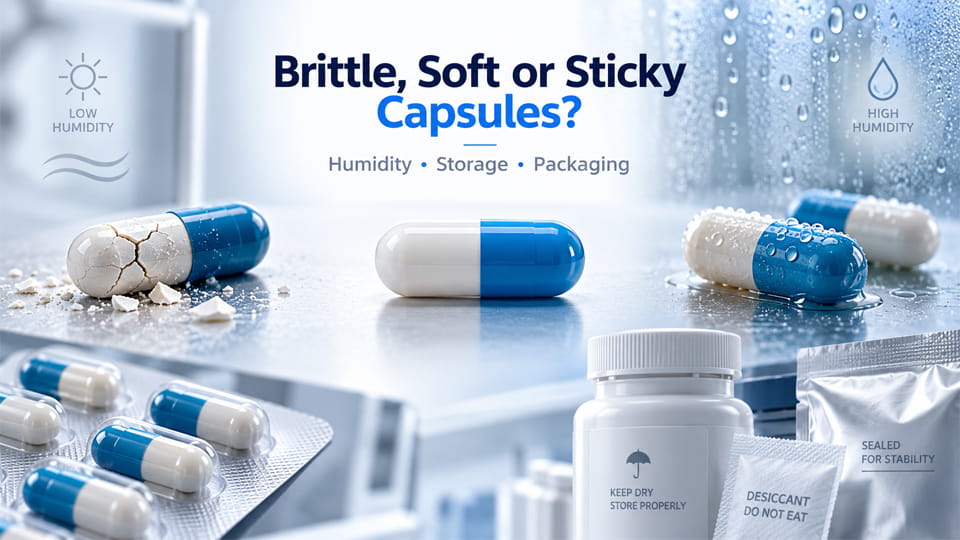
Despite their market dominance, gelatin shells introduce formulation and logistical complexities. Gelatin is inherently sensitive to environmental moisture and temperature, demanding strict storage conditions—typically 15°–25°C and 35–65% relative humidity (RH)—to maintain structural integrity. This sensitivity represents a significant constraint when encapsulating highly hygroscopic (moisture-sensitive) APIs, potentially limiting product stability and shelf life.
Hydroxypropyl methylcellulose (HPMC) capsules, derived from plant fibers and cellulose, have rapidly gained prominence, responding to the burgeoning market demand for vegetarian, vegan, and cruelty-free health products. They are an ideal alternative for consumers adhering to kosher or halal dietary laws.
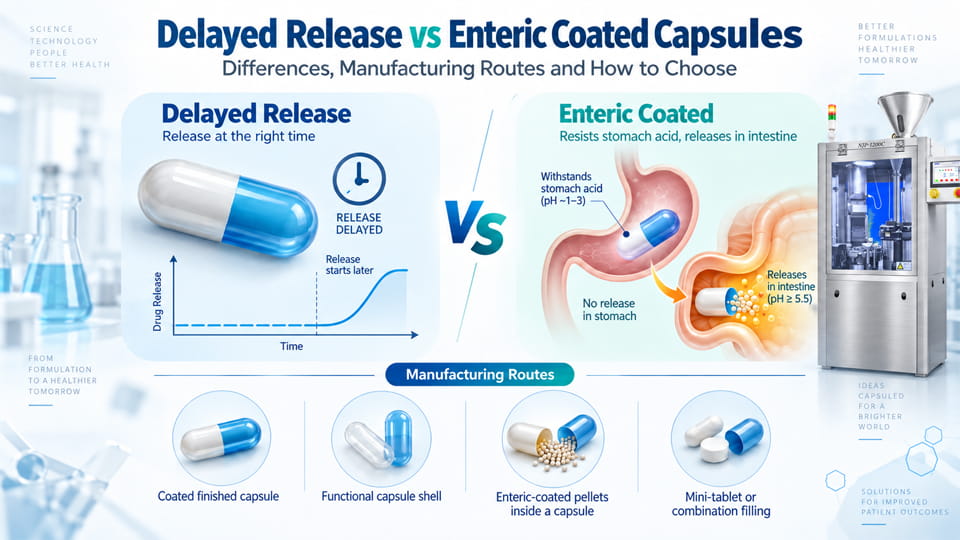
From a technical standpoint, HPMC capsules offer several benefits beyond dietary alignment. They possess a lower intrinsic moisture content and exhibit stability across a wider range of environmental conditions (up to 70% RH), making them the preferred technical choice for encapsulating highly moisture-sensitive or hygroscopic ingredients that would otherwise degrade within a traditional gelatin shell. A further formulation advantage is HPMC’s inherent resistance to gastric acids. This feature allows HPMC shells to function effectively in delayed-release applications without necessarily requiring additional enteric coating layers.
A sophisticated category of Types of capsules in Pharmacy involves engineering the capsule not merely as a container, but as an active component controlling the drug’s release profile within the gastrointestinal tract.
Delayed-release formulations are designed to prevent the immediate release of the drug substance upon ingestion. The most common and reliable method for achieving this is enteric coating. An enteric coating is a specialized polymer barrier applied to the capsule or its contents that remains intact in the highly acidic environment of the stomach and only dissolves when it encounters the less acidic, or alkaline, environment of the small intestine. This mechanism serves two primary purposes: protecting APIs that are sensitive to stomach acid from degradation and mitigating the risk of gastric irritation caused by certain drug substances. While all enteric-coated products are delayed-release, more complex delayed-release systems can also rely on time-based or enzymatic triggers.
These functional capsules are engineered for pharmacological optimization, gradually releasing active ingredients over an extended period. This is frequently achieved by utilizing pellets (multiparticulate systems ranging from 500 to 1500 microns in size) encapsulated within the shell, where each pellet can possess a modulated release profile.
The primary benefit of sustained-release technology is the maintenance of a consistent drug concentration in the bloodstream, optimizing the therapeutic effect and significantly improving patient compliance by reducing the necessity for frequent daily dosing. This sophisticated dosage form requires extremely precise manufacturing. The Capsule Filling Machine used for these products must be equipped with specialized pellet stations that are engineered to be gentle and highly accurate. Uniform pellet dispersion and precise dosing are non-negotiable requirements to ensure the consistent, controlled release profile vital for therapeutic success.
Achieving dosage precision in industrial pharmaceutical manufacturing hinges on correctly matching the bulk formulation properties to the appropriate capsule size and the capabilities of the filling equipment.
Standard hard capsule size ranges are numerically coded, running from the largest, size 000, down to the smallest, size 5.18 Size 000, for instance, can typically hold between 800 mg and 1600 mg of a powdered substance, depending entirely on density. It is crucial to recognize that a capsule’s total capacity is not solely defined by its volume; it is critically dependent on the bulk density and particle size distribution of the filling material. Formulation experts must optimize these parameters to guarantee accurate and consistent dosing when scaling up production.
A high-quality Capsule Filling Machine must possess the flexibility to seamlessly accommodate this entire range of size standards, from 000 to 5, often requiring quick changeover capabilities to maximize production efficiency. For industrial-scale operations, fully automatic fillers are indispensable, offering exceptional dosing precision. These machines are engineered to achieve high accuracy rates, often surpassing 99.98% accuracy with dosing deviations limited to $\pm$0.1 mg, a level of precision that is mandatory when handling high-potency APIs.

The global capsule market is poised for significant expansion, driven by technological innovations focused on enhanced efficiency and highly targeted therapeutic outcomes. Emerging manufacturing approaches, including the use of 3D printing and injection molding, are rapidly evolving, promising to transform capsules from passive carriers into sophisticated, active components for personalized drug delivery strategies.20 Furthermore, the strategic integration of nanotechnology is improving bioavailability, while artificial intelligence (AI) is already being utilized to optimize formulation stability and fine-tune controlled-release mechanisms.
To effectively capitalize on this technological leap and consistently meet stringent global quality and efficacy demands, pharmaceutical manufacturers must invest in flexible, high-precision industrial equipment. The modern Capsule Filling Machinemust be dynamically capable of handling diverse shell materials (Gelatin, HPMC) and complex, multi-particulate fills across all standard capsule size specifications, thereby guaranteeing both uncompromising regulatory compliance and market-leading therapeutic effectiveness.
Capsules are primarily categorized into Hard Capsules, which consist of two separable shells (cap and body), and Softgel Capsules, which have a single-unit, seamless, elastic shell that is hermetically sealed.
Hard capsules (two-piece systems) are traditionally used for dry, solid oral dosage forms like fine powders, granules, pellets, and micro-tablets, although modern technology also allows them to be filled with non-aqueous liquid or semi-solid formulations.
Softgel capsules are ideally suited for encapsulating challenging contents, predominantly liquid, oil-based, emulsion, or semisolid drugs.
Softgel capsules can significantly enhance the bioavailability (rate and extent of absorption) of active pharmaceutical ingredients (APIs) and provide a protective layer for oil-based or oxidation-prone drugs.
Gelatin capsules are animal-derived and are sensitive to moisture, requiring strict storage conditions (35–65% RH). HPMC capsules are plant-derived, possess a lower moisture content, and are stable across a wider environmental range (up to 70% RH), making them preferred for moisture-sensitive APIs.
Delayed-release capsules prevent immediate release in the stomach, most commonly achieved via an enteric coating. This is a specialized polymer barrier that remains intact in the acidic stomach environment but dissolves in the less acidic small intestine.
These capsules gradually release active ingredients over an extended period. The primary benefit is maintaining a consistent drug concentration in the bloodstream, optimizing the therapeutic effect, and improving patient compliance by reducing the necessity for frequent daily dosing.
Standard hard capsule size ranges from 000 (largest) to 5 (smallest). The total capacity (in milligrams) is critically dependent on the bulk density and particle size distribution of the filling material, requiring formulation experts to optimize these parameters for accurate dosing.
A high-precision Capsule Filling Machine executes a multi-step sequence: separating the shells, accurately dosing the specific formulation (powders, pellets, liquids, or combinations), and securely closing and sealing the capsule. Automatic fillers are mandatory for industrial scale due to their high precision (often >99.98% accuracy).
Emerging approaches include 3D printing and injection molding for precise drug delivery, the strategic integration of nanotechnology to improve bioavailability, and the use of Artificial Intelligence (AI) to optimize formulation stability and fine-tune controlled-release mechanisms.
References:
1.PubMed. Soft gel capsules improve melatonin’s bioavailability in humans.
2.Nutrisport Pharmacal. Benefits of Softgel Capsules for Nutraceuticals.
3.Adragos Pharma. HPMC Capsules: Why They Are Gaining Popularity in the Supplement Industry.
4.International Journal of Pharmaceutics and Drug Analysis: CAPSULES AND IT’S TECHNOLOGY: AN OVERVIEW (Review covering gelatin vs. non-gelatin materials like HPMC and Starch).