
Pill counting machines (also known as tablet counters or capsule counters) are automated devices used to precisely count and dispense pills, tablets, or capsules into bottles or packages. These machines are indispensable in pharmaceutical and nutraceutical manufacturing, where accuracy and speed are crucial. By automating the counting process, a pill counting machine significantly increases throughput and consistency of dosage, while dramatically reducing human error.
Manual counting is not only slow but also prone to mistakes. One study found that hand-counting error rates were over twice as high with manual methods compared to automated counting (12.6% vs. 4.8%). In modern pharmaceutical packaging, even a single-pill discrepancy can be costly, so strict quality and hygiene standards must be met. Pill counters ensure every bottle gets exactly the intended count, supporting regulatory compliance and customer safety.

Modern pharmaceutical and supplement production demands high accuracy and speed. Hand-counting pills is laborious and error-prone. In fact, an industry survey found that traditional hand-counting took 42.3% longer and had a much higher error rate than an electronic counter. Pill counting machines remove these bottlenecks: they give precise counts every time, improving inventory accuracy and reducing waste. This efficiency allows packaging engineers to focus on higher-value tasks rather than tedious counting.
Furthermore, automated counters can handle diverse products – from coated tablets to softgel capsules – while maintaining hygiene and consistency. Many machines include dust-extraction and easy-clean designs to comply with Good Manufacturing Practice (GMP) and food/pharma safety standards. By cutting down manual labor, tablet and capsule counters not only raise productivity but also protect workers from repetitive strain. As Jinlupacking notes, these machines are “vital packaging devices” that enhance precision and hygiene on the production floor.
Pill counting equipment comes in several configurations to suit different production scales:
A simple manual tablet counter using a tray with holes (each hole holds one tablet). This illustrates the traditional tray-and-shake method, where each hole represents one counted pill.
Modern pill counters rely on several key components:
In a fully automated line, counted pills travel through discharge funnels directly into bottles on a conveyor. Sensors verify the drop count, and once each bottle is filled, it automatically moves on to capping and labeling. This video shows pills falling through multiple chutes – each funnel delivers the exact count into a bottle. With this design, the line can run continuously at high speed.
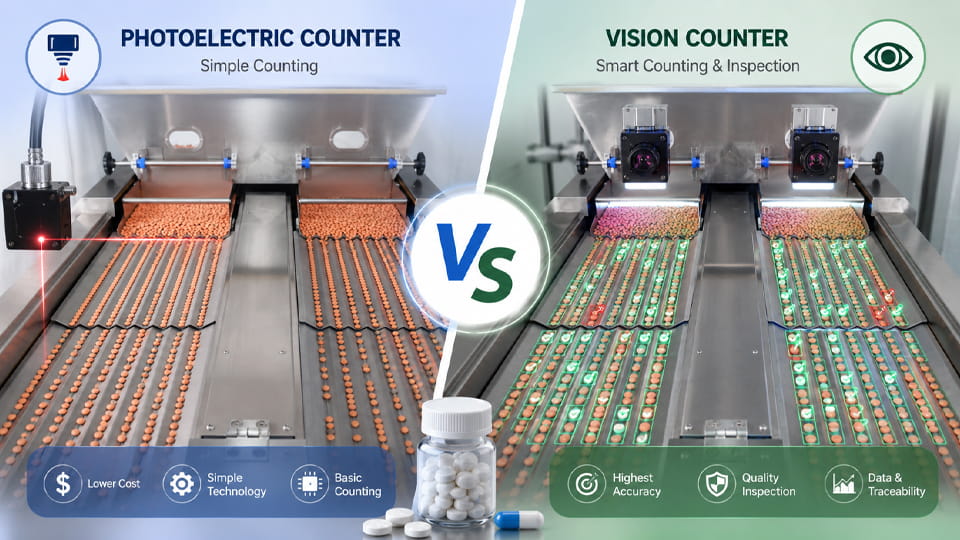
Traditional counters rely on beam interruption. When a pill drops through an infrared beam, the beam is broken and the sensor registers it. This works very well for uniform, opaque tablets or capsules. However, beam sensors can struggle with irregular shapes or transparent pills. For example, an IR beam might not register a tilted oval tablet or a clear gelatin capsule.
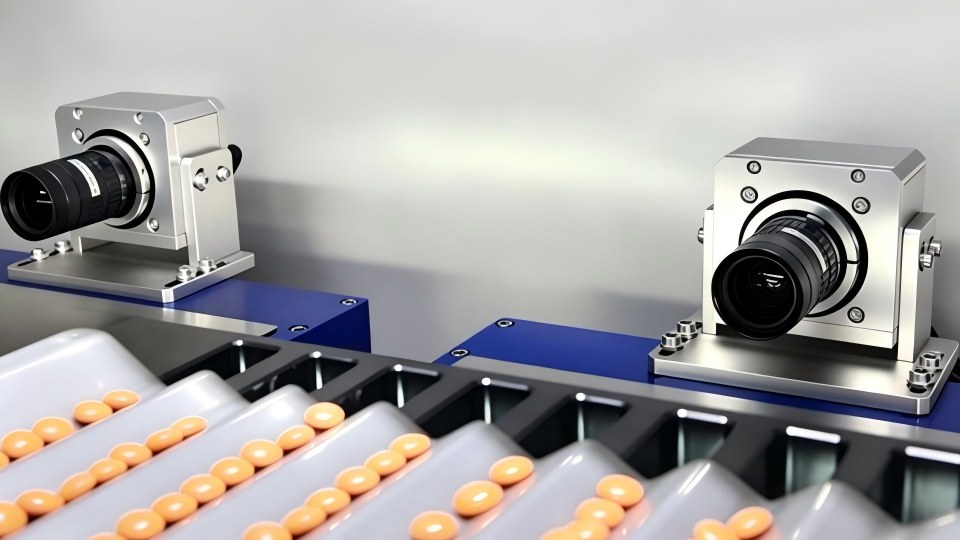
Vision-based counters overcome these issues. High-speed cameras capture each falling pill, and intelligent software analyzes its image. The system recognizes the pill’s shape, size, and even color. This allows it to count irregular shapes or see through translucent shells. Moreover, vision counters can inspect each pill’s surface – detecting cracks, chips, or foreign matter in real time. The added verification ensures nearly 100% accuracy and improves safety. In effect, photoelectric sensors are the “counting eyes” of the machine, while vision cameras are “super-eyes” that also perform quality control.
Implementing a tablet or capsule counting machine yields many advantages:

While pharmaceutical manufacturers are the primary users, pill counting machines are found in many industries. Key examples include:
In each case, the goal is the same: an efficient, accurate count and fill. Modern counters can adapt to the product’s characteristics, ensuring smooth operation in any high-speed packaging line.
Pill counting machines are a cornerstone of modern tablet and capsule packaging. Using vibratory feeders, precision sensors, and smart controls, they automate the counting task to achieve consistent, high-speed filling. From simple manual trays to advanced multi-channel systems (including camera-based models), there’s a solution for every scale. Automated counters boost production efficiency, reduce errors, and ensure dosing accuracy – all of which are crucial for pharmaceutical and related industries.
By understanding how these machines work, pharmaceutical engineers and manufacturers can optimize their packaging lines. A high-quality pill counting system (or a fully integrated counting-filling-labeling line) is a wise investment, delivering higher throughput, better compliance, and more reliable products.
A pill counting machine (also called a tablet counter or capsule counter) is an automated device used to precisely count and dispense a predetermined number of tablets or capsules into bottles or packaging. It reduces human error, increases speed, and ensures dosage accuracy in pharmaceutical and supplement production.
Most pill counting machines use vibratory feeders or turntables to separate and align individual pills, then use sensors (photoelectric, infrared, or vision cameras) to detect each passing pill. When the preset count is reached, the machine diverts or dispenses the pills into a bottle or container.
The primary types are:
• Manual (tray-based) counters — counting by shaking pills into holes on a tray.
• Semi-automatic counters — combining hopper, turntable, and sensors with manual bottle handling.
• Fully automatic / multi-channel counters — high-speed machines with multiple lanes, conveyor integration, and minimal human intervention.
Functionally, they are similar: both are pill counting machines. The difference lies in the products handled. A tablet counter is optimized for flat tablets, while a capsule counter is tailored to count capsules (which may be more elongated, transparent, or delicate). Advanced machines can count both types.
Modern machines generally achieve errors well below 1%, depending on machine design, sensor type, and maintenance. Vision-based systems with image processing can further reduce miscounts and detect defects.
Yes — advanced machines that use vision / camera-based systems can inspect each pill’s shape, size, and surface condition in real time. They can flag or reject broken, chipped, or foreign particles during the counting process.
Challenges include:
• Dust accumulation on sensors affecting accuracy
• Pill jams or bridging in feeders
• Irregular shapes or transparent capsules that are difficult for simpler sensors
• Changeover time when switching pill types or sizes
• Calibration drift over time
Modern machines mitigate these via dust extraction systems, self-check routines, tool-free changeover designs, and sensor cleaning mechanisms.
• Regularly remove and clean funnels, chutes, and surfaces with isopropyl alcohol or suitable cleaning agents
• Keep sensors and optical windows dust-free
• Follow the manufacturer’s maintenance schedule (e.g. weekly, monthly)
• Use tool-free parts for quick disassembly and reassembly
• Perform calibration checks periodically to ensure counting accuracy
Though primarily used in pharmaceuticals, pill counting machines are also employed in:
• Nutraceuticals / dietary supplements
• Veterinary medicine
• Cosmetics & personal care (e.g. small tablets, capsules)
• Food / confectionery (e.g. candy, mints)
• Electronics or precision components (for counting small parts)
Consider the following criteria:
• Production volume (bottles per minute)
• Type and size of pills or capsules you need to count
• Required accuracy and quality inspection features
• Changeover flexibility and ease of cleaning
• Integration capability with upstream/downstream machinery
• Service, parts availability, and supplier support
References:
1.Development of Pill Counting Algorithm and Pill Counting Machine Using Non-contact Photo Sensor ——Retrieved from:ResearchGate
2.6 Key Advanced Pill-Counting Features Pharmacies Should Consider ——Retrieved from:CoverMyMeds Insights, 2022
3.Pill Detection Model for Medicine Inspection Based on Deep Learning ——Retrieved from: ChemoSensors, 2021
4.Pharmacy Automation-Pill Counting Design ——Retrieved from: IJERA, 2015