
Техническое обслуживание фармацевтического оборудования – это не просто ремонт машины, когда она останавливается.. Хорошая программа технического обслуживания обеспечивает чистоту оборудования., надежный, точный, и готовы к производству, сокращая при этом непредвиденные простои и избегая рисков качества.. Под Текущая передовая производственная практика FDA, оборудование, используемое для производства, процесс, пакет, или хранить лекарственные препараты необходимо очищать и обслуживать через соответствующие промежутки времени., поддерживается письменными процедурами и записями. Автоматический, механический, и электронное оборудование также должно регулярно калиброваться., проверено, или проверено в написанной программе.
Для фармацевтического завода, практическая цель проста: знать, какие машины важнее всего, определить компоненты, которые с наибольшей вероятностью повлияют на качество продукции или время безотказной работы, поддерживать их до отказа, документировать работу, и продолжайте совершенствовать план на основе реальных эксплуатационных данных. В «Руководстве по надлежащей практике технического обслуживания» ISPE техническое обслуживание аналогично рассматривается как структурированная программа в области GMP, а не как набор изолированных ремонтных работ..
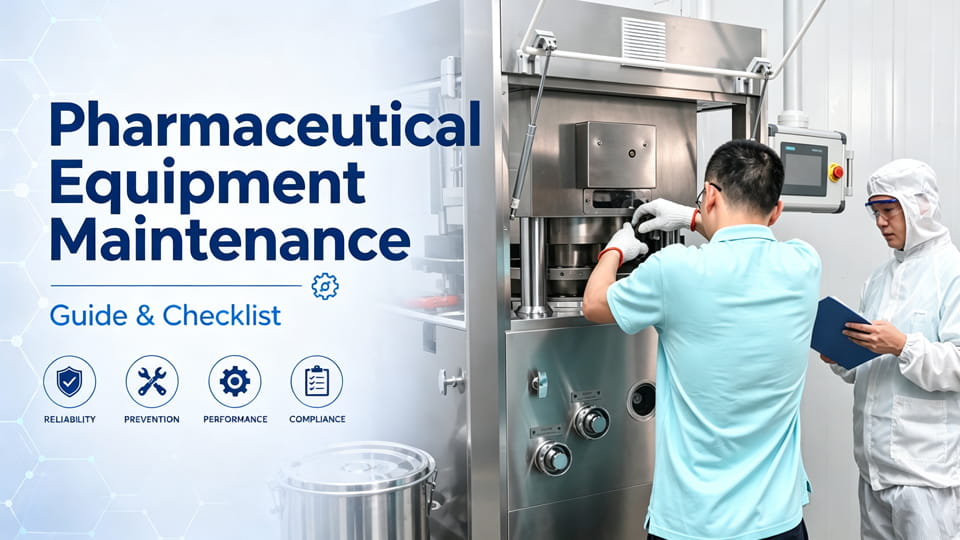
В этом руководстве объясняется, как построить эту систему., с практичным контрольным списком по обслуживанию фармацевтического оборудования, график технического обслуживания, консультации по конкретной машине, и рекомендации GMP для таблеточных прессов, капсульные наполнители, блистерные машины, счетные машины, и картонщики.
Обслуживание фармацевтического оборудования это плановая проверка, уборка, смазка, корректирование, поддержка калибровки, ремонт, и работы по замене, используемые для поддержания работы оборудования фармацевтического производства и упаковки по назначению..
Это гораздо больше, чем просто специалист по техническому обслуживанию с ящиком для инструментов.. Полная программа технического обслуживания фармацевтической продукции объединяет производство, инженерия, гарантия качества, операторы, управление запасными частями, документация, и поставщики оборудования.
Почему это имеет значение?
Существует четыре полезных подхода к техническому обслуживанию.:
| Тип обслуживания | Курок | Лучшее использование | Основное ограничение |
| Реактивное обслуживание | Оборудование уже вышло из строя | Низкая критичность, недорогие компоненты | Создает незапланированные простои и может привести к вторичному повреждению. |
| Профилактическое обслуживание | Время, циклы, партии, или часы работы | Обычные изнашиваемые детали, смазка, инспекции, плановое обслуживание | Возможна замена деталей раньше, чем необходимо, если плохо установлены интервалы |
| Техническое обслуживание по состоянию | Измеренное состояние выходит за определенный предел | Подшипники, моторы, вакуумные системы, чувствительные к температуре компоненты | Требуются надежные измерения и допустимые пределы. |
| Прогностическое обслуживание | Тенденции или модели указывают на ухудшение ситуации | Критически важное оборудование, где раннее предупреждение имеет большое значение | Требует достаточных данных, контроль дисциплины, и технические возможности |
Для большинства фармацевтических производителей, лучший ответ - не выбирать только один метод. В качестве основы используется профилактическое обслуживание., реактивное техническое обслуживание подходящих изделий с низким уровнем риска, а также методы, основанные на условиях или прогнозирующие, если их оправдывает критичность оборудования..
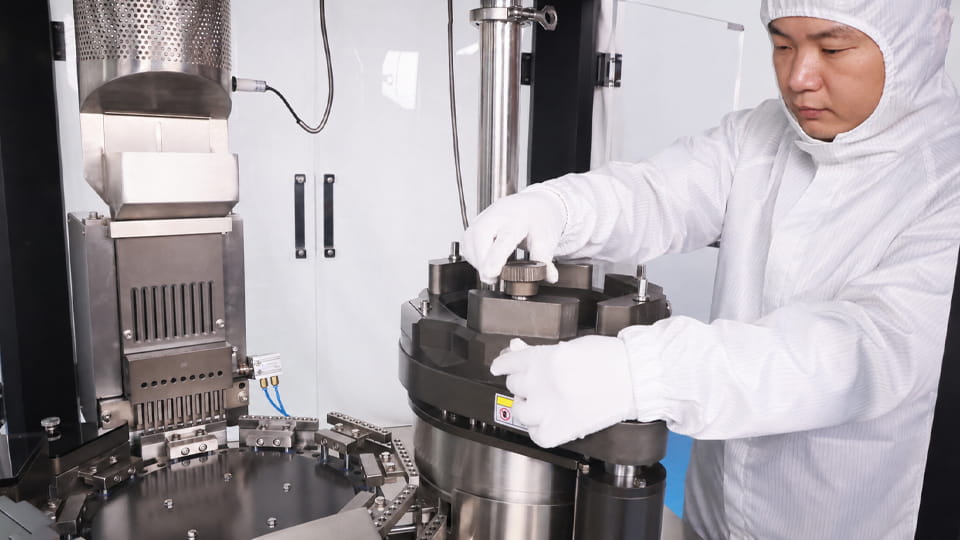
Практичный программа профилактического обслуживания в фармацевтической промышленности начинается с оборудования, а не с общего контрольного списка, загруженного из Интернета.
Простой рабочий процесс выглядит так:
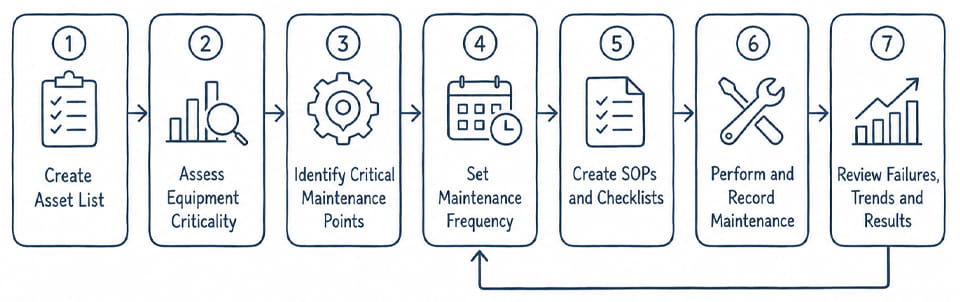
Важная часть - последняя стрелка. График технического обслуживания фармацевтической продукции должен улучшиться по мере того, как вы узнаете, как на самом деле ведет себя оборудование..
Следующий график представляет собой стартовый шаблон, не нормативная частота. Фактические интервалы должны соответствовать рекомендациям производителя оборудования и оценке рисков вашего предприятия., часы работы, материалы, история обслуживания, и проверенное состояние. FDA requires a maintenance schedule and EU GMP expects equipment to be appropriately maintained and relevant measuring and control equipment to be checked at defined intervals.
| Частота | Recommended Pharmaceutical Equipment Maintenance Tasks |
| Ежедневно / each shift | Clean accessible product-contact areas; remove dust and residues; inspect for leakage, необычный шум, вибрация, loose parts, damaged guards, abnormal alarms, air/vacuum problems, and obvious tooling wear; verify safety devices before operation |
| Еженедельно | Inspect and clean sensors, фильтры, цепи, ремни, vacuum lines, pneumatic fittings, кормушки, направляющие, инструмент, and dust-extraction points; lubricate approved points where required |
| Ежемесячно | Осмотр подшипников, камеры, drive components, моторы, электрические соединения, уплотнения, коробки передач, выравнивание оснастки, вакуумная производительность, обогреватели, and wear parts; review alarm and repair history |
| Ежеквартальный | Perform deeper mechanical and electrical inspection; verify critical settings and instrumentation; inspect safety circuits and high-wear assemblies; review recurring failures and spare-parts consumption |
| Ежегодный | Conduct comprehensive inspection or planned overhaul based on machine condition; replace life-limited parts where justified; verify calibration status and safety systems; review the PM program, история обслуживания, документация, и обучение |
Для daily pharmaceutical equipment maintenance checklist, operators are your first line of defense. Ask them to look for changes: a new noise, more powder around a seal, a slower vacuum response, a warmer motor, unstable film tracking, or an increased reject rate. Small changes often appear before a full breakdown.
Weekly work should focus on components that accumulate dust or gradually loosen, засорять, высохнуть, or wear. Monthly maintenance goes deeper into drive systems, электрические соединения, выравнивание, уплотнения, инструмент, and moving assemblies.
Quarterly and annual work should not become a ritual where technicians simply tick boxes. Compare actual machine condition with earlier inspections. Check repeat faults. Посмотрите замененные компоненты. Спросите, правильная ли частота технического обслуживания.
Смазка заслуживает особого внимания.. Слишком мало смазки увеличивает трение.; использование неправильной смазки или ее применение там, где возможно загрязнение, может создать еще одну проблему.. У ДжинЛу есть отдельный Руководство по смазочным материалам для фармацевтического оборудования вопросы выбора смазочных материалов и технического обслуживания фармацевтического оборудования..
Рекомендации по техническому обслуживанию непатентованного фармацевтического оборудования ограничены.. Настоящая ценность заключается в знании того, что проверять на каждой машине..
Обслуживание таблеточного пресса. Сосредоточьтесь на пуансоне и штампах, турель, верхняя и нижняя направляющие кулачка, компрессионные ролики, Force Feeder, система привода, точки смазки, пылеудаление, и защита безопасности. Накопление порошка вокруг турели или инструмента может ускорить износ и привести к дефектам таблеток., в то время как поврежденный инструмент или плохая центровка требуют немедленного расследования.. В таблеточных прессах JinLu используются такие узлы, как поворотные револьверные головки., питатели силы, вакуумные системы, системы сжатия, и защита от перегрузки, выполнение этих логических точек проверки в программе профилактического обслуживания таблеточного пресса. См. ДжинЛу Линейка таблеточных прессов.
Обслуживание машины для наполнения капсул. Держите капсульную кормушку, система разделения, пустой круг, дозирование компонентов, трамбовка или заполнение сборок, запирающая станция, камеры, и зоны контроля пыли чистые и правильно отрегулированные. Особенно следите за попаданием порошка в механические помещения., снижение производительности вакуума, смещение капсулы, и ненормальный шум камеры. В автоматических машинах для наполнения капсул JinLu используются модульные узлы наполнения и, на некоторых моделях, безмасляные подшипники, предназначенные для уменьшения необходимости технического обслуживания. Для более глубокого руководства на уровне компонентов, видеть Как обслуживать автоматическую машину для наполнения капсул и Линейка машин для наполнения капсул.
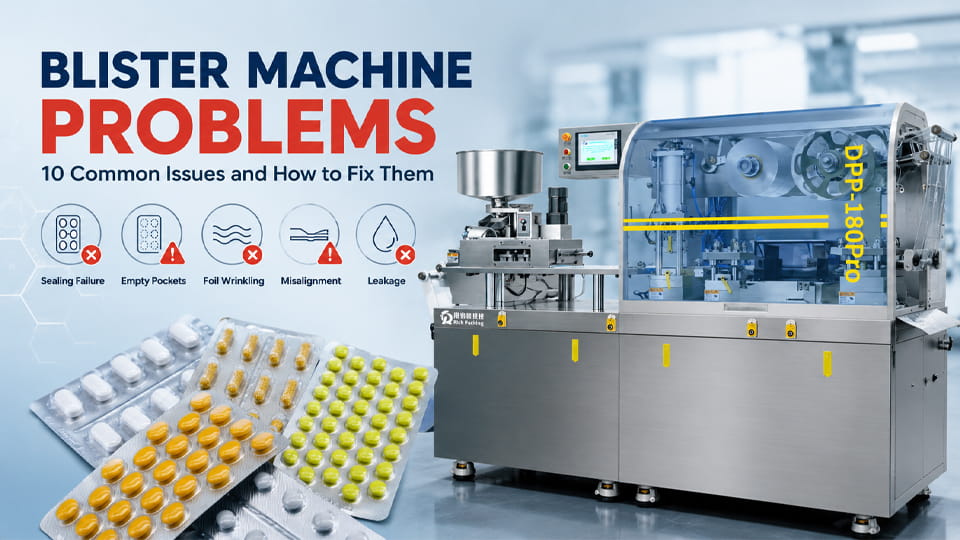
Blister machine maintenance. Inspect forming and sealing stations, обогреватели, sealing plates or rollers, направляющие ролики, напряжение фильма, кормушки, cutting tooling, охлаждение, датчики, pneumatic components, and vacuum systems. Dust or residue on sealing surfaces, изношенные компоненты, incorrect alignment, and unstable processing conditions can quickly show up as weak seals or malformed packs. JinLu blister machines combine forming, кормление, тепловое уплотнение, тяга, and cutting functions, so alignment between stations is particularly important. See the Blister Packing Machine range and JinLu’s Blister Machine Problems Guide.
Counting and cartoning machines. On tablet and capsule counters, keep vibration channels, feeding surfaces, photoelectric or vision sensors, dust-removal areas, bottle handling, reject systems, and pneumatic components clean and correctly positioned. JinLu’s counting equipment is designed for integration into bottling lines, while its JL-16C product uses a modular, enclosed design intended to simplify maintenance and limit dust problems. На Картонирующая машина, pay close attention to vacuum pick-up components, suction cups, carton magazines, цепи, гиды, датчики, leaflet systems, forming stations, and product/carton detection because several coordinated stations must operate in sequence.
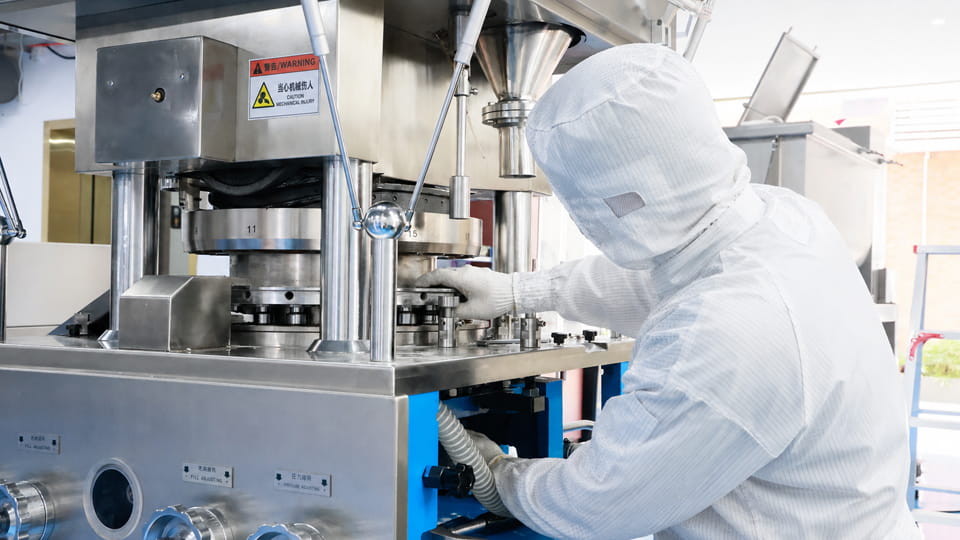
Обслуживание, уборка, and calibration are related, but they are not interchangeable.
| Activity | Основная цель | Typical Example |
| Уборка | Remove product residue, пыль, cleaning-agent residue, и загрязнение | Cleaning a capsule dosing station after a batch |
| Обслуживание | Preserve or restore mechanical/electrical performance | Replacing a worn bearing or adjusting a drive system |
| Калибровка | Confirm that a measuring or control device performs within defined accuracy | Checking a temperature, давление, масса, or force measurement against a reference |
FDA makes those responsibilities clear. Раздел 211.67 requires written cleaning and maintenance procedures, including responsibility, графики, methods and materials, disassembly or reassembly where needed, protection of clean equipment, pre-use cleanliness inspection, и записи. Раздел 211.68 adds routine calibration, осмотр, or checking of automatic, механический, and electronic equipment under a written program.
A GMP-oriented SOP can therefore use this checklist:
| SOP Element | What to Define |
| Purpose and scope | Equipment and activities covered |
| Responsibility | Оператор, обслуживание, инженерия, контроль качества, or contractor roles |
| Частота | Время, operating-hour, цикл, партия, or condition-based trigger |
| Safety and preparation | Isolation, lockout, cleaning status, required PPE |
| Maintenance method | Осмотр, корректирование, replacement, смазка, инструменты, approved materials |
| Disassembly/reassembly | Required sequence and checks before restart |
| Критерии приемки | What constitutes acceptable machine condition |
| Post-maintenance checks | Чистота, охранники, настройки, trial run, calibration or requalification where applicable |
| Документация | Date, technician, work performed, parts used, выводы, отклонения, approvals |
The EU position is closely aligned. EU GMP Chapter 3 says manufacturing equipment should be designed, located, and maintained for its intended purpose; repair and maintenance must not create a product-quality hazard; equipment should be easy to clean; measuring and control equipment should be calibrated and checked at defined intervals with records; and defective equipment should be removed or clearly identified where possible.
This remains an active inspection issue rather than an old requirement sitting in a regulation book. FDA warning letters issued in 2025 и 2026 have continued to cite firms for inadequate equipment cleaning and maintenance procedures or failures associated with 21 CFR 211.67.
One of the most common maintenance mistakes is running everything until failure. Others include giving every machine the same service interval, ignoring small changes in noise or vibration, using the wrong lubricant, over-lubricating, postponing sensor checks, keeping poor records, carrying no critical spare parts, and restarting production without a proper post-maintenance inspection.
Predictive maintenance can take the program further. Instead of asking, “Is it time to replace this bearing?” you ask, “Is the bearing actually deteriorating?” Useful inputs include vibration, температура, давление, motor current, alarm history, vacuum trends, and existing process data. A pharmaceutical manufacturing study using an operating aseptic filling line found that long-term shifts in process-monitoring data could be linked with equipment faults and used to support earlier planned interventions.
The practical benefit is not that every factory needs artificial intelligence. It is that trend information can help move maintenance from a fixed calendar toward evidence-based decisions.
To reduce maintenance cost, start with boring fundamentals: standardize common spare parts where possible, keep critical wear parts available, train operators to notice deterioration, follow correct lubrication practices, document recurring failures, and involve the OEM when a pattern is unclear. ЦзиньЛу, например, provides technical documentation, обучение, профилактическое и корректирующее обслуживание, удаленное устранение неполадок, and parameter/software backup as part of its support offering.
Maintenance cost also starts at приобретение. FDA 21 CFR 211.63 specifically requires pharmaceutical equipment to have appropriate design, размер, and location to facilitate intended operation, уборка, и обслуживание. When comparing pharmaceutical machinery suppliers, look for accessible maintenance points, easy product-contact disassembly, модульная оснастка, understandable fault diagnostics, readily available wear parts, good manuals, удаленная поддержка, and realistic spare-parts lead times.
Ask the supplier a simple question before buying: “Show our maintenance team how we will access, чистый, проверять, and replace the parts that wear most often.” A machine that saves ten minutes every changeover or makes inspection easier can be more valuable over its life than a machine with a slightly lower purchase price.
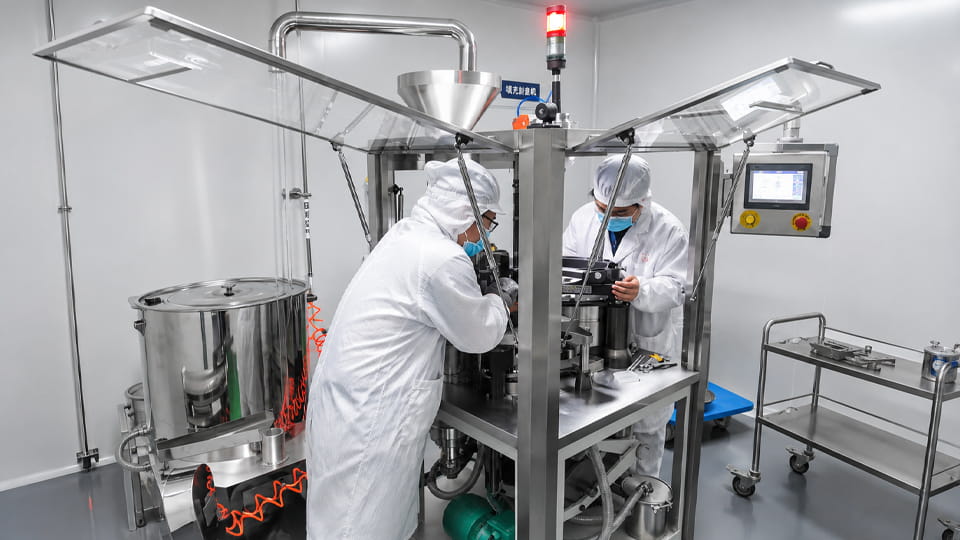
В фармацевтическом производстве, maintenance = reliability + качество + согласие. Хороший Обслуживание фармацевтического оборудования is less about performing more maintenance and more about performing the right maintenance at the right time. Choosing the right equipment is step one; following through with a structured maintenance program is just as crucial. By doing daily checks, sticking to schedules, and documenting every action, you prevent surprises, сократить расходы, and keep patients safe.
И jeinlu собирать, we design our machines (Пережи для планшетов, капсульные наполнители, и т. д.) with hygiene and maintenance ease in mind. But even the best machine needs TLC. We encourage you to apply the tips in this guide to your own equipment, и всегда refer to your machine’s manual for specifics.
If you have questions about maintenance programs or need technical support for your line, our engineers at Jinlu are ready to help. Proper maintenance keeps your line running smoothly – and ultimately, keeps your quality high and costs low.
Ready to improve your machine uptime? Contact JinluPacking’s support team or explore our full range of pharmaceutical packaging equipment to see how we design for easy cleaning and maintenance.
There is no single maintenance interval that works for every pharmaceutical machine. Maintenance frequency should be based on the equipment manufacturer’s recommendations, часы работы, производственная загрузка, equipment criticality, характеристики продукта, and previous maintenance history. High-use or critical equipment may require daily or weekly inspections, while deeper preventive maintenance may be scheduled monthly, quarterly, or annually.
Preventive maintenance is planned maintenance performed before equipment fails. It normally includes inspection, уборка, смазка, корректирование, замена изнашиваемых деталей, проверки безопасности, and functional testing at defined intervals. A good preventive maintenance program helps pharmaceutical manufacturers reduce unexpected downtime, maintain consistent machine performance, and identify component wear before it affects production or product quality.
A pharmaceutical equipment maintenance checklist should cover mechanical parts, точки смазки, drive systems, датчики, electrical components, pneumatic and vacuum systems, устройства безопасности, инструмент, уплотнения, фильтры, and other wear parts. It should also record the equipment ID, inspection date, technician, выводы, заменены детали, корректирующие действия, and the next scheduled maintenance date.
Да. GMP requires pharmaceutical manufacturing equipment to be maintained so that malfunction or contamination does not affect product quality. Under FDA 21 CFR 211.67, manufacturers must establish and follow written equipment cleaning and maintenance procedures, including assigned responsibilities, графики технического обслуживания, методы, инспекции, и записи. The exact maintenance interval should be defined according to the equipment and process rather than using one universal schedule.
Preventive maintenance is normally performed according to a predefined time, operating-hour, цикл, or production schedule. Predictive maintenance uses equipment-condition data to determine when maintenance is actually needed. Например, вибрация, motor temperature, давление вакуума, electrical current, or alarm trends can help identify developing problems before failure. Many pharmaceutical plants use preventive maintenance as the foundation and predictive maintenance for critical equipment.
Pharmaceutical manufacturers should maintain records that clearly show what maintenance was performed, when it was completed, who performed it, what problems were found, and what corrective actions or parts replacements were required. Major equipment records may also include cleaning and use information, equipment identification, batch references, инспекции, calibration checks, отклонения, and follow-up activities. Records should be traceable, chronological, and easy to retrieve during GMP inspections.
Start with a complete equipment list and classify each machine according to its impact on product quality, безопасность, и производство. Then review the OEM maintenance manual, identify critical wear components, and define inspection or replacement intervals based on operating hours, production intensity, failure history, и риск. Assign responsibilities, create equipment-specific checklists, document completed work, and regularly adjust the schedule using actual maintenance data.
Not every maintenance activity requires full requalification, but significant repairs or changes should be assessed for their impact on equipment performance and the validated state. Replacing a routine wear part with an equivalent component may only require defined post-maintenance checks. Changes affecting critical settings, системы управления, measurement accuracy, software, product-contact parts, or operating parameters may require calibration, проверка, контроль изменений, or partial requalification before production resumes.
The most effective approach is to combine risk-based preventive maintenance with good operator inspection and fast access to critical spare parts. Operators should report abnormal noise, вибрация, температура, утечка, потеря вакуума, sensor faults, or increasing reject rates before they become major failures. Maintenance teams should also analyze repeated breakdowns, keep accurate service histories, monitor critical components, and work with the equipment manufacturer when recurring problems cannot be resolved internally.
Buyers should evaluate maintenance accessibility before focusing only on machine speed and purchase price. Look for easy access to wear parts, quick product-contact disassembly, модульная оснастка, standardized spare parts, clear lubrication points, useful PLC diagnostics, accessible electrical and pneumatic components, and simple cleaning procedures. The supplier should also provide maintenance manuals, spare-parts lists, обучение, техническая документация, удаленная поддержка, and reliable after-sales service.
Ссылки:
1.Руководство по передовой практике: Maintenance 2nd Edition —— ИСПЕ
2.Quality assurance of pharmaceuticals: a compendium of guidelines and related materials: объем 2: Good manufacturing practices and inspection, 10th ed —— ВОЗ
3.21 CFR § 211.182 Equipment Cleaning and Use Log —— eCFR
4.ICH Topic Q 7 Good Manufacturing Practice for Active Pharmaceutical Ingredients —— Европейское агентство лекарственных средств
5.Руководство по надлежащей производственной практике и надлежащей практике распределения: Вопросы и ответы —— Европейское агентство лекарственных средств
6.Targeted Preventive Maintenance of Pharmaceutical Equipment —— ИсследованияГейт