
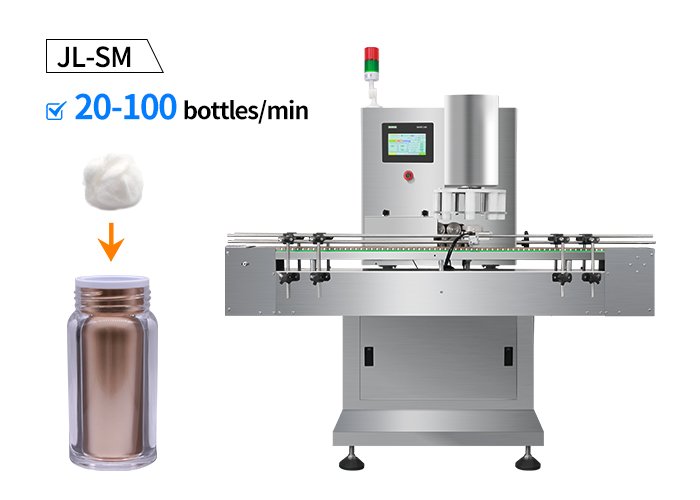
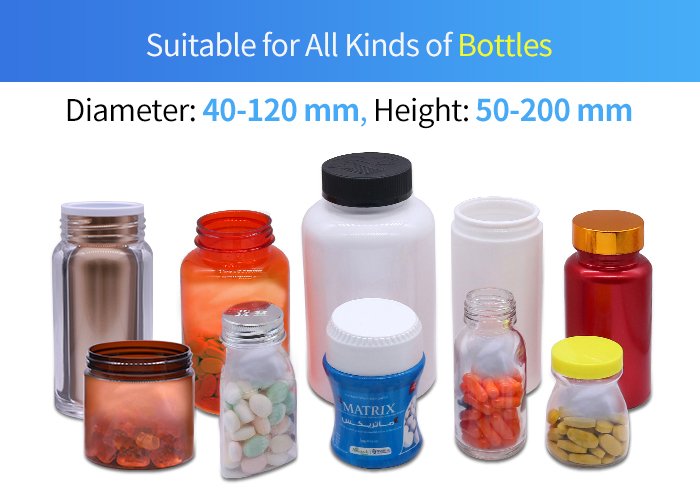

It works with round, square, flat, and special-shaped bottles, designed for seamless integration with capsule tablet counting and bottling lines. Built with cGMP, it includes no-bottle no-operation, fault alarm, and cotton roll reminder functions.


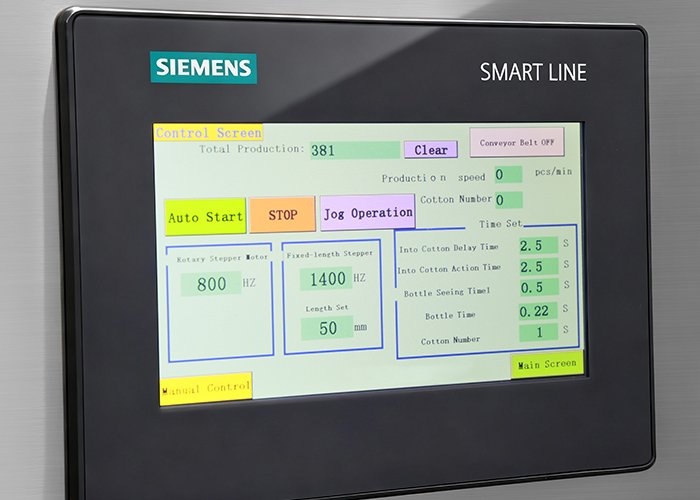
Delivering stable, reliable, and user-friendly operation, the interface offers clear parameter setting, fault diagnosis, and recipe storage, greatly simplifying operation and training.
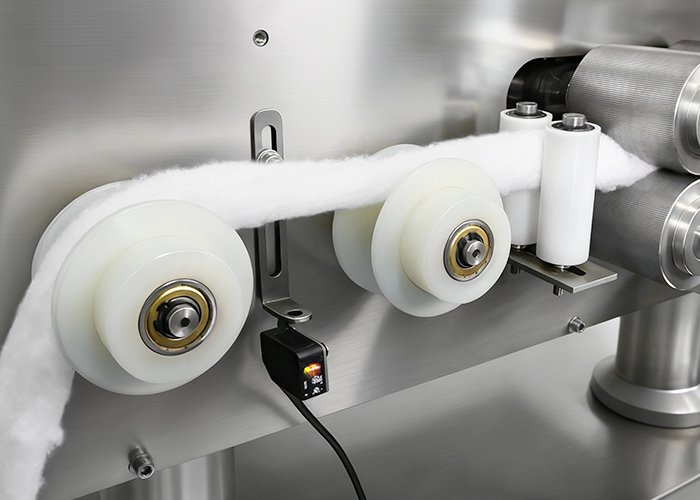
It automatically detects cotton presence, blockage, breakage, and material shortage, ensuring stable and continuous operation. The intelligent detection system effectively avoids idling.
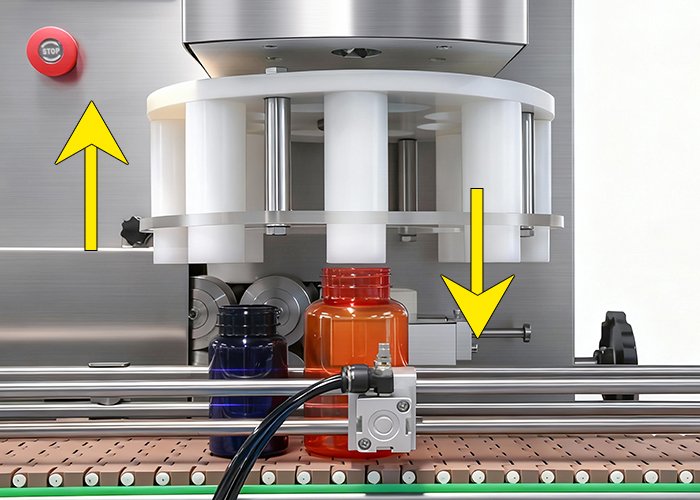
Enabling ultra-fast adaptation to bottles of varying sizes and heights without complex tools or lengthy manual calibration, drastically cuts downtime during batch and bottle format switchovers.
All product-contact parts use food‑grade SUS304 and SUS316 stainless steel with smooth, crevice-free surfaces to prevent contamination and enable easy cleaning.
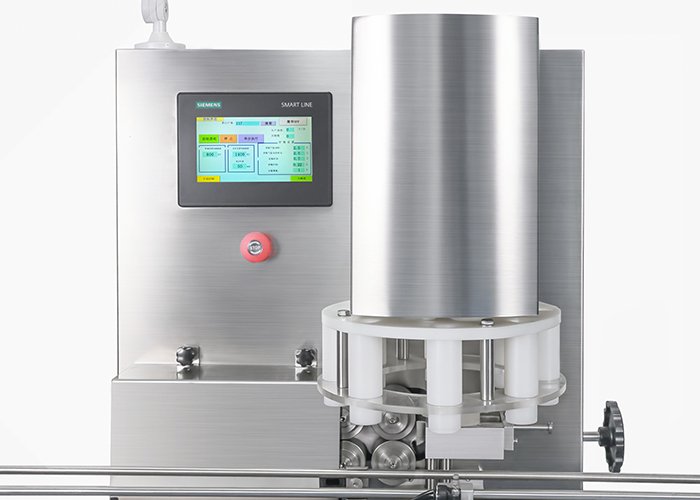
| Capacity(bottles/min) | 50-100 bottles/min |
| Specification of bottles | Dia.25-70mm |
| Outline dim. | 1600mm×750mm×1400mm |
| Weight(kg) | 180 |
| Power consumption(w) | 0.7kw |
| Power supply | 220V / 50~60Hz |
Located in Guangzhou, JL is a supplier of pharmaceutical packaging machinery integrating engineering, production and sales.
Our team focuses on developing pharmaceutical processing & packaging machines that combine functionality, quality, and cost-effectiveness, in addition to providing our customers with hassle-free one-stop service.
Our Advantages
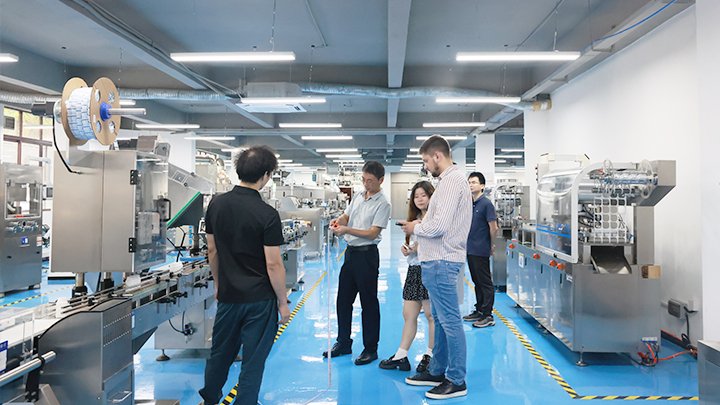
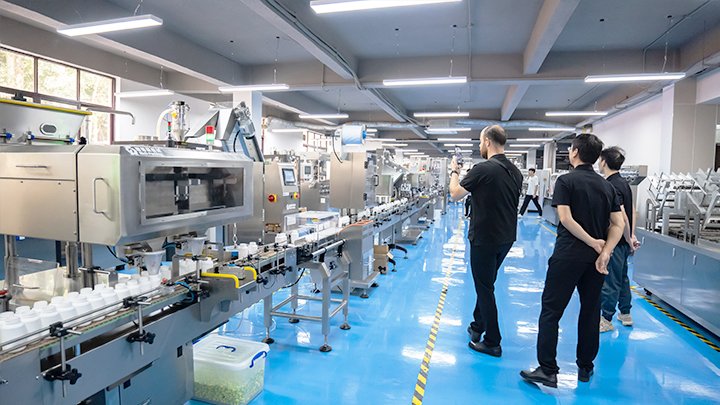
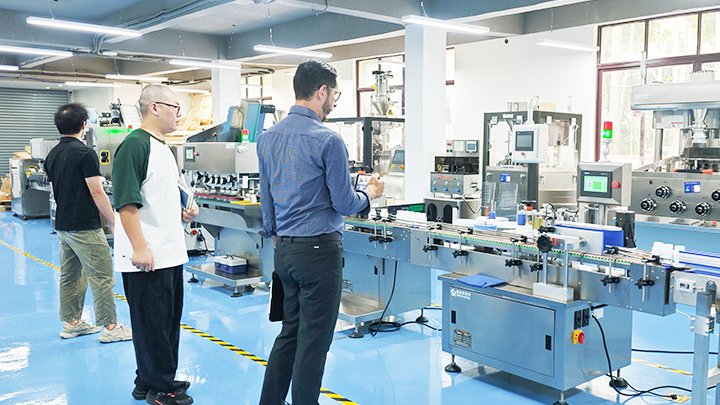
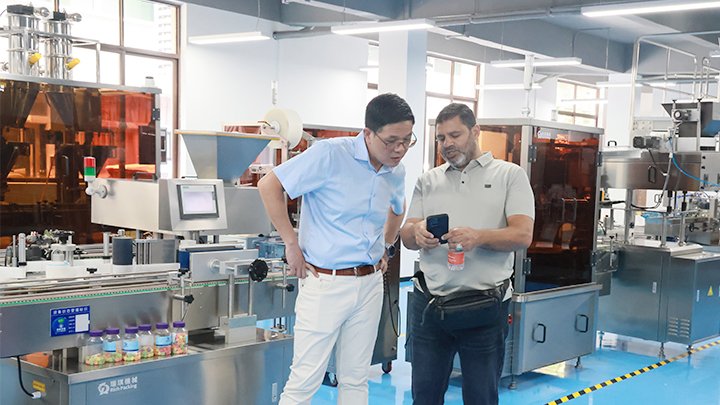
We participate in major pharmaceutical and packaging exhibitions, including CPhI, Expofarm, and IPACK.
We ensure that the machinery is properly packaged to protect it against moisture, dust, and corrosion.
We provide a full set of free technical documents and videos so you don’t have to worry about use and maintenance.
In the global pharmaceutical, nutraceutical, and healthcare manufacturing sectors, every step of the solid dosage bottling process plays a non-negotiable role in product safety, regulatory compliance, and shelf-life stability. While tablet counting, filling, and capping often take center stage, one critical yet frequently overlooked component can make or break the integrity of your final product: the cotton insert inside every bottle. This soft, fibrous barrier protects fragile tablets and capsules from impact damage during transit, acts as a secondary shield against moisture and oxygen ingress, and preserves the potency of active pharmaceutical ingredients (APIs) from production to end-user consumption.
For decades, manufacturers relied on manual cotton insertion, a slow, labor-intensive process rife with risks: inconsistent cotton length and placement, high risk of microbial and particulate contamination from human contact, frequent production bottlenecks, and sky-high labor costs. Even many generic automatic cotton inserter models on the market fail to address the core pain points of regulated industries: they lack the precision for consistent insertion, generate excess cotton lint that contaminates cleanroom environments, cannot adapt to diverse bottle formats, and fail to meet the strict documentation and traceability requirements of cGMP, FDA, and EMA regulations.
Jinlu Packing’s automatic cotton inserter delivers unrivaled precision, hygienic performance, and seamless integration into capsules tablet counting and bottling lines. In this comprehensive guide, we break down the core function, critical role in bottling operations, industry applications, and standout advantages of a high-performance cotton inserter machine, and why Jinlu’s solution is the gold standard for regulated manufacturing worldwide.
A cotton inserter (also referred to as an automatic cotton inserter, cotton inserter machine, or cotton filler machine) is a specialized, fully automated piece of packaging equipment designed to cut, position, and insert cotton wadding into the neck of filled bottles, between the product and the bottle closure. Unlike semi-automatic systems that require manual cotton feeding and bottle handling, a fully automatic model completes the entire insertion cycle without human intervention, synchronizing seamlessly with upstream and downstream bottling equipment to maintain a continuous, high-speed production flow.
The operational workflow of Jinlu’s advanced cotton inserter follows a precision-engineered, fully automated sequence:
This closed-loop, fully automated workflow eliminates all manual intervention in the insertion process, delivering consistent, repeatable results with every cycle, while minimizing the risk of contamination and human error.
A complete, GMP-compliant tablet counting and bottling line follows a sequential, interdependent workflow: bottle unscrambling → tablet/capsule counting and filling → cotton insertion → desiccant insertion → bottle capping → induction sealing → labeling → batch coding → cartoning. In this workflow, the cotton inserter is a critical quality control link that directly impacts the safety, integrity, and regulatory compliance of the final product. Its core roles in the counting filling line include:
Fragile solid dosage forms—including film-coated tablets, effervescent tablets, softgel capsules, and herbal supplements—are highly susceptible to chipping, cracking, and breakage during shipping and handling. Even minor product damage can lead to dosage inconsistencies, customer complaints, and costly product recalls. The cotton insert acts as a shock-absorbing buffer, immobilizing the product inside the bottle and preventing impact damage during global distribution. Jinlu’s cotton inserter machine delivers consistent insertion depth and cotton compression, ensuring uniform cushioning for every single bottle, eliminating the risk of under-filled or over-compressed cotton that fails to protect the product.
Many pharmaceutical APIs, probiotics, vitamins, and herbal supplements are extremely sensitive to moisture, oxygen, and environmental contaminants. The cotton insert works in tandem with desiccants and bottle closures to create a multi-layer barrier against moisture and oxygen ingress, while also trapping any loose product particles or dust inside the bottle, preventing contamination of the closure seal. A high-precision cotton filler machine ensures the cotton wadding fits the bottle neck perfectly, eliminating gaps that could compromise the barrier effect.
Global pharmaceutical regulators, including the U.S. FDA, EMA, and NMPA, enforce strict cGMP requirements for every step of the packaging process, including cotton insertion. Manual insertion processes cannot provide the consistent, repeatable results required for regulatory validation, nor can they deliver the traceable production data needed for audits. Jinlu’s automatic cotton inserter logs all critical production parameters—including cotton length, insertion depth, cycle count, and fault events—in real time, with exportable data trails that align with FDA 21 CFR Part 11 requirements for electronic records. This full traceability simplifies regulatory inspections, eliminates the risk of non-compliance penalties, and validates the consistency of your packaging process.
Our high-speed cotton inserting machine resolves many of the challenges encountered in tablet-counting and bottling production lines:
Unlike generic machines that only handle standard round plastic bottles, Jinlu’s cotton inserter machine offers exceptional versatility, adapting to a wide range of bottle formats, sizes, and materials. It is fully compatible with round, flat, square, and flat-square bottles, made from PET, HDPE, glass, and other common packaging materials, with bottle diameters ranging from 15mm to 120mm and heights from 30mm to 300mm. This broad compatibility eliminates the need for multiple specialized machines for different product lines, making it ideal for contract manufacturing organizations (CMOs) and brands with large SKU portfolios. Format changeovers can be completed in minutes, with no complex mechanical adjustments required.
Jinlu’s automatic cotton inserter is equipped with a full suite of intelligent optical sensors and safety controls to ensure reliable, error-free operation. The core features include:
At the heart of Jinlu’s cotton inserter is a high-performance Siemens PLC control system, the global gold standard for industrial automation in pharmaceutical manufacturing. This precision control system delivers micron-level accuracy for every step of the insertion cycle, with fully programmable parameters including cotton length, insertion depth, bottle dwell time, and number of insertion cycles per bottle. The machine features a high-resolution, multilingual touchscreen HMI, with an intuitive user interface that is easy to learn and operate. Operators can save and recall unlimited product recipes with a single tap, making format changeovers between SKUs fast and error-free. All production data is logged and stored in the system, with exportable audit trails for regulatory compliance.
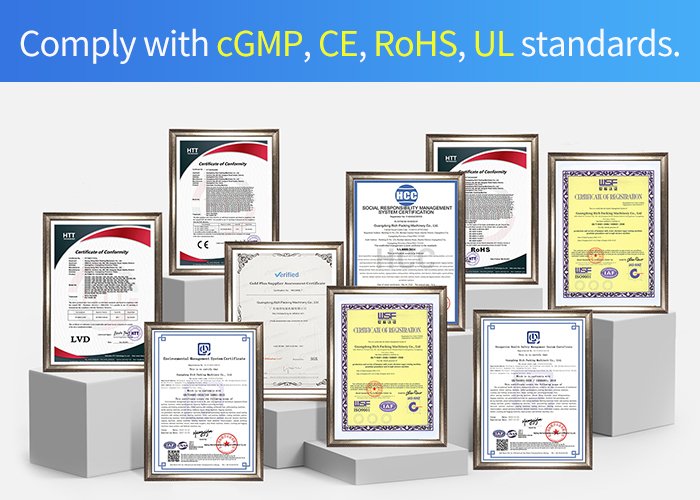
Every detail of Jinlu’s cotton inserter is designed to meet the strictest cGMP, FDA, and EU GMP requirements for pharmaceutical manufacturing equipment. All product and package contact surfaces, as well as the main machine frame, are constructed from pharmaceutical-grade SUS304 or SUS316 stainless steel, with smooth, crevice-free finishes that eliminate hygiene blind spots. The design is free of exposed threads, sharp corners, and hard-to-clean areas, simplifying sanitization and cleaning between batches. All non-metal components are made from non-toxic, food-grade, and pharmaceutical-approved materials, ensuring no risk of product contamination. The machine holds full CE, RoHS, EMC, and LVD certifications, making it suitable for deployment in any global market.
The global market is flooded with low-cost, generic cotton inserter machine models, but Jinlu stands apart as a trusted manufacturing partner, not just an equipment supplier. Here’s why leading manufacturers in over 80 countries choose our cotton inserter for their production lines:
Founded in 1993, Jinlu has 30+ years of specialized experience designing and building machinery exclusively for the pharmaceutical and packaging industries. We don’t manufacture generic industrial equipment—we build solutions tailored to the strict regulatory, hygiene, and performance demands of pharmaceutical manufacturing. This deep industry expertise is built into every component of our cotton inserter, ensuring it addresses the unique pain points that generic equipment ignores.
Our machines are trusted by over 2,600 customers worldwide, including Fortune 500 pharmaceutical companies like GSK, DuPont, and UCB. We have installed our cotton inserter and complete bottling solutions in production facilities across Europe, North America, Southeast Asia, the Middle East, and beyond, with a proven track record of reliable, long-term performance in the most demanding cleanroom production environments.
No two manufacturing facilities are identical, and we never force a one-size-fits-all solution on our clients. Our in-house team of R&D engineers provides full end-to-end customization, from adjusting the machine’s footprint to fit your facility layout, to engineering custom handling for unique bottle designs, to integrating specialized inspection features for high-containment production.
Every cotton inserter we build undergoes strict quality control at every stage of production, from raw material sourcing to final assembly. Before shipment, every machine undergoes 72 hours of continuous runtime testing using your actual bottles and cotton wadding, to validate performance and make fine adjustments before it leaves our factory. Thanks to our mature, well-managed supply chain with global partners like Siemens, Festo, and Omron, we offer industry-leading delivery times: standard configurations ship in as little as 7 days, with custom solutions delivered in a fraction of the lead time offered by our competitors. We also provide free, end-to-end logistics support, including full assistance with customs clearance and freight forwarding, to eliminate the hassle of international procurement.
A cotton inserter machine is an automated packaging system that cuts, positions, and inserts cotton wadding into filled bottles, primarily in pharmaceutical, nutraceutical, and food manufacturing. It provides impact protection for fragile products, enhances moisture barrier performance, and ensures consistent packaging quality for regulatory compliance.
Our automatic cotton inserter is compatible with a wide range of bottle formats, including round, flat, square, and flat-square bottles, made from PET, HDPE, glass, and other common packaging materials. It accommodates bottle diameters from 15mm to 120mm and heights from 30mm to 300mm, with full customization available for unique bottle designs.
Yes. Our cotton filler machine supports fully programmable multiple insertion cycles for the same bottle, ideal for large-format bottles or products requiring enhanced cushioning and protection. The number of insertions, cotton length, and insertion depth can all be customized via the PLC touchscreen interface.
Yes. Our cotton inserter is fully designed to meet cGMP, FDA, and EU GMP requirements for pharmaceutical manufacturing equipment. It uses pharmaceutical-grade SUS304/SUS316 stainless steel for all contact surfaces, features a hygienic, crevice-free design, and provides full traceable production data for regulatory audits. The machine also holds CE, RoHS, EMC, and LVD certifications for global deployment.
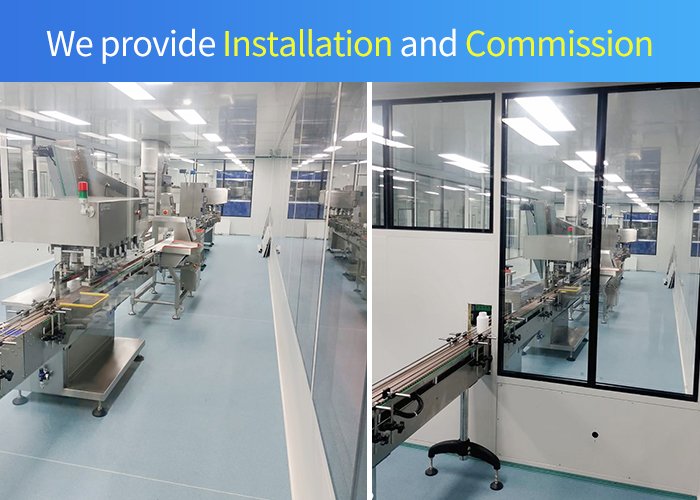
Yes. Our cotton inserter is designed for seamless integration with both new and existing tablet counting and bottling lines, regardless of the equipment manufacturer. Our engineering team can customize the machine’s infeed/outfeed configurations, communication protocols, and speed settings to perfectly synchronize with your existing upstream and downstream equipment, with full support for installation and commissioning.

Copyright © 2026 JinLuPacking.All rights reserved. Terms & Conditions and Privacy Policy
Friendly Links: Rich Packing | Capsule Filling Machine Manufacturers