Wat is farmaceutische contractproductie? Een complete gids voor CDMO, CMO, Voordelen & Proces
Wat is farmaceutische contractproductie? Een complete gids voor CDMO, CMO, Voordelen & Proces
juli 15, 2026
Geen opmerkingen
In de huidige farmaceutische industrie, veel bedrijven besteden de productie van geneesmiddelen uit aan gespecialiseerde contractfabrikanten. Contractproductie in de farmaceutische sector omvat alles van API productie- en formuleringsontwikkeling tot uiteindelijke verpakking – vaak verzorgd door contractontwikkelings- en productieorganisaties (CDMO's) of contractproductieorganisaties (CMO's). In deze gids wordt uitgelegd wat farmaceutische contractproductie betekent, doorloopt het typische proces (van ontwikkeling tot eindproduct), vergelijkt CMO's en CDMO's, en schetst de voordelen en uitdagingen van outsourcing. We belichten ook de gevorderden productie- en verpakkingsapparatuur (capsule -vulstoffen, tablet persen, Blister Machines, enz.) die moderne CDMO's gebruiken.
Contractproductie in de farmaceutische sector (ook wel farmaceutische outsourcing genoemd) Dit is wanneer een farmaceutisch bedrijf een extern bedrijf inhuurt om zijn medicijnen te maken. Deze derde partijen – bekend als Contractproductieorganisaties (CMO's) – kan alleen het commerciële medicijn produceren of soms ontwikkelingssteun bieden. In de praktijk, farmaceutische contractproductie kan dekking bieden:
API's (Actieve farmaceutische ingrediënten): synthese van de actieve geneesmiddelverbinding.
Formulering & FDF's (Voltooide doseringsformulieren): het mengen van ingrediënten tot tabletten, capsules, vloeistoffen, of injectables.
Klinische/commerciële productie: van kleine batches voor tests tot grootschalige commerciële runs.
Belangrijk, de termijn CDMO (Contractontwikkeling en productieorganisatie) is gebruikelijker geworden. Een CDMO produceert niet alleen een medicijn, maar verzorgt ook de ontwikkeling en opschaling onder één dak. Met andere woorden, CMO = “gewoon productie," terwijl CDMO = “ontwikkeling plus productie.” Een CDMO kan helpen bij het ontwerpen van formuleringen, proefbatches, en registratiedossiers, en vervolgens het proces naadloos opschalen naar volledige productie, het minimaliseren van overdrachten en vertragingen.
Een CMO helpt sponsors bij het vervaardigen van hun innovatieve geneesmiddelen en geneesmiddelen (het leveren van productiefaciliteiten en capaciteit). Daarentegen, een CDMO biedt geïntegreerde oplossingen voor de ontwikkeling en productie van geneesmiddelen, het combineren van R&D expertise met productiecapaciteit. In de praktijk, veel farmaceutische bedrijven geven steeds meer de voorkeur aan het CDMO-model voor een end-to-end partnerschap – van de vroege ontwikkeling tot de uiteindelijke serialisatie – om de risico’s tussen transities te verminderen.
Farmaceutisch contractproductieproces
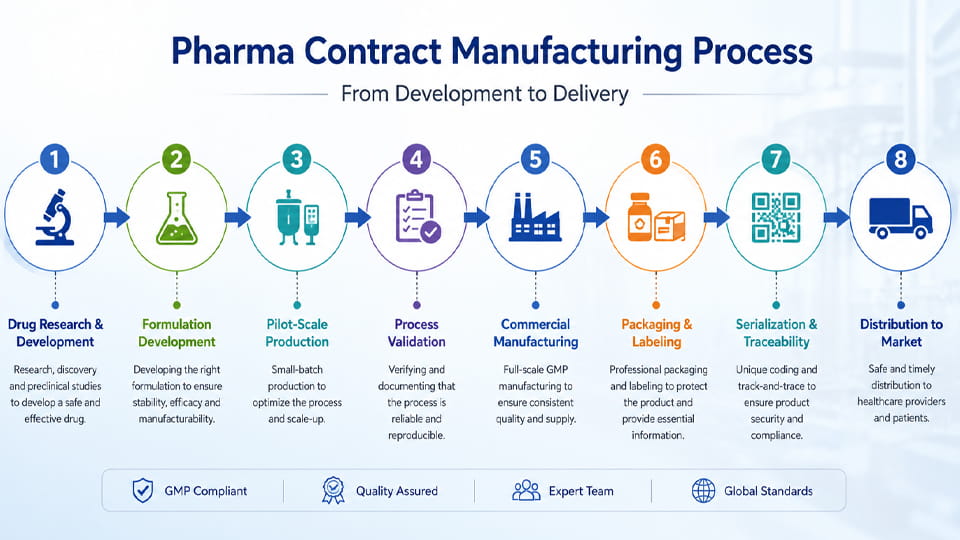
Een contractproductieprogramma volgt doorgaans de levenscyclus van geneesmiddelenontwikkeling, van laboratorium tot markt. De belangrijkste fasen worden uiteengezet in het onderstaande stroomdiagram, en vervolgens kort beschreven:
Geneesmiddelenonderzoek & Ontwikkeling: In het begin van R&D, wetenschappers identificeren een kandidaat-molecuul. Voor kleine bedrijven of biotech, een CDMO kan zelfs samenwerken bij het formuleren of procesontwerp (bijv. het optimaliseren van een tablet- of capsuleformulering).
Formuleringsontwikkeling: De CDMO werkt samen met de sponsor om de formulering van het medicijn af te ronden (tablet, capsule, poeder, vloeistof, enz.) en productiemethoden ontwikkelen. Deze fase omvat laboratoriumwerk en preformuleringsstudies om de stabiliteit en werkzaamheid van de doseringsvorm te garanderen.
Productie op pilotschaal: Zodra een formulering is ingesteld, de CDMO produceert kleine proefbatches (vaak 10^3–10^5 eenheden) onder GMP-omstandigheden. Deze batches worden gebruikt voor klinische onderzoeken of indieningen bij de regelgevende instanties. Het proces wordt stapsgewijs opgeschaald.
Procesvalidatie: Vóór volledige commercialisering, de CDMO valideert het proces (waaruit blijkt dat het medicijn consistent volgens kwaliteitsnormen kan worden vervaardigd). Dit omvat de volledige kwalificatie van apparatuur, verpakkingslijnen, analytisch testen, en documentatie.
Commerciële productie: Met validatie voltooid, de CDMO gaat over op grootschalige productie onder cGMP. Dit kan gepaard gaan met het draaien van meerdere diensten, batch-records, en voldoen aan wettelijke inspecties. De fabriek produceert de actieve ingrediënten en uiteindelijke doseringsvormen in de afgesproken volumes.
Verpakking & Etikettering: Kant-en-klare doseringsvormen worden vervolgens bijvoorbeeld verpakt, tabletten kunnen in blisters of flesjes terechtkomen, vloeistoffen worden gevuld en afgesloten – en geëtiketteerd. Moderne CDMO-verpakkingslijnen bevatten vaak automatische capsulevullers, tablettellers, flessenvullers/cappers, inductie sealers, labelprinters, en kartonneerders die in volgorde werken.
Serialisatie & Traceerbaarheid: Om te voldoen aan de mondiale regelgeving, verpakking omvat serialisatie (unieke barcodes/QR-codes) en track-and-trace-functies. Dit zorgt ervoor dat elke eenheid kan worden getraceerd, van productie tot verkoop.
Verdeling: Eindelijk, de verpakte medicijnen worden opgeslagen en verzonden naar klanten of distributeurs over de hele wereld. De CDMO kan ook opslag en logistiek afhandelen volgens contractvoorwaarden.
In elke fase, het CDMO verzorgt het projectmanagement, kwaliteitstoezicht, en regelgevende ondersteuning om ervoor te zorgen dat de mijlpalen worden gehaald. Door deze stappen uit te besteden, Farmaceutische sponsors vermijden het bouwen van overtollige R&D en productie-infrastructuur.
CMO versus CDMO: Wat is het verschil?
Hieronder vindt u een snelle vergelijking van een traditionele CMO (Contractproductieorganisatie) en een CDMO:
Aspect
CMO (Contractproductieorganisatie)
CDMO (Contractontwikkelaar. & Fabrikant. Org.)
Serviceomvang
Productie en soms verpakking.
Van begin tot eind: R&D, formulering, en productie.
R&D Betrokkenheid
Minimaal; gaat ervan uit dat er formuleringen worden verstrekt.
Actief in formulering, opschaling, en technologieoverdracht.
Productiefase
Meestal commerciële of klinische productie.
Omvat van vroege klinische tot commerciële schaal.
Overdrachten van leveranciers
Heeft mogelijk een aparte ontwikkelingspartner nodig.
Eén partner vermindert overdrachten en vertragingen.
Typische use-case
Extra capaciteit voor bekende medicijnen (generieke geneesmiddelen).
Ontwikkeling van nieuwe medicijnen of complexe projecten.
Deze tabel benadrukt dat CMO's richten zich vooral op de productie, terwijl CDMO's bieden geïntegreerde ontwikkelings- en productiediensten. Met andere woorden, als u al een definitieve medicijnformule heeft en alleen productiecapaciteit nodig heeft, een GMO zou kunnen volstaan. Maar als je hulp nodig hebt het ontwikkelen van een nieuwe medicijnformulering, schaalprocessen, en navigatievoorschriften, een CDMO is de partner bij uitstek.
Soorten farmaceutische producten die op contractbasis kunnen worden vervaardigd
Moderne CDMO's kunnen vrijwel elk type medicijn produceren. Hier zijn veelvoorkomende voorbeelden, samen met de belangrijkste gebruikte apparatuur:
Tabletten: Vaste orale tabletten worden gemaakt door poeders of korrels samen te persen in een roterende tabletpers. Hogesnelheidstabletpersmachines kunnen honderdduizenden tabletten per uur comprimeren. Elektronische rotatiepersen kan standaard en speciaal gevormde tabletten verwerken. Meestal volgt een tabletpers natte of droge granulatie stap gedaan bij de CDMO. (Tabletten kunnen vervolgens in blisterverpakkingen of in flessen worden verpakt.)
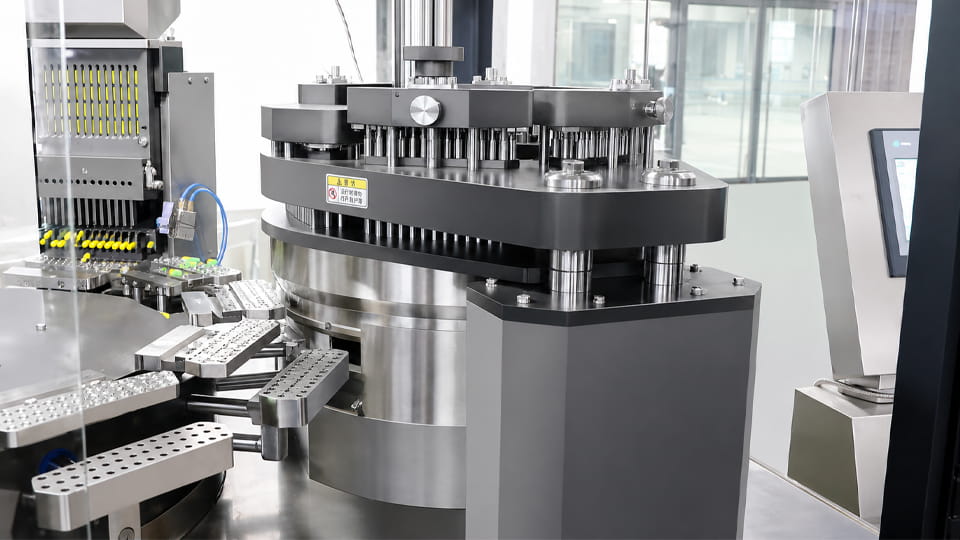
Capsules: Harde capsules worden gevuld met poeders of pellets met behulp van een capsule-vulmachine. De capsulevulmachines van Jinlu variëren van semi-automatische vulmachines (voor kleine batches) tot volautomatische machines met meerdere duizenden capsules/uur. Capsules kunnen ook softgels of vloeibare capsules. Capsuleproductie is gebruikelijk in supplementen en vrij verkrijgbare medicijnen.
Figuur: Automatische capsulevullijnen in een contractproductiefaciliteit. Deze machines doseren poeder of pellets in harde capsules, waardoor tienduizenden capsules per uur mogelijk zijn.
Poeder & Korrels: Bulkpoeders of korrels (bijv. voor sachets of bulkverpakkingen) kan worden verwerkt met een volumetrische of vijzel vulmachines, en verpakt in zakken of flessen. CDMO's maken vaak gebruik van vibratiefeeders, systemen voor gewichtsverlies, of gespecialiseerde poedervullers voor nauwkeurige dosering. (Bijvoorbeeld, stickpack-machines [zie hieronder] integreren vaak volumetrische poederfeeders.)
Zakjes & Stick-pakketten: Sachets met een enkele dosis zijn gebruikelijk voor poedervormige of vloeibare formuleringen (zoals klinische proefpoeders of -vloeistoffen). Verticale vorm-vul-zegel (Vffs) Machines zoals sachetverpakkingsmachines worden automatisch gevormd, vullen, en seal stick-pakketten en kleine zakjes. Deze machines kunnen poeders verpakken, korrels, vloeistoffen of gels in verzegelde verpakkingen.
Flessen (Vloeistoffen, Tabletten): Vloeibare siropen of suspensies worden met hoge snelheid in flessen afgevuld flessenvullijnen, inclusief spoelen, vulling, aftappen, en inductieafdichting. Tabletten en capsules kunnen ook worden geteld en in flessen worden geplaatst. Deze lijnen bevatten vaak automatisch tablet-/capsuletellers flessen te vullen. (De capsules-/tablettelmachines van Jinlu kunnen flessen vullen met een snelheid van 50-100 bpm.) Eenmaal gevuld en afgedekt, een inductie sealer brengt een folieverzegeling aan onder de dop als bewijs van manipulatie.
Blaarpakketten: Veel tabletten en capsules zijn verpakt in blisterkaarten (PVC/Alu-holten). Geautomatiseerd Blaarverpakkingsmachines (bijv. JL's blisterverpakkingen) vormen de blisterzakken, vul ze met de doseringseenheden, en seal met folie of PVC. Blistermachines kunnen 4.000–12.000 blisters per uur verwerken voor producten met een groot volume.
Kartons: Na het blaren of vullen van flessen, producten worden in dozen gedaan. A kartonneermachine vouwt en lijmt kartonnen dozen rond het product (flessen, blisterkaarten, zakjes). De kartonneermachines van Jinlu kunnen tot ~15.600 dozen/uur verwerken en kunnen worden geïntegreerd met downstream etikettering.
Verzegelde zakjes/potten: Sommige producten (crèmes, gelden, schorsingen) in buizen gaan, potten, of gespecialiseerde zakjes. Er bestaan vul- en sluitlijnen voor tubes en potten. (Bijvoorbeeld, inductiedopafdichters of afsluitmachines.) Jinlu levert ook voorgemaakte zakverpakking lijnen en geautomatiseerde kartonneermachines voor multipacks.
Kortom, elke uiteindelijke doseringsvorm – tabletten, capsules, poeders, vloeistoffen, blaarpakketten, flessen – kunnen worden geproduceerd door een capabele CDMO.
Voordelen en uitdagingen van farmaceutische contractproductie
Zoals elke zakelijke beslissing, farmaceutische contractproductie biedt duidelijke voordelen, maar het brengt ook verantwoordelijkheden met zich mee. Door beide kanten te begrijpen, kunnen farmaceutische bedrijven beslissen of outsourcing de juiste strategie is.
Voordelen
Lagere investeringskosten – Het bouwen en valideren van een GMP-farmaceutische faciliteit vergt aanzienlijk kapitaal. Door contractproductie kunnen bedrijven de productie starten zonder te investeren in dure infrastructuur.
Snellere time-to-market – Ervaren CDMO's beschikken al over gekwalificeerde faciliteiten, opgeleid personeel, en gevalideerde productielijnen, producten sneller van ontwikkeling naar commercialisering helpen.
Toegang tot gespecialiseerde expertise – Contractfabrikanten beschikken vaak over ervaren formuleringswetenschappers, kwaliteitsteams, en regelgevende specialisten die de FDA begrijpen, EMA, En GMP-vereisten.
Flexibele productiecapaciteit – Of het nu gaat om het produceren van een pilotbatch of volumes op commerciële schaal, outsourcing biedt de flexibiliteit om de productie te verhogen of te verlagen als de marktvraag verandert.
Geavanceerde productieapparatuur – Moderne CDMO’s investeren in snelle capsulevulmachines, tablet persen, Blaarverpakkingsmachines, verpakkingslijnen voor flessen, en geautomatiseerde inspectiesystemen die veel kleinere fabrikanten zelf niet kunnen rechtvaardigen.
Uitdagingen
Terwijl outsourcing veel voordelen biedt, bedrijven moeten zich ook bewust zijn van verschillende potentiële uitdagingen:
Het handhaven van een consistente productkwaliteit in verschillende sectoren productie batches.
Bescherming van vertrouwelijke formuleringen en intellectueel eigendom.
Coördineren van de communicatie tussen het farmaceutische bedrijf en de productiepartner.
Ervoor zorgen dat de CDMO blijft voldoen aan de wettelijke en GMP-vereisten.
Beheer van supply chain-risico's die de productieschema's kunnen beïnvloeden.
Gelukkig, De meeste van deze uitdagingen kunnen worden geminimaliseerd door te kiezen voor een ervaren farmaceutische contractproductiepartner met een sterk kwaliteitsmanagementsysteem, transparante communicatie, en bewezen naleving van de regelgeving. Een grondige kwalificatieproces voor leveranciers en regelmatige audits helpen ook bij het opbouwen van een succesvol langetermijnpartnerschap.
Hoe u de juiste farmaceutische contractproductiepartner kiest
Het kiezen van een CDMO/CMO is een cruciale beslissing. Hier zijn de belangrijkste criteria, geïllustreerd met de lens van farmaceutische productbehoeften:
Kwaliteit & Naleving van regelgeving: Eerst en vooral, de partner moet beschikken over sterke kwaliteitssystemen en een schone staat van dienst op het gebied van de regelgeving. Zoek naar FDA, EMA, of WHO GMP-certificeringen, ISO-kwaliteitscertificeringen, en een geschiedenis van succesvolle audits. U kunt de FDA-inspectiedatabases bekijken om te controleren op waarschuwingsbrieven of GMP 483's op hun locaties. Het bedrijf moet transparant zijn over zijn kwaliteitscontrolelaboratoria en validatieprocessen.
Relevante ervaring: Zorg ervoor dat de CDMO ervaring heeft met uw type product. Bijvoorbeeld, als u tabletten maakt, hebben ze moderne tabletperslijnen?? Als u biologische geneesmiddelen heeft, beschikken ze over steriele faciliteiten of faciliteiten voor eenmalig gebruik?? Een partner met ervaring op uw therapeutisch gebied (antibiotica versus. hormonen versus. biologische producten) zal beter anticiperen op uitdagingen. Vraag naar vergelijkbare casestudy's of klanten waarmee ze hebben gewerkt.
Productiemogelijkheden & Capaciteit: Beschikken ze over de juiste uitrusting en capaciteitsschaal?? Zoek naar moderne machines (bijv. automatische capsulevullers, tabletpersen met meerdere compressie, blister- en fleslijnen) om ervoor te zorgen dat ze aan uw volumebehoeften kunnen voldoen. Bevestig ook dat ze over reservecapaciteit of uitbreidingsplannen beschikken om met uw project mee te groeien. Een tot de rand gevulde faciliteit geeft uw project mogelijk geen prioriteit.
Technische ondersteuning & Ontwikkelingsdiensten: Als je R nodig hebt&D hulp, kies voor een CDMO (niet zomaar een CMO) met sterke formulerings- en analytische laboratoria. Controleer of ze uitgebreide diensten aanbieden (ontwikkeling van analytische methoden, stabiliteit testen, verpakking ontwerp). Dit maakt overdrachten soepeler en helpt bij registratie bij de toezichthouders. Een partner die bereid is mee te ontwikkelen en problemen op te lossen, is veel waardevoller.
Kwaliteit van communicatie & Dienst: Goed projectmanagement is essentieel. De CDMO moet een speciaal team aanwijzen, zorgen voor regelmatige updates, en wees responsief. Persoonlijk of virtueel ontmoeten zou eenvoudig moeten zijn – de locatie kan ertoe doen. (Zoals een brancheartikel opmerkt, Het hebben van een partner in de buurt kan reisvertragingen verminderen en de coördinatie verbeteren. Echter, Veel mondiale CDMO's bedienen internationale klanten efficiënt.) Zorg ervoor dat de culturele aansluiting en het taalgebruik aansluiten bij uw behoeften.
Financiële stabiliteit & Reputatie: Een betrouwbare partner heeft solide financiën nodig. Bedrijven willen langdurige relaties, controleer dus de omvang en stabiliteit van het bedrijf. Een startende CDMO kan riskant zijn, tenzij deze goed wordt ondersteund. Controleer ook referenties van andere farmaceutische klanten of zoek naar brancherecensies.
Bescherming van intellectueel eigendom: Vraag naar hun IP-beveiligingsbeleid. Hoe slaan ze uw gegevens op, omgaan met laboratoriumnotitieboekjes, en beheer de toegang van personeel? Een betrouwbare CDMO zal strikte vertrouwelijkheidsovereenkomsten hebben.
Prijzen & Overeenkomsten: Natuurlijk, kosten zijn belangrijk. Vraag transparante offertes aan. Pas op voor ongewoon lage biedingen: deze kunnen tot bezuinigingen leiden. Bespreek ook de doorlooptijden, flexibiliteit bij het wijzigen van bestellingen, en boetes in contracten. Een goede partner zal eerlijk en duidelijk zijn.
Samengevat: hun kwaliteit controleren, hun kennis testen, en zorg ervoor dat ze over de juiste uitrusting en capaciteit voor uw project beschikken. Transparantie en vertrouwen zijn essentieel. Voer indien mogelijk bedrijfsbezoeken uit. Zoals een branchegids suggereert, het beoordelen van de FDA GMP-gegevens van een CMO is een slimme zet. Door meerdere leveranciers op deze criteria te vergelijken, u kunt een partner selecteren die een verlengstuk van uw team wordt.
Farmaceutische apparatuur die wordt gebruikt bij contractproductie
Geavanceerde apparatuur vormt de ruggengraat van de productielijn van elke CDMO. Hier zijn enkele kernmachines die u doorgaans aantreft in de fabriek van een contractfabrikant:
Machines voor het vullen van capsules: Deze machines vullen lege capsulehulzen nauwkeurig met poeder, pellets, of korrels. Moderne automatische vullers (zoals die van Jinlu) kan honderden rijstroken tegelijk berijden, productie van tienduizenden capsules per uur. Zij verzorgen delicate aanpassingen (vulgewicht, oriëntatie van de capsule) en zijn voorzien van GMP-kwaliteit roestvrij staal ontwerp.
NJP-1200C Capsule-vulmachine
Tabletpersen (Roterende compressoren): Snelle snelheid roterende tabletdrukken poeder samenpersen tot tabletten. Deze machines oefenen duizenden tonnen kracht uit om tabletten van elke vorm te produceren. Velen hebben automatische feeders, gewichtscontrole, en PLC-bediening voor nauwkeurigheid. Tabletpersen zijn essentieel voor elke productie van vaste doses.
Blisterverpakkingslijnen: Nadat de tabletten/capsules klaar zijn, geautomatiseerde blisterverpakkingsmachines vorm en verzegel ze in plastic/aluminium verpakkingen. Apparatuur van Jinlu omvat het volledige blisterproces (het vormen van gaatjes, voedingstabletten, afdichting, snijden). Deze lijnen zijn vaak voorzien van geïntegreerde feeders en kunnen werken met enkele duizenden blisters per uur.
Tel- en vulmachines voor capsules/tabletten: Voor producten in flessen, toegewijd telmachines vul flessen nauwkeurig met het juiste aantal pillen. Deze machines maken gebruik van vibrerende of roterende banen en vision-sensoren om tabletten of capsules zonder overlap te tellen en in containers te laten vallen. Tellen met hoge precisie (99.97%+) wordt bereikt met foto-elektrische sensoren.
JL-16H cGMP Capsule Tablet Bottelmachine
Flessen vullen & Lijnen afdekken: Voor vloeistoffen of zelfs voor tablet-/capsuleflessen, geautomatiseerde lijnen bevatten een flessenontscrambler, hengel, kapper, en doppensorteerder. Een complete flessenlijn kan 50 tot 100 flessen per minuut of meer verwerken. Veel lijnen bevatten folie-inductiesealers en controlewegers/inspecteurs na het afdekken.
Etiketteermachines: Deze brengen gedrukte etiketten op flessen aan, dozen, of pakjes. Modern etiketteermachines kan opeenvolgende barcodes/serienummers afdrukken en toepassen (voor traceerbaarheid) en inspecteer het resultaat visueel. Terwijl de site van Jinlu geen labelerpagina vermeldde, CDMO's maken vaak gebruik van geautomatiseerde etiketteersystemen op verpakkingslijnen.
Kartonmachines: Zoals hierboven opgemerkt, karton producten inpakken (flessen, blisterkaarten, zakjes) met hoge snelheid in kartonnen dozen. Ze kunnen stroomafwaarts van fillers of blisterers worden aangesloten voor een naadloze lijn.
JL-130W Horizontale kartonneermachine
Sachet-/VFFS-machines: Stickpack- of kussenverpakkingsmachines (verticale vorm-vul-afdichting) worden gebruikt voor poeders met een enkele dosis, vloeistoffen, of gels. Jinlu's verpakkingsmachines voor zakjes kan verpakkingen met meerdere banen voor poedervormige of vloeibare formuleringen met hoge precisie en snelheid vullen.
Automatisering & Inspecteurs: Vaak zijn al deze machines voorzien van geïntegreerde PLC-besturing (bijv. Siemens, PLC's), pneumatische aandrijvingen, en servomotoren voor precisie. Veel lijnen bevatten inspectiesystemen - leuk vinden controlewegers, metaaldetectoren, en visionscanners – om ervoor te zorgen dat elke unit aan de specificaties voldoet (bijv. gewichtscontrole, ontbrekende pillen, afdrukkwaliteit op etiketten). Deze geautomatiseerde controles zijn van cruciaal belang voor de naleving.
Door deze machines te combineren met ervaren operators en SOP’s, CDMO's kunnen complexe meerfasige productie uitvoeren. Bijvoorbeeld, een capsuleproductlijn kan beginnen met een capsulevuller, ga naar een capsuleteller (flessen te vullen), dan een inductiesealer, en eindig met een etiketteer- en kartonneermachine – allemaal werkend onder gesynchroniseerde besturing. Op dezelfde manier, een tabletlijn kan gaan van pers → blisterverpakker → etiketteermachine → kartonneermachine. Geavanceerde apparatuur verhoogt de doorvoer en handhaaft een consistente kwaliteit.
In de praktijk, toonaangevende CDMO’s investeren in state-of-the-art apparatuur. Bijvoorbeeld, Jinlu Packing biedt geïntegreerde oplossingen: hogesnelheidscapsulevulmachines en tabletpersen zijn ontworpen voor cGMP-naleving. Blisterverpakkingen bevatten functies zoals aluminium-aluminium (Aller tijden) en PVC hitteafdichting voor flexibiliteit. Investeren in dergelijke geautomatiseerde verpakkings- en verwerkingsapparatuur zorgt ervoor dat een CDMO grote bestellingen betrouwbaar kan leveren.
Waarom moderne CDMO's geavanceerde verpakkingsapparatuur nodig hebben
Terwijl contractfabrikanten opschalen om de mondiale farmaceutische markten te bedienen, geavanceerde geautomatiseerde verpakkingsapparatuur essentieel wordt. Dit is waarom:
Snelheid & Doorvoer: Hogesnelheidsapparatuur (meerbaansvullers, roterende persen, blaar lijnen) maakt het mogelijk duizenden tot miljoenen doses per dag uit te voeren. Voor een CDMO, snellere machines betekent de mogelijkheid om meer contracten en grotere volumes af te handelen. Geautomatiseerde lijnen kunnen draaien 24/7 met minimale stilstand.
Samenhang & Precisie: Geautomatiseerde machines zorgen ervoor dat elke eenheid hetzelfde is. Bijvoorbeeld, moderne capsulevullers hebben nauwkeurige vulmechanismen (zoals te zien in de gepatenteerde ontwerpen van JL) die de dosisvariatie laag houden. Nauwkeurige tabletpersen en vision-inspectiesystemen helpen een consistent doseringsgewicht te bereiken, wat van cruciaal belang is voor de werkzaamheid en het behalen van de kwaliteitscontrole.
Naleving van regelgeving: GMP-voorschriften vereisen gedocumenteerde controle en netheid. Nieuwere apparatuur is gebouwd met sanitaire ontwerpen (volledig roestvrij staal, gemakkelijk schoon te maken oppervlakken, gesloten processen). Bijvoorbeeld, flessenlijnen met gesloten vulling en dop voldoen aan strenge hygiënenormen. Geavanceerde machines ondersteunen ook serialisatie en geautomatiseerde datalogging, die CDMO's helpen te voldoen aan de track-and-trace-voorschriften.
Arbeidsbesparingen: Geautomatiseerde lijnen verminderen de handmatige arbeid en menselijke fouten aanzienlijk. In plaats van handmatig vullen of handmatig tellen, machines voeden, vullen, zegel, en automatisch labelen. Dit verlaagt niet alleen de arbeidskosten, maar vermindert ook de besmettingsrisico's en ergonomieproblemen.
Flexibiliteit & Integratie: Moderne CDMO-lijnen zijn modulair. Bijvoorbeeld, een capsulevulstation kan worden gekoppeld aan een capsulesteller en vervolgens aan een flessenvuller op dezelfde transportband, een ononderbroken lijn vormen. Deze geïntegreerde aanpak maakt het eenvoudiger om tussen producten te wisselen. Bedrijven als Jinlu Packing bieden kant-en-klare oplossingen (bijv. een end-to-end verpakkingslijn voor flessen met unscrambler → filler → capper → sealer → labeler → cartoner) zodat CDMO's volledige workflows kunnen upgraden.
Kwaliteitsmonitoring: Geavanceerde apparatuur omvat vaak in-line sensoren en camera's. Bijvoorbeeld, na het sluiten van een blisterverpakking, een optische camera kan elke holte inspecteren op ontbrekende tabletten of gaten. Als er een probleem wordt gedetecteerd, die blister kan automatisch worden afgewezen. Een dergelijke ingebouwde QA verbetert de veiligheid van het eindproduct aanzienlijk.
Kortom, State-of-the-art verpakkingsmachines zijn geen luxe maar noodzaak voor CDMO’s. Het verhoogt de algehele effectiviteit van de apparatuur (OEE) en zorgt voor de hoge snelheid, hoge kwaliteit, en strikte regelgevingscontrole vereist de moderne geneesmiddelenproductie. Door te investeren in machines zoals automatische capsulevullers, blisterverpakkingen, roterende tabletdrukken, en flessenvullijnen, CDMO's kunnen de productkwaliteit en leveringsbetrouwbaarheid beter garanderen. Dit komt rechtstreeks ten goede aan hun farmaceutische klanten door het bieden van GMP-consistente output en traceerbaarheid.
Conclusie
Contractproductie in de farmaceutische sector (hetzij via CMO's of CDMO's) is een essentieel model voor de industrie geworden. Door de productie en verpakking van geneesmiddelen uit te besteden, kunnen bedrijven kapitaal besparen, specialistische vaardigheden benutten, en nieuwe medicijnen sneller bij patiënten krijgen. Een goede CDMO-partner regelt alles, van ontwikkeling en validatie tot productie in grote volumes en verpakking, allemaal onder cGMP-omstandigheden.
Terwijl outsourcing uitdagingen met zich meebrengt (zoals het handhaven van toezicht en het beschermen van IE), de voordelen – kostenbesparingen, snelheid, en schaalbaarheid – zijn aanzienlijk. Naarmate de markt groeit (zal naar verwachting de honderden miljarden overschrijden 2030), meer farmaceutische bedrijven zullen voor CDMO's kiezen. Die CDMO's, op zijn beurt, vertrouwen op modern, geautomatiseerde apparatuur (capsule- en tabletmachines, blister- en fleslijnen, enz.) om aan de vraag te voldoen.
Klaar om uw farmaceutische productie te stroomlijnen?Neem contact op met Jinlu Packing voor een consult. Wij bieden volledig geïntegreerde verpakkingsoplossingen – van capsulevulmachines en snelle tabletpersen tot geavanceerde blister- en flesverpakkingslijnen – ontworpen voor GMP-conforme contractproductie. Ons team kan u helpen de juiste apparatuur aan te bevelen om uw geneesmiddelenproductie- en verpakkingsprocessen te optimaliseren. Neem vandaag nog contact op en ontdek hoe wij uw CDMO/CDO-behoeften kunnen ondersteunen!
Veelgestelde vragen over farmaceutische contractproductie
Wat is farmaceutische contractproductie?
Er is sprake van contractproductie bij farmaceutische bedrijven wanneer een farmaceutisch bedrijf de productie van geneesmiddelen uitbesteedt aan een externe fabrikant (een CMO of CDMO). De contractfabrikant voert taken uit zoals API-synthese, formulering, productie van tabletten/capsules, verpakking, en etikettering onder GMP-omstandigheden. Hierdoor kunnen farmaceutische bedrijven externe expertise benutten en vermijden dat ze hun eigen fabrieken bouwen.
Wat is het verschil tussen een CMO en een CDMO??
Een CMO (Contractproductieorganisatie) richt zich op het vervaardigen en verpakken van medicijnen volgens een bestaande formule. Een CDMO (Contractontwikkeling en productieorganisatie) biedt zowel ontwikkelings- als productiediensten. Met andere woorden, GMO's beginnen meestal nadat de formulering is voltooid, terwijl CDMO's kunnen werken vanaf de vroege ontwikkeling van de formulering tot en met commerciële productie.
Waarom besteden farmaceutische bedrijven de productie uit??
Bedrijven besteden uit om kosten en tijd te besparen. Het bouwen van een GMP-faciliteit is extreem duur, dus outsourcing vermijdt die kapitaaluitgaven. CDMO's beschikken al over apparatuur en expertise, wat de productlancering versnelt. Outsourcing biedt ook flexibiliteit om de productie op of af te schalen afhankelijk van de vraag, en toegang tot gespecialiseerde kennis op gebieden als formulering, analyses, en naleving van de regelgeving.
Zijn contractproductiediensten GMP-conform?
Ja. Gerenommeerde farmaceutische contractfabrikanten werken onder cGMP (huidige goede productiepraktijken) normen die worden opgelegd door autoriteiten zoals de FDA, EMA, of WIE. Voordat u gaat samenwerken, u moet hun certificeringen en inspectiegeschiedenis verifiëren. Een goede staat van dienst met FDA-inspecties (geen grote overtredingen) is een must. Werken met een GMP-gecertificeerde CMO zorgt ervoor dat uw product volgens strenge kwaliteitsvoorschriften wordt gemaakt en verpakt.
Welke apparatuur wordt vaak gebruikt bij contractproductie in de farmaceutische sector??
Moderne farmaceutische productiefaciliteiten maken doorgaans gebruik van sterk geautomatiseerde productieapparatuur, inbegrepen: • Capsulevulmachines • Roterende tabletpersen • Poedermengsystemen • Blisterverpakkingsmachines • Flessenvul- en tellijnen • Kartonmachines • Vision-inspectiesystemen • Apparatuur voor serialisatie en traceerbaarheid Automatisering verbetert de productie-efficiëntie, consistentie van het product, en naleving van de regelgeving.
Hoeveel kost de productie van farmaceutische contracten??
De kosten van farmaceutische contractproductie zijn afhankelijk van verschillende factoren, inclusief productformulering, batchgrootte, doseringsvorm, verpakkingsvereisten, wettelijke testen, geldigmaking, en productievolume. Grote commerciële batches realiseren over het algemeen lagere eenheidskosten vanwege schaalvoordelen, terwijl kleine proefbatches doorgaans hogere productiekosten per eenheid hebben.
Waarom is geavanceerde farmaceutische verpakkingsapparatuur belangrijk voor contractfabrikanten??
Geautomatiseerde verpakkingsapparatuur verbetert de productiviteit, vermindert menselijke fouten, ondersteunt de traceerbaarheid van producten, en helpt fabrikanten te voldoen aan de FDA, EMA, en GMP-vereisten. Technologieën zoals blisterverpakkingsmachines, verpakkingslijnen voor flessen, serialisatie systemen, en geautomatiseerde inspectieapparatuur verhogen ook de algehele effectiviteit van de apparatuur (OEE) en zorgen voor een consistente verpakkingskwaliteit, waardoor ze essentiële investeringen zijn voor moderne CDMO's en CMO's.
Welke farmaceutische producten kunnen worden vervaardigd via contractproductie?
Een farmaceutische contractfabrikant kan een breed scala aan doseringsvormen produceren, inbegrepen: • Tabletten • Harde capsules • Softgels • Poeders en korrels • Vloeibare medicijnen • Steriele injectables • Sachets en stickpacks • Blisterverpakkingen • Farmaceutische en nutraceutische producten in flessen Het beschikbare productportfolio is afhankelijk van de faciliteiten van de fabrikant, certificeringen, en productiemogelijkheden.
Kleine fu, Oprichter van Jinlupacking, brengt over 20 jarenlange expertise in de farmaceutische machinesector. Onder zijn leiding, Jinlu is uitgegroeid tot een vertrouwde leverancier die design integreert, productie, en verkoop. Petty is gepassioneerd over het delen van zijn diepgaande kennis van de sector om klanten te helpen bij het navigeren door de complexiteit van farmaceutische verpakkingen, ervoor te zorgen dat ze niet alleen apparatuur ontvangen, maar een echt one-stop-servicepartnerschap, afgestemd op hun productiedoelen.