

Het kopen van een medicijnverpakkingsmachine is een belangrijke beslissing voor elk farmaceutisch bedrijf, Dus door vooraf de juiste vragen te stellen, kunt u tijd besparen, geld, en hoofdpijn later. Modern farmaceutische verpakkingslijnen zijn complex (vaak integrerend capsule -vulstoffen, Blister Machines, telsystemen, karton, en meer), en ze moeten voldoen aan strikte GMP- en regelgevingsnormen. In werkelijkheid, Studies tonen bijna de helft van alles aan terugroepacties van medicijnen verpakkings- of etiketteringsfouten met zich meebrengen. In deze gids, we hebben de belangrijkste vragen en overwegingen voor farmaceutische kopers verzameld. U leert hoe u de naleving kunt evalueren (GMP/FDA/WHO), formaten (tabletten, vloeistoffen, blaren, enz.), snelheid en automatiseringsniveau, reinigings- en validatiebehoeften, serialisatie/traceerbaarheid, TCO (totale eigendomskosten), en leveranciersondersteuning. We hebben er ook een handig bij Controlelijst van de koper en veelvoorkomende inkoopfouten onder de aandacht brengen. Of u nu een kleine contractverpakker of een grote fabriek runt, Dit zal u helpen machines systematisch te vergelijken en kostbare valkuilen te vermijden.
Waarom het ertoe doet: In de farmacie, naleving is niet onderhandelbaar. Apparatuur moet voldoen aan de FDA, EU, en cGMP-normen van de WHO voordat het product ooit wordt uitgevoerd. De contactonderdelen van de machine moeten van farmaceutische kwaliteit zijn (typisch roestvrij staal 316L of 304) met glad, gelaste oppervlakken – geen roest, kuilen, of gaten waar poeder zich kan verbergen. Het ontwerp moet hygiënisch zijn (bijv. vrijdragende modules, schuine oppervlakken) dus gemakkelijk schoon te maken en te inspecteren. Vraag het leverancier van farmaceutische verpakkingsapparatuur voor documentatie: waarvoor u protocollen zou moeten ontvangen IQ (Installatiekwalificatie), OK (Operationele kwalificatie), En PQ (Prestatiekwalificatie). Deze valideren dat de machine correct is geïnstalleerd, draait op alle beoogde instellingen, en presteert consistent onder echte productiebelastingen. Zonder IQ/OQ/PQ-records, waarvoor de apparatuur niet “gekwalificeerd” is GMP-gebruik. Bevestig ook het kwaliteitssysteem en de certificeringen van de leverancier: volgen ze ISO 9001? Kunnen ze materiaalcertificaten verstrekken? (bijv. FDA-conforme siliconen afdichtingen) en CE/UL-markeringen indien nodig? Eindelijk, ervoor zorgen dat het ontwerp de gegevensintegriteit ondersteunt (bijv. 21 CFR-onderdeel 11 voor elektronische logboeken) en sterilisatie indien nodig.
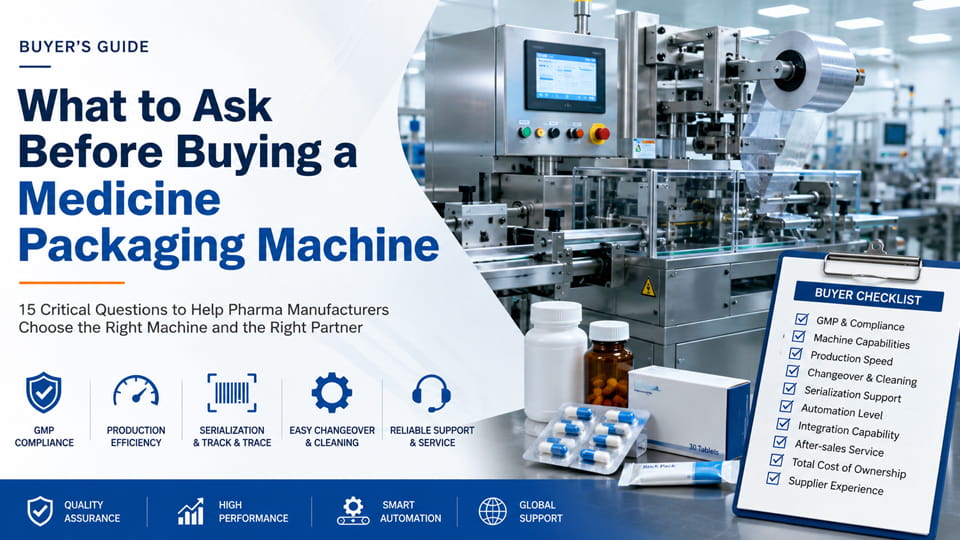
Afbeelding: Een moderne productielijn voor medicijnverpakkingen, ter illustratie van de behoefte aan geïntegreerde machines en een GMP-conform ontwerp.
Niet alle machines verwerken alle producten. U moet heel duidelijk zijn over uw producttypen. Bijvoorbeeld, tabletten en capsules maken vaak gebruik van tel-/flessenvullijnen of blisterverpakkingen, terwijl vloeibare medicijnen speciale vloeistofvul- en sluitmachines nodig. Poeders/korrels kan in sachets of stickpacks gaan. Hieronder vindt u een eenvoudige handleiding – uw behoeften kunnen meerdere machines in één lijn combineren:
| Doseringsvorm & Formaat | Typisch machinetype |
| Stevige tabletten (loszittend, in flessen) | Automatisch tellen & Flessenvullijn |
| Stevige tabletten (strippen of blaren) | Blaarverpakkingsmachine (PVC/Alu-PVC) |
| Capsules (harde gel) | Capsule-vulmachine + (blister- of flessenlijn) |
| Vloeistoffen/siropen (injectieflacons of flessen) | Machine voor het vullen en afdekken van vloeistoffen |
| Poeders/korrels (stokje of zakje) | Sachet- of Stick-Pack-machine |
| Zachte gels/gummies | Teltmachine + Blister of bottelen |
| Kartons (secundair) | Kartonmachine voor het laatste boksen |
Medicijnverpakkingsmachines worden vaak verkocht als geïntegreerde lijnen. Bijvoorbeeld, een capsulelijn kan product van a hengel in een telmachine, dan via een blisterverpakker of karton.
Vraag ernaar bij uw leverancier van medicijnverpakkingsmachines: “Kan de lijn mijn producten verwerken?” Voor elk formaat, materiaalcompatibiliteit verifiëren – b.v. een blistermachine moet uw folie en films verwerken (PVC, HUISDIER, ALU-ALU) bij de juiste temperaturen. Flessenlijnen moeten zich aanpassen aan verschillende fleshoogtes en doptypes. Als u meerdere producten plant (bijv. capsules en tabletten), je hebt wisselonderdelen of zelfs verschillende machines nodig. Sommige machines zijn dat wel multi-formaat, maar bevestig altijd welke omschakeling nodig is (zie volgende sectie).
De nominale snelheid van een machine moet overeenkomen met uw uitvoerdoelstellingen. Ontdek hoeveel eenheden per minuut/uur de machine kan verpakken betrouwbaar. Overweeg zeker netto uitvoer (na afwijzingen) en niet alleen het maximale. Denk na over de huidige behoeften En toekomstige groei. Bijvoorbeeld, een blisterlijn voor middelgrote tabletten kan worden gewaardeerd op 40,000 blaren per uur; een grote volautomatische lijn zou kunnen overschrijden 100,000 per uur. Echter, een zeer snelle machine die vaak crasht, kan erger zijn dan een iets langzamere, stabiele.
Schat uw dag- of jaarvolume in en kies een machine die pieken aankan. Houd rekening met trends in de branche: veel farmaceutische bedrijven draaien nu kleinere batches met frequente wisselingen, dus extreem hoge single-SKU-snelheid is minder kritisch dan flexibiliteit. Als je meerdere diensten draait, Investeren in een hogere doorvoer kan zich sneller terugbetalen dankzij arbeidsbesparingen. Maar als batches klein of op maat zijn, een machine die snelle receptwissels en gereedschapsloze omschakelingen mogelijk maakt (zie sectie 4) zal waardevoller zijn dan pure snelheid.
Bepaal hoeveel automatisering u echt nodig heeft. Halfautomatische machines vereisen dat operators containers laden, cycli starten, of handmatige taken uitvoeren (bijv. tabletten in blisters laten vallen). Volautomatische farmaceutische verpakkingslijnen alles doen, van voeren tot afdichten, met minimale menselijke tussenkomst. Semi-automatische machines kosten vooraf minder en kunnen prima geschikt zijn voor kleine volumes of batchwerk. Volledig automatische lijnen kosten meer, maar besparen op arbeid en verminderen menselijke fouten.
| Functie | Semi-automatisch | Volledig automatisch |
| Betrokkenheid van de operator | Ja – laden/lossen, enz. | Minimaal – één persoon houdt toezicht op de hele lijn |
| Productiesnelheid | Gematigd | Hoog |
| Omschakeling | Langzamer (handmatige aanpassingen) | Sneller (vaak gereedschapsloos, receptgestuurd) |
| Initiële investering | Lager | Hoger |
| Validatiecomplexiteit | Vergelijkbaar (IQ/OQ/PQ is nog steeds nodig) | Vergelijkbaar |
| Ideaal voor | Kleine runs, laboratorium piloten | Grote runs, 24/7 productie |
Volledig geautomatiseerde farmaceutische systemen omvatten vaak voerhoppers, automatische etiketteermachines, doppen, en transportbanden allemaal gesynchroniseerd. Ze integreren ook foutcontroles (weegschaal, vision-systemen) in realtime. Halfautomatische apparatuur kan geschikt zijn voor een beginnende contractfabrikant, maar groeiplannen leiden er vaak toe dat kopers kiezen voor volledige automatisering.
Farmaceutische lijnen wisselen vaker van product dan je zou denken, en elke verandering vereist een grondige reiniging (en vaak opnieuw valideren). Een goed machineontwerp maakt dit snel. Zoek naar gereedschapsvrij verwijderbare onderdelen, lichte componenten (één persoon kan ze aan), en open frames die QA mogelijk maken zien als er resten achterblijven. Er mogen geen verborgen holtes zijn waar pillen of poeder zich kunnen ophopen. De leverancier moet duidelijke SOP's voor het schoonmaken verstrekken, demontage en hermontage. Valideer de omschakelingsprocedures: kan producteren recepten worden opgeslagen, zodat u alle instellingen voor een bepaalde SKU kunt oproepen?
In de praktijk, een machine die snel kan worden gereinigd en gevalideerd, verbetert direct de productiviteit. Als u medicijnen heeft waarbij er tussen moet worden gewisseld, inspraak, een gereguleerde stof en een vitamineproduct, u zult een schoonmaakbeurt en vaak een schone validatietest doorlopen (slechtste producttest) elke keer. Vraag ernaar schoon op zijn plaats (CIP) opties of andere hygiënische kenmerken.
Moderne regelgeving (ONS. DSCSA, EU-MKZ, enz.) vereisen het serialiseren van elke verkoopbare eenheid van de geneeskunde. Voordat u koopt, bevestig dat de lijn codeerprinters kan integreren (inkjet/laser) en visionscanners om 2D-barcodes of QR-codes op pakketten aan te brengen en te verifiëren. Het besturingssysteem moet elk serienummer vastleggen en koppelen aan batchgegevens. In de praktijk, vragen kopers vaak: “Kan deze machine elk ongelabeld of ongeldig gecodeerd artikel weigeren??” En “Is er ruimte en bedrading gereserveerd om later een codeerapparaat of camera toe te voegen??”. Zelfs als u vandaag niet exporteert, het bouwen van een lijn die klaar is voor serialisatie is slimmer dan later achteraf inbouwen.
Voorbij serialisatie, denk aan digitale integratie. Ondersteunt de machine standaard industriële communicatie (Ethernet/IP, OPC UA, Modbus, enz.) zodat het uw MES/ERP kan voeden? Kan het audittrails en elektronische batchrecords voor QA genereren?? Moderne slimme fabrieken verwachten realtime gegevens: uptime, tellingen afwijzen, alarmen, enz. Een ‘slimme’ farmaceutische lijn helpt problemen vroegtijdig op te sporen en ondersteunt vereisten voor gegevensintegriteit (geen handmatige logboeken). Vraag of de HMI/PLC op een netwerk kan worden aangesloten, als er gebeurtenislogboeken zijn, en of service op afstand (via VPN of IoT) wordt aangeboden. Digitale gereedheid maakt uw lijn toekomstbestendig en verbetert de traceerbaarheid.
De stickerprijs is nog maar het begin. Slimme kopers rekenen TCO gedurende de levensduur van de machine. TCO omvat de basisprijs plus verzending, installatie, IR/WH/PQ, opleiding, reserveonderdelen, energieverbruik, onderhoud, en stilstandkosten. Bijvoorbeeld, Uit één onderzoek bleek dat een dure maar betrouwbare, in China gemaakte verpakkingslijn voor medicijnen in drie jaar tijd veel meer bespaarde dan een goedkopere, minder goed ondersteund. Maak een tafel (zoals hieronder) om leveranciers te vergelijken:
| Kostenfactor | Beschrijving | Opmerkingen |
| Aankoopprijs | Machine, accessoires, levering | Eenmalig (maar kan sterk variëren) |
| Installatie & Inbedrijfstelling | Voorbereiding van de locatie, kalibratie, IR/WH/PQ | Gemiste stappen op dit gebied kunnen toekomstige kosten verhogen |
| Opleiding | Exploitant & onderhouds opleiding | Goede training vermindert bedieningsfouten |
| Reserveonderdelen & Componenten | Slijtage onderdelen (riemen, sensoren, enz.) | Vraag om lijst; hoge beschikbaarheid bespaart downtime |
| Energie/nutsvoorzieningen | Elektriciteit, lucht, leeg, enz. | Efficiënte machines kunnen de OPEX verlagen |
| Onderhoud & Downtime | Gepland onderhoud & ongeplande reparaties | Snelle service en een storingsvrij ontwerp minimaliseren dit |
| Ondersteuning/Service | Probleemoplossing op afstand, bezoeken ter plaatse | Een sterke service-SLA is zijn gewicht waard |
| Verbruiksartikelen & Hulpmiddelen | Zeehonden, smeermiddelen, reserve sproeiers, enz. | Vaak over het hoofd gezien, maar het kan oplopen |
Als twee leveranciers vergelijkbare machines citeren, zoek uit wat elke lijst inhoudt. Een duurdere machine gaat mogelijk langer mee, hebben goedkopere reserveonderdelen, of gebruik minder perslucht – waardoor de werkelijke kosten dalen. Zorg ervoor dat u elke leverancier vraagt naar de garantieduur en wat er gedekt wordt (onderdelen, werk, reizen voor techneuten).
Zelfs de beste machine heeft onderhoud nodig. Controleer de staat van dienst en de service-instellingen van de leverancier van de medicijnverpakkingsmachine. Een betrouwbare machine heeft onder meer duidelijke foutcodes op de HMI, een goed gelabelde elektrische kast, en een eenvoudig preventief onderhoudsplan. Vraag naar MTBF (gemiddelde tijd tussen mislukkingen) gegevens of casestudies. Ontdek ook hoe er met reserveonderdelen wordt omgegaan: Het zijn kant-en-klare of op maat gemaakte onderdelen? Hoe snel kunt u cruciale componenten krijgen – volgende dag of weken? Vooral voor wereldwijde kopers, lokale ondersteuning is cruciaal. Uit het onderzoek van JinLu Packing blijkt dat een snelle levering en service van onderdelen verliezen van zes cijfers als gevolg van stilstand kan voorkomen.
[jl_youtube src=”https://www.youtube.com/embed/1Bb_J6rluac”]
Video: Een geautomatiseerde vul- en bottellijn. Evalueer betrouwbaarheidskenmerken (fout sensoren, duidelijke kasten) en onderhoudsgemak bij het kiezen van apparatuur.
Niet alle bouwers van medicijnverpakkingsmachines begrijpen de farmaceutische nuance. Ideaal, kies een leverancier met een bewezen staat van dienst in farma/GMP. Vraag naar hun klantenlijst en recente projecten. Hebben ze uw regio of gereguleerde markten bevoorraad? (Amerikaanse FDA, Ik EMA)? Doen ze FAT? (Fabrieksacceptatietests) en FAT-rapporten? Kunnen ze indien nodig een kwalificatieproces afhandelen?? Gerenommeerde leveranciers beschikken over een technisch QMS en kunnen maatwerk aanbieden (bijv. specifieke visuele inspecties voor OTC versus RX-labeling).
Je moet ook aan de logistiek denken: waar is hun fabriek? Als het in het buitenland is, zijn er kanaalpartners of installateurs in uw land?? Wie regelt de douane en de verzending? Herinneren, de goedkoopste machine is niet veel waard als deze op een schip staat vanwege ontbrekende documenten of als deze niet lokaal wordt ondersteund.
Om af te ronden, hier is een checklist die u kunt gebruiken tijdens vergaderingen of offerteaanvragen:
Deze vragen, terwijl talrijk, zorgt ervoor dat u de meest kritische punten bestrijkt en leveranciers op gelijke basis vergelijkt.
Investeren in de juiste medicijnverpakkingsmachine betekent een evenwichtige prestatie, naleving, en kosten over vele jaren. Door deze vragen te stellen, u maakt uw wensen duidelijk en voorkomt verrassingen. Herinneren, de beste keuze is niet altijd de goedkoopste machine, maar degene die past bij uw proces En zorgt ervoor dat u compliant blijft met minimale stilstand.
Als je begeleiding nodig hebt, overleg bijvoorbeeld met experts op het gebied van verpakkingsautomatisering, Jinlu-verpakking biedt end-to-end ontwerp en ondersteuning voor farmaceutische lijnen, van GMP-lijnlay-out tot validatiedocumentatie. Neem contact met ons op om uw project te bespreken: wij kunnen een voorstel op maat maken of een live demo regelen. Laten we ervoor zorgen dat uw investering zowel succes op het gebied van de regelgeving als operationele efficiëntie oplevert.
Voordat u een medicijnverpakkingsmachine koopt, u moet vragen stellen over de naleving van GMP, productie snelheid, soorten verpakkingen, validatie ondersteuning, machinematerialen, omschakeltijd, beschikbaarheid van reserveonderdelen, en after-sales service. Het is ook belangrijk om te controleren of de machine toekomstige productie-uitbreiding en serialisatievereisten kan ondersteunen.
De juiste machine is afhankelijk van uw producttype, productievolume, verpakking formaat, en nalevingsvereisten. Bijvoorbeeld, blisterverpakkingsmachines worden vaak gebruikt voor tabletten en capsules, terwijl sachet- of stickpack-machines beter zijn voor poeders en korrels. Kopers moeten ook rekening houden met het automatiseringsniveau, onderhoudskosten, en lijnintegratiemogelijkheden.
Een betrouwbare fabrikant van farmaceutische verpakkingsmachines moet documenten en certificeringen verstrekken, zoals:
• CE-certificering
• GMP-conforme ontwerpdocumentatie
• IQ/OQ/PQ-protocollen
• FAT/SAT-documenten
• Materiaalcertificaten
• 21 CFR-onderdeel 11 steun (indien van toepassing)
Deze documenten helpen farmaceutische fabrieken om audits te doorstaan en te voldoen aan de wettelijke vereisten.
GMP-naleving helpt de productveiligheid te garanderen, constante kwaliteit, en wettelijke goedkeuring. Een GMP-conforme machine is ontworpen om besmettingsrisico’s te verminderen, reinigbaarheid verbeteren, en ondersteuning bieden voor goede documentatie en traceerbaarheid. Dit is vooral belangrijk voor farmaceutische fabrikanten die naar gereguleerde markten exporteren.
Moderne farmaceutische verpakkingsapparatuur kan vele verpakkingsformaten ondersteunen, inbegrepen:
• Blisterverpakkingen
• Flessen
• Zakjes
• Stokpakketten
• Zakjes
• Kartons
De beste optie hangt af van uw doseringsvorm, eisen van de markt, en productiedoelstellingen.
Serialisatie wordt in veel landen essentieel vanwege regelgeving op het gebied van farmaceutische traceerbaarheid, zoals DSCSA en EU FMD. Een machine met serialisatiemogelijkheden kan unieke codes afdrukken en verifiëren, fabrikanten helpen namaakproducten te voorkomen en het volgen van de toeleveringsketen te verbeteren.
Halfautomatische machines zijn doorgaans betaalbaarder en geschikt voor kleine productievolumes of startups. Volautomatische farmaceutische verpakkingsmachines zijn beter voor grootschalige productie omdat ze de efficiëntie verbeteren, verlaging van de arbeidskosten, en menselijke fouten minimaliseren.
De prijs is afhankelijk van verschillende factoren, inclusief machinetype, automatiseringsniveau, productie snelheid, en maatwerkeisen. Een eenvoudige halfautomatische machine kost mogelijk veel minder dan een volledig geautomatiseerde farmaceutische verpakkingslijn met ondersteuning voor serialisatie en validatie. Kopers moeten zich concentreren op de totale eigendomskosten in plaats van alleen op de initiële aankoopprijs.
Ja. Veel moderne farmaceutische verpakkingsmachines kunnen verbinding maken met telmachines, etiketteersystemen, kartonneermachines, transportbanden, en ERP/MES-systemen. Integratie helpt de automatisering en de algehele productie-efficiëntie te verbeteren.
Een professionele leverancier zou moeten aanbieden:
• Installatieondersteuning
• Operatortraining
• Online probleemoplossing
• Levering van reserveonderdelen
• Begeleiding preventief onderhoud
• Technische assistentie op afstand
Een goede after-sales service kan de stilstandtijd aanzienlijk verminderen en de productiestabiliteit op de lange termijn verbeteren.
Referenties:
1.Huidige goede productiepraktijken (CGMP) Regelgeving -- ONS. Voedsel- en Geneesmiddelenadministratie
2.Goede productiepraktijken van de WHO voor biologische producten, Bijlage 2, TRS-nr 999 -- WHO
3.Goede productiepraktijk —— Europees Geneesmiddelenbureau
4.Tien veelgestelde vragen over serialisatie —— Internationale Vereniging voor Farmaceutische Technologie