

A verpakkingslijn voor flessen is een end-to-end geautomatiseerd systeem dat lege flessen omzet in etiketten, verpakte producten. Voor farmaceutische en nutraceutische makers, deze lijnen verhogen de doorvoer, arbeidskosten verlagen, en verzekeren GMP-conform uitvoer. In deze handleiding wordt uitgelegd wat een flessenverpakkingslijn is, hoe het werkt, en de belangrijkste betrokken machines. We behandelen verschillende lijntypes (tablet, vloeistof, nutraceutisch, enz.), noem de belangrijkste voordelen van automatisering, en geef praktische tips voor het kiezen van de juiste lijn. Of je nu een kant-en-klare flesverpakkingsoplossing of vergelijken handmatig versus handmatig. automatisch, dit artikel heeft je gedekt.
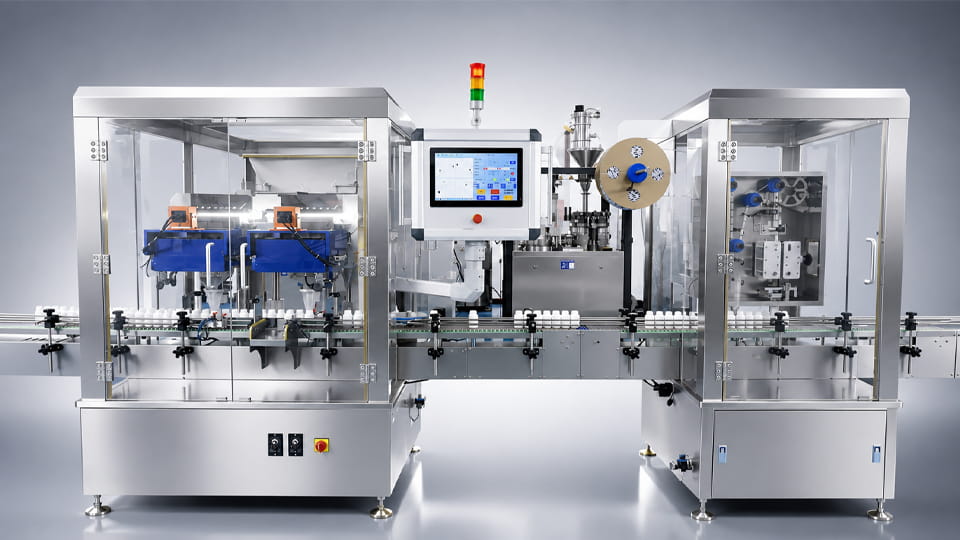
Figuur:Een typische verpakkingslijn voor farmaceutische flessen.
Een flessenverpakkingslijn is dat wel een reeks machines en transportbanden die lege flessen automatisch verwerken tot afgewerkte flessen, verpakte producten. Op het gebied van farmaceutische producten, dit betekent dat u lege tabletten of vloeistofflesjes inneemt en stappen uitvoert zoals tellen/vullen, aftappen, inductie afdichting (folie afdichting), etikettering, en uiteindelijke kartonnen verpakking. In de praktijk, een lijn “automatiseert het hele proces volledig, van het ontkruiden van flessen tot tellen, het invoegen van droogmiddelen, aftappen, aluminium folieafdichting, en etikettering”.
Met andere woorden, in plaats van flessen handmatig op te pakken en ze één voor één te vullen, een automaat verpakkingslijn voor flessen voert flessen achtereenvolgens door elk station. Een typische lijn begint met een flessenontscrambler (die flessen rechtop op de transportband oriënteert), stroomt vervolgens door vullen/tellen, katoen of droogmiddel inbrengen (indien nodig), aftappen, inductie afdichting, etikettering, en ten slotte kartonneren. Deze machines werken synchroon onder PLC-besturing, het vormen van een kant-en-klare lijn die continu kan draaien. Bijvoorbeeld, een leverancier van apparatuur merkt op dat een tel-vullijn “kan worden aangesloten op een flessenontbreker, Dosperante inserter, afdekmachine, aluminiumfolie sluitmachine en etiketteermachine”, die alle belangrijke stappen omvat.
De flessen zelf kan van kunststof zijn (HUISDIER, HDPE), glas, of andere materialen (amberkleurig glas voor lichtgevoelige producten, enz.). De lijn is meestal gebouwd om een reeks flesformaten te verwerken (bijv. 30–150 mm diameter, 40–300 mm hoogte) en kaptypes (schroefdoppen, klikdoppen, kindveilige sluitingen). Alle productcontactonderdelen zijn gemaakt van GMP-kwaliteit roestvrij staal met sanitaire ontwerpen (gladde oppervlakken, geen dode benen) om aan de wettelijke normen te voldoen. Veel machines zijn voorzien van sensoren en transportbanden voor kwaliteitscontrole (bijv. het controleren van het vulniveau, dop koppel, aanwezigheid van etiketten) en ondersteuning van serialisatie (afdrukken van streepjescodes/QR-codes) voor traceerbaarheid.
Kortom, A verpakkingslijn voor farmaceutische flessen is een geïntegreerd, gevalideerd systeem dat alles regelt, van lege flesvoeding tot het uiteindelijke kartonneren, hoge snelheid garanderen, nauwkeurigheid, en naleving.
De workflow van een flessenverpakkingslijn omvat een reeks voorbereidingsfasen, vullen, zegel, en verpak de flessen. Het onderstaande stroomdiagram toont een algemene reeks stappen:
Figuur: Workflow van een typische flessenverpakkingslijn.
In de praktijk, niet alle lijnen hebben elk station. Bijvoorbeeld, een lijn voor niet-vochtgevoelige vaste stoffen kan het inbrengen van katoen overslaan, terwijl een vloeistoflijn geen tabletteller gebruikt. Hier volgt een kort overzicht van elke stap:
Elk van deze stations is verbonden door transportbanden en wordt bestuurd door een centraal PLC/HMI-systeem. De gehele lijn wordt doorgaans opgesteld in een cleanroomomgeving, gebouwd om CGMP normen: roestvrijstalen kozijnen (SUS304/316L), Door de FDA goedgekeurde slangen, washdown-motoren, en gladde lasnaden. PLC-automatisering (Siemens, Panasonic, Omron, enz.) synchroniseert snelheid en werking tussen machines.
[jl_youtube src=”https://www.youtube.com/embed/tSrCmYZ-OQ0″]
Hier zijn de sleutelmachines die je aantreft in een typische flessenverpakkingslijn (met korte specificaties of voordelen):
Voert en oriënteert lege flessen op de transportband. Een hoge kwaliteit ontcijferaar levert 50–120 flessen/min, omgaan met ronde plastic of PET-flessen. Het maakt gebruik van trilkomvoeders en rupsbanden om flessen rechtop te zetten. Moderne ontscramblers zijn volledig omsloten (stofvrij, CGMP) en voorzien van Siemens PLC besturingen en optische/pneumatische sensoren, zodat de flessen in de juiste richting aankomen (100% nauwkeurigheid) zonder handmatig laden. Dankzij de snelle wisselonderdelen kan één operator binnen enkele minuten van flesgrootte wisselen.
Voor vaste doseringen, een Automatische telmachine (ook wel genoemd tablet/capsuleteller of vulmiddel) druppelt een exact aantal pillen in elke fles. Deze maken gebruik van snelle optische sensoren of telkoppen. De tellers van JinLu, bijvoorbeeld, hendel 3–40 mm vaste stoffen, het behalen van een output tot 100 flessen/uur met >99.98% nauwkeurigheid. (Versies met meerdere koppen en meerdere rijstroken kunnen de doorvoer vermenigvuldigen.) Ze integreren naadloos: “van het sorteren van flessen tot het etiketteren… de afvullijn voor telflessen kan worden aangesloten op de flessenontscrambler, Dosperante inserter, afdekmachine, [En] etiketteermachine”. Kortom, de teller zorgt ervoor dat elke fles het juiste aantal pillen krijgt.
Voor siropen, injecteerbare producten, of andere vloeistoffen, een automatische vloeibare vuller geeft elke dosis af. De vloeibare vulstoffen van Jinlu maken gebruik van een servoaangedreven pomp en dompelmondstuk ontwerp, waardoor schuim en terugdruipen wordt vermeden. Ze rennen bij 20–80 flessen per minuut met een nauwkeurigheid van ±0,2 g, en aan te passen aan flesvolumes van enkele ml tot liters. Het tankstation is vaak uitgerust met een indextafel of een verdeelstuk met meerdere spuitmonden om de snelheid te verhogen. Kritisch, deze machines worden bestuurd door PLC/HMI voor nauwkeurige stroomregeling en receptgebaseerd vullen.
Na het vullen, een capper plaatst en beveiligt doppen. Een goede afdekmachine zal verschillende dopstijlen verwerken (schroefdoppen, klikdoppen, kindveilig, enz.) gebruik van specifieke dopkoppen. Het sorteert automatisch, feeds, en brengt de doppen met het juiste aanhaalmoment aan. Jinlu's servo-afsluitmachines (bijv. modelXG-120) aanpassen aan diverse flessen en doppen en aanlopen 120 flessen/min. Kenmerken omvatten real-time koppelaanpassing (via een handwiel of servomotor) en controle op de aanwezigheid van doppen. Als een dop niet goed is uitgelijnd of ontbreekt, het systeem zal die fles afwijzen, verzekeren 100% conforme uitvoer.
Ook wel een genoemd aluminiumfolie sealer. Dit station brengt een door hitte gesealde folievoering onder de dop aan om een hermetische afdichting te creëren. Een typische inductiesealer kan maximaal verwerken 120 flessen/min. Het laat flessen op een transportband lopen onder een hoogfrequente spoel, het kort verwarmen en verlijmen van de folie. Deze stap biedt bewijs van manipulatie en voorkomt lekken. Moderne sealers hebben dual-mode koppen die zich kunnen aanpassen aan verschillende flesdiameters en ingebouwde afkoelventilatoren voor continu gebruik.
Brengt gedrukte etiketten aan op flessen. Roterend met hoge snelheid etiketteermachines (zoals de TBJ-serie van JinLu) kan labelen tot 120 flessen/min met ±1 mm nauwkeurigheid. Ze omvatten een flessenverdeler om flessen gelijkmatig te verdelen en a slim detectiesysteem om elk label perfect uit te lijnen. Multi-mode etiketteermachines kunnen front-wrap aan, omwikkeld, en dubbelzijdige etikettering. Geïntegreerde codeerkoppen bevinden zich vaak naast de etiketteermachines voor het afdrukken van batches/partijen. Na etikettering, vision-systemen kunnen streepjescodes en tekst verifiëren om aan de serialisatievereisten te voldoen.
Zodra de flessen zijn geëtiketteerd, groepen flessen (met instructies of folders indien nodig) worden automatisch in dozen gestoken. Kartonmachines kan oprichten en afsluiten 400–450 dozen per minuut. In flessenlijnen, horizontaal (zijbelasting) kartonneermachines zijn gebruikelijk. Nadat dozen zijn gevormd, casepackers of palletiseermachines kunnen de producten verder bundelen. Deze end-of-line machines maken het systeem compleet en hebben vaak een eigen PLC voor synchronisatie met upstream apparatuur.
Elk van deze machines is er een voorbeeld van apparatuur voor het verpakken van flessen. Wanneer ze aan elkaar gekoppeld zijn op transportbanden met een centrale PLC-besturing, ze vormen een sterk geautomatiseerde flessenverpakkingslijn.
Flesverpakkingslijnen worden doorgaans gecategoriseerd op basis van de primaire productsoort en toepassing. Hieronder vindt u een voorbeeld van veelvoorkomende lijntypen:
| Lijntype | Product/toepassing |
| Tablet-/capsuleflessenlijn | Orale vaste stoffen: tabletten, capsules, poeders (farma & supplementen) |
| Lijn voor vloeibare flessen | Vloeistoffen: siropen, siropen, tonica, injecties (farma & nutraceutisch) |
| Vitamine & Nutraceutische lijn | Voedingssupplementen, vitamines, kruiden pillen (voedings-/gezondheidssupplementen) |
| Cosmetische flessenlijn | Persoonlijke verzorging: crèmes, lotions, serums, oliën (cosmetica) |
| Chemische flessenlijn | Industriële/huishoudelijke chemicaliën, reagentia (chemicaliën) |
| Voorgevulde spuit/bol | Gespecialiseerde farmaceutische steriele vulling (injecteerbare producten) |
Deze lijnen delen een vergelijkbare architectuur, maar gebruiken verschillende vul-/sluitmachines die geschikt zijn voor het product. Bijvoorbeeld, A lijn voor tabletflessen maakt gebruik van telmachines voor pillen, terwijl een siroop lijn maakt gebruik van vloeistofpompen. Nutraceutical-lijnen bevatten vaak functies voor delicate producten (zachte capsules, Gummy vitamines), terwijl cosmetische lijnen zouden kunnen integreren krimpkous of snellere cappers. In elk geval, de lijn kan worden aangepast (soorten mondstukken, transportbanden) aan de flesvorm en procesbehoeften.
Investeren in een volledig geautomatiseerde flessenverpakkingslijn biedt veel voordelen ten opzichte van handmatig verpakken. De belangrijkste voordelen zijn onder meer:
Samengevat, automatische flessenverpakkingslijnen bieden schaalbaarheid en controle. Met de juiste machines, fabrikanten bereiken hogere snelheden, lagere arbeid, en tegelijkertijd een hogere productkwaliteit. Zoals een verpakkingsexpert opmerkt, Met deze systemen kunnen bedrijven “grote hoeveelheden producten in een fractie van de tijd verwerken” en tegelijkertijd het aantal fouten verminderen.
Flessenverpakkingslijnen zijn in veel sectoren essentieel:
Elke sector die zijn product bottelt, kan profiteren van een geautomatiseerde lijn. Zelfs nicheproducten (bijenwas pillen, CBD-olie) gebruik aangepaste lijnen. Het leidende principe is of een hoge doorvoer en kwaliteitscontrole de productie kunnen verbeteren – in al deze industrieën, automatische flessenlijnen spelen een sleutelrol.
Het selecteren van de ideale flessenverpakkingslijn is afhankelijk van verschillende factoren. Dit is waar u rekening mee moet houden:
Samengevat, specificeer uw soorten flessen, productvorm, outputdoelen, en begroting. Werk vervolgens samen met een vertrouwde fabrikant om een aangepaste lijn te configureren. Ze moeten een gedetailleerde lay-out bieden, elektrische vereisten, en verwachte doorlooptijd. (Standaard semi-automatische machines kunnen binnen enkele weken worden verzonden; het bouwen en testen van een volledig geïntegreerde lijn duurt vaak 2 tot 4 maanden.) Valideer altijd de prestaties van de apparatuur met proefproeven voordat u de definitieve versie afrondt.
| Handmatige verpakking | Automatische verpakkingslijn |
| Langzaam (vaak <20 BPM) | Hoge snelheid (50–120 BPM of meer) |
| Arbeidsintensief (veel exploitanten) | Minimale arbeid (één technicus) |
| Variabele nauwkeurigheid (menselijke fout) | Hoge precisie (>99.9% nauwkeurigheid) |
| Ongelijke kwaliteit (inconsistente vulling) | Consistente uitvoer (herhaalbare kwaliteit) |
| Lagere initiële kosten (maar hoge OPEX) | Hogere kapitaalinvesteringen (maar lagere OPEX) |
| Minimale apparatuurintegratie nodig | Kant-en-klare integratie (alles-in-één) |
| Moeilijk om snel te schalen | Eenvoudig te schalen door het toevoegen van rijstroken/modules |
Tafel: Vergelijking van handmatig verpakken vs. een automatische flessenverpakkingslijn.
Zoals de tabel laat zien, automatisering levert een veel hogere doorvoer en consistentie op. Het vergemakkelijkt ook de traceerbaarheid (barcode elke fles) en kan zichzelf vaak binnen een paar jaar terugbetalen dankzij efficiëntiewinsten.
Een moderne verpakkingslijn voor flessen is de ruggengraat van efficiënte farmaceutische producten (en nutraceutisch) fabricage. Door het vullen te automatiseren, aftappen, afdichting, en etikettering, deze lijnen maximaliseren de productiviteit en zorgen tegelijkertijd voor kwaliteit en naleving van de regelgeving. Bij het kiezen van een lijn, stem het ontwerp af op uw producttype (tablet versus. vloeistof), doorvoerbehoeften, en kwaliteitsnormen (GMP, serialisatie, enz.). Zoek naar een gerenommeerde leverancier zoals Jinlu Packing die geïntegreerde oplossingen en krachtige ondersteuning biedt.
Samengevat: een geautomatiseerde flessenverpakkingslijn zet lege flessen in één soepele handeling om in definitieve dozen. Het kan grote volumes aan (vaak honderden per minuut) met uitzonderlijke nauwkeurigheid. Voor fabrieksmanagers en ingenieurs, de voordelen – hogere doorvoer, lagere arbeid, betere consistentie – zijn duidelijk.
Klaar om uw verpakking te automatiseren? Neem contact op met het verkoopteam van Jinlu Packing om een aangepaste flessenlijn voor uw producten te bespreken. Wij bieden een turn-key ontwerp aan, inbedrijfstelling op locatie, en 3 jaar garantie. Met over 30 jaar in de productie van farmaceutische apparatuur, Jinlu kan u helpen bij het selecteren van de juiste snelheid, formaat, en automatiseringsniveau – zodat uw nieuwe lijn een snelle ROI oplevert. Bezoek www.jinlupacking.com of vraag een offerte aan om aan de slag te gaan.
Een flessenverpakkingslijn is een geïntegreerd systeem van machines dat het verpakken van gebottelde producten automatiseert. Het bevat doorgaans een flessenontscrambler, een vul- of telstation, kapper, sealer, etiketteringsmachine, en vaak een kartonneerder. Samen nemen deze fasen lege flessen en transformeren ze in afgewerkte flessen, verpakte goederen.
Een geautomatiseerde lijn volgt een vaste workflow: lege flessen worden rechtop ingevoerd (gedecodeerd), vervolgens verplaatst naar een vulmiddel (voor vloeistoffen) of telmachine (voor tabletten/capsules). Volgende, eventuele aanvullende artikelen (katoen of droogmiddelen) zijn toegevoegd. Vervolgens worden de flessen afgesloten, inductieverzegeld, en geëtiketteerd. Eindelijk, groepen flessen worden verpakt in dozen. Elke machine wordt gesynchroniseerd door PLC-besturing. Moderne lijnen kunnen zich zelfs in realtime aanpassen (bijv. vulgewicht corrigeren) kwaliteit te behouden.
Het hangt af van het model en het formaat. Typische snelheden zijn 50–120 flessen per minuut per baan. Bijvoorbeeld, Jinlu's tablettellijn werkt tot ~70 BPM, en veel dop-/etiketteermachines kunnen ermee omgaan 120 BPM. Lijnen met meerdere rijstroken kunnen de output vermenigvuldigen (een 6-baans teller, bijvoorbeeld, zou 6x het enkelstrookstarief kunnen doen). Voor vloeistoffen, snelheden rond de 20-80 BPM zijn gebruikelijk. Controleer altijd het specificatieblad van de leverancier voor de exacte tarieven onder de door u gekozen configuraties.
Belangrijke componenten zijn: een flessenontscrambler, Vul-/telmachine, Katoen-/droogmiddelinbrengers, Automatische sluitmachine, Inductie sealer, Etiketteringsmachine, Inspectiestation, en kartonneer/casepacker. Elk wordt geleverd door de OEM en geïntegreerd op een gemeenschappelijk transportframe. Sommige lijnen kunnen ook een in-line printer voor batchcodes en een uitwerpsorteerder toevoegen. De exacte opstelling is afhankelijk van of uw product vast of vloeibaar is, uw flestype, en verpakkingsbehoeften.
Ja, flessenlijnen kunnen zowel tabletten als capsules verwerken, aangezien beide telbare vaste stoffen zijn. De lijn zou een vulmiddel voor het tellen van tabletten/capsules bevatten, wat meestal werkt voor elke kleine vaste vorm (capsules, gomachtige snoepjes, enz.) van het opgegeven maatbereik. Het wisselen tussen tabletten en capsules is meestal een kwestie van het aanpassen van de telkop en parameters. Veel fabrikanten ontwerpen hun telmachines om beide te verwerken door simpelweg de recepten te veranderen. Op één lijn kunnen dus verschillende SKU's worden uitgevoerd (bijv. een vitaminetablet in één keer, een capsule in de volgende) met minimale omsteltijd.
Ja – alle machines in een verpakkingslijn voor farmaceutische flessen zijn gebouwd om te voldoen aan de cGMP-normen. Ze zijn gemaakt van roestvrij staal van farmaceutische kwaliteit (SS316L), met sanitair ontwerp (geen spleten, gemakkelijk schoon te maken). Besturingssystemen ondersteunen FDA 21 CFR-onderdeel 11 (elektronische dossiers) en worden doorgaans geleverd met validatiedocumentatie. Bijvoorbeeld, leveranciers vermelden expliciet dat hun flessenlijnen “voldoen aan Good Manufacturing Practices”. (GMP) en FDA-voorschriften.”. Bij het selecteren van apparatuur, zoek naar CE-markering, ISO-certificeringen, en bevestig dat de leverancier IQ/OQ-protocollen levert voor naleving van de regelgeving.
Prijzen variëren sterk, afhankelijk van de snelheid en configuratie. Een eenvoudige, semi-automatische opstelling voor tellen en afdekken kost misschien een paar duizend dollar, terwijl een volledig geïntegreerde hogesnelheidslijn in de tientallen of zelfs honderdduizenden dollars kan lopen. Factoren zijn onder meer het aantal stations (bijv. een extra etiketteerkop brengt kosten met zich mee), maatwerk gereedschap, en compliance-extra's (bijv. vision-systemen). Vraag altijd offertes aan voor uw exacte wensen. Houd rekening met de totale eigendomskosten: een iets duurdere lijn van hoge kwaliteit bespaart na verloop van tijd vaak geld door minder verspilling en uitvaltijd.
Kant-en-klare flessenlijnen zijn complex. Na productie en testen in de fabriek, installatie op locatie duurt doorgaans 2 tot 7 dagen per machinemodule (afhankelijk van de voorbereiding van de locatie, nutsvoorzieningen, en training). Kleine lijnen kunnen binnen een paar weken operationeel zijn, terwijl grote lijnen met meerdere machines 4 tot 6 weken op locatie nodig kunnen hebben (inclusief IQ/OQ-validatie). Uw leverancier moet de mechanische installatie verzorgen, elektrische aansluiting, en initiële kwalificatie. Plan extra tijd voor training van operators en procesvalidatie.
Absoluut. Toonaangevende fabrikanten (zoals Jinlu) gespecialiseerd in maatwerk en turn-key oplossingen. Je kunt bijna elk aspect aanpassen: transportband lengtes, machine-afstand, PLC-taal, kleur schilderen, onderdelen materialen (bijv. SS304 versus SS316), en zelfs klantspecifieke aanvullingen integreren (metaaldetectoren, RFID-applicators, enz.). Omdat de ruimte en workflow van elke fabriek verschillen, indelingen zijn op maat gemaakt. Als u modulaire uitbreiding nodig heeft (bijv. later een 2e vulkop toevoegen) of unieke productbehandeling (kwetsbare producten, speciale doppen), bespreek dit vooraf. De OEM biedt doorgaans vóór de bouw een 3D-fabrieksindeling en -simulatie aan.
Ja – veel leveranciers bieden kant-en-klare geïntegreerde lijnen aan, wat betekent dat ze een volledig ontwikkeld systeem leveren dat klaar is voor gebruik. Bij een turnkey project is het ontwerp inbegrepen, fabricage, testen, verzending, installatie, en eindkwalificatie. Ideaal als u één leverancier wilt die verantwoordelijk is voor de hele lijn. Volgens branchegidsen, een kant-en-klare flessenlijn werkt ‘fase voor fase’, van het hanteren van de flessen tot het afsluiten en etiketteren. Bedrijven als Jinlu werken samen met u aan de lay-out en bieden vervolgens één contractprijs voor de hele lijn. Dit vereenvoudigt de validatie en ondersteuning omdat één team het hele systeem kent.
Referenties:
1.Containersluitsystemen voor het verpakken van geneesmiddelen voor menselijk gebruik en biologische geneesmiddelen -- ONS. Voedsel- en Geneesmiddelenadministratie
2.Gids voor goede praktijken: Verpakking, Etikettering, & Opslagfaciliteiten —— ispe.org
3.DEEL 211 – HUIDIGE GOEDE PRODUCTIEPRAKTIJKEN VOOR VOLTOOIDE GENEESMIDDELEN —— ecfr.gov
4.Hulpmiddelen voor etikettering van dozen en containers -- ONS. Voedsel- en Geneesmiddelenadministratie
5.Richtlijnen voor de verpakking van farmaceutische producten -- WHO