×

Service Online

💬 WhatsApp: +86 1801179332
💡
  • Home
  • Blogs
  • Unit Dose vs Bulk Packaging: Which Pharma Packaging Method Is Better?

Unit Dose vs Bulk Packaging: Which Pharma Packaging Method Is Better?

Pharmaceutical companies today are under pressure from every direction. Hospitals want safer medication handling. Retail markets want lower packaging costs. Regulators expect better traceability and serialization. At the same time, manufacturers are trying to improve production efficiency without creating unnecessary packaging waste. That is why the discussion around unit dose packaging and bulk packaging has become much more important in recent years. One format focuses on dose-level protection and patient safety, while the other prioritizes speed, simplicity, and cost efficiency. Neither option is automatically better for every product. The right choice depends on your drug type, production goals, distribution channel, and packaging line capabilities. For pharma manufacturers, procurement teams, and operations managers, understanding the real differences between unit dose and bulk packaging is essential before investing in a new pharmaceutical packaging system or upgrading an existing packaging line.
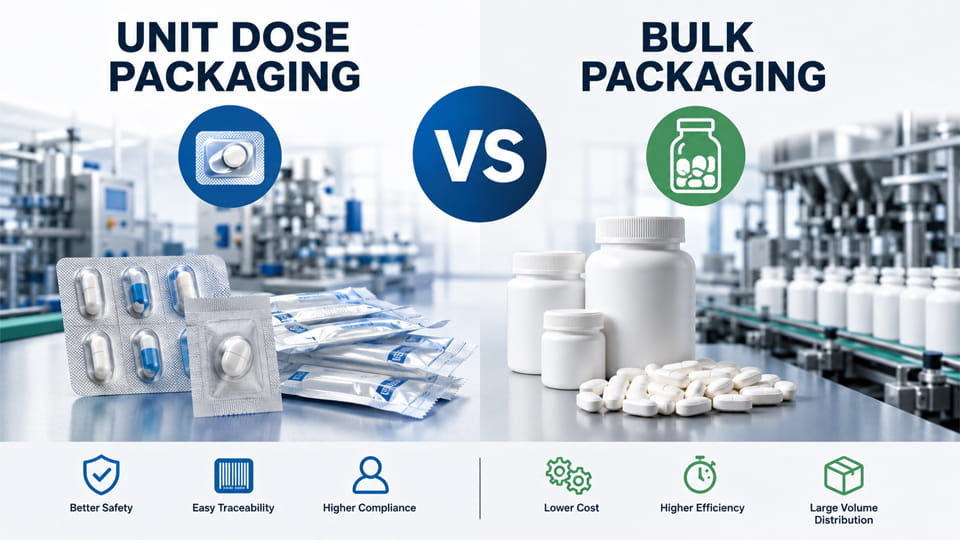
Unit Dose vs Bulk Packaging


What Is Unit Dose Packaging?

Unit dose packaging (also called single-dose packaging) means each dose of medication is individually sealed in its own package. For example, one pill might be in its own blister pocket or pouch. Jinlu Packing explains that “unit dose packaging means each individual dose of a medication is pre-packaged and sealed by itself”. In practice, this can be a single-tablet blister card, a strip pack (one tablet per cavity), a prefilled syringe, a vial, or a sachet containing one dose of liquid or powder. Each package carries labels (drug name, dose, expiration) so a nurse or patient can confirm the medicine without counting pills from a bottle. In US hospitals, over 75% of oral meds are dispensed in unit-dose form.

Unit Dose Packaging-tablets in blister packs

Unit-dose packs are common in hospitals, clinics, long-term care facilities, and clinical trials – essentially anywhere precise dose control and traceability are paramount. They help prevent dosing errors because each packet contains exactly one dose and is clearly labeled. In other words, as Jinlu notes, unit-dose packs require no counting – you “just grab one package and open it”, reducing handling mistakes. Other terms used include single-dose, unit-of-use, or unit-of-medication packaging. Typical formats include:

  • Blister packs: Thermoformed cavities on a plastic or foil sheet, each sealed with a foil or plastic lid. Each cavity holds exactly one tablet or capsule. (See blister packing machines.)
  • Strip packs: Tablets sealed between plastic/foil layers in a strip (like a condom blister pack without individual cavities).
  • Sachet/stick packs: Pouches (often three-sided seals) containing a single dose of powder, granule, gel, or liquid.
  • Vials or cartridges: Small bottles or syringes prefilled with one dose (common for injectables).
  • Calendar packs: Blister cards labeled by day/time (for daily regimens).

In summary, unit dose packaging isolates every dose individually, aiding safety, patient compliance, and traceability.


What Is Bulk Packaging in Pharmaceuticals?

In contrast, bulk packaging refers to multi-dose or collective packaging of drugs. Common bulk formats include large pill bottles, jars, multi-dose tubes, and bulk bags or totes. For example, a 100-tablet prescription bottle or a vitamin jar with 30 capsules is bulk packaging. These containers hold many doses together. Bulk packaging is the norm for consumer pharmacy products, over-the-counter drugs, nutritional supplements, and most generic tablets. It’s also used for intermediate stages of production (e.g. bulk sachets or drums).

nurse pours nutritional supplement capsules from medicine bottle

Bulk packaging is usually more cost-effective per dose and is suited to high-volume, commodity products. The equipment for bulk lines includes tablet/capsule counting and bottle filling machines, capping, sealing, and labeling equipment. For instance, a tablet-counting line may use an automatic counting machine to fill bottles, a capper to seal them, and a labeler to finish. Bulk lines often run faster (counting hundreds of tablets per minute) but offer less dose-by-dose control than unit-dose systems. Bulk packaging is ideal for mass-market OTC drugs, nutritional supplements, generic medications, and any product where price per dose is critical and individual dosing control is less important.


Unit Dose vs Bulk Packaging: Key Differences

The table below compares the two approaches on important factors:

Factor Unit Dose Packaging Bulk Packaging
Medication Safety High. Each dose sealed, reducing contamination. Lower. Multiple doses in one container.
Patient Compliance Better. Individual doses clearly labeled; easier to verify. Lower. Patients count their own doses.
Traceability & Serialization Excellent. Easy to serialize/track each dose. Limited. Only container is tracked, not each pill.
Packaging Cost Higher per dose. More packaging material & handling. Lower per dose. One package holds many units.
Production Throughput Moderate. More steps per dose (e.g. blister forming). Higher. Simple counting/filling is faster.
Packaging Waste More. One-dose packs increase material use. Less. Minimal packaging per dose (e.g. one bottle vs. 100 blisters).
Shelf-life/Protection Better. Blisters/vials often have high-barrier films. Moderate. Bulk bottles protect less per unit, though shelf life can be similar.
Best For Hospitals, clinical trials, high-value drugs, controlled substances, personalized meds. Retail OTC, generic drugs, vitamins, supplements, large-volume consumer products.

As Jinlu Packing notes, think of it like a bottle of 100 tablets (bulk) versus a blister with one tablet (unit dose). Bulk bottles clearly win on cost efficiency and speed, but unit-dose formats excel on safety and control. For example, blister packaging individually protects each pill from moisture and tampering, whereas bulk bottles expose all tablets to the same environment.

Unit Dose vs Bulk Packaging-Key Differences


Advantages of Unit Dose Packaging

Unit-dose systems offer several key benefits:

  • Improved Medication Safety: By packaging each dose separately (instead of a bulk container), unit-dose packs reduce the risk of dosing errors and contamination. Jinlu emphasizes that unit-dose packs ensure each dose stays sealed and tamper-evident. A recent analysis points out that packaging each dose individually (rather than in a bottle) “helps reduce the risk of overdoses and support safer medication handling”. In practice, nurses or pharmacists simply scan and open a single-dose pack at administration, which cuts down mix-ups.
  • Enhanced Traceability: Individual-dose packages can each carry a unique serial number or barcode, which makes serialization and track-and-trace straightforward. This meets DSCSA and EU FMD regulations. (For example, each blister cavity or sachet can be scanned.) This granular tracking is hard to achieve when many pills are in one bottle. Improved traceability also aids recalls and audits.
  • Reduced Medication Waste: Since only needed doses are dispensed, unused pills in unopened unit-dose packs can often be returned or safely discarded. By contrast, leftover pills in opened bottles often must be discarded (due to contamination risk). One study noted that long-term care facilities waste up to $2 billion of medications annually, suggesting the waste-saving potential of unit-dose dispensing.
  • Better Patient Compliance: Unit-dose packs can be organized into calendars or strips by day/time, making it easy to see if a dose was missed. Blister-style packs especially have been shown to improve adherence, because patients and caregivers manage one dose at a time. Clear labeling on each dose also reduces confusion in multi-drug regimens.
  • Hygienic & Tamper-Evident: Each package is sealed from external contaminants. A single broken seal immediately signals a breach. Jinlu notes that unit-dose packs keep each dose “clean and protected”. This isolation is important for high-risk drugs (e.g. sterile injectables or oncology meds).
  • Suitable for High-Risk and Controlled Drugs: Highly potent drugs, controlled substances, or immunizations often require individual-dose formats. Prefilled syringes, autoinjectors, or vial packs are inherently unit dose, reducing handling of dangerous drugs by staff.
  • Regulatory Advantages: Unit-dose packaging aligns well with hospital accreditation and international standards on medication safety. It facilitates compliance with pharmacy dispensing protocols.

In summary, unit-dose packaging maximizes safety, traceability, and patient-centric dosing, at the expense of higher packaging and handling cost. As Jinlu summarizes, unit-dose units are “designed to hold a quantity of drug intended for administration as a single dose”, ensuring “the right medication in the correct strength reaches the right patient at the right time, every time”.
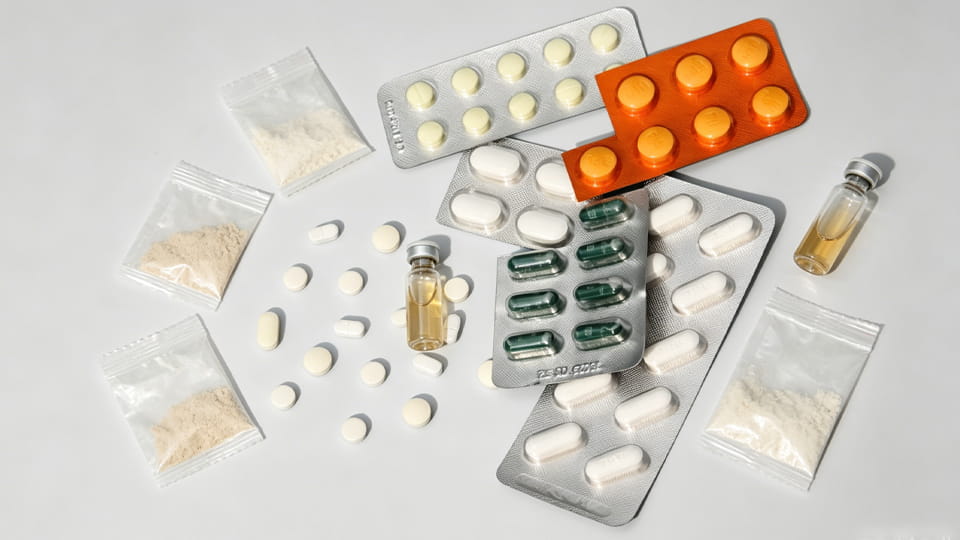
Advantages of Unit Dose Packaging


Advantages of Bulk Packaging

Bulk (multi-dose) packaging has its own strengths:

  • Lower Cost per Dose: Bulk containers use far less material per dose. For example, a single bottle with 100 tablets might use less plastic/foil overall than 100 individual blisters. This reduces material and packaging costs significantly. Bulk lines also use simpler machinery (counting/capping vs. blistering) which tends to be less expensive to buy and operate.
  • Faster Production Speed: Filling and capping machines for bottles or jars can achieve very high throughputs. For instance, an automated tablet-counting and bottling line can process tens of thousands of units per hour. (Jinlu’s capsule/tablet counter can fill about 100 bottles/hour with >99.98% accuracy.) In bulk mode, eliminating the molding and cutting steps of blister machines saves time, so lines usually run faster.
  • Simpler Supply Chain: Bulk-packed products are easier to label, carton, and ship, since they follow standard packaging formats. Warehousing and distribution often favor uniform bottles or cartons. There is also less inventory of different pack sizes to manage.
  • Lower Packaging Waste: From an environmental standpoint, bulk packs produce less waste per dose. One container for 100 doses means fewer wrappers and less non-recyclable material than 100 single-dose packs.
  • Best for OTC and Nutraceuticals: Vitamins, dietary supplements, cough syrup, and generic painkillers are typically sold in bulk. The consumer market expects large quantities at affordable prices. Bulk bottles and tubs meet this demand efficiently.
  • Consolidated Labeling/Information: All dosing information is on one label for the whole bottle, which is convenient for manufacturing and sometimes easier for patient use (if they only take that one drug).
  • High-Density Storage: Bulk containers are usually more compact per dose, allowing more product to be stored or shipped per pallet.

Bulk packaging shines in cost-efficiency and scale, making it ideal for high-volume products where the economy of scale outweighs the need for individual-dose control. In fact, Jinlu’s experience as a supplier shows that bulk bottle lines (including counting, capping, and labeling units) form the backbone of many nutraceutical and generic drug production lines.

Advantages of Bulk Packaging-tablets in bottle with cap


Which Industries Prefer Which?

Different end-markets and use-cases have clear preferences. The table below summarizes typical industry choices:

Industry/Use Case Preferred Packaging
Hospitals & Healthcare (acute care) Unit Dose (blisters, strips, syringes)
Long-Term Care & LTC Pharmacy Unit Dose (blister cards, pre-filled packs)
Clinical Trials & Research Unit Dose (precise dosage control for trials)
High-Potency / Controlled Substances Unit Dose (security, dosing)
Contract Manufacturing (CMOs producing hospital meds) Unit Dose
Over-the-Counter (OTC) Drugs Bulk (bottles/tubes of tablets, capsules)
Nutraceuticals & Supplements Bulk (vitamin bottles, sachets)
Generic Pharmaceuticals (mass market) Bulk (cost focus)
Emerging Consumer Health (cosmetics, nutraceutical combos) Bulk
Veterinary / Animal Health Bulk (often retail multi-dose vials or feed additives)
Emergency Kits / First Aid Unit Dose (single-use pouches for portability)

For example, Jinlu notes that unit-dose systems originated in hospitals and now “vastly expanded” into other fields due to safety advantages. Indeed, over 75% of U.S. hospital oral medications are unit-dosed, reflecting the sector’s preference. In contrast, consumer-facing markets like supplements and OTC pain relievers typically use bulk containers because they demand lower unit cost and higher volume. Clinical and hospital environments favor the dosing control of blisters or sachets, while generic-drug manufacturers and retailers focus on the efficiency of bottle lines.


Cost Comparison: Unit Dose vs Bulk Packaging

Choosing between unit-dose and bulk has significant cost implications. Consider the following cost factors:

  • Equipment (CAPEX): Unit-dose lines require specialized machines – blister formers, heat-sealers, stick packers, or prefilled-syringe assemblers – which are complex and capital-intensive. Bulk lines use counting/filling equipment (bottle fillers, cappers, labelers) that are generally simpler. For example, a high-speed blister line with forming station costs substantially more than a basic counting/capping line. Thus, the upfront equipment investment tends to be higher for unit-dose production.
  • Packaging Materials: Unit-dose packs often use more expensive or multi-layer films (e.g. alu-alu blisters) to protect each dose. The per-dose weight of foil/plastic can be higher. Bulk bottles use standard plastics or glass, which are lower cost on a per-dose basis. This can make material costs for unit packs several times those of bulk packs when amortized per tablet.
  • Labor and Operation (OPEX): Modern lines on both sides are highly automated. Unit-dose lines involve more changeovers (molds, dies) and QC checks per smaller batch, possibly increasing labor or downtime. Bulk lines run continuously longer with less frequent changeovers. However, automation (robotic pick-and-place, vision inspection) is common on both. Labor costs may be offset by output volume on each.
  • Packaging Throughput & Yield: Bulk lines typically yield more finished units per hour (since each machine cycle packs many pills into one bottle). Unit-dose lines have lower per-line throughput because each cavity/seal is a cycle. For example, Jinlu’s DPP-270Max blister machine can do ~11,200 blisters/hr, but an integrated counting/capping line can fill thousands of tablets into bottles in the same time.
  • Waste and Scrap: Unit-dose lines may generate more scrap (e.g. defective blisters or seals), which slightly raises costs. Bulk counting lines also have rejects, but discarding a few pills is lower-value waste. The $2 billion medication waste cited in long-term care highlights that waste is also a big cost in disposal on the receiving end – something unit-dose packaging helps reduce.
  • Logistics and Storage: Unit-dose products often occupy more volume (one tablet per pack), which can increase shipping costs per dose. Bulk bottles are space-efficient. Warehousing many blister packs can be less efficient unless very high volume is managed.
  • Regulatory/Compliance Costs: Unit-dose products usually require more extensive labeling (each unit pack has all details) and often serialization/barcoding at the dose level, which adds regulatory effort and cost. Bulk bottles require labeling on the main container only. However, ensuring compliance (e.g. DSCSA-compliant serialization) is simpler on unit-dose since it’s applied at each unit.
  • Total Cost of Ownership: Ultimately, while unit-dose involves higher unit costs, manufacturers may justify it for critical products (e.g. reducing medical errors or avoiding recalls). Bulk packaging minimizes per-unit cost, which is crucial for competitive pricing in consumer markets.

In summary, unit-dose packaging typically demands higher CAPEX and per-unit packaging cost, but can yield savings from fewer errors and waste. Bulk packaging offers lower material and production costs per dose. The “better” option depends on analyzing these costs alongside the product’s pricing strategy and compliance requirements.


Packaging Machines Used for Unit Dose Packaging

Unit-dose packaging lines use specialized equipment. Key machines include:
  • Blister Packing Machines: These thermoform or cold-form blisters automatically form cavities, fill them with one tablet each, heat-seal with foil, and cut sheets. For example, Jinlu’s DPP-180Pro runs up to 4,800 plates/hour for Alu-PVC or Alu-Alu blisters. The high-speed DPP-270Max can reach 11,200 blisters/hour. (See .) Blister machines often include feeders that orient tablets or capsules (vibratory or brush feeders).
  • Strip/Slide Packing Machines: Similar to blisters but sealing tablets between two layers of material. (Jinlu also supplies such machines; these are essentially narrow blister lines.)
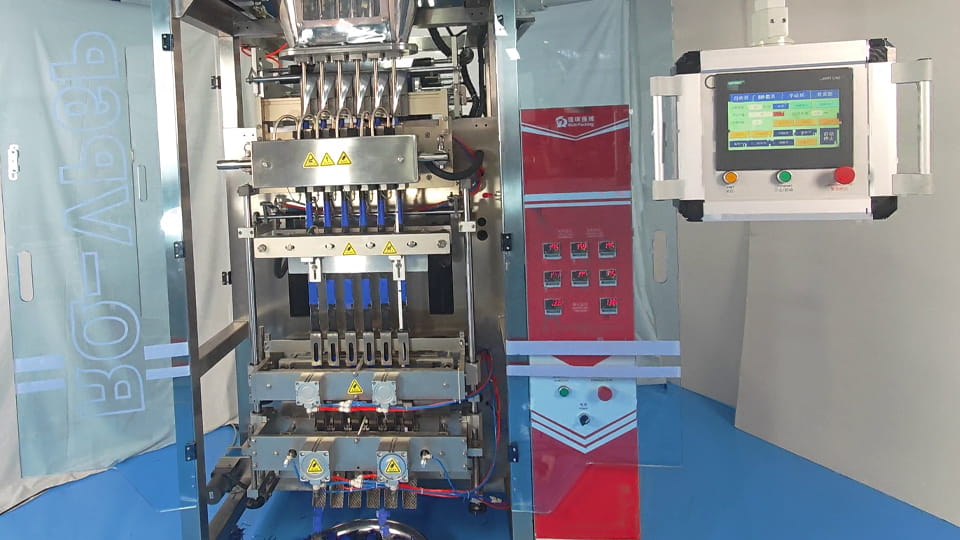
  • Stick/Sachet Packing Machines: Vertical form-fill-seal (VFFS) machines create stick packs or sachets. Jinlu’s multi-lane stick sachet packer (VP series) can pack powders, granules, or liquids into single-dose bags at 30–40 bags per lane per minute, with high accuracy (±0.02g). This machine has one-button sachet length adjustment and PLC controls for precision. (See .)
  • Premade Pouch Packaging Machines: For premade pouches (doypecks, ziplock bags) filled with one portion. Jinlu’s doypack filler handles capsules, powders, gummies, etc., at ~60 bags/min, and meets cGMP/FDA standards.
  • Cartoning Machines: After forming individual dose packs, many applications need boxing. Cartoners tuck single-dose blister cards, sachets, or vials into cartons. Jinlu’s cartoning machine can pack blister sheets, bottles, or sachets into cartons at up to 15,600 boxes/hour. This bridges the blister/sachet line to final cartons (and can link directly with blister machines).
  • Inspection & Serialization Equipment: Vision systems inspect each dose for defects. Roll-code printers or laser coders apply batch/expiry and serial numbers on each blister or pouch. While not unique to unit-dose, these ensure each pack carries required information.

Stick&Sachet Packing Machine for Unit Dose Packaging

In short, a unit-dose line might consist of a blister or sachet machine (for primary packaging), followed by a cartoner (and optionally labeler or printer). For example, a typical hospital drug line is: Tablet orientation feeder → Blister machine → Automatic cartoner → Case packer. Jinlu’s machinery for these steps can be linked in one flow (see  that “can be connected to blister machines”).

[jl_youtube src=”https://www.youtube.com/embed/k0uyYbGttCU”]


Packaging Machines Used for Bulk Packaging

Bulk lines use equipment optimized for speed and volume:

  • Automatic Counting / Bottling Machines: These are multi-head counters that fill bottles with tablets or capsules. Jinlu’s counting machine can fill bottles at up to 100 bottles/hour with accuracy >99.98% for tablets/capsules (and up to 80 bottles/min for gummies). The machine vibrates and counts the tablets into bottles via optical sensors.
  • Bottle Unscrambler: Feeds empty bottles upright into the line automatically. (Jinlu’s lines include an unscrambler as in the JL-16R gummy line.)
  • Desiccant Inserter: For moisture-sensitive products, automatically drops silica packs into bottles (as seen in) right after counting.
  • Capping Machine: Applies caps to bottles. High-speed spindles or pressure cappers put on tamper-evident caps.
  • Induction Sealer / Foil Liner: Adds foil seals on bottles (especially for OTC supplements). Jinlu’s lines include foil sealing stations.
  • Labeling Machine: Applies front and back labels. The JL-16R line, for example, has a labeller at the end.
  • Cartoning Machines: If bulk-packed products (bottles, vials) are put into cartons for secondary packaging, a cartoner like Jinlu’s (15,600 boxes/hr) is used.
  • Case Packer: Finally, cases or trays of cartons can be packed for palletizing.

In effect, a bulk packaging line typically looks like: Bottle unscrambler → Tablet counter filling machine → Desiccant inserter → Capper → (Foil sealer) → Labeler → Cartoner. These modular machines can also handle diverse products (gummies, powders, liquids) as long as counting/filling and capping are adjusted. Jinlu’s  and  pages illustrate how such lines are integrated.

For example, the JL-16R gummy line “automatically complete the entire process of unscramble bottles, counting … inserting desiccant, capping, aluminum foil sealing and labeling” at up to 80 bottles/min. These advanced lines emphasize throughput and consistency, making them ideal for bulk product packaging.
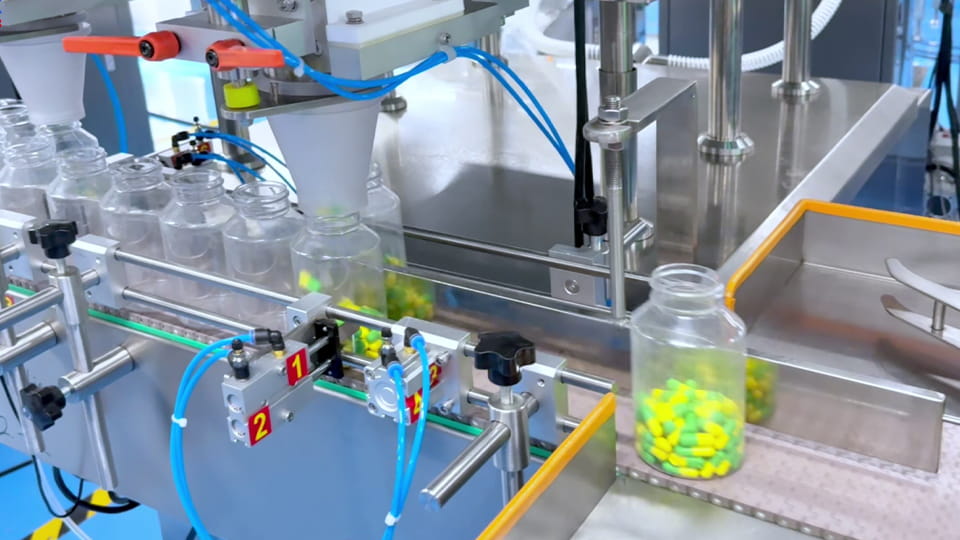
Counting&Bottling Machine for Bulk Packaging


How to Choose Between Unit Dose and Bulk Packaging

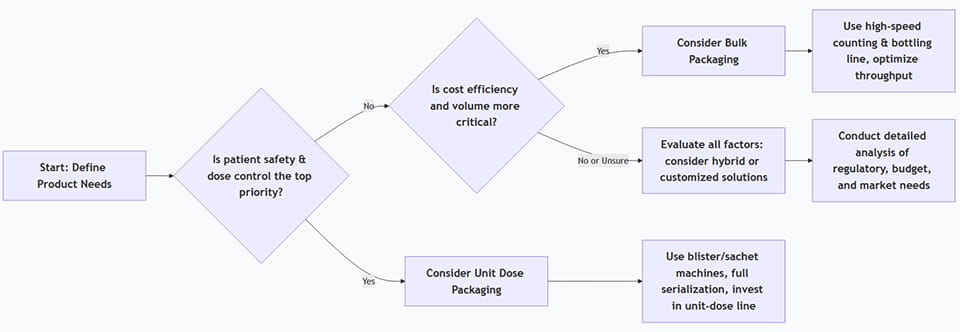
Choosing the right approach depends on multiple factors. Use the checklist and flowchart below as a guide:
Key Decision Factors

  • Product Type & Dose: High-potency, sterile, or multi-dose regimens often demand unit-dose. Common OTC tablets and vitamins typically use bulk.
  • Regulatory/Market Requirements: Hospital & clinical products usually require unit-dose for compliance. Retail drugs and supplements often allow bulk packaging.
  • Target Customer: Hospitals, nursing homes, or pharmacies favor unit-dose. Consumers and mass-market channels favor bulk for value.
  • Production Volume: Very high-volume products lean bulk to maximize efficiency and minimize cost. Specialized drugs with lower volume can bear unit-dose costs.
  • Cost vs. Safety Trade-off: If minimizing errors and waste (e.g. in hospital use) is paramount, unit-dose pays off. If cost-per-unit must be low, bulk likely wins.
  • Supply Chain: Consider storage space, shipping cost, and shelf life. Unit-dose packs may take more room but can cut lost inventory.
  • Technology & Infrastructure: Does your facility already have blister/sachet lines, or counting/capping lines? Investing in new line type is a big commitment.
  • Customization Needs: Some products benefit from unit-dose customization (e.g. patient-specific polypharmacy packs, calendar blisters).
  • Future Trends: Will drug serialization or patient-centric packaging be required? Unit-dose is inherently more adaptable to barcoding and personalized formats.

Decision Flowchart

Unit Dose VS Bulk Packaging Decision Flowchart

This chart shows a simplified guide: if medical safety/tracability outweighs cost, lean towards unit-dose. If budget and volume dominate, bulk is likely best. In real cases, mixed strategies (e.g. bulk bottle inside a serialized carton) can also be considered.


Conclusion

There is no one-size-fits-all answer. The choice between unit dose and bulk packaging depends on your product’s requirements and your business strategy. Unit-dose packaging offers unmatched safety, compliance, and convenience for hospitals, clinical trials, and high-value drugs, but it requires more investment in machinery (blister or sachet packers, cartoners) and packaging material. Bulk packaging (bottles, jars, tubes) excels at low cost and high throughput, ideal for retail drugs and supplements, but gives less control over individual dosing.

In practice, many companies use both methods for different products. For example, a drug with a narrow therapeutic index might be packed in single-dose blisters for hospital sale, while the same medication’s OTC version is sold in 30-count bottles. When designing your line, consider the total cost of ownership (equipment + materials + errors) and regulatory needs.

To determine the best approach, review the factors above: target market, dose form, volume, compliance rules, and budget. A packaging machinery expert (or Jinlu’s customization team) can design an appropriate line. For instance, Jinlu Packing provides turnkey solutions – from high-speed blister machines to integrated tablet-counting and bottling lines – to fit both unit-dose and bulk needs.


FAQs About Unit Dose and Bulk Packaging

What is the difference between unit dose packaging and bulk packaging?

Unit dose packaging means each medication dose is individually sealed and labeled, such as one tablet per blister cavity or one sachet per use. Bulk packaging stores multiple doses together in a bottle, container, or larger package. Unit dose packaging focuses more on safety, traceability, and dose control, while bulk packaging is usually more cost-efficient for high-volume production.

Which is better: unit dose packaging or bulk packaging?

There is no single answer for every pharmaceutical product. Unit dose packaging is often better for hospitals, clinical environments, and high-value medications because it improves medication safety and tracking. Bulk packaging is usually preferred for nutraceuticals, OTC products, and large-scale retail distribution because it reduces packaging cost and improves production speed.

Why do hospitals prefer unit dose packaging?

Hospitals commonly use unit dose packaging because each dose is clearly identified and protected until administration. This helps reduce medication errors, supports barcode scanning systems, and improves patient safety during dispensing.

Is bulk packaging cheaper than unit dose packaging?

Yes, in most cases bulk packaging has lower packaging material costs and higher line efficiency. Bottle filling lines and tablet counting systems can usually run at faster speeds than individual dose packaging systems. However, total cost should also consider medication waste, labor, compliance requirements, and product protection.

What pharmaceutical products are commonly packed in bulk packaging?

Bulk packaging is widely used for:
• Vitamins and supplements
• Generic tablets and capsules
• OTC medications
• Nutraceutical products
• High-volume retail pharmaceuticals
These products are often packed using counting machines, bottle filling lines, capping machines, and labeling systems.

What machines are used for unit dose packaging?

Common unit dose packaging equipment includes:
• Blister packing machines
• Strip packing machines
• Sachet packing machines
• Stick pack machines
• Cartoning machines
• Vision inspection systems
These pharmaceutical packaging machines help create individually sealed doses with better product protection and traceability.

Does unit dose packaging improve medication safety?

Yes. Unit dose packaging helps lower the risk of contamination, incorrect dosing, and handling mistakes because each dose remains sealed until use. Many healthcare facilities use unit dose systems to support safer dispensing workflows and barcode verification processes.

Is blister packaging considered unit dose packaging?

Yes. Pharmaceutical blister packaging is one of the most common forms of unit dose packaging. Each tablet or capsule is stored in a separate cavity, which helps protect the product from moisture, oxygen, and contamination while also improving dose tracking.

Which industries typically use bulk packaging?

Bulk packaging is commonly used in:
• Nutraceutical manufacturing
• Supplement production
• Retail pharmaceutical distribution
• Veterinary medicine
• High-output tablet and capsule production
Manufacturers choose bulk pharmaceutical packaging when production efficiency and lower packaging costs are the main priorities.

How do I choose between unit dose and bulk packaging for my pharmaceutical product?

The best choice depends on several factors, including:
• Product type
• Target market
• Regulatory requirements
• Packaging budget
• Production volume
• Shelf-life needs
• Distribution channels
For example, hospitals and clinical products often benefit from unit dose packaging, while retail supplements and high-volume generic drugs are usually more suitable for bulk packaging systems.


References:
1. CPG Sec 430.100 Unit Dose Labeling for Solid and Liquid Oral Dosage Forms —— U.S. Food and Drug Administration
2.Data Standards Manual (monographs) Package Type —— U.S. Food and Drug Administration
3.Drug packaging —— WikiPedia
4.Guidance on good manufacturing practice and good distribution practice: Questions and answers —— European Medicines Agency
5.ISO 15378 certification – Primary Packaging Material for Medicinal standard

Share this Article:
Picture of Petty Fu
Petty Fu

Petty Fu, Founder of Jinlupacking, brings over 30 years of expertise to the pharmaceutical machinery sector. Under his leadership, Jinlu has grown into a trusted supplier integrating design, production, and sales. Petty is passionate about sharing his deep industry knowledge to help clients navigate the complexities of pharma packaging, ensuring they receive not just equipment, but a true one-stop service partnership tailored to their production goals.

Table of Contents

Send Your Inquiry

Leave a Reply

Your email address will not be published. Required fields are marked *

Get A Free Quote

*We respect your confidentiality and all data is protected. Your personal data will only be used and processed for JL solution.