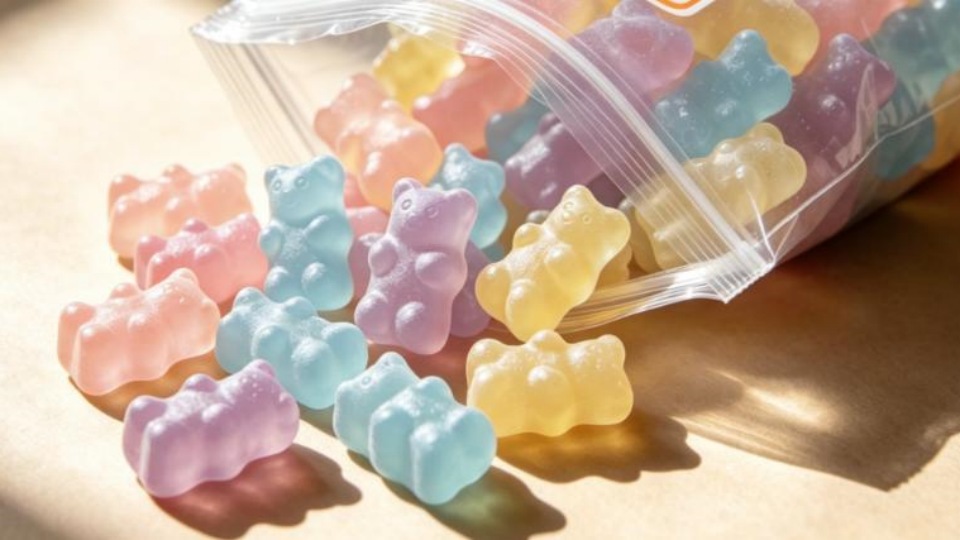

When packaging gummy vitamins or supplements, the big question is: should you fill bottles by piece count or by net weight? In practice, the answer depends on how you sell your product and on your gummy’s characteristics. If your label emphasizes the number of gummies (for example “60 Gummies per Bottle”), a counting machine may be best. If your label is based on weight (for example “Net Wt. 180 g”), a weigh-filler is an option. But many factors come into play – gummy size and shape, stickiness, line speed targets, product giveaway and even the cost of compliance – so it’s not always obvious which method wins.
This article cuts to the chase: it compares gummy piece-counting machines and weight-based fillers on accuracy, speed, cost (including product giveaway), and label requirements. By the end, you’ll know which method suits your gummy production line and labeling needs, or how to use both in tandem for best results.
Counting machines and weigh-fillers operate on very different principles:
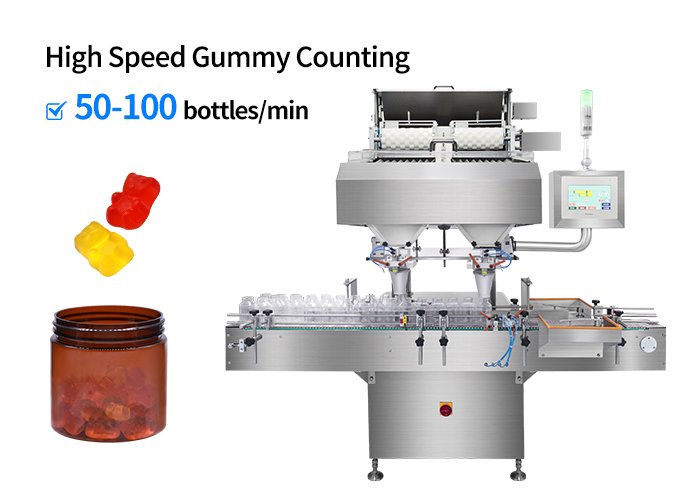
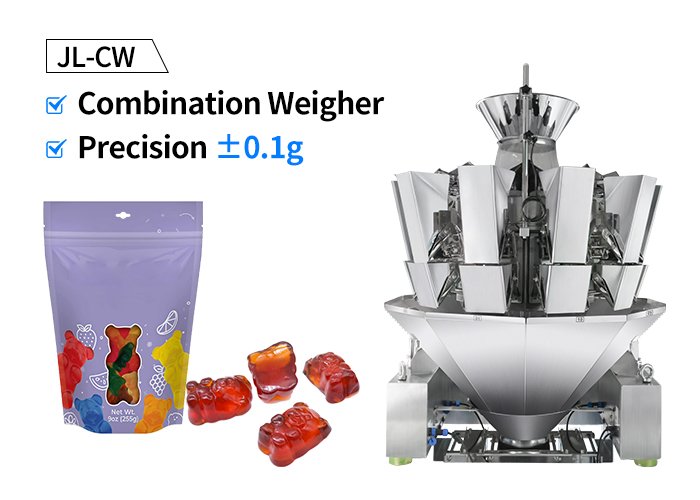
In short, a counting system is a piece-measurement approach (counting sensor→pieces), while a weigh-filler is a weight-measurement approach (scales→grams). In some lines, companies even combine both: a counting machine dispenses pieces into the bottle, followed by a checkweigher that verifies net weight. However, most operations use one primary control: either control by pieces or by weight.
Piece Counting Accuracy: Counting machines promise very high count accuracy for individual pieces. In ideal conditions, “optical counting — as opposed to weight-centric control — guarantees that the net contents in terms of count is 100% accurate”. Because each gummy is physically counted by a sensor, small variations in individual candy weight don’t affect the count. For example, if your label says “60 gummies,” a counting filler will deliver exactly 60 (±0 if designed correctly). Modern counters often claim >99.9% accuracy.
However, gummy candies pose challenges. Gummies are often soft, sticky and irregularly shaped. If two gummies stick together or overlap as they pass the sensor, the machine can miscount. Conventional tablet counters (designed for hard pills) can struggle: they may either miss a gummy stuck on top of another, or count a double-cluster as one. In practice, sticky or sugar-coated gummies can clump, leading to jams or occasional miscounts. Advanced gummy counters address this with anti-clumping designs – e.g. dispersion rollers, vibrating chutes and PTFE channels – to separate pieces. With those, Jinlu’s gummy counters can maintain ~99.97–99.98% count accuracy (for example, our JL-16R machine runs at 80 BPM with >99.98% accuracy). Still, any counting line should be verified with test runs on your actual product to catch potential error modes (doubled counts, misses, etc.).
Weight-Filler Accuracy: A weigh-based filler does not know piece count; it only knows total weight. Its accuracy is measured in weight units (grams). A good multihead weigher can consistently hit the target net weight within about ±0.5–1.0 g per bottle. For example, if you target 180 g net, the scale ensures at least 180 g, often overshooting slightly to ensure compliance. Because gummies often weigh a few grams each, a 1 g tolerance might correspond to roughly half of a small gummy. In other words, weight accuracy does not equal count accuracy. If your gummies vary 1–2 g apiece, the machine may include 59 pieces in one bottle and 61 in another to hit ~180 g.
A weight filler’s main “error sources” are product weight variation and filling system fluctuations:
Crucially, if your product is sold by count (e.g. “60 gummies”), a weight filler cannot guarantee exactly 60 pieces every time unless each piece is very uniform and the line is calibrated frequently. Mixing product count and weight methods often leads to “overcounts or undercounts”. If a few gummies are heavier, an under-count might slip through; if a few are lighter, the machine may add extra pieces to meet weight.
Key takeaways on accuracy: Counting machines give exact piece counts (avoiding giveaways) but must manage sticky clumps to avoid missing or double-counting gummies. Weigh-fillers give consistent net weight, but individual bottle counts will vary. In a weigh-fill operation, expect a deliberate slight overfill of product to meet regulatory net weight rules, whereas a counting system aims for zero underfill by pieces.
Counting Line Speed: The throughput of a counting machine is usually measured in bottles per minute (BPM) for a given count per bottle. Jinlu’s product line, for example, lists speeds up to 100 BPM for our 16-channel counter. In real terms, a 100 BPM machine filling 30 gummies per bottle would process 3000 gummies per minute. High-end counting lines often use multiple parallel channels or heads to increase output. For instance, Modern gummy counters can “process thousands of gummies each minute”. Actual speed depends on bottle size, count per bottle, and how quickly candies can move through the feeder. Sticky candies may require slower speeds or more gentle handling to avoid jams.
Weigh-Filler Speed: Multihead weighers are designed for high-throughput packaging. By using multiple weighing hoppers, the system can calculate and release product combinations that closely match the preset target weight. This allows it to handle continuous filling operations efficiently. However, actual output depends on several factors, including the target fill weight, gummy size and density, product flow characteristics, hopper configuration, and the speed of the downstream packaging equipment. Larger fills or sticky, irregularly shaped gummies may require longer feeding and discharge cycles, which can reduce overall throughput. Therefore, the most meaningful way to compare weighing and counting systems is to evaluate their actual finished-bottle output under the same product and packaging conditions. A properly configured weigh-filling line can achieve high production speeds, but whether it outperforms a counting line depends on the specific application and should be confirmed through product trials.
Other factors affecting speed for both systems include:
Speed summary: Multihead weighers can achieve high throughput in suitable applications, particularly for free-flowing products and pouch packaging. However, actual gummy packaging speed depends on product characteristics, target fill weight, equipment configuration, and downstream line capacity. A direct comparison should use actual packages per minute under equivalent production conditions. Counting lines like Jinlu’s can reliably do up to about 100 BPM with precise control. In practice, aim to match the line speed to your bottle size and daily output needs: for ultra-high volumes, weigh-fillers (or counting lines with many lanes) shine; for moderate outputs, counting machines are quite competitive.
In cost terms, the trade-off is between equipment investment (and related operating cost) and product giveaway (or yield loss).
Even a small overfill percentage becomes significant at multi-million bottle volumes.
Cost summary: If minimizing product giveaway is crucial (especially for high-value gummies), a counting machine has the edge. If capital budget is tight and a small giveaway is acceptable, weigh-fillers may win. Always run the numbers on your volumes and product cost. A rough check: a 1% overfill on 10 million gummies per year at $0.05/gummy is $5,000/year lost. At 100 million gummies, that’s $50,000/year. In contrast, the equipment cost difference is usually a one-time expense. In many cases, the counting solution can pay back the slightly higher machine cost in saved gummy value within a year.
A key decision is how your product is declared on the package. The label rules in most markets allow net quantity to be expressed in several ways: by weight (g or lbs), by volume (fl oz, ml), by measure (e.g. teaspoons), or by count. Some products even use a combination (e.g. “60 gummies; Net Wt. 180 g”). For dietary supplements in the U.S., for example, you commonly see either a count declaration (“60 Gummies”) or a net weight with number (“Net Wt. 180 g (60 Gummies)”).
Key point: The format of your label drives your primary control method. U.S. FDA labeling guidance explicitly allows net content to be shown as count or weight (or both). There is no regulation that forces you to weigh-fill for a weight label (or vice versa). But you must meet whichever claim you print. If you label by count, aim for a true count system. If by weight, a weigher is logical. In all cases, include appropriate tolerances: e.g., FDA allows a small underfill tolerance (the “tolerable error”) which in practice means targets are set above claim.
Summing up labeling: Choose your filling strategy to match how you will declare net quantity. Do not assume weigh-filling automatically means weight-label, or that count-filling automatically means count-label – labeling choice is independent of machine choice, but they must align. Use count for count-label, weight for weight-label; use checkweighers as needed for double-check. Always verify with your regulatory advisor for local market rules.
To decide, consider these common scenarios:
In many cases, the best answer is not absolute: you might use both. For example, use a counting machine to dose the target number, then run the filled bottles over a checkweigher as a safety net. Or use a weigh-filler for bulk packaging (pouches), and a counter for premium bottles. The point is, match the filling control to your key requirement: count accuracy or weight accuracy.
In practice, here’s a quick checklist when evaluating counting vs. weigh-fillers for your gummies:
By following these steps, you’ll make an informed choice. Don’t just compare equipment specs; compare the outcome: accuracy and profit impact.
There is no one-size-fits-all best answer. The right method depends on your label format, gummy characteristics, and production goals. If your gummies are sold by count or are uniform and you want to minimize giveaway, a dedicated gummy counting machine (with anti-clump features) will deliver precise counts and fast ROI. If your label focuses on net weight or your gummy fill is very heavy or variable, a weight-based filling system may be simpler and faster (with the trade-off of a small regular giveaway). Many high-volume manufacturers actually use both methods in tandem: a counting dispenser plus weight check (or vice versa) to get the best of both.
Whichever path you choose, remember: test with your actual product and measure the results. Every gummy recipe behaves differently. We recommend running pilot batches with both systems if possible. Doing so will show if count errors or weight variances occur, and how much extra product is used. Armed with that data, you can confidently select (or design) the filler that matches your brand promise and budget.
Next steps: If you’re ready to explore automated gummy filling, contact the experts at Jinlu Packing. Provide your gummy samples, target count or weight, and bottle size, and ask for an on-site or lab trial. Jinlu offers a range of gummy counting machines and complete bottling lines. Our specialists can help you compare a GMP-grade automatic counter versus a weigh-filler setup, and calculate the true cost per bottle for your product. Don’t hesitate to get a quote or arrange a demo.
Give your gummy production the right boost – choose the filling method that fits your product, not the other way around.
Counting machines dispense a preset number of gummies into each container. Weigh-filling machines dispense gummies until they reach a target weight, so the number of pieces may vary.
Counting is designed to control the number of gummies per container, while weighing controls the net fill weight. The better option depends on the product specification and the accuracy requirement.
Yes, some gummy counting machines are designed to handle sticky products. Suitable feeding tracks, anti-clumping features, and product-specific testing help improve counting stability.
Speed varies by machine model, gummy size, product flow, and bottle configuration. Ask the supplier to test your gummies and confirm the actual bottles-per-minute rate for your required format.
It can help reduce overfilling by controlling the target net weight. Actual savings depend on the product’s weight variation, machine settings, and the fill-weight limits used in production.
A counting machine may be more economical when each bottle needs a fixed number of gummies. Weigh-filling may be worth the investment when net-weight control and reduced giveaway are the main priorities.
No. A weigh-filling machine controls weight rather than piece count. If each bottle must contain an exact number of gummies, use a counting system or add a separate count-verification step.
The correct declaration depends on the product category and destination market. In the United States, FDA guidance for dietary supplements allows net quantity to be expressed by weight, measure, numerical count, or a combination, subject to applicable requirements.
Potentially, but performance depends on the machine design and the characteristics of each product. Test different sizes and coatings—including sugar-coated and oil-coated gummies—and confirm changeover, cleaning, and counting performance before purchase.
Test actual production gummies at the required speed. Check fill accuracy, product damage, clumping, giveaway, changeover time, cleaning needs, and performance over multiple batches.
References:
1.Dietary Supplement Labeling Guide: Chapter III. Net Quantity of Contents —— FDA
2.Handbook 133 Checking the Net Contents of Packaged Goods. —— NIST
3.Prepacked products in the EU —— European Commission
4.Packaged goods: weights and measures regulations —— UK Government
5.Quantity of Product in Prepackages —— OIML R 87:2016