
Have you ever encountered this question when choosing packaging—3 side seal vs four side seal sachet, which is better?
This is a professional and detailed question. Although most consumers probably don’t pay much attention to these two types of packaging, it matters to health supplement and pharmaceutical manufacturers. However, when choosing the packaging format, many manufacturers encounter this question: if both can ensure complete sealing, what role does the extra seal play in health supplement sachet packaging?
That is exactly what this article aims to solve. We will guide you through a deep understanding of three-side seal sachets and four-side seal sachets, and provide insights for your production line packaging selection based on a comparison from a manufacturer’s perspective.
Key Takeaways
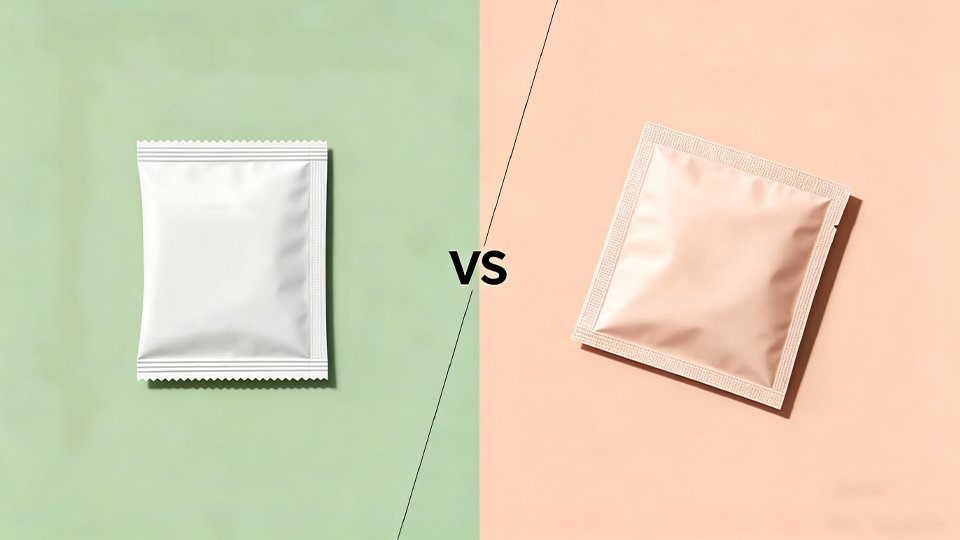
Just like tailoring a dress requires taking measurements, to make a decision on the package style, you’d better off understanding 3 sided seal pouch and 4 side seal pouch.
Key Features:

A 4 side seal sachet has all four sides sealed independently, completely enclosing the contents in the middle. The overall shape is more square and flat. The appearance is also more refined, and it is often used for products with high requirements for display effect and sealing integrity in pharmaceutical sachet packaging.
Key Features:
Now that we have a basic understanding of bag structure, let’s move on to the next step and conduct a comprehensive comparison of the two bag types from the aspects that manufacturers care about most.
Table 1-A comprehensive Difference between 3 Sided Seal Sachet and 4 Sided Seal Sachet
| Comparison Metric | 3 Sided Seal Sachet | 4 Side Seal Sachet |
| Material Efficiency | High | Moderate (more trim waste) |
| Barrier Protection | Good | Excellent |
| Production Speed | Extremely Fast | Fast to Moderate |
| Visual Appeal | simple, lightweight | Flat, rigid, premium |
In terms of material efficiency, 3 side sealed pouch is more advantageous for producing high-volume, common health products such as vitamin candies. This makes it a staple in everyday health supplement sachet packaging. Due to the massive production volume, even a one-cent saving in film material per bag can result in significant annual savings.
However, for products with high costs and stringent sealing requirements, 4 side seal sachet is the preferred choice. “While three side seal bag dominates the high-speed food industry, the pharmaceutical industry’s transition to active biological products demands the superior sealing performance for four side flat pouch market,” said Dr. Gerald Rostwa, a senior packaging compliance auditor.
Use 3 Side Seal Bag When:
This format helps reduce film waste and boost your sealing speed.
Use 4 Side Seal Sachet When:
The full sealing of the 4 sided seal sachet can shelter the materials from the exterior moisture.
This format endow the product with exquisite appearance which allows for brand presentation.
Although we understand the difference between three-side sealing and four-side sealing, when this issue is applied to the specific scenario of production, you’ll find it’s far more complex than you imagined. Determining the sealing method is only the first step; what truly matters in production is the ultimate automatic packaging solution that performs the sealing and packaging function, that is, the sachet filling and sealing machine.
Choosing the right sachet packing machine for your specific liquid sachet packaging or powder sachet packaging needs is critical. To truly understand how to optimize production with vertical form fill seal sachet packing machine, one must understand this continuous workflow:
When you make up your mind on the packaging format and are evaluating an industrial sachet packaging solution from a reputable sachet packing machine manufacturer, you need to take factors like operation, maintenance, precision into consideration. The following are some of the major issues that your machine need to tackle.
Traditional button-based machines often require operators to manually adjust sealing temperature, bag length, filling speed, and cutting position one by one.
This not only increases the learning curve for new operators, but also makes recipe changeovers slow and prone to human error, especially on a strict 4 side seal sachet packaging line.
Another common concern is maintenance complexity.
On some conventional machines, the auger structure, feeding tube, or sealing assembly requires multiple components to be removed before cleaning. So the time for maintenance or changeover may probably be more than two hours.
This is especially troublesome for pharmaceutical sachet packaging manufacturers that require frequent cleaning and product changeovers.
Film tracking drift is another major production headache in high-speed sachet lines.
When the film runs off-center, common problems include: wrinkled sachets, off-center cutting, printing registration errors, and even the machine shutdown.
These issues are usually caused by unstable film tension or roller misalignment.
Overcoming these complex, daily operational hurdles requires far more than just a high-quality equipment, what matters most is a reliable sachet packing machine manufacturer. Operating under rigorous 6S workshop management protocols and proudly boasting comprehensive ISO, CE, and cGMP certifications, Jinlu Packing is dedicated to provide both automatic packaging solution and considerate after-sales service.
We understand that the debate over the 3 side seal vs 4 side seal pouch is only half the battle; successfully producing them flawlessly at scale is our exact area of expertise. Here is how our engineered solutions directly neutralize the common challenges mentioned above:
Considerate and Precision Machine Design
End-to-End Service:
Beyond providing exceptional hardware, Jinlu Packing is deeply committed to ensuring your line never stops running with:
The choice between 3 side seal sachet and 4 side seal sachet ultimately depends on production costs, production scale, and brand positioning. During the production stage, a good stick sachet packing machine is fundamental, while a thoughtful and trustworthy sachet packing machine manufacturer is even more valuable. If you are looking for a VFFS machine or industrial sachet packaging solution with complete after-sales service, please feel free to contact Jinlu Packing.
In terms of the structure, 4 side seal sachet means one more sealed side. When it comes to the production, their difference relates to speed, appearance, and cost.
3 side seal sachet is more cost-effective and provides faster speed, while 4 side seal sachet offers more sleek appearance and is ideal for high-end products manufacturing.
These pouches are absolutely fantastic for high-volume products including everyday granular or powder supplements.
If your products are expensive, and requires watertight sealing, then this format perfectly fits your needs.
Another case is that you’re building a high-end brand where premium look is preferred.
It depends on your machine design. In short, a versatile multi-lane sachet packing machine can often handle both, while dedicated models may only support one type.
References
[1] MarketsandMarkets: Flexible Packaging Market Global Forecast to 2027.
[2] PMMI (The Association for Packaging and Processing Technologies): State of the Industry Report – Packaging Machinery.
[3] World Health Organization (WHO): Guidelines on packaging for pharmaceutical products.