Controlled Release vs. Sustained Release vs. การขยายเวลาปล่อย: ความแตกต่างคืออะไร?
Controlled Release vs. Sustained Release vs. การขยายเวลาปล่อย: ความแตกต่างคืออะไร?
พฤศจิกายน 4, 2026
ไม่มีความคิดเห็น
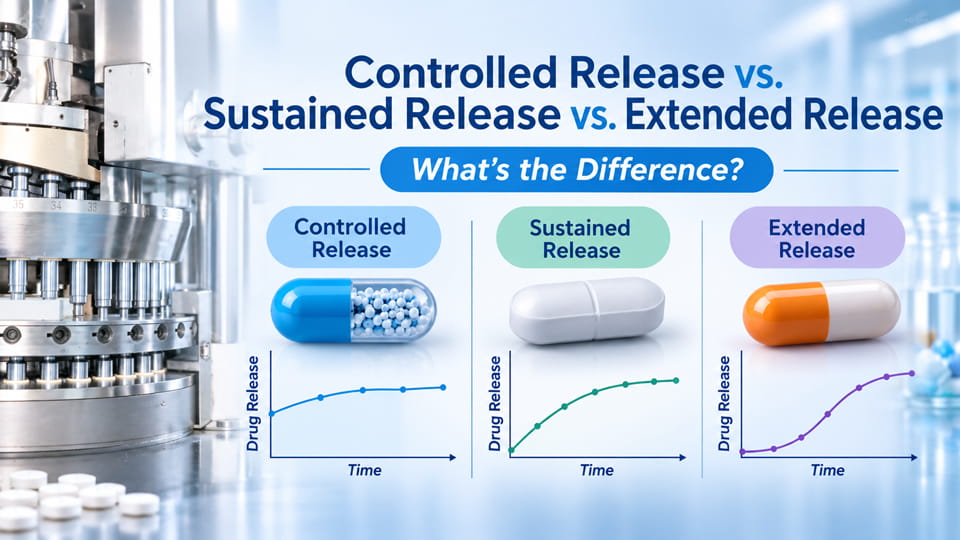
Controlled-, sustained-, and extended-release are all types ofmodified-release drug formulationsthat make a pill last longer in the body instead of releasing the dose all at once. ในแง่ง่ายๆ, ควบคุมการปล่อย (CR)means the pill is engineered todispense medication at a predetermined rate (think of a dimmer switch vs. a light switch), ในทางตรงกันข้าม การปล่อยอย่างต่อเนื่อง (เอสอาร์)generally means the tabletslows downthe drug release to extend its effect. Extended release (เป็น)is the term you see on labels (often abbreviated XR or XL) that indicates a slower-release form allowingปริมาณน้อยลงต่อวัน. ในทางปฏิบัติ, all three aim to prolong drug action, but with a few important distinctions. ตัวอย่างเช่น, CR formulations use membranes or matrices toprecisely regulaterelease and smooth out blood levels, SR formulations simply stretch out the release to reduce dosing frequency, and ER is the FDA-recognized category for any formulation shown to cut dosing intervals in half. In the paragraphs below, we’ll break down each term, highlight their differences, and explain why it matters for pharmaceutical manufacturing (and how high-quality packaging machines play a role).
In controlled-release tablets, polymer coatings and special matrices can be applied so that the drug comes out steadily over many hours, not all at once. This tablet “timer” effect means patients take pills less often and experience more stable drug levels. ในทางตรงกันข้าม, sustained-release tablets also slow release but don’t tightly control the exact rate – they simply extend the duration of action, which stillboosts adherencefor chronic therapy. Extended-release is the broad label for these approaches, indicating that the formulation is proven to allow fewer daily doses (at least twice the dosing interval of immediate-release).
โดยสรุป, CR isall about precision (tightly controlling drug release profiles), SR isall about longevity (just slowing the release to last longer), and ER is theregulatory labelfor dosage forms that achieve extended dosing schedules. All are “modified-release” strategies, and each has practical implications for how the pill is formulated, ผลิต, and used. Below we’ll dig into what each one means in more detail, with examples and considerations.
What Is a Modified-Release Formulation?
Modified-release (นาย) formulations encompass all tablets or capsules engineered to change the release profile of the drug. Unlikeปล่อยทันที (และ)products that dissolve quickly (often all at once), MR dosage formsdelay หรือ extenddrug release through time or location. ตัวอย่างได้แก่ แท็บเล็ตเคลือบ (which delay release until reaching the intestine), matrix tablets, and anyยั่งยืน, ขยาย, หรือ ควบคุมrelease forms.
Why use MR formulations? There are several advantages:
ปรับปรุงการปฏิบัติตามข้อกำหนด.By extending release, patients take medication less often. A once-daily pill is easier to remember than multiple IR doses.
Steadier blood levels.MR forms aim to avoid the peaks and troughs of IR dosing. Controlled plasma levels can reduce side effects and improve efficacy.
Targeted action.Some MR systems protect the drug until it reaches the right location in the GI tract. ตัวอย่างเช่น, เคลือบลำไส้postpone release until after the stomach.
Stable effect for chronic therapy.Long-acting forms are ideal for chronic illnesses (โรคเบาหวาน, ความดันโลหิตสูง, pain management) where constant drug levels are desirable.
โดยทั่วไป, formulating a modified-release tablet or capsule involves careful selection ofสารเพิ่มปริมาณ (โพลีเมอร์, เมทริกซ์, การเคลือบ) and multiple processing steps (ดูด้านล่าง) to meet these goals.
การควบคุมการปล่อย (CR) สูตร
Controlled-release (CR)describes a drug delivery approach in which the formulation is engineered to regulate the rate and pattern of drug release according to a predefined kinetic profile. The release behavior is determined by the formulation design and its underlying mechanisms, such as diffusion through a polymer matrix or membrane, polymer swelling, erosion, or osmotic control. Depending on the system, drug release may follow different kinetic patterns, including zero-order, first-order, or diffusion-related profiles.
A key objective is to achieve a more predictable release pattern over a specified period, helping maintain drug concentrations within the desired therapeutic range when the formulation is appropriately designed and clinically evaluated. อย่างไรก็ตาม, controlled release does not necessarily mean constant-rate release or perfectly steady blood concentrations. Zero-order kinetics, in which the drug is released at an approximately constant rate, is one possible design objective rather than a universal characteristic of all CR formulations.
Key points about CR systems:
Precision release profile.CR tablets or pumps are designed so the release rate does not depend on drug concentration. They often use specialized technologies (E.G. ปั๊มออสโมติก) to achieve constant release.
A classic example is the ConcertaⓇ methylphenidate tablet (osmotic pump delivering ADHD medication over 12 ชั่วโมง). Many CR forms are “matrix” tablets or coated beads, but others use push-pull osmotic designs.
The terms “controlled-release” and “extended-release” are sometimes used interchangeably in marketing. อย่างไรก็ตาม, ขยายออก (เป็น) is the broader category; all CR products are ER, but not all ER are CR.
How Do Controlled-Release Systems Work?
Controlled-release systems rely on one or more mechanisms to regulate drug diffusion or dissolution:
Polymer matrices (diffusion-controlled).A common CR approach is to embed drug particles in a polymer matrix (often hydrophilic polymers like HPMC, ไฮดรอกซีโพรพิลเมทิลเซลลูโลส). When the tablet contacts gastrointestinal fluids, the polymer hydrates and forms a gel. The drug then diffuses slowly through this gel layer or is released as the matrix erodes. By adjusting polymer type, ความหนืด, and tablet porosity, formulators can tailor the release rate. ตัวอย่างเช่น, hydrophilic HPMC tablets swell to form a controlled-release matrix.
Coated pellets or tablets (reservoir systems).Another CR design coats a drug core with a release-controlling membrane (E.G. ethyl cellulose or acrylic polymer film). Drug slowly dissolves through microscopic pores in the coating, allowing a steady output. Even multi-particulate systems can be made by coating thousands of tiny beads or granules with the same polymer layer. The overall effect is a sustained, controlled diffusion of drug.
Osmotic pumps (zero-order release).Osmotic systems (such as push-pull pumps) achieve very precise release. These tablets have a semi-permeable membrane surrounding an inner core. Water is drawn in osmotically, pushing the drug out through a laser-drilled orifice at a nearly constant rate. The classic Push-Pull Osmotic Pump (PPOP) uses two layers – a drug “pull” layer and an osmotic “push” layer – inside a rigid coating. The constant pressure yields almost zero-order release, ideal for 24-hour delivery.
Ion-exchange resins.Some CR products bind the drug to an insoluble resin. When the tablet disintegrates, the drug is released in exchange for ions in the GI fluids. This mechanism (E.G. used in some ADHD medications) further helps regulate release.
ในทางปฏิบัติ, many controlled-release tablets useหลายรายการmechanisms together (matrix plus coatings, ฯลฯ) to fine-tune the profile. No matter the technology, the aim is the same: a predictable, sustained drug output.
การปล่อยอย่างต่อเนื่อง (เอสอาร์) สูตร
Sustained-release (เอสอาร์)products also extend the duration of drug release, แต่เน้นต่างกันเล็กน้อย. The primary goal of an SR formulation is tomaintain therapeutic levels over an extended time, reducing dosing frequency. Unlike the strict definition of CR, SR systems may allow the release rate to decline over time (often first-order kinetics), as long as the drug effect is prolonged.
Key aspects of SR forms:
Broad goal.SR tablets or capsules may simply mean “release over time” rather than “precisely controlled rate.” For many SR products, the release profile is slower than IR but doesn’t attempt perfect zero-order. It’s still effective at keeping drug levels higher than IR for longer.
Common approach.SR is often achieved via hydrophilic matrix tablets or coated multiparticulates. ตัวอย่างเช่น, a high-dose drug might be mixed into a hydrogel matrix. As the gel slowly erodes, drug diffuses out. Over 8–12 hours, the effect is sustained even if the release rate gradually tapers.
Synonymity with ER.ในทางปฏิบัติ, “sustained release” and “extended release” are treated as synonyms by many companies. Industry sources note that “sustained-release medications, also known as extended-release medications, are designed to provide a constant drug concentration over prolonged periods”.
How Do Sustained-Release Systems Work?
Sustained-release formulations use similar principles to CR but often with simpler designs:
Hydrophilic matrix tablets.One of the most common SR methods. The active drug is uniformly mixed with a hydrophilic polymer (HPMC, polyethylene oxide, ฯลฯ) and compressed. Upon ingestion, fluids penetrate and swell the polymer, forming a gel barrier. The drug then diffuses slowly out of this gel. As time goes on, the gel slowly dissolves or erodes, prolonging release. Manufacturers can adjust polymer grade and amount to set the desired release duration.
Coated multiparticulates.An SR capsule might be filled with coated beads or pellets. Each bead has a different polymer layer thickness, causing staggered release. Some SR beads use microencapsulation (drug core coated with polymer). This multiparticulate approach can be more robust (less risk of “dose dumping” if a tablet breaks).
Waxes and insoluble matrices.In some SR tablets, lipid or wax matrices (like glyceryl behenate) embed the drug. As GI fluids slowly dissolve the wax, drug is released. This is more of a diffusion-controlled erosion approach.
Delayed plus extended systems.Some sustained-release forms combine delayed release with prolonged action. ตัวอย่างเช่น, a capsule might have one immediate-release layer and a second coated layer that dissolves later. But these are often categorized as “extended release” in marketing.
ในที่สุด, sustained-release products share the same benefit: longer time between doses. SR formulations allow for prolonged periods between daily doses while maintaining a constant drug concentration in plasma, ปรับปรุงการปฏิบัติตามกฎระเบียบ. While true zero-order release isn’t required, SR designs still aim to prevent the sharp peaks of IR forms.
การขยายเวลาปล่อย (เป็น) สูตร
ขยายออก (เป็น)is the umbrella term for any formulation that extends drug release beyond that of an immediate-release product. In many pharmacopeia and regulatory contexts, “extended release” is the preferred term for all modified-release systems. ตัวอย่างเช่น, สหรัฐอเมริกา. FDA and USP often use ER in labeling. มีผลบังคับใช้, ER encompasses both CR and SR formulations.
Important points about ER:
General definition.ER simply means the drug is released over a longer time than an IR form. It does not specify how (E.G. controlled vs. variable rate). ER tablets slowly release drug over an extended period, and the terms CR, เอสอาร์, ฯลฯ. fall under this category.
นอกจาก ขยายออก, other phrases likeprolonged-release, ปล่อยอย่างยั่งยืน, และ long-actingare often used in product names. ตัวอย่างเช่น, marketing names might include “XR,” “XL,” “CR,” or “SR” suffixes, but all imply an extended action.
Regulatory stance.In official drug monographs, USP typically uses “extended-release” as the category name. Other labels (CR, เอสอาร์) are considered non-specific terms. เป็นผลให้, sometimes a manufacturer may market a tablet as “extended-release” on the label, even if the commercial name includes “CR” or “SR.”
ER dosage forms aim for a defined duration (E.G. 12 หรือ 24 ชั่วโมง). อย่างไรก็ตาม, the release profile could still be first-order (a gradually declining rate) or pseudo-zero-order depending on the design. The key is that the drug effect is prolonged.
How Do Extended-Release Systems Work?
Since ER is a broad term, the mechanisms can be identical to those listed for CR and SR. Common ER technologies include:
Matrix and reservoir systems.Any CR or SR matrix or coating technique yields an ER tablet. เช่น, a matrix tablet described earlier for SR would also be an ER tablet.
Osmotic tablets.Many ER forms are actually osmotic pump tablets that deliver drug steadily for 24 ชั่วโมง. Though often called “CR,” they fall under ER by definition.
Multiparticulate ER.ER capsules may contain beads with graduated release rates (some immediate, some delayed) to cover the full interval.
One way to view it: All CR forms are a type of ER form, but not all ER forms control release rate. ขยายออก (เป็น) is the broad term for a medication that prolongs the release of its API, while controlled-release (CR) is a more specific type of ER that delivers the drug at a constant, predetermined rate. ในทางปฏิบัติ, this means a marketing “extended-release tablet” could have a gently sloping release profile, whereas a “controlled-release tablet” implies more precision.
Examples of ER Dosage Forms
ER tablets and capsules.Most common. These may be matrix tablets (E.G. Metformin XR), coated beads (E.G. venlafaxine XR capsules), or osmotic pump tablets (E.G. certain calcium channel blockers).
แพทช์ผิวหนัง.Nicotine and hormone patches release drug over many hours and are considered ER systems.
Implants and depots.Though not oral, things like hormone implants or injectable depot formulations (E.G. leuprolide depot) are extended-release systems by the same principle.
Oral strips or suspensions.Some novel forms (E.G. extended-release suspension beads) also exist.
ความแตกต่างที่สำคัญ: CR vs. SR vs. เป็น
It may be easiest to summarize the terms side by side:
การควบคุมการปล่อย (CR):Formulations explicitly designed for a predetermined release rate, often aiming for constant (zero-order) kinetics. Provides the most uniform plasma levels. ตัวอย่าง: osmotic pump tablets, some coated matrix tablets.
การปล่อยอย่างต่อเนื่อง (เอสอาร์):General term for formulations that release drug over an extended time. The release rate often tapers off (first-order), but overall duration is lengthened. ตัวอย่าง: hydrophilic matrix tablets, coated beads, wax matrix systems.
การขยายเวลาปล่อย (เป็น):Broad regulatory/marketing term for any dosage form that extends drug release beyond IR. It covers both CR and SR. An ER tablet might not be as tightly controlled as a CR product.
In table form:
คุณสมบัติ
การควบคุมการปล่อย (CR)
การปล่อยอย่างต่อเนื่อง (เอสอาร์)
การขยายเวลาปล่อย (เป็น)
เป้าหมายหลัก
Precisely maintain a set rate
Prolong drug effect over time
Prolong effect vs immediate-release
โปรไฟล์การเผยแพร่
Ideally constant (zero-order)
Usually first-order (declining rate)
Usually extended (zero- or first-order)
Level of Control
High – engineered kinetics
Moderate – drug stays longer, rate may vary
Variable – just slower than IR
Dosing Frequency
Typically once daily (depends)
Less frequent than IR
Less frequent than IR
ตัวอย่าง
Osmotic pump tablets (E.G. Concerta), some CR matrix tablets
Matrix tablets like Theophylline SR, coated capsule beads
Many ER tablets/capsules (E.G. Metformin XR, Wellbutrin XL)
Terminology Notes
Usually labelled “CR” if claimed
Often labelled “SR” (or “XR”, “XL”)
Often labelled “XR/XL” or just “ER”
ตามที่ระบุไว้ข้างต้น, the categories overlap greatly. All three share the outcome of reduced dosing frequency and extended action. ในทางปฏิบัติ, the exact difference matters most for pharmacokinetics specialists rather than patients or marketers.
Understanding Drug Release Profiles and Release Kinetics
To visualize these concepts, consider an idealizeddrug release profileover time (time vs cumulative percent released).
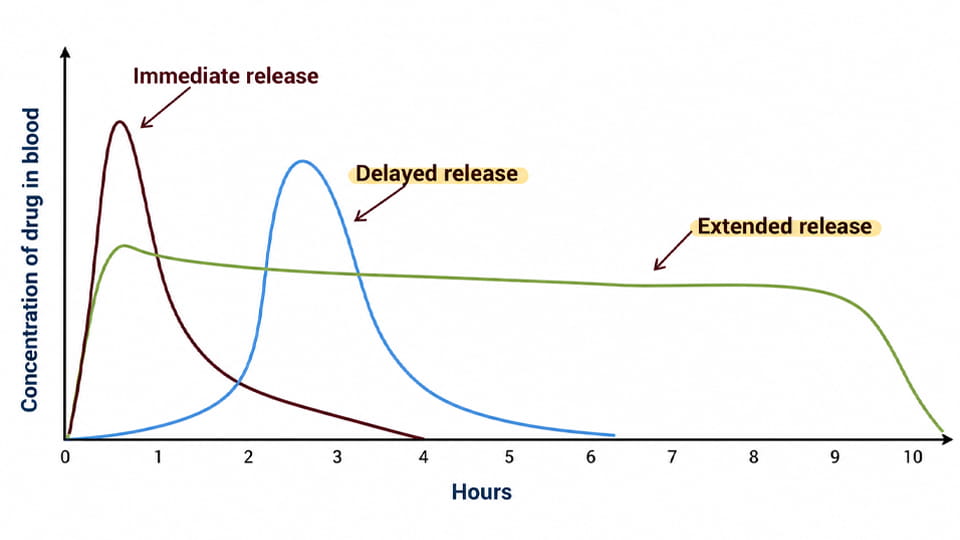
หนึ่ง ปล่อยทันที (และ)tablet typically shows a steep curve: 80–90% of the drug may release in the first 1–2 hours.
ก ปล่อยอย่างยั่งยืน (เอสอาร์)profile is more gradual: it might release steadily so that the curve levels off over 8–12 hours, but it often starts faster and slows down (a concave curve).
ก controlled-release (CR)profile aims to be linear (straight line), indicating a constant rate.
กล่าวอีกนัยหนึ่ง, CR = flat plateau of release rate; SR = gently decelerating release; IR = sharp spike. (ในความเป็นจริง, few products achieve perfect zero-order.) The key takeaway is that MR forms give broader, flatter profiles, resulting in longer drug exposure compared to IR. These profiles are confirmed viadissolution testingduring development and quality control. If you were to draw hypothetical curves, you would see IR reaching its peak and almost finishing early, while SR/ER/CR curves stretch far to the right.
Modified-release systems can be made in various dosage formats:
By far the most common. MR tablets can be matrix tablets or coated tablets (multiple layers). They may be single-unit (one tablet per dose) or multi-layer (two tablet layers with different release rates).
Hard capsules can hold MR granules, ลูกปัด, หรือเม็ด. ตัวอย่างเช่น, a capsule might contain many tiny coated beads, each providing a portion of the dose at staggered times.
Instead of one tablet, multiple small pellets are used. These can be filled into capsules or compressed into tablets.
แพทช์ผิวหนัง.While outside the GI context, patches are essentially sustained/extended-release systems, continuously delivering drug through the skin.
Gastro-retentive tablets.Some MR tablets float or swell in the stomach (gastro-retentive systems), prolonging release in the upper GI tract.
Pregelatinized strips & ภาพยนตร์.Chewing gums or oral strips with SR can also exist, แม้ว่าจะพบได้น้อยกว่าก็ตาม.
Injectable/implantable depot systems.(Technically beyond “tablets,” but related concept: E.G. a polymer implant in the body releasing drug slowly over months.)
The choice of dosage form depends on the drug properties (ความสามารถในการละลาย, ความมั่นคง) and the release goal. In the context ofเครื่องจักรยา, it’s worth noting that Jinlu Packing offers equipment for both tablet production (แท็บเล็ตกด, multi-layer presses) and capsule filling (automated capsule fillers) to handle various MR forms.
Manufacturing Sustained-Release Tablets and Capsules
Producing CR/SR/ER dosage forms adds complexity compared to IR products. Key manufacturing steps include:
Formulation and Mixing.APIare blended with excipients like polymers, ฟิลเลอร์, and plasticizers. For a matrix tablet, uniform mixing of drug and polymer is critical. If using coated beads, the coating process (spraying polymer solution onto cores) may occur in a separate step. Powder flow must be excellent to ensure dose uniformity – sometimesการทำเม็ดเล็ก (เปียกหรือแห้ง)is used to improve it.
การทำเม็ดเล็ก (ถ้าจำเป็น).For high-dose or poor-flow formulations, granulating the mixture can create larger, เม็ดที่ไหลอย่างอิสระ. This is done inเครื่องผสม/เครื่องบดย่อย. (บันทึก: Jinlu also offers mixers to help with powder blending.)
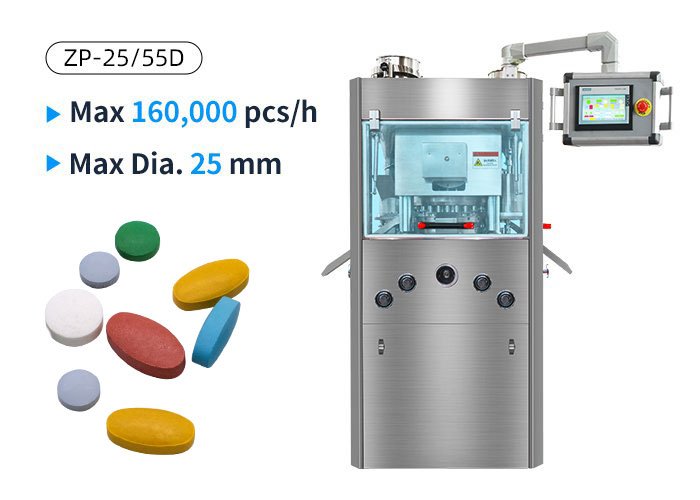
The granules or powder mix is fed into a tablet press. เครื่องอัดยาเม็ดแบบหมุนความเร็วสูงcompress the powder into tablets. Consistent compression force and fill-depthare vital. These parameters affect tablet hardness and porosity. Hardness and porosity, ในทางกลับกัน, influence release: a very hard tablet with low porosity may slow water penetration and drug release, while a softer tablet may dissolve faster. เครื่องอัดแท็บเล็ตสมัยใหม่ (like Jinlu’s multi-station presses) have precise control over these settings.
ไส้แคปซูล.If the product is a capsule, หนึ่ง เครื่องบรรจุแคปซูลอัตโนมัติ ถูกนำมาใช้. It accurately measures the granule/bead fill for each capsule and places the cap. Consistent fill weight ensures uniform drug content. Automatic capsule fillers can handle high speeds (thousands of capsules per hour) and various sizes. อีกครั้ง, the filling process itself doesn’t create sustained release – that comes from the formulation inside (matrix granules or coated beads) – but the equipment ensures each capsule gets the correct mix.
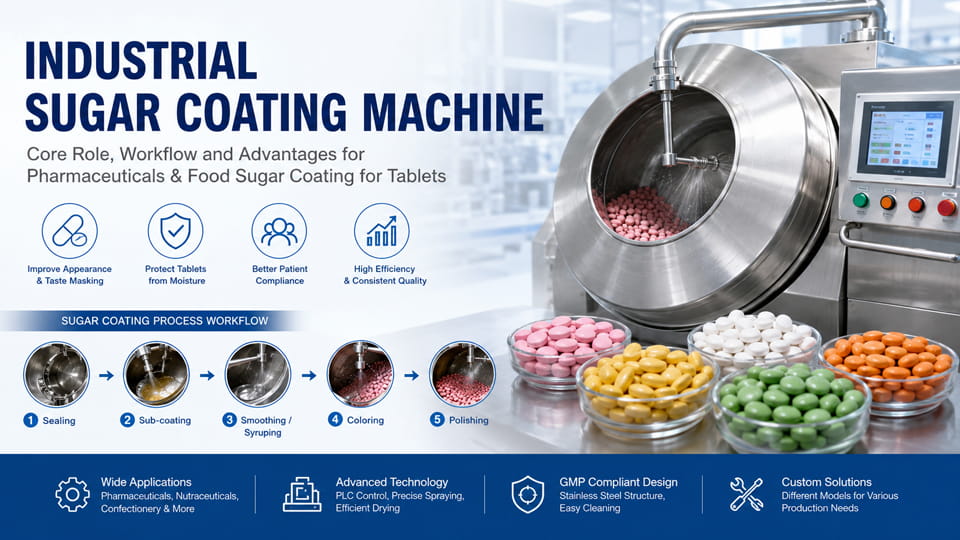
Functional Coating.Many ER formulations use a coating step. Tablets are tumbled in a coating pan (or fluid bed) while a polymer solution is sprayed on. ตัวอย่างเช่น, an HPMC or acrylic aqueous dispersion can be applied to form a controlled-release film. The coating machine must evenly apply a thin, ชั้นสม่ำเสมอ. Parameters like spray rate, อุณหภูมิอากาศเข้า, and pan speed are fine-tuned. Some tablet coaters also provide immediate-release or enteric layers as needed.
Final Size/Form Checks.After compression and coating, tablets or capsules are checked for weight, ความหนา, ความแข็ง, and appearance. For MR tablets, ความสม่ำเสมอของน้ำหนัก และ ความสมบูรณ์ของการเคลือบare especially important.
Dissolution Testing and Release Profiling.Every batch of MR product is subjected todissolution teststhat mimic GI conditions (USP apparatus). The resulting release profile (percent drug released over time) must match the target. For CR/ER products, strict criteria ensure each batch behaves the same.
การประกันคุณภาพ.นอกจากจะปล่อยตัวแล้ว, other tests include content uniformity (each tablet/capsule contains the proper dose) and physical tests (ความแข็ง, ความกร่อน). ตัวอย่างเช่น, tablet hardness is important for handling and may influence release rate, but it does not replace the need for dissolution testing in MR forms.
Efficient manufacturing of MR products requires reliable equipment. เครื่องอัดยาเม็ดแบบหมุนความเร็วสูง (ดูภาพ) and precise coating machines are staples on such production lines.
รูป: High-speed rotary tablet press used in pharmaceutical manufacturing. Rotary presses compress granules into tablets with adjustable fill depth and pressure. Proper press setup is crucial for consistent tablet weight and density in extended-release products.
After tablets are made, บรรจุภัณฑ์หลักsteps in to protect the product. Because many MR drugs require protection from moisture or oxidation, บรรจุภัณฑ์พุพอง เป็นเรื่องธรรมดา. ตัวอย่างเช่น, thermoformed plastic/aluminum blisters seal each tablet in its own cavity, shielding it from the environment. Jinlu Packing’s blister machines automate this process (การขึ้นรูป, การกรอก, การปิดผนึก) to create unit-dose blisters that preserve the controlled-release formulation. In secondary packaging, blister cards or bottles are placed into cartons (often using cartoners), complete with labels and instructions.
Quality Control of Modified-Release Dosage Forms
Ensuring consistent release is at the heart of MR quality control:
การทดสอบการละลาย.ตามที่ได้กล่าวไปแล้ว, in-vitro dissolution testing is performed on each batch. Instead of a quick pass-fail (like some IR tablets), MR products typically have multiple specification points. ตัวอย่างเช่น, a 24-hour ER tablet might require 30% release at 2 ชั่วโมง, 50% ที่ 6 ชั่วโมง, and at least 80% โดย 12 ชั่วโมง. USP monographs sometimes list these for specific drugs (if they exist).
Release Profile Comparison.Long-term stability studies include dissolution profiles at various timepoints (accelerated/stress conditions) to confirm the ER characteristics don’t change over shelf life.
ความสม่ำเสมอของเนื้อหา.Each unit is tested to ensure it contains the correct dose. This is no different from IR forms, but the stakes are higher with MR (any variability can lead to sub- or supra-therapeutic levels).
Physical Attributes.Tablet hardness and friability are checked. อย่างไรก็ตาม, as one Jinlu technical note explains, “tablet hardness and friability are important physical attributes, but they cannot replace dissolution testing for ER products.” A tablet can be hard and robust yet still release drug too quickly or slowly.
Batch-to-Batch Consistency.Because MR systems can be sensitive to manufacturing conditions, manufacturers perform process validation runs to demonstrate that production (การผสม, การบีบอัด, การเคลือบ) consistently yields the desired release profile. Equipment like tablet presses and coaters may be qualified and calibrated specifically for MR production lines.
Other Tests.Microbial limits, uniformity of fill (สำหรับแคปซูล), and other safety tests are also standard. For coated products, tests like coat adhesion or moisture uptake (for sensitive drugs) might be added.
ในระยะสั้น, CR/SR/ER products undergo more extensive release testing than IR forms. This is to make sure that the “sustained” release is not accidentally lost (E.G. by a formulation change or equipment drift), which could lead to dose dumping. As noted on Jinlu’s blog, even factors like the environment (ความชื้น) or slight changes in coating thickness can affect release, so rigorous QC is a must.
Benefits and Challenges of Modified-Release Formulations
ประโยชน์:
Patient adherence.ตามที่ได้หารือกัน, fewer daily doses mean better compliance. Patients with chronic conditions often prefer once-daily pills.
Stable therapy.A steadier drug level can improve therapeutic outcomes and reduce side effects (no peak-related toxicity).
Competitive edge.จากมุมมองทางธุรกิจ, converting an existing drug to an ER version can extend patent life and marketability (new formulation).
ความปลอดภัย (for some drugs).Certain medications are safer in ER form. ตัวอย่างเช่น, some opioids have lower abuse potential if released slowly.
ความท้าทาย:
Formulation complexity.Developing a reliable MR system is scientifically challenging. Finding the right polymers and balancing release (especially if the drug has challenging solubility) takes extensive research.
Manufacturing precision.Small changes in processing can alter release. ตัวอย่างเช่น, over-compressing a matrix tablet might slow release too much. This requires tight process control and often slows line speed.
ต้นทุนที่สูงขึ้น.MR formulations typically cost more to develop and manufacture (more excipients, multi-step processes, stringent testing). They also often come at a higher unit price, though this may be offset by improved efficacy.
Risk of dose dumping.If a formulation is compromised (E.G. capsule cut open, coating damaged), a burst release (“dose dump”) can occur. This is a safety concern. (That’s why package instructions usually warn against crushing ER tablets.)
Patient variability.GI transit time and pH can vary between patients. A drug with a very narrow window might still show variability even in a well-designed ER form.
Manufacturers mitigate these challenges through robust development, การทดสอบ, and by choosing appropriate drugs (not all drugs are good ER candidates). ตัวอย่างเช่น, drugs with a long half-life or narrow therapeutic window may not benefit as much from MR design.
Choosing the Right Equipment
For companies producing CR/SR/ER products, selecting proper manufacturing equipment is crucial:
เครื่องอัดแท็บเล็ต.ก เครื่องอัดยาเม็ดแบบหมุนความเร็วสูงwith precise control (เหมือนนางแบบของ Jinlu) ensures uniform tablet weight and hardness. Multi-layer tablet pressescan even make tablets with different release layers. It’s important to have a robust machine that meets cGMP standards and can handle the formulation’s powder flow.
เครื่องเคลือบ.For tablets requiring film coatings, มีประสิทธิภาพ แท็บเล็ต Coaterwith uniform spray distribution is needed. Vacuum or fluidized bed coaters (depending on batch size) with automated process control help achieve consistent membrane layers.
แคปซูลฟิลเลอร์.If the dosage form is a filled capsule, automated capsule filling machinesprovide the speed and accuracy required. Digital controls ensure each capsule gets the correct fill volume (be it powder or pellets).
เครื่องบรรจุตุ่ม.Since many ER tablets/capsules are blister-packaged, an automated blister packaging line is often part of the production chain. This includes thermoforming the blister cavities, filling them, and heat-sealing with foil. Jinlu เครื่องบรรจุพุพอง, เช่น, can package tablets at high speed while maintaining sterile conditions.
Tablet Dedusters and Inspection Systems.Before packaging, tablets are often dedusted (to remove debris) and checked by vision systems for size and color. This ensures only perfect tablets get blistered or bottled.
When purchasing equipment, factories should consider capacity (หน่วยต่อชั่วโมง), ความยืดหยุ่น (can it handle multiple tablet sizes or capsule types?), และการปฏิบัติตาม (GMP, ความเข้ากันได้ของห้องสะอาด). Service and support are also important, since MR production lines cannot afford downtime.
บทสรุป
โดยสรุป, controlled-release, ปล่อยอย่างยั่งยืน, และ ขยายออกall describe dosage forms that slow down drug delivery, but with slight nuance: controlled-release emphasizes precise rate control, sustained-release emphasizes prolonged action, and extended-release is the catch-all term. From a pharmaceutics standpoint, the differences lie in formulation design and regulatory naming, not in basic patient impact – all aim to reduce dosing frequency and maintain therapeutic levels longer than immediate-release forms.
For pharmaceutical engineers and procurement professionals, understanding these distinctions guides formulation strategy and equipment selection. Making CR/SR/ER products requires careful design of polymer matrices, การเคลือบ, and processing conditions, as well as robust quality control. Machinery like high-speed tablet presses, precision coating machines, และ ฟิลเลอร์แคปซูลare integral to producing uniform, reliable modified-release products.
ที่ จินลู่บรรจุ, we specialize in equipment tailored to these needs. Our tablet presses offer precise control over compression force and fill depth for reproducible tablet density. Our coating machines ensure even, uniform application of functional films. And our capsule filling and blister packing machines support high-speed production of MR formulations with strict hygienic standards. Whether you’re developing a new extended-release prescription or upgrading an existing tablet line, having the right machines makes all the difference.
Ready to optimize your modified-release production?ติดต่อ Jinlu บรรจุto discuss how our specialized tablet presses, ฟิลเลอร์แคปซูล, and packaging machines can support your controlled-, sustained-, and extended-release formulation processes. Let us help you deliver safe, effective MR products to patients worldwide.
FAQs on Controlled Release vs. Sustained Release vs. การขยายเวลาปล่อย
Is controlled release the same as sustained release?
In practice they overlap a lot. Controlled release is technically a subset of extended-release where the drug is released at a precisely controlled rate. Sustained release generally means simply prolonging the drug action over time. All controlled-release products are considered extended- or sustained-release, but not all extended-release products are controlled-release.
What’s the difference between sustained release and extended release?
For most purposes, ปล่อยอย่างยั่งยืน (เอสอาร์) and extended-release (เป็น) mean the same thing: a formulation that prolongs drug release compared to immediate-release. These terms are often used interchangeably by manufacturers. ในความเป็นจริง, some sources explicitly call SR products “extended-release” formulations.
Is one of these types better than the others?
Not inherently. Each label (CR, เอสอาร์, เป็น) is just a way to describe the release profile. Which is “better” depends on the drug and patient needs. CR is useful when you need extremely consistent dosing. SR/ER works when you mainly want to reduce frequency. The choice depends on medical goals and formulation feasibility.
Do extended-release tablets always release drug more slowly?
ใช่, by definition an ER tablet releases drug over a longer period than an equivalent immediate-release form. อย่างไรก็ตาม, “slower” release can mean different things. Some ER tablets release steadily all day, while others release half quickly and half slowly. Always check the specific release profile in the product data.
How long do sustained-release tablets last?
It varies widely. Some SR tablets are designed for 12-hour action (taken twice daily), others for 24-hour (once daily). The exact duration depends on formulation. You must look at the product specification or labeling. There is no one-size-fits-all “SR duration.”
What types of systems are used for controlled release?
Common controlled-release systems include matrix tablets (drug dispersed in polymer matrix), reservoir tablets (drug core with polymer membrane), and osmotic pump tablets (semipermeable membrane with push layer). Less common methods include ion-exchange resins and specialized bead technologies.
Are sustained/extended-release the same as delayed-release (ลำไส้) สูตร?
เลขที่. ล่าช้า-ปล่อย (เคลือบลำไส้) tablets are designed to release drug after a delay (usually past the stomach). ตัวอย่างเช่น, an enteric-coated aspirin won’t release in stomach acid. ในทางตรงกันข้าม, sustained/extended-release tablets release continuously over time after administration; they usually do start releasing in the stomach (unless also enteric-coated). DR is about when release starts; SR/ER is about how long release continues.
What polymers are commonly used for extended-release?
Widely used hydrophilic polymers include HPMC (ไฮดรอกซีโพรพิลเมทิลเซลลูโลส), ตรึง, polyethylene oxide, and xanthan gum. Insoluble polymer coatings often use ethyl cellulose or acrylic polymers. These materials swell or dissolve slowly, controlling release. (ตัวอย่างเช่น, HPMC is frequently used to create a gel matrix in ER tablets.)
How are extended-release tablets manufactured?
The process is similar to ordinary tablets but with extra steps. โดยทั่วไป, API is mixed with release-controlling excipients (โพลีเมอร์), เป็นเม็ด, and compressed on a tablet press. Then tablets may be coated with a polymer film for further release control. Key tests (dissolution profiling) are done to confirm the ER properties. Automated equipment like rotary tablet presses, เครื่องเคลือบฟลูอิดเบด, and blenders are used. The equipment itself doesn’t slow release; that comes from the formulation and coating.
Can extended-release tablets be crushed or split?
โดยทั่วไปไม่มี. Crushing or cutting an ER tablet destroys its release mechanism, often causing the drug to release all at once. This can lead to dangerous overdose or loss of efficacy. ตัวอย่างเช่น, Colorcon warns that breaking a controlled-release tablet “can cause the medication to be released immediately, leading to a potentially dangerous overdose”. Always follow label instructions – only take ER/SR tablets whole unless a product specifically says it’s safe to split.