×
オンラインサービス
✉️メール: 💬WhatsApp: +86 18011793320
💡
  • ブログ
  • カプセル充填材: 粉末のカプセル製剤ガイド, 顆粒, ペレットまたはミニタブレット

カプセル充填材: 粉末のカプセル製剤ガイド, 顆粒, ペレットまたはミニタブレット

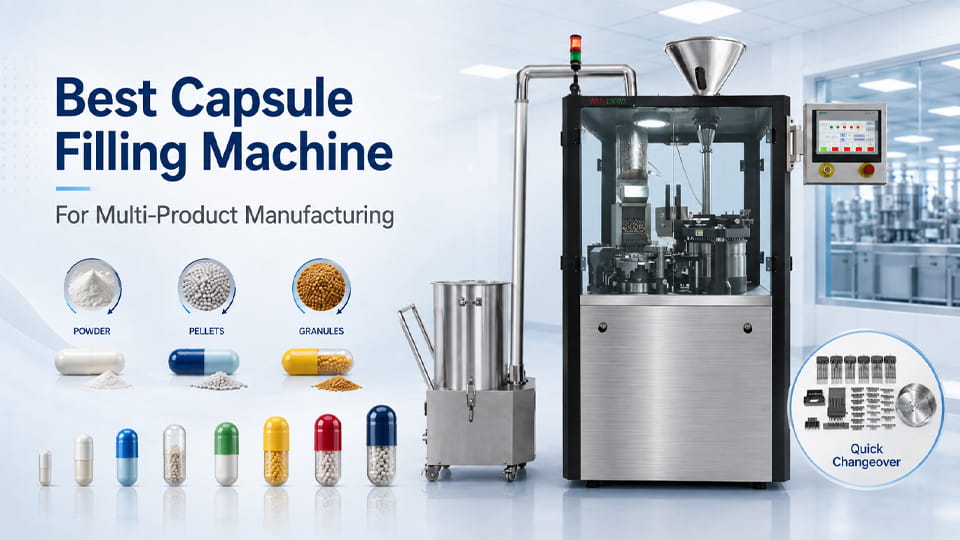
Capsule formulation can use powders, 顆粒, pellets or mini-tablets, each with unique pros and cons. 粉末 are simple and common but can be dusty or poorly flowing. 顆粒 (agglomerated powders) improve flow and reduce dust at the cost of extra processing. ペレット are roughly spherical multi-unit particles with excellent flow and are ideal for controlled-release and combination formulations. Mini-tablets (tiny tablets filled into a capsule) allow precise dosing and multiple APIs or release profiles in one capsule. The choice of fill material affects mixture uniformity, dose flexibility and flowability – and it influences which カプセル充填機 features are needed.

This guide compares each form, shows how material choice matters for production, and even provides a decision tree to help you pick the best capsule fill material for your product (and thus the right equipment). We also list the key formulation data to share with capsule machine suppliers when scoping your project.

粉末入りカプセル製剤, 顆粒, 医薬品カプセル充填機と並んでペレットとミニ錠剤


Capsule Fill Materials at a Glance

Hard capsules can be filled with a variety of solid forms. Here is a quick comparison of 粉, 顆粒, ペレット そして ミニタブレット in capsules:

充填材 Typical Form Main Advantages 共通の課題
(fine particles) Dry mix of API + 賦形剤 High dosing flexibility; rapid dissolution (即時解放); simple formulation. Flow issues: tends to clump, segregate or bridge; dose uniformity can suffer. Sensitive to moisture and static.
顆粒 (agglomerated powder) Larger clusters from wet/dry granulation Better flowability and bulk density; reduced dust; more uniform fill weight. Enables cohesive dosing. Extra process steps: granulation adds cost/time. Particle size variation affects uniformity; bridging still possible if poorly dried.
ペレット (spheroids) Rounded micro-beads (often coated) 制御されたリリース: can coat each pellet for timed release. Uniform shape → very good flow in hoppers. <br>Consistent dosing: measured by volume, not count. Complex production: require granulation/extrusion and coating. Equipment must handle small beads without segregation.
ミニタブレット (マイクロタブレット) Tiny tablets (2–4 mm dia) 柔軟な投与: mix multiple mini-tablets for multi-API or staggered release. Easy to handle like small tablets. Counting challenge: need special feeder to count and drop. May have lower flowability than loose beads. Requires precise tablet press tooling.

Each material can be the primary fill or part of a combination. Modern capsule lines can even mix forms in one capsule (例えば. ペレット + 粉) to achieve complex release profiles.

Capsule formulation comparison showing powder, 顆粒, pellets and mini-tablets used as different hard capsule fill materials.


Why Fill Material Matters in Capsule Formulation

The physical properties of your fill material directly affect capsule-filling performance and product quality. 流動性, 粒径, density and moisture are key factors. 例えば, very fine powders may be cohesive or dusty (tending to clump or hang up on surfaces), whereas larger particles or pellets flow more easily. The choice also affects blend uniformity – fine powders with mixed particle sizes can segregate during handling, whereas uniform pellets or mini-tablets reduce that risk.

Fill material also drives dose precision and formulation flexibility. ペレット (often called “multiparticulates”) enable complex release patterns and the combination of different pellets in one capsule. Mini-tablets allow multiple APIs or coatings per capsule. 対照的に, a simple powder blend usually delivers one release profile. Many capsule machines allow mixing different forms, but each addition (例えば. ペレット + 粉) adds complexity and may require separate feeders or stations.

ついに, the material dictates which dosing mechanism on the capsule-filler is used. Auger or disc feeders and tamping pins work well for free-flow powders, while pellet or tablet stations handle rigid particles. We cover these machine considerations below.


Powder-Filled Capsules: Flexible but Flow-Sensitive

is the classic capsule fill. It’s simply a free-flowing blend of API そして 賦形剤 (希釈, グライディングダンス, 等). Powders shine when you need 単純, immediate-release formulas or highly customizable doses. Because powders have 高い表面積, they dissolve quickly — ideal for fast onset of action. And powders let you fine-tune a dose: for pediatrics, geriatric or variable strengths, you can adjust the mix easily.

Powder-filled hard capsule showing a pharmaceutical powder capsule formulation.

しかし, powders come with drawbacks. 流動性 is often poor: fine particles can bridge in hoppers or stick in feeders. Even well-blended powder can segregate (heavier particles settle) if shaken, causing fill-weight variation. The lack of a defined shape means dosing relies on volumetric or tamping methods (ディスク, vacuum/air) that demand very consistent powder behavior. As GMP Insiders notes, “powders often have poor flowability, making them difficult to handle”, which can lead to dosing issues. Moist or static-prone powders clump, causing some capsules to overfill and others underfill. ついに, powders can taste bad or irritate, since they release instantly; encapsulation or coatings can mask taste, but powders themselves offer limited protection.

When to choose powder: Formulations that call for 即時解放, high-dose APIs (easy fill weight), or maximal flexibility. For low-dose potent drugs, powders can be tricky without granulation. Lab and R&D scales often use powders. 例えば, Jinlu’s NJP-400C capsule filler (24k capsules/hr) is designed for powders and granules, using tamping pins or dosing discs for precise fill weight.

Tips: Control particle size and moisture. Use glidants (例えば. Mg stearate) 流れを改善するために. Keep the blend uniform and conduct powder flow studies. High-speed lines should track fill weight trends; common causes of variation include humidity changes, segregation and worn dosing discs.


Granules in Capsules: When Better Flow Matters

顆粒 are simply powder particles bonded into larger granules (湿式または乾式造粒). By making particles bigger and more uniform, 顆粒 dramatically improves flow and handling. The granule’s larger mass means it empties hoppers more consistently, and there is less dust. This leads to more stable fill weight and less machine downtime. GMP Insiders confirms that “granules offer improved flow properties and compressibility” over powders. Granules are also great intermediates if you eventually compress tablets: capsules can be a quick dose, while granules are also compressible.

Granule-filled hard capsule showing pharmaceutical granules used in capsule formulation.

ペレット (下に) are essentially spherical granules. But even uncoated granule masses help for uniform filling. メーカー向け, granulation adds an extra step, but it often 報われる by eliminating bridging. A fluid-bed or high-shear granulator can produce granules that dramatically cut segregation. (造粒後, you may screen to size to ensure uniform feed into the capsule fill hopper.)

When to choose granules: Use granules when the base powder is sticky, cohesive or has a wide size distribution. Granulation ensures consistent capsule weights especially on high-speed lines. Granules can also incorporate バインダー or coatings. For moderate release control, you might coat granules as mini-pellets.

Tips: Optimize granule size (usually a few hundred microns) for your filler’s hopper. Ensure granules are fully dried and free-flowing. Vibratory feeders or augers often feed granules reliably, and capsule fillers with volumetric granule dosing (例えば. segmented hoppers) handle them well. Jinlu’s capsule fillers accommodate granules: the NJP-400C, 例えば, is rated for powders そして 顆粒.


Pellets in Capsules: A Flexible Option for Modified Release

ペレット (または回転楕円体) 小さいです, rounded particles — often 0.5 に 2 mm in diameter — usually produced by extrusion-spheronization or layering techniques. Each pellet can be coated to control release (腸溶性, 遅延, 制御された, 等), so pellet-filled capsules are ideal for multiparticulate and modified-release 製剤. オリジナルのジンルノート, “pellets are small spherical multi-unit beads, often coated for sustained release”. Capsules filled only with pellets (also called multi-particulate capsules) can give precise, predictable release: 一部のペレットはすぐに溶けます, 他の人は後で. This multi-phase release profile is hard to achieve with uniform powders.

Pellet-filled hard capsule containing pharmaceutical pellets for a multiparticulate capsule formulation.

Pellets flow very well due to their shape. A quick tilt of the hopper and pellets pour out smoothly into a dosing disc or rotating star-wheel feeder. Modern fillers often have segmented powder discs for volumetric pellet filling, あるいは フラッシュ hoppers that meter pellets by volume. Because pellets are relatively heavy and coarse, there’s very little dust, and machines run fast — up to tens of thousands of capsules per hour.

When to choose pellets: When you need controlled release or want to minimize dose variation. Pellets let you combine immediate- and extended-release pellets in one capsule to create different or staged drug-release profiles. They’re excellent for high-dose drugs that benefit from sustained release. また, if your formula can handle the extra processing (extrusion, layering, or coating), pellets can outperform powders in consistency.

Tips: Match pellet size to the capsule filler. Large pellets may reduce count per capsule; too many small pellets may cause segregation in the hopper. Calibrate the volumetric feeder — since pellets fill by volume rather than count, accurate star-wheel settings are key. Check that pellets are not friable (ほこり). Jinlu’s specialized multi-particulate filling テクノロジー (available on machines like the NJP-1500D) handles pellets reliably and can accommodate multiple pellet sizes.


Mini-Tablets in Capsules: Precise Multi-Unit Dosing

Mini-tablets (sometimes called micro-tablets) are tiny compressed tablets, typically 2–4 mm in diameter. Think of putting one or more of these very small tablets inside a larger hard capsule. This approach blends the benefits of tablets and capsules: each mini-tablet can contain a precise dose or different API, and can be coated for tailored release. 例えば, a capsule might contain one immediate-release mini-tablet of Drug A and one sustained-release mini-tablet of Drug B. Jinlu’s guide explains that mini-tablets “lets manufacturers combine different drugs, 用量, or release profiles in one unit”.

Mini-tablets filled into hard capsules for a multiple-unit capsule formulation.

Mini-tablets have excellent dose flexibility. Because they are compressed units, you can count them like tablets: one capsule = 5 タブレットまたは 10 錠剤, 等. This makes adjusting total dose easy. They also minimize segregation because each mini-tablet holds a fixed composition. Compared to pellets, mini-tablets often have lower porosity (less moisture sensitivity) そして consistent tablet weight. A study notes that multi-unit forms (顆粒, ペレット, ミニタブレット) “offer efficient control of drug release” with “smaller inter- and intra-variability”.

反対側では, feeding mini-tablets requires special equipment. Capsule fillers need a tablet-dosing station: typically a vibrating or rotating disk with pockets that count and drop each mini-tablet into the capsule body. This adds complexity and cost. また, because mini-tablets are solid, they flow like granules but can jam if not handled gently. しかし, modern capsule fillers (including Jinlu’s machines) offer optional mini-tablet feeders. 確かに, Jinlu specifies that the NJP-400C accepts “micro tablet” fills, meaning it can feed pre-made mini-tablets.

When to choose mini-tablets: When you need precise dose combinations or want to include multiple APIs or release rates in one capsule. They are popular for pediatric or multi-drug products, where dose titration is key. Use mini-tablets if your formulation is tablet-friendly and you can afford the extra filling station. They shine when 均一 そして fixed dosing 最も重要です.

Tips: Ensure all mini-tablets are consistent in size and 硬度. Validate the tablet feeder with your specific mini-tablet shape. If using coated mini-tablets, handle them gently to avoid chipping. Combining mini-tablets with pellets or powder in one capsule is possible — just program the filler sequence (drop tablets, 次にペレットを加えます, then top with powder, 等) as Jinlu describes.


Can You Combine Different Fill Materials in One Capsule?

Sometimes the best solution uses more than one material. Multi-component fills can give dual-release or combination therapies. 例:

  • ペレット + 粉: Fill a capsule halfway with coated pellets (持続放出用) and top it with powder (即時釈放のために). Patients get an IR+ER profile.
  • ミニタブレット + ペレット: Insert one IR mini-tablet plus several ER pellets. Ideal for multi-API (Drug A immediate, Drug B delayed).
  • 顆粒 + ミニタブレット: Add a dose of mini-tablet(s) and fill the rest with granules of a second drug. Great for fixed-dose combinations.
  • 粉 + ペレット + ミニタブレット: A complex three-phase fill. 例えば, Drug A in powder (速い), Drug B as coated pellets (slow), Drug C as mini-tablets (targeted or second pulse).

These combination strategies exploit the strengths of each form. It requires a filling line with multiple stations, but many high-end machines support this. The benefit is a true combination dosage form: better therapeutic control and fewer pills for the patient. 例えば, an anti-inflammatory might be delivered as 2 immediate-release mini-tablets + 50 delayed pellets in one capsule.


Powder vs Granules vs Pellets vs Mini-Tablets: どれを選ぶか?

Choosing the right fill depends on your key requirements: 流動性, dose flexibility, リリースプロファイル, 取り扱い, と設備. The table below maps these factors to each material:

要因 / 材料 顆粒 ペレット ミニタブレット
流動性 中くらい / 低い (fine powders can bridge) 良い (larger size reduces bridging) Very Good (smooth spheres) 良い (generally fine, but need gentle handling)
用量の柔軟性 高い (blend ratios easily changed) 高い (same as powder after granulation) 高い (mix different pellet types) 非常に高い (count tablets for precision)
修正リリース 限定 (blend with excipients) Possible (coated granules) 素晴らしい (coat each pellet) 素晴らしい (coat tablets or use different tablets)
コンテンツの均一性 適度 (risk of segregation) 良い (granulation promotes uniformity) Very Good (each pellet identical) Very Good (counted doses)
Processing Cost 低い (simple mixing) 適度 (造粒工程) 高い (extrusion + コーティング) 高い (タブレットの圧縮 + コーティング)
Capsule Filling Ease 単純 (standard tamping/disc) より簡単に (flows smoothly) 簡単 (volumetric fillers work well) 複雑な (needs tablet counting station)
ベストユースケース Immediate-release or simple formulas Bridging powders/low-dust fill Controlled-release/multiparticulate Multi-API or precise dosing (例えば. combination therapy)

Above factors guide the decision. 例えば:

  • もし 流動性 is your top concern (例えば. very cohesive powder), choose granules or pellets.
  • 必要な場合は top-notch controlled release, pellets or mini-tablets are best.
  • のために highest dosing precision, mini-tablets shine (you literally count tablets per capsule).
  • のために low-cost simple products, powder is often enough.


How Fill Material Affects Capsule Filling

The fill material fundamentally determines the dosing mechanism and machine setup:

  • 粉末充填: Typically uses a tamping-pin or dosing-disc system. The powder rests on a disc plate; a vacuum or pin levels off a dose. Tamping pins can adjust pressure for weight. Vibratory aids ensure powder flows into the auger. (Jinlu’s NJP-1500D, 例えば, has a patented 3D adjustment for low fill error.) Poor-flow powders may require slower speeds, vacuum assist, or special agitators.
  • 顆粒充填: Often filled by volume with no tamping. A segmented hopper/drop into a dosing disc can meter granules. Since granules flow freely, machines use simpler volumetric feed. Vibrators or stirrers in the hopper help prevent rat-holing.
  • Pellet Filling: Uses volumetric or star-wheel feeders. Some machines have circular dosing disks with cavities sized for pellets, or segmented tracks that release a fixed volume of beads into each capsule. Pellets’ spherical shape makes gravity feeding very consistent. Jinlu machines with multi-particulate filling have adjustable pellet tracks for precise dosing.
  • Mini-Tablet Filling: Requires a tablet counter/delivery unit. 通常, mini-tablets are loaded into a hopper above a vibrating disk with indexed pockets. Each pocket catches exactly one tablet and drops it when a capsule body passes. Many capsule fillers have an optional mini-tablet attachment. 例えば, Jinlu’s equipment list shows “マイクロタブレット” filling capabilities for these tiny tablets.

それぞれの場合において, 考慮する 投与精度 そして feed consistency: dense powders might use tamping pins; fluffy powders may need vacuum or augers; pellets benefit from volumetric precision; mini-tablets rely on good pocket design. The machine’s metering parts must be chosen to match the fill type.

例えば, の NJP-400C automatic capsule filling machine is built to handle powders, 顆粒, pellets and mini-tablets. Its adjustable feeding system (pneumatic agitation, tamper, 等) allows switching between these materials. 同じく, の high-speed NJP-1500D capsule filler covers the same range at up to 90,000 cps/hour.


Key Formulation Factors for Capsule Filling

Before choosing a capsule filler (or adjusting an existing one), examine these material properties:

  • 粒子サイズ & 分布: 微粉末 (<100 μm) flow poorly and may pack too tightly; coarse granules/pellets (>500 μm) fill easily but may leave voids. Uniform size prevents segregation.
  • Bulk and Tapped Density: Determines capsule fill volume. Low-density powders require larger volume for the same dose. For accurate filling, communicate both bulk and tapped density to the supplier. 例えば, 500 mg of a very fluffy powder might fill a capsule size 0, whereas a denser powder might fit in size 1.
  • 流動性 (カー指数): Powders with Carr’s index >25% (流れが悪い) often need granulation or glidants. Watch for signs like bridging or inconsistent hopper emptying. Granules and pellets usually have Carr’s <20%, leading to reliable flows.
  • Moisture/Hygroscopicity: Powders and granules that pick up moisture will clump (固まる) and skew fill weights. Capsules themselves (gelatin vs HPMC) have different 湿度 tolerances. Control RH or use dehumidified feeding if needed.
  • Electrostatics: Static-charged powders cling to surfaces, causing uneven fills or leftover residue. Good grounding, ionizers or antistatic agents help.
  • Segregation Tendency: A blend of different particle sizes or densities (例えば. API + diluent) can separate during handling, leading to dose variability.
  • Desired Release Profile: Immediate release favors powder or soluble granules. For delayed/sustained release, consider coated pellets or mini-tablets with polymer layers. Some excipients (lipids, ポリマー) can slow release even in powder form.
  • Target Fill Weight & カプセルサイズ: High fill weight (例えば. 500 mg) might require capsule #0 または 1. Low weight (10 mg) may need special low-dose fillers or mini-tablets for accuracy.

例: A low-dose potent drug (<10 mg) with poor powder flow is a classic case for either granulation or mini-tablets. A high-dose, moisture-sensitive vitamin (300 mg) might do fine as coated pellets to avoid hygroscopicity.

The key is to feed this data into your equipment choice. Jinlu recommends giving suppliers the product’s bulk density, カー指数, 粒径, 水分含有量, and desired output. This ensures the right dosing principle (tamping pin vs dosator) is selected.


How to Choose a Capsule Filling Machine for Your Formulation

Now that the formulation needs are clear, match them to equipment:

  1. What material are you filling? Each machine has options:
  2. Powder/Granules: Most automatic fillers (like NJP-400C, NJP-1500D) handle these with tamp/dose disks and vibro-feeders.
  1. ペレット: Ensure the machine can mount a segmented pellet dosing system or star-wheel. Jinlu’s multi-particulate fillers include this option.
  2. ミニタブレット: Look for a tablet-feeder accessory. Jinlu machines list “micro tablet” capability.
  3. Target fill weight and accuracy: Higher fill weight (例えば. >500 mg) might allow a simpler volumetric filler; very low weight (例えば. 25 mg) may need dosator systems or even multiple cavities (pellets/mini-tabs).
  4. Capsule size (#000–5): All Jinlu fillers adjust to standard sizes. For extremely small sizes (#4-#5), ensure feeders are fine enough.
  5. 生産速度: 少量のバッチ or R&D can use semi-auto or small auto-fillers (NJP-400C at 24k/hr). For scale, 高速機械 (NJP-7800C up to 468k/hr) may be needed, which usually have greater fill consistency.
  6. Combination fills: If you need mixed forms (例えば. 錠剤 + ペレット), confirm the machine’s multi-station capability. Jinlu’s high-end models allow sequential filling (tablet then pellet then powder) as described in their dosage guide.
  7. Environmental/Containment: For dusty powders or potent APIs, consider enclosed or vacuum systems. Ensure the chosen machine can add dust-hoods or laminar flow units if needed.
  8. 柔軟性: 複数の商品を企画する場合, a modular machine (クイックチェンジツール, adjustable tamp depth) is valuable. Features like Jinlu’s quick-change mold (change in ~15 min) cut downtime.

Example Decision Flowchart:

Capsule formulation flowchart showing filling methods for powder, 顆粒, pellets and mini-tablets and how to select a capsule filling machine.

This simple flow says: identify your fill type, then pick the corresponding feed mechanism and machine. Along the way, keep material properties in mind. 最終的に, select the capsule filler that supports your material and throughput (Jinlu offers semi and fully automatic models to suit both R&D and full-scale production).


Common Capsule Filling Problems and How to Troubleshoot Them

Even with the right machine, watch out for these よくある問題 in capsule filling, and how to fix them:

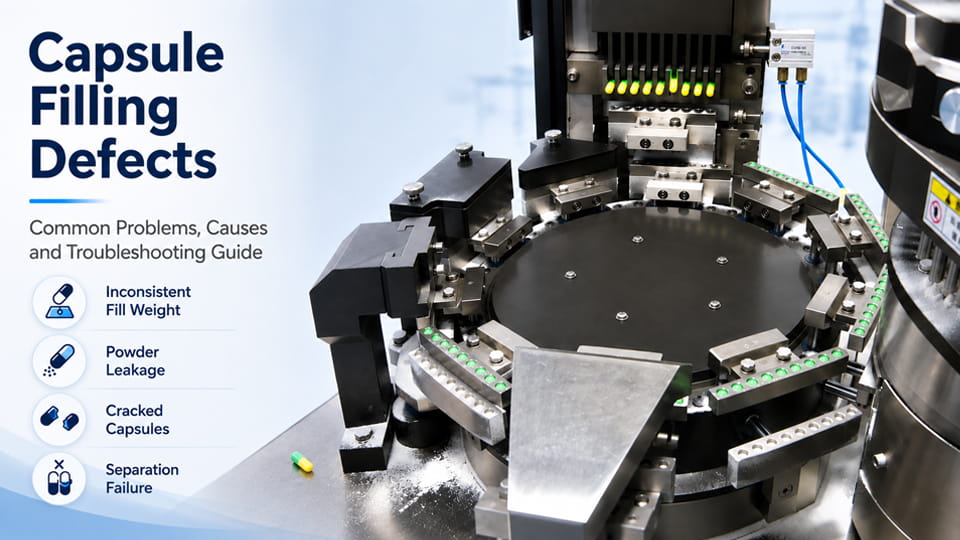
  • 充填重量の変動: Some capsules come out too light or heavy. Often due to powder flow changes or mechanical issues. Causes include moisture clumps, segregation or an improperly set dosing disk.
    Fix: Calibrate or replace the dosing disk; ensure auger and disk speeds match. Improve powder flow with drying, glidants or re-granulation. Keep hoppers topped up and use vibrators to feed consistently. Track weight trends during runs and adjust tamping depth if drift appears.
  • Bridging or Rat-Holing: Granules or powders may clump at the hopper outlet, causing no feed.
    Fix: Use internal agitators or external vibrators on the hopper. Adjust filling machine’s feed speed. Consider re-screening granules to remove fines that plug. Anti-adherent coatings on hopper walls (例えば. Polytetrafluoroethylene) 助けることができる.
  • Static and Dust: Fine powders can charge and stick to capsule surfaces (leaving dusty capsules) or clog the machine.
    Fix: Implement dust extraction or カプセル研磨 (vacuum/deduster). Maintain 40–60% RH to reduce static. Use ionizers or anti-static bars. Clean feed paths frequently.
  • カプセルの亀裂: Fills can cause capsules to break if too tight or if the shells are brittle.
    Fix: Check fill weight vs capsule volume – overfilling even by 5–10% can split capsules. Adjust tamping pins for less compression. Use fresh high-quality shells (HPMC shells resist moisture changes better). Ensure closing pins aren’t set too deep.
  • Mini-Tablet Jamming: If using mini-tablets, they can jam pockets.
    Fix: Ensure mini-tablets are within tight diameter/hardness specs. Adjust tablet feeder vibration settings. Remove any broken tabs.
  • Multiple Capsule Issues (例えば. 伸縮式): Not specific to fill material, but ensure closing station settings are correct.

Most problems trace back to material behavior vs. 機械の設定. 鍵となるのは in-process monitoring. As an industry guide advises, watch for weight drift, check material for dust/bridging signals, and adjust one factor at a time. Keep detailed batch records: variations in particle size or moisture of raw materials often explain downstream issues.


What Formulation Data Should You Give a Capsule Filler Supplier?

When requesting a capsule filler quote, give the vendor as much formulation data as possible. Key information includes:

Data to Provide なぜそれが重要なのか
製品 & 用量: Target fill weight, カプセルサイズ (000–5) Determines required fill volume and machine capacity.
Formulation Density: Bulk/tapped density, Carr’s index/Hausner Indicates flow and compressibility. Helps choose auger pitch and predict fill uniformity.
粒子サイズ: Powder D50 or granule size range Affects flow behavior and risk of segregation or bridging.
Flow/Texture: Free-flowing vs cohesive/sticky (and moisture content) Signals need for special feeders (例えば. 振動, air fluidization) and whether compression will hold.
Unit Dosage: # of tablets or pellets per capsule (該当する場合) Ensures the machine’s dosing stations (tablet chute, pellet auger) are set up for the right count.
出力: Desired production rate (カプセル/時間) Matches filler speed (semi-auto vs rotary) to your throughput requirements.

Providing these details lets suppliers recommend the right model and settings. 例えば, Jinlu advises including Carr’s Index and moisture info so engineers can suggest features for poor-flow powders. The table above (inspired by industry best practices) should serve as a checklist when talking to vendors. Ask them how they handle any flag items (例えば. “my powder is very hygroscopic” or “I need to mix two different pellets”).


実践的なヒント

  • Prototype Early: Run an actual fill trial with your formulation on a test machine. Use your real capsule size and fill weight. Check for bridging, 重量ドリフト, and feeding issues before full production.
  • Blend Homogeneity: Ensure APIs are uniformly blended. Sampling at multiple points in the blend avoids surprises.
  • 環境管理: Maintain consistent temperature/humidity in the fill area. Too dry or humid can change powder flow or capsule brittleness.
  • メンテナンス: Keep dosing parts clean and calibrated. Even slight wear on a dosing disc can skew volumes.
  • マテリアルハンドリング: For granules/pellets, screen for fines or agglomerates. For mini-tablets, make sure feeder hopper levels are consistent to prevent misfeeds.


結論

要約すれば, powder isn’t automatically best for capsule fills. Each option has trade-offs:

  • 粉末 offer flexibility and simplicity, but require attention to flow and homogeneity.
  • 顆粒 give big improvements in fill consistency at the cost of extra processing.
  • ペレット excel in controlled release and high-speed filling.
  • Mini-tablets provide unmatched dose precision and combination dosing.

The right choice depends on your drug’s properties, target release profile, and production needs. 重要です, match your fill material to the カプセル充填装置. A good rule of thumb: plan your formulation first, then pick the machine, not the other way around.

Looking for a capsule filling solution? Jinlu Packing’s machines cover all these scenarios. 私たちの NJP series machines can handle powder, 顆粒, pellets and mini-tablets. Whether you need small-scale R&D runs or high-speed production, we can recommend the right model and tooling. ジンルに連絡する to discuss your formulation and machinery needs – our experts can guide you to the ideal capsule filler for your powder, 顆粒, pellet or mini-tablet formulation.


FAQs About Fill Material in Capsule Formulation

What types of materials can be filled into a hard capsule?

Hard capsules can hold a wide range of fills – not just powder. They can contain dry powders, 顆粒, small pellets/beads, or even mini-tablets (プラス, with special equipment, semi-solids or liquids). 実際に, you often see multiparticulate fills like coated pellets or tablet-pellet mixes. オリジナルのジンルノート, empty hard shells can hold powders, 顆粒, pellets or small tablets, as well as suspensions or oils. The key is that your capsule filler must be set up for the specific form.

Powder vs Granules: Why use granules in capsules?

Granulation solves many powder woes. By agglomerating fine powder into larger particles, flowability and dosing become much more reliable. Granules pack more densely and flow smoother, preventing hopper bridging and dust. They also reduce segregation during feeding, giving more uniform capsule weights. So if your powder mix is “clingy” or has wide particle sizes, converting it to granules (濡れているか乾いているか) is often the best fix. Use granules when you need stable filling performance.

Why put pellets in capsules instead of powder?

ペレット (small beads) unlock advanced release profiles. Each pellet can be coated for delayed or extended release. A capsule full of coated pellets can deliver multiple drug-release phases (some pellets dissolve now, 他の人は後で). Pellets also flow extremely well and eliminate blending issues (each capsule gets a consistent volume of pellets). 要するに, pellets are ideal for controlled-release formulations. They do require specialized pellet-feeding equipment, but Jinlu and others offer fillers optimized for them.

Can mini-tablets be placed inside capsules?

Yes – this is called the “tablet-in-capsule” approach. Mini-tablets (例えば. 2–4 mm) can be dropped into a capsule using a counting feeder. This lets you put precise, pre-compressed doses inside each capsule. You might have one or more mini-tablets in a capsule, possibly combined with other fill. Advantages include mix-and-match dosing (different drugs or release forms in one pill) and low variability. The trade-off is you need a capsule filler with a tablet-dosing station. Jinlu’s machines can handle mini-tablets (they list “micro tablet” in their spec).

Can I combine powders and pellets in the same capsule?

絶対に. Many formulations use combinations to achieve multi-phase release or combine APIs. 例えば, a powder for immediate effect plus coated pellets for sustained effect. The capsule goes through two fill steps: first pellets, then powder (またはその逆). The capsule machine just has multiple stations in series. Each station handles one form. Jinlu’s advanced fillers support this – you can “drop mini-tablets, 次にペレットを加えます, then top off with powder” in one capsule. Just be mindful of how the materials interact (例えば. powder may settle into pellet gaps, which is fine if intended).

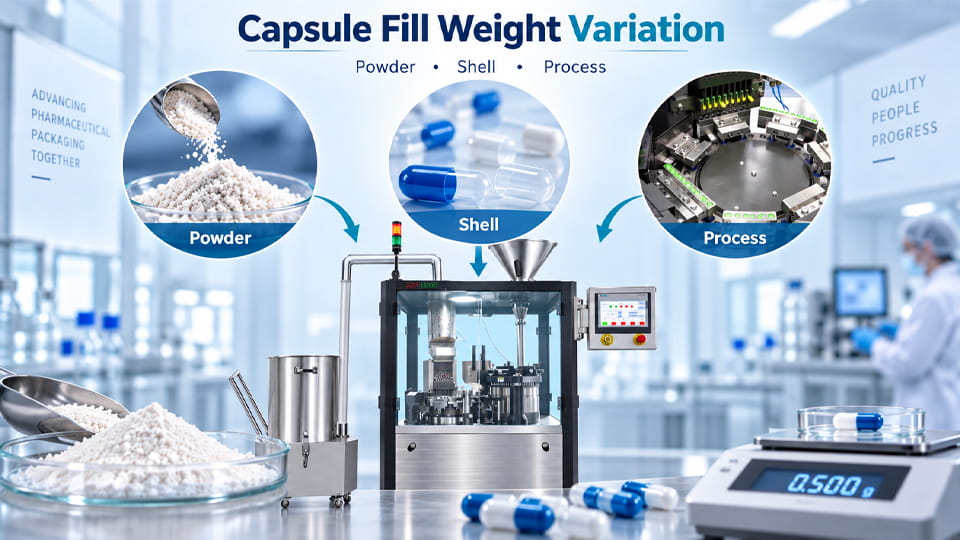
What causes capsule fill weight variation, and how to fix it?

Fill variation usually comes from either the dosing mechanism or the material. Common culprits:
• Powder flow changes: moisture uptake, 静的, or fines can make the powder pack differently.
• Dosing misalignment: A worn disk or tamping pin delivers uneven doses.
• Segregation: Blend components settling differently (heavy particles vs light).
• Equipment factors: Star-wheel rate mismatched to auger, or hopper starvation when refill is delayed.

Fixes include: Calibrating and aligning the dosing disc or tampers; using agitators/vibrators in the hopper; maintaining consistent feed (avoid hopper going empty); conditioning the powder (乾燥, 流動促進剤の添加, or granulating). Also run in-process checks (例えば. check capsule weights regularly during a run) to catch drift early.

How to improve powder flow in capsule filling?

Powder flow can be improved several ways:
• Add glidants/lubricants: A small % of magnesium stearate or colloidal silica coats particles and reduces inter-particle friction.
• Granulate or agglomerate: As discussed, converting powder to granules drastically improves flow.
• Control humidity: Keep RH stable; some powders flow better when slightly humidified, others when dry.
• Particle size optimization: A narrow PSD (粒度分布) avoids extreme fines. Sometimes milling the API helps.
• Machine adjustments: Use vacuum assist or change tamp depth. Ensure the hopper has proper vibration or paddle mixing.

Do capsule filling machines handle pellets and mini-tablets?

はい. Most high-end automatic capsule fillers have options for pellets and mini-tabs. For pellets, machines use special dosing disks or segmented hoppers. Jinlu explicitly lists pellet applications for their models (例えば. NJP-400C, NJP-1500D can fill “pellet” material). For mini-tablets, look for a machine with a tablet feeder. Jinlu’s product page notes “micro tablet” as applicable material, meaning those models have the tablet-dosing station available. 要するに, ensure the chosen model’s spec sheet or datasheet mentions pellet and mini-tablet capability.

How do particle size and bulk density affect capsule filling?

Particle size influences flow and fill volume. 微粉末 (300 μm) flow better but pack less densely (so more volume needed for same dose). Bulk/tapped density tells you how many capsules you need for a given dose. 例えば, a very low bulk density means your 500 mg dose might not fit in a size 3 カプセル. Capsule fillers must be set up for the expected particle size or density; さもないと, capsule bodies could slip, 詰まる, or break. Always characterize your blend’s density and size (as Jinlu recommends) before committing to a machine.

What is a multiparticulate capsule?

A multiparticulate capsule is one containing many small units (ペレット, ビーズ, ミニタブレット) instead of a single mass of powder. These systems are prized for controlled release. Each unit can release drug independently, giving smoother kinetics. 例えば, a multiparticulate capsule with coated pellets can provide extended release with less risk of dose dumping. The term also covers combinations like pellets+pills in one capsule. It’s essentially an umbrella term for multi-unit dosage forms in capsules.


参考文献:
1.剤形 製薬メーカーの cGMP (10/93) —— 私たち. 食品医薬品局
2.Mini-tablets versus pellets as promising multiparticulate modified release delivery systems for highly soluble drugs —— パブメッド
3.A flexible technology for modified-release drugs: multiple-unit pellet system (MUPS) —— パブメッド
4.粉末を2ピースのハードカプセルに充填 —— サイエンスダイレクト
5.The influence of pellet shape and film coating on the filling of pellets into hard shell capsules —— サイエンスダイレクト
6.Role of Pellet Size, 形, and Filling Method in Achieving Fill Weight Uniformity for Encapsulated Pelletized Systems: A Comparison of Experiment and Computer Simulation —— サイエンスダイレクト

この記事をシェアする:
の写真 ペティフー
ペティフー

ペティフー, 金魯包装の創設者, もたらす 20 製薬機械分野における長年の専門知識. 彼のリーダーシップの下で, Jinlu はデザインを統合する信頼できるサプライヤーに成長しました, 生産, と販売. ペティは、クライアントが医薬品包装の複雑さを乗り越えられるよう、業界の深い知識を共有することに情熱を持っています。, 機器だけでなく確実に受け取れるようにする, しかし、生産目標に合わせて調整された真のワンストップ サービス パートナーシップ.

目次

お問い合わせを送信してください

返信を残す

あなたのメールアドレスは公開されません. 必須フィールドにマークが付いています *

無料見積もりを取得する

*私たちはあなたの機密性を尊重し、すべてのデータは保護されます. あなたの個人データは、JL ソリューションのためにのみ使用および処理されます。.