×
オンラインサービス
✉️メール: 💬WhatsApp: +86 18011793320
💡
  • ブログ
  • Capsule Fill Weight Variation: Should You Check the Powder, Capsule Shell or Filling Process First?

Capsule Fill Weight Variation: Should You Check the Powder, Capsule Shell or Filling Process First?

Capsule fill-weight variation can stem from many sources – inconsistent powder flow, カプセルシェル differences, or equipment settings. When your in-process weight checks start showing random or drifting fill weights, don’t immediately tweak the machine. 初め confirm what’s really varying (gross vs net weight, station pattern), then follow a logical troubleshooting sequence. This guide shows a step-by-step diagnostic process (Measure → Pattern → Powder vs Shell vs Process → Machine → Confirm) to identify the root cause, along with actionable tips and checklists.

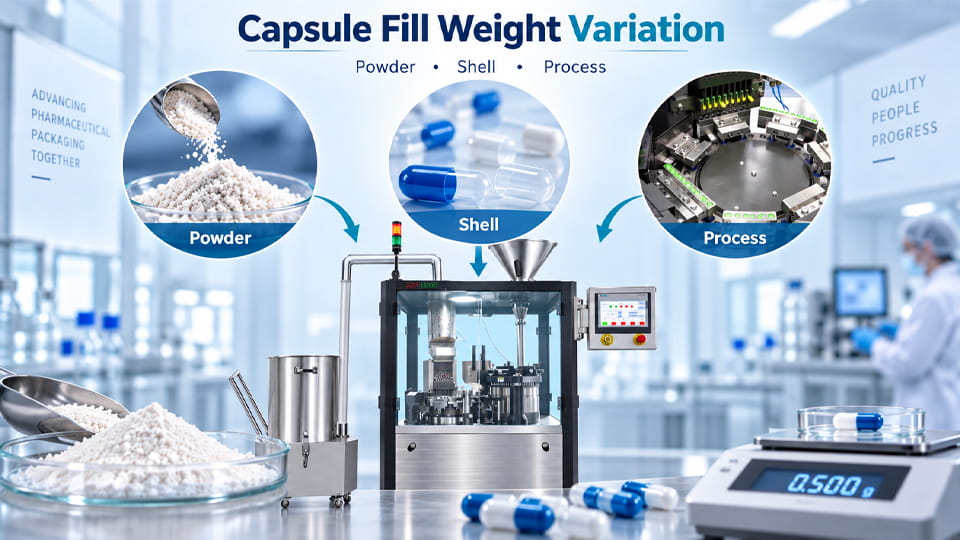
Capsule fill weight variation caused by powder, capsule shell and filling process factors
形: Capsule fill weight variation caused by powder, capsule shell and filling process factors


What Is Capsule Fill Weight Variation?

Capsule fill weight variation refers to unwanted differences or drift in the net weight of the formulation filled into individual capsules within the same batch. 言い換えると, some capsules end up underfilled or overfilled compared to the target dose. Since capsule fillers dose by 音量, not by weight, even small shifts in material behavior or machine operation can change the actual mass placed in each capsule. The key question isn’t “can every capsule weigh exactly the same?」, しかし “can the process keep the differences within spec”.

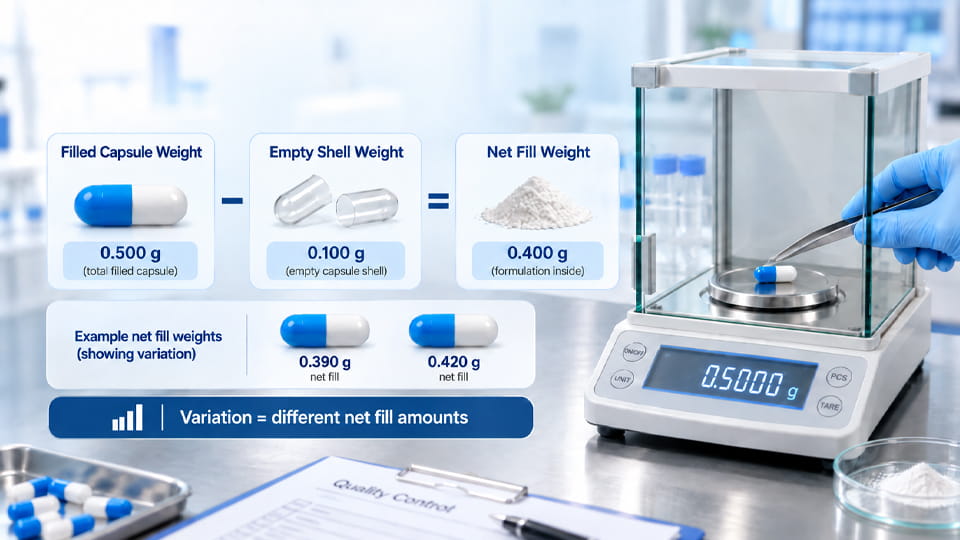
定義上, weight variation is assessed on the net fill weight カプセルの (有効成分 + 賦形剤). Operators often measure gross capsule weight (シェル + 埋める) and subtract a standard empty-shell weight (tare). Note that empty shells themselves have weight scatter. If shell weights vary, gross-weight changes might reflect shell differences, not powder dosing. 実際には, using an average shell weight introduces bias. For precision, always compare gross weight plus tare:

Gross capsule weight = Shell + 埋める.
Net fill weight = Gross – Empty shell weight.

実際に, monitor both gross and net weights. Shell-to-shell weight variation can “mask” a stable powder feed or exaggerate an apparent drift. A well-controlled process keeps individual net fills tightly clustered around the target, even if capsules differ a bit in shell weight.

Capsule weight variation is primarily a process-control issue. It shows whether the dosing system (tamping disk, ディスペンサー, 等) is delivering a repeatable volume of powder. コンテンツの均一性 (アッセイ) and blend homogeneity are separate matters. 言い換えると, a tight weight distribution only proves volumetric consistency – it doesn’t ensure chemical uniformity. それにもかかわらず、, controlling weight variation (and its trend) is crucial to meet finished-dose specs.

Capsule fill weight variation explained by measuring filled capsule weight, empty shell weight and net fill weight on an analytical balance

Capsule Weight Variation vs. コンテンツの均一性

Note that weight variation (mass-based) コンテンツの均一性 (API assay) are different quality tests. 米国薬局 <905> allows using weight variation for hard capsules only if the drug is at least 25 mg and ≥25% of capsule weight. さもないと, capsules must meet content uniformity requirements (assay each unit). In-process fill-weight checks are a process control tool, but final product compliance depends on the applicable USP method.


Gross vs Net Fill Weight: Why the Difference Matters

A good way to spot the true cause of weight variation is to compare gross and net weight trends. The formulas are:

  • Gross weight (as weighed) = Capsule shell + コンテンツ.
  • Empty shell (tare) = the shell’s weight alone.
  • Net fill weight = Gross – Tare.
Weight Term 意味 一般的な使用方法
Gross capsule weight Filled capsule (シェル + コンテンツ) Quick IPC check; includes shell mass
Empty shell weight Weight of capsule body + キャップ Evaluate capsule supplier/specification
Net fill weight Powder dose only (gross – shell) Machine adjustment & final QC of fill weight uniformity

Every capsule shell naturally has some weight variability. If your shells are ±5 mg around the average, and the powder dose is 500 mg, then switching to shells that are 10 mg heavier will make the gross weight seem +10 mg, even if the fill is identical. This “false” shift happens because we typically subtract a fixed tare. 実際には, correcting for individual shell weights shows that the real fill weight didn’t change.

キーポイント: If gross weights drift but net fill weights stay flat, the powder metering is fine. The change likely comes from capsule shell weight variation. If both gross and net move together, suspect the fill process or formulation. Always examine a set of empty-shell weights separately. 例えば, if overall capsule weight suddenly steps up or down when a new shell batch is introduced, the culprit is likely shell, not the capsule filling equipment.

Formula:

Net fill weight (mg) ≈ Dosing volume (mL) × (Powder bulk density, g/mL) × 1000 – binder/absorbent weight.

Because fillers usually meter 音量, even a slight density change (due to powder batch or moisture) alters the mass.

Gross vs net capsule fill weight comparison showing capsule shell weight and powder fill weight


Quick Diagnostic Framework (Measure → Classify → Check Powder → Check Shell → Check Process → Confirm)

When variation is detected, follow a systematic workflow rather than hasty adjustments. The steps are:

  1. Measure – Sample and weigh a set of capsules across the run. Record both gross and net weights. Calculate average, SD/RSD.
  2. Classify – Look for patterns in the data (見る Pattern Table 下に). Is the change random or trending? Does variation increase at high speed? Compare gross vs net.
  3. Check Powder – Inspect powder flow and physical properties first if patterns suggest it.
  4. Check Shell – Verify empty capsule weight and condition.
  5. Check Process – Examine machine settings and tooling.
  6. Confirm – After any fix, sample again to ensure variation is resolved.

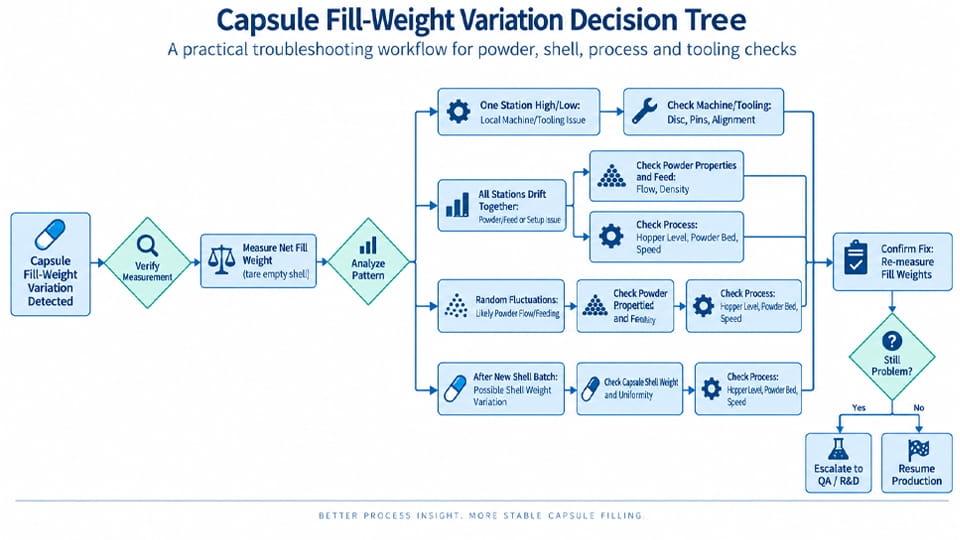
簡略化された decision-tree diagram illustrates this approach:

Capsule fill-weight variation troubleshooting decision tree for checking powder, カプセルシェル, filling process and machine tooling

Each node represents a clue. 例えば, if gross weight shifts but net fill is stable, immediately check shell weight variation. もし variation grows at faster speeds, suspect feeding or dwell-time issues. The goal is to narrow the likely cause category (powder vs shell vs machine) before diving into details.

ステップ 1: Check the Powder First

For most powder-filled capsule processes, の powder formulation is the most common source of fill-weight variation. Troubleshoot the powder by examining:

  • 流動性: Is powder feeding evenly? 流れが悪い (例えば. high cohesive forces, 静的) leads to intermittent fills and high RSD. Look for bridging or ratholing in the hopper. Run a simple flow test (angle of repose, shear index). Studies show poor-flow powders often correlate with greater fill-weight CV.
  • Bulk Density: Since most fillers use volumetric cavities, a density shift changes the dose mass. Measure the bulk or tapped density of the blend. If bulk density increases, capsules gradually become heavier; if decreases, they go lighter (gradual drift). A single new powder lot can have a different packing density than the previous one, even if formulation is identical.
  • 粒子サイズ & 分離: Blends with wide particle size or density disparities can separate during hopper loading or vibration. Heavier or larger particles may feed differently into the dosing disc. Check if weight variation coincides with ingredient changes or uneven mixing. A blend that splits (例えば。, light fluffy fines vs. dense granules) can fill some cavities richer than others.
  • 水分含有量: Hygroscopic or slightly damp powder may clump or stick to surfaces. If moisture in the room or blend changes, the powder can “swell” or cake in the hopper, reducing flow and causing progressive under-fill. Check the powder’s water activity (aw) and control humidity. Sticky or caking powders often lead to steadily increasing variation and weight loss.

実際に, start by sieving the blend to remove large agglomerates, checking if flow improves. Gentle shaking or a portable powder rheometer can reveal whether the material tends to bridge. Remember that small changes (±5% in bulk density) can produce ±5% or more change in fill weight. Correcting flow issues (by adding glidants, dehumidifying, or switching feeder type) may eliminate the variation entirely.

ステップ 2: Check the Capsule Shell

If powder seems consistent, examine the capsules themselves:

  • Empty Shell Weight: Weigh a representative sample of empty caps and bodies. Compare against manufacturer specs. Significant scatter (>±2–3 mg) means shells are inconsistent. Shell weight shifts directly translate to gross fill changes. Use a high-precision balance. If shells from a new batch are heavier or lighter, that explains a global offset.
  • Shell Moisture and Condition: カプセルの水分をチェックする. Gelatin/HPMC shells that are too dry can crack; too moist can be sticky. Moisture-imbibed shells (or environmental changes) can jam or alter locking force. High or low humidity in the plant may make shells brittle or limp, affecting fill. Ensure storage RH is ~40–60% for gelatin/HPMC.
  • Dimensions and Fit: Run gauge checks on capsule lengths and diameters. Out-of-spec shells may sit improperly in the dosing plate or not lock correctly. If certain capsule sizes (例えば. unusual diameters) were swapped in, confirm the machine tooling was reconfigured correctly. A slightly misaligned shell can look “overfull” or “underfull” on weight.

If empty-shell weight variability is the culprit, the solution is to tighten shell specifications or use individual tare measurements. In the short term, focus on net-fill weights (subtracting each shell’s weight) to see if powder fill is truly varying. A scenario to watch: gross weight drifting but net stable means suspect shells.

ステップ 3: Check the Filling Process (機械)

After ruling out major powder or shell issues, look at the capsule filling process itself. Key checkpoints include:

  • Dosing Disc and Tamping Pins: Inspect the dosing disc cavities and tamping pins. Worn, scratched or misaligned pins/discs cause inconsistent compaction. Even small scratches or build-up can change how powder is compressed. Ensure pins move freely and retreat fully. Clean any powder build-up on disc surfaces.
  • Dosator or Tamper Wear: On dosator machines, worn dosing tubes or vacuum seals cause variation. If vacuum draw or ejection force fluctuates, doses can be inconsistent. Replace any suspect parts.
  • Powder Bed Height: Check that the hopper (feed shoe or constant-pressure system) maintains a consistent head of powder above the disc. Powder-bed height affects how much powder flows into each cavity before compaction. If the powder level drops too low (例えば. towards end of batch), the dosing volume can shrink. Maintain the recommended minimum fill in the hopper.
  • Agitator / Hopper Feed: A stalled or slow agitator can’t feed powder evenly at high speed. Confirm the hopper agitator or feed paddle is running at correct speed and free of blockage. If powder is bridging, add rub bars or increase agitation.
  • Machine Speed: High output speed can expose feed or compaction limits. If fill-weight variation jumps at higher RPM, slow the machine and check if the problem resolves. Faster operation reduces dwell time and increases vibration. This can disturb powder settling or leave cavities partially empty. Try running a test at 50–70% speed to see if fill weights stabilize; if so, the process likely needs fine-tuning (perhaps a slower tamp or improved feeding).
  • Tooling Alignment: Verify the alignment of all mechanical parts in the fill station. If one dosing station consistently underfills or overfills, it may be tilted or offset. Check cam and gear backlash, and ensure each capsule pocket lines up with the dosing disc/flight tube.
  • Vacuum and Airflow: Loss of vacuum during capsule handling (especially in HPMC or magnetic-assist machines) can let particles stick to the wrong place, causing misfills. Check vacuum lines and filters.

A single small tweak (like compressing pins slightly more, or slowing the rotation) often won’t solve a powder-driven problem. Focus first on factors that change the mass entering the cavity, such as feed geometry and bed height. The solutions here (once you confirm a process cause) usually involve adjustments or replacement of machine parts.

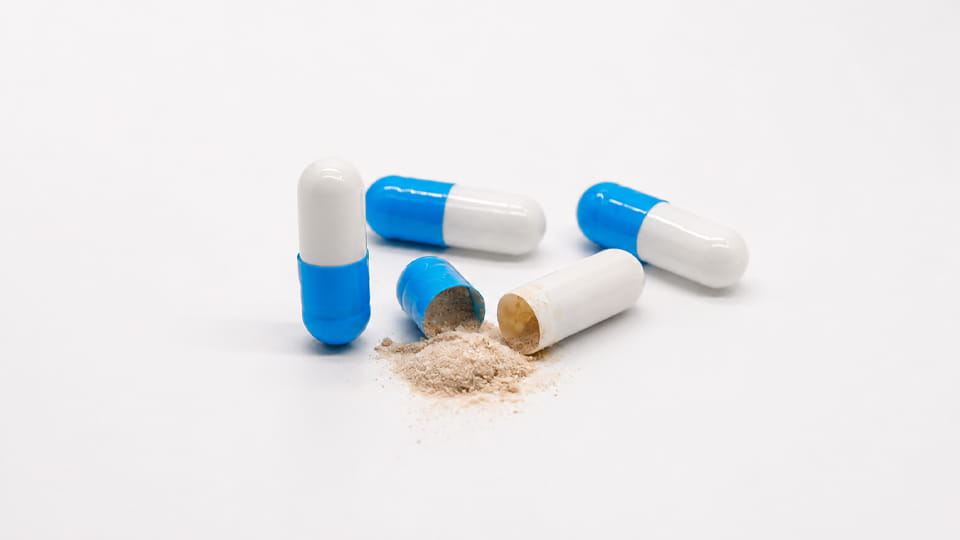
Capsule samples for diagnosing capsule fill weight variation


Reading Weight Variation Patterns

頻繁, the pattern of how weights vary tells you where to look first. Here are some common scenarios (“patterns”) and suggested checks:

  • Pattern A: Slow drift (increase/decrease) of average weight over time (all capsules getting heavier or lighter).
    Likely causes: Powder level falling (hopper emptying), bulk density change (例えば. settling or aeration), moisture change, or gradual equipment wear.
    First checks: Hopper feed height, powder bulk/tapped density, presence of bridging.
  • Pattern B: Sudden jump in weight at start, stable thereafter.
    Likely causes: Initial powder compaction/aeration (first capsules light), or an equipment parameter autoadjust (like tamp pad settling).
    First checks: Powder fluffing, initial tamp force, ensure stable flow from the start.
  • Pattern C: Random high/low weights (widely scattered, no trend).
    Likely causes: 流れが悪い (bridging/ratholing), powder segregation (lumpiness), environmental fluctuations.
    First checks: Powder cohesiveness, presence of fines/dusting, uniformity of blend.
  • Pattern D: Certain stations or rows of capsules systematically over- or under-filled.
    Likely causes: 機械式. Misaligned or worn dosing pins/disc at specific stations, uneven tamping pin depths.
    First checks: Inspect and replace suspected pins/disc segments. Check station alignment per OEM manual.
  • Pattern E: Gross weight shifting but net fill weight constant (またはその逆).
    Likely causes: Shell variability (e: gross shift only) or powder shift (net shift).
    First checks: Re-weigh empty shells. Compare net weights.

テーブル: Variation patterns vs likely cause (よくある例):

Observation Likely Powder/Material Issues Likely Machine/Process Issues
All stations track high or low together 流れが悪い (橋渡し), bulk density change, uneven hopper refill Common setup (例えば. dose target too high/low), uniform tool change
One station consistently under/overfills Unlikely Dosing pin/disc wear, stuck seal, wrong change-part on that station
Weight drifts gradually (上/下) Segregation in powder, hopper level change, moisture effects Variable feeding rate, inadequate hopper stirring
Step-change after restart Powder settling or refill sequence Hot-start issue, valve sequencing, incomplete re-level
Variation only after new powder lot Batch-to-batch powder variability (密度, 流れ)  
Variation only after new capsule lot Shell weight/dimension difference  
Variation larger at high speed (but stable slow) Feeding or flow limit exceeded at speed Dosing timing, incomplete fill at speed
Powder bridges or rats-hole in hopper Powder issue (流れが悪い)  

Use these clues as a “triage” to prioritize checks. 例えば, if variation shows up only after a new powder blend was loaded, powder differences are indicated. If it ramps up with speed, suspect mechanical feeding. If only one dosing ring is off, suspect tool wear/alignment. A quick review of the weight chart (カプセル # vs weight) often points to whether the issue is powder or machine.


Troubleshooting Checklist

Below is a condensed チェックリスト to ensure no factor is overlooked. Check boxes as you go:

  • 材料 (粉): Flowability tests ✓, Bulk/tapped density measured ✓, 水分含有量 (water activity) ✓, 粒子サイズ / blend uniformity ✓, Powder batch consistency ✓.
  • カプセル (Shell): Empty-shell weight variance ✓, Shell moisture content ✓, Shell dimensions and seals ✓, Capsule size/compatibility ✓.
  • 機械 / プロセス: Dosing disc and tamping pin condition ✓, Dosator tube integrity ✓, Powder bed height and hopper feed ✓, Agitator speed/function ✓, Feed shoe clearance ✓, Filling speed and timing ✓, Tooling alignment & wear ✓, Vacuum lines/filters ✓, Environmental conditions (temp/RH) ✓.
  • Process Data: Sampling frequency (IPC log) ✓, Statistical analysis (mean vs time, station charts) ✓, Compare to IPC spec limits ✓, Record machine settings (pin depths, 速度) ✓.

To clarify what to suspect first, consider this quick table of common observations:

Observation Powder/Shell Likely? Machine/Process Likely?
Variation started immediately after a new powder lot ✔ Powder (lot density/flow change)  
Variation started after a new shell lot ✔ Shell (empty weight change)  
One station (or pocket) is consistently off   ✔ Machine/tooling (pin/disc issue)
All stations random scattering high/low ✔ Powder (flow/feed)  
Variation only appears at production speed (stable slow)   ✔ Process (feeding rate, タイミング)
Variation rises as hopper empties ✔ Powder (橋渡し) ✔ Feed system (stalling)
Swapping dosing disc/pin fixes the issue   ✔ Machine/tool (wrong disc, 着る)
Powder flows poorly on one machine but good on another ✔ Possibly machine (agitator, drive)
Same machine runs a different powder fine ✔ Powder (material-specific)  

Completing a structured check before calling service can save hours. If after all above the issue remains, then carefully adjust machine settings: 例えば, increase tamping pin depth or compressing force only after verifying powder/shell stability. 覚えて, hiding an unstable powder with more force can mask a problem but won’t fix it long-term.


How to Reduce Capsule Fill Weight Variation

Long-term fixes often involve upstream controls:

  • Standardize the Powder: Develop a robust formulation with consistent excipient grades. Use glidants (例えば. コロイダルシリカ) 流れを改善するために, and ensure controlled moisture. Maintain clear blend procedures to avoid segregation (slow fill rates, proper discharge geometry). For challenging powders, consider pre-compression or slugs to improve handling.
  • Control Capsule Shell Quality: Specify capsules with tight weight tolerances. Audit your shell supplier. Keep shells properly conditioned and use in FIFO order. 必要に応じて, implement in-house checks on shell weight and dimensions.
  • Optimize Dosing Parameters: Sometimes changing the dosing principle or tooling solves variation. 例えば, adding a magnetic plug or plug dosage (for very cohesive powders) instead of plain tamping may help. Adjust feeding aids: rub bars, stainless steel liners, or vacuum control. Try varying pin depth or multiple tamps (if machine allows) and measure impact.
  • Validate with Actual Powder: Don’t assume a machine will work with all powders. Before scaling up or changing machines, run a real powder trial (including actual capsule shell, 充填重量, 目標速度). Record results under different speeds. Many OEMs, ジンルを含む, recommend testing the actual formulation on the proposed machine model before purchase. This practical step often reveals hidden issues like sticking or feed starvation.
  • Implement In-Process Control (IPC): Sample at a defined interval (often in the batch record). Calculate mean and spread (SD or RSD). If you see a trend (drift or widening RSD), stop and investigate immediately. Avoid chasing variation by constant machine tweaking; その代わり, confirm root cause first.

By combining better material control and smart equipment selection, many manufacturers achieve ±2–3% weight variation or better.


When to Adjust the Machine vs. Check Powder/Shell

A common mistake is blaming the machine first. Here are some rules of thumb:

  • Check Powder/Shell First If:
    • A new powder batch or formulation was introduced.
    • Environmental conditions (temp/RH) have changed.
    • Empty shell weight has shifted (例えば. new capsule lot).
    • Variation is intermittent, random, or jumps with hopper filling.
  • Adjust Machine Only If:
    • Powder properties and shells are stable and per spec.
    • Variation correlates with machine speed (例えば. only at high RPM).
    • A single station is off.
    • Dosing parts are worn or have recently changed.
    • After all raw materials checks, the variation still persists.

要するに: Don’t rush to change dosing pin depth, stroke, or speed until you are sure the powder isn’t the real issue. If powder-induced problems are left unaddressed, a “fixed” machine will just hide the symptom under different conditions. 例えば, if blend bulk density is lower than expected, forcing the machine won’t stabilize fills in the next batch. Always solve material issues first, then fine-tune the machine.


適切なカプセル充填機の選択

If you’re shopping for a new machine or upgrade, remember that no machine is truly “universal.” The best machine is the one proven to work with your formulation. 考慮すべき主な要素:

  • Dosing Principle: Dosing-disc vs. dosator vs. tamping-disk. Each handles powders differently. Choose based on powder fluidity and dose weight.
  • Machine Flexibility: Look for adjustable tamp pins and modular tooling. This allows tuning for different powders and capsule sizes.
  • スピードと正確さ: Faster machines (例えば. ジンル カプセルフィラー) may offer high throughput, but check they can hit your weight accuracy at rated speed. Actual powder trial reports should show both speed and weight data.
  • Capsule Size Range: Ensure the machine supports your capsule size (#000–#5) and has tooling for any special shells (size 2H, 等).
  • Ease of Cleaning/Changeover: Frequent product changes require quick, tool-less cleaning. Options like easy-mount molds reduce downtime.
  • Support and Testing: Choose a manufacturer that offers a formulation test trial on your specific blend (as recommended by experts). ジンルパッキング, 例えば, encourages customers to submit samples for trial runs, tailoring machine choice to real data.
  • アフターサービス: オンサイトでの試運転, トレーニング, and fast spare parts ensure consistent performance.
NJP-1200Cカプセル充填機
NJP-1200Cカプセル充填機

覚えて: a shiny new filler won’t automatically fix weight variation if the formulation isn’t addressed. The best ROI comes from a well-matched combination of powder and equipment.


結論

Capsule fill weight variation is a complex issue with multiple potential causes. The effective approach is a structured troubleshooting sequence: confirm the variation, interpret the pattern, then check powder, シェル, and machine systematically. As experts note, consistency requires both a stable formulation and a well-adjusted machine.

要約すれば:

  • Measure and classify the variation (gross vs net, trending vs random).
  • Check the powder formulation thoroughly (流れ, 密度, 水分, segregation).
  • Inspect the capsule shells (weight tolerance, 水分, fit).
  • Review the filling process (ツーリングの状態, feed/hopper, スピード, アライメント).
  • Only then adjust machine settings or consider alternate equipment.

If you’re still seeing uncontrolled variation after all these checks, it may be time to consult your pharma machinery supplier. メーカーのような ジンルパッキング offer capsule filling trials to verify that a given machine will handle your exact powder and fill-weight requirements. By focusing on the root causes before tweaking the machine, you’ll save time and ensure a robust, reproducible filling process.

Next steps: Use the checklist and decision tree above to diagnose your issue. If you need advice on selecting or configuring a capsule filling machine, Jinlu Packing’s engineers can help evaluate your formulation and target fill weight to recommend the most suitable solution. Stable capsule weights are achievable with the right combination of material control そして machine configuration.

Learn more about troubleshooting capsule filling issues on Jinlu’s Capsule Filling Defects Guide, or explore our 自動カプセル充填機 for high-speed production.


FAQs About Capsule Fill Weight Variation

What causes capsule fill weight variation?

Capsule fill weight variation can be caused by inconsistent powder flow, changes in bulk density or moisture, powder segregation, unstable powder feeding, incorrect dosing settings, 機械の速度, or worn filling components. The best starting point is to identify the variation pattern before changing machine settings. Research has shown a relationship between powder flow properties and capsule fill-weight variation.

Why does capsule fill weight vary during production?

Capsule fill weight may vary when powder flow, powder-bed density, feeding conditions, or dosing parameters change during production. A gradual drift, random variation, or station-specific difference can point to different causes, so reviewing the weight trend is more useful than looking only at the average weight.

Should I check the powder first when capsule weight varies?

Powder is an important first check, especially when the formulation or material lot has changed. Review flowability, かさ密度, 水分, particle characteristics, segregation, and powder-bed behavior before making major machine adjustments. しかし, the variation pattern should determine the actual troubleshooting order.

How does powder flowability affect capsule fill weight?

Poor or inconsistent powder flow can make feeding and powder-bed formation less uniform, which may increase capsule fill-weight variation. Studies have found relationships between powder flow properties, powder-bed density and capsule filling performance.

Can bulk density cause capsule fill weight variation?

はい. Bulk density affects how much powder occupies a given dosing volume or capsule volume. If powder density changes between batches or during processing, the same dosing conditions may produce different fill weights. Bulk density is therefore an important material attribute to monitor when investigating fill-weight variation.

How can I tell if capsule shell weight is causing the variation?

Compare the gross weight of filled capsules with the net fill weight after accounting for empty-shell weight. If gross capsule weight changes while net fill weight remains relatively stable, capsule shell weight or shell variability may be contributing to the result. USP procedures for hard-shell capsules specifically use the individual empty-shell weight to calculate net capsule contents when required.

What is the difference between gross capsule weight and net fill weight?

Gross capsule weight is the weight of the complete filled capsule, including the shell and contents. Net fill weight is the weight of the contents only:

Net fill weight = Gross capsule weight − Empty capsule shell weight.

This distinction is important because a change in shell weight can affect gross weight without indicating a problem with the powder dosing process.

Can a capsule filling machine cause weight variation?

はい. Dosing settings, powder-bed conditions, tooling geometry, tamping or dosator components, feeding stability, alignment and mechanical wear can all affect filling consistency. しかし, machine settings should not automatically be blamed; material properties and process conditions can also be major contributors.

Does capsule filling speed affect fill weight variation?

できる, but the effect depends on the formulation and filling system. Changes in speed can alter powder feeding, settling or dosing conditions, but speed is not always the primary cause. このため, compare weight variation at controlled operating conditions rather than assuming that higher speed automatically causes poorer accuracy.

How can I reduce capsule fill weight variation?

Start by stabilizing the powder properties and capsule shell quality, then optimize the filling process and dosing parameters. Monitor powder flow, かさ密度, 水分, powder-bed conditions, tooling and machine settings. For a new capsule filling machine, testing the actual formulation under representative production conditions can help confirm whether the equipment can achieve the required fill-weight consistency.


参考文献:
1.投与単位の均一性 —— 米国薬局 <905>
2.粉末流動特性がカプセル充填重量の均一性に及ぼす影響 —— パブメッド
3.Powder flowability as an indication of capsule filling performance —— サイエンスダイレクト
4.Powder flow studies III: 抗張力, consolidation ratio, flow rate, and capsule-filling-weight variation relationships —— パブメッド
5.ドーセータノズルマシンのカプセル充填重量と重量変動に対する材料属性の影響 —— パブメッド
6.Influence of capsule shell composition on the performance indicators of hypromellose capsule in comparison to hard gelatin capsules —— パブメッド

この記事をシェアする:
の写真 ペティフー
ペティフー

ペティフー, 金魯包装の創設者, もたらす 20 製薬機械分野における長年の専門知識. 彼のリーダーシップの下で, Jinlu はデザインを統合する信頼できるサプライヤーに成長しました, 生産, と販売. ペティは、クライアントが医薬品包装の複雑さを乗り越えられるよう、業界の深い知識を共有することに情熱を持っています。, 機器だけでなく確実に受け取れるようにする, しかし、生産目標に合わせて調整された真のワンストップ サービス パートナーシップ.

目次

お問い合わせを送信してください

返信を残す

あなたのメールアドレスは公開されません. 必須フィールドにマークが付いています *

無料見積もりを取得する

*私たちはあなたの機密性を尊重し、すべてのデータは保護されます. あなたの個人データは、JL ソリューションのためにのみ使用および処理されます。.