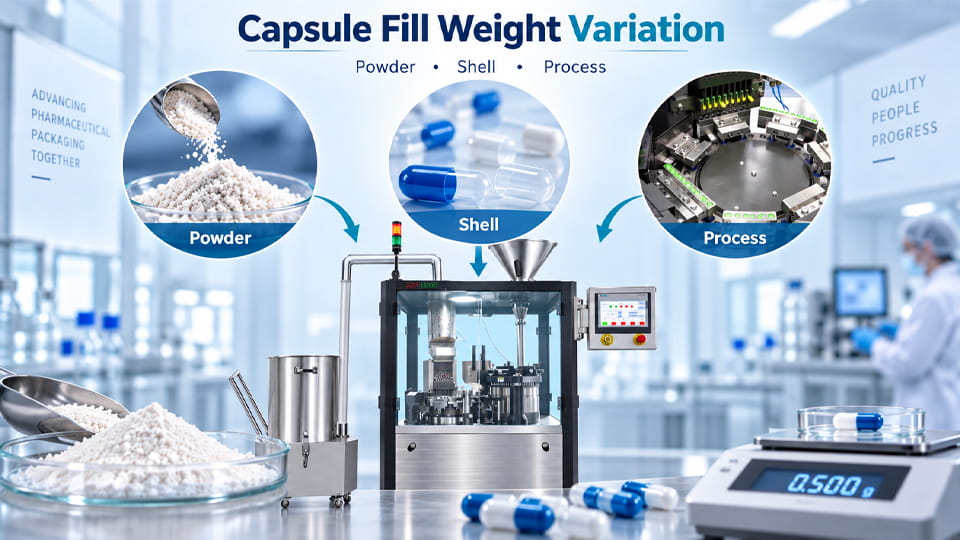

Un lot de capsules peut paraître parfait lorsqu’il entre dans l’entrepôt et causer encore des problèmes quelques semaines plus tard.. Sur la ligne de remplissage de gélules, les coquilles peuvent se fissurer lors de la séparation. Un autre lot peut sembler mou, se déformer dans la trémie, ou rester ensemble. La production peut blâmer le remplisseuse de capsules, Le contrôle qualité peut soupçonner le fournisseur de coques, et l'approvisionnement peut se demander si le matériau d'emballage est inadéquat.
Très souvent, le vrai problème est équilibre hydrique.
Les enveloppes des capsules dures échangent de l’eau avec l’air ambiant, le formulation de remplissage, et l'espace libre à l'intérieur de leur paquet. Pour les coques de gélatine en particulier, perdre trop d'humidité réduit la flexibilité et augmente fragilité des capsules; gagner trop d’humidité peut provoquer un ramollissement, gonflement, et capsules collantes. HPMC et pullulane se comporter différemment, mais ils ne sont pas non plus complètement indépendants de l’humidité. L'USP reconnaît la gélatine, hypromellose, et coques dures de pullulane en tant que systèmes polymères contenant de l'eau, tandis que les directives USP traitent séparément la teneur en eau, activité aquatique, et la transmission de l'humidité de l'emballage est aussi importante qualité pharmaceutique notions.
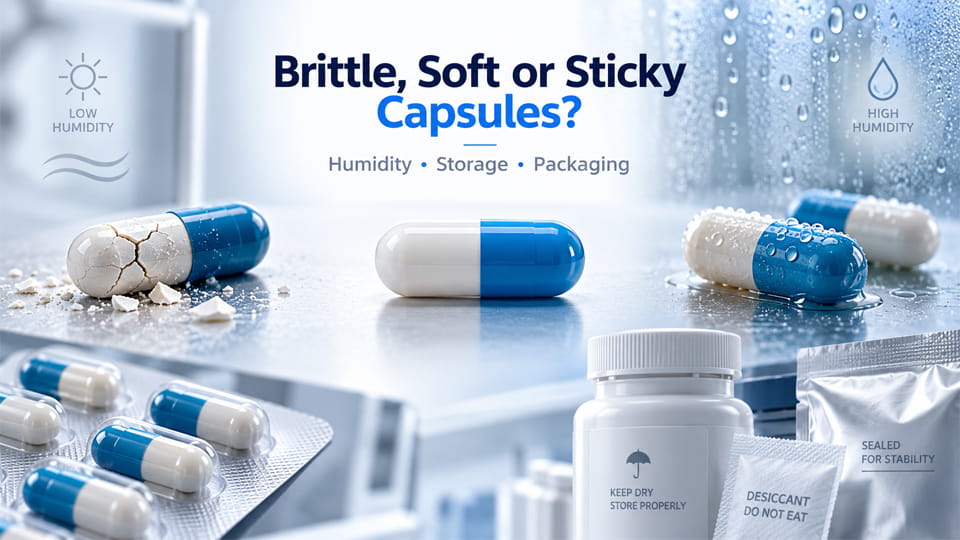
Cet article se concentre sur capsules dures en deux parties qui deviennent molles, pas la forme posologique distincte communément appelée capsule molle.
Quand les capsules deviennent cassantes, commencez par rechercher la perte d’humidité. Les capsules de gélatine dure contiennent généralement environ 13–16% d'eau dans des conditions appropriées. La recherche indique que lorsque leur teneur en eau tombe en dessous de la plage de fonctionnement normale, en raison d'une faible humidité relative, remplissages très secs ou hygroscopiques, ou migration d'humidité : la coque perd progressivement sa flexibilité et peut se briser plus facilement. Inversement, une absorption excessive d'eau peut plastifier la gélatine, rendre les coquilles plus molles et potentiellement collantes.
Pour les équipes de production et d’assurance qualité, quatre points comptent le plus:
Vous trouverez ci-dessous un bref résumé des facteurs environnementaux courants et de leurs effets sur les gélules.:
| Condition | Effet de coque de capsule | Effet de remplissage/poudre | Action préventive |
| Trop sec (Faible humidité relative) | Les capsules perdent de l'eau et deviennent fragile; peut se fissurer ou se briser | Les poudres fines peuvent adhérer à la coque à cause de l'électricité statique; le remplissage hygroscopique peut aspirer l'humidité de la coque | Augmenter l'humidité (utiliser des humidificateurs); salles d'approvisionnement en phoques; utiliser une capsule moins absorbante (Hpmc) |
| Trop humide (HR élevée) | Les capsules absorbent l'humidité, ramollir ou gonfler; peut devenir flasque ou collant | Amas de poudres; les huiles peuvent gonfler les capsules | Utiliser des déshumidificateurs; utiliser des emballages haute barrière; ajouter des déshydratants |
| Migration de l'humidité | L'eau se déplace entre la coque et le contenu jusqu'à l'équilibre; peut dessécher coquille ou mouillé cela dépend du remplissage | Les ingrédients actifs peuvent se dégrader ou s’agglutiner | Associez la coque et remplissez l'humidité; équilibrer les capsules dans une HR contrôlée avant de les remplir |
| Problèmes d'emballage | Des fuites ou des joints médiocres laissent entrer/sortir l’humidité, provoquant une humidité imprévisible de la coquille | Contamination ou pénétration d’humidité provenant de l’environnement | Utiliser des emballages hermétiques (Ampoules Alu-Alu, pochettes en aluminium); assurer une bonne étanchéité; inclure des déshydratants |
| Températures extrêmes | La chaleur élevée ramollit la gélatine (∼30–32°C point de fusion), favorise la réticulation; une température très basse peut condenser l'humidité | La chaleur peut accélérer la dégradation du remblai; le gel peut endommager certaines API | Conserver à la température recommandée entre 15 et 25 °C (gélatine); évitez les points chauds et la lumière du soleil |
L’objectif pratique n’est donc pas de « garder les capsules au sec ». Il s’agit de maintenir l’équilibre validé entre teneur en humidité de la capsule, humidité relative, activité aquatique, formulation, conditionnement, et conditions de stockage.
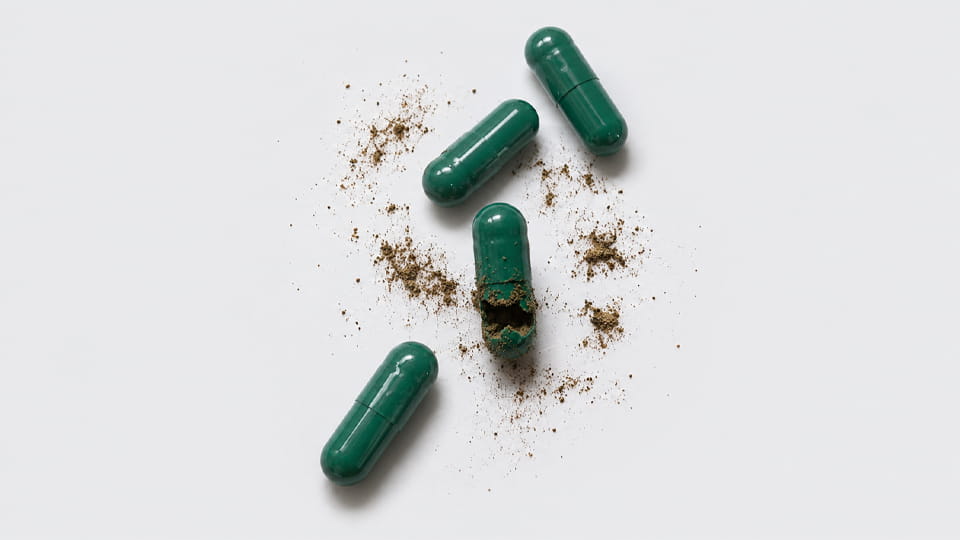
L'enveloppe d'une capsule dure n'est pas un récipient en plastique inerte. Gélatine, Hpmc, et le pullulane sont des systèmes polymères hydrophiles, et l'eau interagit avec leur structure. Les monographies USP pour les trois types de coques dures incluent explicitement l'eau dans la composition de la coque.
Pour la gélatine, l'eau contribue également à la flexibilité. Dans des conditions couramment citées d'environ 15–25 °C et 30 à 65 % HR, les coques de gélatine dure contiennent généralement environ 13–16% d'eau. Des recherches examinant les performances des capsules indiquent que le fait de tomber en dessous de cette plage normale entraîne une perte progressive de flexibilité., tandis que l'excès d'eau rend la coque plus douce et plus collante.
C'est pourquoi humidité de la capsule ne peut pas être jugé à partir de la seule pièce RH. Le système évolue continuellement vers un équilibre impliquant l’air ambiant, enveloppe de capsule, formulation, et espace libre du paquet.
L'USP distingue également teneur en eau depuis activité aquatique (oh). L'humidité totale vous indique la quantité d'eau présente, tandis que l'activité aquatique aide à décrire la quantité d'eau disponible pour participer à des activités physiques., chimique, ou processus microbiologiques. Pour une poudre hygroscopique en capsule, cette distinction est utile car deux matériaux ayant une humidité totale similaire peuvent néanmoins avoir des tendances différentes à échanger de l'eau..
Un modèle simplifié de migration de l'humidité ressemble à ceci:
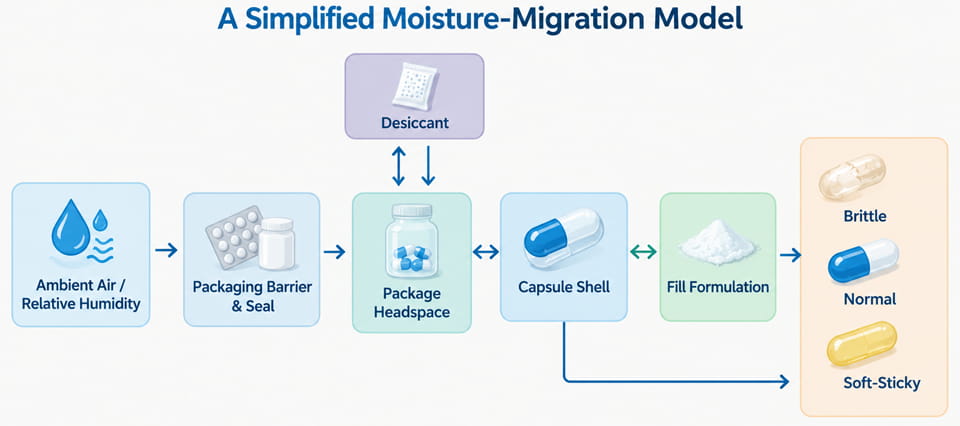
Le point clé est que l'eau peut se déplacer dans les deux sens. Un emballage peut ralentir l’entrée de l’humidité de l’extérieur, pendant que l'eau se redistribue encore entre la coque et le remplissage à l'intérieur de l'emballage scellé. Des études de capsules de gélatine dure ont démontré exactement ce transfert d'humidité de la coque au remplissage.
Le mécanisme le plus courant est la perte excessive d’humidité de la coque..
Faible humidité relative crée un gradient d'humidité entre la coque et son environnement. Comme la gélatine perd de l'eau, il devient moins flexible et moins capable d'absorber les contraintes mécaniques. Des recherches classiques ont révélé une forte relation entre la fragilité des capsules de gélatine et l'humidité relative., tandis que des études ultérieures ont confirmé à plusieurs reprises que le comportement mécanique change à mesure que l'humidité de la coquille diminue.
En pratique, des coquilles fragiles peuvent apparaître comme:
La question diagnostique importante est où la capsule se brise. Si les capsules vides se fissurent avant que la poudre ne pénètre dans le corps, enquêter sur l'état de la coque, stockage, âge des capsules, HR environnementale, contact outillage, et passer l'aspirateur d'abord. Si la fissuration se produit principalement lors de la fermeture, déborder, profondeur de fermeture, alignement, et une force mécanique excessive deviennent des contributeurs plus probables. L'analyse des défauts de remplissage des capsules de Jinlu fait la même distinction entre la faiblesse de la coque et les causes de l'équipement/du processus..
Habituellement, le gradient d’humidité se déplace dans la direction opposée.
À une humidité élevée, la gélatine absorbe l'eau. L'eau plastifie le polymère, réduisant la dureté et la rigidité. UN 2025 étude contrôlée exposant des coques de gélatine et de HPMC à 25°C/75% HR constaté un ramollissement important de la gélatine lié à l'humidité et une baisse marquée de sa résistance mécanique; HPMC a mieux conservé son intégrité mécanique sous le même test.
Sur un atelier de production, une humidité excessive peut apparaître sous forme de corps mous, changements dimensionnels, mauvais mouvement de la casquette/du corps, capsules collées les unes aux autres, instabilité alimentaire, ou déformation. Des études mécaniques antérieures ont également montré que le ramollissement de la capsule devenait particulièrement visible à mesure que l'humidité relative dépassait à peu près 60%, bien que la réponse exacte dépende de la formulation de la coque.
La température est importante car elle modifie à la fois le comportement des matériaux et la dynamique du transfert d'humidité.. Un mouvement soudain entre des environnements frais et chauds peut également créer un risque de condensation locale. Pour cette raison, éviter de traiter l’humidité relative et la température comme des contrôles sans rapport; le produit expérimente les deux simultanément.
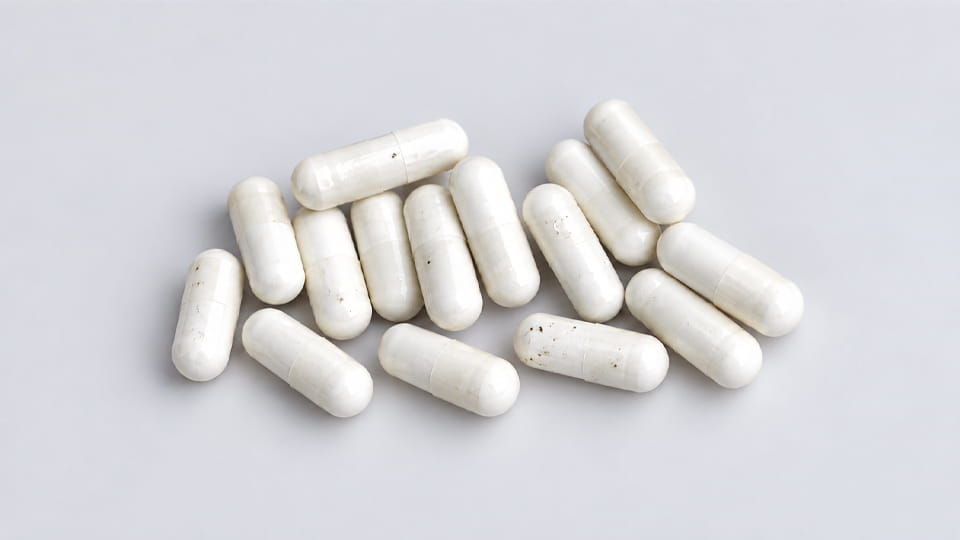
Oui, et c'est l'une des causes les plus fréquemment négligées de fragilité des capsules de gélatine.
Supposons que votre entrepôt soit contrôlé correctement, vos capsules non ouvertes ont passé l'inspection à l'arrivée, et les coques vides tournent bien sur la machine. Après remplissage et plusieurs semaines de stockage, cependant, les capsules finies se fissurent facilement.
Le remplissage peut extraire l'eau de la coquille.
Une étude bien connue du Journal of Pharmaceutical Sciences a étudié une substance médicamenteuse hautement hygroscopique contenue dans des capsules de gélatine dure.. Humidité transférée de la coque à la poudre, réduire suffisamment la teneur en eau de la coquille pour créer un problème de fragilité. Les chercheurs ont utilisé les relations sorption/désorption d’humidité pour prédire l’équilibre et repenser l’équilibre hydrique..
C’est pourquoi les équipes de formulation ne doivent pas évaluer uniquement la perte initiale de la poudre au séchage..
UN poudre hygroscopique a une affinité pour l'eau atmosphérique. Si son activité hydrique et ses caractéristiques d'humidité d'équilibre diffèrent fortement de celles de l'enveloppe de la capsule, la migration de l'humidité peut se poursuivre même après le scellement de la capsule. Le cadre d'activité de l'eau de l'USP est utile ici car aw aborde la disponibilité thermodynamique de l'eau plutôt que de simplement mesurer le pourcentage total d'eau..
En termes pratiques, Les équipes d’assurance qualité et de formulation devraient demander:
Le remplissage est-il très sec? Est-ce fortement hygroscopique? Quelle est son isotherme de sorption? Quelle est son activité aquatique? Que se passe-t-il une fois que l'enveloppe et la formulation ont atteint l'équilibre ??
Ne présumez pas qu’il suffit de spécifier indépendamment l’humidité de la coque et celle de la poudre.. La stabilité du produit fini dépend de système combiné.
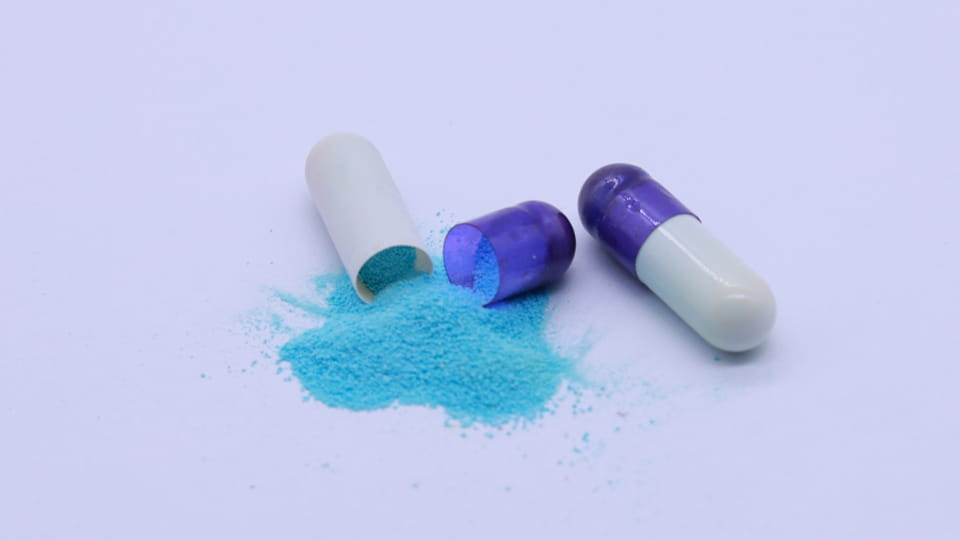
Pour capsules de gélatine dure vides, la littérature pharmaceutique cite généralement environ 15–25 °C et 30 à 65 % HR comme fenêtre de travail/stockage appropriée associée à la plage normale de 13 à 16 % d'eau de coquille. Certaines directives commerciales et industrielles utilisent une bande d'humidité légèrement plus étroite, telle que 35 à 65 % d'humidité relative.. Ces valeurs doivent être traitées comme des conseils techniques généraux et non comme une spécification universelle.. Les instructions de stockage et le certificat/spécifications approuvés par votre fournisseur de capsules doivent avoir la priorité.
Pour stockage des capsules de gélatine, éviter une exposition prolongée à l’air très sec, humidité élevée, chaleur excessive, lumière directe du soleil, et ouvertures répétées des colis. Conservez les capsules vides dans leur emballage de protection d'origine jusqu'à ce que vous en ayez besoin., et permettre aux conteneurs scellés de s'équilibrer dans la salle de traitement avant d'être ouverts lorsqu'il y a eu une différence de température significative. Ces pratiques suivent le principe plus large de l'USP selon lequel le stockage pharmaceutique doit protéger les matériaux de l'humidité et d'une exposition excessive à l'environnement et maintenir les conditions de stockage étiquetées..
Pour le produit pharmaceutique rempli, ne copiez pas simplement la plage de stockage à coque vide sur l'étiquette de votre produit. Les conditions de durée de conservation doivent être étayées par des données de stabilité générées avec la formulation dans le système de fermeture du récipient prévu.. Je Q1A(R2), tel qu'adopté par la FDA, établit des cadres de tests de stabilité qui incluent des conditions de température/HR contrôlées; ce sont des conditions d'étude de stabilité, pas automatiquement les spécifications de fonctionnement pour chaque salle à capsules vides.
Gélatine vs. HPMC et. Pullulane
La comparaison ci-dessous résume les recherches évaluées par des pairs sur la sorption de l'humidité., Définitions du shell USP, Spécifications techniques ACG/Qualicaps, et études récentes sur l'humidité. HPMC a généralement une humidité initiale plus faible et une plus grande résilience mécanique à faible HR; le pullulane absorbe moins d'humidité que la gélatine mais change quand même mécaniquement avec la variation d'humidité.
| Enveloppe de la capsule | Comportement typique en matière d'humidité | Risque de fragilité à faible humidité | Comportement à haute humidité | Ajustement pratique |
| Gélatine | Humidité de la coquille commune autour de 13 à 16 % | La plus haute sensibilité des trois | Peut adoucir, gonfler et devenir collant | Produits pharmaceutiques et suppléments conventionnels où l’humidité est bien contrôlée |
| Hpmc | Humidité inférieure de la coque, généralement environ 3 à 8 % selon le produit | Généralement beaucoup plus résistant | Échange toujours de l'humidité, mais conserve souvent mieux son intégrité mécanique que la gélatine | Remplissages hygroscopiques ou sensibles à l'humidité; produits à base de plantes |
| Pullulane | Absorption d'humidité inférieure à celle de la gélatine; la rétention d'humidité diffère de celle du HPMC | Peut encore devenir cassant s'il est suffisamment séché | La variation de l'humidité peut altérer les propriétés mécaniques | Produits à base de plantes, surtout là où d'autres propriétés barrières sont également importantes |
Pour une comparaison plus approfondie des matériaux, voir celui de Jinlu Guide des capsules de gélatine et des capsules HPMC, Guide des capsules Pullulane, et Guide des capsules vides. Le contenu existant de Jinlu permet également d'éviter de surcharger cet article avec des sujets de type capsule qui méritent leur propre intention de recherche..
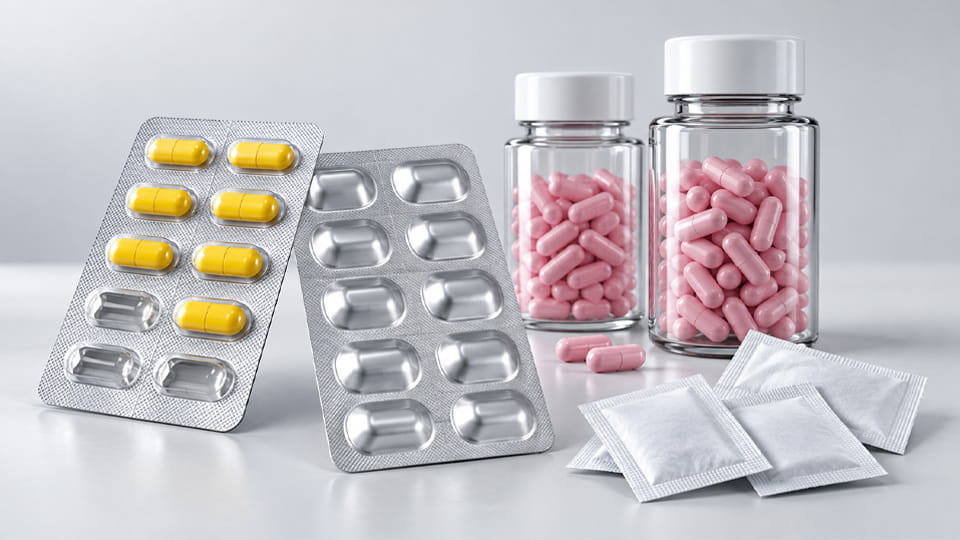
Bien emballage en capsules ne « gèle » pas la teneur en humidité de la capsule. Son travail consiste à contrôler la vitesse à laquelle l'environnement extérieur modifie le système interne..
USP <671> évalue les performances du conteneur en utilisant la transmission de l'humidité et de la vapeur, et la recherche sur l'emballage pharmaceutique montre pourquoi c'est important: différentes structures d'emballage peuvent produire des taux de pénétration d'humidité très différents et donc une stabilité du produit différente.
| Possibilité d'emballage | Protection relative contre l'humidité | Conseils pratiques |
| Plaquette PVC | Faible à modéré | Économique pour les formulations dont les données de stabilité montrent que cette barrière est suffisante |
| Plaquette PVC/PVDC | Plus haut que le PVC ordinaire | Utile lorsqu'une plus grande protection contre l'humidité est requise sans passer directement à l'aluminium formé à froid |
| Blister Alu-Alu moulé à froid | Très élevé | Candidat idéal pour les produits très sensibles à l'humidité ou les environnements de distribution exigeants |
| Bouteille en PEHD + fermeture/joint d'induction efficace | Potentiellement élevé au niveau du système | La performance dépend de la bouteille, doublure, fermeture, espace de tête, intégrité du joint et modèle d'ouverture |
| Bouteille + déshydratant | Contrôle actif de l'humidité | Le type et la quantité de déshydratant doivent être sélectionnés à partir des données de stabilité/équilibre d'humidité., pas en supposant que « plus c'est mieux » |
Dans une étude accélérée publiée sur un produit oral sensible à l'humidité, Les emballages blister en PVC ordinaire ont des résultats nettement moins bons que les structures blister à barrière plus élevée., tandis que l'aluminium moulé à froid et une bouteille en PEHD scellée par induction offraient une protection nettement plus forte.. Les chiffres exacts sont le produit- et spécifiques à la géométrie, la leçon n’est donc pas de copier l’emballage d’un autre produit, mais de valider la barrière contre votre propre formulation.
Le même principe s'applique à déshydratant. Les déshydratants réduisent l'humidité de l'espace libre de l'emballage et peuvent être extrêmement utiles pour les remplissages sensibles à l'humidité.. Mais comme la flexibilité de la coque de gélatine dépend elle-même de l'eau, un séchage agressif de l'espace libre peut théoriquement éloigner l'eau d'équilibre de la coquille. Il s'agit d'une inférence technique à partir de modèles établis de transfert d'humidité et d'équilibre des dessicants.: le bon objectif est un bilan hydrique validé, pas l'HR la plus basse possible.
Pour plus de détails sur l'emballage, Jinlu a déjà un dédié Guide complet des options d'emballage des capsules, cet article devrait donc rester axé sur la défaillance due à l'humidité plutôt que de répéter un guide complet sur les matériaux des blisters..
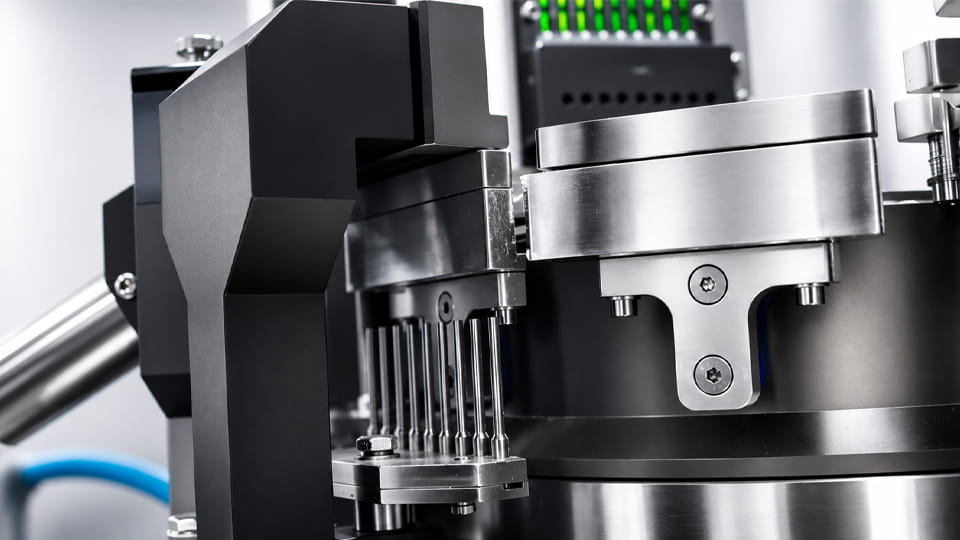
Le machine de remplissage de capsule C’est souvent là qu’un problème d’humidité en amont devient visible.
Une coque fragile peut survivre au stockage et à l'alimentation, mais se briser lorsque le corps de la capsule est retiré du capuchon., quand le corps entre dans le segment, ou lorsque la force de fermeture est appliquée. Une coque ramollie peut créer le problème inverse: les changements dimensionnels et l'adhérence plus élevée de la surface peuvent interférer avec une alimentation en douceur, orientation, séparation capuchon/corps, et verrouillage. Les conditions sèches peuvent également augmenter les problèmes de manipulation liés à l'électricité statique, tandis que la poudre humide ou cohésive peut créer ses propres difficultés d'alimentation et de dosage.
C'est pourquoi les équipes de production doivent résister à l'instinct de compenser immédiatement par plus de vide, plus de pression de fermeture, ou une vitesse plus lente. Inspectez d’abord les capsules inutilisées du même lot. Comparez leur condition physique avec des capsules ayant passé du temps en salle de remplissage. Examiner les enregistrements HR de l'entrepôt et de la salle, temps d'ouverture du sac, comportement en humidité de la formulation, et l'humidité de la coquille si votre programme de contrôle qualité la mesure. Puis inspectez le vide, alignement des outils, volume de remplissage, paramètres de dosage, et profondeur de fermeture.
Par exemple, si les capsules vides se fissurent déjà lors d'une manipulation manuelle douce, augmenter le vide de la machine ne corrigera pas le problème sous-jacent. Si les capsules sont saines avant le remplissage mais se fendent seulement après qu'un corps trop rempli ait atteint la station de fermeture, la machine ou le processus de dosage mérite plus d’attention.
Jinlu Défauts de remplissage des capsules: Problèmes courants, Causes & Guide de dépannage couvre le côté mécanique, y compris échec de séparation, rupture, remplissage excessif, vide, alignement, et les paramètres de fermeture – plus en détail.
Quand les gélules deviennent soudainement cassantes, doux, ou collant, utiliser la même séquence à chaque fois:
Tableau de dépannage concernant l'humidité des capsules
| Symptôme | Cause probable | Que vérifier en premier | Direction corrective rapide |
| La coque se fissure facilement | Perte d'humidité / faible humidité relative | Chambre RH, humidité de la coquille, exposition ouverte | Restaurer les conditions contrôlées; séparer les obus suspects |
| Les capsules se brisent lors de la séparation | Coque fragile ou vide excessif/contrainte mécanique | État de la coque non remplie + vide/outillage | Résoudre le problème environnemental avant d'augmenter le vide |
| Les capsules deviennent molles | Absorption excessive d'humidité | RH, historique de stockage, barrière de colis | Réduire l’exposition et revoir la protection barrière |
| Les capsules collent ensemble | Humidité élevée, chaleur, déformation | RH, température, sceau d'emballage | Environnement de contrôle; évaluer le lot affecté |
| Les capsules sont normalement vides mais cassantes après remplissage | Remplissage hygroscopique/très sec | Remplissez aw, données de sorption, transfert d'humidité de la coque au remplissage | Réévaluer la compatibilité formulation-enveloppe |
| La poudre devient collante ou l'écoulement se détériore | Absorption de l'humidité de la poudre | Poudre ah, RH, conditionnement | Contrôler l'exposition et évaluer la formulation/l'emballage |
| Les problèmes n'apparaissent qu'après des mois dans le pack | Équilibre du colis ou pénétration d’humidité | Données de stabilité, MVTR, fermeture, déshydratant | Réévaluer le système final de fermeture des conteneurs |
Ces relations symptôme-cause sont étayées par des études sur le transfert d'humidité de la gélatine, recherche récente sur l'humidité des capsules, Principes d'emballage USP, et preuves de dépannage de la machine de remplissage.
Pour la prévention courante, conserver les capsules vides scellées jusqu'à leur utilisation; surveiller l'environnement de production réel; minimiser l’exposition ouverte inutile; caractériser les formulations hygroscopiques plutôt que de les juger sur leur apparence; sélectionner le matériau de la coque autour de la formulation; choisir l'emballage à partir des données de barrière contre l'humidité et de stabilité; taille déshydratant scientifiquement; et confirmer le produit fini dans l'emballage de marché final grâce à un programme de stabilité approprié.
En résumé, la fragilité ou le caractère collant de la capsule est presque toujours un problème d'humidité. En contrôlant l'humidité, choisir le bon matériau de capsule, et en utilisant un emballage approprié, les fabricants peuvent maintenir la qualité des capsules et éviter les problèmes de production. Par exemple, Les solutions de Jinlu Packing comprennent des contrôles environnementaux précis et des machines d'emballage à haute barrière pour conserver les capsules conformément aux spécifications..
Maintenir une humidité relative de 40 à 60 %, conserver à 15-25°C (gélatine), en utilisant des blisters en aluminium ou des bouteilles desséchées, et la sélection de types de capsules stables à l'humidité est essentielle pour éviter la fragilité ou le caractère collant. Quand des problèmes surviennent, reportez-vous à la liste de contrôle de dépannage et à l'organigramme ci-dessus: identifier si le problème est dû à une humidité faible ou élevée, puis corrigez l'environnement ou l'équipement en conséquence. Avec les meilleures pratiques en place, les capsules se rempliront et seront expédiées avec succès, maintenir l’efficacité du produit et la confiance des clients.
Prêt à optimiser votre production de capsules? Jinlu Packing propose des équipements d'encapsulation et d'emballage avancés conçus pour les produits pharmaceutiques sensibles à l'humidité. Contactez nos spécialistes pour obtenir des conseils sur le contrôle de l’humidité, solutions d'emballage, et des lignes de remplissage à grande vitesse qui conservent les capsules parfaitement stable de l'entrepôt au patient.
Capsules (surtout la gélatine) sécher lorsque l'humidité relative ambiante est faible. Les coquilles de gélatine contiennent normalement environ 13 à 16 % d'eau; si l'HR baisse (par exemple. entrepôt chauffé), les coquilles perdent de l'humidité et deviennent cassantes. Pour éviter cela, conservez-les à ~ 40–50 % HR et 15–25°C. L’utilisation de sacs ou de blisters à haute barrière maintient également leur humidité.
Lorsque l'HR est élevée, les capsules absorbent l'humidité et adoucissent. À une humidité ou une température élevée, la gélatine devient gélatineuse et peut coller ensemble. C'est pourquoi des blisters ou des déshydratants sont utilisés: ils empêchent l'humidité de pénétrer. Si vous voyez des capsules collantes, vérifier que l'emballage a été scellé et abaisser le RH de stockage.
Oui. Une poudre très sèche à l’intérieur peut extraire l’humidité d’une coque de gélatine humide, le rendant cassant. De même, un remplissage très humide ou huileux peut ajouter de l'humidité à une coque plus sèche. Utilisez des capsules adaptées à votre type de remplissage (par exemple. HPMC pour poudres hygroscopiques) et équilibrer l'humidité de la coque et du remplissage pour minimiser la migration.
Surveillez l’HR de votre zone de production. S'il se situe en dehors de la plage recommandée de 35 à 65 %, l'humidité est probablement la cause. Vérifiez également la teneur en humidité de la capsule vide si possible.. Pannes fréquentes à certaines saisons (l'hiver contre. été) indiquent souvent des problèmes de RH environnementale.
Les capsules HPMC offrent la meilleure résistance à l'humidité; ils ont une très faible humidité de base et une perméabilité à l'humidité beaucoup plus faible. Le pullulane est meilleur que la gélatine mais pas aussi bon que le HPMC. La gélatine est la moins résistante à l'humidité.
Les déshydratants peuvent être utiles dans des bouteilles ou des sachets, mais utilisez-les judicieusement. Si vous séchez trop les capsules avec trop de déshydratant, ils peuvent devenir cassants. Typiquement, un pack de silice par bouteille (dimensionné de manière appropriée) est suffisant. Testez des lots avec et sans dessicant pour trouver le bon équilibre.
L'emballage blister scelle chaque capsule dans sa propre cavité, offrant une excellente barrière contre l’humidité et la lumière (surtout une feuille Alu-Alu). Études (et le guide d'emballage de Jinlu) montrer que les blisters offrent « une protection supérieure contre l’humidité et la lumière » par rapport aux bouteilles en vrac. Les bouteilles sont plus économiques pour les gros volumes mais dépendent de bouchons et d'un déshydratant..
Non. La teneur en humidité mesure la quantité d'eau présente. L'activité de l'eau décrit la disponibilité thermodynamique de l'eau et est particulièrement utile pour évaluer le transfert d'humidité., stabilité chimique, et comportement de formulation.
Souvent, Oui. Les coques HPMC commerciales contiennent généralement beaucoup moins d'eau que la gélatine et conservent mieux leurs propriétés mécaniques à faible HR.. Qualicaps positionne spécifiquement les capsules HPMC pour les formulations hygroscopiques, et des recherches comparatives rapportent une sorption d'humidité plus faible pour le HPMC que pour la gélatine ou le pullulane.. La sélection finale nécessite encore des tests de compatibilité et de stabilité de la formulation.
Il n’y a pas de gagnant universel. Les blisters à haute barrière tels que l'aluminium moulé à froid offrent une très forte protection, tandis qu'une bouteille en PEHD correctement conçue, joint d'induction, et le système déshydratant peut également bien fonctionner. Choisir selon la formulation’sensibilité à l'humidité, marchés cibles, utiliser un modèle, MVTR, intégrité du joint, et résultats de stabilité.
Références:
1.Une étude sur la fragilité des capsules de gélatine: transfert d'humidité entre l'enveloppe de la capsule et son contenu —— PubMed
2.Fragilité des capsules de gélatine en fonction de l'humidité relative à température ambiante —— ScienceDirect
3.Propriétés de sorption et de désorption d'humidité de la gélatine, Gélules HPMC et pullulane —— PubMed
4.Activité aquatique —— USP <922>
5.Évaluation comparative des coques de capsules d'inhalation de gélatine et de HPMC exposées à des conditions d'humidité simulées —— PubMed
6.Sélection d'emballages pour la protection contre l'humidité des solides, produits pharmaceutiques oraux —— Bibliothèque en ligne WILEY