La mise sur le marché d’un nouveau produit pharmaceutique implique bien plus que le développement d’une formulation efficace.. L’une des décisions les plus importantes auxquelles les fabricants sont confrontés est de choisir le bon emballage.. Le conditionnement choisi pour un produit pharmaceutique peut affecter directement sa stabilité, durée de conservation, conformité réglementaire, sécurité des transports, et l'expérience des patients. Un emballage qui ne protège pas de l’humidité, oxygène, lumière, ou la contamination peut compromettre la qualité du produit bien avant qu'il n'atteigne l'utilisateur final. L'emballage n'est donc pas qu'un simple contenant : c'est un élément essentiel du système de protection des produits..
Pour les fabricants de produits pharmaceutiques, directeurs de production, et les équipes achats, sélectionner le bon emballage nécessite d’équilibrer plusieurs facteurs, y compris la forme posologique, compatibilité des matériaux, performance de la barrière, sécurité des patients, efficacité de production, et évolutivité future. Si le produit est une tablette, capsule, poudre, liquide, ou injectable, la bonne solution d'emballage peut contribuer à garantir l'intégrité du produit tout en favorisant une production commerciale efficace. Dans ce guide, nous explorerons les facteurs clés que chaque fabricant devrait prendre en compte lors du choix de l'emballage d'un nouveau produit pharmaceutique.
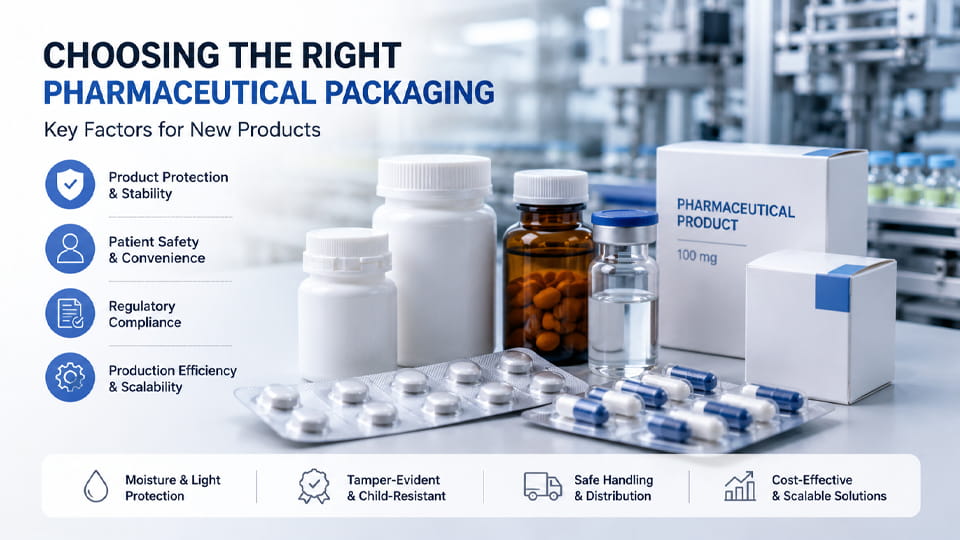
Pourquoi la sélection des emballages est importante dans le secteur pharmaceutique
Emballage pharmaceutique est vital, pas facultatif. Contrairement aux emballages de consommation ordinaires, les emballages pharmaceutiques doivent protéger l’intégrité du médicament pendant toute sa durée de conservation. L'OMS et les directives réglementaires soulignent que l'emballage doit protéger les médicaments des humidité, lumière, oxygène et autres menaces externes. Autrement dit, il « préserve la stabilité et la qualité des médicaments » et empêche la détérioration ou la falsification.
Les fonctions clés de l'emballage comprennent:
- Protection des produits: Protéger de l'humidité, oxygène, lumière, chaleur et contaminants. Par exemple, un guide de l'USP note que les pilules solides « doivent être protégées de la vapeur d’eau » puisque l'humidité peut modifier l'activité ou la dissolution du médicament. Matériaux haute barrière (feuille d'aluminium, films enduits, verre ambré) sont souvent utilisés là où la sensibilité est élevée.
- Conformité réglementaire: L'emballage doit être conforme à la FDA, EMA et OMS Exigences BPF. Cela inclut le bon intégrité de la fermeture du conteneur (CCI), matériaux validés, et des fonctionnalités comme inviolable scellés. Emballage à l'épreuve des enfants est nécessaire pour de nombreux médicaments afin d’éviter toute ingestion accidentelle. Sérialisation et traçabilité (codes-barres uniques sur chaque paquet) sont désormais obligatoires sur les principaux marchés (FDA-DSCSA, FMD de l'UE).
- Sécurité et observance des patients: La conception de l’emballage doit éviter les erreurs de dosage et les abus. Étiquettes inviolables et bouchons de sécurité enfants « protéger contre les intoxications accidentelles ». Fonctionnalités conviviales (ouverture facile, aides au dosage, ampoules de calendrier) aider les patients à prendre correctement leurs médicaments.
- Marque et communication: Emballage secondaire (cartons, étiquettes) donne des instructions, avertissements, et marque. Selon les experts, les étiquettes doivent être durables et claires pour éviter les confusions. En effet, une analyse a trouvé près 50% des rappels de médicaments sont liés à des problèmes d’emballage/étiquetage.
En bref, l’emballage est une protection active. Ne pas choisir le bon package peut conduire à des API dégradées, préjudice au patient, et maux de tête réglementaires. Le bon emballage "protège la qualité des médicaments» et soutient ainsi l'efficacité et la réputation du produit.

Étape 1: Comprenez les caractéristiques de vos nouveaux produits pharmaceutiques
La première étape est une audit produit approfondi. Demander: Quelle est la forme posologique (comprimé, capsule, poudre, liquide, injectable, etc.)? Quelles sensibilités le médicament a-t-il (humidité, oxygène, lumière, chaleur)? Faut-il un contrôle de dosage spécial (inhalateur-doseur, compte-gouttes, seringue préchargée)?
- Forme posologique: Les comprimés et les gélules sont généralement dose solide et souvent emballé dans des blisters ou des bouteilles. Les liquides/suspensions entrent dans bouteilles ou flacons. Les injectables nécessitent flacons stériles, ampoules ou seringues préremplies. Les gaz/inhalateurs utilisent des cartouches spécialisées. Les poudres ou granulés peuvent être conditionnés dans sachets, des sticks ou des bouteilles.
- Sensibilités chimiques/physiques: Le médicament est-il hygroscopique ou sujet à l'oxydation? Médicaments très sensibles à l'humidité (par exemple. comprimés effervescents) besoin emballage haute barrière comme les blisters Alu-Alu ou les flacons doublés de dessicant. Les composés sensibles à la lumière ont besoin contenants opaques ou teintés. Les médicaments réactifs nécessitent des matériaux inertes (par exemple. verre, certains polymères).
- Durée de conservation et stabilité: Tenir compte de tout contrôle de température requis (réfrigération) ou conditions sous vide/stériles. Certains vaccins ou produits biologiques peuvent nécessiter un emballage sous chaîne du froid ou des flacons spécialisés..
Point clé: L'emballage primaire doit être inerte et protecteur. Il ne doit pas lessiver ou absorber le médicament, et il doit maintenir un environnement scellé. Par exemple, La FDA note que les récipients oraux solides devraient avoir un «faible taux de perméation de la vapeur d'eau, et le système de fermeture doit établir un sceau ». Il est crucial d'effectuer des tests de compatibilité et d'extractibles avec les composants d'emballage candidats..
Liste de contrôle pour l'audit du produit:
- Forme/type posologique (comprimé, capsule, liquide, etc.)
- Conditions de stockage/stabilité (température, humidité, lumière)
- Exigences de dosage/administration (compte-gouttes, pompe, dose unitaire)
- Considérations relatives à l'utilisation par les patients (médecine enfant vs adulte, mobilité, adapté aux seniors)
- Contraintes réglementaires (par exemple. les informations sur les patients font-elles partie du pack principal ??)
Cette compréhension déterminera votre choix d’emballage primaire (l'emballage en contact direct avec le médicament). Suivant, nous discutons de ces options.
Étape 2: Choisissez l'emballage primaire approprié
Emballage primaire est le contenant immédiat qui contient le médicament. Il touche directement le médicament. Les types d'emballages primaires courants comprennent packs de cloques, bouteilles (plastique/verre), flacons/ampoules, pochettes, tubes, etc.. Chacun a des avantages/inconvénients:
- Packs de cloques (Alu-Alu ou Alu-PVC): Idéal pour les formes solides unitaires (comprimés, gélules). Ils fournissent excellente barrière contre l'humidité et la lumière, surtout le De tout le temps (feuille moulée à froid) taper. Les blisters garantissent que chaque dose est scellée jusqu'à son utilisation, améliorer la conformité et réduire la contamination croisée. Les ampoules modernes peuvent être rendues résistantes aux enfants. Équipement: Grande vitesse machines d'emballage sous blister formation de poignée, alimentation, thermoscellage et découpe (par exemple. Blistereuses Alu-Alu de JinluPacking).
- Bouteilles (Plastique ou verre): Commun pour les emballages à unités multiples (sirops, gélules, comprimés). Les bouteilles sont rentables pour les gros volumes. Bouteilles en verre (Borosilicate de type I) offrent une excellente inertie chimique et peuvent être teintés en ambre pour une protection contre la lumière. Bouteilles en plastique (PEHD, PP) sont légers et incassables, mais ont généralement une plus grande perméabilité à l'humidité. Les bouteilles utilisent souvent bouchons de sécurité pour enfants. Équipement: Les machines de comptage/remplissage remplissent et bouchent les bouteilles, et peut insérer des déshydratants ou des joints en aluminium (voir sur les lignes de comptage). Les lignes de remplissage de bouteilles et les machines de capsulage automatiques de Jinlu intègrent ces étapes.
- Sachets & Packs de bâtons: Utilisé pour les poudres, granulés, ou des liquides unidose (par exemple. antibiotiques, SRO). Il s'agit de pochettes flexibles en aluminium ou en stratifié scellées de tous les côtés.. Les sachets offrent une excellente barrière (souvent avec du papier aluminium) et commodité. Équipement: Formulaire de machines d'emballage de sachets, remplir, et scellez ces pochettes en une seule fois.
- Flacons & Ampoules: Norme pour les injectables stériles (solutions, poudres lyophilisées). Flacons (verre ou plastique) avec bouchons en caoutchouc maintiennent la stérilité. Ampoules (verre) sont hermétiquement fermés jusqu'à leur utilisation. Les deux offrent une grande pureté et conviennent aux aiguilles/seringues. Équipement: Lignes de remplissage de flacons, des machines de capsulage et de sertissage sont utilisées (souvent avec des zones de flux laminaire pour la stérilité).
- Autres: Tubes (en métal ou en plastique) sont courants pour les pommades/crèmes. Seringues ou inhalateurs préremplis (MDI/DPI) impliquent un emballage d’appareil personnalisé. Ceux-ci nécessitent souvent des équipements de remplissage et d'assemblage spécialisés..
L’adéquation de chaque option dépend de votre produit:
- Coût par rapport. Protection: Le tableau ci-dessous compare les principaux types de packs:
| Taper |
Mieux pour |
Niveau de protection |
Coût |
Équipement |
| Pack de cloques |
Comprimés, Capsules |
Très élevé (Humidité/Lumière) |
Moyen |
Machine d'emballage sous blister |
| Bouteille |
Comprimés, Sirops, Pilules |
Moyen (bien avec les inserts) |
Faible |
Ligne de remplissage/bouchage de bouteilles |
| Sachet/Bâton |
Poudres, Granulés |
Haut (Barrière en aluminium) |
Moyen |
Sachet Packing Machine |
| Flacon/Ampoule |
Injectables, Sérums |
Très élevé (Verre stérile) |
Haut |
Remplissage de flacons & Ligne de scellage |
Choisissez le conditionnement principal qui correspond à la forme posologique et aux besoins en matière de barrière. Par exemple, un comprimé sensible à l'humidité peut nécessiter un Blister Alu-Alu ou une bouteille en verre ambré avec déshydratant. Des comprimés en vente libre plus ordinaires pourraient être conditionnés dans une bouteille en plastique avec un bouchon étanche aux fibres. (et fonction de sécurité enfants).
Conseil: Si le respect de la dose unitaire est important (Par exemple, distribution hospitalière ou trousses de voyage), les blisters ou les sticks sont souvent préférés. Pour la flexibilité (les dosages peuvent être modifiés), les bouteilles sont meilleures.
Étape 3: Tenir compte des exigences de stabilité et de durée de conservation
Les décisions d’emballage sont indissociables de la stabilité. Un mauvais contenant peut entraîner une dégradation ou une défaillance de l'étiquette. Considérations clés:
- Propriétés barrières: Utiliser des matériaux qui bloquent les facteurs critiques. Pour médicaments sensibles à l'humidité, des films ou du verre à haute barrière sont nécessaires. Par exemple, blisters en aluminium formés à froid ne fournit pratiquement aucune pénétration d’humidité. Les directives de stabilité FDA/ICH indiquent que les produits contenus dans des contenants véritablement imperméables (Par exemple, blisters en aluminium ou verre scellé) peut être testé dans des conditions normales sans études d'humidité spéciales. Inversement, emballages semi-perméables (comme certains plastiques) nécessitent une évaluation minutieuse de l’humidité.
- Protection contre la lumière: Les API sensibles à la lumière nécessitent un emballage opaque ou ambré. Par exemple, les bouteilles en verre ambré ou les pochettes métallisées protègent des UV. Une pratique courante consiste à emballer les flacons transparents dans un suremballage en aluminium si nécessaire..
- Compatibilité: Assurez-vous que les matériaux d’emballage ne réagissent pas avec le médicament. Le verre est inerte, mais certains plastiques peuvent lessiver ou absorber des composés. Réaliser des études extractibles/lixiviables sur les composants primaires. Orientations réglementaires (FDA, Ema) attendre intégrité de la fermeture du conteneur (CCI) tests tout au long de la durée de conservation.
- Détermination de la durée de conservation: Etudes de stabilité (Je Q1A/R2) doit utiliser le système de fermeture de conteneur proposé. Si les essais de durée de conservation montrent une dégradation, vous devrez peut-être ajuster l'emballage (par exemple. passer à une meilleure barrière) ou instructions de manipulation/stockage sur les étiquettes.
- Fonctionnalités avancées: Certains emballages intègrent des déshydratants ou des désoxygénants. Stratifiés multicouches (PET/aluminium/PE) sont souvent utilisés pour une distribution mondiale. Pour une protection de très haute précision, emballage actif (absorbeurs d'humidité intégrés) peut être utilisé.
Liste de contrôle pour la compatibilité de la stabilité:
- Choisissez un matériau primaire à haute barrière si nécessaire (De tout le temps, verre, stratifiés).
- Vérifier la méthode de scellement (thermoscellage, casquettes) permet une faible transmission de vapeur d'humidité (MVTR).
- Effectuer une stabilité accélérée (40°C/75%HR) selon ICH pour garantir l'absence de pénétration d'humidité ou de changements chimiques.
- Planifier l’intégrité de la fermeture des conteneurs (test de pénétration de vide ou de colorant) spécialement pour les produits liquides/stériles.
- S'assurer que l'emballage peut résister aux chocs de distribution (tests de chute/vibration avec emballage secondaire/tertiaire).
En sélectionnant en amont un emballage répondant aux exigences de stabilité, vous évitez une reformulation coûteuse ou un reconditionnement ultérieur.
Étape 4: Évaluer la commodité et l’observance du patient
Au-delà de la protection, un emballage moderne devrait aider les patients à utiliser correctement leurs médicaments. Conception d'emballage influence directement l’adhésion et la sécurité. Considérer:
- Ouverture/Facilité d'utilisation: Les patients âgés peuvent avoir des difficultés avec les bouchons serrés. Offre casquettes adaptées aux seniors ou des joints faciles à décoller peuvent être bénéfiques. Pour les médicaments en dose unitaire, ampoules de calendrier (jours ou heures étiquetés) peut rappeler aux patients de prendre la bonne pilule.
- Aides au dosage: Le cas échéant, inclure des tasses/cuillères à mesurer pour les liquides, compte-gouttes pour produits ophtalmiques, ou pompes à doseur. Marquages clairs sur le conteneur (diplômes, bandes de couleurs) améliorer la précision.
- Portabilité: Si les patients voyagent ou transportent des médicaments, des sachets compacts ou des petites bouteilles sont utiles. Les fonctionnalités inviolables assurent la sécurité.
- Fonctionnalités de conformité: Certains packs principaux sont conçus pour la conformité: Par exemple, distributeurs de pilules avec alarmes intégrées, ou des cartes blister intelligentes qui suivent l'utilisation. Si une adhésion élevée est essentielle, envisager de telles innovations.
- Étiquettes et inserts: Assurez-vous que, instructions multilingues sur le carton ou la notice. Un bon emballage aide les pharmaciens et les patients avec des étiquettes lisibles, tableaux de dosage, et icônes de stockage.
Essentiellement, demander: Le patient trouvera-t-il ce package facile et sûr à utiliser? Sinon, ils peuvent abuser ou abandonner le produit. Y compris des fonctionnalités centrées sur le patient (sécurités enfants, ouverture facile, étiquetage clair) satisfait également les régulateurs qui mettent l’accent sur la sécurité des patients.
Étape 5: Garantir la conformité réglementaire
L’emballage pharmaceutique est fortement réglementé. Problèmes clés de conformité:
- Sécurité enfants (CR) exigences: De nombreux pays (NOUS, UE, UA) rendre obligatoire l'emballage CR pour les médicaments oraux à haut risque. L'OMS note que « Des fermetures de sécurité enfants ont été développées » pour protéger les enfants. Assurez-vous que les médicaments oraux solides et liquides sur ordonnance utilisent des bouchons CR certifiés ou des mécanismes à poussée-tour si la loi l'exige.. (Par exemple. NOUS 16 CFR 1700 or EU standards EN 14375).
- Sceaux inviolables: La FDA et d’autres exigent la preuve qu’un colis n’a pas été ouvert. Bandes anti-bourrage, films rétractables, ou les joints détachables sont courants sur les bouteilles; les joints en aluminium sont courants sur les bocaux. Même les plaquettes thermoformées devraient être difficiles à ouvrir sans dommages évidents.
- Étiquetage: Les packages primaires et secondaires doivent contenir toutes les informations requises (nom du médicament, force, forme posologique, numéro de lot/lot, expiration, conditions de stockage, fabricant). Les polices doivent être lisibles et conformes aux directives de la pharmacopée. Par exemple, FDA 21 CFR 201.15 couvre la durabilité de l’étiquette.
- Sérialisation et traçabilité: Des réglementations comme la DSCSA de la FDA (NOUS) et la directive européenne sur les médicaments falsifiés exigent des codes uniques (par exemple. 2Codes-barres D) sur chaque unité vendable. La conception de l'emballage doit permettre l'impression ou la gravure des numéros de série et des codes datamatrix sur les plaquettes thermoformées ou les étiquettes des bouteilles.. Votre ligne d'emballage peut avoir besoin d'une imprimante de codage et d'un système de vision, et intégration avec une base de données de suivi et de traçabilité.
- Bonnes pratiques de fabrication (GMP): Lignes de conditionnement doit respecter les BPF (nettoyabilité, traçabilité des matières, etc.). Tous les packs primaires utilisés doivent être qualifiés GMP (par exemple. ISO 15378 pour matériaux d'emballage). Les machines devraient être IR/WH/PQ qualifié. (Voir ci-dessous pour l'équipement d'emballage Jinlu).
Conseil réglementaire clé: Ne considérez pas la conformité comme une réflexion après coup. Par exemple, le fait de ne pas inclure une fonction d'inviolabilité peut bloquer l'enregistrement du produit. Examinez tôt les règles spécifiques au pays – par ex.. USP <661> pour récipients en plastique, CFR 211 pour les contrôles d'emballages. Vérifiez toujours que l'emballage et l'équipement de conditionnement choisis peuvent répondre à ces normes.
Étape 6: Équilibrer le coût de l’emballage et l’efficacité de la production
A ce stade, évaluer coût total de possession (TCO) pour les options d'emballage. Considérer:
- Coût du matériel: Les pochettes flexibles et les blisters peuvent coûter plus cher à l'unité que les simples flacons. Le film blister Alu-Alu est plus cher que le film PVC. Les bouteilles en verre coûtent plus cher que le plastique.
- Débit de l'équipement: Les formats à haute barrière comme les blisters peuvent fonctionner plus lentement que les lignes de bouteilles, ayant un impact sur le nombre d'équipements nécessaires. Inversement, les remplisseuses de bouteilles peuvent atteindre des vitesses très élevées (plusieurs milliers de bouteilles/heure) mais j'ai besoin de redresseurs, casquettes, et étiqueteuses en ligne.
- Complexité de la ligne: Des emballages plus complexes (par exemple. plaquettes thermoformées unitaires) nécessite des machines spécialisées. Vérifiez si les investissements en capital et la maintenance correspondent à votre budget.
- Travail: Les lignes entièrement automatisées réduisent le travail manuel mais augmentent le capital. Les machines semi-automatiques coûtent moins cher mais nécessitent plus d'opérateurs.
- Logistique: Les emballages secondaires/tertiaires coûtent également. Les grandes bouteilles en verre sont plus lourdes à expédier. Les cartons volumineux augmentent les coûts de transport.
- Déchets et rendement: Plus de traitement (par exemple. poinçonnage de blisters) peut générer de la ferraille. Évaluer les matériaux gaspillés (couper des ampoules, bouteilles cassées, etc.).
Effectuer un brouillon comparaison des coûts: par exemple. coût par paquet final, y compris les matériaux et le traitement. Pensez également à la vitesse (unités par heure) et taille de lot requise.
UN Liste de contrôle du coût total de possession:
- Comparez le coût unitaire des matériaux d'emballage.
- Évaluer le débit machine nécessaire par rapport à la demande.
- Calculer les coûts de main d'œuvre et d'énergie pour chaque ligne.
- Inclure les coûts d’élimination/recyclage des déchets.
- Tenir compte du risque de retouche (par exemple. si l'emballage échoue, coût de réétiquetage ou de reconditionnement).
- Mise à l'échelle future: si les volumes doublent, cette solution est-elle évolutive?
Souvent le le matériau le moins cher n’est pas le meilleur si cela entraîne des rappels ou des rejets. Trouver un équilibre est crucial: Parfois, payer plus pour une meilleure barrière ou une meilleure automatisation s'avère payant en termes de rendement et de conformité..
Étape 7: Garantir que l’emballage peut s’adapter à la demande future
Ne pensez pas seulement au lancement immédiat, mais le cycle de vie à long terme du produit:
- Pilote contre. Commercial: Pour les premiers lots cliniques ou de petits marchés, vous pouvez utiliser des lignes manuelles ou semi-automatiques. Pour une production à grande échelle, une ligne entièrement automatisée sera nécessaire. Assurez-vous que votre choix (ou la proposition du vendeur) permet des mises à niveau modulaires.
- Modularité des équipements: Pouvez-vous ajouter des voies ou des unités pour augmenter la vitesse? Par exemple, certaines blistereuses peuvent ajouter des poches rotatives supplémentaires. Les lignes d'embouteillage peuvent ajouter des remplisseuses parallèles.
- Intégration: Pensez de bout en bout: comptage/remplissage → scellage → cartonnage → emballage de caisses → palettisation. Si vous êtes partenaire de Jinlu Packing ou similaire, ils peuvent concevoir un ligne de conditionnement clé en main qui inclut la sérialisation, mise en carton, emballage des caisses, etc..
- Échelle réglementaire: Tout changement dans les composants de l'emballage (par exemple. un nouveau fournisseur de bouteilles) nécessite une nouvelle approbation réglementaire si cela affecte la stabilité ou la conformité. Planifier le contrôle qualité des fournisseurs d'emballages et les fournisseurs de secours.
- Produits futurs: Si votre entreprise peut produire d'autres formes posologiques (par exemple. un gel à l'avenir), choisissez un équipement flexible. Les remplisseuses de gélules modulaires ou les blisters capables de gérer différents formats peuvent constituer un bon investissement..
Impliquer des ingénieurs d’emballage ou un consultant dès le début peut éviter des goulots d’étranglement plus tard. Comme le note un expert du secteur, « L'emballage doit être considéré en parallèle avec le développement de la formulation., pas après coup. Les bonnes décisions précoces faciliteront la mise à l’échelle et l’expansion de la ligne.
Erreurs courantes de sélection d’emballage à éviter
- Laisser la sélection des emballages trop tard: Ne décidez pas de l’emballage seulement une fois la formulation verrouillée. Les premières études de stabilité devraient utiliser l'emballage final, pas de pots factices.
- Sauter les tests de stabilité: Ne présumez jamais qu’un conteneur fonctionnera; testez toujours votre médicament dans le contenant/fermeture réel dans les conditions ICH. Une formule par ailleurs stable peut se dégrader si l'emballage est de mauvaise qualité.
- Se concentrer uniquement sur le coût: Les matériaux bon marché peuvent permettre d'économiser de l'argent au départ, mais coûtent plus cher en cas de rappels ou de durée de conservation raccourcie.. Équilibrer le coût avec la protection.
- Ignorer les facteurs liés au patient: Une bouteille standard peut correspondre aux objectifs de coûts, mais si les patients ne peuvent pas l'ouvrir ou adhérer, le produit sera sous-performant sur le marché.
- Sous-estimer les besoins réglementaires: Le fait de ne pas inclure un sceau d'inviolabilité ou une fermeture à l'épreuve des enfants lorsque cela est nécessaire peut suspendre l'approbation.. Consultez toujours les lignes directrices.
- Négliger la chaîne d’approvisionnement: Tenir compte des délais d’approvisionnement et de la durée de conservation des emballages. Certains matériaux spécialisés (comme des doublures évacuant l'oxygène) les délais de livraison peuvent être longs.
En évitant ces erreurs et en revue transversale (R&D, Assurance qualité, Production, Réglementaire), vous vous assurez que l'emballage que vous avez choisi est réalisable, conforme, et efficace.
Emballage recommandé par nouveau type de produit pharmaceutique
| Type de produit |
Emballage primaire recommandé |
| Comprimés/Capsules |
Dose unitaire packs de cloques (Alu-Alu ou PVC/Alu) ou en gros bouteilles. Bouchons sécurité enfants pour bouteilles. Équipement idéal: machine d'emballage sous blister ou comptage de comprimés/capsules & ligne d'embouteillage. |
| Poudres/granulés oraux |
Sachets ou paquets de bâtons (pour dose unique); ou bouteilles (pour le vrac). Machines de conditionnement de sachets pour dose unitaire, remplisseuses à vis pour bouteilles. |
| Liquides/Sirops |
Bouteilles en plastique ou en verre avec bouchons à vis (souvent avec un joint en aluminium et un capuchon de sécurité enfants). Pour une grande pureté, Verre de type I. Équipement: ligne de remplissage de liquide (pompes, bouchage en ligne). |
| Injectables |
Flacons ou ampoules en verre (stérile) ou seringues préremplies. Utiliser des machines de remplissage et de sertissage de flacons stériles en salle blanche. |
| Crèmes/Onguents (Semi-solides) |
Tubes ou pots (tubes en aluminium/plastique, pots en verre/plastique). Tubes avec scellés d'inviolabilité. Machines de remplissage de tubes semi-automatiques ou automatiques. |
| Comprimés effervescents |
Tubes ou bouteilles en aluminium (rester au sec); souvent avec un déshydratant. Les blisters en papier d'aluminium sont également courants. Machines à tubes (pour tablettes) ou des blisters. |
| Suppositoires |
Barquettes blister (généralement Alu/PVC ou Alu/Alu) ou des boîtes d'unités emballées individuellement. Blistereuses ou thermoformeuses. |
| Inhalateurs/Sprays nasaux |
Canettes MDI ou cartouches DPI (spécifique à l'appareil). Coordination avec le fabricant de l'appareil; équipement de remplissage/remplissage de canettes sur mesure. |
Cette cartographie permet de garantir que chaque forme de médicament bénéficie de la protection appropriée. Par exemple, les plaquettes thermoformées sont excellentes pour les doses orales solides, alors que les flacons en verre sont indispensables pour les injectables stériles. Le tableau suggère également des équipements: par exemple. machines d'emballage sous blister, lignes de remplissage et de bouchage de bouteilles, machines d'emballage de sachets, remplisseurs de flacons, et ainsi de suite.
Comment Jinlu Packing aide les sociétés pharmaceutiques
Jinlu Packing est un leader fabricant de machines d'emballage pharmaceutique. Nous proposons des solutions clé en main pour les nouvelles lignes de conditionnement de médicaments. Offres clés:
- Machines d'emballage en cloque: Blistereuses à grande cadence pour emballages PVC/Alu ou Alu-Alu. Conceptions personnalisées pour s'adapter au format de votre comprimé/capsule et à vos exigences de vitesse.
- Remplissage de bouteilles & Lignes de bouchage: Remplissage de bouteilles automatisé, plafonnement, et systèmes d'étiquetage. Nos lignes de comptage et de remplissage peuvent intégrer des redresseurs, inséreurs déshydratants, scellants en aluminium, et capsuleuses pour bouteilles de comprimés/gommes.
- Encartonneuses: Encartonneuses horizontales et verticales pour ériger les cartons autour des blisters, bouteilles, ou sachets. Des fonctionnalités comme 100% analyse de code pour la sérialisation et les changements rapides.
- Systèmes de sérialisation/codage: Nous pouvons équiper les lignes de codeurs jet d'encre/laser et d'inspection visuelle pour imprimer et vérifier les lots, expiration, et codes uniques.
- Lignes de conditionnement complètes: De l’alimentation du produit à la mise en caisse, nous pouvons concevoir une ligne entièrement intégrée répondant aux besoins cGMP et de sérialisation. Nos machines sont conçues pour un nettoyage facile (Acier inoxydable SUS316L) et inclure la documentation IQ/OQ.
- Soutien & Conformité: Nous vous aidons à qualifier les machines (IR/WH/PQ) et proposons une installation et une formation sur site dans le monde entier.
En travaillant avec nous, vous n'obtenez pas seulement du matériel, mais une expertise en matière d'emballage. Nous garantissons la méthode d'emballage choisie (ligne de blister, ligne de bouteilles, etc.) est optimisé pour vos produits et vos besoins réglementaires, rendre le lancement de votre produit plus fluide.
Conclusion
Choisir le bon emballage pour un nouveau produit pharmaceutique est une décision à multiples facettes. Cela nécessite d’équilibrer la stabilité du médicament, sécurité des patients, conformité, coût, et évolutivité. Souviens-toi: le meilleur emballage est celui qui maintient votre produit sûr et efficace jusqu'à ce qu'il parvienne au patient. Il ne s’agit pas seulement d’être attrayant ou bon marché, c’est une question de qualité. En analysant soigneusement les propriétés du produit, tester les options d'emballage, et suivant la réglementation, les fabricants peuvent éviter des rappels coûteux et garantir que leurs médicaments restent efficaces, pur, et en toute sécurité. Avec une stratégie packaging bien choisie (et les bonnes machines), vous protégez à la fois vos clients et la réputation de votre marque.
FAQ sur le choix de l'emballage pour un nouveau produit pharmaceutique
Pourquoi l'emballage est-il important pour un nouveau produit pharmaceutique?
L’emballage fait bien plus que contenir un médicament. Il protège le produit pharmaceutique de l'humidité, oxygène, lumière, contamination, et dommages physiques. Un emballage approprié contribue également à garantir la conformité réglementaire, sécurité des patients, stabilité du produit, et durée de conservation tout au long de la distribution et du stockage.
Quels facteurs doivent être pris en compte lors de la sélection d'un emballage pharmaceutique?
Les fabricants doivent évaluer plusieurs facteurs, y compris:
• Forme posologique (comprimé, capsule, liquide, poudre, injectable)
• Sensibilité à l'humidité et à l'oxygène
• Exigences de protection contre la lumière
• Objectifs de durée de conservation
• Exigences réglementaires
• Commodité pour les patients
• Frais d'emballage
• Efficacité de production
• Évolutivité future
La solution d'emballage idéale doit équilibrer la protection du produit, conformité, et efficacité opérationnelle.
Quel est le meilleur emballage pour les comprimés et les gélules?
Les blisters et les bouteilles sont les options les plus courantes.
• L'emballage blister offre une excellente protection contre l'humidité et la contamination tout en offrant la commodité d'une dose unitaire..
• Les flacons sont rentables pour la production de gros volumes et sont couramment utilisés pour les comprimés., gélules, et suppléments alimentaires.
Le meilleur choix dépend du produit’s exigences de stabilité et marché cible.
Comment l'emballage affecte-t-il la stabilité des médicaments?
Les matériaux d’emballage influencent directement un médicament’s exposition à des facteurs environnementaux tels que l’humidité, oxygène, et la lumière. Un mauvais emballage peut accélérer la dégradation, réduire la puissance, et raccourcir la durée de conservation. Que’C'est pourquoi les tests de stabilité sont généralement effectués en utilisant la configuration d'emballage finale destinée à la distribution commerciale..
Comment les sociétés pharmaceutiques peuvent-elles garantir la conformité des emballages?
Les fabricants doivent vérifier que les matériaux d'emballage, étiquettes, fermetures, et les équipements d'emballage sont conformes aux réglementations applicables telles que la FDA, BPF de l'UE, sérialisation, et exigences en matière d'emballage à l'épreuve des enfants. Travailler avec des fournisseurs expérimentés d’équipements d’emballage pharmaceutique peut contribuer à simplifier les processus de validation et de conformité..
Quand l’emballage doit-il être pris en compte lors du développement d’un produit pharmaceutique?
L'emballage doit être évalué le plus tôt possible pendant le développement du produit. Attendre la commercialisation peut créer des problèmes de stabilité, retards réglementaires, coûts de refonte des emballages, et les défis de production. La sélection précoce des emballages permet aux fabricants de mener des études de stabilité précises et de développer une stratégie d'emballage commercial plus efficace..
Comment choisir la bonne machine d'emballage pharmaceutique pour un nouveau produit?
Commencez par évaluer:
• Type de produit et forme posologique
• Format d'emballage (cloque, bouteille, sachet, ampoule)
• Capacité de production requise
• Niveau d'automatisation
• Exigences réglementaires
• Plans d'expansion futurs
Le choix d'un équipement d'emballage pharmaceutique évolutif peut contribuer à réduire les coûts d'investissement futurs et à soutenir la croissance de l'entreprise à long terme..
Références:
1.Systèmes de fermeture de conteneurs pour le conditionnement de médicaments et de produits biologiques à usage humain -- NOUS. Administration des aliments et des médicaments
2.Développement pharmaceutique ICH Q8 —— Base de données du PCI
3.Bonnes pratiques de fabrication des produits pharmaceutiques -- OMS
4.USP Q&UN: Normes pour les systèmes d'emballage en plastique pour les produits pharmaceutiques ——usp.org
5.Tests d'intégrité des fermetures de conteneurs : aspects pratiques et approches dans l'industrie pharmaceutique —— pda.org
