

Choisir l'idéal machine de conditionnement de comprimés effervescents est crucial pour les producteurs pharmaceutiques et nutraceutiques. Comprimés effervescents (comme de la vitamine C ou des comprimés antiacides) sont extrêmement sensibles à l’humidité, l'emballage doit donc garantir une barrière fiable contre l'humidité. Ce guide explique pourquoi les effervescents nécessitent un emballage spécialisé, compare les formats d'emballage courants (tubes, packs de cloques, sachets/bandes), et décrit le 7 facteurs clés à considérer lors de l’achat d’une machine. Vous trouverez également des tableaux utiles comparant les types de machines et un organigramme simple pour guider votre décision.. Enfin, consultez notre FAQ et une introduction sans pression expliquant pourquoi l'équipement et le service de Jinlu Packing peuvent être le bon choix pour vos besoins de production..
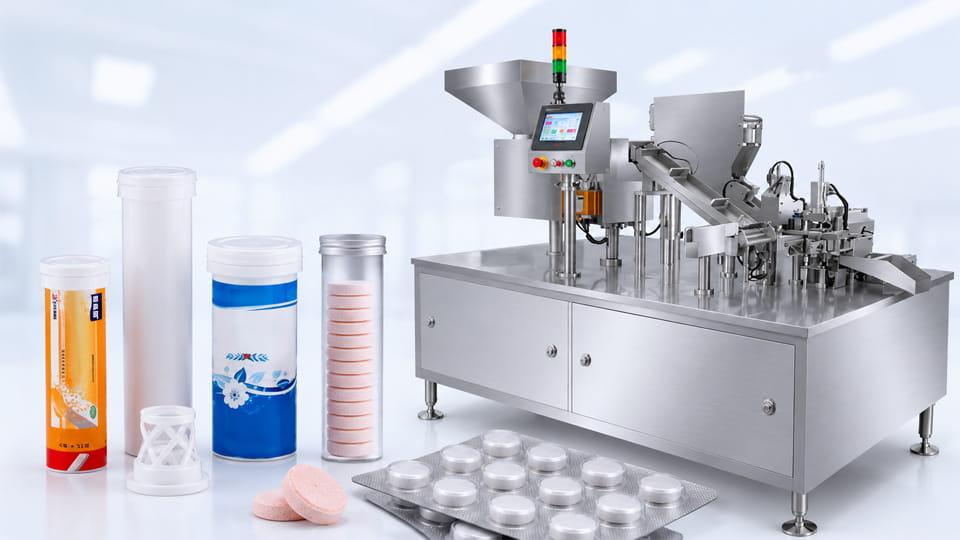
Les comprimés effervescents contiennent une chimie acido-basique réactive qui libère du CO₂ une fois dissous dans l'eau, effectuer une livraison rapide de nutriments ou de médicaments. C'est ce qui crée le pétillant, mais cela signifie aussi qu'ils sont extrêmement sensible à l'humidité. En pratique, même des traces d'humidité peut déclencher prématurément la réaction, ramollir les comprimés, ou réduire la puissance. Pour éviter cela, les produits effervescents sont fabriqués et conditionnés dans des conditions de très faible humidité (souvent <20–25% HR).
En outre, les effervescents sont généralement non couché (se dissoudre rapidement), il n'y a donc pas de film protecteur pour bloquer l'humidité. Leur stabilité dépend entièrement de l'emballage. Comme le note un expert, si de l'humidité pénètre avant utilisation, « la réaction peut commencer trop tôt » et ruiner le produit. En bref, les comprimés effervescents diffèrent des pilules ordinaires en ce sens la conception de l’emballage doit donner la priorité aux barrières contre l’humidité et l’oxygène avant tout. L'objectif principal est de garder les comprimés complètement secs et scellés – en préservant à la fois leur intégrité et leur durée de conservation..
La chimie unique des comprimés effervescents la qualité de l'emballage est une question de qualité du produit. Les principales raisons pour lesquelles un bon emballage est essentiel sont les suivantes ::
En résumé, sélectionner le bon emballage de comprimés effervescents n'est pas seulement une question de commodité ou de stratégie de marque – il s'agit fondamentalement protection contre l'humidité, puissance, et conformité. Un emballage robuste maintient les comprimés effervescents stables et efficaces jusqu'à la toute fin de leur durée de conservation.
Les comprimés effervescents sont généralement vendus dans l'un des trois formats d'emballage primaires: tubes (avec des casquettes), clochards (souvent feuille Alu-Alu), ou bandelettes/sachets à usage unique. Chacun présente des avantages et des compromis en matière de barrière contre l'humidité., commodité, et le coût.
De nombreux produits effervescents utilisent du rigide tubes ou bouteilles (en plastique, verre, ou en métal) avec un bouchon à vis ou à pression. Tubes en plastique (PP ou PE) sont les plus courants pour les vitamines et les suppléments. Ces conteneurs comprennent souvent bouchons dévissables qui sont résistants à l'humidité ou contiennent un insert déshydratant interne en gel de silice. La combinaison du tube en polymère et d'un capuchon déshydratant offre excellente protection contre l'humidité (le déshydratant absorbe activement toute humidité à l’intérieur). Les tubes offrent généralement une forte protection contre l'humidité, ce qui est critique pour ces comprimés hydroscopiques.
Capacité et remplissage: Les tubes sont généralement remplis de n'importe où 10 jusqu'à ~ 20 comprimés chacun (en fonction de la taille du comprimé et de la hauteur du tube). Les machines de remplissage de tubes automatiques comptent et chargent autant de comprimés par tube.
Commodité et image de marque: Les tubes sont portables et conviviaux – faciles à ouvrir d’une seule main – et offrent beaucoup d’espace pour les étiquettes. Les avantages incluent la portabilité, refermable, et suffisamment d'espace pour la marque et les instructions. Les inconvénients sont qu'ils peuvent être plus volumineux (emballages et cartons plus grands) et contiennent généralement moins de comprimés par emballage qu'un blister complet.
Comprimés effervescents haut de gamme (notamment dans le secteur pharmaceutique ou sur les marchés d'exportation) utilise souvent Blisters Alu-Alu formés à froid. Sous blister Alu-Alu, la cavité et le couvercle sont tous deux en papier d'aluminium (parfois laminé sur du plastique). Cela crée un barrière quasi totale: pas de lumière, pratiquement aucune humidité ni oxygène ne peut pénétrer. Jinlupacking décrit Alu-Alu comme « l’étalon-or » pour les médicaments hygroscopiques, obtenir une transmission de vapeur d'humidité proche de zéro. En pratique, Les blisters Alu-Alu peuvent prolonger la durée de conservation jusqu'à plusieurs années même par temps chaud, climats humides.
Lorsqu'il est utilisé: L'Alu-Alu est courant en Europe ou dans les régions où une longue durée de conservation est essentielle. Il est idéal pour les formules très puissantes ou sensibles à l’humidité.
Compromis: L'inconvénient est le coût et la taille. Le film Alu-Alu coûte cher, et son formage à froid nécessite des processus mécaniques plus lents. Les plaquettes alvéolées qui en résultent sont souvent 30 à 50 % plus grandes que les plaquettes alvéolées en plastique standard., ce qui signifie des cartons plus gros et un volume d'expédition plus important. Le coût par dose peut être 2 à 3 fois supérieur à celui des blisters en plastique. L'Alu-Alu est donc généralement réservé aux cas où ses avantages barrières justifient la dépense..
Paquets de bandes (sachets en aluminium) sont une autre option. Il s'agit de bandes d'aluminium continues scellées de tous les côtés dans des sachets. Points forts:
Chiffre: Les comprimés effervescents sont souvent emballés dans des tubes en plastique munis de bouchons déshydratants pour une forte protection contre l'humidité..
Le cœur de la machinerie pour le conditionnement des comprimés effervescents correspond au format choisi. Les deux principaux types de machines d'emballage sont Machines de remplissage de tubes (pour tubes/bouteilles) et Machines d'emballage sous blister (pour blisters en aluminium). Nous considérons également le système entièrement intégré Ligne d'emballage qui relie ensemble en comptant, remplissage, plafonnement, étiquetage, et cartonnage.
UN machine de remplissage de tubes (parfois appelée machine de remplissage de bouteilles de comprimés) automatise le processus de remplissage d'un tube rigide avec des comprimés, ajouter un bouchon déshydratant si nécessaire, et le sceller. Les caractéristiques clés incluent:
[jl_youtube src= »https://www.youtube.com/embed/uNKQtVIApls »]
Exemple – Jinlu JL-ZGJ-80Pro: Cette machine de remplissage de tubes effervescents entièrement automatique gère les comprimés de grand diamètre. Il effectue le tri, compte, chargement, et le plafonnement à des vitesses allant jusqu'à 80 tubes par minute (≈4800 tubes/h), avec >99.98% précision de remplissage. Il répond aux normes cGMP et est construit en acier inoxydable pour faciliter le nettoyage.. Ces machines représentent le haut de gamme des remplisseuses de tubes automatiques.
Les remplisseurs de tubes modernes mettent l'accent précision et fiabilité. Ils incluent souvent une conception conforme aux BPF (Construction SUS316L, systèmes fermés) et des outils à changement rapide pour les commutateurs de format. Lors de l'évaluation d'une machine, recherchez une précision de comptage éprouvée (≥99,9 %), servomoteurs pour un mouvement précis, et nettoyage/accès facile.
Plutôt qu'un remplisseur autonome, de nombreux fabricants déploient un ensemble complet ligne de conditionnement qui intègre les équipements amont et aval. Une ligne typique de conditionnement de comprimés effervescents peut inclure:
Jinlu note que notre tube de remplissage peut être « combiné avec Machines de presse à tablette, dépoussiéreurs, et encartonneuses» pour une ligne totalement intégrée. Par exemple, le remplisseur de tubes recevra automatiquement les comprimés de la presse en amont et alimentera les tubes finis vers l'encartonneuse en aval, minimiser la manipulation manuelle.
En automatisant chaque étape – en comptant, remplissage, plafonnement, étiquetage, cartonnage – la ligne de conditionnement augmente la productivité et la traçabilité. Les capteurs à chaque étape détectent les erreurs plus tôt, s'assurer que chaque carton quitte la ligne entièrement conforme.
Pour emballage blister Alu-Alu, un machine d'emballage sous blister est utilisé. Ces machines thermoforment ou forment à froid des cavités et scellent les comprimés dans des plaquettes alvéolées.. Points clés:
Si vous choisissez une ligne de conditionnement sous blister pour comprimés effervescents, il faut s'assurer qu'il est conçu pour les matériaux à haute barrière. Le principal argument de vente est performances de barrière contre l'humidité, pas de vitesse. Une machine Alu moulée à froid offre une protection maximale (entrée proche de zéro) au détriment du débit.
Le choix entre les tubes (avec bouchons déshydratants) et les cartes blister Alu-Alu dépendent des besoins du produit. Le tableau ci-dessous compare ces formats sur des facteurs clés:
| Facteur | Tube (avec capuchon déshydratant) | Blister Alu-Alu |
| Barrière contre l'humidité | Excellent (déshydratant + mur en plastique) | Excellent (MVTR proche de zéro) |
| Barrière lumière/oxygène | Tube opaque (bon blocage de la lumière) | Complètement opaque (100% barrière lumineuse) |
| Visibilité sur tablette | Non visible (les tubes sont généralement opaques) | Non visible (déjouer) |
| Commodité pour les patients | Refermable, bouteille portative | À usage unique par cavité (une fois cassé, disparu) |
| Vitesse typique | Haut (par exemple. 60–80 tubes/min) | Modéré (formage à froid plus lent que le PVC) |
| Coût par unité | Moyen (tube + capuchon, coût matériel modéré) | Haut (feuille chère, 2–3× coût du matériau) |
| Durée de conservation | Long (avec déshydratant, souvent 2+ années) | Très longtemps (3+ années, même dans des climats rigoureux) |
| Utilisation typique | Vitamines quotidiennes, suppléments effervescents | Produits pharmaceutiques sensibles, produits d'exportation |
Tableau: Comparaison des effervescents emballage en tubes (avec bouchon déshydratant) contre. Emballage blister Alu-Alu. Note: Les blisters Alu-Alu assurent une fermeture presque hermétique, alors que les tubes dépendent d'un déshydratant pour maintenir la sécheresse.
En bref, tubes (ou bouteilles) sont un format convivial et parfaitement adéquat lorsqu'il est associé à un déshydratant. Ils sont plus rapides et moins chers à emballer. Ampoules Alu-Alu sont choisis lorsqu’une barrière maximale est requise malgré le coût – par exemple, pour les effervescents sur ordonnance ou sur les marchés qui exigent une durée de conservation de 3 ans.
Lors de l'évaluation des machines de conditionnement pour comprimés effervescents, concentrez-vous sur ces fonctionnalités cruciales – elles ont également tendance à être les demandes les plus élevées des clients:
Vous trouverez ci-dessous un tableau comparatif résumant les choix de matériaux et d’emballages pour les performances de barrière contre l’humidité.:
| Matériau/format d'emballage | Barrière contre l'humidité (MVTR) | Utilisation typique |
| Tube en plastique (PP/PE) + Déshydratant | Très faible (avec capuchon + déshydratant) | Vitamines en vente libre, suppléments (utilisation quotidienne) |
| Blister Alu-Alu formé à froid | Proche de zéro (barrière ultime) | Effervescents haut de gamme, marchés d'exportation |
| Blister PVC-PVDC | Modéré (0.5–1,0 g/m²·jour) | Comprimés génériques (utilisé si le coût de l'Alu est trop élevé) |
| Plaquette PVC (pas de PVDC) | Faible (3–6 g/m²·jour) | Non recommandé pour composés hygroscopiques |
| Bandelette/Sachet (Feuille/Film) | Variable (0.5–2,0 g/m²·jour) | Packs unidose ou de voyage (une barrière, options moins que rigides) |
Tableau: Barrière contre l'humidité typique de divers emballages effervescents. Même les tubes PP/PE comptent sur le capuchon déshydratant pour une utilisation proche de zéro. barrière, tandis que la feuille Alu-Alu est pratiquement imperméable.
Même avec le bon équipement, des problèmes peuvent survenir dans les emballages effervescents. Voici les problèmes typiques et comment les résoudre:
Une maintenance proactive est essentielle: conserver toutes les trémies d'alimentation (comprimés, tubes, casquettes) propre et sec, remplacer les pièces usées (par exemple. grattoirs à poêle, roues étoiles) dans les délais, et exécutez des lots d'essai lors du changement de format.
Pour une fiabilité ligne de conditionnement effervescent, Jinlu Packing propose une solution unique. Les composants clés comprennent:
Chacune de ces machines est construite selon les normes pharmaceutiques (Conforme FDA/CE, Pièces de contact SUS316L) et est livré avec de la documentation. En choisissant un système coordonné, vous vous assurez que chaque étape du comprimé à l'emballage est optimisée pour les produits effervescents.
Choisir le bon machine de conditionnement de comprimés effervescents c'est bien plus que de la vitesse. Il s’agit de protéger vos comprimés de l’humidité, assurer la stabilité du produit, et répondant aux normes réglementaires. Comme nous en avons discuté, les formules effervescentes sont très sensibles, donc chaque aspect de l'emballage – matériau, machine, et processus – doivent minimiser l’humidité et maintenir un joint étanche.
En termes pratiques, cela signifie choisir une machine (ou une ligne) qui offre une manipulation robuste des barrières (bouchons déshydratants ou papier d'aluminium), opérations précises (comptage et bouchage précis), et une conformité totale (Conception et documentation BPF). Lignes de remplissage de tubes automatisées (avec comptage, étiquetage, mise en carton) sont généralement les bêtes de somme de l’industrie effervescente d’aujourd’hui.
Vous recherchez une solution fiable de conditionnement de comprimés effervescents? Contactez Jinlu Packing aujourd’hui pour des conseils d'experts et un devis sur mesure. Notre équipe peut vous aider à choisir la bonne machine et à garantir qu'elle répond aux normes de conformité mondiales – le tout soutenu par des garanties complètes et une assistance technique..
Parce que leur chimie (acide + base) réagit même avec de petites quantités d'eau, les effervescents sont extrêmement hygroscopiques. L'humidité peut les déclencher prématurément, ramollir les comprimés, ou provoquer la dégradation des principes actifs. Un emballage spécial avec des déshydratants et des joints hermétiques empêche toute humidité d'atteindre les comprimés, les garder puissants jusqu'à leur utilisation.
Cela dépend des besoins du produit. Tubes (avec un bouchon déshydratant) sont populaires pour les vitamines et les suppléments des consommateurs car ils sont pratiques, refermable, et offre une excellente protection contre l'humidité. Les blisters Alu-Alu offrent une barrière encore plus solide (pénétration d'humidité presque nulle) et prolonger la durée de conservation, ce qui est idéal pour les produits pharmaceutiques sensibles ou les exportations de grande valeur. Les sachets sont également utilisés pour la commodité d'une dose unique, mais ils offrent moins de barrière que les tubes ou les blisters en aluminium.
Les plaquettes thermoformées standard en PVC n'offrent généralement pas à elles seules une protection suffisante contre l'humidité pour les comprimés effervescents.. Ils ont une perméabilité modérée. Si vous utilisez des ampoules, il est préférable d'utiliser un film laminé PVC+PVDC ou une feuille Alu-Alu complète pour bloquer l'humidité. Sinon, la pénétration d’humidité peut réduire considérablement la durée de conservation.
Vous avez besoin d'une machine de remplissage de tubes de comprimés effervescents, qui compte automatiquement, remplit des tubes, insère des bouchons déshydratants, et les coiffe. Recherchez des machines qui gèrent la taille de votre tube, avoir la vitesse désirée (par exemple. 60–80 tubes/min), et une précision de comptage élevée (>99.9%). Par exemple, Le JL-ZGJ-80Pro de Jinlu remplit jusqu'à 80 bouteilles/min à 99.98% précision.
La « meilleure » machine dépend de votre échelle et de votre format. Pour emballage en tube, une machine de remplissage de tubes de comprimés effervescents entièrement automatique (avec comptage et bouchage intégrés) est idéal pour les volumes moyens à grands. Pour les blisters, une blistereuse Alu-Alu à froid est nécessaire. En général, donner la priorité aux machines spécialement conçues pour les produits hygroscopiques – avec des fonctionnalités telles qu’une manipulation douce, contrôle du comptage fin, et des designs désinfectables. Vérifiez que le fournisseur fournit une assistance en matière de conformité et de validation GMP.
Utiliser un équipement de haute précision avec des contrôles de rétroaction. Les machines modernes utilisent des servomoteurs et des capteurs pour confirmer chaque action. Par exemple, des caméras ou des capteurs de proximité peuvent vérifier le nombre correct de comprimés et la présence de chaque capuchon. Testeurs d'intégrité des joints (désintégration du vide, par exemple) peut faire partie de l'assurance qualité en cours. Un remplissage constant vient également d’un bon flux de matériaux (mesures antistatiques, même l'alimentation par comprimés). Si vous voyez une variation, cela peut indiquer des pièces usées ou des capteurs mal alignés qui nécessitent un entretien.
Certaines machines sont conçues pour un changement rapide. Par exemple, Le remplisseur de tubes de Jinlu gère des tubes de 23 à 29 mm de diamètre (différentes longueurs) avec des moules modulaires qui s'échangent en ~5 minutes. Vérifiez toujours les pièces de rechange et la plage de réglage du modèle.. La véritable flexibilité est une fonctionnalité premium; les machines économiques ne peuvent prendre en charge qu'une seule taille de tube.
Au minimum, La conformité aux BPF est requise (pour l'industrie pharmaceutique). Recherchez le marquage CE (pour l'Europe), UL ou CSA (pour la sécurité électrique en Amérique du Nord), et ISO 9001 fabrication. Si votre organisme de réglementation local (par exemple. FDA aux États-Unis) exige des critères spécifiques (comme la partie 11 pour les enregistrements électroniques), assurez-vous que la machine prend en charge cela. En pratique, choisir un équipement auprès d'un fabricant réputé (Ils, Novapak, Il y a, etc.) qui fait la publicité des normes pharmaceutiques est le plus sûr. L'équipement de Jinlu répertorie CE, Ul, Rohs, et conformité aux BPF.
Références:
1.L'effet de l'humidité et de la température de l'environnement sur la stabilité physique des comprimés effervescents dans des emballages stratifiés en aluminium contenant de minuscules imperfections —— tandfonline.com
2.Conditionnement des comprimés effervescents —— pharmapproach.com
3.Feuille d'aluminium à haute barrière pour l'emballage de comprimés effervescents —— feuilles d'aluminium
4.Les effets de l'emballage sur la stabilité d'un composé sensible à l'humidité ——ScienceDirect
5.Carbonate de potassium comme déshydratant dans les comprimés effervescents ——ScienceDirect
6.Les comprimés effervescents deviennent « Airborne »’ en tube —— monde de la meute
7.Avancées récentes dans la technologie des comprimés effervescents: leçons apprises et perspectives d’avenir ——ScienceDirect