

Αγοράζοντας α μηχανή συσκευασίας φαρμάκων είναι μια σημαντική απόφαση για κάθε φαρμακευτική εταιρεία, Έτσι, κάνοντας τις σωστές ερωτήσεις εκ των προτέρων μπορεί να εξοικονομήσετε χρόνο, χρήματα, και πονοκεφάλους αργότερα. Σύγχρονος γραμμές συσκευασίας φαρμάκων είναι πολύπλοκα (συχνά ενσωματώνοντας πλήρωση κάψουλας, μηχανές φυσαλίδων, συστήματα μέτρησης, χαρτοκιβώτια, και άλλα), και πρέπει να πληρούν αυστηρά πρότυπα GMP και ρυθμιστικά πρότυπα. Οντως, μελέτες δείχνουν σχεδόν το ήμισυ όλων ανακλήσεις ναρκωτικών περιλαμβάνουν σφάλματα συσκευασίας ή επισήμανσης. Σε αυτόν τον οδηγό, Συγκεντρώσαμε τις πιο σημαντικές ερωτήσεις και σκέψεις για τους αγοραστές φαρμάκων. Θα μάθετε πώς να αξιολογείτε τη συμμόρφωση (GMP/FDA/WHO), μορφές (δισκία, υγρά, φουσκάλες, και τα λοιπά.), επίπεδο ταχύτητας και αυτοματισμού, ανάγκες καθαρισμού και επικύρωσης, σειριοποίηση/ιχνηλασιμότητα, TCO (συνολικό κόστος ιδιοκτησίας), και υποστήριξη προμηθευτών. Περιλαμβάνουμε επίσης ένα εύχρηστο Λίστα ελέγχου αγοραστή και να επισημάνετε κοινά λάθη στις προμήθειες. Είτε διαχειρίζεστε έναν μικρό συσκευαστή συμβολαίου είτε ένα μεγάλο εργοστάσιο παραγωγής, αυτό θα σας βοηθήσει να συγκρίνετε συστηματικά μηχανήματα και να αποφύγετε δαπανηρές παγίδες.
Γιατί έχει σημασία: Σε φαρμακευτική, η συμμόρφωση είναι αδιαπραγμάτευτη. Ο εξοπλισμός πρέπει να πληροί τον FDA, ΕΕ, και τα πρότυπα cGMP του ΠΟΥ πριν από την εκτέλεση του προϊόντος. Τα μέρη επαφής του μηχανήματος πρέπει να είναι φαρμακευτικής ποιότητας (τυπικά ανοξείδωτο ατσάλι 316L ή 304) με λεία, συγκολλημένες επιφάνειες – χωρίς σκουριές, λάκκους, ή κενά όπου μπορεί να κρυφτεί η σκόνη. Ο σχεδιασμός πρέπει να είναι υγιεινός (π.χ.. πρόβολες ενότητες, κεκλιμένες επιφάνειες) έτσι είναι εύκολο να καθαριστεί και να επιθεωρηθεί. Ρωτήστε το προμηθευτής φαρμακευτικού εξοπλισμού συσκευασίας για τεκμηρίωση: θα πρέπει να λάβετε πρωτόκολλα για IQ (Προσόντα εγκατάστασης), OQ (Επιχειρησιακά Προσόντα), και PQ (Προσόντα Απόδοσης). Αυτά επιβεβαιώνουν ότι το μηχάνημα έχει εγκατασταθεί σωστά, τρέχει σε όλες τις προβλεπόμενες ρυθμίσεις, και αποδίδει με συνέπεια κάτω από πραγματικά φορτία παραγωγής. Χωρίς εγγραφές IQ/OQ/PQ, ο εξοπλισμός δεν είναι «κατάλληλος». Χρήση GMP. Επιβεβαιώστε επίσης το σύστημα ποιότητας και τις πιστοποιήσεις του προμηθευτή: ακολουθούν το ISO 9001? Μπορούν να προσκομίσουν πιστοποιητικά υλικού (π.χ.. Σφραγίδες σιλικόνης συμβατές με το FDA) και σήματα CE/UL εάν χρειάζεται? Τελικά, βεβαιωθείτε ότι ο σχεδιασμός υποστηρίζει την ακεραιότητα των δεδομένων (π.χ.. 21 Μέρος CFR 11 για ηλεκτρονικά αρχεία καταγραφής) και αποστείρωση εάν απαιτείται.
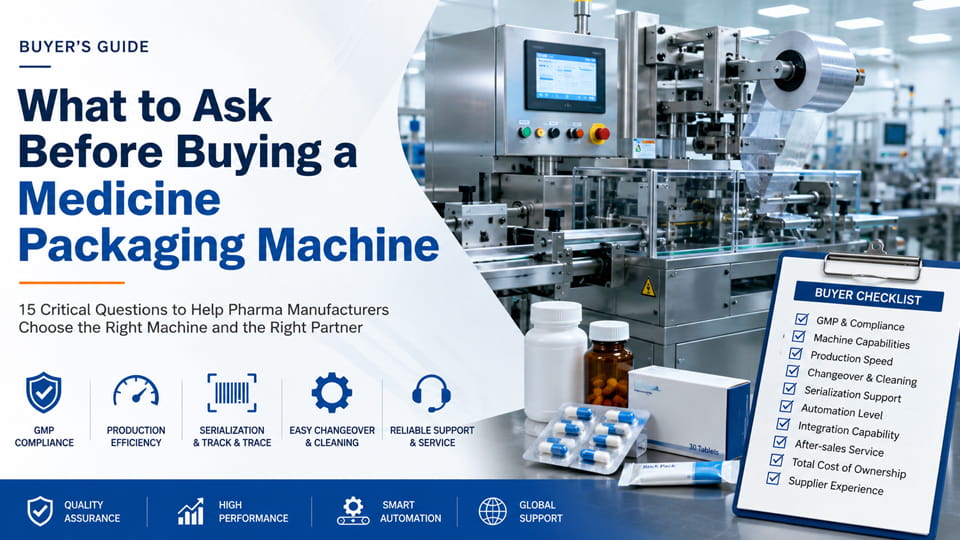
Εικών: Μια σύγχρονη γραμμή παραγωγής συσκευασίας φαρμάκων, καταδεικνύοντας την ανάγκη για ολοκληρωμένα μηχανήματα και σχεδιασμό συμβατό με GMP.
Δεν χειρίζονται όλα τα μηχανήματα όλα τα προϊόντα. Θα πρέπει να είστε πολύ σαφείς σχετικά με τους τύπους των προϊόντων σας. Για παράδειγμα, δισκία και κάψουλες χρησιμοποιήστε συχνά γραμμές μέτρησης/γεμίσματος φιαλών ή συσκευασίες κυψέλης, ενώ υγρά φάρμακα χρειάζονται ειδικά μηχανήματα πλήρωσης και σφράγισης υγρών. Σκόνες/κόκκοι μπορεί να μπει σε φακελάκια ή κολλητικές συσκευασίες. Παρακάτω είναι ένας απλός οδηγός – οι ανάγκες σας μπορεί να συνδυάζουν πολλά μηχανήματα σε μια γραμμή:
| Δοσολογική Μορφή & Σχήμα και διάταξις βιβλίου | Τυπικός τύπος μηχανής |
| Στερεά δισκία (χύμα, σε μπουκάλια) | Αυτόματη Καταμέτρηση & Γραμμή πλήρωσης μπουκαλιών |
| Στερεά δισκία (λωρίδα ή φουσκάλες) | Μηχανή συσκευασίας blister (PVC/Alu-PVC) |
| Κάψουλες (σκληρό τζελ) | Μηχανή πλήρωσης καψουλών + (γραμμή κυψέλης ή φιάλης) |
| Υγρά/Σιρόπια (φιαλίδια ή φιάλες) | Μηχανή πλήρωσης και κάλυψης υγρών |
| Σκόνες/Κόκκοι (ραβδί ή φακελάκι) | Μηχάνημα φακελίσκου ή στικ-συσκευασίας |
| Απαλά τζελ/ούλα | Μηχανή μέτρησης + Κυψέλη ή εμφιάλωση |
| Χαρτοκιβώτια (δευτερεύων) | Μηχανή χαρτοκιβωτίου για την τελική πυγμαχία |
Συχνά πωλούνται μηχανές συσκευασίας φαρμάκων ως ολοκληρωμένες γραμμές. Για παράδειγμα, μια σειρά κάψουλας μπορεί να τροφοδοτήσει προϊόν από α ράβδος σε α μετρητική μηχανή, στη συνέχεια μέσω α συσκευασία blister ή χαρτοκιβώτιο.
Ρωτήστε τον προμηθευτή της μηχανής συσκευασίας φαρμάκων σας: «Μπορεί η σειρά να τρέξει τα προϊόντα μου?” Για κάθε μορφή, επαληθεύστε τη συμβατότητα του υλικού – π.χ. ένα μηχάνημα blister θα πρέπει να τρέχει το φύλλο και τις μεμβράνες σας (PVC, ΚΑΤΟΙΚΙΔΙΟ ΖΩΟ, ALU-ALU) στις σωστές θερμοκρασίες. Οι γραμμές φιαλών πρέπει να προσαρμόζονται για διαφορετικά ύψη φιαλών και τύπους πωμάτων. Εάν σχεδιάζετε πολλά προϊόντα (π.χ.. κάψουλες και δισκία), θα χρειαστείτε αλλαγή εξαρτημάτων ή ακόμα και διαφορετικά μηχανήματα. Κάποια μηχανήματα είναι πολλαπλών μορφών, αλλά πάντα επιβεβαιώστε ποια αλλαγή απαιτείται (δείτε την επόμενη ενότητα).
Η ονομαστική ταχύτητα ενός μηχανήματος πρέπει να ταιριάζει με τους στόχους εξόδου σας. Μάθετε πόσες μονάδες ανά λεπτό/ώρα μπορεί να συσκευάσει το μηχάνημα αξιοπίστως. Να είστε βέβαιος να εξετάσει καθαρά παραγωγή (μετά από απόρριψη) και όχι μόνο το μέγιστο. Σκεφτείτε τις τρέχουσες ανάγκες και μελλοντική ανάπτυξη. Για παράδειγμα, μια σειρά κυψελών δισκίων μεσαίου μεγέθους μπορεί να αξιολογηθεί σε 40,000 φουσκάλες ανά ώρα; μια μεγάλη πλήρως αυτόματη γραμμή θα μπορούσε να ξεπεράσει 100,000 ανά ώρα. Ωστόσο, ένα μηχάνημα πολύ υψηλής ταχύτητας που συντρίβεται συχνά μπορεί να είναι χειρότερο από ένα ελαφρώς πιο αργό, σταθερό.
Υπολογίστε τον ημερήσιο ή ετήσιο όγκο σας και επιλέξτε ένα μηχάνημα που μπορεί να χειριστεί τις κορυφές. Λάβετε υπόψη τις τάσεις του κλάδου: Πολλές φαρμακευτικές εταιρείες διαθέτουν πλέον μικρότερες παρτίδες με συχνές αλλαγές, Έτσι, η εξαιρετικά υψηλή ταχύτητα ενός SKU είναι λιγότερο κρίσιμη από την ευελιξία. Εάν εκτελείτε πολλές βάρδιες, Η επένδυση σε υψηλότερη απόδοση μπορεί να αποπληρώσει γρηγορότερα μέσω της εξοικονόμησης εργασίας. Αλλά αν οι παρτίδες είναι μικρές ή κατά παραγγελία, ένα μηχάνημα που επιτρέπει γρήγορους διακόπτες συνταγών και αλλαγές χωρίς εργαλεία (βλέπε ενότητα 4) θα είναι πιο πολύτιμη από την ακατέργαστη ταχύτητα.
Αποφασίστε πόσο αυτοματισμό χρειάζεστε πραγματικά. Ημιαυτόματες μηχανές απαιτούν από τους χειριστές να φορτώνουν εμπορευματοκιβώτια, έναρξη των κύκλων, ή να εκτελέσετε χειροκίνητες εργασίες (π.χ.. ρίψη δισκίων σε κυψέλες). Πλήρως αυτόματες γραμμές συσκευασίας φαρμάκων κάντε τα πάντα, από το τάισμα μέχρι το σφράγισμα με ελάχιστη ανθρώπινη παρέμβαση. Οι ημιαυτόματες μηχανές κοστίζουν λιγότερο εκ των προτέρων και μπορεί να είναι καλές για εργασίες μικρού όγκου ή παρτίδας. Οι πλήρως αυτόματες γραμμές κοστίζουν περισσότερο, αλλά εξοικονομούν εργασία και μειώνουν τα ανθρώπινα λάθη.
| Χαρακτηριστικό | Ημιαυτόματος | Πλήρως αυτόματος |
| Συμμετοχή χειριστή | Ναι – φόρτωση/εκφόρτωση, και τα λοιπά. | Ελάχιστο - ένα άτομο επιβλέπει ολόκληρη τη γραμμή |
| Ταχύτητα Παραγωγής | Μέτριος | Ψηλά |
| Αλλαγή | Πιο αργά (χειροκίνητες ρυθμίσεις) | Πιο γρήγορα (συχνά χωρίς εργαλεία, με γνώμονα τη συνταγή) |
| Αρχική Επένδυση | Χαμηλότερος | Άνω |
| Πολυπλοκότητα επικύρωσης | Παρόμοιος (Το IQ/OQ/PQ χρειάζεται ακόμα) | Παρόμοιος |
| Ιδανικό για | Μικρές διαδρομές, πιλότοι εργαστηρίου | Μεγάλες διαδρομές, 24/7 παραγωγή |
Τα πλήρως αυτοματοποιημένα φαρμακευτικά συστήματα περιλαμβάνουν συχνά χοάνες ζωοτροφών, αυτόματες ετικέτες, καπάκια, και οι μεταφορείς όλοι συγχρονισμένοι. Ενσωματώνουν επίσης ελέγχους σφαλμάτων (ζυγαριά, συστήματα όρασης) σε πραγματικό χρόνο. Ο ημιαυτόματος εξοπλισμός μπορεί να είναι κατάλληλος για έναν κατασκευαστή που ξεκινάει, αλλά τα σχέδια ανάπτυξης συχνά οδηγούν τους αγοραστές στην επιλογή πλήρους αυτοματισμού.
Οι φαρμακευτικές σειρές αλλάζουν προϊόντα πιο συχνά από όσο νομίζετε, και κάθε αλλαγή απαιτεί σχολαστικό καθαρισμό (και συχνά επανεπικύρωση). Ένας καλός σχεδιασμός μηχανής θα το κάνει γρήγορο. Αναζητώ χωρίς εργαλεία αφαιρούμενα μέρη, ελαφριά εξαρτήματα (ένα άτομο μπορεί να τα χειριστεί), και ανοιχτά κουφώματα που αφήνουν QA βλέπω εάν μείνει κάποιο υπόλειμμα. Δεν πρέπει να υπάρχουν κρυφές κοιλότητες όπου μπορούν να συσσωρευτούν χάπια ή σκόνη. Ο πωλητής θα πρέπει να παρέχει σαφείς SOP για καθαρισμό, αποσυναρμολόγηση και επανασυναρμολόγηση. Επικύρωση των διαδικασιών μετάβασης: μπορεί προϊόν συνταγές να αποθηκευτεί έτσι ώστε να ανακαλείτε όλες τις ρυθμίσεις για ένα δεδομένο SKU?
Στην πράξη, ένα μηχάνημα που μπορεί να καθαριστεί και να επικυρωθεί γρήγορα βελτιώνει άμεσα την παραγωγικότητα. Εάν έχετε φάρμακα που απαιτούν εναλλαγή μεταξύ, λέγω, μια ελεγχόμενη ουσία και ένα προϊόν βιταμινών, θα εκτελέσετε τον καθαρισμό και συχνά μια καθαρή δοκιμή επικύρωσης (δοκιμή προϊόντος στη χειρότερη περίπτωση) πάντοτε. Ρωτώ για καθαρό επί τόπου (CIP) επιλογές ή άλλα χαρακτηριστικά υγιεινής.
Σύγχρονοι κανονισμοί (ΜΑΣ. DSCSA, ΕΕ αφθώδης πυρετός, και τα λοιπά.) απαιτώ σειριοποίηση κάθε πωλήσιμης μονάδας της ιατρικής. Πριν την αγορά, επιβεβαιώστε ότι η γραμμή μπορεί να ενσωματώσει εκτυπωτές κωδικοποίησης (inkjet/λέιζερ) και σαρωτές όρασης για την εφαρμογή και επαλήθευση γραμμωτών κωδίκων 2D ή κωδικών QR σε πακέτα. Το σύστημα ελέγχου θα πρέπει να καταγράφει κάθε σειριακό αριθμό και να τον συνδέει με δεδομένα παρτίδας. Στην πράξη, οι αγοραστές ρωτούν συχνά: «Μπορεί αυτό το μηχάνημα να απορρίψει οποιοδήποτε στοιχείο χωρίς ετικέτα ή μη έγκυρο κωδικό?” και «Υπάρχει δεσμευμένος χώρος και καλωδίωση για την προσθήκη κωδικοποιητή ή κάμερας αργότερα?”. Ακόμα κι αν δεν εξάγετε σήμερα, Η κατασκευή μιας γραμμής έτοιμη για σειριοποίηση είναι πιο έξυπνη από την εκ των υστέρων τοποθέτηση.
Πέρα από τη σειριοποίηση, εξετάστε την ψηφιακή ενοποίηση. Υποστηρίζει το μηχάνημα τυπική βιομηχανική επικοινωνία (Ethernet/IP, OPC UA, Modbus, και τα λοιπά.) ώστε να μπορεί να τροφοδοτήσει το MES/ERP σας? Μπορεί να δημιουργήσει ίχνη ελέγχου και ηλεκτρονικά αρχεία παρτίδας για QA? Τα σύγχρονα έξυπνα εργοστάσια αναμένουν δεδομένα σε πραγματικό χρόνο: χρόνο λειτουργίας, μετράει απόρριψη, συναγερμός, και τα λοιπά. Μια «έξυπνη» σειρά φαρμάκων βοηθά στον έγκαιρο εντοπισμό προβλημάτων και υποστηρίζει απαιτήσεις ακεραιότητας δεδομένων (χωρίς χειροκίνητα αρχεία καταγραφής). Ρωτήστε εάν το HMI/PLC μπορεί να συνδεθεί σε δίκτυο, εάν υπάρχουν αρχεία καταγραφής συμβάντων, και αν η απομακρυσμένη εξυπηρέτηση (μέσω VPN ή IoT) προσφέρεται. Η ψηφιακή ετοιμότητα προστατεύει τη γραμμή σας και βελτιώνει την ιχνηλασιμότητα.
Η τιμή του αυτοκόλλητου είναι μόνο η αρχή. Οι έξυπνοι αγοραστές υπολογίζουν TCO στη διάρκεια ζωής του μηχανήματος. Το TCO περιλαμβάνει τη βασική τιμή συν αποστολή, εγκατάσταση, IR/WH/PQ, εκπαίδευση, ανταλλακτικά, χρήση ενέργειας, συντήρηση, και το κόστος διακοπής λειτουργίας. Για παράδειγμα, Μια μελέτη διαπίστωσε ότι μια ακριβή αλλά αξιόπιστη σειρά συσκευασίας φαρμάκων κινεζικής παραγωγής εξοικονομούσε πολύ περισσότερα μέσα σε τρία χρόνια από μια φθηνότερη, λιγότερο καλά υποστηριζόμενο. Κάντε ένα τραπέζι (όπως παρακάτω) να συγκρίνουν προμηθευτές:
| Συντελεστής Κόστους | Περιγραφή | Σχόλια |
| Τιμή Αγοράς | Μηχανή, αξεσουάρ, διανομή | Κάποτε πριν (αλλά μπορεί να ποικίλλει ευρέως) |
| Εγκατάσταση & Ανάκαμψη | Προετοιμασία τοποθεσίας, διαμέτρηση, IR/WH/PQ | Τα χαμένα βήματα εδώ μπορεί να αυξήσουν το μελλοντικό κόστος |
| Εκπαίδευση | Χειριστής & εκπαίδευση συντήρησης | Η καλή εκπαίδευση μειώνει τα σφάλματα χειριστή |
| Ανταλλακτικά & εξαρτήματα | Φορέστε εξαρτήματα (ζώνες, αισθητήρες, και τα λοιπά.) | Ζητήστε λίστα; Η υψηλή διαθεσιμότητα εξοικονομεί χρόνο διακοπής λειτουργίας |
| Ενέργεια/Υπηρεσίες κοινής ωφέλειας | Ηλεκτρισμός, αέρας, αδειάζω, και τα λοιπά. | Τα αποτελεσματικά μηχανήματα μπορούν να κόψουν το OPEX |
| Συντήρηση & Χρόνος αργίας | Προγραμματισμένη συντήρηση & μη προγραμματισμένες διορθώσεις | Η γρήγορη εξυπηρέτηση και ο σχεδιασμός χαμηλών βλαβών το ελαχιστοποιούν |
| Υποστήριξη/Υπηρεσία | Απομακρυσμένη αντιμετώπιση προβλημάτων, επιτόπιες επισκέψεις | Μια ισχυρή υπηρεσία SLA αξίζει το βάρος της |
| Αναλώσιμα & Εργαλεία | Σφραγίδες, λιπαντικά, ανταλλακτικά ακροφύσια, και τα λοιπά. | Συχνά παραβλέπεται, αλλά μπορεί να προστεθεί |
Εάν δύο πωλητές αναφέρουν παρόμοια μηχανήματα, ψάξτε σε τι περιλαμβάνει κάθε λίστα. Ένα μηχάνημα με υψηλότερη τιμή μπορεί να διαρκέσει περισσότερο, έχουν φθηνότερα ανταλλακτικά, ή χρησιμοποιήστε λιγότερο πεπιεσμένο αέρα – μειώνοντας το πραγματικό του κόστος. Φροντίστε να ρωτήσετε κάθε προμηθευτή σχετικά με τη διάρκεια της εγγύησης και τι καλύπτεται (μέρη, εργασία, ταξίδια για τεχνικούς).
Ακόμη και το καλύτερο μηχάνημα χρειάζεται συντήρηση. Ελέγξτε το ιστορικό και τη ρύθμιση σέρβις του προμηθευτή του μηχανήματος συσκευασίας φαρμάκων. Ένα αξιόπιστο μηχάνημα έχει χαρακτηριστικά όπως σαφείς κωδικούς βλάβης στο HMI, ένα καλά επισημασμένο ηλεκτρικό ντουλάπι, και ένα εύκολο σχέδιο προληπτικής συντήρησης. Ζητήστε MTBF (μέσος χρόνος μεταξύ των αποτυχιών) δεδομένα ή μελέτες περιπτώσεων. Μάθετε επίσης πώς γίνεται ο χειρισμός των ανταλλακτικών: είναι εξαρτήματα εκτός ραφιού ή προσαρμοσμένα? Πόσο γρήγορα μπορείτε να αποκτήσετε κρίσιμα εξαρτήματα – την επόμενη μέρα ή εβδομάδες? Ειδικά για τους παγκόσμιους αγοραστές, Η τοπική υποστήριξη είναι το κλειδί. Η μελέτη της JinLu Packing έδειξε ότι η γρήγορη παράδοση και σέρβις ανταλλακτικών μπορεί να αποτρέψει εξαψήφιες απώλειες λόγω διακοπής λειτουργίας.
[jl_youtube src=”https://www.youtube.com/embed/1Bb_J6rluac”]
Βίντεο: Μια αυτοματοποιημένη γραμμή πλήρωσης και εμφιάλωσης. Αξιολογήστε τα χαρακτηριστικά αξιοπιστίας (αισθητήρες σφαλμάτων, καθαρά ντουλάπια) και ευκολία συντήρησης κατά την επιλογή εξοπλισμού.
Δεν κατανοούν όλοι οι κατασκευαστές μηχανημάτων συσκευασίας φαρμάκων τη φαρμακευτική απόχρωση. Ιδανικά, επιλέξτε έναν προμηθευτή με αποδεδειγμένο ιστορικό pharma/GMP. Ρωτήστε για τη λίστα πελατών και τα πρόσφατα έργα τους. Έχουν προμηθεύσει την περιοχή σας ή τις ρυθμιζόμενες αγορές (FDA των ΗΠΑ, I EMA)? Κάνουν FAT (Εργοστασιακές δοκιμές αποδοχής) και τις εκθέσεις FAT? Μπορούν να χειριστούν μια διαδικασία πιστοποίησης εάν χρειαστεί? Οι αξιόπιστοι προμηθευτές θα διαθέτουν μηχανικό QMS και ενδέχεται να προσφέρουν προσαρμογή (π.χ.. ειδικές επιθεωρήσεις όρασης για σήμανση OTC έναντι RX).
Θα πρέπει επίσης να εξετάσετε τα logistics: που είναι το εργοστάσιό τους? Αν είναι στο εξωτερικό, υπάρχουν συνεργάτες καναλιού ή εγκαταστάτες στη χώρα σας? Ποιος χειρίζεται τελωνείο και ναυτιλία? Θυμάμαι, το φθηνότερο μηχάνημα δεν αξίζει πολλά εάν κάθεται σε πλοίο λόγω έλλειψης εγγράφων ή δεν υποστηρίζεται τοπικά.
Για να ολοκληρώσω, Ακολουθεί μια λίστα ελέγχου που μπορείτε να χρησιμοποιήσετε σε συναντήσεις ή σε RFQ:
Αυτά τα ερωτήματα, ενώ πολυάριθμες, θα διασφαλίσει ότι καλύπτετε τα πιο κρίσιμα σημεία και θα συγκρίνετε τους προμηθευτές σε ισότιμη βάση.
Η επένδυση στη σωστή μηχανή συσκευασίας φαρμάκων σημαίνει εξισορρόπηση της απόδοσης, συμμόρφωση, και κόστος για πολλά χρόνια. Κάνοντας αυτές τις ερωτήσεις, θα ξεκαθαρίσετε τις απαιτήσεις σας και θα αποφύγετε εκπλήξεις. Θυμάμαι, η καλύτερη επιλογή δεν είναι πάντα το φθηνότερο μηχάνημα, αλλά αυτή που ταιριάζει στη διαδικασία σας και σε κρατάει σε συμμόρφωση με ελάχιστο χρόνο διακοπής λειτουργίας.
Εάν χρειάζεστε καθοδήγηση, συμβουλευτείτε ειδικούς σε θέματα αυτοματισμού συσκευασίας – για παράδειγμα, Συσκευασία Jinlu προσφέρει ολοκληρωμένη σχεδίαση και υποστήριξη φαρμακευτικής σειράς, από τη διάταξη γραμμής GMP έως την τεκμηρίωση επικύρωσης. Επικοινωνήστε μαζί μας για να συζητήσετε το έργο σας: μπορούμε να παρέχουμε μια προσαρμοσμένη πρόταση ή να κανονίσουμε μια ζωντανή επίδειξη. Ας βεβαιωθούμε ότι η επένδυσή σας προσφέρει τόσο ρυθμιστική επιτυχία όσο και λειτουργική αποτελεσματικότητα.
Πριν αγοράσετε μια μηχανή συσκευασίας φαρμάκων, θα πρέπει να ρωτήσετε σχετικά με τη συμμόρφωση με την GMP, ταχύτητα παραγωγής, τύπους συσκευασίας, υποστήριξη επικύρωσης, υλικά μηχανής, χρόνος μετάβασης, διαθεσιμότητα ανταλλακτικών, και εξυπηρέτηση μετά την πώληση. Είναι επίσης σημαντικό να ελέγξετε εάν το μηχάνημα μπορεί να υποστηρίξει μελλοντικές απαιτήσεις επέκτασης παραγωγής και σειριοποίησης.
Το σωστό μηχάνημα εξαρτάται από τον τύπο του προϊόντος σας, όγκος παραγωγής, μορφή συσκευασίας, και απαιτήσεις συμμόρφωσης. Για παράδειγμα, Οι μηχανές συσκευασίας blister χρησιμοποιούνται συνήθως για δισκία και κάψουλες, ενώ οι μηχανές συσκευασίας φακέλων ή στικ είναι καλύτερες για σκόνες και κόκκους. Οι αγοραστές θα πρέπει επίσης να εξετάσουν το επίπεδο αυτοματισμού, έξοδα συντήρησης, και δυνατότητα ολοκλήρωσης γραμμής.
Ένας αξιόπιστος κατασκευαστής μηχανημάτων συσκευασίας φαρμακευτικών προϊόντων θα πρέπει να παρέχει έγγραφα και πιστοποιήσεις όπως π.χ:
• Πιστοποίηση CE
• Τεκμηρίωση σχεδιασμού συμβατή με GMP
• Πρωτόκολλα IQ/OQ/PQ
• Έγγραφα FAT/SAT
• Πιστοποιητικά υλικού
• 21 Μέρος CFR 11 υποστήριξη (εάν ισχύει)
Αυτά τα έγγραφα βοηθούν τα φαρμακευτικά εργοστάσια να περνούν ελέγχους και να πληρούν τις κανονιστικές απαιτήσεις.
Η συμμόρφωση με την GMP συμβάλλει στη διασφάλιση της ασφάλειας του προϊόντος, σταθερή ποιότητα, και ρυθμιστική έγκριση. Ένα μηχάνημα συμβατό με GMP έχει σχεδιαστεί για να μειώνει τους κινδύνους μόλυνσης, βελτίωση της ικανότητας καθαρισμού, και υποστηρίζει την κατάλληλη τεκμηρίωση και την ιχνηλασιμότητα. Αυτό είναι ιδιαίτερα σημαντικό για τους κατασκευαστές φαρμακευτικών προϊόντων που εξάγουν σε ρυθμιζόμενες αγορές.
Ο σύγχρονος εξοπλισμός φαρμακευτικής συσκευασίας μπορεί να υποστηρίξει πολλές μορφές συσκευασίας, συμπεριλαμβανομένου:
• Συσκευασίες blister
• Μπουκάλια
• Φακελάκια
• Πακέτα ραβδιών
• Θήκες
• Χαρτοκιβώτια
Η καλύτερη επιλογή εξαρτάται από τη δοσολογική σας μορφή, απαιτήσεις της αγοράς, και τους στόχους παραγωγής.
Η σειριοποίηση καθίσταται απαραίτητη σε πολλές χώρες λόγω των κανονισμών για την ιχνηλασιμότητα των φαρμακευτικών προϊόντων, όπως το DSCSA και το EU FMD. Ένα μηχάνημα με δυνατότητα σειριοποίησης μπορεί να εκτυπώσει και να επαληθεύσει μοναδικούς κωδικούς, βοηθώντας τους κατασκευαστές να αποτρέψουν τα πλαστά προϊόντα και να βελτιώσουν την παρακολούθηση της αλυσίδας εφοδιασμού.
Τα ημιαυτόματα μηχανήματα είναι συνήθως πιο προσιτά και κατάλληλα για μικρούς όγκους παραγωγής ή startups. Οι πλήρως αυτόματες μηχανές συσκευασίας φαρμακευτικών προϊόντων είναι καλύτερες για παραγωγή μεγάλης κλίμακας επειδή βελτιώνουν την απόδοση, Μειώστε το κόστος εργασίας, και ελαχιστοποιεί το ανθρώπινο λάθος.
Η τιμή εξαρτάται από διάφορους παράγοντες, συμπεριλαμβανομένου του τύπου μηχανής, επίπεδο αυτοματισμού, ταχύτητα παραγωγής, και απαιτήσεις προσαρμογής. Ένα βασικό ημιαυτόματο μηχάνημα μπορεί να κοστίζει πολύ λιγότερο από μια πλήρως αυτοματοποιημένη γραμμή συσκευασίας φαρμακευτικών προϊόντων με υποστήριξη σειριοποίησης και επικύρωσης. Οι αγοραστές θα πρέπει να επικεντρωθούν στο συνολικό κόστος ιδιοκτησίας και όχι μόνο στην αρχική τιμή αγοράς.
Ναί. Πολλές σύγχρονες μηχανές συσκευασίας φαρμακευτικών προϊόντων μπορούν να συνδεθούν με μηχανές μέτρησης, συστήματα σήμανσης, μηχανές χαρτοκιβωτίου, μεταφορείς, και συστήματα ERP/MES. Η ενσωμάτωση συμβάλλει στη βελτίωση της αυτοματοποίησης και της συνολικής αποδοτικότητας της παραγωγής.
Ένας επαγγελματίας προμηθευτής πρέπει να προσφέρει:
• Υποστήριξη εγκατάστασης
• Εκπαίδευση χειριστή
• Online αντιμετώπιση προβλημάτων
• Προμήθεια ανταλλακτικών
• Οδηγίες προληπτικής συντήρησης
• Εξ αποστάσεως τεχνική βοήθεια
Η καλή εξυπηρέτηση μετά την πώληση μπορεί να μειώσει σημαντικά το χρόνο διακοπής λειτουργίας και να βελτιώσει τη μακροπρόθεσμη σταθερότητα της παραγωγής.
Αναφορές:
1.Τρέχουσα ορθή παραγωγική πρακτική (CGMP) Κανονισμοί —— Η.Π.Α. Υπηρεσία Τροφίμων και Φαρμάκων
2.Ορθές πρακτικές παραγωγής του ΠΟΥ για βιολογικά προϊόντα, Παράρτημα 2, TRS Αρ 999 -- ΠΟΥ
3.Ορθή κατασκευαστική πρακτική —— Ευρωπαϊκός Οργανισμός Φαρμάκων
4.Δέκα συχνές ερωτήσεις σχετικά με τη σειριοποίηση —— International Society for Pharmaceutical Engineering