

Καλή πρακτική παραγωγής (GMP) κατευθυντήριες γραμμές υπαγορεύουν αυστηρούς κανόνες για εξοπλισμός συσκευασίας φαρμακευτικών προϊόντων για τη διασφάλιση της ποιότητας των προϊόντων και της ασφάλειας των ασθενών. Οι βασικές απαιτήσεις περιλαμβάνουν τον υγιεινό σχεδιασμό του μηχανήματος, μη αντιδραστικά υλικά, πλήρης πιστοποίηση εξοπλισμού (IR/WH/PQ), επικυρωμένος καθαρισμός, αυτοματοποίηση για τη μείωση των σφαλμάτων, ακεραιότητα δεδομένων (21 CFR Μέρος 11) και την ιχνηλασιμότητα του προϊόντος (σειριοποίηση). Αυτός ο οδηγός καλύπτει το FDA, Πρότυπα EMA/ΕΕ και ΠΟΥ, παρουσιάζει μια λίστα ελέγχου GMP και εξηγεί πώς να επιλέξετε και να διατηρήσετε Μηχανές συσκευασίας συμβατές με GMP.
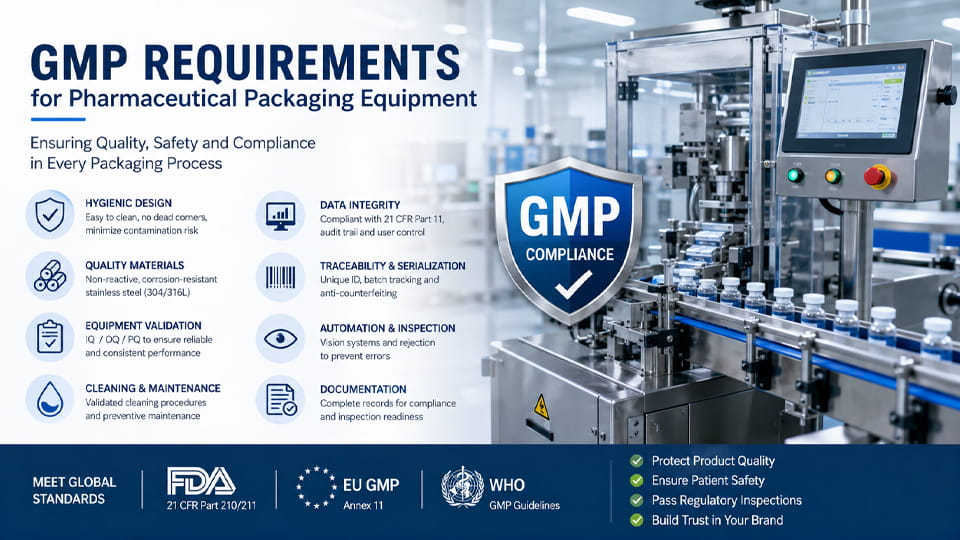
GMP (Καλή πρακτική παραγωγής) είναι το πλαίσιο ποιότητας που διασφαλίζει ότι τα φαρμακευτικά προϊόντα παράγονται και ελέγχονται με συνέπεια. Σε συσκευασία, GMP σημαίνει σχέδια και διεργασίες που αποτρέπουν την ανάμειξη ή τη μόλυνση. Ρυθμιστικοί φορείς όπως ο FDA (21 CFR210/211), EMA (EU GMP PartI, Παραρτήματα) και ΠΟΥ (κατευθυντήριες οδηγίες για την ποιότητα των φαρμάκων) Όλα απαιτούν εξοπλισμό που χρησιμοποιείται στη συσκευασία για την τήρηση των αρχών GMP. Στόχος είναι η προστασία του προϊόντος ταυτότητα, δύναμη, ποιότητα και αγνότητα (χωρίς ανεπιθύμητες χημικές αντιδράσεις ή μόλυνση). Οι παγκόσμιες ρυθμιστικές αρχές τονίζουν επίσης ότι οι διαδικασίες και ο εξοπλισμός συσκευασίας πρέπει να είναι επικυρωμένος/επικυρωμένος ακριβώς όπως τα βήματα παρασκευής φαρμάκων, και ότι μόνο εκπαιδευμένο προσωπικό λειτουργεί με γραπτές διαδικασίες.
Οι μηχανές συσκευασίας πρέπει να έχουν υγειονομικός, καθαριζόμενο σχέδιο. Αυτό σημαίνει ανοξείδωτο χάλυβα (π.χ.. 304 ή 316L για τρόφιμα) κατασκευή, λείες επιφάνειες, κεκλιμένα αεροπλάνα για την αποφυγή παγίδων σκόνης, και χωρίς νεκρά πόδια ή κρυφές κοιλότητες. Οι οδηγίες του FDA επισημαίνουν ότι ο εξοπλισμός «πρέπει να κατασκευάζεται και να βρίσκεται για να διευκολύνει τον καθαρισμό» και να «αποτρέπει τη μόλυνση από άλλες...λειτουργίες». Ομοίως, η GMP της ΕΕ απαιτεί τον εξοπλισμό κατασκευής να καθαρίζεται "εύκολα και σχολαστικά" με λεπτομερείς γραπτές διαδικασίες. Στην πράξη, Οι σύγχρονες μηχανές GMP χρησιμοποιούν συχνά πρόβολο ("μπαλκόνι") σχέδια που απομονώνουν τους κινητήρες και τα συστήματα λίπανσης μακριά από την περιοχή του προϊόντος. Όλες οι ζώνες πρέπει να είναι προσβάσιμες για επιθεώρηση, σκούπισμα, και το σφουγγάρι. Για παράδειγμα, Η Jinlupacking σημειώνει ότι οι συμβατές μηχανές blister χρησιμοποιούν κεκλιμένες επιφάνειες και χάλυβα SUS316L σε όλα τα εξαρτήματα που έρχονται σε επαφή με το προϊόν για την αποφυγή παγίδων σωματιδίων.
Όλα τα εξαρτήματα που έρχονται σε επαφή με το προϊόν πρέπει να είναι μη αντιδραστικό και μη απορροφητικό, ώστε να μην εκπλένουν ή να δεσμεύουν τα ενεργά συστατικά. Η CGMP του FDA απαιτεί ότι «οποιαδήποτε επιφάνεια εξοπλισμού έρχεται σε επαφή με…φάρμακα είναι αντιδραστική, πρόσθετος, ή απορροφητικό ώστε να αλλοιωθεί η…ποιότητα του φαρμακευτικού προϊόντος».. Επίσης, Η EU GMP λέει ότι τα μέρη επαφής «δεν πρέπει να αντιδρούν, πρόσθετο ή απορροφητικό… ότι θα επηρεάσει την ποιότητα του προϊόντος». Στην πράξη, Αυτό σημαίνει χρήση καθαρού ανοξείδωτου χάλυβα (SUS316L) ή πλαστικά φαρμακευτικής ποιότητας, και λιπαντικά για τρόφιμα. Όλα τα εξαρτήματα, Οι σφραγίδες και οι εύκαμπτοι σωλήνες πρέπει να είναι συμβατοί με τα φάρμακα και τα καθαριστικά που χρησιμοποιούνται. Για παράδειγμα, Οι φλάντζες νοσοκομειακής ποιότητας και οι σωλήνες PTFE προτιμώνται για την αποφυγή διάβρωσης ή υπολειμμάτων. Το αποτέλεσμα είναι ο εξοπλισμός συσκευασίας που δεν μπορεί να μολύνει ή να υποβαθμίσει το προϊόν.
Το GMP απαιτεί πλήρη πιστοποίηση εξοπλισμού. Μετά την εγκατάσταση, ένα νέο ή τροποποιημένο μηχάνημα πρέπει να υποβληθεί Προσόντα εγκατάστασης (IQ), Επιχειρησιακά Προσόντα (OQ), και Προσόντα Απόδοσης (PQ).
Οι επιθεωρητές του FDA τονίζουν ότι «ο νέος εξοπλισμός πρέπει να εγκατασταθεί σωστά…και να καθαριστεί πριν από τη χρήση σύμφωνα με γραπτές διαδικασίες» με «τον καθαρισμό τεκμηριωμένο και επικυρωμένο». Η παράδοση εξοπλισμού συμβατό με GMP σημαίνει παροχή πλήρους πακέτου τεκμηρίωσης επικύρωσης (Π.χ., Πρωτόκολλα και αναφορές IQ/OQ/PQ). Αυτό γίνεται συχνά μέσω FAT/SAT και ισχυρής υποστήριξης προμηθευτών. Για παράδειγμα, το ιστολόγιο Hikma σημειώνει ότι τα μηχανήματα που είναι συμβατά με την FDA απαιτούν "ανοξείδωτο χάλυβα SUS316L για όλα τα μέρη επαφής" και "αλεξίσφαιρη τεκμηρίωση IQ/OQ/PQ" για επιτυχία ελέγχου. Με άλλα λόγια, χωρίς τεκμηριωμένο IQ/OQ/PQ, ο εξοπλισμός δεν θεωρείται επικυρωμένος με GMP.
(Διάγραμμα γοργόνας: ροή βημάτων επικύρωσης IQ→OQ→PQ)
Οι γραμμές συσκευασίας πρέπει να έχουν επικυρωμένες διαδικασίες καθαρισμού. Μετά από κάθε εκτέλεση προϊόντος ή παρτίδας, Ο εξοπλισμός καθαρίζεται σύμφωνα με τις τυπικές διαδικασίες λειτουργίας (Κοφτερός). Οι ρυθμιστικές αρχές απαιτούν να τεκμηριώνονται οι διαδικασίες καθαρισμού, επαληθεύτηκε, και επανεπικυρώνεται περιοδικά. Η καθοδήγηση GMP του ΠΟΥ σημειώνει ότι ο σχεδιασμός του εξοπλισμού θα πρέπει να λαμβάνεται υπόψη κατά τον σχεδιασμό επικύρωσης καθαρισμού, δεδομένου ότι ο σχεδιασμός μπορεί να επηρεάσει την αποτελεσματικότητα. Μόνο οι επιφάνειες επαφής απαιτούν ενδελεχή επικύρωση - μπορούν να αποκλειστούν περιοχές που δεν έχουν επαφή. Κρίσιμα στοιχεία (όπως επαναχρησιμοποιούμενες χοάνες ή ακροφύσια) συχνά απαιτούν αποκλειστική χρήση ή χρήση ενός προϊόντος για να απλοποιηθεί ο καθαρισμός. Στην πράξη, Οι εταιρείες ορίζουν όρια αποδοχής για τα υπολείμματα και εκτελούν δοκιμές μπατονέτας ή έκπλυσης. Οι συχνές ερωτήσεις του FDA συνιστούν τη χρήση μεθόδων όπως ο συνολικός οργανικός άνθρακας (TOC) ή ειδικές αναλύσεις για την επιβεβαίωση της αφαίρεσης υπολειμμάτων.
Απαιτείται επίσης συντήρηση και βαθμονόμηση. Η GMP αναμένει τακτική προληπτική συντήρηση: Τα ελαττωματικά ή φθαρμένα μέρη πρέπει να επισκευάζονται πριν προκαλέσουν κίνδυνο μόλυνσης. Βαθμονόμηση εξοπλισμού (βάρη, Ζυγός, αισθητήρες) πρέπει να ακολουθούν γραπτές διαδικασίες με αρχεία (21 CFR211,68). Για παράδειγμα, Η καθοδήγηση του FDA λέει ότι οι συσκευές μέτρησης και ελέγχου «πρέπει να βαθμονομούνται και να ελέγχονται σε καθορισμένα διαστήματα» και να τηρούνται αρχεία. Αυτό διασφαλίζει ότι το μηχάνημα συνεχίζει να αποδίδει εντός των προδιαγραφών (Π.χ., σωστός όγκος πλήρωσης, τοποθέτηση ετικέτας).
Οι αυτοματοποιημένες λειτουργίες υποστηρίζουν GMP μειώνοντας το ανθρώπινο λάθος. Τα σύγχρονα μηχανήματα περιλαμβάνουν συχνά συστήματα όρασης, σαρωτές γραμμωτού κώδικα, ή σταθμούς ελέγχου για επιθεώρηση εν σειρά. Για παράδειγμα, οι αυτοματοποιημένοι σαρωτές ετικετών/γραμμωτού κώδικα επαληθεύουν ότι κάθε πακέτο έχει σωστά σήμανση και ταυτοποίηση - ένα βασικό βήμα GMP. Η ενσωμάτωση με συστήματα MES/ERP μπορεί να καταγράψει δεδομένα παρτίδας. Η αυτοματοποιημένη απόρριψη εξαλείφει τις υπογεμισμένες ή ελαττωματικές συσκευασίες. Ρομποτική (για χειρισμό φιαλών ή παραλαβή) ενίσχυση της συνέπειας. Στην πράξη, πολλές σειρές GMP περιλαμβάνουν χαρακτηριστικά συσκευής όπως interlocks (Π.χ., το μηχάνημα δεν θα λειτουργήσει εάν μια πόρτα είναι ανοιχτή), αυτόματα προστατευτικά αλλαγής, και αισθητήρες για την αντιμετώπιση εμπλοκών. Όλο το λογισμικό θα πρέπει να έχει ασφαλείς λογαριασμούς χρηστών (δείτε την επόμενη ενότητα).
Η φαρμακευτική GMP απαιτεί ισχυρή ακεραιότητα δεδομένων. Στις ΗΠΑ και σε πολλές αγορές, τα ηλεκτρονικά στοιχεία ελέγχου πρέπει να πληρούν το 21CFRPart11: αυτό περιλαμβάνει μοναδικές συνδέσεις, ίχνη ελέγχου, και ηλεκτρονικές υπογραφές. Όλα τα αρχεία παρτίδας, Οι συναγερμοί και οι αλλαγές πρέπει να έχουν χρονική σήμανση και να προστατεύονται από παραβιάσεις. Για παράδειγμα, Ο FDA προειδοποιεί ότι οι ζυγαριές με αυτόματη βαθμονόμηση εξακολουθούν να χρειάζονται εξωτερικούς ελέγχους, και το λογισμικό ελέγχου πρέπει να παρακολουθεί ποιος άλλαξε τις παραμέτρους και πότε. Οι βασικές απαιτήσεις περιλαμβάνουν πρόσβαση βάσει ρόλων (χειριστές εναντίον διαχειριστών), αμετάβλητα αρχεία καταγραφής ελέγχου των αλλαγών παραμέτρων, και ψηφιακή αποσύνδεση σε κρίσιμα βήματα. Το παράρτημα 11 της ΕΕ απαιτεί ομοίως επικυρωμένα συστήματα και ίχνη ελέγχου για οποιαδήποτε ηλεκτρονικά συστήματα που σχετίζονται με GMP. Στην ουσία, το HMI/PLC του μηχανήματος πρέπει να αποτρέπει μη εξουσιοδοτημένες αλλαγές. Η σωστή ακεραιότητα δεδομένων σημαίνει επίσης ηλεκτρονικά αντίγραφα των SOP, αρχεία παρτίδας και αρχεία καταγραφής συντήρησης.
Πρόσφατοι κανονισμοί (π.χ.. Οδηγία της ΕΕ για τα ψευδεπίγραφα φάρμακα, ΗΠΑ DSCSA) απαιτούν μοναδικά αναγνωριστικά σε κάθε πρωτεύον πακέτο. Ο εξοπλισμός συσκευασίας GMP πρέπει να το υποστηρίζει εκτυπώνοντας/χαράσσοντας 2D γραμμωτούς κώδικες ή κωδικούς QR. Ιχνηλασιμότητα σημαίνει σύνδεση κάθε σειριακού κώδικα με μια παρτίδα παραγωγής. Ο εξοπλισμός θα πρέπει να ενσωματώνεται με λογισμικό σειριοποίησης ή κάμερες για να διασφαλίζεται ότι κάθε μονάδα λαμβάνει έναν μοναδικό κωδικό που συμμορφώνεται με τους κανόνες της χώρας. Αυτό δεν είναι μόνο GMP αλλά και νόμος της αγοράς. Στην πράξη, Οι κατασκευαστές εγκαθιστούν συχνά έναν κωδικοποιητή λέιζερ ή inkjet και τον συνδέουν σε μια βάση δεδομένων που επαληθεύει την αυθεντικότητα κάθε κώδικα. Η τελική γραμμή συσκευασίας θα πρέπει να επιτρέπει την ανάκληση ή την παρακολούθηση οποιασδήποτε παρτίδας μέσω του κωδικού της.
Η GMP καλύπτει όχι μόνο τις μηχανές αλλά όλες τις εργασίες συσκευασίας. Τα βασικά στοιχεία ελέγχου περιλαμβάνουν:
Ακολουθώντας αυτούς τους ελέγχους διαδικασίας, Οι εταιρείες διασφαλίζουν ότι δεν προκύπτουν μπερδέματα ή μόλυνση κατά τη συσκευασία.
| Απαίτηση | Βασικά Σημεία |
| Σχέδιο | Υγιεινός, σχέδιο πρόβολου ή μπαλκονιού; χωρίς νεκρές ζώνες; επικλινές, προσβάσιμες επιφάνειες |
| Υλικά | Φαρμακευτική (316μεγάλο) ανοξείδωτο χάλυβα; μη αντιδραστικά σφραγίσματα/λιπαντικά; ομαλές συγκολλήσεις |
| Νομιμοποίηση | Πλήρες IQ, OQ, PQ (εγκατάσταση, επιχειρησιακά προσόντα και επιδόσεις) |
| Καθάρισμα | Επικυρωμένες διαδικασίες καθαρισμού; τεκμηρίωση/SOP; καθαρίστε στη θέση τους εάν υπάρχει |
| Συντήρηση | Προγράμματα προληπτικής συντήρησης; κούτσουρα ανταλλακτικών; διαμέτρηση (με ρεκόρ) |
| Αυτοματοποίηση | Συστήματα όρασης, ανιχνευτές μετάλλων, απορρίψτε τις πύλες, σαρωτές ετικετών για τη μείωση των ανακατώσεων και των σφαλμάτων |
| Ακεραιότητα δεδομένων | 21 Συμμόρφωση με το CFRPart11: ίχνη ελέγχου, ηλεκτρονικές υπογραφές, έλεγχοι πρόσβασης χρήστη |
| Ιχνηλασιμότητα | Σειριοποίηση (2D barcodes/UID); κωδικοποίηση παρτίδας; σύνδεση κωδικών με εγγραφές παρτίδας |
Διαφορετικά μηχανήματα έχουν διαφορετικές προκλήσεις GMP:
Μηχανές συσκευασίας φυσαλίδων: Αυτά σχηματίζουν και σφραγίζουν πλαστικές/αλουμινένιες τσέπες. Βασικά σημεία GMP: Η περιοχή διαμόρφωσης και θερμοσφράγισης πρέπει να είναι κλειστή ή σε καθαρή ζώνη για την αποφυγή μόλυνσης. Οι κύλινδροι και οι μήτρες θερμικής σφράγισης δεν πρέπει να έχουν αιχμηρές άκρες, και το σύστημα κενού (εάν υπάρχει) δεν πρέπει να απελευθερώνει σωματίδια στις κυψέλες. Για ευαίσθητα φάρμακα, Οι μηχανές blister ενδέχεται να λειτουργούν σε ελεγχόμενα περιβάλλοντα (κουκούλες στρωτής ροής ή καθαροί χώροι).
Μηχανές χαρτοκιβωτίου: Αυτά τα όρθια χαρτοκιβώτια, εισάγετε προϊόντα (φουσκάλες, μπουκάλια, φακελάκια), και κλείστε τα χαρτοκιβώτια. ανάγκες GMP: ακριβής εκτύπωση και σάρωση κωδικών παρτίδας σε κάθε χαρτοκιβώτιο (100% επαλήθευση), και αυστηρό έλεγχο των χαρτοκιβωτίων γεμιστών (για να αποφευχθεί η ανάμειξη μεταξύ διαφορετικών προϊόντων). Ο έλεγχος της σκόνης μπορεί να είναι ένα πρόβλημα κατά την τροφοδοσία χαρτοκιβωτίων και φυλλαδίων; Ως εκ τούτου, χρησιμοποιούνται φίλτρα ή κλειστές χοάνες.
Μηχανές σήμανσης: Εφαρμόζουν ετικέτες ή φυλλάδια στις συσκευασίες. Θέματα GMP: συγχρονισμός (έτσι οι ετικέτες ταιριάζουν με το σωστό προϊόν); κάμερες επαλήθευσης για να συλλάβουν εσφαλμένες ετικέτες ή ετικέτες που λείπουν; και καθαρές επιφάνειες ετικετών (οι κόλλες δεν πρέπει να μολύνουν το προϊόν).
Αρίθμηση & Μηχανές πλήρωσης: Μετρητές tablet, πλήρωση κάψουλας, και τα πληρωτικά μπουκαλιών χειρίζονται χύδην στερεά ή υγρά. Το GMP απαιτεί όλα τα μέρη επαφής να είναι καθαρά (μερικές φορές CIP για υγρά συστήματα), και όλα τα γεμίσματα να είναι ακριβή. Ελαττώματα όπως υπογεμίσεις πρέπει να απορρίπτονται αυτόματα (μέσω ενός σταθμού ελέγχου). Για υγρά, Τα σφραγισμένα ακροφύσια και η απαέρωση μπορούν να αποτρέψουν τις φυσαλίδες.
Μηχανές φακελίσκου/σακουλών: Για σκόνες ή κόκκους. Συχνά χρειάζονται χαρακτηριστικά καθαρισμού φακελίσκων (για να αφαιρέσετε τη χυμένη σκόνη), και επιθεώρηση εφελκυσμού της αντοχής στεγανοποίησης. Τα μαχαίρια που κόβουν τις άκρες πρέπει να προστατεύονται.
Σε κάθε περίπτωση, αναζητώ επικύρωση ειδικού εξοπλισμού: Π.χ., μια μηχανή φυσαλίδων χρειάζεται δοκιμή διαρροής κενού (για να εξασφαλίσετε μια πραγματικά σφραγισμένη κυψέλη), και ένα χαρτόνι χρειάζεται επικύρωση drop-test (για να δείξει ότι τα χαρτοκιβώτια αντέχουν). Οι κατασκευαστές παρέχουν συχνά τεκμηρίωση (π.χ.. ένα παράδειγμα σχεδίου OQ) για κάθε τύπο μηχανής. Όταν εξετάζετε α γραμμή με το κλειδί στο χέρι, βεβαιωθείτε ότι ο προμηθευτής έχει εμπειρία στην ενσωμάτωση αυτών των μηχανημάτων με τρόπο συμβατό με την GMP (π.χ.. Η Jinlu's απέδειξε την ενσωμάτωση του blister+cartoner+labeler με απρόσκοπτο έλεγχο).
[jl_youtube src=”https://www.youtube.com/embed/1Bb_J6rluac”]
Όταν επιλέγετε μηχανήματα για τη φαρμακευτική σας σειρά, βεβαιωθείτε ότι έχει σχεδιαστεί και υποστηρίζεται για λειτουργίες GMP:
👉 Για προσαρμοσμένες λύσεις συμβατές με GMP, επικοινωνήστε με την Jinlu Packing ή ζητήστε μια λεπτομερή προσφορά. Προσφέρουμε πιστοποιημένα Μηχανές συσκευασίας φουσκάλων, μηχανές χαρτοκιβωτίου, μηχανές σήμανσης και πλήρη πακέτα τεκμηρίωσης. Ο εξοπλισμός μας έχει σχεδιαστεί για να πληροί τα πρότυπα cGMP και ενσωματώνει χαρακτηριστικά όπως μεταφορείς από ανοξείδωτο χάλυβα, εργαλεία γρήγορης αλλαγής, και αυτοματοποιημένες ενότητες σειριοποίησης.
Οι απαιτήσεις GMP για τον εξοπλισμό φαρμακευτικής συσκευασίας καλύπτουν κάθε πτυχή της μηχανής και της διαδικασίας – από την ποιότητα χάλυβα και τον υγιεινό σχεδιασμό έως την επικύρωση, καθάρισμα, αυτοματοποίηση, και ελέγχους δεδομένων. Η σωστή εφαρμογή αυτών διασφαλίζει ότι τα προϊόντα σας είναι ασφαλή, ανιχνεύσιμος, και έτοιμη για έλεγχο. Η επένδυση σε συμβατό εξοπλισμό και διαδικασίες δεν πληροί μόνο κανονισμούς (FDA/EMA/WHO) αλλά και ελαχιστοποιεί ανακαλεί και ενισχύει τη διασφάλιση ποιότητας. Επιλέξτε μηχανήματα κατασκευασμένα για GMP, και η γραμμή παραγωγής σας θα είναι αποτελεσματική και έτοιμη για επιθεώρηση.
Οι βασικές απαιτήσεις GMP περιλαμβάνουν τον υγιεινό σχεδιασμό (ανοξείδωτο χάλυβα, χωρίς νεκρές ζώνες), νομιμοποίηση (IR/WH/PQ), επικυρωμένες διαδικασίες καθαρισμού, τακτική συντήρηση και βαθμονόμηση, αυτοματοποιημένοι έλεγχοι για την αποφυγή σφαλμάτων, και ισχυρή ακεραιότητα δεδομένων (21 CFR 11) και ιχνηλασιμότητα (σειριοποίηση) μέτρα. Αυτά διασφαλίζουν ότι δεν υπάρχει μόλυνση ή ανάμειξη των προϊόντων.
Η επικύρωση IQ/OQ/PQ παρέχει τεκμηριωμένη απόδειξη ότι ο εξοπλισμός έχει κατασκευαστεί και λειτουργεί όπως προβλέπεται. Το IQ επαληθεύει τη σωστή εγκατάσταση; Το OQ ελέγχει κάθε λειτουργία και όριο; Το PQ δείχνει ότι το μηχάνημα παράγει σταθερή απόδοση υπό πραγματικές συνθήκες. Χωρίς αυτή την τεκμηρίωση, Οι ρυθμιστικές αρχές θεωρούν τον εξοπλισμό ως «μη επικυρωμένο» και κάθε ύποπτο δεδομένων παρτίδας.
Ο εξοπλισμός GMP χρησιμοποιεί υψηλής ποιότητας, μη διαβρωτικά υλικά (σαν ανοξείδωτο ατσάλι 316L) για όλα τα εξαρτήματα που έρχονται σε επαφή με το προϊόν. Έχει λεία, καθαριζόμενες συγκολλήσεις και επιφάνειες. Τα χαρακτηριστικά περιλαμβάνουν προστατευτικά που αφαιρούνται εύκολα, Δυνατότητες CIP, και σφραγισμένα ρουλεμάν. Οι πίνακες ελέγχου πρέπει να είναι σφραγισμένοι ή θωρακισμένοι. Ουσιαστικά, τίποτα στο σχέδιο δεν πρέπει να δημιουργεί κίνδυνο μόλυνσης ή διάβρωσης.
Το Μέρος 11 διέπει τα ηλεκτρονικά αρχεία και τις υπογραφές. Για μηχανές συσκευασίας, σημαίνει ότι το λογισμικό/HMI πρέπει να επιβάλει τις συνδέσεις χρηστών, να έχετε μια ασφαλή διαδρομή ελέγχου για τυχόν αλλαγές (ποιος έκανε τι, όταν), και επιτρέπουν την ηλεκτρονική υπογραφή των αναφορών παρτίδας. Εξασφαλίζει δεδομένα παρτίδας (συμπληρώστε ποσά, αριθμοί παρτίδας, και τα λοιπά.) δεν μπορεί να αλλάξει χωρίς ίχνος. Τα σύγχρονα συστήματα PLC έχουν συχνά 21 CFR 11 ενσωματωμένες λειτουργίες για φαρμακευτική χρήση.
Η σειριοποίηση εκχωρεί ένα μοναδικό αναγνωριστικό σε κάθε συσκευασμένη μονάδα (συνήθως ένας 2D κωδικός) και την καταγραφή του σε βάση δεδομένων. Κανονισμοί (Π.χ., ΕΕ αφθώδης πυρετός, ΗΠΑ DSCSA) τώρα απαιτούν σειριοποίηση σε πρωτεύουσες και δευτερεύουσες συσκευασίες για να αποφευχθεί η παραχάραξη και να επιτραπεί η ανάκληση. Οι γραμμές GMP πρέπει να διαθέτουν κωδικοποιητές και σαρωτές για την εφαρμογή και επαλήθευση αυτών των κωδικών. Αυτό επιτρέπει την πλήρη ιχνηλασιμότητα κάθε κουτιού/μπουκαλιού πίσω στην παρτίδα παραγωγής του.
Η συμμόρφωση με την GMP διασφαλίζει ότι τα φάρμακα συσκευάζονται σωστά, πρόληψη της μόλυνσης, μπερδέματα, και σφάλματα επισήμανσης. Βοηθά στη διατήρηση της ποιότητας του προϊόντος και προστατεύει την ασφάλεια των ασθενών σε όλη την αλυσίδα εφοδιασμού.
Οι βασικοί κανονισμοί GMP περιλαμβάνουν:
• FDA 21 Μέρος CFR 210/211 (ΗΠΑ)
• EU GMP (Τόμος EudraLex 4)
• Οδηγίες GMP της ΠΟΥ
Οι κατασκευαστές πρέπει να συμμορφώνονται με τους κανονισμούς της αγοράς-στόχου τους.
Κατά την επιλογή εξοπλισμού, θεωρώ:
• Σχεδιασμός και υλικά συμβατά με GMP
• Διαθεσιμότητα εγγράφων επικύρωσης (IR/WH/PQ)
• Χαρακτηριστικά ακεραιότητας και ιχνηλασιμότητας δεδομένων
• Συμμόρφωση με τα πρότυπα FDA/EU/WHO
Η επιλογή του σωστού προμηθευτή εξασφαλίζει ομαλότερους ελέγχους και μακροπρόθεσμη συμμόρφωση.
Αναφορές:
1.Ερωτήσεις και απαντήσεις σχετικά με τις τρέχουσες απαιτήσεις ορθής παρασκευαστικής πρακτικής | Εξοπλισμός —— Η.Π.Α. Υπηρεσία Τροφίμων και Φαρμάκων
2.Παράρτημα 9 Οδηγίες για τη συσκευασία φαρμακευτικών προϊόντων —— gmp-compliance.org
3.21 Μέρος CFR 211 – ΤΡΕΧΟΥΣΑ ΚΑΛΗ ΠΑΡΑΓΩΓΙΚΗ ΠΡΑΚΤΙΚΗ ΓΙΑ ΕΤΟΙΜΕΣ ΦΑΡΜΑΚΕΥΤΙΚΕΣ —— Ινστιτούτο Νομικών Πληροφοριών
4.Βασικές Αρχές GMP για Φαρμακευτικά Προϊόντα -- ΠΟΥ